Archive for the Maynooth Category

The Term Ahead

Posted in Biographical, Education, Maynooth with tags , , , , on January 29, 2023 by telescoper

It’s the day before the start of a new Semester in Maynooth. Last week we finished all due processes relating to the First Semester examinations and the provisional results will be uploaded to “The System” next week. They’re provisional at this stage because they’re not set in stone until the final meeting of the Examination Board. Obviously I can’t discuss the results here. I could comment here about how clunky the whole process is, including multiple downloads of spreadsheets and subsequent uploads somewhere else, but I won’t bother. Nobody seems to be interesting in fixing it. Perhaps by the time I retire “The System” will have been replaced by something that doesn’t waste an enormous amount of staff time. But I doubt it.

It’s a curiosity of the teaching allocation in the Department of Theoretical Physics that I do first-year and second-year modules (MP110 Mechanics and Special Relativity and MP201 Vector Calculus & Fourier Series) in Semester 1 while in Semester 2 it’s the third and fourth year students who have to put up with my ramblings.

The menu for this term involves MP354 Computational Physics 1, which entails just one hour of lectures per week but two two-hour lab sessions. Each student attends one of these sessions, so they get 3 contact hours per week but I have to look after both sessions. Our computer lab has a small cluster of Linux machines and, this term, a brand new display screen which I am looking forward to playing with. I’m also looking forward to seeing how the infamous ChatGPT copes with the Python coding exercises I give the students to do in class: I’ve only tried one so far, without much success. This is the first module I taught at Maynooth, back in 2018, so this will be the 6th time I’ve done it.

My other class is MP465 Advanced Electromagnetism, which I’m doing for the 3rd time now. This is a standard chalk-and-talk kind of module covering a well-established syllabus, and involving two lectures per week plus a tutorial. At least I’m teaching in a classroom rather than online like when I first did this module!

In 2020/21 (during the Pandemic restrictions) I did five modules as well as being Head of Department. At this time two academic staff departures left us severely short-staffed and struggling to deliver our programmes. My workload then was unmanageable and I asked to step down. I changed my mind when were eventually allowed to recruit two lecturers and saw out my three-year term to the end. I had better not repeat here what I think of the deliberate management decisions that left us reeling and had such negative effects on staff morale and on the education of students in the Department. I just hope the damage is not irreparable.

Although I am doing the same number of modules as last term, the number of contact hours I have to do is higher (8 versus 5) because of the labs and the fact that we don’t have tutors for 4th-year modules so lecturers have to do the tutorials themselves. Four modules a year is a much heavier teaching load than a Full Professor at a UK university would be expected to carry, but it seems normal in Ireland where the funding for sciences is far less than adequate. The impact on research productivity is obvious and is systemic. There are excellent physicists in Maynooth but they are given little time or other resources. It’s a big waste of potential. That’s another “System” that needs changing, but I see little appetite for change of the required sort at institutional level. It’s all about recruiting more and more students to be taught with fewer and fewer resources.

The impact of this on staff careers is severe: teaching loads are so heavy that it’s very difficult to reach the level of research productivity required for promotion. For myself, though, the next career step will be retirement so I don’t have to worry about promotion. Fortunately too, I enjoy teaching, so I’ll just get on with it. So I’ll stop writing and get on with preparing my first week of lectures and lab sessions!

Maynooth University Library Cat Update

Posted in Maynooth with tags on January 23, 2023 by telescoper

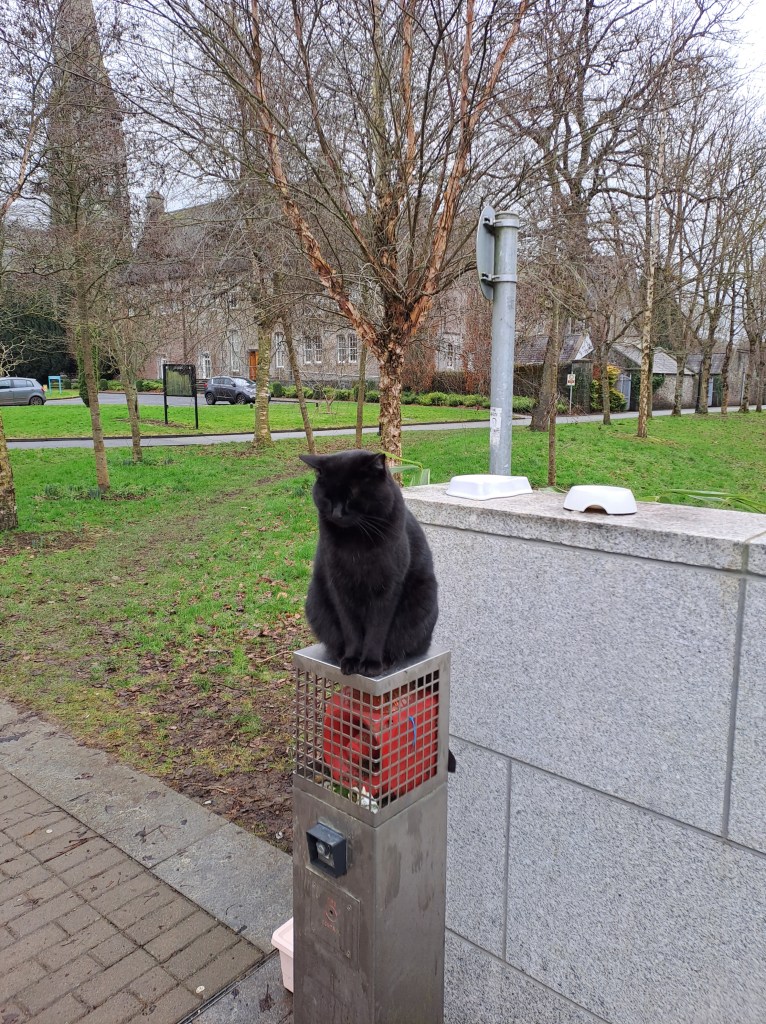
People keep asking me how Maynooth University Library Cat is getting on so on my way back from lunch today I took a picture of him on post near the Library.

He seemed a bit drowsy, no doubt because he’d recently emptied his food bowl and was having a post-prandial snooze, and wouldn’t open his eyes so here’s a closer shot when he was a bit more awake.

Anyway, our famous feline friend seems to be in good health. We’ve had a few very cold days recently. In fact once when I came to give him some food I had to break the ice on his water bowl. He’s a hardy animal though and seems to be able to cope with inclement conditions. Today it is much warmer but rather cloudy and overcast.

Lectures recommence at Maynooth next Monday so he’ll have a bit more company then. He likes to be the centre of attention. In Vietnam, the Lunar New Year celebrations at the weekend marked the Year of the Cat. In Maynooth, every year is the Year of the Cat.

ChatGPT in the Swampland

Posted in Maynooth, Open Access, The Universe and Stuff with tags , , , , , on January 22, 2023 by telescoper

My inestimable PhD student Kay Lehnert has been having a look at the capabilities of the Artificial Intelligence platform ChatGPT at writing about string theoretical ideas, specifically the swampland conjectures. It’s remarkable what this does well but also notable what it doesn’t do well at all. What he found was so interesting he wrote it up as a little paper, which you can find on the arXiv here. The abstract is:

In this case study, we explore the capabilities and limitations of ChatGPT, a natural language processing model developed by OpenAI, in the field of string theoretical swampland conjectures. We find that it is effective at paraphrasing and explaining concepts in a variety of styles, but not at genuinely connecting concepts. It will provide false information with full confidence and make up statements when necessary. However, its ingenious use of language can be fruitful for identifying analogies and describing visual representations of abstract concepts.

It took arXiv a while to decide what to do with this paper as it doesn’t fit in any of the usual categories. The arXiv sections that usually cover string theory are General Relativity and Quantum Cosmology (gr-qc) and/or high-energy physics theory (hep-th), which was where it was originally submitted, but this isn’t really a string theory paper per se. After being held by the moderators for a while it eventually it appeared in Popular Physics (physics.pop-ph), cross-listed in Artificial Intelligence (cs.AI) & Computation and Language (cs.CL); the latter two are computer science categories, obviously.

Figure 2 of the paper, which you should read if you want to know what it represents!

The reclassification of this paper was perfectly reasonable. In fact with this, as with any other arXiv paper, the thing that matters most is that it it is freely available to anyone who wants to read it and is discoverable, i.e. can easily be found via search engines. In the era of Open Access, things will generate interest if they are interesting (and accessible).

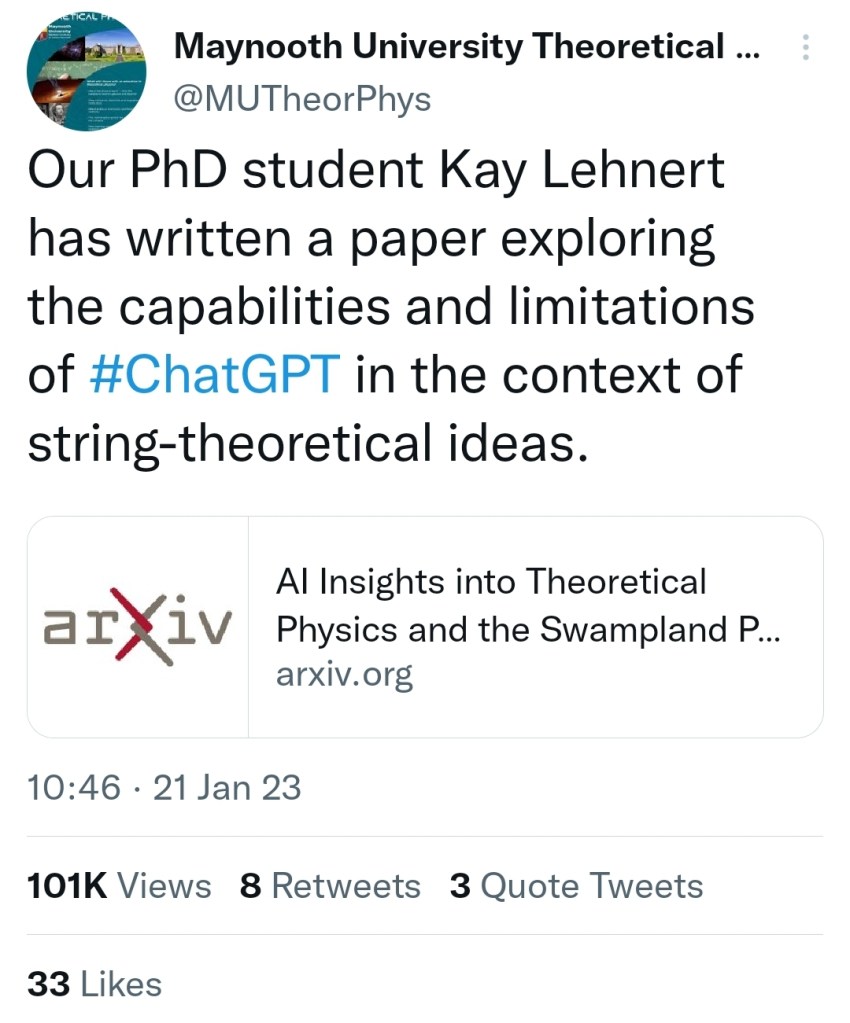
We posted the following on the Maynooth University Theoretical Physics Department Twitter account, something we do whenever a new paper by someone in the Department comes out:

Judging by the number of views (101K) by this morning, this one certainly seems to be attracting interest! Hopefully this blog post will generate even more..

Finally, there might be people reading this blog who can suggest a journal that might consider publishing an article on this sort of subject? Whatever you think about ChatGPT I think it’s generating a lot of discussion right now, so the topic is… er… topical.

Please use the box below for any suggestions.

Reflections on Exam Marking

Posted in Education, Maynooth with tags , , , on January 21, 2023 by telescoper

At long last I’ve finished my marking my examination scripts. I’ve also entered the marks onto a spreadsheet and combined them with coursework so I’m almost done with this task. They just need one more check through and I can upload the results onto the system. in good time for next week’s departmental exam board meeting. It took a lot longer than I had anticipated because we have a big first-year class this year. So much for my New Year resolution not to work at weekends…

I’m a bit tired now so I thought I’d just rehash an excerpt from something I posted a while ago on the subject of examinations and what I believe to be the over-assessment of students at modern universities.

My feelings about examinations agree pretty much with William Wordsworth, who studied at the same University as me, as expressed in this quotation from The Prelude:

Of College labours, of the Lecturer’s room
All studded round, as thick as chairs could stand,
With loyal students, faithful to their books,
Half-and-half idlers, hardy recusants,
And honest dunces–of important days,
Examinations, when the man was weighed
As in a balance! of excessive hopes,
Tremblings withal and commendable fears,
Small jealousies, and triumphs good or bad–
Let others that know more speak as they know.
Such glory was but little sought by me,
And little won.

It seems to me a great a pity that our system of education – and not only at Third Level- places such a great emphasis on examination and assessment to the detriment of real learning. In particular, the biggest problem  with physics education in many institutions is the way modular degrees have been implemented.

I’m not at all opposed to modularization in principle. I just think the way we teach modules often fails to develop any understanding of the interconnection between different aspects of the subject. That’s an educational disaster because what is most exciting and compelling about physics is its essential unity. Splitting it into little boxes, taught on their own with no relationship to the other boxes, provides us with no scope to nurture the kind of lateral thinking that is key to the way physicists attempt to solve problems. The small size of each module makes the syllabus very “bitty” and fragmented. No sooner have you started to explore something at a proper level than the module is over. More advanced modules, following perhaps the following year, have to recap a large fraction of the earlier modules so there isn’t time to go as deep as one would like even over the whole curriculum.

Students in Maynooth take 60 “credits” in a year, split into two semesters. These are usually split into 5-credit modules with an examination at the end of each semester. The first-year module I teach is different, being 7.5 credits. Projects, and other continuously-assessed work do not involve a written examination, but the system means that a typical  student will have four or five written examination papers in January and another four or five in May. Each paper is usually of two hours’ duration.

One consequence of the way modularization has been implemented throughout the sector is that the ratio of assessment to education has risen sharply over time  with a negative effect on real understanding. The system encourages students to think of modules as little bite-sized bits of education to be consumed and then forgotten. Instead of learning to rely on their brains to solve problems, students tend to approach learning by memorizing chunks of their notes and regurgitating them in the exam. I find it very sad when students ask me what derivations they should memorize to prepare for examinations. A brain is so much more than a memory device. What we should be doing is giving students the confidence to think for themselves and use their intellect to its full potential rather than encouraging rote learning.

You can contrast this diet of examinations with the regime when I was an undergraduate. My entire degree result was based on six three-hour written examinations taken at the end of my final year, rather than something like 30 examinations taken over 3 years. Moreover, my finals were all in a three-day period.

Morning and afternoon exams for three consecutive days is an ordeal I wouldn’t wish on anyone, so I’m not saying the old days were better, but I do think we’ve gone far too far to the opposite extreme. The one good thing about the system I went through was that there was no possibility of passing examinations on memory alone. Since they were so close together there was no way of mugging up anything in between them. I only got through  by figuring things out in the exam room.

I don’t want to denigrate the achievements of students who are successful under the current system.  What I’m saying is that I don’t think the education we provide does justice to their talents. That’s our fault, not theirs…


PhD Opportunity in Theoretical Astrophysics at Maynooth!

Posted in Maynooth, The Universe and Stuff with tags , , , on January 18, 2023 by telescoper

Posting this again because the deadline (31st January) is coming up fast….

The Department of Theoretical Physics at Maynooth University invites applications for a PhD in Theoretical Astrophysics starting in September 2023. The successful applicant will work in the group led by Dr. John Regan on a project examining the formation processes of massive black holes in the early Universe. Massive black holes populate the centres of all massive galaxies and are now also observed in both the centres and in off-centre locations in less massive dwarf galaxies.

For more details and instructions on how to apply, see here.

Marking Schemes

Posted in Biographical, Education, Maynooth with tags , , , on January 17, 2023 by telescoper

It’s 3.40pm so I’ve reached the tea interval on the first day of marking the scripts from my first-year module on Mechanics and Special Relativity. Blogging will be a bit thin until I’ve completed this task, which will take even longer than usual as we have more students on this module than in previous years, up by more than 50% on last year. At the current rate I estimate it will take me until Friday to finish.

It turned very cold here at the weekend and I realized I had run out of food for the birds so I had to dash out to the shops on Sunday and replenish my stock. When I refilled the feeders it only took a few minutes for the robin to arrive, closely followed by starlings, a magpie, some sparrows, a woodpigeon, and then some more starlings. While I was waiting for my pot of tea to brew I filled the dispensers again.

I woke up this morning to find a very hard frost in Maynooth. The temperature hasn’t risen above zero all day so the frost is still there now. I am at home while I do the marking, which gives me an excuse not to venture out into the cold (except to feed the birds). It’s nice to be in the warm, but marking at home ensures that I am not interrupted by anyone but myself and especially not a student who might wander into my office on campus with all the scripts lying around.

Some scripts (side view)

For the last two years we’ve held this examination as an online timed assessment, but now uses old-fashioned written answer books which are much easier on the eye. I still find however that I can only managed about 30 scripts in one sitting before my attention starts to wander. I’ve therefore divided them into five packets, taking a break when I’ve finished each one. Thirty is about the number of overs you get in a session of Test Match Cricket, though I don’t stick very strictly to the same timings; I don’t always have lunch at 1pm, for example.

I’ve often discussed the process of marking examinations with my colleagues and they all have different techniques. What I do is mark one question at a time rather than one script at a time. What I mean by that is that I go through every script marking all the attempts at Question 1, then I start again and do Question 2, etc. I find that this is much quicker and more efficient than marking all the questions in each script then moving onto the next script. The reason for this is that I can upload into my mind the model answer for Question 1 so that it stays there while I mark dozens of attempts at it so I don’t have to keep referring to the marking scheme. Other advantages are that it’s easier to be consistent in giving partial credit when you’re doing the same question over and over again, and that also you spot what the common mistakes are more easily.

Whichever way you do it, grading this number of examinations is a long job, a marathon not a sprint. We also owe it to the students to be as fair as possible, all of which means taking it at a steady pace.

Now, it’s 4pm and time for the resumption…

Putting girls off Physics

Posted in Education, mathematics, Maynooth, Politics with tags , , on January 9, 2023 by telescoper

I see that Katharine Birbalsingh has resigned from her job as UK Government commissioner for social mobility. Apparently she feels she was “doing more harm than good”. If only the rest of the Government had that level of self-awareness.

I wrote about Katharine Birbalsingh last year, and her departure gives me the excuse to repeat what I said then. Birbalsingh is Head of a school in which only 16% of the students taking physics A-level are female (the national average is about 23%) and tried to explain this by saying that girls don’t like doing “hard maths”.

..physics isn’t something that girls tend to fancy. They don’t want to do it, they don’t like it.

Gender stereotyping begins at school, it seems.

There is an easy rebuttal of this line of “reasoning”. First, there is no “hard maths” in Physics A-level. Most of the mathematical content (especially differential calculus) was removed years ago. Second, the percentage of students taking actual A-level Mathematics in the UK who are female is more like 40% than 20% and girls do better at Mathematics than boys at A-level. The argument that girls are put off Physics because it includes Maths is therefore demonstrably bogus.

An alternative explanation for the figures is that schools (especially the one led by Katharine Birbalsingh, where the take-up is even worse than the national average) provide an environment that actively discourages girls from being interested in Physics by reinforcing gender stereotypes even in schools that offer Physics A-level in the first place. The attitudes of teachers and school principals undoubtedly have a big influence on the life choices of students, which is why it is so depressing to hear lazy stereotypes repeated once again.

There is no evidence whatsoever that women aren’t as good at Maths and Physics as men once they get into the subject, but plenty of evidence that the system dissuades then early on from considering Physics as a discipline they want to pursue. Indeed, at University female students generally out-perform male students in Physics when it comes to final results; it’s just that there are few of them to start with.

Anyway, I thought of a way of addressing gender inequality in physics admissions about 8 years ago. The idea was to bring together two threads. I’ll repeat the arguments here.

The first is that, despite strenuous efforts by many parties, the fraction of female students taking A-level Physics has flat-lined at around 20% for at least two decades. This is the reason why the proportion of female physics students at university is the same, i.e. 20%. In short, the problem lies within the school system.

The second line of argument is that A-level Physics is not a useful preparation for a Physics degree anyway because it does not develop the sort of problem-solving skills or the ability to express physical concepts in mathematical language on which university physics depends. In other words it not only avoids “hard maths” but virtually all mathematics and, worse, is really very boring. As a consequence, most physics admissions tutors that I know care much more about the performance of students at A-level Mathematics than Physics, which is a far better indicator of their ability to study Physics at University than the Physics A-level.

Hitherto, most of the effort that has been expended on the first problem has been directed at persuading more girls to do Physics A-level. Since all UK universities require a Physics A-level for entry into a degree programme, this makes sense but it has not been very successful.

I believe that the only practical way to improve the gender balance on university physics course is to drop the requirement that applicants have A-level Physics entirely and only insist on Mathematics (which has a much more even gender mix). I do not believe that this would require many changes to course content but I do believe it would circumvent the barriers that our current school system places in the way of aspiring female physicists, bypassing the bottleneck at one stroke.

I suggested this idea when I was Head of the School of Mathematical and Physical Sciences at Sussex, but it was firmly rejected by Senior Management because we would be out of line with other Physics departments. I took the view that in this context being out of line was a positive thing but that wasn’t the view of my bosses so the idea sank.

In case you think such a radical step is unworkable, I give you the example of our Physics programmes in Maynooth. We have a variety of these, including Theoretical Physics & Mathematics, Physics with Astrophysics, and Mathematical Physics and/or Experimental Physics through our omnibus science programme. Not one of these courses requires students to have taken Physics in their Leaving Certificate (roughly the equivalent of A-level) though as I explained in yesterday’s post, Mathematics is a compulsory subject at Leaving Certificate. The group of about first-year 130 students I taught this academic year is considerably more diverse than any physics class I ever taught in the UK, and not only in terms of gender…

I contend that the evidence suggests it’s not Mathematics that puts female students off Physics, a large part of it is A-level Physics.

Mathematics for All?

Posted in Education, mathematics, Maynooth, Politics with tags , , on January 8, 2023 by telescoper
Random maths stuff to scare Simon Jenkins.

One of the things I noticed in the news from the UK last week was PM Rishi Sunak’s suggestion that all school students in England should study mathematics to age 18. I’ve emphasized in England because responsibility for education is devolved to the governments of Scotland, Wales and Northern Ireland so what the Prime Minister on this matter says has no bearing outside England.

Anyway, two of the obvious fundamental problems with Sunak’s proposal are:

  1. How will making mathematics a compulsory subject at age 16-18 fit within the current system of A-levels, in which most students study only three subjects?
  2. Who is going to teach all the extra lessons required when there is already a shortage of STEM teachers?

I’m not sure of the extent to which Sunak has thought through this plan. I suspect it’s nothing more than the usual sort of half-baked idea that his type of politician likes to float in order to distract attention away from serious problems elsewhere (e.g. NHS, the economy, strikes, etc). The suggestion has generated a wide range of responses, including from the Guardian’s resident idiot Simon Jenkins who, as usual, misses the point spectacularly when he writes:

Like many of my generation, I did basic and advanced maths to age 16. This embraced complex algebra, trigonometry, quadratic equations, differential calculus, the use of logarithms and old-fashioned slide rules. I cannot recall ever using one jot of it, all now forgotten. 

I’m tempted to suggest that if Simon Jenkins hadn’t forgotten what he’d learnt at school he might write less garbage, but I won’t. I also studied these things to age 16 and, because I chose a career in science, I have used all of them (except slide rules, which were obsolete, but including logarithms). Of course not everyone will feel the same.

I should however point out that as well as Mathematics and science subjects I also studied Geography, History, French, Latin, and English Literature to O-level (which I took at age 16). I don’t think I have ever “used” any of these since, but I do not for one minute regret having studied them. In my opinion education is not just about the acquisition of things to use, but represents a way of opening the mind up to a range of different ways of thinking. Mathematical reasoning is not the only way of thinking but it is important, as is the process involved in learning another language. As I have written on this blog many times before, education is not just about “skills training”: it’s about expanding the mind.

Putting most of Simon Jenkins’s childish rant to one side, there is a serious point buried in it. What Sunak seems to want to achieve is increased levels of basic numeracy which does not require the fluency in trigonometry or differential calculus. The question then is what has gone wrong with the education of a student who hasn’t acquired that knowledge by the age of sixteen? I’d suggest that indicates as significant failing of the pre-16 education system, which is therefore what needs to be fixed. Remedial action in post-16 education is at best a sticking-plaster solution, when more fundamental reform is required.

I feel obliged to point out, however, that here in Ireland, Mathematics is indeed a compulsory subject up to age 18 at least for those students who take the Leaving Certificate. This plays a role here similar to that of GCE A-levels in the UK, but most students take 7 subjects rather than just three. Mathematics is compulsory (as are English and Irish). All subjects can be taken at Ordinary or Higher level in the Leaving Certificate and Mathematics can also be taken at Foundation level (as can Irish).

Last Semester I was involved in teaching Mathematical Physics to a class of about 130 first-year students at Maynooth University. Most of these students are doing our General Science degree, entry to which requires just Ordinary level mathematics and one science subject at Leaving Cert.

The great strength of the Leaving Certificate, which it shares with the International Baccalaureate, is its breadth. I think having English as a compulsory subject for everyone is just as positive as the Mathematics requirement. The concentration of subjects at A-level can work very well for students who know what they want to do after School – as it did with me – but there are dangers involved in pigeonholing students at age 16. A broader education does not put so much pressure on students to decide so young.

Moving to something more like the Leaving Certificate addresses Item 1. at the start of this piece, but Item 2. remains an issue for England as it does in Ireland. In reality the choice for many students is restricted not by the examination system by the lack of specialist teachers in schools, especially (not not only) in STEM subjects. The problem there is that the pay and working conditions for teachers in state schools are not commensurate with their importance to society. I don’t see Sunak showing any inclination to change that situation.

First Day Back

Posted in Biographical, Education, Maynooth with tags , on January 3, 2023 by telescoper

So here we are, then, 3rd January 2023 and my first day back after the Christmas break. Maynooth University Campus has been largely deserted, though a few of my colleagues have been in today.

Quite a few people seem to have been down with various bugs over the holiday, including a few that have tested positive for Covid-19. We haven’t had information about actual case numbers since before Christmas but I expect a big increase when the figures are announced later this week. Hospitals are already under pressure here in Ireland so things could be quite difficult during the next few weeks.

My plans to do an in-person revision lecture were foiled by the fact that the teaching room I planned to use was locked so I adopted plan B which was to put up some lecture recordings to help the students with their revision ahead of the examination period which starts on Friday. That’s a bit early, really, as 6th January (being Epiphany) is still very much a part of the Christmas season for many people. I remember trying to arrange a meeting on January 6th years ago with a European collaboration only to be met with complete disbelief. At least the first examination for which I am responsible isn’t until Saturday.

For many of the students taking examinations in subjects I have been teaching, these will be the first University examinations and I’m sure many of them are a bit apprehensive, so I thought I’d pass on some advice.

  1. Try to get a good night’s sleep before the examination and arrive in plenty of time before the start. Spending all night cramming is unlikely to help you do well. Prepare well in advance so you’re relaxed when the time comes.
  2. Read the entire paper before starting to answer any questions. In particular, make sure you are aware of any supplementary information, formulae, etc, given in the rubric or at the end.
  3. Start off by tackling the question you are most confident about answering, even if it’s not Question 1. This will help settle any nerves. You’re under no obligation to answer the questions in the order they are asked.
  4. Don’t rush! Students often lose marks by making careless errors. Check all your numerical results on your calculator at least twice and – PLEASE – remember to put the units!
  5. Don’t panic! You’re not expected to answer everything perfectly. A first-class mark is anything over 70%, so don’t worry if there are bits you can’t do. If you get stuck on a part of a question, don’t waste too much time on it (especially if it’s just a few marks). Just leave it and move on. You can always come back to it later.

Ireland and CERN

Posted in Maynooth, Politics, Science Politics, The Universe and Stuff with tags , , , on December 30, 2022 by telescoper

Not long ago I posted an item about Ireland’s potential membership of CERN. There seems to have been some progress at political levels in this direction. In Mid-December, the Seanad called for a detailed proposal for CERN membership to be drawn up. More recently still, Minister Simon Harris has indicated that he will bring such a proposal to Cabinet on the matter.

There’s an article in yesterday’s Irish Times by Cormac O’Raifeartaigh reviewing the situation.

As I understand things, if the Irish Government were to decide to take Ireland into CERN then it would first have to become an Associate Member, which would cost around €1.5 million per year. That’s a modest contribution, and the financial returns to Irish industry and universities are likely to far exceed that. This Associate member stage would last up to 5 years, and then to acquire full membership a joining fee of around €16.8 million would have to be paid, though that could be spread out over ten years, along with an annual contribution of around €13.5m.

While I support the idea of Ireland joining CERN I feel obliged to stress my concerns. The most important of these is that there seems to me to be a real danger that the Government would simply appropriate funding for CERN membership from within existing programmes leaving even less for other forms of scientific research. In order to reap the scientific reward of CERN membership the Government will have to invest the additional resources needed to exploit the access to facilities membership would provide. Without a related increase in research grant funding for basic science, the opportunity to raise the level of scientific activity in Ireland would be lost and science overall may end up worse off.

Ireland recently joined the European Southern Observatory (ESO), a decision which gave Irish astronomers access to some amazing telescopes. However, there is no sign at all of Irish funding agencies responding to this opportunity by increasing funding for academic time, postdocs and graduate students needed to do the actual science. In one respect ESO is very like CERN: the facilities do not themselves do the science. We need people to do that. CERN membership could turn out to be like a very expensive Christmas gift that looks very exciting until you open the box and find that the batteries are not included.

P.S. At least Cormac’s employers in Waterford have been quick off the mark in exploiting the potential of CERN by renaming their entire institution after it…