Archive for the Maynooth Category

Writing Things

Posted in Biographical, Education, Maynooth with tags , , , , on September 14, 2022 by telescoper

I learned yesterday from Keith Flett’s blog that the new King of England appears to have had a bit of problem with his writing equipment. It must be difficult to face such a severe challenge at such an early stage of his reign but I’m sure he’ll sort it out, or perhaps his servants will.

As a result of this important news I was thinking that I must be very old-fashioned in continuing to use fountain pens. I have four different pens like that, three for everyday use, and one for “best” i.e. mainly for signing important letters. Although I don’t have a blotter, I do fill my pens with ink from a bottle rather than from cartridges. I have noticed, however, that it is rather difficult to buy bottles of ink these days so I tend to buy several bottles at a time. Another issue is that not all forms of paper are suitable for writing on with a fountain pen. I use this as an excuse to buy quite posh notebooks. In particular, fountain pens are useless for doing crosswords as the ink spreads into an illegible smudge on the paper,

You might think I’m an old fuddy-duddy for using such pens rather than biros or even doing everything using a word processor but old habits die hard. When I was at school my handwriting was very bad so a teacher suggested I start using a fountain pen in order to improve it. That didn’t work, but I got into the habit of using that sort of pen and I’ve never broken it (though I have broken many nibs).

I use a keyboard when writing documents nowadays but whenever I have to do calculations, I write out the complete thing (with equations), when I’ve checked it, using a fountain pen. After that I type them up using LaTex. The chaotic scribbles I produce during the actual process of calculating are usually done in pencil or biro, but the final version to go in my notebook is written out with actual ink.

Another example is when I am preparing to give a lecture. Although we have printed notes – like a textbook – I never lecture directly from them. I think a lecture should have a coherent structure to it so I always write out what I want to say with a beginning, middle and end. Writing it out longhand means it enters my mind far better than just reading from the notes.

On reflection, I think these approaches are extensions of the technique for taking lecture notes I used as an undergraduate student. Another teacher at school spent one lesson teaching us all how to write very quickly without looking at the paper. Doing that means you don’t waste time moving your head to and fro between paper and screen or blackboard.

Of course, the notes I produced using this method weren’t exactly aesthetically pleasing, but my handwriting is awful at the best of times so that didn’t make much difference to me. I always wrote my notes up more neatly after the lecture anyway, using a fountain pen. But the great advantage was that I could write down everything in real time without this interfering with my ability to listen to what the lecturer was saying.

An alternative to this approach is to learn shorthand, or invent your own form of abbreviated language. This approach is, however, unlikely to help you take down mathematical equations quickly.

My experience nowadays is that many students simply aren’t used to taking notes like this – I suppose because they get given so many powerpoint presentations or other kinds of handout –  so they struggle to cope with the old-fashioned chalk-and-talk style of teaching that some lecturers still prefer (and which actually works very well in mathematically-based disciplines). That’s probably because they get much less practice at school than my generation did. Most of my school education was done via the blackboard..

Even if I hand out copies of slides or other notes, I always encourage my students to make their own independent set of notes, as completely as possible. I don’t mean by copying down what they see on the screen and what they may have on paper already, but by trying to write down what I say as I say it. I don’t think many take that advice, which means much of the spoken illustrations and explanations I give don’t find their way into any long term record of the lecture.

And if the lecturer just reads out the printed notes, adding nothing by way of illustration or explanation, then the audience is bound to get bored very quickly.

My argument, then, is that regardless of what technology the lecturer uses, whether he/she gives out printed notes or not, then if the students can’t take notes accurately and efficiently then lecturing is a complete waste of time. In fact for the modules I’m doing this term I don’t intend to hand out lecture notes at all during the lectures, although I do post lecture summaries and answers to the exercises online after they’ve been done.

As a further study aid, most lectures at my previous institutions (Sussex University and Cardiff University) are recorded and made available to students to view shortly after the event. I have seen no evidence that availability of recorded lectures lowers the attendance at lectures. It appears that students use the recordings for revision and/or to clarify points raised in the notes they have taken, and if anything the recordings allow the students to get greater value from lectures rather than persuading them that there’s no need to attend them. Unfortunately we don’t have lecture capture at Maynooth, and a recent policy decision at high level is basically to ban lecture recordings here. I think that is regrettable to say the least, but since we don’t have proper equipment we can’t do it anyway so there’s nothing I can do.

I do like lecturing, because I like talking about physics and astronomy, but as I’ve got older I’ve become less convinced that lectures play a useful role in actually teaching anything. I think we should use lectures more sparingly, relying more on problem-based learning to instill proper understanding. When we do give lectures, they should focus much more on stimulating interest by being entertaining and thought-provoking. They should not be for the routine transmission of information, which is far too often the default.

As a matter of fact don’t think I ever learned very much about physics from lectures – I found problem-based learning far more effective – but I’m nevertheless glad I learned out how to take notes the way I did because I find it useful in all kinds of situations. Effective note-taking is definitely a transferable skill, but it’s also in danger of becoming a dying art. If we’re going to carry on using lectures, we old fogeys need to stop assuming that students learnt it the way we did and start teaching it as a skill.

Berg & Mahler at the National Concert Hall

Posted in Biographical, Maynooth, Music with tags , , , , , , , on September 10, 2022 by telescoper
Obligatory Souvenir Programme

Last night I made it to the National Concert Hall in Dublin for the opening concert of the season for the National Symphony Orchestra directed by Chief Conductor Jaime Martín. It’s been three years since the last full season of these weekly concerts so let’s hope we get a complete set this time.

The programme for last night’s concert comprised two works by Austrian composers, Alban Berg‘s Violin Concerto (with soloist Simone Lamsma) and Gustav Mahler‘s Fifth Symphony. Each of these great pieces in its own way explores a vast emotional landscape and together they made for a compelling and moving performance.

Berg’s Violin Concerto, composed in 1935, is dedicated “to the memory of an Angel”, namely Manon Gropius, who died of polio at the age of just 18. She was the daughter of Alma Mahler and Walter Gropius (Alma Mahler’s second husband, whom she married four years after Mahler’s death).

The work is divided into two movements, each of which is in two parts. It is often described as a completely atonal (serialist) piece but it’s is composed in such a way that the twelve tones are sometimes grouped in such a way as to suggest an underlying tonality. Emotionally the piece ranges from the poignant to the fiery. Anyone who has experienced grief will recognize the sense of rage that at times bursts through. In other passages, though, the music has an austere beauty that is completely compelling.

After the wine break we had Mahler’s Fifth Symphony. This work is best known for the 4th movement Adagietto but I’ve always felt that section fits rather uncomfortably with the rest of the composition. That’s not to say that I dislike the Adagietto, which I think is one of the most beautiful movements in all music, and regularly makes me shed a tear. I just think it’s a bit of a detour from the rest of the work. I suppose one should think of it as a restful interlude before the journey reaches its climax in the 5th movement Rondo which was played with electrifying passion last night.

Like the Berg piece, Mahler’s Fifth Symphony veers across a vast emotional landscape. The conductor Bruno Walter described it as “passionate, wild, pathetic, buoyant, solemn, tender, full of the sentiments of which the human heat is capable, but still ‘only’ music”. Although by no means an atonal work, there isn’t really a clear tonal signature: at least five different keys are used and there are passages in which the key is ambiguous.

The first movement begins with a funeral march, introduced with a solo trumpet statement like a fanfare, followed by lyrical passages from the strings. The second movement is extremely tempestuous, contrasting moods of melancholy and frenzy, with the trumpet theme from the first movement returning. The third movement, a long Scherzo, is unexpectedly playful, with two thematic forms bouncing off each other. Then there’s the soulful longing of the Adagietto, beautifully played last night to a rapt audience and the joyful finale in an unambiguously major key.

Overall this was a superb concert, with the large orchestral forces marshalled superbly by Jaime Martín. I have to mention the brass section in particular, who were brilliant. It wasn’t a full house, which is a shame for the season’s curtain-raiser, but those who were there clearly enjoyed it enormously.

As it happens, last night was the first of five concerts by Garth Brooks (who he? Ed) at Croke Park. The train from Maynooth unto Dublin earlier in the evening was absolutely crammed with people (many in cowboy hats) going there and the train back was similarly full with people leaving. Fortunately I was only slightly delayed getting home by the congestion, though I think there were seriously issues with later trains. There is another concert by him next Friday, when there is another concert at the NCH so fingers crossed that my travel to and from that isn’t too badly affected either…

Irish Times Supplement

Posted in Education, Maynooth with tags , , , , on September 9, 2022 by telescoper

I don’t usually buy a newspaper during the week but I noticed that today the Irish Times published a special supplement to mark these momentous times so I made an exception. Yes, today is the day the full set of CAO points are published in the print edition, about a year since last year. The official low-tech results for Maynooth are here. Minimum points required for Maynooth’s most important course, MH206 Theoretical Physics and Mathematics, are 510 this year, down a little from 521 last year, but the same as two years ago. Generally speaking, as expected, the points for other courses seem roughly the same as last year.

Students now have to decide whether to accept their first-round offer or try to change course. I suspect there might be fewer this year doing that because of the accommodation shortage, but that remains to be seen…

P.S. There was another supplement in today’s Irish Times about the death of Queen Elizabeth II.

A Day for Celebrations

Posted in Biographical, Education, Maynooth with tags , on August 31, 2022 by telescoper

It’s quite a busy day today. I spent a slice of of this morning attending the Autumn Examination Board (online). Students taking repeat exams will get their results on Friday which, coincidentally, is the same day that this year’s Leaving Certificate Examinations will come out.

I have one major task to finish today, completing the revisions of a paper to get it ready to resubmit. I’ve been struggling with this over the last few days but I think only minor changes are left to do so I should get it done after lunch. I’ll be at the Irish National Astronomy Meeting tomorrow (Thursday) and Friday so I’d like to get that done before that.

I already have two causes for celebration today. The first is that my first Maynooth PhD student’s first paper has now hit the arXiv. The second is that today is the last day of my three-year as Head of the Department of Theoretical Physics. As I wrote on the occasion of my appointment:

It’s about three years now since I stepped down as Head of School at the University of Sussex at which point I didn’t imagine I would be stepping up to be Head of Anything again, but to be honest this position has a smaller and much better defined set of responsibilities than the one I used to hold so I’m actually quite looking forward to it.

The idea that the job would have “a smaller and much better defined set of responsibilities” turns out to have been one of the worst miscalculations of my life, entirely for reasons outside the Department and not only because of the pandemic. Suffice to say that it’s been a difficult three years. I have to say though that the staff and students in the Department have been great to work with over this period, and their support is the only thing that made the job bearable. I will of course be continuing to work with them as a teacher and researcher and will do the best I can to support my replacement, assuming the University management gets around to appointing a successor, which it has yet to do despite having many months to do so.

Now, to finish revising that paper.

Fair Play for PhD Researchers

Posted in Maynooth with tags , on August 30, 2022 by telescoper

I thought I’d use the medium of this blog to share a petition aimed at increasing the stipends of PhD students in Ireland. The background to this petition, described on this blog here, is that in June the Government of Ireland introduced a new scheme in which a select group of students would receive a stipend of €28k per annum for PhD. The justification for this amount from the Government itself is that it corresponds to an appropriate level of paper. It seems to me to be entirely logical that if this is the appropriate level of pay, then all PhD stipends should be increased to this level with immediate effect.

As the petition site says:

We maintain that the current PhD stipend is insufficient on several accounts. All of Ireland, especially Dublin, has a cost of living crisis driven by increasing rents and rising inflation. The costs are even higher for non-EU researchers, who have to pay for health insurance and residence permits each year.

The Central Statistics Office (CSO) reported an approximate 9.1% inflation of prices1 in the last year, which means that the current (average) stipend of €18.5k has the same purchasing power as a €17k stipend pre-inflation, when current first-year PhD researchers accepted their roles.

I hope that not only other PhD students and academic staff at Maynooth and beyond will sign this petition. It is particularly important for the we academic staff to show solidarity with research students as we head into a possible industrial dispute ourselves.

You can find the petition here.

The Notional Lottery

Posted in Biographical, Education, Maynooth with tags , , on August 29, 2022 by telescoper

On Friday evening I got an email to tell me I’d won a prize on the Euromillions lottery. My excitement was short-lived, however, as I discovered on checking my ticket that my winnings amounted to the princely sum of €5, not the jackpot of nearly €100 million.

As regular readers of this blog might know, I play the Euromillions every week. I use the same numbers each time and always stake the minimum amount (€2.50) . Some think it is strange, but I see it partly as one of those little rituals we all invent for ourselves and partly as a small price to pay for a little frisson of excitement when the numbers are drawn.

But I do sometimes wonder what on Earth I would do if I won the huge jackpot prize. I have no dependents. I don’t have a car and have no interest in getting one, especially a fancy one. I don’t need a bigger house, or a yacht, or a private jet.  Frankly, there’s nothing that I would really want to buy that I couldn’t buy already. It’s not that I have a huge salary, just that I’m not exactly very materialistic. I would of course pay of my mortgage, but that wouldn’t make much of a dent in €100 million!

Would I quit my job? Would I quit teaching? If you had asked me those questions a decade ago I would have said a firm “no” but now I’m not so sure. If I could ditch the admin stuff, I would of course do so. I still enjoy teaching and research, though. On the other hand I’m pushing sixty now, and my departure from a paid position would open up opportunities for someone younger. I might carry on in some voluntary arrangement if this were possible.

So what would I do with the money? I think what I would probably do is set up some sort of philanthropic foundation to give most of it to good causes, including the arts and sciences; the latter would include a big donation to arXiv.

One thing I wouldn’t do would be to give the money directly to universities, as any donation would be swallowed up by the central coffers and most of it would probably just be wasted on management salaries and vanity projects instead of education and research. I suppose if I set up a foundation I could give grants directly to researchers and students for specific purposes bypassing the top layer.

Anyway, all this is notional because I only won €5. Maybe next week…

The Week Ahead

Posted in Biographical, Maynooth with tags , , , , , on August 28, 2022 by telescoper

I’m aware that tomorrow (Monday 29th August) is a Bank Holiday across the Irish Sea, but here on the Emerald Isle we had our August Bank Holiday at the start of the month so tomorrow I’ll be working. Among the important events to take place next week is the final Examination Board of 2021/2 on Wednesday morning at which we see all the results of all the students not just those from our Department. After that final check the marks will be released to students on Friday 2nd September and they’ll be able to discuss their situation with staff on Consultation Day which is Tuesday of next week (6th September).

The term of my appointment as Head of the Department of Theoretical Physics ends on Wednesday August 31st. I did try to step down a year ago. Here is what I wrote then:

Over the last few days, in an exhausted and demoralized state, I have been looking back over the best part of two years I have been Head of the Department of Theoretical Physics at Maynooth University – most of which has coincided with the Covid-19 pandemic. Frankly, I have found the burden of administration on top of the heavy teaching load required of me to be unmanageable. Because we are a very small Department teaching a full degree course, all of us have to teach many more modules than is reasonable for for staff who are expected to do research as well. I had to teach five modules* last academic year; that would have been bad enough even without having to do everything online and without the additional and frequently onerous duties associated with the Head of Department. There is no prospect of that burden decreasing for the foreseeable future.

For reasons which now escape me I agreed to carry on for one more year until the end of the three-year term to which I was appointed. I regret that “the burden”, far from decreasing, has continued to increase, to the extent that last year we had to cope with staff shortages too.

As it happens I will be spending Thursday and Friday at the Irish National Astronomy Meeting which this year is at the historic Dunsink Observatory (just outside Dublin and not far from Maynooth). I was last there on a trip to Dublin many years ago so I am looking forward to seeing it again as well as listening to the talks. The programme seems very broad and varied, so it should be interesting. The last one of these I attended in person was in Armagh in 2019, before Covid intervened and meetings became virtual. I’m not giving a talk this time, so hopefully it will be a fairly relaxed occasion.

Knowing that I was due to step down as HoD on 31st August I booked a week’s annual leave the following week (5th-9th September inclusive). I have had very little opportunity to take holidays over the past three years, so I am looking forward to a little bit of peace and quiet before the academic term starts. Before that, however, I have two research papers which are almost finished and which I’d really like to submit by Wednesday (and another which will have to wait until I return from leave). I’ve had little time to do research over the last three years either.

This year’s Leaving Certificate results are due out on Friday 2nd September and first-round CAO offers go out on Thursday 8th August. There will then be a scramble to allocate places, but I shall be blissfully out of the way for at least part of that. I will of course be back for the start of teaching (for returning students on 19th September and for new students on 26th September). As I have mentioned before that there is a serious student accommodation crisis in Ireland which will probably disrupt the studies of many students. I have yet to hear of any steps that my institution is taking to mitigate the looming disaster. It’s going to be a very challenging Semester, even without being Head of Department.

Oh, and on Monday I will be attending a virtual briefing about the plans from my Union (IFUT) to ballot its members for industrial action, of which more anon….

In Defence of Blackboards

Posted in Covid-19, Education, Maynooth with tags , on August 21, 2022 by telescoper
Lecturing from Home

I wasn’t very surprised to find that the large lecture theatres in the swanky new building at Maynooth University are not equipped with chalkboards, as I had been told that the powers-that-be were finding it difficult to “source” boards of the appropriate size. I was more surprised and disappointed to find that none of the smaller teaching rooms have blackboards either; the best they have is very small whiteboards which are useless for teaching mathematical subjects.

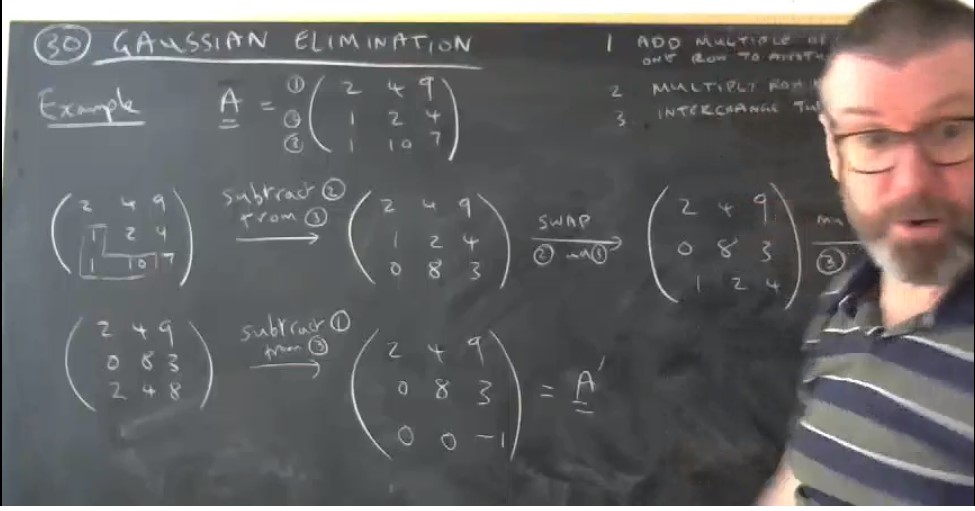
I know people think I am very old fashioned in persistently using a chalkboard (a better word than “blackboard” as many chalkboards are actually dark green). They also find it quite amusing that I bought one especially so I could do lectures during the pandemic from home using it. One reason for that is that it’s far easier to get a decent contrast on camera than using a whiteboard. I also find that standing up and walking around allows me to communicate more effectively, at a decent pace and with a reasonable amount of energy which made the lectures from home a little less unbearable to give and, hopefully, to watch. Here’s the green blackboard in my office that I used to give some lectures during lockdown:

The very chalky chalkboard in my office on campus

It was never the intention of course that the board in my office would be used for lecturing. We have such things to facilitate the communication of ideas during a discussion by scribbling mathematical expressions or diagrams.

I found some time ago an article about why Mathematics professors at Stanford University still use chalkboards. I agree with everything in it. The renowned Perimeter Institute in Canada and the Isaac Newton Institute in Cambridge also have blackboards, not only in teaching rooms but also in corridors and offices to encourage scientific discussions.

For teaching I think the most important thing for the students in a lecture on a subject like theoretical physics to see a calculation as a process unfolding step-by-step as you explain the reasoning, rather than being presented in complete form which suggests that it should be memorized rather than understood. Far too many students come to university with the impression that their brain is just a memory device. I fill it’s our job as lecturers to encourage students develop genuine problem-solving skills. The example in the first picture above – Gaussian Elimination – is a good illustration of this. Most of my colleagues in Theoretical Physics and in the Department of Mathematics and Statistics seem to prefer chalkboards too, no doubt for similar reasons.

I know that many in Senior Management think of us as dinosaurs for clinging to “old technology” but the fact is that new technology isn’t always better technology. Whiteboards are just awful. As well as being impossible to read in a large room or to record from, the marker pens are expensive, filled with nasty solvent, and impossible to recycle when empty. Unfortunately the purveyors of these items seem to have cornered the market I hate whiteboards so much I call them shiteboards.

Anyway, with the new academic year due to start in a month, and there being no likely resolution of the accommodation crisis, it looks like many students will be unable to attend lectures in person. It doesn’t matter whether rooms have blackboards or whiteboards or enhanced multimedia digital display screens if the students can’t get to the campus…

The Accommodation Crisis Again

Posted in Education, Maynooth with tags , , on August 20, 2022 by telescoper

There’s an article on the RTÉ website drawing attention to the national crisis in student accommodation. Included in the article is an example of a student at Maynooth:

Clara Battell is heading into her second year of studying Law and Criminology at Maynooth University. The Sligo student and her four friends thought they’d beat the crowd when they started looking for accommodation shortly after Christmas. However, eight months on, they’re still looking.

I checked this morning on daft.ie and there are just two properties currently available to rent in Maynooth; the rest are miles away and would require the tenant(s) to have a car. One is property is a studio apartment for €1,250 per month (which is way beyond the budget of a typical undergraduate student) and the other a four-bedroom shared house suitable at €3,800 per month. And remember that new students haven’t even started looking yet as this year’s CAO offers are not out until September. Clara Battell might end up having to commute from Sligo:

I’m from Sligo, it’s a three hour train journey and the only option at this stage appears to be commuting. It’s surely not feasible, six hours every day – and you’re not getting the best out of your education if you are travelling so much. We are all a bit stuck really.

Not to mention of course the inability to participate in clubs, societies and other extra-curricular activities. Clara’s situation is by no means atypical. Some brave students may try long-distance commuting this for a week or two, but few will keep it up for the entire academic year when they know how tough it is going to be.

The reality is that a great many students will have to choose between lengthy commutes and skipping lectures. This is particularly bad at Maynooth where the University Management has failed to invest in lecture recording equipment that would at least do something to mitigate the negatives of not being able to attend campus teaching sessions. I can see attendance on campus being very low this forthcoming term, as it was last term. The reality for many students is that they will be stuck at home just like during the lockdown, but without online classes. This was entirely predictable, but little has been done. It’s extremely frustrating for staff as well as students.

I heard this week of a much-needed proposal for a new housing complex including 260 student beds in Maynooth. It’s not on campus, but within walking distance on the other side of the Moyglare Road. This is good news, but the application for planning consent has only just been lodged; a decision is not expected until November 30th. Even if permission is granted it will take years to build and remember that there are 15,000 students in Maynooth so 260 beds is a drop in the ocean.

It is important to stress what is driving this. With costs increasing but income per student falling over many years, third-level institutions have had no choice but to recruit more and more students. The same Government that has driven this requirement is also responsible for inadequate investment in housing across the country. Some people are trying to blame the current crisis on the 48,000 Ukrainian refugees now in Ireland, but all their presence has done is to expose the long-term negligence of the Government at whose door the blame must rest.

It will take at least two years, and probably much longer, to fix this crisis. The big question is whether Ireland’s University system will survive that time without disintegrating.

Quiet Quitting

Posted in Biographical, Education, Maynooth with tags , , on August 16, 2022 by telescoper

Not long ago I had lunch with a friend and former colleague from Sussex now working elsewhere. During the conversation I found myself saying words to the effect of “It’s only easy being a manager of something if you don’t care”. Speaking in the context of University management I meant “care” about the things that matter, i.e. staff and students and teaching and research, not metrics, rankings and key performance indicators.

Over the years that I’ve worked in universities, I’ve seen them systematically taken over by people who really don’t care at all about the important things. The result among ordinary staff is exhaustion caused by the overwork required to meet arbitrary criteria of productivity imposed by a remote and uncaring managerial class. Universities are thus a microcosm of neoliberal society at large, with the management being the propertied class, the academics being the workers, and the students being mere commodities.

The drive to alienate and demoralize staff through overwork accelerated during the Covid-19 pandemic. Teaching staff were required to transform their working methods, undertake countless hours of unpaid overtime and suffer long periods of isolation and stress. Being a Head of Department with lots of responsibilities but no actual power and no reduction in teaching load to compensate for the administrative burden, compounded this They did it because they knew there was an emergency and because they actually care. In return for this sacrifice they have generally received no appreciation except for platitudes and nothing by way of financial compensation, with the notable exception of Queen’s University Belfast which paid a bonus to staff in recognition of their exceptional efforts. Well done to them, but they are the exception rather than the rule. Elsewhere the only reward for efforts during the pandemic looks likely to be real-terms cuts in pay.

My worry, which is rapidly becoming reality, is that in the post-pandemic era The Management, aware of how far their employees were prepared to go during the pandemic, will continue to take them completely for granted, increase their workload by recruiting more and more students to be taught with fewer and fewer resources, all of it driven by financial targets. Why do we continue to put up with this gross exploitation? Are we doomed forever to labour under the dead weight of managerialism?

Over the past few weeks I’ve seen a number of articles about quiet quitting, most recently this one in the Guardian. Roughly speaking “quiet quitting” means fulfilling one’s contract but not going any further – no work at evening or weekends, taking one’s full holiday entitlement, and so on. Staff have generally done these things because they care but that care has been and is still being systematically exploited. Indeed, it says something about the way higher education institutions operate nowadays that “working to contract” is generally regarded as a form of industrial action! Universities would grind to a halt without the good will of staff, and there’s very little of that still left. In my own case, my employer still hasn’t fulfilled the terms of my employment contract almost five years after I joined.

So am I now going to join the ranks of those quitting quietly? You might very well think that. I couldn’t possibly comment. What I will say is that my union, IFUT, is going to ballot its members next month on industrial action over pay. I think you can probably guess which way I’ll be voting…