Archive for the Maynooth Category

The Joy of Rollmops

Posted in Biographical, Maynooth with tags , , on March 2, 2021 by telescoper

The other day I had a bit of a craving for pickled herring which, in the form of rollmops, is something I’ve liked since I was a kid but rediscovered on a trip to Denmark many years ago where sild on lovely rugbrød with a peberrod sauce became one of my favourite light meals. Pickled herring doesn’t seem to be so popular in Ireland but fortunately it is popular with folk from countries around the Baltic Sea, including Poland, and in Maynooth there is a very nice little Polish mini-market where I found a wide variety of pickled herrings with different kinds of marinade.

In the course of this discovered what the Polish word for rollmops is:

For some reason I had always assumed that “rollmops” was an English word but in fact it is of German origin and Rollmops is actually singular (the plural is Rollmöpse).

In the shop I also bought some rye bread and horseradish to go with the fish. In fact the little shop is full of lovely produce and, although yesterday was the first time I’ve been inside, I’m sure to be a regular visitor in future.

I know some people don’t like pickled herring at all but I love it. In fact I think it’s tanginess makes it an ideal starter and I’ve often served it as such when I’ve had guests for dinner. The bonus is you don’t need to cook it!

A Year of Covid-19 in Ireland

Posted in Biographical, Covid-19, Maynooth, Politics with tags , , on February 28, 2021 by telescoper

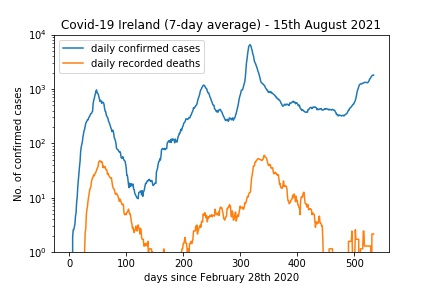
Last night I was updating my Covid-19 statistics and plotting new graphs (which I do every day – the results are here) when I noticed that I now have 365 data points. The first officially recorded case of Covid-19 in Ireland was dated 29th February 2020 (although there is evidence of cases in Ireland before that, including one of community transmission). I can’t actually mark the anniversary of that date exactly – for obvious reasons – but it seems a good point to look at what has happened. I didn’t actually start doing a daily update until 22nd March when we were all in the first lockdown but there were relatively few cases in the intervening time and it was possible quite easily to fill in the earlier data.

Little did I know that I would be doing an update every day for a year!

Anyway, here are today’s plots:


On a linear y-axis the cases look like this:


The numbers for deaths on a linear scale look like this:


The recent trend is for a slow decline in new cases, hospitalizations, ICU referrals and testing positivity rates which is all good news. The rate of vaccination- severely limited by supply issues – is starting to increase and from April to June is expected to reach a million a month and then two million a month thereafter. There is therefore some grounds for optimism that a significant fraction of the population will be immunized by the end of the summer, assuming the supply ramps up as expected and there are no more dirty tricks from certain pharmaceutical companies.

Comparing with the situations elsewhere I’d say that Ireland has in broad terms handled the pandemic quite well: worse than some (especially Scandinavian countries) but better than many. It does seem to me that there have been three serious errors:

  1. There has never been – and still isn’t – any sensible plan for imposing quarantine on arrivals into Ireland. A year on one is being put in place but it is simply ridiculous that an island like Ireland failed to do this earlier.
  2. Those lockdown measures that have been imposed have been very weakly enforced, and have often been accompanied by confused messaging from the Government, with the result that a significant minority of people have simply ignored the restrictions. The majority of the population has complied but the others that haven’t have kept the virus in circulation at a high level: the current daily rate of new cases is 650-700, which is far too high, and is declining only slowly.
  3. Finally, and probably the biggest mistake of all, was to relax restriction for the Christmas holiday. The huge spike in infections and deaths in January and February is a direct result of this catastrophic decision for which the Government is entirely culpable.

The situation in the United Kingdom with regard to 3 was even worse:

The excess mortality from January is a direct consequence of Boris Johnson “saving Christmas”. The difference in area under the two curves tells you precisely how many people he killed. I hope politicians on both sides of the Irish Sea are one day held to account for their negligence.

As for myself, I am reasonably optimistic for the future, and not just because Spring appears to have arrived. I have found the Covid-19 restrictions very irksome but I am fortunate to be in a position to cope with them reasonably well, especially now that I have my own house with a garden in a nice quiet neighbourhood.

It has been very hard work doing everything online, and it’s essential to take a break from the screen from time to time, but the upside of that is that by keeping busy you avoid becoming bored and frustrated. One thing that does annoy me though is the number of people who thinking that “working from home” means “not working at all”. I’m sure there are many others, especially in the education sector, who will agree with me!

Although I have coped reasonably well in a personal sense I still very much want to get back to campus to resume face-to-face teaching. I like talking to students and find teaching much more rewarding when there is a response. Moreover, since we’re now going to be off campus until the end of this academic year, that means that a second cohort of students will complete their degrees and graduate this summer without their lecturers being there to congratulate them in person and give them a proper sendoff into the big wide world. I find that very sad.

Anyway, tomorrow we start week 5 of the Semester, which means 4 weeks have passed. That means there are two weeks before the Study Break, the halfway point of teaching term, and we are one-third of the way through the semester. Life goes on.

Particle Physics Masterclass at Maynooth

Posted in Education, Maynooth, The Universe and Stuff with tags , , on February 26, 2021 by telescoper

I have already informed you of a Masterclass in Astrophysics & Cosmology at Maynooth that will take place on March 25th 2021. For more information on that event including instructions on how to book see here.

Now it’s time to announce the International Masterclass on Particle Physics. The  Department of Theoretical Physics has hosted such event for secondary school students each Spring, apart from last year when it was cancelled because of Covid-19.  The next event will take place online on 21 and 22 March 2021. You can find more information, including instructions on how to book a place, here.

These Masterclasses give secondary school students the opportunity to discover the world of quarks and leptons for themselves, by performing measurements on real data from CERN, meeting active particle physics researchers and linking up with like-minded students from other countries.  We will join thousands of other secondary school students at more than 100 universities and laboratories around Europe and worldwide in a programme stretching over four weeks.

Physics at the most fundamental level – the smallest and most basic building blocks of matter – is an exotic world.  But a few introductory talks and working with data from CERN will give the students insight into the fundamental particles of matter and the forces between them, as well as what went on during the Big Bang.

On Sunday afternoon, the students are introduced to particle physics, experiments and detectors in lectures given by active particle physics researchers.  On Monday, after a virtual visit to the ALICE detector at CERN, they work on their own with data from ALICE Afterwards they participate in a video conference with students from other countries and moderators at CERN, where they discuss and compare their results.

For more information on the Particle Physics Masterclasses, see the International Masterclasses web site.

I don’t know. You wait ages for a Masterclass in Physics at Maynooth University, and then along come two in quick succession!

Údarás na Gaeltachta

Posted in Biographical, Maynooth with tags , , on February 25, 2021 by telescoper

In today’s lunchtime Irish Language lesson we learned a bit about the Gaeltacht, i.e. Irish speaking areas in Ireland. Here is a little video:

You will see that most of the Gaeltacht is in the Western extremes of the country because these are the regions that largely escaped the English encroachment and suppression of the Irish language. One thing I wasn’t aware of before today however is that there is a part quite near Maynooth in the form of the town of Ráth Chairn (English: Rathcairn) about 40km away in County Meath. The people who live there were originally from Connemara so they speak the Gaeilge Chonnacht. This is where our teacher comes from, actually, so if I ever develop any ability to speak the language I’ll probably have do so with a Connacht accent!

Astrophysics & Cosmology Masterclass at Maynooth

Posted in Education, Maynooth, The Universe and Stuff with tags , , on February 23, 2021 by telescoper

Regular readers of the blog – both of them – may remember that we planned to present a Masterclass in Astrophysics & Cosmology on January 14th 2021 but this had to be postponed due to Covid-19 restrictions. After today’s announcements by the Government of  a phased return to school starting on March 1st we have now decided to proceed with a new date of March 25th 2021.

This will be a half-day virtual event via Zoom. It’s meant for school students in their 5th or 6th year of the Irish system, who should be returning to classrooms on March 15th, but there might be a few of them or their teachers who see this blog so I thought I’d share the news here. You can find more information, including instructions on how to book a place, here.

Here is the updated official poster and the programme:

I’ll be talking about cosmology early on, while John Regan will talk about black holes. After the coffee break one of our PhD students will talk about why they wanted to study astrophysics. Then I’ll say something about our degree programmes for those students who might be interested in studying astrophysics and/or cosmology as part of a science course. We’ll finish with questions either about the science or the study!

What is Quantum Technology? – A Public Lecture by Prof. Sir Peter Knight

Posted in Maynooth, The Universe and Stuff with tags , , , , on February 23, 2021 by telescoper

On Thursday March 11th (at 7pm) the Maynooth University Faculty of Science and Engineering will present its first ever Dean’s Lecture. This is a public event, consisting of a talk followed by a Q&A session.

The topic of the talk is quantum technology and it is presented by Prof. Sir Peter Knight who is Senior Research Investigator at Imperial College London. He retired in 2010 as Deputy Rector (Research) at Imperial. He was knighted in 2005 for his work in optical physics. Knight was the 2004 President of the Optical Society of America and 2011-2013 President of the Institute of Physics. He is Editor of Contemporary Physics, Chair of the UK National Quantum Technology Programme Strategy Advisory Board, chairs the Quantum Metrology Institute at the National Physical Laboratory, was until 2010 chair of the UK Defence Scientific Advisory Council and remains a UK Government science advisor. His research centres on quantum optics and quantum technology. He has won the Thomas Young Medal and the Glazebrook Medal of the Institute of Physics, the Ives Medal and the Walther Medal and Prize of the OSA, the Royal Medal of the Royal Society and the Faraday Prize of the IET.

Here is a description of the talk:

We already live in a quantum-enabled world with devices powered by quantum mechanics affecting our everyday world (lasers, telecoms semiconductor chips, and much more). But we are now poised to exploit a hitherto largely unexplored technology capability enabled by some of the stranger aspects of quantum physics: quantum coherence and entanglement. These new capabilities include novel sensing, timing, imaging, and of course computing. I will describe these new quantum coherence capabilities and plans to develop the next generation of quantum technologies. Quantum Information Science is advancing our understanding of the physical world in remarkable ways. But it is also driving novel and disruptive technologies. I will describe plans for ensuring the advanced quantum science and demonstrator platforms in imaging, sensing, communications, and computing developed over the past five years or so will drive the formation of the quantum technology sector and embed quantum technology in a broad range of industries.

The event is free but you will need to register here.

A Year of Covid-19 in Maynooth

Posted in Biographical, Covid-19, Maynooth with tags , on February 22, 2021 by telescoper

One useful thing about having a blog is that I can look through my back catalogue of posts quite easily to remind me exactly when things happened. Doing that over the weeked I discovered that it was exactly a year ago today that I travelled from Maynooth into Dublin to see a production of Fidelio. That was a few weeks before Covid-19 related travel restrictions were introduced. I was planning to fly to Cardiff in March but couldn’t do so because of the collapse of FlyBe.

And so it came to pass that I now haven’t left Maynooth for an entire year. I have of course moved house, but only by a few hundred yards. I have spent 12 months entirely within a 5km radius.

The only time I’ve (accidentally) broken the rules was when, during a walk up the Moyglare Road, I accidentally strayed into County Meath. Travel across county boundaries is verboten, you see. The County boundary is shown on the map, to the North of the town, and is closer than I had thought.

Anyway, it looks as I’m going to have a 5km horizon for some time to come. The state of play with Covid-19 as of yesterday isn’t particularly promising. Case numbers and hospitalizations are falling, but very slowly.

The reduction in new cases is only around 15 per day on average and at the current level of around 800 that’s far too high to be even thinking about opening up again.

Why is this reduction so slow? The answer to that question is fairly obvious: far too many people are flouting the existing rules. I have hardly been outside the house since Christmas, mainly to follow the health advice, but also partly because it annoys me to see so many people out and about ignoring social distancing, face coverings, and the rest. The sad thing is that by not taking responsibility now, these people are ensuring that this wretched pandemic lasts even longer.

Ireland’s vaccination programme is going steadily with over 100,000 fully vaccinated and twice that number having received one dose.

Note the considerable variation in vaccination progress across the different countries*. Denmark is top of the heap, probably because it has a fully computerised nationwide health system. Things would obviously be going faster had one of the major suppliers not decided to renege on its contract with the EU but, despite the sharp practice from AstraZeneca, there is expected to be a big increase in vaccines available from April onwards, with about three million doses available between April and June.

*The UK has adopted a different strategy from most others, by giving one dose to as many as possible as quickly as possible by delaying the second dose. This may turn out to be an effective approach. I’m not sufficiently expert to comment.

Today is the start of week 4 of Semester Two of the academic year at Maynooth University. That means we have three weeks to go until the mid-term study break (which was when the first lockdown began last year). Halfway to halfway through the Semester, in other words.

The way things are going I think I’ll be remaining within the 5km horizon until June at the earliest, and probably until September, assuming I’m not carted off to an institution before then.

Job in Theoretical Physics at Maynooth!

Posted in Maynooth with tags , on February 17, 2021 by telescoper

Just a short post passing on the information that we have a fixed-term job available in the Department of Theoretical Physics at Maynooth University. You can find the details here.

The position is for 10 months, starting in September 2021, and is to provide teaching cover for Professor Jiri Vala who will be on sabbatical next year. He originally intended to take his sabbatical this academic year, starting in September 2020, hence the previous advertisement of this post, but it was postponed for reasons of Covid-19 and the previous position was not filled.

I know it is a relatively short appointment, but it seems to me that it would provide a good opportunity for an early-career academic, perhaps someone straight out of a PhD, to gain some teaching experience.

The deadline for applications is 23.30 on Sunday March 14th, i.e. about 4 weeks away, and you should apply through the jobs portal here.

If you’d like to know any more please feel free to contact me privately.

Oh, and please feel free to pass this on to anyone who may be interested!

Cold Snap

Posted in Maynooth on February 9, 2021 by telescoper

I just thought I’d try out something I’ve never done on here before: sharing an Instagram post. I’m curious to see what it looks like.

It’s also an opportunity to state for the record that we’re in a bit of a cold snap here in Maynooth. It’s snowed off and on most of today. Note however that the pictures are from 2018…

The Irish word for snow, incidentally, is sneachta.

Yesterday, before the snow arrived, I filled the bird feeders in my garden. This morning, when the snow was just starting, the peanut feeder was almost empty. It normally takes 4-5 days to become depleted. It’s as if the birds had been reading the forecast and decided to fatten up! Birds do seem to know when bad weather is on the way…

I ventured out before my lecture this morning to replenish the supply. I wonder if I’ll need to do it again tomorrow?

Language Lessons

Posted in History, Irish Language, Maynooth with tags , , , , , , , , , , on February 4, 2021 by telescoper

Thursday is Computational Physics Day this term so this morning I delivered the first Panopto lecture of that module and in the afternoon we had our first laboratory session. The students are all at home of course so we had to run the lab with them using their own laptops rather than the dedicated Linux cluster we have in the Department and interacting via Microsoft Teams.  The first lab is very introductory so it was really just me presenting and them following on their machines without too much interaction. The ability to share a screen is actually very useful though and I imagine using it quite a lot to share Spyder. It went fairly well, I think, with all the students getting started out on the business of learning Python.

In between lecturing the morning and running the laboratory session this afternoon I had the chance to study another kind of language. Soon after I first arrived in Maynooth I got an email from Maynooth University about Irish language classes. Feeling a bit ashamed about not having learned Welsh in all my time in Cardiff, I thought I’d sign up for the Beginners class and fill in a Doodle Poll to help the organizers schedule it. Unfortunately, when the result was announced  it was at a time that I couldn’t make owing to teaching, so I couldn’t do it. That  happened a couple of times, in fact. This year however I’ve managed to register at a time I can make, though obviously the sessions are online.

I’m not sure how wise it is for me to try learning a new language during a term as busy as this, but I have to say I enjoyed the first session enormously. It was all very introductory, but I’ve learnt a few things about pronunciation – unsurprisingly the Irish word for pronunciation fuaimniú is unsurprisingly quite difficult to pronounce – and the difference between slender and broad vowels. I also learnt that to construct a verbal noun, instead of putting -ing on the end as you would in English, in Irish you use the word ag in front of the verb.

That’s not to say I had no problems. I’m still not sure I can say  Dia duit (hello) properly. The second “d” is hardly pronounced. 

Irish isn’t much like Welsh, which I failed to learn previously.  Although Irish and Welsh are both Celtic languages they are from two distinct groups: the Goidelic group that comprises Irish, Manx and Scottish Gaelic; and the Brythonic group that comprises Welsh, Cornish and Breton. These are sometimes referred to as q-Celtic and p-Celtic, respectively, although not everyone agrees that is a useful categorization. Incidentally, Scottish Gaelic is not the language spoken by the Celtic people who lived in Scotland at the time of the Romans, the Picts, which is lost. Scottish Gaelic is actually descended from Middle Irish. Also incidentally, Breton was taken to Brittany by a mass migration of people from South-West Britain fleeing the Anglo-Saxons which peaked somewhere around 500 AD. I guess that was the first Brexodus.

Welsh and Irish don’t sound at all similar to me, which is not surprising really. It is thought that the Brythonic languages evolved from a language  brought to Britain by people from somewhere in Gaul (probably Northern France), whereas the people whose language led to the Goidelic tongues were probably from somewhere in the Iberia (modern-day Spain or Portugal). The modern versions of Irish and Welsh do contain words borrowed from Latin, French and English so there are similarities there too.

Only a diacritic mark appears in Irish, the síneadh fada (`long accent’), sometimes called the fada for short, which looks the same as the acute accent in, e.g., French. There’s actually one in síneadh if you look hard enough. It just means the vowel is pronounced long (i.e. the first syllable of síneadh is pronounced SHEEN). The word sean (meaning old) is pronounced like “shan” whereas Seán the name is pronounced “Shawn”.

One does find quite a few texts (especially online) where the fada is carelessly omitted, but it really is quite important. For example Cáca is the Irish word for `cake’, while the unaccented Caca means `excrement’…

I took the above text in Irish and English from the front cover of an old examination paper. You can see the accents as well as another feature of Irish which is slightly similar to Welsh, the mysterious lower-case h in front of Éireann. This is a consequence of an initial mutation, in which the initial character of word changes in various situations according to syntax or morphology (i.e. following certain words changing the case of a noun or following certain sounds). This specific case is an an example of h-prothesis (of an initial vowel).

In Welsh, mutations involve the substitution of one character for another. For example, `Wales’ is Cymru but if you cross the border into Wales you may see a sign saying Croeso i Gymru, the `C’ having mutated. The Irish language is a bit friendlier to the learner than Welsh, however, as the mutated character (h in the example above) is inserted in front of the unmutated character. Seeing both the mutated and unmutated character helps a person with limited vocabulary (such as myself) figure out what’s going on.

Mutations of consonants also occur in Irish. These can involve lenition (literally `weakening’, also known as aspiration) or eclipsis (nasalisation). In the case of eclipsis the unmutated consonant is preceded by another denoting the actual sound, e.g. b becomes m in terms of pronunciation, but what is written is mb. On the other hand, lenition is denoted by an following the unmutated consonant. In older forms of Irish the overdot (ponc séimhithe) -another diacritic – was used to denote lenition.

Anyway, I’ve seen Dia duit written Dia dhuit which might explain why the d sounds so weak. We live and learn. If I keep at it long enough I might eventually be able to understand the TG4 commentary on the hurling..