Archive for the Maynooth Category

Teaching from Home

Posted in Covid-19, Education, Maynooth on February 3, 2021 by telescoper

Determined to follow the public health advice and work from home I decided to set up a blackboard in my study so I can do lectures online. I find the blackboard shows up better on camera than a whiteboard and using this arrangement allows me to stand up while I deliver the material, which I find much more comfortable than sitting down.

I’m fortunate of course in having enough space to do this. Not every University lecturer can do this.

The bit you see on the board was the start of my second Engineering Mathematics lecture to first-year students. I had asked the students at the end of Lecture 1 to think about the Laplace Transform of f(t)=t and began Lecture 2 by going through the necessary integration on the board.

Today I have three lectures – another Engineering Maths and two Advanced Electromagnetism to give so the board will be more extensively used. I just hope my internet connection stays up!

P. S. Playing back today’s videos I have discovered an optical defect in the Panopto system that makes my hair look grey.

P.P.S. Three lectures in an afternoon (12-1, 2-3 and 4-5) is quite hard work but at least I had breaks between them!

The Start of Spring Semester

Posted in Biographical, Education, Maynooth with tags , , , , , , , on February 1, 2021 by telescoper

It’s February 1st 2021, which means that today is Imbolc, a Gaelic festival marking the point halfway between the winter solstice and vernal equinox, i.e. it’s a Cross-Quarter Day. To be pedantic, Imbolc is actually the period between this evening and tomorrow evening as in the Celtic calendar days were counted from sunset to sunset.

The first Day of February is also the Feast day of St Brigid of Kildare (c. 451-525), one of Ireland’s patron saints along with Saints Patrick and Colm Cille. One of her miraculous powers was the ability to change water into ale, which perhaps explains her enduring popularity among the Irish.

In Ireland this day is sometimes regarded as the first day of spring, as it is roughly the time when the first spring lambs are born. It corresponds to the Welsh Gŵyl Fair y Canhwyllau and is also known as the `Cross Quarter Day’ or (my favourite) `The Quickening of the Year’. According to legend it is also the day on which jackdaws mate. Given how many of them there are around Maynooth there should be a lot of action today.

Today is, appropriately enough in the light of all this, the start of the Spring Semester of teaching at Maynooth University, the fourth Spring Semester I will have experienced here although this is obviously not like the others in that we’ll be teaching online at least for the first half and probably for the entirety. I was planning to stay at home today but I realised I’d left some things I need in the office on campus so will have to go to collect them. That’s why I’m up early. That and the need to shake myself out of the lockdown torpor that has afflicted me since New Year. It’s time to get my act together, pull my finger out, put my best foot forward, etc.

This Semester I am teaching Engineering Mathematics II, Computational Physics I and Advanced Electromagnetism. The former, what you would probably call a `service course’, covers a mixture of things, mainly Linear Algebra but with some other bits thrown in for fun, such as Laplace transforms. Interestingly I find the Mathematical Physics students do not encounter Laplace Transforms in the first year, but perhaps engineers use them more often than physicists do? I think I’ve written only one paper that made use of a Laplace transform. Anyway, I have to start with this topic as the students need some knowledge of it for some other module they’re taking this semester. I reckon six lectures will be enough to give them what they need. That’s two weeks of lectures, there being three lectures a week for this module.

Once again my teaching timetable for this module is quite nice. I have lectures on Monday, Tuesday and Wednesday and then the students have a choice of tutorial (on either Thursday or Friday). That means I can get through a decent amount of material each week before each tutorial. I don’t do the tutorials, by the way: that’s left to one of our PhD students, who gets paid for doing that and correcting the weekly coursework. There are about 50 students on this module, divided into two courses: Electronic Engineering and Robotics and Intelligent Devices. We don’t have Civil or Mechanical or Chemical Engineering, etc, at Maynooth, in case you were wondering. Lectures will be done as webcasts using Panopto but also recorded for later viewing.

My first Computational Physics lecture, which I will do from home, is on Thursday, after which there is a lab session which we will do via Microsoft Teams. That’s the way we did it after lockdown last year and it worked OK. Students attend one two-hour lab session in addition to the lecture, on either Thursday or Tuesday. The first lecture being on Thursday the first lab session will be Thursday afternoon, with the same material being covered the following Tuesday. Fortunately, Python is free to download and easy to install so it’s quite straightforward to run the labs remotely. Teams has a screen sharing facility so it’s quite easy for myself or my demonstrator to see what is wrong in the same way we would do in a laboratory class.

The Advanced Electromagnetism module is a new one for me but I’m quite looking forward to it. Being a final-year module its content is less prescriptive than others and I’ll be adding a few things that I find interesting. Both lectures for that one are on Wednesdays and again will be given as webcasts with recordings available later.

Today is a particularly busy day because in addition to my first lecture (at 2pm) I have a meeting of Academic Council (3pm via Teams), a Euclid telecon (via Zoom) and a meeting with my PhD student via Teams. I have also been trying to sort out tutors and tutorials for the forthcoming Semester: these don’t start until next week so there’s time, but it has been quite a challenge to get everyone sorted. Fortunately I think that’s now done.

Oh, and another thing. I signed up for Irish language lessons (Beginners Level) and will be having classes once a week from now on.

It’s going to be a very busy term but I reckon being busy is probably going to be a good way to get through the next few months.

Maynooth and the Boyle Family

Posted in History, Maynooth, The Universe and Stuff with tags , , , , , , , on January 30, 2021 by telescoper

It’s a rainy Saturday afternoon in Maynooth and I don’t feel like taking my usual walk so I thought I’d post another bit of local history like I did last week. This is another thing I’ve just found out and thought I’d share. This is a view I took last spring of Maynooth Castle (or the ruins thereof):

The Castle, together with a Manor House that was next to it, belonged to the Fitzgerald family, local aristocracy since the 13th Century. As I mentioned in a previous post, Thomas Fitzgerald, the 10th Earl of Kildare, led a rebellion against the English authorities during the time of Henry VIII. He acquired the nickname “Silken Thomas” because of the ribbons of silk worn by his supporters. The rebellion failed and his family castle was badly damaged. Thomas surrendered and was subsequently executed, along with several members of his family, in 1537. The family fortunes declined pretty drastically at that point but the family line did survive.

Now fast forward to 1630 when George Fitzgerald, the 16th Earl of Kildare married a Lady Joan Boyle. She was the daughter of a tremendously powerful figure by the name of Richard Boyle, the 1st Earl of Cork. Richard Boyle had been part of the Tudor plantation of Ireland and had acquired enormous amounts of land and personal wealth in the process. He spent some of his riches at the time of his daughter’s wedding doing up the ancestral home of his son-in-law, refurbishing the castle and building a new manor house next to it.

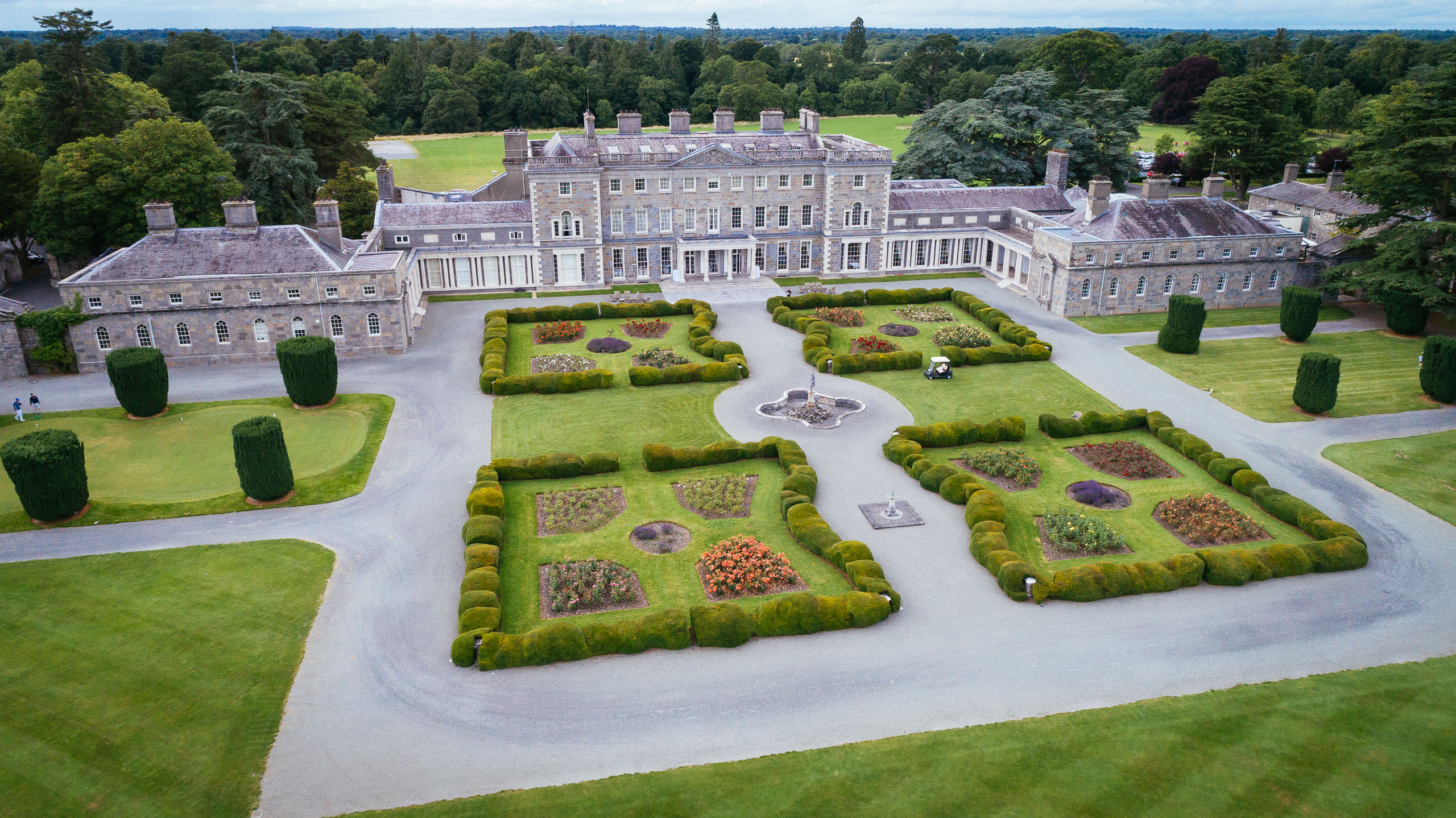
Unfortunately this didn’t last long. During the Irish Confederate Wars the Castle was attacked several times and badly damaged. It remained in occupation but by the end of the 17th Century it was derelict. The Fitzgerald family eventually moved to a new home at the other end of Maynooth, Carton House (now an upmarket golf resort). All Richard Boyle’s refurbishment work went to nothing and all that survives to the present day – the Gatehouse and Solar Tower – dates to the 13th Century, no doubt because it was more solidly built.

I’ve known about this for quite a while, but only this morning I discovered something else. Richard Boyle had a very large family – fifteen children altogether – and his seventh son (14th child altogether) was none other than the famous natural philosopher Robert Boyle, after whom Boyle’s Law is named. He was a particularly important figure in the development of chemistry, paid for the publication of a translation of the Bible into Irish, was a founder member of the Royal Society of London and, more importantly than any of those things, wrote the book whose cover I use when I post rambling from In The Dark on Twitter:

It’s a very descriptive title for this blog, but perhaps not so catchy.

Anyway, largely because he found it difficult to acquire materials and equipment in Ireland, Robert Boyle spent most his scientific career in England. He did however return to Ireland a number of times. He was born in Lismore, in County Waterford, so probably would have stayed near there on these visit. It is entirely possible – and indeed likely – that he may have visited his sister in Maynooth while in Ireland.

The Term Ahead

Posted in Covid-19, Education, Maynooth with tags , , , , on January 28, 2021 by telescoper

After a recent Government announcement that current Covid-19 restrictions would be extended until at least March 5th, this morning we received the expected communication from the University authorities that almost all our teaching at Maynooth University would be online until March 22nd at the earliest. This is because the half-term “study break” is from 15th to 19th March (to include St Patrick’s Day) and there would be no point in trying to get students back for one week (8th-12th March) before breaking up for the following week. In fact, if I had to bet money on it I would say we’ll probably be online all the way through to the summer, and possibly beyond, but that decision has not been made yet.

To nobody’s surprise we’re also going to have online examinations in the summer again. We’ve done two rounds of these already so are getting used to them now so that’s not a problem.

The St Patrick’s Day break was basically when we flipped – by which I mean “changed teaching methods” rather than “went mad” – last year so at least we’ve already got teaching prepared for the second half of the forthcoming semester if Level 5 restrictions do continue.

I am actually a bit annoyed at the politicians for making hints about when the restrictions might end. It is clearly far too early to be talking about that. Here are yesterday’s numbers:

If you prefer them on a linear scale here they are:

New cases have fallen significantly since the latest peak but at least part of that is due to the fact that automatic close contact tracing couldn’t cope and was abandoned. Testing positivity rate has fallen to around 8.2% (from over 20%) , hospital admissions admissions are falling, and deaths may have peaked, so the evidence suggests there is a is a reduction, but the numbers are still way too high. They need to come down to much less than a 100 before any lifting of restrictions can be contemplated. At the current rate of decline that will take many weeks.  Suggesting opening up is going to happen soon will only make people impatient and reduce compliance.

Teaching term at Maynooth starts on Monday (1st February) and I have three modules to deliver, one of them a module I’ve never given before. Because there has been so much to do behind the scenes since Christmas I don’t think I’ll ever have started a term feeling so exhausted. The cycle of academic life carries on remorselessly despite the fact that everything takes longer to do under Covid-19 restrictions. It is an effort just to keep up.

Still at least we’ve all still got jobs to do and are still getting paid. It’s time to knuckle down and focus on reaching the mid-term break in one piece and then seeing where we go thereafter.


Teaching after Covid

Posted in Covid-19, Education, Maynooth with tags , , , on January 26, 2021 by telescoper

I know it’s a Business lecture, but at least there is a periodic table on the wall to remind students of the time when Universities used to care about science.

Near the end of a planning meeting this morning I was asked to give my thoughts about any long-term impacts of the Covid-19 pandemic on teaching and/or research. That also echoed a discussion I had with staff in the Department of Theoretical Physics on Teams a while ago, which touched on the same question.

My own view in general is that although we find ourselves constantly saying things like “When we get back to normal…” I think we have to accept that the pandemic is going to change many things irreversibly. We’re going to have to get used to new ways of working in both teaching and research. Some changes will be made to make financial savings owing to loss of income over however long the pandemic lasts, and some of those will no doubt be painful and sad. Others will be opportunities created by us learning how to do things differently and a number of these could be very positive, if we seize the initiative and make the most of them.

One specific thing in the latter category is that Maynooth University installed a system of lecture capture to help deliver teaching when access to campus was restricted (as it is now). The hardware and software installed is fairly basic and isn’t by any means perfect, but it has worked pretty well. The main problem is that the cameras that have been installed are very limited webcams and are not capable of capturing, e.g. a blackboard.

One thing I hope will happen in the long term is that we include lecture capture as a routine way of augment students’ learning. That will require additional investment in infrastructure, but I think it would be well worth it.

Some years ago I blogged about this at another institution, which had facilities allow lecturers to record videos of their own lectures which are then made available for students to view online.

This is of course very beneficial for students with special learning requirements, but in the spirit of inclusive teaching I think it’s good that all students can access such material. Some faculty are apparently a little nervous that having recordings of lectures available online would result in falling attendances at lectures, but in fact there is evidence that indicates precisely the opposite effect. Students find the recorded version adds quite a lot of value to the “live” event by allowing them to clarify things they might not have not noted down clearly. In my experience they rarely watch the whole video, instead focusing on things they didn’t get first time around. And if a few students decide that it’s good enough for them just to watch the video, then so what? That’s their choice. They are adults, after all.

I’ll add that I do feel we should still make the effort to return to doing live lectures in some form and not rely entirely on recordings. I think that what you can do in a lecture is fairly limited part of the overall educational package, but that’s not the same as saying that they should be scrapped. Many students do enjoy lectures and find them very helpful. I just think we should make the best of the available technology to offer as wide a range of teaching methods as possible. No two students are the same and no two students learn precisely the same way. Let us offer them a variety of resources and they can choose which serves them best.

Another important, but perhaps less tangible, aspect of this is that I think education is or should be a shared experience for students. Just having everyone sit in the same room “enjoying” the same teaching session is a great benefit compared with having them sit in their room watching things on a laptop screen. I think that’s one of the worst issues with remote teaching, and wish we had found better ways of dealing with that over the past year.

There is a benefit for the lecturer of having a live audience too, in that actually seeing the people you’re trying to teach helps you gauge how well you’re getting it across.

Anyway, I started a poll on lecture capture a while ago before the pandemic. Feel free to add your opinion. It will be interesting to see if opinions have changed!

A Little Local History

Posted in Biographical, History, Maynooth with tags , , , , , , , , on January 24, 2021 by telescoper

I’ve lived in Maynooth for over three years now and for a large part of that time my home was a flat on Straffan Road near Court House Square. Across the road from where I lived is Lyreen House (sometimes called Larine House). The Lyreen, incidentally, is the name of the small river that runs through Maynooth, on which the old mill was built.

The house was built in the 1780s and is now used as a day care centre. Towards the rear it has a very pleasant walled garden; from the side looking across Straffan Road it looks like this:

The car is not always there. Note the rather unattractive grey pebbledash rendering which is I’m afraid rather ubiquitous on old buildings in this area. I think this is because many of these buildings are made from limestone which needs to be protected from weathering. There is a lot of this rendering on the South Campus at Maynooth University too.

Anyway, I walked past Lyreen/Larine House every time I went to work without ever really thinking about its history. Then, yesterday, I saw this:

The picture at the bottom shows Lyreen House as seen looking South from Court House Square, with Straffan Road to the right. The article in the local paper explains that during the War of Independence a hundred years ago, it was for a time used as a barracks for the Black and Tans! I had absolutely no idea about that until yesterday!

Nowadays the view looking North through Court House Square towards Main Street is this:

The white building to the right is Brady’s pub. The structure you see is a monument to the victims of the Great Hunger in a pleasant seating area that is often used for craft fairs, musical performances and other gatherings. Or at least it was in the pre-Covid era.

What you don’t see is any sign of a Court House. That is because it was destroyed by the IRA in 1920. This is what it looked like after the attack.

The War of Independence in County Kildare didn’t see anything like as much violence as other parts of Ireland, abut that didn’t mean there wasn’t a strong Republican presence here. When rumours circulated that the British were going to use the Court House as a garrison the local IRA decided to deny them that opportunity by setting it on fire (though they first ensured that everyone inside was taken to safety).

The Old Court House lay derelict for many years and was eventually demolished. Then a public convenience was built on the site. This was not only an eyesore but also a smelly and unpleasant place that people generally avoided. It  was then demolished and the monument was constructed in 1993.

I walked through Court House Square last night on a rare trip out of my house to collect a takeaway for my dinner. I noticed that the Christmas lights and nativity scene were still there, almost a month after Christmas. I wonder when they’ll take them down?


NUI Dr Éamon De Valera Post-Doctoral Fellowship in Mathematical Sciences

Posted in History, mathematics, Maynooth, The Universe and Stuff with tags , , , on January 21, 2021 by telescoper

I found out yesterday that the National University of Ireland is commemorating the centenary of the election of Éamon de Valera as its Chancellor. To mark this occasion, NUI will offer a special NUI Dr Éamon De Valera Post-Doctoral Fellowship in Mathematical Sciences. This post is in addition to the regular NUI awards, which include a position for Science & Engineering.

Éamon de Valera, photographed sometime during the 1920s.

Éamon de Valera, founder of Fianna Fáil (formerly one of the two largest political parties in Ireland) and architect of the Irish constitution. De Valera (nickname `Dev’) is an enigmatic figure, who was a Commandant in the Irish Republican Army during the 1916 Easter Rising, who subsequently became Taoiseach  and then President of the Irish Republic.

You may or may not know that de Valera was a mathematics graduate, and for a short time (1912-13) he was Head of the Department of Mathematics and Mathematical Physics at St Patrick’s College, Maynooth,  a recognized college of the National University of Ireland. The Department became incorporated in Maynooth University, when it was created in 1997.Mathematical Physics is no longer a part of the Mathematics Department at Maynooth, having become a Department in its own right and it recently changed its name to the Department of Theoretical Physics.

Anyway, the Fellowship will be awarded on the basis of a common competition open to NUI graduates in all branches of the Mathematical Sciences. All branches of the Mathematical Sciences will be deemed as including, but not limited to, all academic disciplines within Applied Mathematics, Pure Mathematics, Mathematical Physics and Statistics and Probability.

You can find more details of the position here. I should say however that it is open to NUI graduates only, though it can be held at any of the constituent colleges of the National University of Ireland. Given the de Valera connection with Maynooth, it would be fitting if it were held here!
The deadline for applications is February 9th.

It’s raining…

Posted in Biographical, Maynooth, Poetry with tags , , , , , , on January 19, 2021 by telescoper

Taking a short break from examination marking I had a look outside. I’m not sorry to be cooped up indoors given that it’s pouring with rain. In fact it rained all night and morning and is set to continue in the same vein until tomorrow.

While I was waiting for my coffee to brew I was thinking about some idiomatic expressions for heavy rain. The most familiar one in English is Raining Cats and Dogs which, it appears, originated in a poem by Jonathan Swift that ends with the lines:

Drowned puppies, stinking sprats, all drenched in mud,
Dead cats and turnip tops come tumbling down the flood.

My French teacher at school taught me the memorable if slightly indelicate Il pleut comme vache qui pisse, although there are other French expressions involving, among other things nails, frogs and halberds.

One of my favourites is the Welsh Mae hi’n bwrw hen wragedd a ffyn which means, bizarrely, “It’s raining old ladies and sticks”. There is also Mae hi’n bwrw cyllyll a ffyrc – “It’s raining knives and forks”.

Related idiomatic expressions in Irish are constructed differently. There isn’t a transitive verb meaning “to rain” so there is no grammatical way to say “it rains something”. The way around this is to use a different verb to represent, e.g., throwing. For example Tá sé ag caitheamh sceana gréasaí which means “It’s throwing cobblers’ knives”.

Talking (of) cobblers, I note that in Danish there is Det regner skomagerdrenge – “It’s raining shoemakers’ apprentices” and in Germany Es regnet Schusterjungs – “It’s raining cobblers’ boys”.

Among the other strange expressions in other languages are Está chovendo a barba de sapo (Portuguese for “It’s raining toads’ beards”), Пада киша уби миша (Serbian for “It’s raining and killing mice”),  Det regner trollkjerringer (Norwegian for “It’s raining female trolls”) and Estan lloviendo hasta maridos (Spanish for “It is even raining husbands”).

No sign of any husbands outside right now so I’ll get back to correcting exams.

Cosmology Talks: Marika Asgari on Kids 1000

Posted in Cardiff, Maynooth, The Universe and Stuff with tags , , , , on January 18, 2021 by telescoper

It’s time I shared another one of those interesting cosmology talks on the Youtube channel curated by Shaun Hotchkiss. This channel features technical talks rather than popular expositions so it won’t be everyone’s cup of tea but for those seriously interested in cosmology at a research level they should prove interesting. Since I haven’t posted any of these for a while I’ve got a few to catch up on – this one is from September 2020.

In this talk Marika Asgari tells us about the recent Kilo-Degree Survey (KiDS) cosmological results. These are the first results from KiDS after they have reached a sky coverage of 1000 square degrees. Marika first explains how they know that the results are “statistics dominated” and not “systematics dominated”, meaning that the dominant uncertainty comes from statistical errors, not systematic ones. She then presents the cosmological results, which primarily constrain the clumpiness of matter in the universe, and which therefore constrain Ωm and σ8. In the combined parameter “S8“, which is constrained almost independently from Ωm by their data they see a more than 3σ tension with the equivalent parameter one would infer from Planck.

P. S. The papers that accompany this talk can be found here and here.

For the Birds..

Posted in Biographical, Maynooth with tags , , , on January 17, 2021 by telescoper

The Giant Robin of Newgrange

I saw the above picture of a robin on Twitter the other day and it reminded me of the one that visits my garden. I’ve never been quick enough to take a picture of him, but he’s every bit as plump as the one in the picture. If he were taller he’d be spherical.

The robin situation in my garden has seen an important development: another robin has arrived. The new one is smaller than the first and the first time I saw it I only noticed it because it was having a squabble with the plump one. I assumed it was a younger rival, but on subsequent days I saw the two of them together quite peacefully. Since male and female robins are virtually indistinguishable I wonder if they might be a husband and wife team? The fact that I saw them having a row lends support to this theory.

Another interesting thing concerned niger seed. I bought some of this a while ago, together with a feeder that purported to be designed for dispensing it. Niger seed is a fine oily seed very good for the smaller birds. Unfortunately the mesh in the feeder is too coarse and the seed just poured out as I filled it. I put the bag of seed away and filled the feeder with other stuff. Last week I remembered the bag of niger seed and decided to try putting some loose in the bird table. In no time a group of four chaffinches were tucking in. These were definitely two males and two females – the females are notably different in colour. Anyway, they love it – as do a number of other birds, including the robin(s) – and I’ve had to replenish the supply twice.

I usually wait until there don’t seem to be any birds present before going out to check the food supply, but this is a waste of time. Even if the garden appears empty, as soon as I go out there’s a whooshing sound and lots of chirps as birds that had secreted themselves in various trees and hedges take to the air to escape the scary human.

The birds provide a welcome distraction when I take a break from exam marking, as does writing a blog, but I guess I should get back to it now.