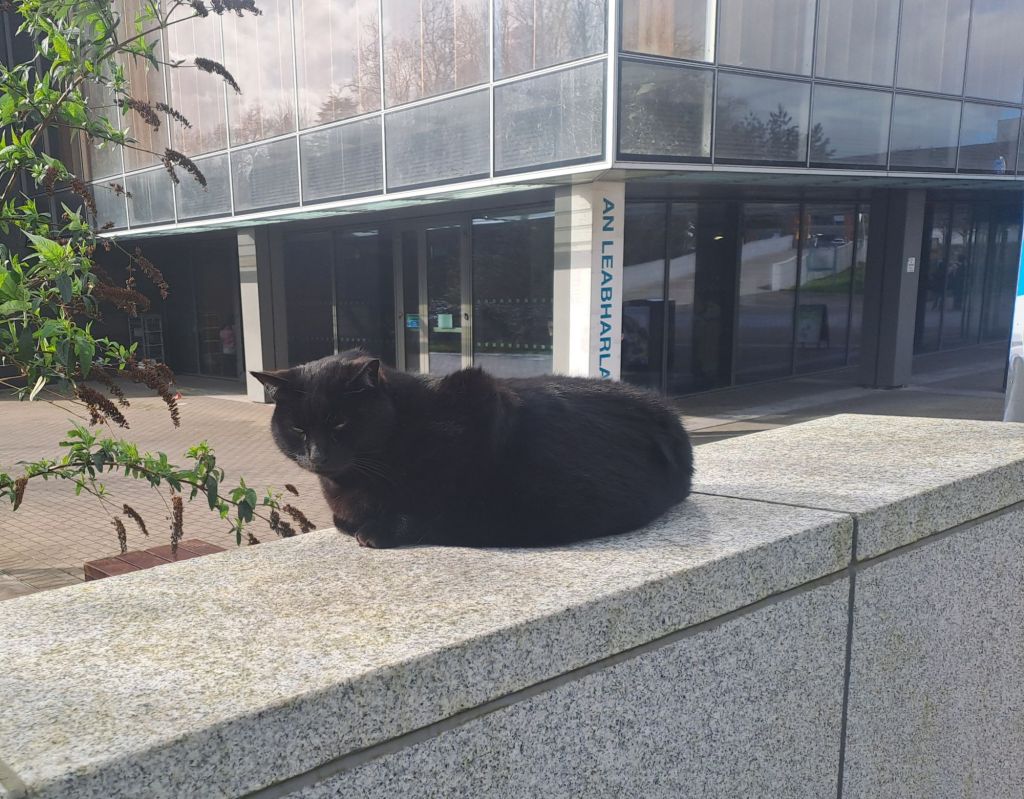
It being a spring-like day, Maynooth University Library Cat took the opportunity to choose a spot away from his usual post so he could loaf in the sunshine.
It being a spring-like day, Maynooth University Library Cat took the opportunity to choose a spot away from his usual post so he could loaf in the sunshine.
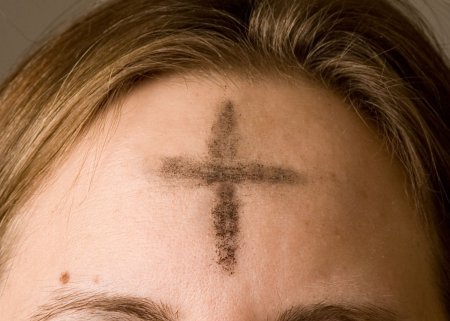
Yesterday was Ash Wednesday. I remember this time eight years ago when I was very much a newcomer to Maynooth being quite surprised to see some folk wearing a cross marked in ash on their forehead as in the picture above. I think this practice is a tradition within the Roman Catholic Church, with which Maynooth has long historical associations, so it’s not really surprising to see it here. Having been brought up in Protestant England I had never seen this before moving to Ireland, but it doesn’t surprise me any more to see people with crosses on their foreheads. That said, I noticed very few around the place yesterday. The numbers observing this ritual seem to be declining every year. Perhaps if they want to increase its popularity they could zhuzh it up a bit: how about some glitter in the ash? Just a thought.
Apparently the tradition used to be for ashes to be sprinkled on the top of the head of a male worshipper but a cross to be made on the forehead of a woman because she would be expected to be wearing a hat. Based on a small sample of those I have observed it seems both genders wear the cross on the forehead nowadays.
Anyway, although I’m not a Christian myself, respect to all those observing the season of Lent (Quadragesima), whether that means fasting, devotional prayer, or just giving up luxuries, such as reading this blog perhaps.
P.S. I’m told that the normal rule for Lent is `One meal and two collations’. The word collation, in the sense of ‘light meal,’ comes from the title of John Cassian‘s early fifth-century work Collationes patrum in scetica eremo (Conferences with the Egyptian hermits), which was read in Benedictine communities before a light meal. I haven’t heard that English word for a while, but it has the same origin as the Italian colazione, used in prima colazione (breakfast).
There’s been a lot of rain recently, combined with an unusual easterly wind; the usual prevailing wind in Ireland is from a westerly direction. I’ve managed to avoid the worst of the wet until today. On the way home from work this evening I got absolutely drenched. A lot of water had pooled on the paths and pavements on campus too; I hadn’t put sufficiently sturdy footwear on so my feet got wet too. It seems set to be similar weather tomorrow, so I’ll make sure I’m better prepared. Was it Billy Connolly who said that there’s not really such a thing as bad weather, just the wrong clothes?
We are approaching the end of Week 2 of Semester 2 at Maynooth. I’ve been busy with the usual start-of-term things as well as some other jobs of the sort that crop up from time to time. I started teaching Computational Physics again last week for the first time in a different computer lab, and there were numerous problems with logins, etc, which caused quite a lot of stress. The second cycle of labs started today and everything went much better. I hope this continues. My lecture course on Particle Physics seems to be going reasonably well too, although it’s early days. Hopefully things will settle down and I won’t feel so exhausted for the rest of term. Thursdays are busy for me this term, with a 9am lecture as well as a lab and, today, several other things in between. Combined with the drenching on the way home I feel in need of refreshment, so I think I’ll have a hot bath followed by a glass of brandy and an early night…
P.S. Anniversaries often give me ideas for blog posts but I forgot one yesterday, which was ten years to the day since the announcement of the discovery of gravitational waves. Here’s the blog I did on that day. Was it really a decade ago?
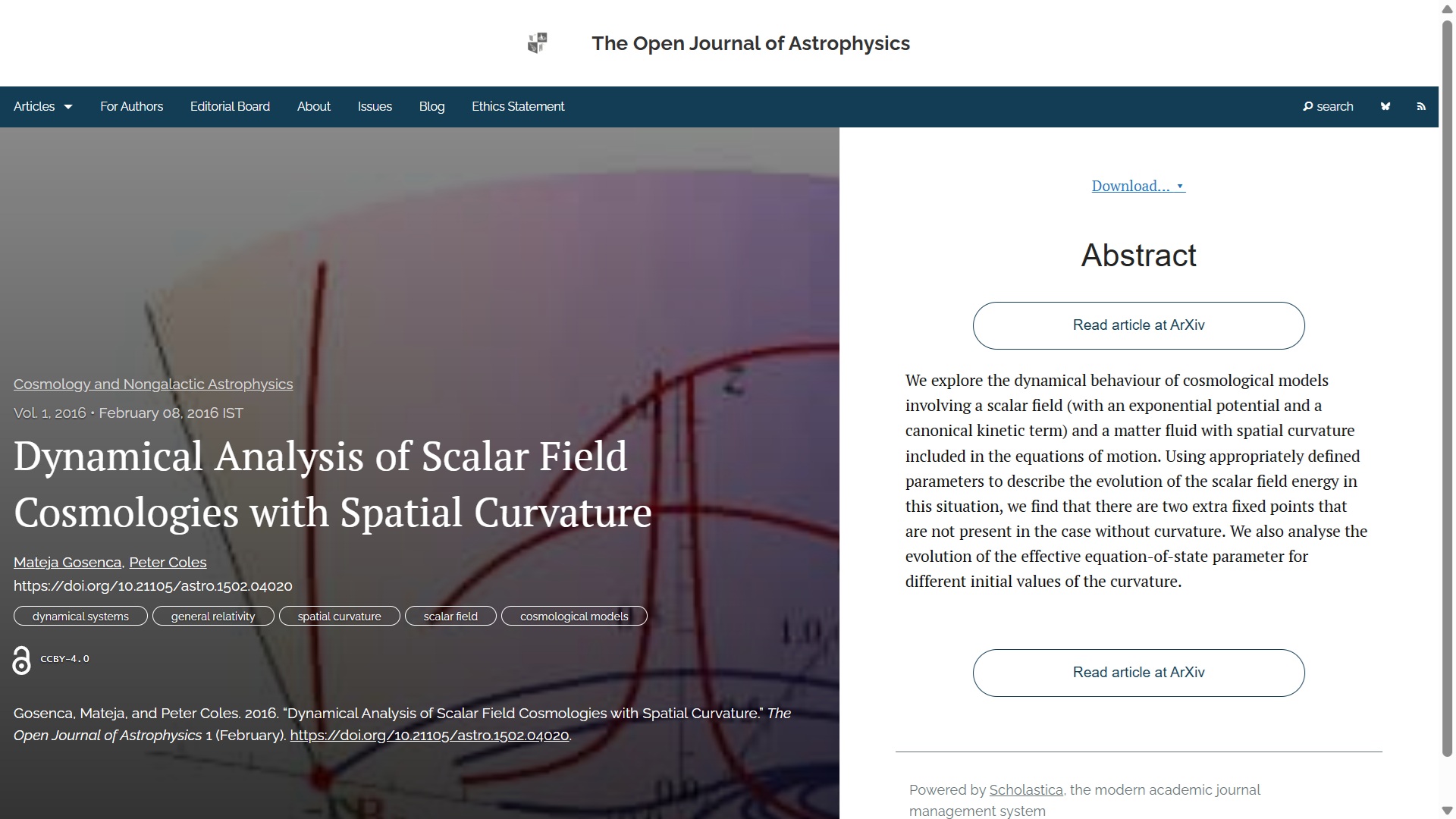
The visit of my former PhD student Mateja Gosenca to Maynooth last year reminded me that she was co-author of the very first paper published by the Open Journal of Astrophysics. The date of publication for that paper was 8th February 2016, i.e. excactly10 years ago today.
Here is the overlay:
In those days OJAp was very much an experiment, and we used a protoptype platform which I had paid a developer to set up but it never really progressed beyond a “beta” version owing to stability and other issues. I was a Head of School at Sussex then and had very little time to work on the project and it stalled. I came to Maynooth in late 2017 and discussed the idea of OJAp with staff at the Library who were enthusiastic about it. We abandoned the prototype and switched to the Scholastica platform, imported the papers we had previously published into the new site and restarted. It was slow going at first and then we had the Covid-19 lockdown tand I had to conted with a workload that went through the roof. Several times I thought it was never going to take off and wondered about closing it to new submissions. With a bit of pig-headed obstinacy and a refusal to look facts in the face, however, we carried on.
The journal has grown steadily since the end of the pandemuic: from just 17 papers in 2022, 50 in 2023, 120 in 2024, to 213 last year (including our first Supplement). I expect we’ll publish over 250 this year. I think a large part of the growth has been due to the decision of the Royal Astronomical Society to adopt a pay-to-publish model. I expected it to take a while to establish a reputation, but perhaps not as long as it did. We’re still quite small compared to other journals, but I’m pleased with the progress. I think in the long run the slow start helped, as it gave us more time to iron out various issues and recruit more editors.
This brings me to the fact that I will be retiring in a couple of years, if not sooner, and someone else will have to take over as Editor-in-Chief when that happens. At present, OJAp is published by Maynooth Academic Publishing and it’s not obvious that arrangement can continue when I am no longer employed at Maynooth. It would not be technically difficult to transfer everything to a new owner, but the handover would have to be planned to avoid disruption.
P.S. As I mentioned last month, we are always on the lookout for new Editors. Please contact me if you’re interesed!
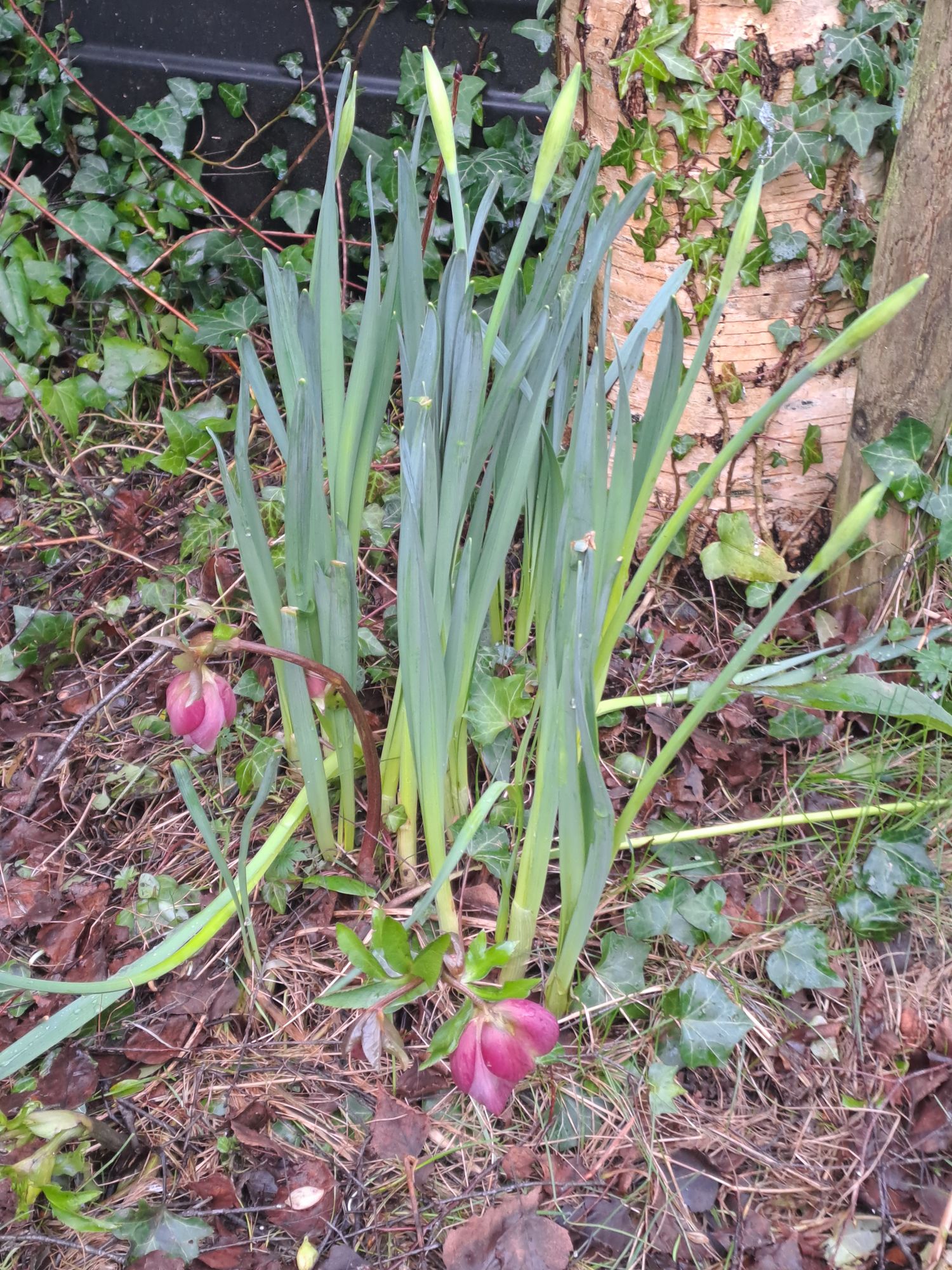
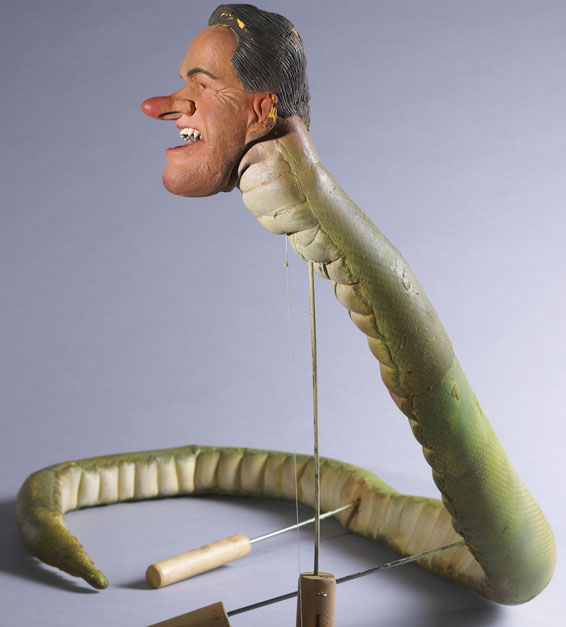

P.S. The pink flowers in the first picture in front of the daffodils are examples of Lenten Rose (Helleborus Orientalis), all parts of which are toxic (cf. Mandelson)
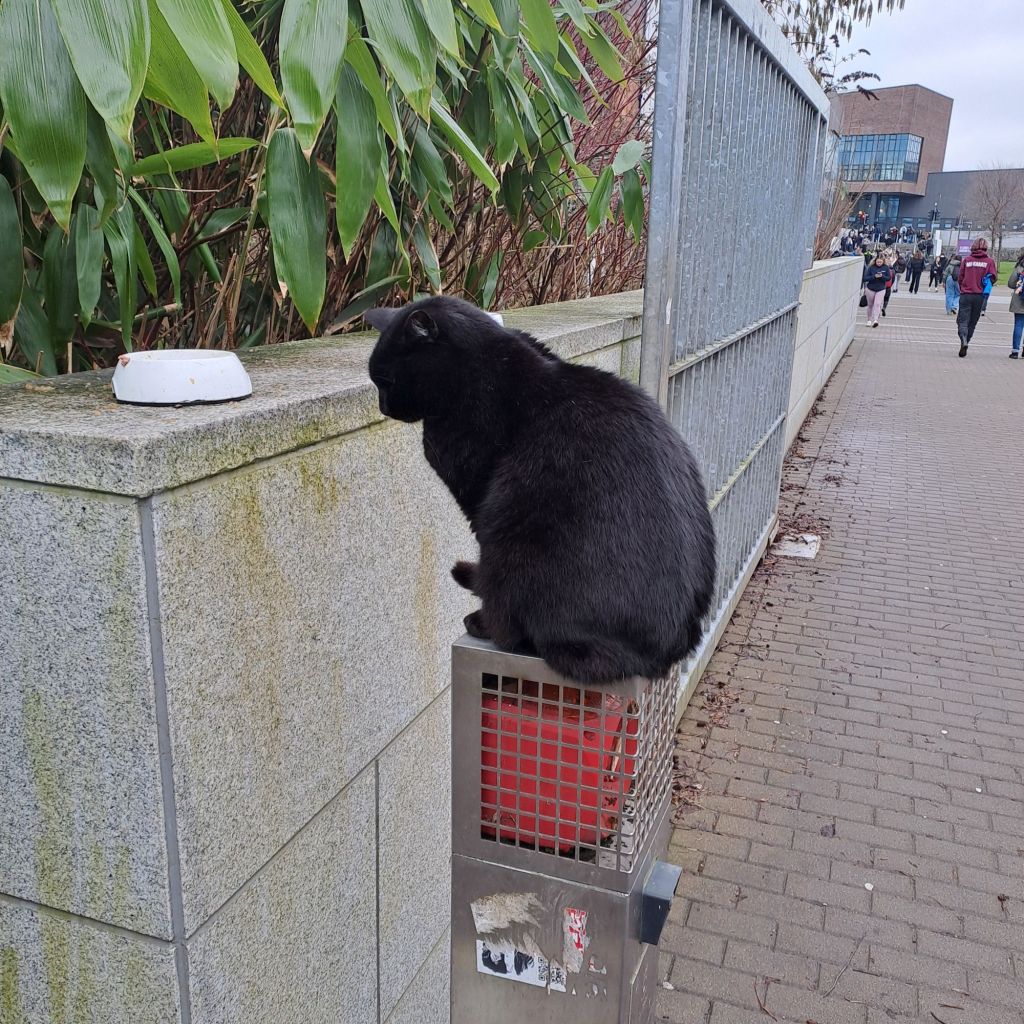
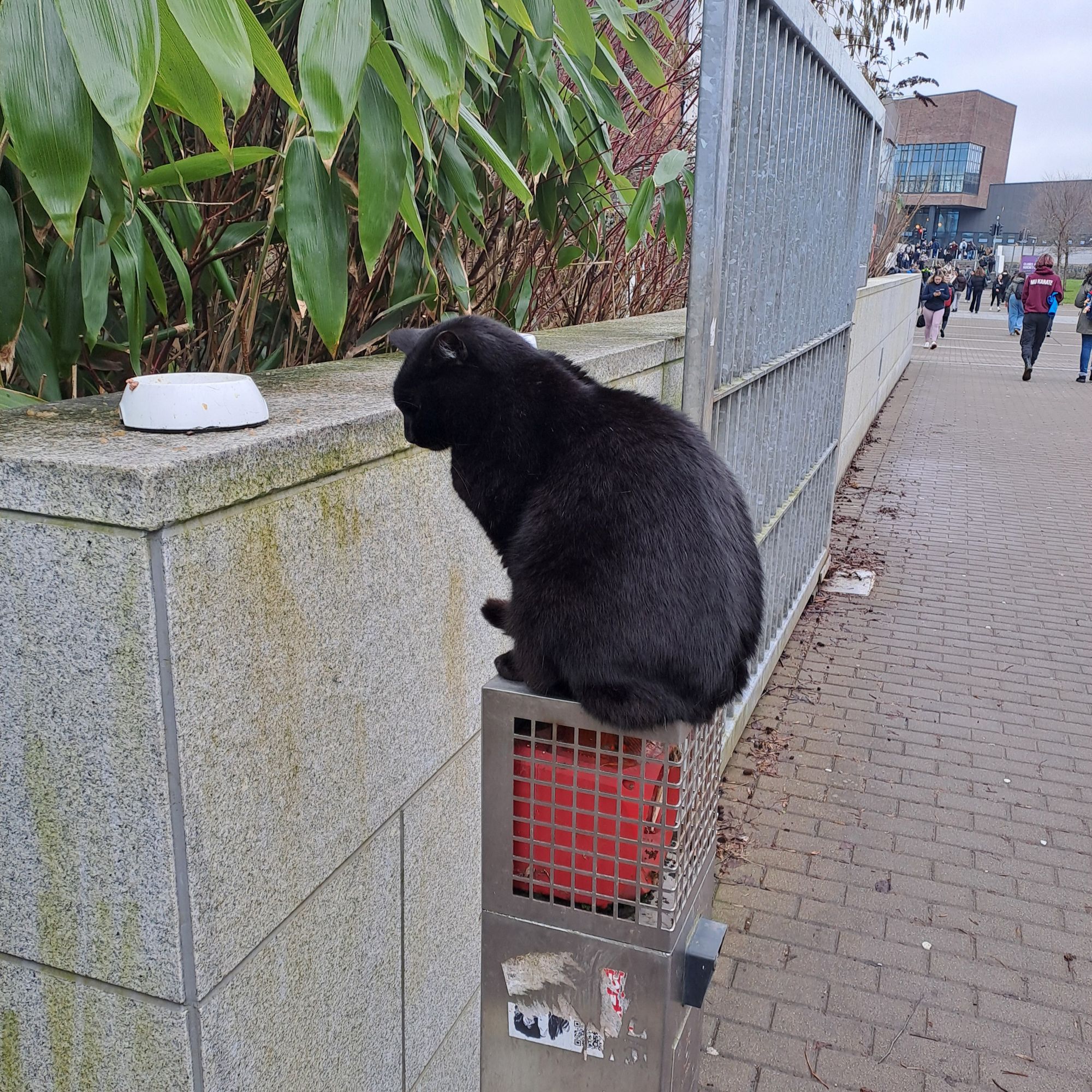
I hadn’t seen Maynooth University Library Cat for a while, so it was nice to see him today, on post, as large as life. Approaching him I saw him receive a number of back scratches. It seems he enjoyed them and continued to present his back to passers-by in the hope of getting more.
It is 1st February 2026, which means that today is Imbolc (or Imbolg in modern Irish), an ancient Gaelic festival marking the point halfway between the winter solstice and vernal equinox. In the old pagan calendar, this day is regarded as the first day of spring, as it is roughly the time when the first spring lambs are born, daffodils etc start to appear, and the days get noticeably longer. The name Imbolg may be derived from “i mbolg” meaning “in the belly”, referring to the pregnancy of ewes. This time corresponds to the Welsh Gŵyl Fair y Canhwyllau and is also sometimes called, rather beautifully, The Quickening of the Year. It’s a time for rebirth and renewal after the darkness of winter.
Incidentally, in spoken Irish it is common to place an unstressed vowel sound – often schwa – between certain pairs of consonants, e.g. the name “Colm” is pronounced “Collum”. This extends to Hiberno-English: e.g. many Irish people say “fillum” for “film”. Imbolg is therefore pronounced something like “Imbollig”. In phonology this is called anaptyxis.
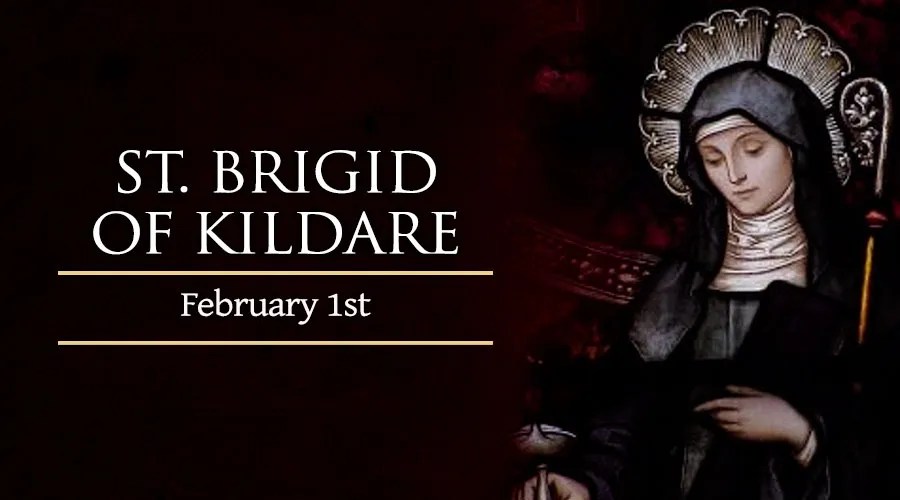
In Ireland Imbolc is usually often referred to a Lá Fhéile Bríde, St Brigid’s Day, after St Brigid of Kildare, whose feast day is today 1st February. There are events going on in Maynooth, which is in Couny Kildare, but I am not in Maynooth today so I don’t know what is going on. Incidentally, the Celts counted each day starting from sunset, so the Imbolc/St Brigid’s Day celebrations in County Kildare started last night, 31st January, but I didn’t see any of them either.
In the Northern hemisphere, in astronomical terms, the solar year is defined by the two solstices (summer, around June 21st, and winter, around December 21st) and the equinoxes (spring, around March 21st, and Autumn, around September 21st). These four events divide the year into four roughly equal parts of about 13 weeks each.
If you divide each of these intervals in two you divide the year into eight pieces of six and a bit weeks each. The dates midway between the astronomical events mentioned above are the cross-quarter days, of which Imbolc is one. They are:
The names I’ve added in italics are taken from the Celtic/neo-Pagan and, in parenthesis the Christian terms, for the cross-quarter days. These timings are rough because the dates of the equinoxes and solstices vary from year to year. Imbolc is often taken to be the 2nd of February (Groundhog Day) and Samhain is sometimes taken to be October 31st, Halloween but hopefully you get the point that although the Pagan festivals have been appropriated by the Christian church, they have much older origins. The status of St Brigid herself is particular obscure; it is not known for sure whether she was a real person or Christian appropriation of a Celtic deity, or some amalgamation of those.
Until recently there was an anomaly in that the first of these was the only one not associated with a Bank Holiday. That was changed in 2022 and tomorrow, Monday 2nd February, will be the St Brigid’s Day holiday. It would have been the first of teaching in Semester 2 had it not been a holiday; we return to teaching on Tuesday. As you may have surmised, I’ve taken the opportunity of the long weekend for a bit of a break and a trip elsewhere.
P.S. As it also happens, today is also the 8th anniversary of the very first lecture I gave in Maynooth, on Computational Physics, on 1st February 2018. I”ll be giving pretty much the same lecture again on Thursday 5th February.
Following on from my post earlier today, I was sent a copy of a letter (below) instructing those people who run its social media accounts to desist from posting on X/Twitter.:

It stops short of deactivating accounts, but that is probably just to prevent someone else taking over the username/handle and using it for nefarious purposes. It’s a pity they don’t recommend Mastodon as well as BlueSky, as I think that is better for disseminating research-based news than BlueSky, but this is positive news and I’ll count it as a win.
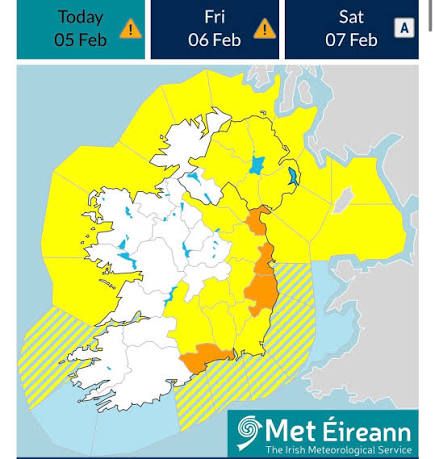
The Irish news today has been dominated by the arrival of Storm Chandra on these shores, accompanied by strong winds, heavy rain and widespread flooding. The whole country has been under a yellow alert, which will last until 11pm today.
The fact that it had been raining very heavily for days before the storm must have saturated the ground, which would have contributed to the flooding. Unusually, the worst has been on the East Coast, with Counties Wexford, Wicklow, Carlow, and Dublin badly hit. Usually it’s the West of Ireland that bears the brunt of storms which typically come from across the Atlantic.
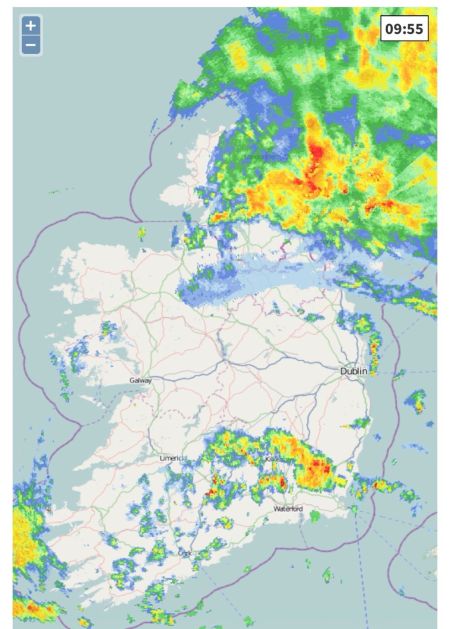
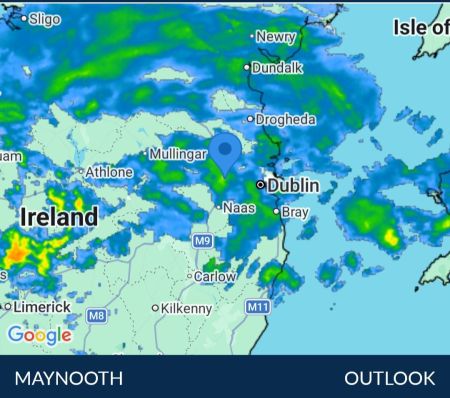
It’s been a strange day in Maynooth because, despite the storm, the weather hasn’t been too bad at all. There was a long window this morning during which it was actually quite sunny and pleasantly mild, though a bit breezy. The picture on the left shows the situation in mid-morning when the prevailing wind was southerly.
The main mass of raincloud to the North had passed over us by then, and the small but intense strip off the Louth/Dublin coast missed Maynooth entirely. You can see a big gap. Rain was heading towards us from the South, and did reach us in the afternoon, though it wasn’t particularly severe. It remained reasonably warm throughout the day, though it is much colder now (I’m writing this at about 7.30pm).
Dublin is only about 25km from Maynooth and it was a surprise to see major flooding, with parts of the M50 flooded for a time while we experienced nothing particularly severe. Not that I’m complaining!
For more about Storm Chandra, including animations of its progress can be found here. It seems that Great Britain had a lot of weather to contend with!


