Archive for the Jazz Category

Stormy Weather (Billie Holiday)

Posted in Jazz with tags , on January 26, 2016 by telescoper


Jazz, STEM and the Creative Process

Posted in Art, Jazz, The Universe and Stuff with tags , , , , , , on January 23, 2016 by telescoper

The Times Higher has given me yet  another reason to be disgruntled this week, in the form of an article that talks about the possible effect of the proposed Teaching Excellence Framework (TEF) on “creative” subjects. What bothers me about this piece is not that it criticises the TEF – I think that’s an unworkable idea that will cause untold damage to the University system if, as seems likely, it is railroaded through for political reasons – but that the author (Nigel Carrington, Vice-Chancellor of the University of Arts London), like so many others, lazily implies that STEM disciplines are not creative. I think some of the most intensively creative people in the world are to be found in science and engineering and creativity is something we try very hard to nurture in students at Sussex University regardless of discipline.

Anyway, while feeling grumpy about this article, I remembered this video of an interview with the great jazz pianist, Bill Evans. Jazz is undoubtedly an intensely creative form, not only because it requires spontaneous real-time conversion of ideas into sounds. Evans talks with great passion and insight about creativity in music-making, but the striking thing about what he says at the  very beginning about the need to analyse your subject at a very elementary level before proceeding in order to create something that’s “real” applies equally well to, e.g. theoretical physics as it does to jazz.

In the following section he reiterates this point, but also stresses the discipline imposed by a particular form and why this does not limit creativity but makes it stronger.

It’s better to do something simple that is real. It’s something you can build on. because you know what you’re doing. Whereas, if you try to approximate something very advanced and don’t know what you’re doing, you can’t build on it.

No matter how far I might diverge or find freedom in this format, it only is free insofar that it has reference to the strictness of the original form. That’s what gives it its strength.

In much the same way, theoretical physics is not made less creative because it has to obey the strict rules of mathematics but more so. This is true also in the fine arts: the more limited the canvas the more creative the artist must be, but it also applies to, e.g. engineering design. Self-teaching is important in STEM subjects too: the only really effective way of learning, e.g. physics, is by devoting time to working through ideas in your own mind, not by sitting passively in lectures.

All subjects require technical skill, but there is more to being a great jazz musician than mastery of the instrument just as there’s more to being a research scientist than doing textbook problems. So here’s to creativity wherever it is found, and let’s have a bit more appreciation for the creative aspects of science and engineering!


Saturday Night Function

Posted in Jazz with tags , , on January 16, 2016 by telescoper

Well, it’s Saturday Night so I thought I’d post a bit of classic Jazz from the late twenties. This is from the superb Duke Ellington band, vintage 1929, which was resident at the Cotton Club in Harlem, New York City. I haven’t seen a personnel listing for this but a couple of the soloists are easy to identify: Barney Bigard on clarinet and Joe “Tricky Sam” Nanton on trombone. The tune Saturday Night Function has become a traditional jazz standard but not many bands can get close to that unique Ellington sound, especially the growling trumpets. Enjoy!

Peace Piece

Posted in Jazz with tags , , on January 9, 2016 by telescoper

By way of an interlude in this busy period as term gets back underway I thought I’d post this beautiful track by the great jazz pianist Bill Evans. I remember reading somewhere that Bill Evans recorded this right at the end of a session, in 1958. It was unrehearsed, entirely improvised and done in one take. It’s based on a simple two-chord progression that subsequently appeared in Flamenco Sketches, one of the tracks on the classic Miles Davis album Kind of Blue. To my ears, Peace Piece is more redolent of the composition style of Erik Satie than any other jazz musician I can think of. Although it starts out very simply it becomes more complex and fragmented as it develops, and makes effective use of dissonance in creating tension to contrast with the rather meditative atmosphere established at the beginning. Anyway, this is one of my all-time favourite tracks by one of my all-time favourite jazz musicians so I hope you don’t mind me sharing it on here.


The Top 10 Jazz Artists

Posted in Jazz with tags , , , , , on December 8, 2015 by telescoper

Back from a short break I thought I’d mention that BBC Radio 3 recently announced the results of a poll for the top Jazz artist of all time. The result was:

  1. Miles Davis
  2. Louis Armstrong
  3. Duke Ellington
  4. John Coltrane
  5. Ella Fitzgerald
  6. Charlie Parker
  7. Billie Holiday
  8. Thelonious Monk (8=)
  9. Bill Evans (8=)
  10. Oscar Peterson

Although my ordering would have been a little different, I was quite surprised that the top 10 corresponded so closely with my own selection. In fact 8 of the above list would have made it into mine: Miles Davis; Louis Armstrong; John Coltrane; Charlie Parker; Billie Holiday; Thelonious Monk; and Bill Evans.

The only differences were that (a) I couldn’t possibly have had Billie Holiday without having Lester Young and (b) I simply had to have Ornette Coleman in there. To accommodate Messrs Young and Coleman I would have displaced Ella Fitzgerald and Oscar Peterson. The latter are great artists, of course, but I wouldn’t say either influenced the development of Jazz as much as the others I mentioned, and that’s one of the criteria I applied.

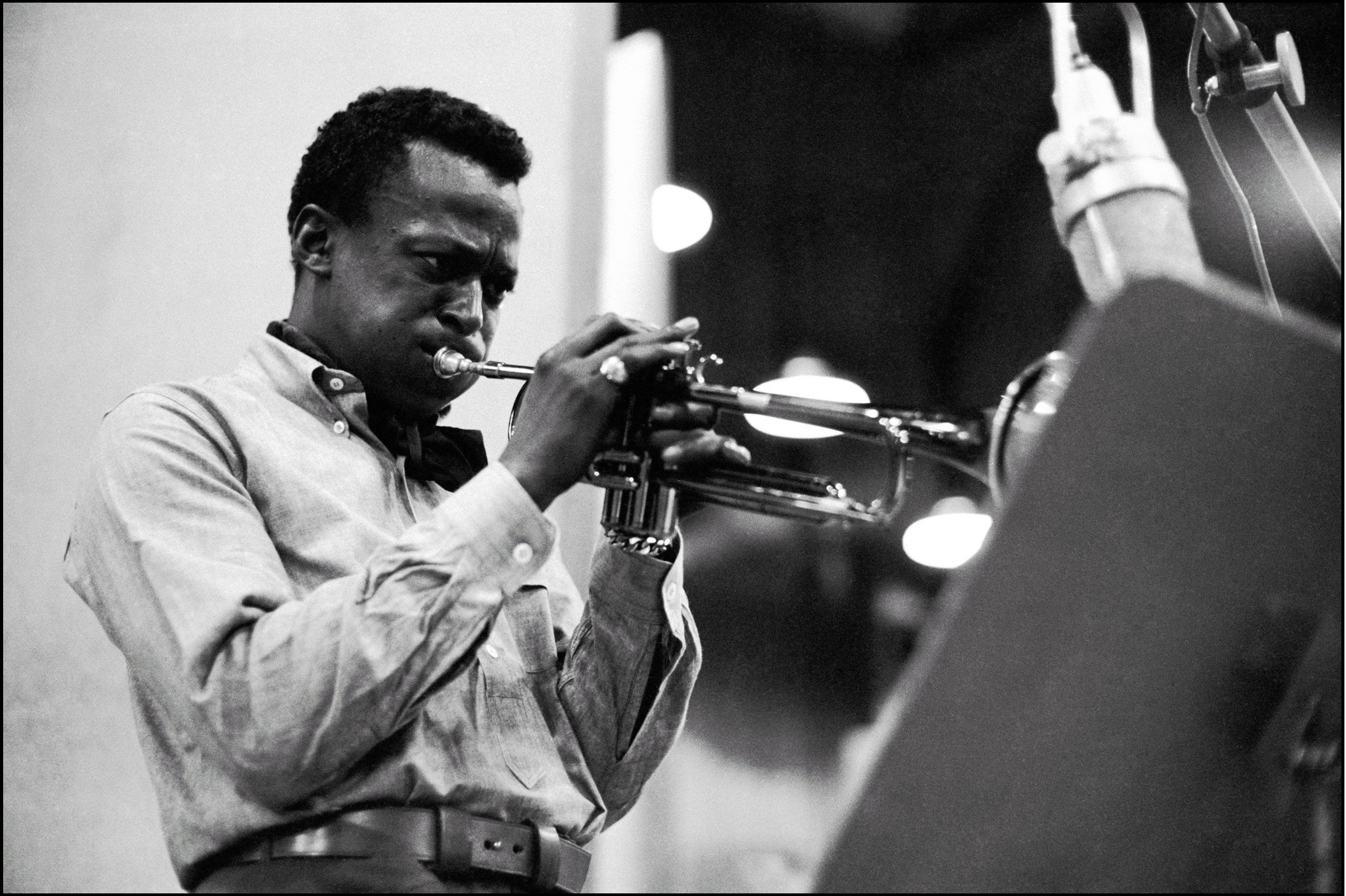
miles-davis

No surprise that Miles Davis (above) came top. He changed musical direction so many times that he should actually count as four or five different musicians. It’s no coincidence that Miles Davis, John Coltrane and Bill Evans all appeared on Kind of Blue, which is arguably the greatest jazz record of all time. I don’t think any serious Jazz enthusiast could have left out Charlie Parker or Thelonious Monk either. And of course, Louis Armstrong just had to be there too. It’s hard to imagine what Jazz would have been without Satchmo. The same goes for the great Duke Ellington.

Anyway, it’s all a matter of personal choice. There are dozens of great jazz artists who didn’t make it into the top ten. Among my near misses were Coleman Hawkins, Sidney Bechet, Eric Dolphy and Dizzy Gillespie.

Who else would you have picked?


On Treasure Island

Posted in Jazz with tags , , , on November 6, 2015 by telescoper

After a long and very trying week I thought I’d sign off for the weekend with a lovely old bit of jazz. This is what I think was Humphrey Lyttelton’s band, vintage 1950, playing a tune, On Treasure Island, that Humph almost certainly got off a copy of the gorgeous record Louis Armstrong made of this song in the 1930s, although the Lyttelton version is very different in tempo and character.

The front line of this incarnation of the Lyttelton band was the best ever: Humphrey Lyttelton himself on trumpet, Wally Fawkes on clarinet and Keith Christie on trombone. The ensemble playing after Humph’s trumpet solo, from about 1.47, is an absolutely fantastic polyphonic blend of three great soloists. Enjoy!

Honeysuckle Rose

Posted in Jazz with tags , , on October 5, 2015 by telescoper

Not too well today – and ridiculously busy – so I thought I’d post a brief pick-me-up by the “King of Swing”.  I remember that my Dad – who was a semi-professional Jazz drummer – wasn’t all that keen on Benny Goodman’s clarinet playing, which he regarded as “too clinical”. In fact many jazz writers also refer to Benny Goodman as “unemotional”. I can’t agree – the clarinet on this track is absolutely sensational to me, and I find it a joy to listen to over and over again. And if that wasn’t enough for a three-minute 78 there’s also a fine solo from pioneering electric guitarist Charlie Christian and Cootie Williams on trumpet on this big band version of Fats Waller’s familiar composition Honeysuckle Rose.

Thelonious Monk – Misterioso

Posted in Jazz with tags , , , , on September 26, 2015 by telescoper

A couple of days ago I posted a piece of music by Eric Dolphy that was inspired by Thelonious Monk , so today I thought I’d post something by Monk himself together with my own appreciation of his music.

Thelonious Monk was a remarkable musician. His self-taught style of piano-playing was unlike that of anyone who came before or after him, including those followers who tried to copy him. He broke many rules, especially in the way he used his fingers – keeping them straight as he played to get a uniquely percussive sound from the instrument, well matched, on the track I’ve posted below, to the vibraphone of Milt Jackson.

Monk was often called “The High Priest of Bop” and regarded as one of the leaders of the post-war bebop revolution in Jazz alongside Charlie Parker and Dizzy Gillespie. Actually, I don’t think Monk ever really played bebop at all. I’ve always thought the archetypal bop pianist was Bud Powell whose style was totally different to Monk’s. But the “High Priest” tag owed at least something to his eccentric personality: he hardly ever spoke and, aside from his music, he seemed to communicate with the outside world largely through his choice of hat.

Monk’s piano style is hard to describe – his wife Nellie once described it as “Melodious Thunk” – but I’ve always loved his music. To me his solos sound like someone talking directly at you in a strange and wonderful language that you don’t quite understand but which sounds beautiful anyway. His use of syncopation is quite different from the usual bebop musicians and it seems, to me anyway, to echo the rhythms of everyday speech. But, above all, when you hear Monk play the piano, you know immediately who it is. He had many admirers, but nobody could play like him. He was a genius.

In later life his behaviour became disturbingly erratic; he would sometimes stand up in the middle of a performance and go wandering around the stage.  In my opinion his music also deteriorated from the early sixties onwards.  I think it was generally assumed that he had a drugs problem, which he may well have had, but it was eventually realised that he was suffering from a serious mental illness. Although attempts were made to treat this, he stopped playing in the 1970s and lived out the rest of his life as a virtual recluse.

I remember very well the day he died, in February 1982. It was during the Newcastle Jazz Festival, on the day when the great British jazz pianist Stan Tracey was due to give a concert there. As we took our seats in the Newcastle Playhouse for the gig, an announcement was made that Thelonious Monk had died. Stan Tracey, for whom Monk had been a major musical inspiration, responded to the occasion by playing two sets exclusively consisting of tunes by his hero. It was one of the best concerts I’ve ever been to and remains strong in my memory to this day.

I think Monk’s best records are from the 40s and 50s, and he was certainly in his prime in 1948 when he recorded this classic performance, for the Blue Note label, of his own composition, Misterioso.

Hat and Beard

Posted in Jazz with tags , , , , on September 22, 2015 by telescoper

I haven’t posted much Jazz recently, and was reminded of this fact when I listened to the following track on my iPod yesterday while travelling back from Cardiff to Brighton.  Hat and Beard is an original composition by one of my favourite jazz artists, saxophonist Eric Dolphy and was written in honour of another of my favourite jazz artists, Thelonious Monk, who not only sported a splendid beard but also had a famously eccentric taste in headgear…

hat and beard

Anyway, Hat and Beard is taken from the pioneering free jazz album Out to Lunch. This album is without doubt one of the high points of 1960s avant-garde jazz, primarily because of Dolphy’s extraordinary playing (in this case on bass clarinet) but also because of the brilliance of the other musicians: Freddie Hubbard on trumpet; Bobby Hutcherson on vibes; Richard Davis on bass; and the superb Tony Williams on drums (who was only 18 when this track was recorded).

September in the Rain

Posted in Jazz with tags , , on September 16, 2015 by telescoper

Need cheering up on a rainy September afternoon? The gorgeous voice of Sarah Vaughan should do the trick!