Archive for the Jazz Category

John McLaughlin & The Fourth Dimension

Posted in Jazz with tags , , , , , on May 27, 2022 by telescoper
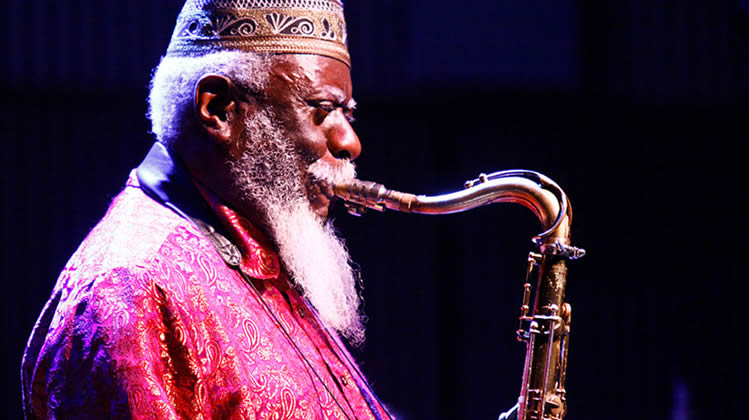
John McLaughlin last night (Picture Credit National Concert Hall)

Last night I went to the National Concert Hall in Dublin for a superb gig by guitarist John McLaughlin with his band The Fourth Dimension. This was the first time I’d seen him live though I have known some of his music on disc, especially two albums he made with Miles Davis in the late Sixties, Bitches Brew and In A Silent Way. Since then John McLaughlin has been consistently regarded as one of the best jazz guitarists ever. He is now eighty years old but apart from the fact that his hair is white you would never guess that. He looks as fit as a fiddle, and last the band played for over 90 minutes without a break.

John McLaughlin (who was born in Doncaster but who referred to Ireland as “the land of my ancestors”) is currently on a European tour and he began his concert last night with a heartfelt expression of his gratitude for being able to perform in person with his band after a gap of over two years. This period has been particularly difficult for Jazz musicians who depend so much on mutual interaction when performing. The first number they played was called Lockdown Blues

The band The 4th Dimension brings together excellent musicians from different cultures and musical traditions, integrating their all cultural influences in a unique way while at the same time preserving the spontaneity of jazz. The result is hard to classify – there’s definitely more than an echo of McLaughlin’s earlier musical work in jazz/rock fusion, but with diverse elements of world music thrown in. His own musical style is instantly recognizable to anyone who has heard music from his back catalogue, but subtly altered to suit his current band.

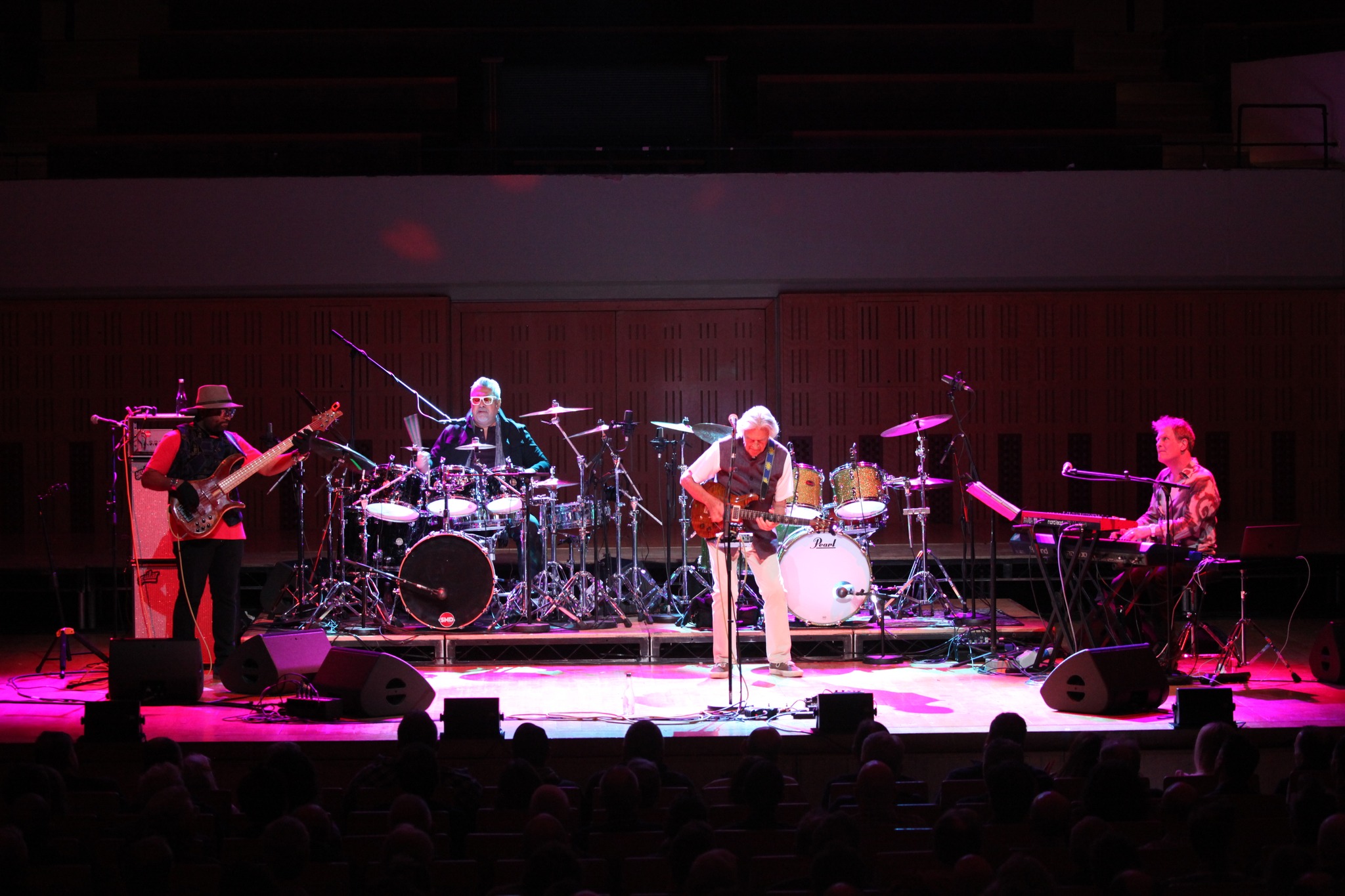
Gary Husband (right in the picture), who is from the UK, played keyboards (and drums on a couple of numbers). Ranjit Barot – Indian by birth and living in Mumbai – was the main drummer (sometimes playing together with Husband, hence the two kits in the picture); he also made various vocal contributions. On electric bass (left) was the extraordinarily virtuosic Étienne M’Bappé who is of Senegalese origins. The band played collectively but also in various combinations with and without McLaughlin, who tended to move around the stage generally encouraging and directing the traffic.

It was a fantastic gig with a wide range of musical influences being evidence. I noticed two pieces made famous by Pharaoh Sanders – The Creator has a Master Plan and The Light at the Edge of the World – but there were also numerous references to McLaughlin’s work with Indian musicians.

It was a very enjoyable performance that generated a huge response from the audience. The NCH wasn’t quite full, but it was a good crowd. I think I was in danger of forgetting how much I enjoy watching musicians as well as listening to their music.

So after a break since February 2020 I’ve finally resumed concert-going. It’s not only the musicians who have missed live music! As a matter of fact I’ll be back at the National Concert Hall this very evening after the final day of ITP2022, for a very different concert…

Ah Um! 100 Years of Mingus

Posted in Jazz with tags , on April 22, 2022 by telescoper

I discovered this morning that the great bass player, composer and bandleader Charles Mingus was born one hundred years ago today (on April 22nd 1922 in Nogales, Arizona). That gives me a great excuse to end the week by posting some music by him. The 1959 album Mingus Ah Um is one of my favourite albums not only in jazz but in any musical genre, and I think it’s a must-have for anyone interested in “modern” (i.e. post-War) jazz, so that’s what I’ve picked.

There are many great things about this album but probably the greatest of them is the extraordinary blend of thematic material and musical styles in represents. It would take a very long essay or even a book to pay appropriate homage to the kaleidoscopic variety of the shifting patterns and textures Mingus creates from ensemble and solo passages. Mingus’s compositional techniques allowed his musicians a remarkable freedom to express themselves which, together with the constant rhythmic and melodic variation, inspires them to great heights of inventiveness. Jimmy Knepper’s trombone solo on Pussy Cat Dues is really superb, as is the long sax solo on Goodbye, Porkpie Hat (a eulogy for Lester Young) which is usually attributed to Booker Ervin but I think is actually played by John Handy. Mingus himself introduces the first number Better git it in your soul, a wonderfully riotous Gospel-inspired creation, that explodes into life after his opening statements on bass.

There are not many albums that comprise traditional elements such as swing riffs, bop lines, and Gospel inflections alongside avant garde ideas like the intro and coda to Bird Calls, which sound like premonitions of the free jazz of Albert Ayler and others. A number of fine jazz composers inherited the legacy of Jelly Roll Morton (to whom Mingus doffs his cap in the last track) and Duke Ellington, including Gil Evans and Tadd Dameron, but in my view none was finer than Mingus.

Here is the whole album. Listen to the first track, and if you’re not hooked you can have your money back.

The Old Rugged Cross – George Lewis

Posted in History, Jazz with tags , , , on April 15, 2022 by telescoper

A descendant of Senegalese slaves, George Lewis was born in the French Quarter of New Orleans in 1900 where he learned to play the clarinet and started to play with jazz bands in the 1920s. Many musicians left New Orleans for Chicago during that period but Lewis stayed and lived on in relatively obscurity until the New Orleans “revival” began in the 1940s. After appearing on records with likes of Bunk Johnson, Lewis became a sort of Patron Saint of traditional jazz, with a style rooted in the home-town traditions of Gospel Music and Street Parades that was very different from that of the popular clarinetists of the Swing Era such as Benny Goodman and Artie Shaw. Lewis was never a great player from a technical point of view, but he was an authentic emblem of early Jazz and the back-to-basics move he represented proved very popular especially in Western Europe and Lewis had a late renaissance in his career in which he travelled widely playing with “traditional” bands around the world during the height of the “trad” boom of the fifties and sixties. He died in 1968.

Anyway, because it’s Good Friday I thought I would post this video of him in his later years playing the hymn The Old Rugged Cross, which was written in 1912 and has been a staple of New Orleans funeral processions ever since:

Blues Yesterday – Art Hodes

Posted in Jazz with tags , , on March 22, 2022 by telescoper

I’ve long been a fan of Art Hodes, a brilliant jazz and blues pianist, whose self-taught style reminds me quite a lot of Thelonious Monk, although Monk was a modernist and Hodes a traditionalist. It was only tonight however that I was reminded that he was actually born in Mykolaiv (Ukraine), in 1904, although he moved to America when he was only a few months old. He’s probably best remembered for some of the great early records of the Blue Note label, including some with Sidney Bechet, made in New York in the late 30s and early 40s, but he spent much of his later life playing and recording and living in and around Chicago. He died in 1993.

Anyway, here’s a record that wasn’t released until 1994, after his death, which is typical of his relaxed yet slightly quirky take on the blues and which I couldn’t resist sharing today because of the Ukrainian connection.

A Time for Peace Piece

Posted in Jazz on February 22, 2022 by telescoper

With all that’s going on in the world right now it seems appropriate to repost this beautiful track by the great jazz pianist Bill Evans. I remember reading somewhere that Bill Evans recorded this right at the end of a session, in 1958. It was unrehearsed, entirely improvised and done in one take. It’s based on a simple two-chord progression that subsequently appeared in Flamenco Sketches, one of the tracks on the classic Miles Davis album Kind of Blue. To my ears, Peace Piece is more redolent of the composition style of Erik Satie than any other jazz musician I can think of. Although it starts out very simply it becomes more complex and fragmented as it develops, and makes effective use of dissonance in creating tension to contrast with the rather meditative atmosphere established at the beginning. Anyway, this is one of my all-time favourite tracks by one of my all-time favourite jazz musicians so I hope you don’t mind me sharing it on here.

Jazz Quiz – Spot the Link

Posted in History, Jazz with tags , , , , on February 11, 2022 by telescoper

Time, I think, for a quick lunchtime jazz quiz. Here are two great old records from the classical period of Jazz. Can you spot the link between them?

The first is a slow blues recorded in 1928 called Superstitious Blues featuring a formidable singer by the name of Hattie Burleson in the company of Don Albert (trumpet), Siki Collins (soprano saxophone), Allen Van (piano), John Henry Bragg (banjo) and Charlie Dixon (brass bass):

The second, an up-tempo stomp recorded a year earlier in 1927, is one of the hottest jazz records ever made – the way it catches fire for the last 45 seconds or so is absolutely sensational no matter how many times you listen to it. It is performed by the Johnny Dodds (on clarinet) and his Black Bottom Stompers, consisting of George Mitchell and Natty Dominique on cornets, John Thomas on trombone, Charlie Alexander piano, Bud Scott banjo and Johnny Dodds’s younger brother, Warren ‘Baby’ Dodds, drums.

So, what’s the connection?

Well, nobody tried to answer so I will: real name of Don Albert, the trumpet player in the first track, was Albert Dominique and he was the nephew of the more famous Natty Dominique who played on the second track. Not a lot of people know that.

Rum & Coca Cola – The Christie Brother Stompers

Posted in Jazz with tags , , , , on December 11, 2021 by telescoper

And now for something completely different in the form of a lovely bit of British revivalist Jazz from 70 years ago. Once upon a time I had a 7″ EP record with this track on it, but I’m afraid I lost it along the way. I’ve been hoping someone would put it on Youtube and it seems about six months ago somebody did!

The song Rum and Coca Cola was a hit for the Andrews Sisters in the immediate post-war years although it began as a satirical calypso with clear references to prostitution. Anyway, it’s a catchy tune and it’s no surprise that it was picked up by traditional jazz bands during the New Orleans revival, including this terrific version by the Christie Brother Stompers made in 1951; note the calypso-style piano intro.

When this particular record was made, British bands were being heavily influenced by the discs that were coming over from the States at the time – especially from Bunk Johnson’s 1940s band and the Kid Ory band – to the extent that a recorded-in-a-garage sound was sedulously acquired. Despite the somewhat muffled sound quality, I really love this record for the general exuberance of the playing, especially that of the superb trombonist Keith Christie whose style of tailgate trombone was clearly influenced by Kid Ory.

Keith Christie was for some time a member of the front line of Humphrey Lyttelton’s band and when Keith Christie passed away in 1980, Humph devoted full hour on his weekly radio programme The Best of Jazz to examples of his work (including this track). I remember Humph drawing attention to the robust humour that permeated Keith’s playing and admitting that when he was with the Lyttelton band they had several band meetings in which he tried to get him to temper the playful side of things. Quite wrongly, he admitted because while Keith Christie often brought out the humorous side of trombone he never mocked it.

The revivalist bands of that day were indeed a bit po-faced about their jazz and although the music they produced is great fun to listen to, they were all deadly serious about it. I think “The Guv’nor” Ken Colyer (who plays cornet on this track) was even more grave than Lyttelton and I’m not sure how he felt about Keith’s propensity to emphasize the knockabout fun of the music, though it is true that this band did change personnel rather abruptly shortly after the 1951 session.

The full line-up is: Keith Christie (trombone); Ian Christie (clarinet, Keith’s brother); Ken Colyer (cornet); Pat Hawes (piano); Ben Marshall (banjo); Micky Ashman (bass); and George Hopkinson (drums). I think Keith Christie’s playing on this is absolutely terrific, not only his solo – built in Kid Ory style around a single phrase – but his rumbustious contributions to the ensemble from about 1:45 seconds. And what a head of steam they build up together! Enjoy!

Sugar Rum Cherry – Duke Ellington

Posted in Biographical, Jazz with tags , , , , , on December 3, 2021 by telescoper

Today has been one of those days on which I’ve been quite busy all day but seem to have achieved very little so I eventually retreated home in the rain to have a drink or several before making dinner.

Jazz and classical music don’t always provide a palatable blend, but here’s one cocktail that definitely works, especially as the festive season approaches. It’s from the 1960 album The Nutcracker Suite by Duke Ellington, based on original music for the ballet by Pyotr Ilyich Tchaikovksy. Most of the arranging on the album was done by Duke Ellington’s regular collaborator Billy Strayhorn,  and the result is every bit as witty, elegant and charming as you’d expect.  This is their gorgeous take on The Dance of the Sugar Plum Fairy:

Jazz Quiz – Name that Trumpeter

Posted in Jazz on November 27, 2021 by telescoper

It’s difficult to post a quiz that can be answered easily by the use of Google, but I thought I’d try because this track from Youtube doesn’t have any personnel information or recording date on it.
It’s a big band arrangement by Benny Carter of the standard Just You Just Me. Carter himself solos on this live performance along with other members of the band, but can you put a name to the trumpeter who comes at about 43 seconds, after Carter’s opening solo?

Read on for the answer:

Continue reading

Pithecanthropus Erectus – Charles Mingus

Posted in Jazz with tags , on November 13, 2021 by telescoper

I heard this track on the radio the other night courtesy of John Kelly’s show and thought I’d write a post about it because I think it’s a neglected masterpiece. Pithecanthropus Erectus is the title track of an album by Charles Mingus released in 1956. For that time it was incredibly new: the long passages of static harmony, along with grunts and squeals from the horns, all became common place in avant garde jazz in later years but it is very surprising to hear them in a record from the mid 50s.

Mingus intended this piece to convey in music humanity’s evolution, which he imagined would end in violent destruction. Who’s to say he was wrong? The tune itself is in an intriguing ABAC form with the B and C sections based on the same unvarying harmonic pattern but the C section being agitated and even chaotic. On the first and last choruses the alto sax of Jackie Mclean and the tenor of J.R. Monterose play improvised duets on the B section while the C section involves the whole band improvising collectively in a style reminiscent of the free jazz of the 1960s. The unusual accents on the fourth beat of the bar were later adopted by Miles Davis on Milesetones. These are just a couple of examples of how influential this track was to turn out to be. Looking back on it in historical perspective you can see how much of the musical vocabulary of jazz expanded with this one track.

Mingus shared with Miles Davis the ability to create music that was distinctively his own while somehow at the same time giving his musicians plenty of time to express themselves. In this performance there’s a very fine piano solo by Mal Waldron who, among other things, very effectively channels Thelonious Monk to a marvelous bass accompaniment by Mingus.

The other three tracks on the album are good too, but inevitably pale beside this work of genius in which Mingus managed to weld all these new and untried elements into a completely satisfying unity that was years ahead of its time.