From the album Cookin’ by the Miles Davis Quintet* of 1957 here is a classic.
*John Coltrane was in the Quintet but doesn’t play on this track: the musicians are Miles Davis (tp), Red Gardland (p), Paul Chambers (b) and Philly Joe Jones (d).
I was just about to have an early night when I saw the news of the death at the age of 79 of legendary jazz pianist Chick Corea. Yet another of the Greats is no more.
In the circumstances I’ll just put up one example that demonstrates his talents both as a pianist and a composer. Chick Corea was in at the start of jazz fusion in the late Sixties when he joined Miles Davis’s band. At that time and through the 1970s he frequently performed on electric piano superb records such as In A Silent Way and Bitches Brew. He played on a huge range of records sometimes as leader, sometimes as a sideman and sometimes in a duet. One of the first jazz albums I bought was a live recording of a concert in Zurich in 1979 together with vibraphonist Gary Burton. I’ll certainly be playing that this weekend.
This track was recorded at a live performance in 2013 and released on the album Trilogy. It is a great example of him stretching out on a version of his own tune Armando’s Rhumba, of which he has recorded many very different versions, and which is now a jazz standard. The drummer is Brian Blade and the bassist Christian McBride.
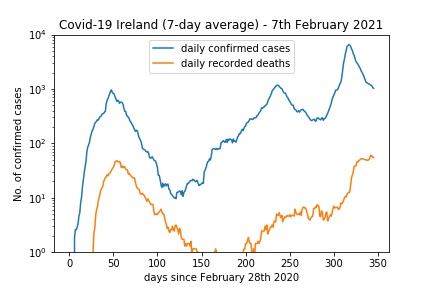
I just updated my Coronavirus page with the days statistics for Ireland (1024 new cases, 12 deaths). We’re obviously well past the Christmas peak but cases are falling very slowly. At this rate we’ll still have several hundred a day by the end of February (which, incidentally will be a year since the first Covid-19 case was recorded in Ireland).
Unlocking with case levels in the hundreds before Christmas was a disaster and I sincerely hope there’s no repeat of that foolishness.
Anyway, the current state of play remind me of this track from a great album called Trouble in Mind which I bought as a vinyl LP about 40 years ago. It’s by Archie Shepp (tenor sax) and Horace Parlan (Piano). Both made their reputations as avant garde jazz musicians but in this album they went back to the roots and explored the classic blues repertoire. Goin’ Down Slow dates back to 1941 and it’s a standard 12-bar blues (usually performed in B♭). Horace Parlan passed away in 2017, but Archie Shepp is still going strong.
I was just relaxing by listening to the superb album Old and New Dreams (vintage 1977) and thought I’d share a track here given the ongoing prevalence of lockdown dreams. This album was actually the debut album by the Quartet of the same name that featured Dewey Redman on tenor sax, Don Cherry on trumpet, Charlie Harden on bass and Ed Blackwell on drums. I love the balance they achieved between free improvisation and swing and the interplay between the different instruments. Just listen to Charlie Haden’s playing on this, holding everything together rhythmically but also leading it in so many different directions! This is called Augmented…
It has been a long time since I last listened to the album Focus featuring Stan Getz on tenor saxophone so it was nice to be reminded of it when Bernard Clarke played the first track from that album on his show The Blue of the Night yesterday. I was listening when this track came up and I thought I’d share it here because I think it’s a cracker.
If you assume that a Stan Getz album from 1961 is going to be full of Samba and Bossa Nova tracks then you couldn’t be more wrong. This is an experimental album featuring Getz with a string orchestra. The suite of music for the album was originally commissioned by Getz from composer and arranger Eddie Sauter. Sauter’s orchestration did not include melodies for Getz. Instead he left spaces in the arrangements in which Getz would improvise.
The theme of the opening track, “I’m Late, I’m Late”, is nearly identical to the opening minutes of the second movement of Béla Bartók’s Music for Strings, Percussion and Celesta which Sauter intended the track as an homage. Not only the theme but also the broken rhythms and string orchestration definitely show the the influence of Bartók. One thing that struck me listening to this last night after not hearing it for a while is that it sounds very much like part of a movie soundtrack. Maybe it will be some day!
As an added bonus I’m Late, I’m Late also features the great Roy Haynes on drums, but front and centre for most of the time it’s Stan Getz himself playing quite brilliantly. In fact I’m told that Getz regarded this as his best album. Anyway, I think it’s great and I hope you enjoy it.
This is Swedish musician Gunhild Carling out front of a swinging big band on the open-air stage at Central Park, New York, tearing it up on the bagpipes*.
You’re welcome.
(*to be precise these are a kind of traditional Swedish bagpipes known as the säckpipa).
I heard on Saturday via social media that the great bass player Gary Peacock had passed away on 4th September, only to see other posts claiming that the rumours of his death were a hoax. I was relieved about that but then it turns out that the hoax reports were themselves a hoax and Gary Peacock had indeed died. He was 85 years old.
Gary Peacock is probably best known for his work with the likes of Keith Jarrett, Bill Evans and Jack DeJohnette but as a tribute I thought I would post an example of his earlier work with Albert Ayler. I think the album Spiritual Unity with Gary Peacock on bass and Sonny Murray on drums is one of the highlights of 1960s free jazz.
This tune, the shorter of two versions on Spiritual Unity of an original composition by Albert Ayler called Ghosts, is a great example how he could make coherent what at first hearing sounds like disassociated bursts of sound. It involves remarkable improvised melodies based on short thematic lines designed to evoke unsophisticated folk music or nursery tunes. It may sound primitive on the surface, but it’s very complex underneath and creating this extraordinary sound world clearly required great technical mastery from Ayler and his supporting musicians, especially Gary Peacock, who plays wonderfully on this track.
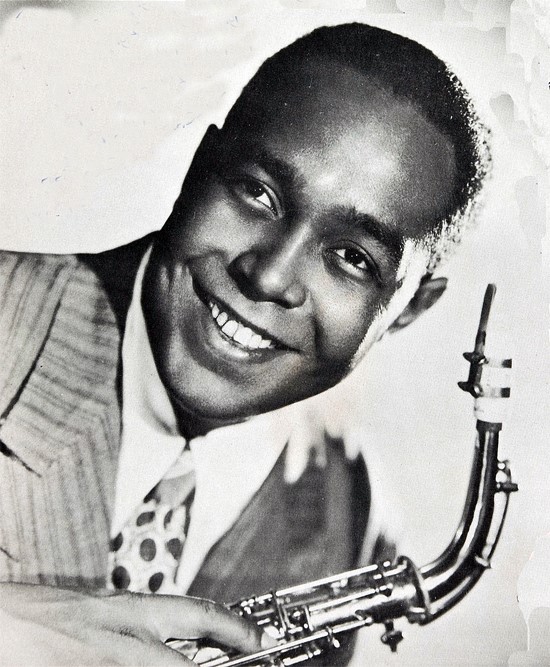
Still going with posts to celebrate the centenary of the birth of Charlie Parker, aka Bird, a musical genius on the saxophone whose influence not only on jazz but on twentieth century music is incalculable. I’ve posted quite a few tracks by Bird over the years and one thing I’ve learned from doing that is that he’s by no means everyone’s cup of tea. I can’t do anything about that, of course, but I can at least point out the existence of his wonderful legacy to those (regrettably many) people who’ve never heard of him or his music I still remember the mixture of astonishment and exhilaration I felt when I first heard him on record and if I can give that sense of joy to just one person via the blogosphere then it’s worth a hundred posts.
Here’s Kim, another one of Bird’s tunes based on the rhythm changes, with an alto sax solo improvised at breakneck speed and with incredible virtuosity. The other day I was talking to a friend of mine who only has a passing interest in jazz and he asked me whether Charlie Parker really was that good. Well, if you’re asking that question to yourself, listen to this and then you’ll have the answer. As far as I’m concerned this is three minutes of pure awesome….
The next item in my homage to Charlie Parker on the occasion of the centenary of his birth is one of his variations on the blues in F, called Now’s the Time. It’s definitely one of the bluesiest of Bird’s blues, and indeed it’s quite close to the usual 12-bar chord progression:
Here is another bit of music to celebrate the 100th anniversary of the birth of the great saxophonist Charlie Parker (“Bird”) on 29th August 1920.
I’ve written quite a few posts relating to Charlie Parker over the years but today has provided a good excuse to spend my lunchtime writing another one, this time featuring one of my favourite tracks from one of my favourite albums. First released in 1952 but in fact recorded in two separate sessions in 1949 and 1950, the album Bird and Diz was actually the last studio album made under the joint leadership of Charlie Parker and Dizzy Gillespie, the two main architects of the bebop revolution; the track I’ve picked has the added advantage of featuring another great musical genius on piano, Thelonious Monk.
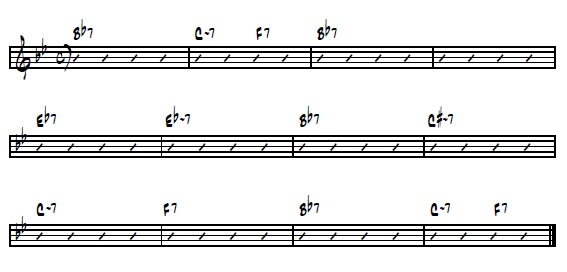
The Charlie Parker composition Bloomdido is yet another of his variations on the blues, though this one is a bit less intricate than some of the others he wrote. Here are the chords for Bloomdido:
You can see that the progression is based around the standard three chords of a blues in B♭. The foundation is a “tonic” chord (T) based on the root note of whatever key it’s played in, in this case B♭. This sometimes a basic triad consisting of the first, third and five notes of a major scale starting on that note or, as in this example, including the dominant 7th so it’s B♭7. The next chord is the subdominant chord (S), shifting things up by a perfect fourth relative to the tonic, in this case an E♭7 and then finally we have the dominant (D) which brings us up by a fifth from the original root note, in this case F7.
The basic blues sequence in B♭ would be four bars of B♭7 (T), two of E♭7 (S), back to B♭7 (T) for two, then the characteristic bluesy cadence returning to two bars of B♭7 (T) via one bar each of F7 (D) and E♭7 (S). The sequence for Bloomdido has a few alterations, including a characteristic turnaround at the end, but is otherwise fairly recognizable. I guess the first part of the title is a play on the blues origin too, though I wonder if the second part suggests that some of the alterations are inspired by the A-section of the Juan Tizol standard Perdido?
Some people tell me they find Charlie Parker’s music “too technical” and that somehow if music “needs to be explained” it’s not good music. I don’t understand that attitude at all. I find this music so fascinating and exciting to listen to that I want to try to dig a little bit into it and find out what’s going underneath the surface. It’s particularly striking what a difference a few substitutions and passing chords can make to the overall harmonic “feel” of a piece like this compared to a standard blues sequence, for example. But you don’t need to study the chords to appreciate the sheer beauty of the music that Charlie Parker built on these harmonic foundations; his solo on this track, as on so many others he recorded in his short life, is just sublime even if you don’t realise how hard it is to play! I guess it all depends whether your way of enjoying a thing is to sit back and let it wash over you, or for it to inspire you to find out more. Many of the physicists I know are deeply interested in music. Perhaps that’s because they’re the sort of people who don’t just think “wow that’s beautiful”, they tend to think “wow that’s beautiful – how does it work?”.
Charlie Parker and Albert Einstein died in the same year, just over a month apart, the former in March 1955 and the latter in April. They were two very different geniuses but it’s as difficult to imagine physics without Einstein as jazz without Bird.
The views presented here are personal and not necessarily those of my employer (or anyone else for that matter).
Feel free to comment on any of the posts on this blog but comments may be moderated; anonymous comments and any considered by me to be vexatious and/or abusive and/or defamatory will not be accepted. I do not necessarily endorse, support, sanction, encourage, verify or agree with the opinions or statements of any information or other content in the comments on this site and do not in any way guarantee their accuracy or reliability.

 In the Dark