Archive for the Music Category

Jubilee Stomp – Duke Ellington

Posted in Jazz with tags , , , on June 5, 2022 by telescoper

As my only contribution to the ongoing Platinum Jubilee celebrations, here’s a classic record that’s almost as old as Queen Elizabeth II and is by a prominent member of the Jazz nobility, the Duke of Ellington.

As far as I know this is the first recording of Jubilee Stomp, made in early 1928, though the band made several other versions. At the time this one was made, Duke Ellington’s Orchestra had just started as the house band at the famous Cotton Club in Harlem which soon established the venue as the hottest nightspot in New York. That almost didn’t happen: the residency was initially offered to King Oliver, but he wanted too much money and so it passed to the second choice, Duke Ellington. The rest, as they say, his history.

Anyway, this is a digitally remastered version of the original Okeh recording, which brings out the best of the Ellington Band of that time, especially the great Wellman Braud who introduced the style of walking bass that quickly established itself as a mainstay of every rhythm section.

This version of Ellington’s Orchestra was actually only a ten-piece band, but it was packed with great soloists and you’ll hear superb growl trumpet from James “Bubber” Miley, clarinet from Barney Bigard, and trombone from Joe “Tricky Sam” Nanton, among others. There’s also a nice example of the piano style of the young Duke Ellington himself. Enjoy!

Mahler & Schubert at the National Concert Hall

Posted in Music with tags , , , , , , on May 28, 2022 by telescoper

Yesterday evening, after a very pleasant wine reception at the end of ITP2022, I walked to the National Concert Hall in Dublin for my second concert in two days. Before the lockdown I used to go regularly to the Friday evening performances by the National Symphony Orchestra but until last night I hadn’t attended one since February 2022. Since I was in Dublin anyway and Mahler was on the menu I couldn’t resist this one and have now at last added to my stock of souvenir programmes. Last night’s concert was actually the last of the season but hopefully I’ll be able to go more frequently from September when the next season starts.

Last night’s performance began with Mahler’s Blumine which began life as the second movement (marked Andante) of his First Symphony but which was subsequently deleted. We heard the four-movement version of the work (i.e. without this part) in the second half of the concert. Blumine is a nice enough piece, relaxed and lyrical, but it is difficult to see how it was supposed to fit in with the rest of the symphony which is now always performed without it. Still, it served as a very good warm-up for the orchestra which, under the direction of Jaime Martín, established a polished tone and warm colour for this piece and for the rest of the evening.

After Blumine a large fraction of the orchestra left the stage to leave a pared-down version for some Lieder by Franz Schubert performed by legendary Swedish mezzo soprano Anne Sofie von Otter who was resplendent for the occasion in an emerald green dress.

You wait two years to go a concert and then along come two in the space of two days! Only one of the songs, the first, Romanze from the incidental music for the play Rosamunde, was actually orchestrated by Schubert; the other were written with piano accompaniment and then orchestrated by others. I have to say I didn’t find the addition of a full orchestra added much to these songs, many of which have a rather spare piano accompaniment that works superbly well. A good example is An Sylvia which has its origins in Shakespeare’s play The Two Gentlemen of Verona. I love the sprightly version of this with piano accompaniment but the orchestrated version was much slower, as if weighed down by the arrangement. Still, these pieces were beautifully sung and that made them very enjoyable. After rapturous applause, Anne Sofie von Otter returned to give an encore of the old song The Last Rose of Summer which, as you can imagine because it is set to a traditional Irish tune, went down very well with the Irish audience.

After the interval the full orchestra returned to deliver a powerfully impressive performance of Mahler’s First Symphony. The programme notes remind us that for much of his life Gustav Mahler was celebrated as a conductor rather than a composer, and the First Symphony was not well received largely because it was deemed in some quarters at the time to have a structure that was insufficiently symphonic. There’s no reason why we should pay much attention the opinions of over a hundred years ago. The symphonic form has been pulled around in many directions since this work, not least by Mahler himself, and I think Mahler 1 is a very fine work. I always particularly enjoy the 3rd movement, with its occasionally raucous evocation of a Klezmer band.

The final movement brought the piece – and the whole concert – to a thrilling climax. Near the end, the entire brass section of the orchestra (7 horns, 5 trumpets, 4 trombones, and a tuba) stood up at which point I thought “this is going to be loud”. It was. Gloriously loud.

I’ve said before on this blog how much I enjoy watching a full orchestra in action. From my position at the right of the auditorium I had a great view of the double basses who were working very hard but clearly enjoying themselves.

Anyway, last night’s concert was broadcast live on the radio and also streamed and you don’t have to take my word for anything because you can watch the whole thing yourself here:

John McLaughlin & The Fourth Dimension

Posted in Jazz with tags , , , , , on May 27, 2022 by telescoper
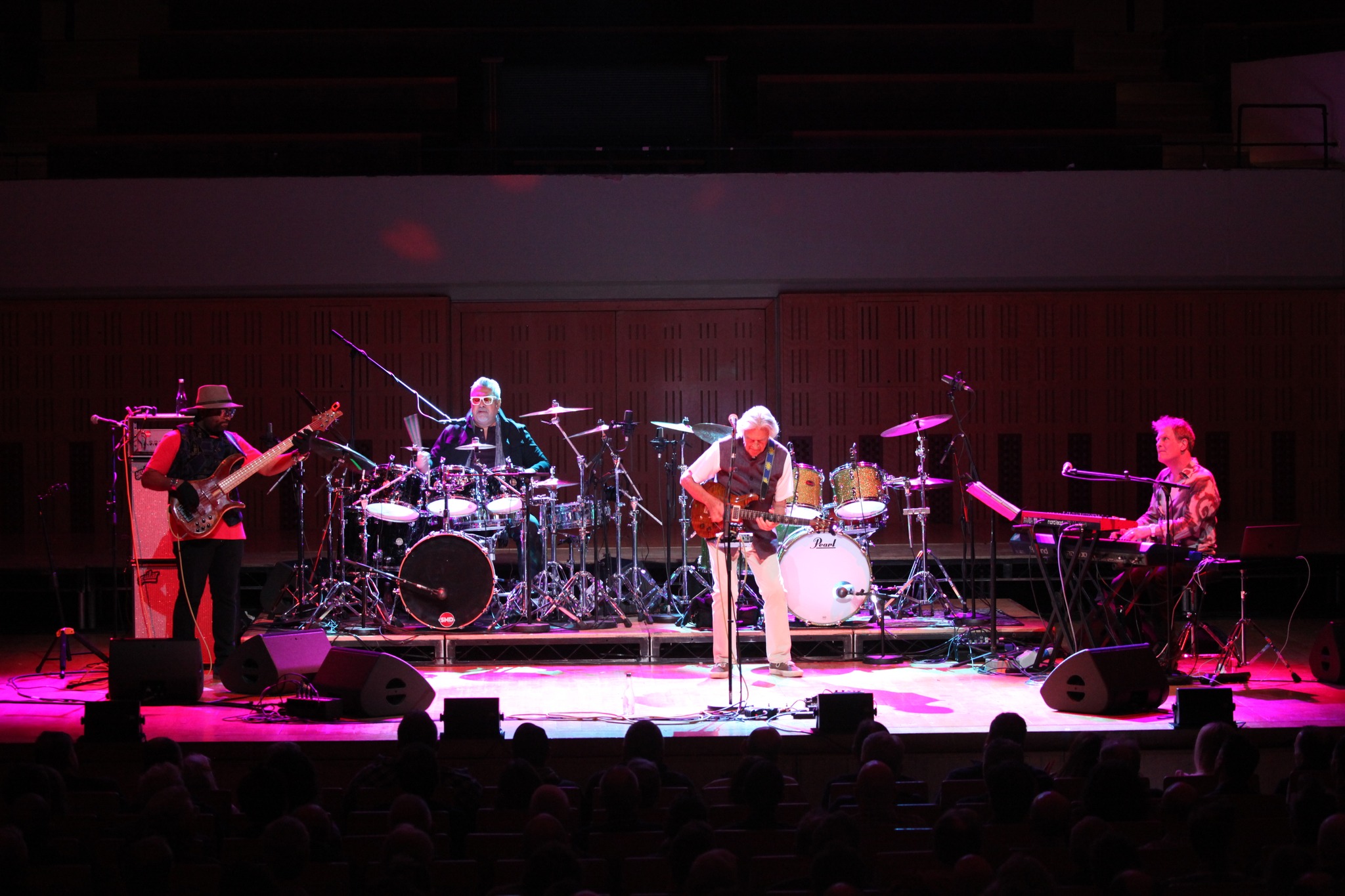
John McLaughlin last night (Picture Credit National Concert Hall)

Last night I went to the National Concert Hall in Dublin for a superb gig by guitarist John McLaughlin with his band The Fourth Dimension. This was the first time I’d seen him live though I have known some of his music on disc, especially two albums he made with Miles Davis in the late Sixties, Bitches Brew and In A Silent Way. Since then John McLaughlin has been consistently regarded as one of the best jazz guitarists ever. He is now eighty years old but apart from the fact that his hair is white you would never guess that. He looks as fit as a fiddle, and last the band played for over 90 minutes without a break.

John McLaughlin (who was born in Doncaster but who referred to Ireland as “the land of my ancestors”) is currently on a European tour and he began his concert last night with a heartfelt expression of his gratitude for being able to perform in person with his band after a gap of over two years. This period has been particularly difficult for Jazz musicians who depend so much on mutual interaction when performing. The first number they played was called Lockdown Blues

The band The 4th Dimension brings together excellent musicians from different cultures and musical traditions, integrating their all cultural influences in a unique way while at the same time preserving the spontaneity of jazz. The result is hard to classify – there’s definitely more than an echo of McLaughlin’s earlier musical work in jazz/rock fusion, but with diverse elements of world music thrown in. His own musical style is instantly recognizable to anyone who has heard music from his back catalogue, but subtly altered to suit his current band.

Gary Husband (right in the picture), who is from the UK, played keyboards (and drums on a couple of numbers). Ranjit Barot – Indian by birth and living in Mumbai – was the main drummer (sometimes playing together with Husband, hence the two kits in the picture); he also made various vocal contributions. On electric bass (left) was the extraordinarily virtuosic Étienne M’Bappé who is of Senegalese origins. The band played collectively but also in various combinations with and without McLaughlin, who tended to move around the stage generally encouraging and directing the traffic.

It was a fantastic gig with a wide range of musical influences being evidence. I noticed two pieces made famous by Pharaoh Sanders – The Creator has a Master Plan and The Light at the Edge of the World – but there were also numerous references to McLaughlin’s work with Indian musicians.

It was a very enjoyable performance that generated a huge response from the audience. The NCH wasn’t quite full, but it was a good crowd. I think I was in danger of forgetting how much I enjoy watching musicians as well as listening to their music.

So after a break since February 2020 I’ve finally resumed concert-going. It’s not only the musicians who have missed live music! As a matter of fact I’ll be back at the National Concert Hall this very evening after the final day of ITP2022, for a very different concert…

Solomon Linda’s Original Evening Birds – Mbube

Posted in Music with tags , , , , , on May 19, 2022 by telescoper

And now for something completely different…

The other evening it was warm enough for me to sit out in the garden, listening to the birdsong until it got dark. I couldn’t identify some of the sounds so when I came inside I started googling about for various combinations of “birds singing in the evening”. To cut a long story short I found this, and it’s been in my head ever since so I thought I’d share it here.

The song Mbube by South African singer and composer Solomon Linda was first performed in 1939 and was an immediate hit in his native land. Since then it has had more cover versions than I’ve had hot dinners, mostly with an English title The Lion Sleeps Tonight or Wimoweh, a not-entirely-accurate phonetic attempt to render the isiZulu phrase uyimbube (“you are a lion”) which occurs in the song. Solomon Linda sold the rights to the Gallo record company for just ten shillings in 1949 so never received significant income from the worldwide sales. The song was also used in the Disney film The Lion King without any royalties being paid, leading to a lawsuit brought by Linda’s surviving relatives (which was settled out of court).

There are two other fascinating things about this tune.

The first is that the “lion” referred to in the song is none other than the famous Zulu king Shaka Zulu (the subject of this famous poem) who acquired legendary status after his death. Rather like King Arthur, there was a folk belief that Shaka is not dead but only sleeping and one day he will return to liberate his people from their colonial oppressors.

The second is that the (mostly wordless) falsetto vocals were improvised by Solomon Linda (over wonderfully sonorous and rhythmically compelling bass riffs) but it was not until near the end (about 2:22) of this, the third, take that he was inspired to produce the melody that is now universally associated with the words “In the jungle, the mighty jungle, the lion sleeps tonight”.

Anyway, here it is.

Notes on Eurovision

Posted in Biographical, Music, Politics with tags , , , , on May 15, 2022 by telescoper

To nobody’s surprise Ukraine won last night’s Eurovision song contest after collecting a huge dollop of the televotes. After the jury votes, the United Kingdom’s entry was in the lead which surprised me because I thought it wasn’t much of a song at all. I’ve never been very good at picking the tunes that do well though. I didn’t like Ukraine’s entry – Stefania by the Kalush Orchestra – much either, but obviously there are special circumstances this year and I’m not at all sorry that they won.

In fact I thought the best song – and the best singer – by a long way was the Lithuanian entry sung by Monika Liu, who held the stage brilliantly by standing there and singing, without any fancy staging. She finished a disappointing 14th.

Monika Liu

Other entries I enjoyed were: Spain, catchy dance number with excellent choreography that finished 3rd; Moldova, an energetic performance full of humour (7th); and Norway, whose entry Give that Wolf a Banana was enjoyably deranged (10th). The less said about the other entries the better. I’m still as baffled by how Sam Ryder’s entry for the UK, Space Man, did so well in the jury votes as I am that Lithuania did so badly there, but there you go. What do I know?

I’ll state without comment that the Ukrainian jury gave a maximum douze points to the United Kingdom, but in return the UK jury gave Ukraine nil points

Anyway, three things struck me as I sipped my wine and watched the show:

  1. Ironically the Opera on the radio last night was Wagner’s Die Meistersinger von Nürnberg which is about a sixteenth century song contest that resembles the Eurovision versiononly in the length of time it goes on for. Perhaps someone should write a modern music drama called Die Meistersinger von Eurovision?
  2. I think the Research Excellence Framework would be much more fun if it were done like the Eurovision Song Contest. Each University regardless of size could be given the same distribution of scores to allocate to the others (but not itself). I can see interesting patterns emerging during that!
  3. When I was formally presented with my DPhil in the summer of 1989, the graduation ceremony took place on the same stage (at the Brighton Centre) on which Abba won the Eurovision Song Contest in 1974 with their song Waterloo.

Ah Um! 100 Years of Mingus

Posted in Jazz with tags , on April 22, 2022 by telescoper

I discovered this morning that the great bass player, composer and bandleader Charles Mingus was born one hundred years ago today (on April 22nd 1922 in Nogales, Arizona). That gives me a great excuse to end the week by posting some music by him. The 1959 album Mingus Ah Um is one of my favourite albums not only in jazz but in any musical genre, and I think it’s a must-have for anyone interested in “modern” (i.e. post-War) jazz, so that’s what I’ve picked.

There are many great things about this album but probably the greatest of them is the extraordinary blend of thematic material and musical styles in represents. It would take a very long essay or even a book to pay appropriate homage to the kaleidoscopic variety of the shifting patterns and textures Mingus creates from ensemble and solo passages. Mingus’s compositional techniques allowed his musicians a remarkable freedom to express themselves which, together with the constant rhythmic and melodic variation, inspires them to great heights of inventiveness. Jimmy Knepper’s trombone solo on Pussy Cat Dues is really superb, as is the long sax solo on Goodbye, Porkpie Hat (a eulogy for Lester Young) which is usually attributed to Booker Ervin but I think is actually played by John Handy. Mingus himself introduces the first number Better git it in your soul, a wonderfully riotous Gospel-inspired creation, that explodes into life after his opening statements on bass.

There are not many albums that comprise traditional elements such as swing riffs, bop lines, and Gospel inflections alongside avant garde ideas like the intro and coda to Bird Calls, which sound like premonitions of the free jazz of Albert Ayler and others. A number of fine jazz composers inherited the legacy of Jelly Roll Morton (to whom Mingus doffs his cap in the last track) and Duke Ellington, including Gil Evans and Tadd Dameron, but in my view none was finer than Mingus.

Here is the whole album. Listen to the first track, and if you’re not hooked you can have your money back.

Handel’s Messiah at the National Concert Hall

Posted in Music with tags , , on April 16, 2022 by telescoper

I wasn’t there in person yesterday – I haven’t been to a concert for a couple of years now – but I thought I’d share this recording of the sold-out Good Friday performance of Handel’s Messiah from the National Concert Hall in Dublin. Although nowadays associated mainly with Christmas, Messiah was intended to be performed at Easter and had its premiere 280 years ago in Dublin on Good Friday in 1742. The National Symphony Orchestra was conducted by Nicholas McGegan, with soloists including Máire Flavin (soprano) James Oxley (tenor) and Stephan Loges (bass-baritone) with the National Symphony Chorus (David Young, chorus director). Enjoy!

The Old Rugged Cross – George Lewis

Posted in History, Jazz with tags , , , on April 15, 2022 by telescoper

A descendant of Senegalese slaves, George Lewis was born in the French Quarter of New Orleans in 1900 where he learned to play the clarinet and started to play with jazz bands in the 1920s. Many musicians left New Orleans for Chicago during that period but Lewis stayed and lived on in relatively obscurity until the New Orleans “revival” began in the 1940s. After appearing on records with likes of Bunk Johnson, Lewis became a sort of Patron Saint of traditional jazz, with a style rooted in the home-town traditions of Gospel Music and Street Parades that was very different from that of the popular clarinetists of the Swing Era such as Benny Goodman and Artie Shaw. Lewis was never a great player from a technical point of view, but he was an authentic emblem of early Jazz and the back-to-basics move he represented proved very popular especially in Western Europe and Lewis had a late renaissance in his career in which he travelled widely playing with “traditional” bands around the world during the height of the “trad” boom of the fifties and sixties. He died in 1968.

Anyway, because it’s Good Friday I thought I would post this video of him in his later years playing the hymn The Old Rugged Cross, which was written in 1912 and has been a staple of New Orleans funeral processions ever since:

Blues Yesterday – Art Hodes

Posted in Jazz with tags , , on March 22, 2022 by telescoper

I’ve long been a fan of Art Hodes, a brilliant jazz and blues pianist, whose self-taught style reminds me quite a lot of Thelonious Monk, although Monk was a modernist and Hodes a traditionalist. It was only tonight however that I was reminded that he was actually born in Mykolaiv (Ukraine), in 1904, although he moved to America when he was only a few months old. He’s probably best remembered for some of the great early records of the Blue Note label, including some with Sidney Bechet, made in New York in the late 30s and early 40s, but he spent much of his later life playing and recording and living in and around Chicago. He died in 1993.

Anyway, here’s a record that wasn’t released until 1994, after his death, which is typical of his relaxed yet slightly quirky take on the blues and which I couldn’t resist sharing today because of the Ukrainian connection.

The Great Gate of Kyiv – Horowitz

Posted in Music with tags , , , on March 3, 2022 by telescoper

Modest Mussorgsky’s Piano Suite Pictures at an Exhibition was inspired by a series of artworks by his friend Viktor Hartmann. The 10th movement of this suite was based on a design for Bogatyr Gates intended to be placed at the entrance to Kiev Kyiv:

Hartmann’s plan for the Bogatyr Gate

The gates were never built, so at least they can’t be destroyed. Here is the piece played live at a concert in Carnegie Hall by Vladimir Horowitz, who was born in Kyiv.