Archive for the Music Category

The Lamentations of Jeremiah

Posted in Music with tags , , , on March 24, 2018 by telescoper

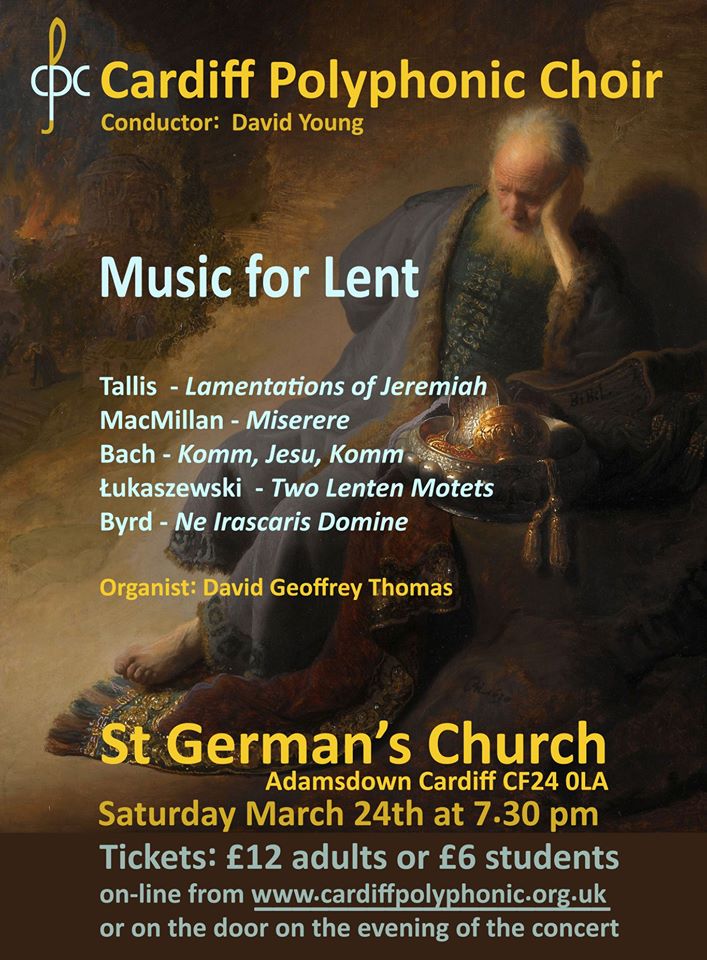
This evening I’m going to this concert, which I’ve been looking forward to for some time.

It may be sombre and melancholy, but the setting of The Lamentations of Jeremiah by Thomas Tallis is also astonishingly beautiful and it’s been one of my favourite choral works for many years. In fact it’s one of the most frequently played recordings on my iPod because I turn to it when I need to listen something peaceful and reflective. I have never heard it performed live, however, so this will be a treat for me. To give you a taster, here is the work (performed by The Sixteen):

P.S. The Hebrew text of the Book of Lamentations is remarkable for being in the form of an acrostic, with each verse starting with consecutive letters of the Hebrew alphabet. Tallis sets verses from the Latin (Vulgate) translation, but includes the initial letters of the Hebrew version: Aleph, Beth, etc..

UPDATE: I went to the concert as planned. Very enjoyable it was, though I was a bit surprised to find the two parts of The Lamentations of Jeremiah were not performed one after the other but either side of two motets by Lukaszewski. I guess this is to emphasise that they are separate pieces rather than one 20-minute long work but I always listen to them together.

The concert had an interval of about 25 minutes but, lamentably, no drinks were on sale…

Bird of Paradise – In Memoriam Charlie Parker

Posted in Jazz with tags , , on March 12, 2018 by telescoper

Today is the 63rd anniversary of the death, in 1955 aged just 34, of the great saxophonist and composer Charlie Parker, also known as `Bird’.  I know a lot of people don’t really `get’ Bird’s way of playing, but for me he created some of the most beautiful and exciting sounds not only in jazz, but in any musical genre. Here, to mark his memory, is a piece called Bird of Paradise (a thinly disguised version of the Jerome Kern standard All The Things You Are) recorded in 1947 for the Dial label with a quintet that included a young (21 year-old) Miles Davis on trumpet. Miles Davis was still finding his way musically at the time of the Dial sessions, but Bird had already established himself as a powerful creative force and his solo on this number is absolutely exquisite.

An Interview with Lauritz Melchior

Posted in Opera with tags on March 10, 2018 by telescoper

I’ve written more than once about the great tenor Lauritz Melchior, and the other day I came across this fascinating interview with him recorded when he was in his eighties and was living in America.

It’s full of interesting comments, but I have to say that above all I just love the way he speaks. English spoken with a Danish accent sounds so wonderful to my ears, especially with that tendency to inflect downward at the end of words. It sounds wonderfully lugubrious.

Willow Weep For Me – Mary Lou Williams

Posted in Jazz with tags , , , on March 8, 2018 by telescoper

Today is International Women’s Day, so I thought I’d post this lovely performance of the standard Willow Weep For Me, not just because it is played by the wonderfully talented pianist composer and arranger Mary Lou Williams, but because the song itself was written by Ann Ronell

45° Angle

Posted in Jazz with tags , , , , on February 24, 2018 by telescoper

Some time ago I posted a piece of music by Dick Twardzik from the mid-50s. The jazz piano scene in those days was so heavily dominated by Thelonious Monk and Bud Powell that pianists seem to struggle to find their own voice in the space created by those two. Twardzik certainly succeeded, though he died very young. Well, here’s another track from roughly the same period (1957) featuring another underrated musician who solved this problem in a different way. This fine track, undoubtedly influenced by Monk and Powell, but at the same time with its own sound, is by Herbie Nicholls, playing his own composition 45° Angle with the excellent George Duvivier on bass and Dannie Richmond on drums. Enjoy!

The Philharmonia Orchestra: Beethoven & Mahler

Posted in Music with tags , , , , , , on February 19, 2018 by telescoper

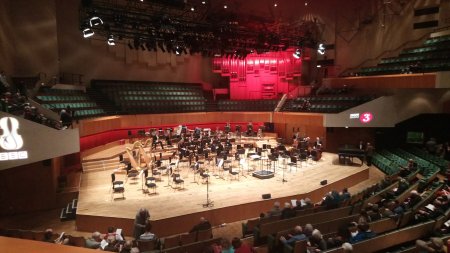
I spent yesterday afternoon at a very enjoyable concert at St David’s Hall in Cardiff for a programme of music by Beethoven and Mahler given by the Philharmonia Orchestra under Principal Guest Conductor Jakub Hrůša. The picture above was taken about 10 minutes before the concert started, from my seat in Tier 1. Quite a few people arrived between then and the beginning of the performance, but there wasn’t a very big audience. St David’s Hall may have been less than half full but those who did come were treated to some fantastic playing.

The first half of the concert consisted of Beethoven’s Piano Concerto No. 1 (in C) with soloist Piotr Anderszewski. This work was actually composed after his Piano Concerto No. 2 but was published first. It consists of three movements, an expansive slow movement (marked Largo) sandwiched between two sprightly up-tempo movements, marked Allegro con brio and Rondo-Allegro Scherzando, respectively. I think the first part of the last movement, full of energy and wit, is the best part of this work and Anderszewski play it with genuine sparkle. His performance was very well received, and he rounded it off with a charming encore in the form of a piece for solo piano by Bartok.

After the wine break we returned to find the piano gone, and the orchestra greatly expanded for a performance of Mahler’s Symphony No. 5 , the fourth movement of which (the `Adagietto’) is probably Mahler’s best-known music (made famous by its use in Visconti’s 1971 film Death in Venice). This lovely movement is sometimes performed on its own – a practice Mahler himself encouraged – but I think it’s particularly powerful when heard in its proper context, embedded in a large orchestral work that lasts well over an hour.

Although nominally five movements, this work is really in three sections: the first section consists of the first two movements (the first starting with Trauermarsch (a funeral march), and the second a stormy and at times savage movement, punctuated with brief interludes of peace). The last section consists of the beautiful Adagietto 4th movement (played entirely on the strings) followed by an energetic and ultimately triumphant finale. In between there’s an extended Scherzo, which is (unusually for Mahler) rather light and cheerful. Roughly speaking this symphony follows a trajectory from darkness into light and, although it certainly doesn’t go in a straight line, and does start with a death march, this is undoubtedly one of Mahler’s cheerier works!

The Philharmonia Orchestra gave a very accomplished and passionate reading of this piece, with especially fine playing from the brass section (who have lot to do). The exuberant ending brought many members of the audience to their feet and rightly so, as it was a very fine performance – the best I’ve heard live of this work.

Wild Man Blues

Posted in Jazz with tags , , on February 16, 2018 by telescoper

Time, I think, for some vintage jazz. This one doesn’t really need many words of introduction. It was recorded on May 7th 1927 in the Okeh Studios in Chicago by Louis Armstrong and his Hot Seven: Louis Armstrong (cornet), John Thomas (trombone), Johnny Dodds (clarinet), Lil Armstrong (piano), Johnny St. Cyr (banjo), Pete Briggs (tuba), and Warren `Baby’ Dodds (drums). Two things are worth saying, though. One is that this piece is very modern-sounding for its time, in that there’s very little of the ensemble work that one associates with New Orleans jazz, just two extended solos by Louis and Johnny Dodds, and that those solos are both very free. The other is that Armstrong’s solo is so good that there were only a few soloists who could have taken over from him without creating an anti-climax. Fortunately, one of those men (Johnny Dodds) was in the studio and did just that, matching Satchmo in power and invention. Enjoy!

The Greatest Scarpia

Posted in Opera with tags , , on February 15, 2018 by telescoper

Thursdays are always busy so today I’ll just put this here. It’s the great operatic baritone Tito Gobbi as Baron Scarpia in Tosca, a role he sang almost a thousand times in his career. This is the Te Deum scene, at the end of Act I, in which Scarpia after sending his men to follow Tosca to her lover Cavaradossi, he sings of his lustful desire as worshippers gather fora service at the Church in which the action takes place.

There have been many excellent interpreters of the role of Tosca (in which role I think Renata Tebaldi was every bit as good as Maria Callas) but Tito Gobbi (who sang the role with both Callas and Tebaldi) was the Scarpia of his age, and perhaps of any…

WNO Tosca

Posted in Opera with tags , , , , on February 12, 2018 by telescoper

My current schedule takes me back and forth across the Irish Sea, making it a bit of challenge to take in as many musical events as I’d like to, but I did manage to get to see yesterday’s performance of Tosca at Welsh National Opera. I don’t usually go for afternoon performances, but this was basically my option. Not surprisingly there was a packed house in the Wales Millennium Centre for a tale of jealousy and murder set to gorgeous music by Giacomo Puccini.

Tosca is an opera in three acts (which means two intervals wine breaks…). It’s a melodrama, and is set in Rome in 1800. Each act takes place in a very specific location within the Eternal City. Act I is in the Church of  Sant’Andrea della Valle, Act II in the Palazzo Farnese, and the final denouement of Act III takes place among the battlements at the top of the Castel Sant’ Angelo overlooking the Tiber. The setting is so specific to time and place that it resists being monkeyed about with, done in modern dress, staged in a chip shop or whatever. Thankfully, Michael Blakemore’s production (of which this is a revival) is very firmly of the period and location required. As a longstanding opera bore, I have to admit that I have been on a Tosca pilgrimage and have visited all three locations in Rome. The scenery used in last night’s performance isn’t exactly as the real locations but it definitely evokes them very well.

Floria Tosca (Claire Rutter) is a celebrated opera singer who is in love with an artist (and political radical) by the name of Mario Cavaradossi (Hector Sandoval), who helps to hide an escaped political prisoner while working on a painting in Act I. The odious Baron Scarpia (Mark Doss), Chief of Police, comes looking for the convict and decides to catch Tosca and Cavaradossi too. He lusts after Tosca and hates Cavaradossi. In Act II, we find Scarpia at home eating dinner for one while Cavaradossi is being tortured in order to find out the location of the escapee. Tosca turns up to plead for his life, but she hasn’t bargained with the true depths of Scarpia’s depravity. He wants to have his way with her, and to put pressure on he lets her listen to the sound of her lover being tortured. She finally consents, in return for Scarpia’s promise to let Cavaradossi go and grant free passage to the two of them. This he seems to do, but while she is waiting for him to write the letter of conduct she sees a knife. Instead of letting Scarpia defile her, she grabs it and stabs him to death. Act III begins with Cavaradossi facing execution, sure he is about to die. Tosca is convinced that this is just a charade and that Scarpia ordered them to pretend to shoot Cavaradossi so he wouldn’t look like he was being merciful, which would be out of character. The firing squad fire and Cavaradossi falls. But it was no fake. He is dead. Tosca is distraught and bewildered. Shouts offstage reveal that the police have found Scarpia’s body and that Tosca must have murdered him. To avoid capture she hurls herself from the battlements. Her last words are “O Scarpia, avanti a Dio!” – “I’ll meet you before God, Scarpia”.

Hector Sandoval (Cavaradossi) and Claire Rutter (Tosca). Picture credit: WNO.

The opera wasn’t particularly well received when it was first performed in 1900, being famously described by one critic as “a shabby little shocker”, but it has become a firm favourite with audiences around the world and is now acknowledged as a masterpiece of music drama. So how did Puccini manage to transform a penny-dreadful plot into a great work of art? I don’t think it’s hard to see why it works so well.

First and foremost, there’s the music, which  is wonderful throughout, but it is always plays an essential part in keeping everything moving. Of course there are the great arias: Vissi d’arte, Vissi d’amore sung by Tosca in Act II and E Lucevan le Stelle from Act III, sung by Cavaradossi; but even apart from those tremendous set-pieces, Puccini uses the music to draw out the psychology of the characters and underline the drama. Although not usually associated with the use of leitmotifs, Puccini deploys them throughout: Scarpia’s arrival is announced with a suitably menacing theme that recurs whenever he is present or even just referred to.  This theme is actually the first thing we hear as the Opera starts. It also plays Scarpia out at the end of Act 1 when he sings his magnificently chilling Va Tosca over a setting of the Te Deum. Time does stand still for Tosca’s great Act II aria, the dramatic fulcrum of the Opera, but that just emphasises the pace of the rest of the piece. This is a work with no spare flesh or padding anywhere, and a perfect interplay between music and action. The moment when Tosca sees the knife with which she will kill Scarpia is signalled by the orchestra.

And that leads to the second point. Each of the three principals could have been very two-dimensional: Cavaradossi the good guy.; Scarpia the bad guy; Tosca the love interest. But all the characters have real credibility and depth. Cavaradossi is brave and generous, but he succumbs to despair before his death. No superhero this, just a man. Scarpia is a nasty piece of work all right, but at times he is pathetic and vulnerable. He is monstrous, but one is left with the impression that something made him monstrous. And then there’s Tosca, proud and jealous, loving but at the same time capable of violence and spite. It is a truly shocking moment when she kills Scarpia. In this production, she doesn’t just stab him once: she chases him around the room repeatedly plunging the knife into him, then stands over him  as he begs for help. There’s no attempt to sanitise the violence of his death. It’s all so real. I guess that’s why this type of opera is called Verismo!

Top marks for the Orchestra of Welsh National Opera, under the direction of Carlo Rizzi, who did full justice to Puccini’s magnificent score. Claire Rutter has a fine voice for the role, and I thought Hector Sandoval sang and acted wonderfully. The big numbers in Tosca are quite familiar, but they still sounded fresh and were performed with great feeling. Best of all, Mark Doss has a dark baritone voice that gave Scarpia a tremendous sense of power and danger. He even got a few pantomime boos at the end.


Erbarme Dich Allah

Posted in Music with tags , , on February 4, 2018 by telescoper

Here is a wonderful re-imagining of the aria Erbarme Dich, Mein Gott from the St Matthew Passion by Johan Sebastian Bach sung in Arabic with intense passion by Egyptian contralto Fadia el-Hage.

Three things struck me when I first heard this on the radio the other night. After the initial surprise when I first heard her voice, I thought how wonderfully well the Middle-Eastern inflections work with Bach. That’s no surprise of course, because Bach’s music is so beautifully constructed that it can be performed in many different ways without diminishing its power. It really is universal.

The other thing was about a different kind of universality, that it seems common to all humans to reach out for whatever it is that lies beyond everyday life and experience, whether through religion or by some other means. We don’t have to agree with each other’s beliefs to see in others the same need as ourselves. This aria in particular (I’ve posted about it before) conveys the feelings of shame and remorse of the disciple Peter after having betrayed Jesus. The point is that feelings such as this are universal. We all – men and women, christian and non-christian – come to know what it is to feel like this, just as we all come to know about pain and death. It’s the fact that we all know that we will die that gives the story of the Passion its tragic power.

Finally it occurred to me that this might annoy some intolerant folk as it translates all these things into an Islamic context. That gives me an additional reason for posting it!