Mozart died before he could complete his Requiem. And of this movement, Lacrimosa, only the first eight bars are known to have been written by him. Nevertheless, even a small piece of Mozart’s genius was enough to create a work of tragic beauty which is a suitable tribute for all those whose lives have been cut short. I hope I don’t have to say any more about why I’m posting it now at the end of this horrible week.
Follow @telescoperArchive for the Music Category
Cav/Pag and WNO
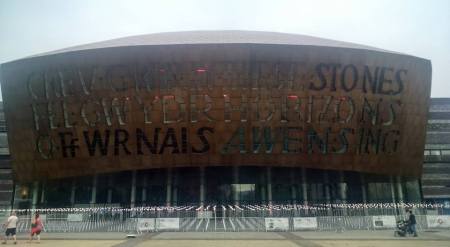
Posted in Opera with tags Carlo Rizzi, Cavalleria Rusticana, David Kempster, Gwyn Hughes Jones, Pagliacci, Welsh National Opera on June 7, 2016 by telescoperWell, I’m back in Brighton after a short break either side of my nth birthday (where n→∞). As is traditional on such occasions I spent the evening of the day in question at the Wales Millennium Centre for a night at the Opera:

On the bill for Saturday night were Cavalleria Rusticana and Pagliacci, two short operas written (respectively) by Pietro Mascagni and Ruggero Leoncavallo. Both works are in the verismo tradition of late 19th Century Italian opera and have central themes of love, jealousy, betrayal revenge and murder. So idea fare for a birthday treat!
The “Cav/Pag” package is quite a familiar pairing to opera goers. They weren’t actually written to be performed together, though it is believed that Leoncavallo wrote his piece Pagliacci in response to the success of Cavalleria Rusticana. The compositional style and orchestration are not dissimilar and often the principals are played by the same singers. The latter was the case with Saturday’s production, at least in terms of the two male roles: Gwyn Hughes Jones (shown below as Canio in Pagliacci; he also sang Turiddu in Cavalleria Rusticana) sang both tenor parts, while David Kempster (baritone) played Alfio (Cav) and Tonio (Pag). Both were excellent throughout.

These two productions of this combo differ very much in their look and feel. Cavalleria Rusticana is beautifully staged, in a conventional 19th Century rural Italian setting. The lighting is particularly impressive: the opening looks like a scene from a painting by a Grand Master. The excellent chorus of Welsh National Opera is very much to the fore, especially in the famous Easter Hymn, and the principal soprano Camilla Roberts sang the role of Santuzza with great depth of expression. Carlo Rizzi conducted the Orchestra of Welsh National Opera.
Pagliacci is given a more modern setting – costumes were generally around the 1950s – but still set in Italy. The set is much plainer and the lighting harsher. The chorus has less to do in terms of singing, but provides colour and movement to the drama. Although the two male principals were good I felt the cast overall was weaker. Meeta Raval (Nedda) sang her part well enough, and got some good laughs in the moments of comedy, but she didn’t have the emotional depth needed to make her part really come alive. Gyula Nagy (as Nedda’s lover Silvio) also sang well enough, but really needs to take some acting lessons..
The big set-piece in Pagliacci is Vesti La Giubba, a powerfully emotional tenor ara which never fails to move. Enrico Caruso’s version of this was the hit record of its day.
Although there were some shortcomings it was still a very enjoyable evening of music drama. Indeed it was the last night in Cardiff for this season, Welsh National Opera’s 70th. The company’s debut when it gave its first performance – as an amateur organisation – on 15th April 1946, was a double bill of Cavalleria Rustica and Pagliacci…
I’d therefore like to end by wishing Welsh National Opera a very happy birthday and send my deepest thanks for providing me with so many hours of pleasure through their performance. Long may they continue!
Follow @telescoper
Jazz and Physics
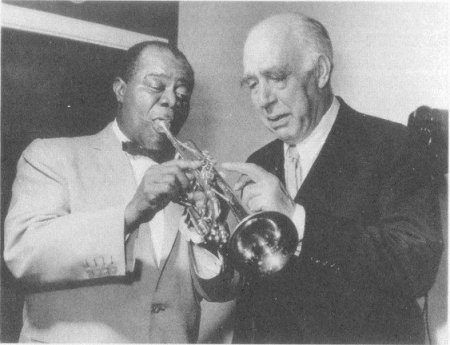
Posted in History, Jazz, The Universe and Stuff with tags Louis Armstrong, Niels Bohr on May 26, 2016 by telescoperNo time for a full post today, so I’ll just share this intriguing picture I found on the interwebs of two great figures from very different fields: Jazz trumpet legend Louis Armstrong and pioneering quantum physicist, Niels Bohr.

When I first saw this I assumed it had been photoshopped, but I’m reliably informed that the picture is genuine and that it was taken in Copenhagen in 1959. Other than that I know nothing of the circumstances in which it was taken. I’d love to hear from anyone who knows the full story!
Follow @telescoperThe Dream of Gerontius
Posted in Music with tags Brighton Dome, Brighton Festival Chorus, City of Birmingham Symphony Orchestra, Edward Elgar, Edward Gardner, The Dream of Gerontius on May 23, 2016 by telescoperJust a quick lunchtime post to mention that I took yesterday (Sunday) evening off to attend a concert at the Brighton Dome which was part of the annual Brighton Festival. The perf0rmance consisted of just one piece: The Dream of Gerontius by Sir Edward Elgar, performed by the City of Birmingham Symphony Orchestra (conducted by Edward Gardner) together with the Brighton Festival Chorus.
I happen to know a couple of people who sing with the Brighton Festival Chorus. Both were a bit nervous ahead of last night’s performance because it’s a challenging work and although they’ve been rehearsing the choral passages themselves, they only had a short time to practice together with the orchestra. Reading about the performance history of this work, their fears might have been justified: the first performance, in Birmingham in 1900, was a shambles, largely due to inadequate rehearsal time, and it took some time for it to become established in the repertoire. As it turned out, however, they had nothing to worry about. I thought the Chorus was magnificent, as was the Orchestra and indeed the three soloists: Alice Coote (Mezzo), Robert Murray (Tenor) and Matthew Rose (Bass). I particularly liked Matthew Rose’s performance. He cut an imposing figure on the platform, towering over the other musicians, and his sonorous bass tones projected wonderfully.
Although I began by saying that the concert was “just one piece”, The Dream of Gerontius is a very substantial work, lasting over 90 minutes (excluding the interval). It requires a large choir (well over a hundred voices last night) as well as large orchestral forces, including two harps and a big brass section. I’m sure it’s a handful to perform, but last night’s concert was well-controlled and at times simply beautiful.
It’s basically a setting of a long poem, describing the journey of a dying man towards death. It takes a very Roman-Catholic view of Paradise, Purgatory, and the Last Judgement and this may have contributed to its initial lack of popularity in (Protestant) England; it found greater favour in Germany in the years after its first performance.
I’m actually not the biggest fan of Elgar, generally speaking. He’s often very rhythmically unimaginative and predictable, as in the opening passage of Part 1 in last night’s performance which plodded along for a quite a while before getting going. However, there are some thrilling passages too. This work does sound surprisingly modern at times and at others is very reminiscent of Richard Strauss, at least to my ears.
Anyway, an excellent performance of a profound and challenging work. I’m glad to say that it attracted a full house too, though the majority of the audience were (like me) not in the first flush of youth..
P.S. I texted a friend that I was at The Dream of Gerontius, but autocorrect turned it into The Dream of Geronimo. As far as I know there’s no choral work with that title, but perhaps there should be!
Follow @telescoperListening and Seeing (and Mahler)
Posted in Biographical, Music with tags Gustav Mahler, Leonard Bernstein, Ruhevoll, Symphony No. 4, Vienna Philharmonic on May 14, 2016 by telescoperThree things led me to post this recording. One is that this piece (though not this performance) was one of the late Harry Kroto’s selections for Desert Island Discs. Another is that I had occasion to sort out my CD collection recently and I realised in doing so that I had more recordings of this Symphony than any other. And the third is that I heard a discussion on Radio 3 recently in which a record company executive noted that while sales of opera performances on DVD were very healthy, it was very difficult to sell DVDs of symphonic concerts. I am not particularly surprised by that but I have to say that I love the visual as well as the auditory experience of a classical concert. A large group of talented people coming together to make music is a great thing to watch, and it also helps understand the music a bit too. I’d much rather go to a live concert (even a mediocre one) than listen to a CD (even a very good one), but failing that I’d definitely go for a DVD.
All of this provides an excuse to show this film of the Vienna Philharmonic under the baton of Leonard Bernstein playing the gorgeous third moment (marked Ruhevoll) of Symphony No. 4 in G Major by Gustav Mahler. My favourite recording of this symphony is actually by Von Karajan with the Berlin Philharmonic on Deutsche Grammophon, but this is well worth watching to see the communication between Lenny and the band. And if you think Mahler is always gloomy and angst-ridden, hopefully this will make you change your mind.
Follow @telescoper
Extraordinary Rendition
Posted in Music, Opera with tags Florence Foster Jenkins, Mozart, The Genius of Mozart, The Magic Flute on May 6, 2016 by telescoperHere’s something to end the week with: a piece from my favourite Mozart opera, The Magic Flute, in a version that’s itself very rarely heard. Fortunately. This is what Florence Foster Jenkins – the opera singer to end all opera singers – did with Der Hölle Rache kocht in meinem Herzen. For some reason Sony admits to owning the copyright of this, so you’ll have to click through to Youtube to hear it in its full glory.
Follow @telescoperNothing Compares
Posted in Biographical, Music with tags Nothing Compares 2U, Prince, Sinead O'Connor on April 25, 2016 by telescoperFor some reason I just remembered this morning that a song that is full of nostalgia for me was written by Prince, who died last week. The version I still have on vinyl was a huge hit for Sinead O’Connor in 1990:
Incidentally, I once saw Sinead O’Connor in person at the Zap Club in Brighton during my previous incarnation here as a research student and postdoc. I literally bumped into her trying to get to the bar to buy a drink. When she turned around I was staggered to see such a beautiful face looking at me, although to be honest I did for a moment assume she was a boy. It was, I should explain, a gay night at the club. Fortunately she was very nice and friendly and forgave my clumsiness with a gracious smile.
There aren’t many any other pop videos done like this, almost entirely in close-up. Can anyone think of any others?
Follow @telescoper
Buddy DeFranco Plays Rhythm Changes
Posted in Jazz with tags Buddy DeFranco, clarinet, Jazz, Rhythm Changes on April 21, 2016 by telescoperThe late great Buddy DeFranco was the musician who finally convinced me that I’d never be any good at playing the clarinet, though I still make the occasional half-hearted attempt. He nevertheless remains a musical hero of mine, not least because he was one of the few people to play clarinet in a “modern” style. I found this transcription of one of his solos on Youtube a while ago and thought I’d share it here. Twelve choruses of rhythm changes at a brisk tempo provide the foundation for a great jazz musician who unleashes a flood of improvisation. Feel free to play along at home!
Follow @telescoperPanama
Posted in History, Jazz with tags Bunk Johnson, Jazz, New Orleans, Panama on April 4, 2016 by telescoperFor some reason today’s news made me think of this famous old record by Bunk Johnson.
Bunk Johnson was born in New Orleans way back in 1879 and he made his name playing trumpet in the very early days of jazz, including – if his own account can be believed – a stint with the legendary Buddy Bolden. He was regarded by many, including Louis Armstrong no less, as one of the top trumpeters in New Orleans in the period between 1905 and 1915. Jazz had begun with the marching bands that performed in New Orleans but then largely moved into the bordellos of Storyville, the biggest (legal) red light district in the history of the United States. When Storyville was closed down in 1917 most professional jazz musicians lost their only source of regular income. However, a few years later, in 1919, the United States Senate proposed the 18th Amendment to the Constitution which prohibited the manufacture, distribution and sale of alcohol for human consumption and ushered in the era of Prohibition. This turned Chicago into a bootlegger’s paradise and jazz musicians flocked there to perform in the numerous speakeasies. That’s why the great New Orleans Jazz records of the 1920s were all made in Chicago and it also caused the music to evolve in new directions. Bunk Johnson did not join the mass exodus to Chicago and his career faded into obscurity, ending entirely in 1931 when he had his front teeth knocked out in a brawl and could no longer play the trumpet.
However, in 1942, Bunk Johnson was rediscovered as a very old man by some young jazz fans who travelled to New Orleans and recorded him playing with a band of local musicians in the basement of a house courtesy of a new set of dentures. Despite the poor sound quality of the recording, the resulting tracks proved incredibly popular, ushering in the New Orleans Revival that began in the United States and then propagated across to Europe after the war to the extent that many revivalist bands even sedulously acquired the “recorded-in-a-garage” sound. Bunk Johnson passed away in 1947 but George Lewis, who plays clarinet on this track, carried the flag for “authentic” New Orleans jazz for many years after that, visiting Europe on many occasions. My Dad played the drums with him a few times..
P.S. I’ve always felt particularly sorry for Walter Decou, who played piano on the famous Bunk Johnson records of 1942, because apparently he was pounding away like a good ‘un but you can barely hear a note from him on any of them!
Follow @telescoper
Akhnaten at ENO
Posted in Opera with tags Akhnaten, Anthony Roth Costanzo, Emma Carrington, English National Opera, Juggling, Nefertiti, Philip Glass, Queen Tye, Rebecca Bottone on March 12, 2016 by telescoperHaving had a very stressful time at work over the last few days I decided on the spur of the moment to treat myself to a night at the Opera. The hottest tickets in London right now are for English National Opera’s new production of Akhnaten, by Philip Glass, but I managed to get one for Thursday night’s performance. I’m so glad I did, as it really lived up to the the reviews.
The Opera Akhnaten, which had its world premiere in 1983, is based on a real historical figure, Akhenaten, who ruled Egypt over 3300 years ago. Act I begins with the funeral rites of his father Amenhotep III, his son’s installation as Pharaoh Amenhotep IV and the beginning of his 17-year reign alongside his wife Nefertiti.
Roughly five years into his rule, however, Amenhotep IV changed his name to Akhenaten and set up a new, monotheistic religion, in which the Aten (the disk of the Sun) represented the supreme divine influence. Not content with that, he decided to up sticks from the city of Thebes (modern-day Luxor) and found a new city called Amarna in the desert. Act II is set in the Amarna period. It seems that, although Akhnaten had revolutionary ideas about religion, the costs of establishing this new way of life, and the resentment it caused among advocates of the old order, put strain on the kingdom of Egypt. In Act III we find Akhnaten and his family in a state of total detachment from the reality of the disintegration of his empire. Ailing and beset by hostile forces, Akhnaten eventually dies.
After Akhnaten’s death the Amarna project was abandoned, as was the new religion, and the 18th Dynasty resumed with the enthronment of Akhnaten’s son, a young boy by the name of Tutankhamun. Very little remains of the City of Amarna and there seems to have been a systematic attempt to eradicate Akhnaten from historical memory. One suspects that the priests of the old religion played a not inconsiderable role in these developments.
But Glass’s Akhnaten is more of a reflection or meditation on this extraordinary period than an attempt to depict it via a traditional historical narrative. His minimalist score also challenges the conventions of grand opera. The music develops only incrementally and the actors move in a correspondingly stylised fashion. Each act consists of a set of dreamlike tableaux mixing up the archaeological elements of the story with references to the modern world. In the first Act, for example, the funerary rites of Amenhotep IV involve characters in both ancient and modern dress to emphasize that death has been, and remains, a mystery for all cultures and civilisations.
It’s obviously an enormous challenge to bring such a work to the stage, but this production (developed in conjunction with the theatre company Improbable) rose to that challenge with great imagination. To counter the sense of stasis generated by the music, for example, there was a liberal influsion of brilliantly executed and extremely kinetic juggling. I knew there was going to be juggling before the performance and had worried that it might be distracting, or even just a gimmick. In fact I think the juggling worked extremely well not only in the context of the opera but also in the context of history; some of the earliest depictions of juggling are from ancient Egypt. The costumes and lighting add even more to the spectacular visual experience.
I don’t like all of Philip Glass’s music but I do think that Akhnaten is a masterpiece of minimalism. It’s full of subtle and interesting ideas but also extremely accessible, and it creates a strange hypnotic atmosphere which goes perfectly with this staging. The orchestra played the music well, though I felt the brass section could have played with a bit more “bite”, especially in the first Act. The ENO chorus was in excellent voice, as were all the principals: soprano Rebecca Bottone as Queen Tye (Akhnaten’s mother) and mezzo Emma Carrington as Nefertiti (Akhnaten’s wife) both sang extremely their demanding parts with great poise.
But I have to make special mention of Anthony Roth Costanzo as Akhnaten. He makes his first appearance on stage in Act I completely naked, walking slowly as if in a trance across a gallery and down the stairs in centre stage, and is then dressed in the garb of a Pharoah. His appearance then – slim, athletic, definitely masculine, and I have to say not inconsiderably sexy – contrasts with his increasingly androgynous appearance later on. But it is his stage presence and the truly remarkable quality of his singing that I will remember.

Akhnaten attempts to commune with the Aten. Picture credit: Guardian
Despite all I have written about the juggling and other aspects of the staging, for me the most powerful scene of the Opera is the last scene of Act II which is effective primarily for its simplicity. Here Akhnaten sings a longish aria in the form of Hymn to the Aten, which is based on an ancient text but bearing striking resemblance to Psalm 104 (a point underlined when the chorus sings Psalm 104, in Biblical Hebrew, offstage afterwards).This is the only part of the text sung in English; the rest is in a mixture of Aramaic, Akkadian and Hebrew. Constanzo’s rendition of the Hymn was stunningly beautiful, the clarity of his voice giving it a childlike sense of wonder. Akhnaten then walks slowly up a staircase in front of a representation of the Aten (above), then turns towards it and reaches out with both arms in an attempt to touch it, but he can’t reach it. He turns to face the audience, a desolate expression on his face, and the curtain falls on Act II.
That moment is so poignant because it spells out the universal nature of Akhnaten’s tragedy. His downfall seems inevitable from that point. He tries, as we all do in one way or another, and at some time or another, to commune with something beyond human existence. Inevitably, he fails, and his obsession costs him not only his kingdom, but also his life.
Follow @telescoper