On what looks set to be the hottest day of the year I’m getting ready to head off to the Brighton Dome for this afternoon’s graduation ceremony for the School of Mathematical and Physical Sciences. This requires the wearing of ridiculously heavy robes on top of a suit which means that I’ll probably melt even before I start reading the names out. Anyway, the need to wear silly clothes for this performance reminded me of the famous aria Vesti La Giubba, which I translate roughtly as “Put on the costume”, from the Opera Pagliacci. Here is a collection of recordings of this by the great Enrico Caruso, whose 1907 version of Vesti La Giubba was the world’s first million-selling record.
It was just brought to my attention that one of the historical landmarks of Ghent, the location of the conference I am currently at, is the home of Lamoral, Count of Egmont whose execution in 1568 sparked an uprising against Spanish occupation that eventually led to the independence of the Netherlands. The house itself is extremely old, being built in 1200 from roman bricks.
Egmont was also the inspiration behind Beethoven’s famous overture played here in suitably dramatic style by the Berlin Philharmonic under the direction of Herbert von Karajan.
Whenever I’m in dire need of inspiration – which happens a lot these days – I usually turn to music. I found this not long ago and decided to share it here because it’s not just inspirational, but awe-inspiring. I don’t have any information about the date or location of this recording of Dizzy Atmosphere– except that it’s obviously live, and that it features the composer Dizzy Gillespie on trumpet after a great solo by the great Charlie Parker on alto saxophone. Bird is absolutely on fire in this performance! In case you’re interested this is yet another bebop standard that’s built on rhythm changes though it is in an unusual key (A♭) for such pieces. Anyway, never mind about that, just listen to Bird flying through this!
I’ve posted this at 7.20am on 1st July 2016. Precisely one hundred years ago, following a heavy artillery bombardment that had been going on for a week, an enormous mine was exploded under a fortified position at Hawthorn Ridge near Beaumont Hamel on the River Somme in France. Here is footage of the actual explosion:
Ten minutes later, the first French and British troops went “over the top” on the first day of the Battle of the Somme. It was to be the bloodiest day in the history of the British Army.
Here is an edited version of a piece I wrote some time ago about this battle and its aftermath.
–0–
Twelve summers ago, in 2004, I spent an enjoyable day walking in the beautiful Peak District of Derbyshire followed by an evening at the opera in the pleasant spa town of Buxton, where there is an annual music festival. The opera I saw was A Turn of the Screw, by Benjamin Britten: a little incongruous for Buxton’s fine little Opera House which is decorated with chintzy Edwardiana and which was probably intended for performances of Gilbert & Sullivan light comic operettas rather than stark tales of psychological terror set to unsettling atonal music.
When Buxton’s theatre was built, in 1903, the town was a fashionable resort at which the well-to-do could take the waters and relax in the comfort of one of the many smart hotels.
Arriving over an hour before the opera started, I took a walk around the place and ended up on a small hill overlooking the town centre where I found the local war memorial. This is typical of the sort of thing one can see in small towns the length and breadth of Britain. It lists the names and dates of those killed during the “Great War” (1914-1918). Actually, it lists the names but mostly there is only one date, 1916.
The 1st Battalion of the Nottingham and Derbyshire Regiment (known as the Sherwood Foresters) took part in the Battle of the Somme that started on 1st July 1916. For many of them it ended that day too; some of their names are listed on Buxton’s memorial.
On the first day of this offensive, the British Army suffered 58,000 casualties as, all along the western front, troops walked slowly and defencelessly into concentrated fire from heavy machine guns that were supposed to have been knocked out by the artillery barrage that preceded the attack. The bombardment had been almost entirely ineffective, and it finished well before the British advance started, so the Germans had plenty of time to return to their positions and wait for the advancing British. It had also been believed that the artillery shells would have cut the barbed wire protecting German positions. It didn’t. British and French troops who got entangled were sitting ducks. Carnage ensued.
Rather than calling off the attack in the face of the horrific slaughter, the powers that be carried on sending troops over the top to their doom for months on end. By the end of the battle (in November that year) the British losses were a staggering 420,000, while those on the German side were estimated at half a million. The territory gained at such a heavy price was negligible.
These numbers are beyond comprehension, but their impact on places like Buxton was measurably real. Buxton became a town of widows. The loss of manpower made it impossible for many businesses to continue when peace returned in 1918 and a steep economic decline followed. It never fully recovered from the devastation of 1916 and its pre-war posterity never returned.
And the carnage didn’t end on the Somme. As the “Great War” stumbled on, battle after battle degenerated into bloody fiasco. Just a year later the Third Battle of Ypres saw another 310,000 dead on the British side as another major assault on the German defences faltered in the mud of Passchendaele. By the end of the War on 11th November 1918, losses on both sides were counted in millions.
–0–
I decided to end this piece with the following video featuring music by George Butterworth (A Shropshire Lad: Rhapsody for Orchestra, inspired by the poetry of A.E. Housman, and one of the few surviving complete works of this composer). Images of present-day Shropshire are interspersed with photographs taken on the Somme in 1916. I chose this because George Butterworth too lost his life in the Battle of the Somme (on 5th August 1916). Lest we forget.
Mozart died before he could complete his Requiem. And of this movement, Lacrimosa, only the first eight bars are known to have been written by him. Nevertheless, even a small piece of Mozart’s genius was enough to create a work of tragic beauty which is a suitable tribute for all those whose lives have been cut short. I hope I don’t have to say any more about why I’m posting it now at the end of this horrible week.
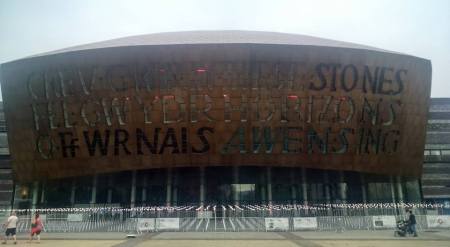
Well, I’m back in Brighton after a short break either side of my nth birthday (where n→∞). As is traditional on such occasions I spent the evening of the day in question at the Wales Millennium Centre for a night at the Opera:
On the bill for Saturday night were Cavalleria Rusticana and Pagliacci, two short operas written (respectively) by Pietro Mascagni and Ruggero Leoncavallo. Both works are in the verismo tradition of late 19th Century Italian opera and have central themes of love, jealousy, betrayal revenge and murder. So idea fare for a birthday treat!
The “Cav/Pag” package is quite a familiar pairing to opera goers. They weren’t actually written to be performed together, though it is believed that Leoncavallo wrote his piece Pagliacci in response to the success of Cavalleria Rusticana. The compositional style and orchestration are not dissimilar and often the principals are played by the same singers. The latter was the case with Saturday’s production, at least in terms of the two male roles: Gwyn Hughes Jones (shown below as Canio in Pagliacci; he also sang Turiddu in Cavalleria Rusticana) sang both tenor parts, while David Kempster (baritone) played Alfio (Cav) and Tonio (Pag). Both were excellent throughout.
These two productions of this combo differ very much in their look and feel. Cavalleria Rusticana is beautifully staged, in a conventional 19th Century rural Italian setting. The lighting is particularly impressive: the opening looks like a scene from a painting by a Grand Master. The excellent chorus of Welsh National Opera is very much to the fore, especially in the famous Easter Hymn, and the principal soprano Camilla Roberts sang the role of Santuzza with great depth of expression. Carlo Rizzi conducted the Orchestra of Welsh National Opera.
Pagliacci is given a more modern setting – costumes were generally around the 1950s – but still set in Italy. The set is much plainer and the lighting harsher. The chorus has less to do in terms of singing, but provides colour and movement to the drama. Although the two male principals were good I felt the cast overall was weaker. Meeta Raval (Nedda) sang her part well enough, and got some good laughs in the moments of comedy, but she didn’t have the emotional depth needed to make her part really come alive. Gyula Nagy (as Nedda’s lover Silvio) also sang well enough, but really needs to take some acting lessons..
The big set-piece in Pagliacci is Vesti La Giubba, a powerfully emotional tenor ara which never fails to move. Enrico Caruso’s version of this was the hit record of its day.
Although there were some shortcomings it was still a very enjoyable evening of music drama. Indeed it was the last night in Cardiff for this season, Welsh National Opera’s 70th. The company’s debut when it gave its first performance – as an amateur organisation – on 15th April 1946, was a double bill of Cavalleria Rustica and Pagliacci…
I’d therefore like to end by wishing Welsh National Opera a very happy birthday and send my deepest thanks for providing me with so many hours of pleasure through their performance. Long may they continue!
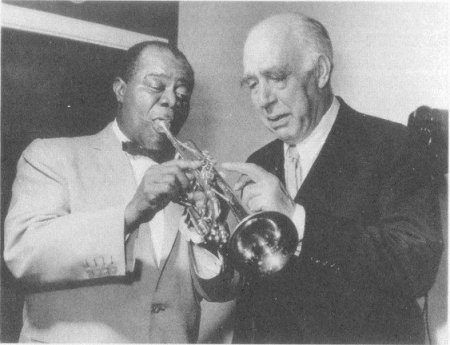
No time for a full post today, so I’ll just share this intriguing picture I found on the interwebs of two great figures from very different fields: Jazz trumpet legend Louis Armstrong and pioneering quantum physicist, Niels Bohr.
When I first saw this I assumed it had been photoshopped, but I’m reliably informed that the picture is genuine and that it was taken in Copenhagen in 1959. Other than that I know nothing of the circumstances in which it was taken. I’d love to hear from anyone who knows the full story!
I happen to know a couple of people who sing with the Brighton Festival Chorus. Both were a bit nervous ahead of last night’s performance because it’s a challenging work and although they’ve been rehearsing the choral passages themselves, they only had a short time to practice together with the orchestra. Reading about the performance history of this work, their fears might have been justified: the first performance, in Birmingham in 1900, was a shambles, largely due to inadequate rehearsal time, and it took some time for it to become established in the repertoire. As it turned out, however, they had nothing to worry about. I thought the Chorus was magnificent, as was the Orchestra and indeed the three soloists: Alice Coote (Mezzo), Robert Murray (Tenor) and Matthew Rose (Bass). I particularly liked Matthew Rose’s performance. He cut an imposing figure on the platform, towering over the other musicians, and his sonorous bass tones projected wonderfully.
Although I began by saying that the concert was “just one piece”, The Dream of Gerontius is a very substantial work, lasting over 90 minutes (excluding the interval). It requires a large choir (well over a hundred voices last night) as well as large orchestral forces, including two harps and a big brass section. I’m sure it’s a handful to perform, but last night’s concert was well-controlled and at times simply beautiful.
It’s basically a setting of a long poem, describing the journey of a dying man towards death. It takes a very Roman-Catholic view of Paradise, Purgatory, and the Last Judgement and this may have contributed to its initial lack of popularity in (Protestant) England; it found greater favour in Germany in the years after its first performance.
I’m actually not the biggest fan of Elgar, generally speaking. He’s often very rhythmically unimaginative and predictable, as in the opening passage of Part 1 in last night’s performance which plodded along for a quite a while before getting going. However, there are some thrilling passages too. This work does sound surprisingly modern at times and at others is very reminiscent of Richard Strauss, at least to my ears.
Anyway, an excellent performance of a profound and challenging work. I’m glad to say that it attracted a full house too, though the majority of the audience were (like me) not in the first flush of youth..
P.S. I texted a friend that I was at The Dream of Gerontius, but autocorrect turned it into The Dream of Geronimo. As far as I know there’s no choral work with that title, but perhaps there should be!
Three things led me to post this recording. One is that this piece (though not this performance) was one of the late Harry Kroto’s selections for Desert Island Discs. Another is that I had occasion to sort out my CD collection recently and I realised in doing so that I had more recordings of this Symphony than any other. And the third is that I heard a discussion on Radio 3 recently in which a record company executive noted that while sales of opera performances on DVD were very healthy, it was very difficult to sell DVDs of symphonic concerts. I am not particularly surprised by that but I have to say that I love the visual as well as the auditory experience of a classical concert. A large group of talented people coming together to make music is a great thing to watch, and it also helps understand the music a bit too. I’d much rather go to a live concert (even a mediocre one) than listen to a CD (even a very good one), but failing that I’d definitely go for a DVD.
All of this provides an excuse to show this film of the Vienna Philharmonic under the baton of Leonard Bernstein playing the gorgeous third moment (marked Ruhevoll) of Symphony No. 4 in G Major by Gustav Mahler. My favourite recording of this symphony is actually by Von Karajan with the Berlin Philharmonic on Deutsche Grammophon, but this is well worth watching to see the communication between Lenny and the band. And if you think Mahler is always gloomy and angst-ridden, hopefully this will make you change your mind.
Here’s something to end the week with: a piece from my favourite Mozart opera, The Magic Flute, in a version that’s itself very rarely heard. Fortunately. This is what Florence Foster Jenkins – the opera singer to end all opera singers – did with Der Hölle Rache kocht in meinem Herzen. For some reason Sony admits to owning the copyright of this, so you’ll have to click through to Youtube to hear it in its full glory.
The views presented here are personal and not necessarily those of my employer (or anyone else for that matter).
Feel free to comment on any of the posts on this blog but comments may be moderated; anonymous comments and any considered by me to be vexatious and/or abusive and/or defamatory will not be accepted. I do not necessarily endorse, support, sanction, encourage, verify or agree with the opinions or statements of any information or other content in the comments on this site and do not in any way guarantee their accuracy or reliability.