I’ve just heard the very sad news that the great Italian conductor Claudio Abbado has passed away at the age of 80. No words of mine can pay adequate tribute to his wonderful career. He leaves a rich legacy of recordings which can speak more eloquently than I could ever do and he will live on through them and through the memories of those who attended live performances he conducted. Here is a superb example, a recording of a sublime performance one of the five Rückert-Lieder by Gustav Mahler (“Ich bin der Welt abhanden gekommen“) featuring the Lucerne Festival Orchestra under Abbado’s direction, and the gorgeous voice of mezzo-soprano Magdalena Kožená. Rest in peace, Maestro Claudio Abbado.
Follow @telescoperArchive for the Music Category
R.I.P. Claudio Abbado
Posted in Music with tags Claudio Abbado, Gustav Mahler, Ich bin der Welt abhanden gekommen, Magdalena Kozena, Ruckert Lieder on January 20, 2014 by telescoperEarly Junction: Door of the Cosmos
Posted in Jazz, The Universe and Stuff with tags BBC Radio 3, Door of the Cosmos, Jazz, Sun Ra Arkestra on January 15, 2014 by telescoperOne of the quirks of being in Japan is the 9 hour time difference between here and the UK, which means I’m just getting up when folk back home are going to bed; and one of the consequences is that BBC Radio 3’s Late Junction is on (via the internet) in the morning. It’s playing as a write this, in fact. Yesterday morning there was a track by Sun Ra, which reminded me that 2014 is the centenary of his birth. It prompted me to look back at an old post I’d written about him where I found the track included there had been deleted from Youtube. I therefore decided to post a new version, including a different track.
Sun Ra was one of the most extraordinary composers and bandleaders of the 20th Century, was born Herman Poole Blount in Bimingham, Alabama, on 22nd May 1914. From the 1950s, until his death in 1993, he led various combinations of musicians in bands with various permutations of names involving the word Arkestra, such as the Blue Universe Arkestra and the Solar Myth Arkestra. He himself played keyboards, sometimes solo and sometimes with huge bands of over 30 musicians; his music touched on virtually the entire history of jazz, from ragtime to swing music, from bebop to free jazz, as well as soul and pop. He was also one of the first musicians, in any genre, to make extensive use of electronic keyboards.
He never achieved mainstream commercial success, but was a prolific recording artist with a cult following, partly fuelled by his outrageous claims to have been born not on Earth but on Saturn and the fact that much of his music was to do with space travel. Quoted in Jazziz magazine
They really thought I was some kind of kook with all my talk about outer space and the planets. I’m still talking about it, but governments are spending billions of dollars to go to Venus, Mars, and other planets, so it’s no longer kooky to talk about space
Quite. In fact, Sun Ra developed a complex performing identity based on his music, “cosmic” philosophy, and poetry. He abandoned his birth name, took on the persona of Sun Ra (Ra being the ancient Egyptian god of the sun), and often dressed in the style of an ancient Egyptian pharoah, as in the video clip. In other words, he was very odd.
Sun Ra’s music is eclectic, outrageous and sometimes downright mystifying, but it also has a marvellous coherence to it maintained as his style evolved over four decades and is consistently imbued with a powerful sense of the Jazz tradition. Anyway, whatever I think, the music of Sun Ra has withstood its skeptics and detractors for generations and long may it continue to do so. The world needs more of his kind of eccentric.
Here’s a number called Door of the Cosmos. See what you think.
Follow @telescoperMusic for Zen Meditation
Posted in Jazz, Music with tags Charlie Parker, Music for Zen Meditation, New Age, Tony Scott on January 12, 2014 by telescoperGiven my current location I thought I’d try this one out readers of this blog. I bought the album Music for Zen Meditation about 20 years ago; it was recorded in 1964 and features jazz clarinettist Tony Scott with two Japanese musicians, Shinichi Yuize (who plays the koto, a 13-stringed Japanese harp) and Hōzan Yamamoto (shakuhachi, a kind of bamboo flute). I think the music, and especially Scott’s lovely tone on the clarinet, creates a wonderful sense of peace, and it’s fascinating to hear the blending of styles. However, I played some of the music for my Japanese friend Chiaki some time ago and he said it sounded like something you would hear in an elevator. Ouch!
This album is often said to have been the first ever recording in the musical genre that came to be known as New Age, most of which I can’t stand. That reminds me of one of my favourite Gary Larson cartoons:
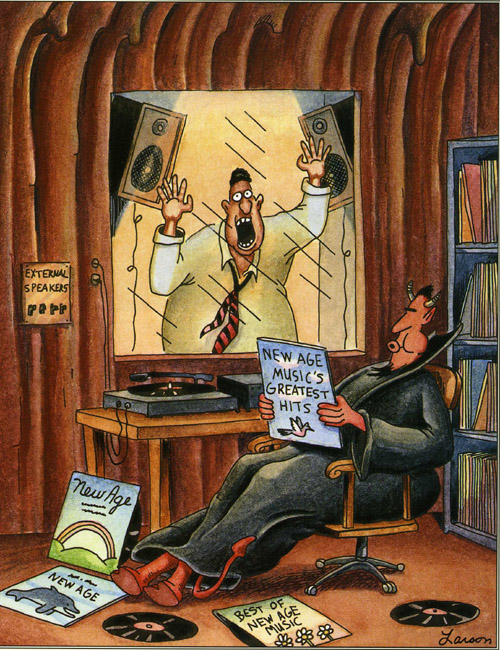
Music for Zen Meditation is certainly a far cry from bebop, but I’ll leave it to you to make your own mind up about it. See what you think. This track is the first one on the album and is entitled Is All Not One?
Follow @telescoperMy Favo(u)rite Things
Posted in Jazz with tags Elvin Jones, Jazz, John Coltrane, McCoy Tyner, My Favourite Things on January 7, 2014 by telescoperI’ve got a short gap in between meetings which I thought I’d fill by posting a classic piece by John Coltrane. This is the title track from the 1961 album My Favorite Things which, as it happens, is one of my favourite things. Coltrane plays soprano sax on this track; apparently he hadn’t played a soprano sax until 1960, when Miles Davis bought him one. I like its use on this particularly recording as it gives the performance a very “Eastern” sound.
You might think that a song from The Sound of Music would be unlikely material for John Coltrane to tackle, but in fact he does something extremely interesting with it: the melody is heard numerous times throughout the track, but instead of playing solos over the written chord changes, the soloists improvise over just two chords, E minor and E major, in a manner that seems influenced by Indian music. The whole thing is played in waltz time. In fact, although John Coltrane and McCoy Tyner are great on this track I can never quite manage to tear my ears away from the drummer, the late and very great Elvin Jones, who keeps an intense but fluidly swinging pulse going in 3/4 but also does so much around and across that central beat that it seems he must have more than one pair of hands…
Follow @telescoperThe Jazz Legends we lost in 2013
Posted in Jazz with tags Cedar Walton, Chico Hamilton, Donald Byrd, Jazz, Jim Hall, Marian McPartland, Stan Tracey, Yusef Lateef on December 29, 2013 by telescoperI’ve become rather slow to find out about things since I gave up buying newspapers regularly. That’s why I only found out yesterday that Jazz musician Yusef Lateef had passed away on 23rd December, at the age of 93. He had a good innings, but it’s still sad to lose someone who was there at the birth of the modern era of jazz; Lateef played with Dizzy Gillespie’s band way back in the 1940s before going on to carve out his own career as a bandleader and a pioneering figure in the development of world music.
The death of Yusef Lateef got me thinking about all the other great jazz musicians who also passed away in 2013 to whom I haven’t yet found time to pay tribute. The list I’ve selected is sadly rather long, and I could have included more. I’ve added links to examples of their playing:
- Cedar Walton (August 19, aged 79). Terrific piano player in the hard bop tradition, who came to prominence with Art Blakey’s band of the 1960s as pianist and arranger. Listen to him clearly enjoying himself playing Duke Ellington’s Satin Doll here.
- Chico Hamilton (November 25, aged 92). Drummer and bandleader who, among many other things, sought to merge jazz with classical forms (e.g. by bring a flute and cello into his band). Check out Blue Sands Live , recorded at the Newport Jazz Festival in 1958.
- Jim Hall (December 10, aged 83). Brilliant jazz guitarist, also played at the Newport Jazz Festival in 1958, with Jimmy Giuffre and Bob Brookmeyer on The Train and the River.
- Donald Byrd (February 4, aged 80). Began his career as a bebop trumpeter, but later moved towards a more popular jazz funk/rhythm & blues/fusion style. Listen to him on his famous Blue Note recording of Cristo Redentor.
- Marian McPartland (August 20, aged 95). British born pianist who presented a long-running radio series on piano jazz on US Radio. Here she is playing a duet with Dave Brubeck. You might just recognize the tune!
- Stan Tracey (December 6, aged 86). Uniquely gifted British pianist with an instantly recognizable style. House pianist at Ronnie Scott’s Club in London for many years, in which role he earned the respect and admiration of the very best musicians in the world.The one musician on this list that I’ve seen live. I’ve seen him several times, in fact, and could never take my eyes off his hands:
People such as these are irreplaceable, of course, but at least they will live on in our hearts through their music. I hope they all knew how much we loved them.
Follow @telescoperVon deiner Güt’, o Herr und Gott
Posted in Music with tags Creation, Joseph Haydn on December 28, 2013 by telescoperThis morning I listened to Building a Library on BBC Radio 3, a programme in which music experts discuss the best available recordings of classic works; the work under consideration this time The Creation, by Joseph Haydn. I won’t comment on the final choice, as I haven’t heard it all the way through, but I do agree with the presenter that there are many superb versions of this wonderful oratorio. All this gives me an excuse to post one of my favourite pieces, Von deiner Güt’, o Herr und Gott from Part III. Here Adam and Eve are singing a prayer of thanks, to music that’s almost childlike in its simplicity. It’s so simple, in fact, that only a genius could have written it. Later a chorus of angels joins in, accompanied by gently rolling timpani, a moment which for some reason always brings me to the edge of tears. If there is music in Heaven, surely it sounds like this.
Follow @telescoperBlue Christmas
Posted in Jazz with tags Blue Christmas, Bob Dorough, Gil Evans, Miles Davis on December 23, 2013 by telescoperIt’s the fifth Christmas season for this blog but I’ve not yet posted this festive (?) classic by Miles Davis. The rest of the band consists of Frank Rehak (trombone), Wayne Shorter (tenor sax), Paul Chambers (bass), Jimmy Cobb (drums), and Willie Bobo (bongos); the arrangement is unmistakeably Gil Evans. The vocalist is the legendary Bob Dorough who also wrote the lyrics. “Bah Humbug” never sounded so cool!
Follow @telescoperWinterreise
Posted in Music with tags Benjamin Britten, Peter Pears, Schubert, Winterreise on December 21, 2013 by telescoperI spent this morning doing the crosswords as usual and then had a decidedly wintry journey to the shops and then to campus. It’s not snowing, but cold and windy and pouring with rain. All of which convinced me that it would be appropriate to post something from the recording of Schubert‘s Winterreise made by Benjamin Britten and Peter Pears in the year of my birth, 1963. Looking on Youtube, though, I found that some wonderful person has posted the entire song cycle, so here it is.
If you haven’t got time to listen to the whole thing then here are the timings of the various songs together with their catalogue numbers.
0:00–5:46 Gute Nacht (« Fremd bin ich eingezogen »…) D.911-1
5:47–7:47 Die Wetterfahne (« Der Wind spielt mit der Wetterfahne ») D. 911-2
7:48–10:00 Gefrorene Tränen (« Gefrorne Tropfen fallen ») D. 911-3
10:01–13:10 Erstarrung (« Ich such im Schnee vergebens ») D. 911-4
13:11–18:18 Der Lindenbaum (« Am Brunnen vor dem Tore ») D. 911-5
18:19–22:06 Wasserflut (« Manche Trän aus meinen Augen ») D. 911-6
22:07–25:41 Auf dem Flusse (« Der du so lustig rauschtest ») D. 911-7
25:42–28:02 Rückblick (« Es brennt mir unter beiden Sohlen ») D. 911-8
28:03–30:20 Irrlicht (« In die tiefsten Felsengründe ») D. 911-9
30:21–33:38 Rast (« Nun merk ich erst, wie müd ich bin ») D. 911-10
33:39–38:17 Frühlingstraum (« Ich träumte von bunten Blumen ») D. 911-11
38:18–41:09 Einsamkeit (« Wie eine trübe Wolke ») D. 911-12
41:10–43:12 Die Post (« Von der Straße her ein Posthorn klingt ») D. 911-13
43:13–46:02 Der greise Kopf (« Der Reif hatt einen weißen Schein ») D. 911-14
46:03–48:20 Die Krähe (« Eine Krähe war mit mir ») D. 911-15
48:21–50:22 Letzte Hoffnung (« Hie und da ist an den Bäumen ») D. 911-16
50:23–54:33 Im Dorfe (« Es bellen die Hunde, es rasseln die Ketten ») D. 911-17
54:34–55:31 Der stürmische Morgen (« Wie hat der Sturm zerrissen ») D. 911-,18
55:32–56:39 Täuschung (« Ein Licht tanzt freundlich vor mir her ») D. 911-19
56:40–1:00:29 Der Wegweiser (« Was vermeid ich denn die Wege ») D. 911-20
1:00:30–1:04:58 Das Wirtshaus (« Auf einen Totenacker ») D. 911-21
1:04:59–1:06:32 Mut (« Fliegt der Schnee mir ins Gesicht ») D. 911-22
1:06:33–1:09:31 Die Nebensonnen (« Drei Sonnen sah ich am Himmel stehn ») D. 911-23
1:09:32–1:12:49 Der Leiermann (« Drüben hinterm Dorfe ») D. 911-24
Doctor Who at 50
Posted in Biographical, Music, Television, The Universe and Stuff with tags astronomy, Bernard Lodge, Delia Derbyshire, Doctor Who, Ron Grainer, Science on November 23, 2013 by telescoperToday is the official 50th birthday celebration of Doctor Who and, since The Doctor and myself are of the same vintage, I thought I’d repeat an old post about the show. I just listened to the original theme music again before posting this and I still think it sounds amazingly fresh.
–0–
As a Professor of Astrophysics I am often asked “Why on Earth did you decide to make a career out of such a crazy subject?”
I guess many astronomers, physicists and other scientists have to answer this sort of question. For many of them there is probably a romantic reason, such as seeing the rings of Saturn or the majesty of the Milky Way on a dark night. Others will probably have been inspired by TV documentary series such as The Sky at Night, Carl Sagan’s Cosmos or even Horizon which, believe it or not, actually used to be quite good but which is nowadays uniformly dire. Or it could have been something a bit more mundane but no less stimulating such as a very good science teacher at school.
When I’m asked this question I’d love to be able to put my hand on my heart and give an answer of that sort but the truth is really quite a long way from those possibilities. The thing that probably did more than anything else to get me interested in science was a Science Fiction TV series or rather not exactly the series but the opening titles.
The first episode of Doctor Who was broadcast in the year of my birth, so I don’t remember it at all, but I do remember the astonishing effect the credits had on my imagination when I saw later episodes as a small child. Here is the opening title sequence as it appeared in the very first series featuring William Hartnell as the first Doctor.
To a younger audience it probably all seems quite tame, but I think there’s a haunting, unearthly beauty to the shapes conjured up by Bernard Lodge. Having virtually no budget for graphics, he experimented in a darkened studio with an old-fashioned TV camera and a piece of black card with Doctor Who written on it in white. He created the spooky kaleidoscopic patterns you see by simply pointing the camera so it could see into its own monitor, thus producing a sort of electronic hall of mirrors.
What is so fascinating to me is how a relatively simple underlying concept could produce a rich assortment of patterns, particularly how they seem to take on an almost organic aspect as they merge and transform. I’ve continued to be struck by the idea that complexity could be produced by relatively simple natural laws which is one of the essential features of astrophysics and cosmology. As a practical demonstration of the universality of physics this sequence takes some beating.
As well as these strange and wonderful images, the titles also featured a pioneering piece of electronic music. Officially the composer was Ron Grainer, but he wasn’t very interested in the commission and simply scribbled the theme down and left it to the BBC to turn it into something useable. In stepped the wonderful Delia Derbyshire, unsung heroine of the BBC Radiophonic Workshop who, with only the crudest electronic equipment available, turned it into a little masterpiece. Ethereal yet propulsive, the original theme from Doctor Who is definitely one of my absolute favourite pieces of music and I’m glad to see that Delia Derbyshire is now receiving the acclaim she deserves from serious music critics.
It’s ironic that until earlier this year I used to live in Cardiff, where the newer episodes of Doctor Who and its spin-off, the anagrammatic Torchwood, are made. One of the great things about the early episodes of Doctor Who was that the technology simply didn’t exist to do very good special effects. The scripts were consequently very careful to let the viewers’ imagination do all the work. That’s what made it so good. I’m pleased that the more recent incarnations of this show also don’t go overboard on the visuals. Perhaps that’s a conscious attempt to appeal to people who saw the old ones as well as those too young to have done so. It’s just a pity the modern opening title music is so bad…
Anyway, I still love Doctor Who after all these years. It must sound daft to say that it inspired me to take up astrophysics, but it’s truer than any other explanation I can think of. Of course the career path is slightly different from a Timelord, but only slightly.
At any rate I think The Doctor is overdue for promotion. How about Professor Who?
Follow @telescoperVictor Borge at the Opera
Posted in Opera with tags Caro Nome, Marilyn Mulvey, Rigoletto, Victor Borge on November 20, 2013 by telescoperNo time for a proper post today as I’ve got a lot to do before this afternoon’s meeting of Senate. It’s such a cold and miserable day I thought it would be an idea to post this which I bookmarked some time ago but have never got round to posting. If you enjoy it half as much as I did then I enjoyed it twice as much as you…
Follow @telescoper
 In the Dark