Archive for the Music Category

A New Season at the National Concert Hall

Posted in Biographical, Music with tags , , , , , , , , on September 14, 2024 by telescoper

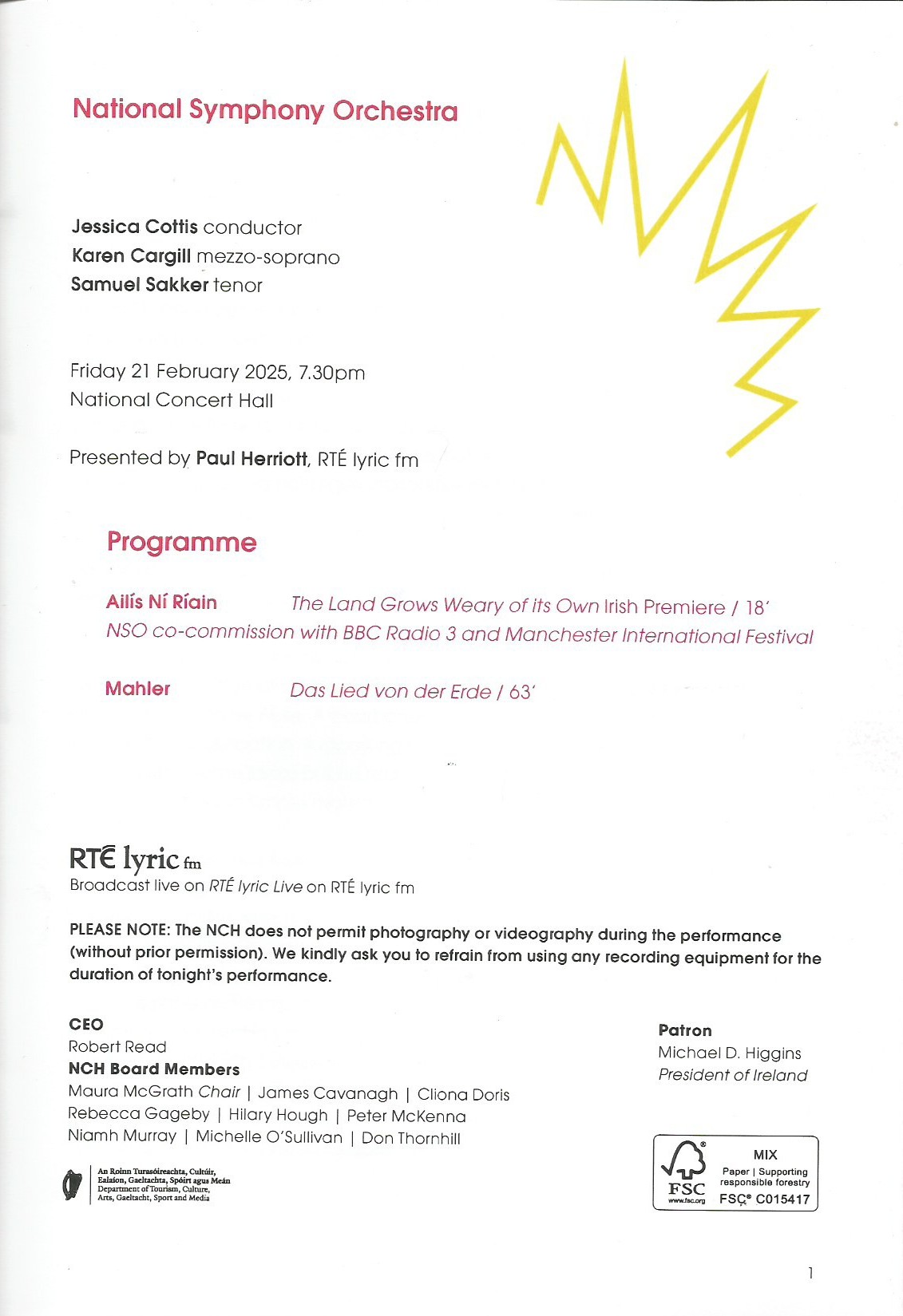
It was just over a year ago that I last went to the National Concert Hall in Dublin. That occasion was the opening of a new season of concerts for 2023-4 by the National Symphony Orchestra. After a year away on sabbatical, last night I went to the season opening of the next year of concerts by the National Symphony Orchestra, this time under the direction of Mihhail Gerts. I’m hoping to see more of the forthcoming season than I did the last!

The programme for the concert is shown in the picture. The first half was dominated by legendary mezzo-soprano Dame Sarah Connolly, resplendent in a turquoise frock, who sang six songs by Alma Mahler (born Alma Schindler) who was of course the wife of Gustav Mahler whose 1st Symphony we heard in the second half. Gustav famously (and reprehensibly) told Alma that she had to give up composing music when they married (which they did in 1902). Until then she had written not only songs but also piano music. Few of her compositions survive, however. Apparently she destroyed many of the manuscripts herself in later life. Of the fifty or so songs she is thought to have written, only 17 (including the 6 we heard last night) still exist on paper. She at least responded by outliving him by more than 50 years: Gustav died in 1911 and Alma Mahler passed away in 1964.

It’s very unfair to compare Alma Mahler’s settings with those of Gustav Mahler, who was a master of the orchestral song cycle. The compositions we heard all all quite short, three or four minutes, and are definitely influenced by Wagner. The first song, for example, deploys the famous Tristan Chord and there are passages that are clearly influenced by the Wesendonck Lieder. None of the manuscripts are dated, but in terms of style they do sound like late Romantic works from around 1900 when she was very young. Overall these works not at the same level of achievement of either Richard Wagner or Gustav Mahler but, with Sarah Connolly in fine voice, there was much to enjoy. I had never heard any of these songs before this evening, and it left me wondering what Alma Mahler might have achieved musically had she continued to compose. We’ll never know.

Before these songs we heard the concert overture In Nature’s Realm by Antonín Dvořák. This is also a piece that feels very late-19th Century (it was composed in 1891). It’s a sort of homage to the beauty of the composer’s native Bohemia with distinct echoes of Beethoven’s Pastoral Symphony, I thought.

After the interval wine break we returned for the second half which consisted of (Gustav) Mahler’s Symphony No. 1 in D Major. This is a very familiar concert work nowadays, but it’s worth remembering that it didn’t exactly set the world on fire when it was first performed in 1889 and Mahler revised it extensively before it arrived at the form now usually performed. Like all Mahler symphonies it covers a vast territory. One of the most famous Mahler quotations is “the symphony is a world”, but in the case of his own symphonies each movement is a world. The first movement begins in hesitant and fragmentary fashion before bursting into life with a metaphorical evocation of daybreak. The second movement is earthier and more forceful, quoting from folk songs and country dances. The third is my favourite, with its humorously up-beat references to Klezmer music before ending in a kind of funeral march. The final movement is tempestuous at first, then calm, then erupts into a glorious finale.

Last night’s performance was broadcast live on RTÉ Lyric FM but what radio listeners won’t have got was the thrilling sight of a symphony orchestra in full flood. At the end of the last movement, members of brass section stood up to give extra power to the climactic resolution of the piece. Mahler does “loud” very well indeed, but I was impressed by the spectacle too: the lights gleaming off the array of trombones and horns as they blasted out the final phrases (in another context I would call them “riffs”). Great stuff, and very well received by the audience.

P.S. On the way into Dublin to see last night’s concert I realized that the Irish Rail timetable had changed while I was away so, instead of terminating at Connolly (the station, not the mezzo-soprano), the train I was on went all the way through to Pearse, thereby saving me a bit of time walking. It only takes about 20 minutes (for me) to walk from Pearse to the NCH, in case you’re wondering, and I do like a bit of a walk to stretch my legs before sitting down for a couple of hours at a concert.

September – Herman Hesse

Posted in Music, Poetry with tags , , , on September 2, 2024 by telescoper

Der Garten trauert,
kühl sinkt in die Blumen der Regen.
Der Sommer schauert
still seinem Ende entgegen.

Golden tropft Blatt um Blatt
nieder vom hohen Akazienbaum.
Sommer lächelt erstaunt und matt
in den sterbenden Gartentraum.

Lange noch bei den Rosen
bleibt er stehen, sehnt sich nach Ruh.
Langsam tut er die großen
müdgewordnen Augen zu.

by Hermann Hesse (1877-1962)

This poem was set to music in September 1948 by Richard Strauss and became one of his famous Four Last Songs. It was in fact the last of these songs he composed, although it is usually performed as the second song in the sequence. Strauss died in September 1949.

The first verse translates roughly as:

The garden is mourning,
cool sinks the rain sinks into the flowers.
Summer shudders
as it meets its end.

Juju Music – King Sunny Adé & His African Beats

Posted in Biographical, Music with tags , on September 1, 2024 by telescoper

I was obliged to take a taxi home from last week’s appointment. Taxi drivers don’t always make the best company, but this time I was lucky. The driver was a nice friendly chap with an infectious laugh, and when I had settled into my seat he asked me if he wanted him to turn the music down. I said no, it was fine. It wasn’t loud anyway. After a little while I realized that I really liked the music (which I hadn’t heard before) so I asked him to turn it up a bit. He smiled into the mirror, turned up the volume, and thereafter started humming and singing along. I made a note of the name of the band and the record in the hope that I could find it on YouTube, which I did.

Here we are then. This is Juju Music by Nigerian musician King Sunny Adé and his African Beats. Apparently it’s quite a famous record – it was released way back in 1982. I love the complex polyrhythms so typical of African music, and there’s some fine guitar playing on it too. I’ve been listening to it off and on over the whole weekend, so I thought I’d share it here. Enjoy!

Quasar – The Jimmy Giuffre 4

Posted in Jazz with tags , , , , on August 19, 2024 by telescoper

Jimmy Giuffre (1921-2008) was an immensely gifted saxophonist and clarinet player who was also an accomplished arranger and composer who worked for many big bands. His most famous piece as an arranger was Four Brothers which he wrote for Woody Herman’s fantastic saxophone section of Stan Getz, Zoot Sims, Serge Chaloff and Herb Steward. My first encounter with Giuffre as an instrumentalist was in the opening track of the 1958 film Jazz on a Summer’s Day playing a tune called  The Train and the River which has been a favourite of mine for many years. Back then he had a quite accessible style that blended jazz with folk elements, but he later developed a freer and more “modern” approach, including the use of electronic instruments and elements of jazz/rock fusion. I recently read a biographical article about him and – for obvious reasons – was intrigued that in 1985 he made an album called Quasar so I thought I’d share the title track here. Giuffre is on soprano sax on this one.

Ben Webster in Copenhagen

Posted in Jazz with tags , , , , , on July 9, 2024 by telescoper

The great tenor saxophonist Ben Webster moved to Europe in 1964 and spent much of the rest of his life in Denmark until he passed away in 1973. After his cremation, his ashes were interred in the Assistens Kirkegård in Copenhagen; I visited his grave many moons ago:

That’s a bit of context for a beautiful clip I just stumbled across and couldn’t resist sharing here. It was filmed in Copenhagen in 1965 in the intimate surroundings of the apartment of Danish bass player Niels-Henning Ørsted Pedersen (who plays on the track), with Ole Steenberg on drums and Kenny Drew on piano. Kenny Drew is also buried in the Assistens Kirkegård, in a grave not far from Ben Webster’s.

This is a fine demonstration of Webster’s beautifully tender way of playing ballads, in this case George Gershwin’s Someone to Watch Over Me.

All Things You Are – Joe Pass

Posted in Jazz with tags , , , on June 23, 2024 by telescoper

I wrote a piece a while ago about the richness of  Jerome Kern’s great tune All The Things You Are. Here’s an example in the form of a wonderful live version on solo guitar by the great Joe Pass.

The Mooche – Steve Lacy

Posted in Jazz with tags , , , , , on June 15, 2024 by telescoper

Duke Ellington’s tune The Mooche, composed in 1928, belongs to an era that spawned many other atmospheric classics such as Luis Russell’s Call of the Freaks and Don Redman’s Chant of the Weed. Fifty years later the menacing undertone of The Mooche was seized upon by saxophonist Steve Lacy and turned into an unforgettably raw version on his 1978 album Points (which I bought on vinyl when it first came out) in which he duets on soprano with Steve Potts, delivering the haunting minor-key theme with a sound like knives being sharpened.

All The Things You Might Be

Posted in Jazz with tags , , , on April 29, 2024 by telescoper

Apparently the great American songwriter Jerome Kern didn’t like Jazz at all. It’s ironic therefore that his tune All The Things You Are is such a favourite among Jazz musicians, sometimes played as it is and sometimes forming the underlying chord progression for some other tune. Here it is, sung by the sublime Ella Fitzgerald:

The first things you learn if you try to teach yourself something about how jazz works is that there are two basic forms: the Twelve-bar Blues and the Thirty-two-bar form built from an A section and a B section (the bridge) arranged AABA. It’s true that this gets you quite a long way but it doesn’t take you long to realize that many famous Blues are not based on 8 or 16 -bar cycle and many of those that are 12-bar blues don’t have the standard progression. Then you find out that some of the most well-known Jazz standards aren’t AABA either.

All The Things You Are is an example. The chorus of this tune actually consists of 36 bars in a A1A2BA3 form with two twists on the usual 32-bar AABA song-form: A2 transposes the initial A section down a fourth, while the final A3 section adds an extra four bars. The result is much easier to lose your way when you try to improvise but, on the other hand, provides a very rich framework within which to experiment. That’s obviously why Jazz musicians like it so much.

Here is a backing track for this tune that shows you the chords without the melody. Although I’m a fairly incompetent musician I love trying to play along to this sort of thing, playing the melody for one chorus to find your feet and then just letting the chords suggest possibilities. It’s tremendous fun and very rewarding if you do manage to play something original, even if it makes Jerome Kern turn in his grave.

Revolução dos Cravos

Posted in History, Music, Politics with tags , , , , , , on April 25, 2024 by telescoper

My office mate in Barcelona is Portuguese and he very proudly reminded me this morning that today, 25th April 2024, is the 50th anniversary of the Carnation Revolution that ultimately overthrew a fascist dictatorship and led Portugal towards becoming a progressive democracy. Just over a year later, General Franco died and Spain began its transition to democracy too. Both countries joined the European Community in 1986 and are now members of the European Union. It’s hard to believe, only 50 years on, that fascism is on the rise once more in Europe (and elsewhere). That makes it all the more important to remember the struggles of the not-so-distant past.

The signal for the Revolução dos Cravos in Portugal to begin was a song played on the radio. The result was remarkable. Although led by military officers dissatisfied with the ruling regime, it garnered a huge level of popular support and morphed into a coordinated campaign of mass civil resistance. When regime change was achieved, it was largely peaceful. The name “Carnation Revolution” refers to the flowers given to soldiers by people celebrating their liberation from authoritarianism.

Fascismo nunca mais! Vinte e cinco de abril sempre!

I couldn’t help sharing the song that triggered that huge historical moment. It is Grândola, Vila Morena by Zeca Afonso. Few people can lay claim to have written a song that brought down a dictatorship.

Mad about the Boy – Blossom Dearie

Posted in Jazz with tags , , , , , , on April 17, 2024 by telescoper

The song Mad about the Boy was written by Noel Coward and published in 1932. It’s a song about an infatuation with a movie star and has generally been performed by female singers, although it was apparently inspired by Coward’s own crush on Douglas Fairbanks Jnr (which wasn’t reciprocated). The song became popular again in 1992 when a version recorded by Dinah Washington was used in a famous Levi commercial. . I never liked Noel Coward’s own recording – with him singing in a curious falsetto – very much at all, although I suppose it is authentic to what Coward was writing about. For a long time my favourite version was Dinah Washington’s but recently I came across this version, which has now, for me, eclipsed that one.

Blossom Dearie was a very underrated singer and pianist. Her voice – very high and girlish – was well suited to the whimsical songs she seemed to like to sing, but it meant that she wasn’t taken as seriously as a singer as she might have been. The lack of appreciation of her singing also extended to her piano playing, which was consistently excellent and innovative. No less a pianist than the great Bill Evans was a huge admirer of her musicianship, and he even attributed his use of stacked fourths in the left hand as inspired by Blossom Dearie. Other reasons to like this recording are that it was made live at Ronnie Scott’s Club in London and she goes straight into a verse that’s missed in many versions, probably because it uses the word “gay”. I love the way the accompaniment changes the mood each time she repeats the verses.