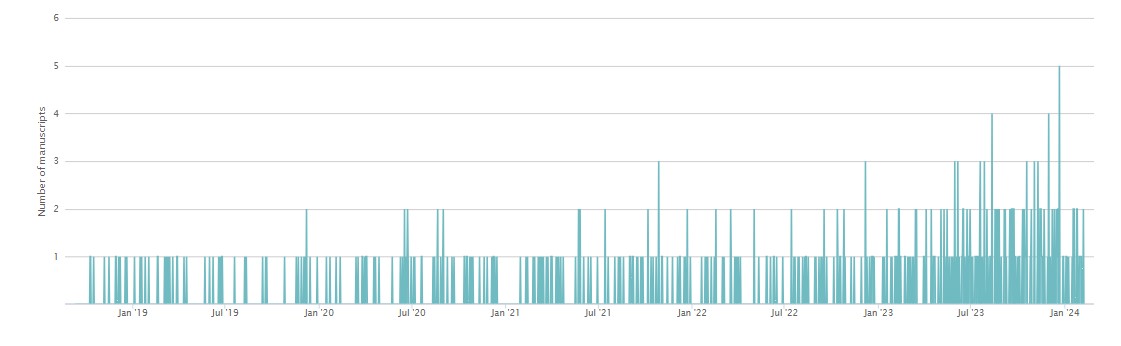
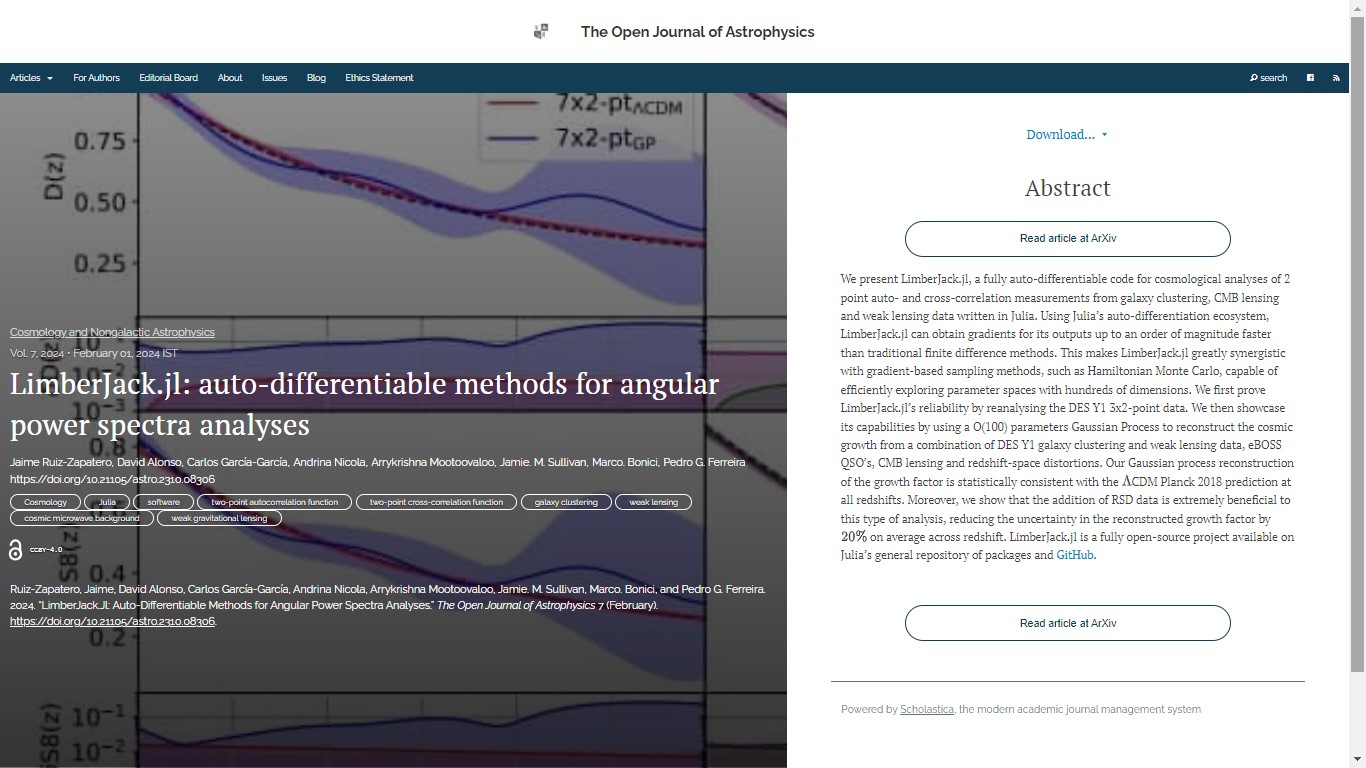
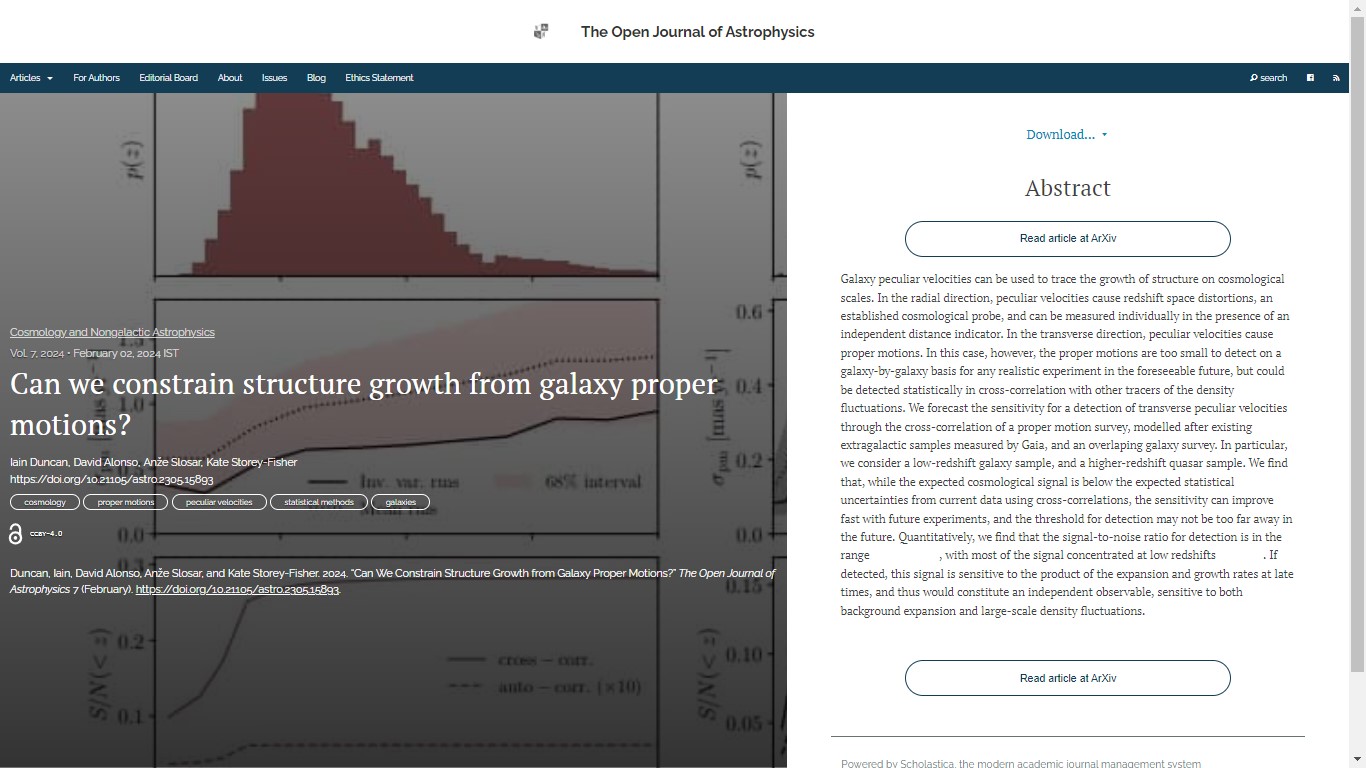
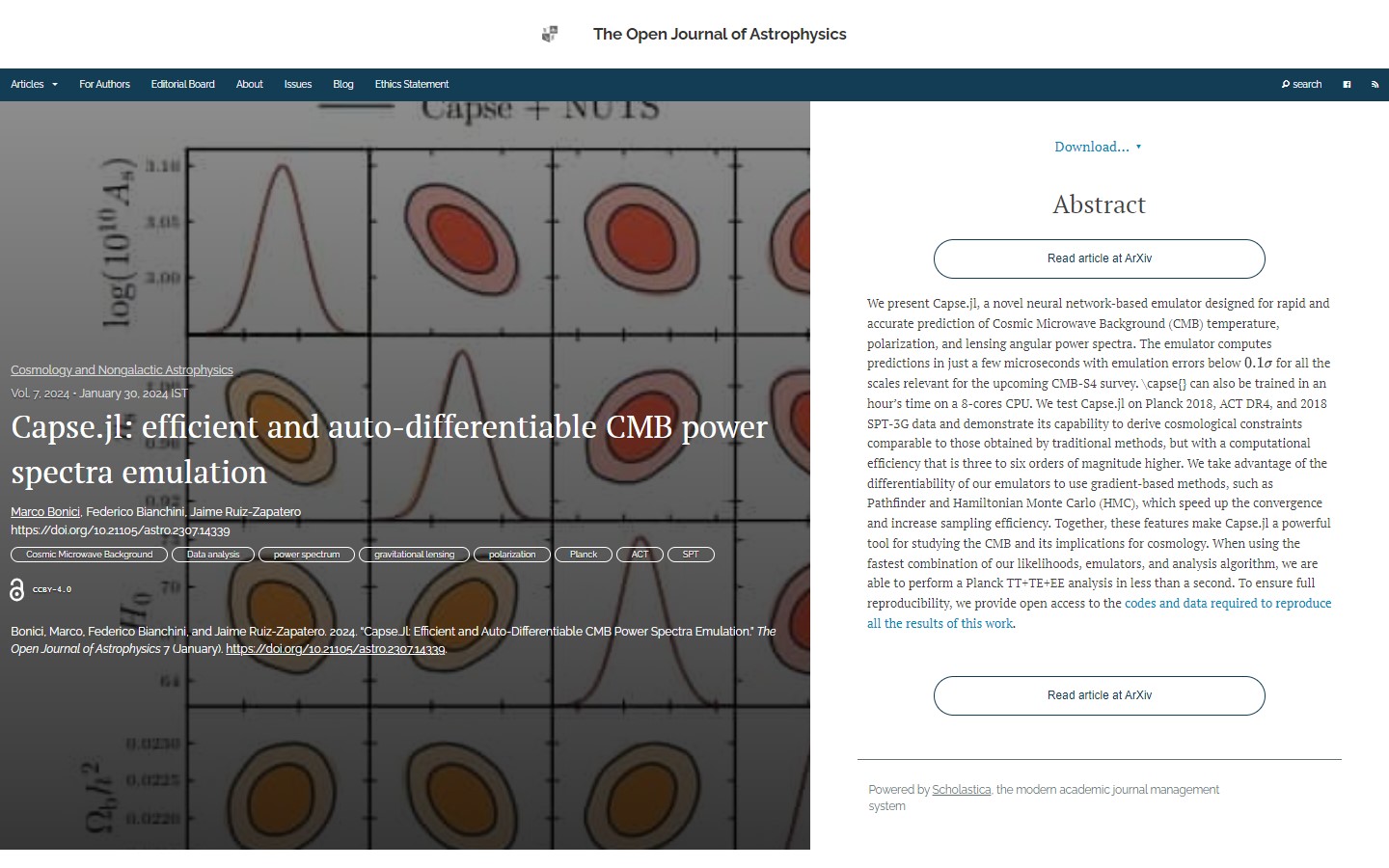
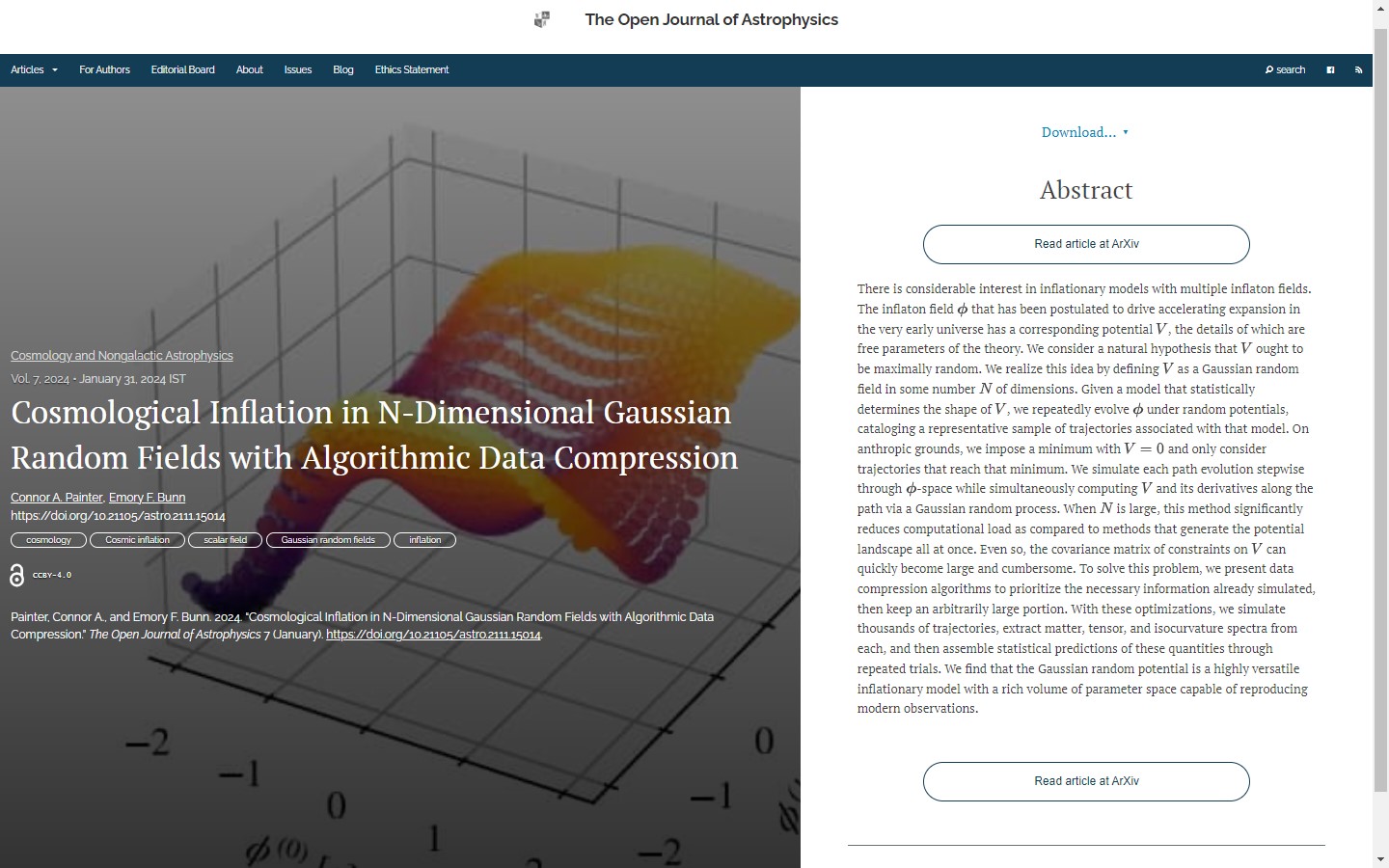
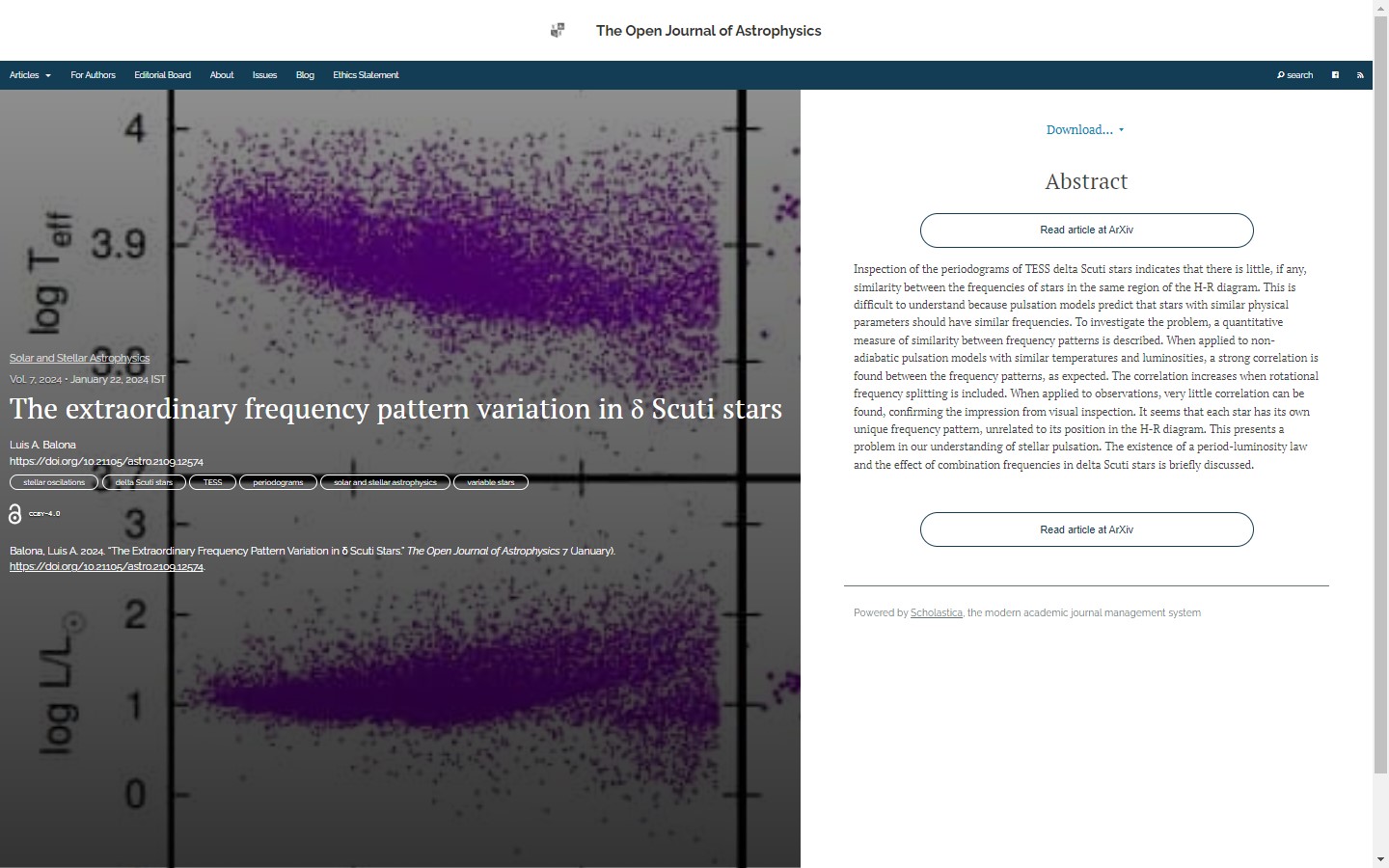
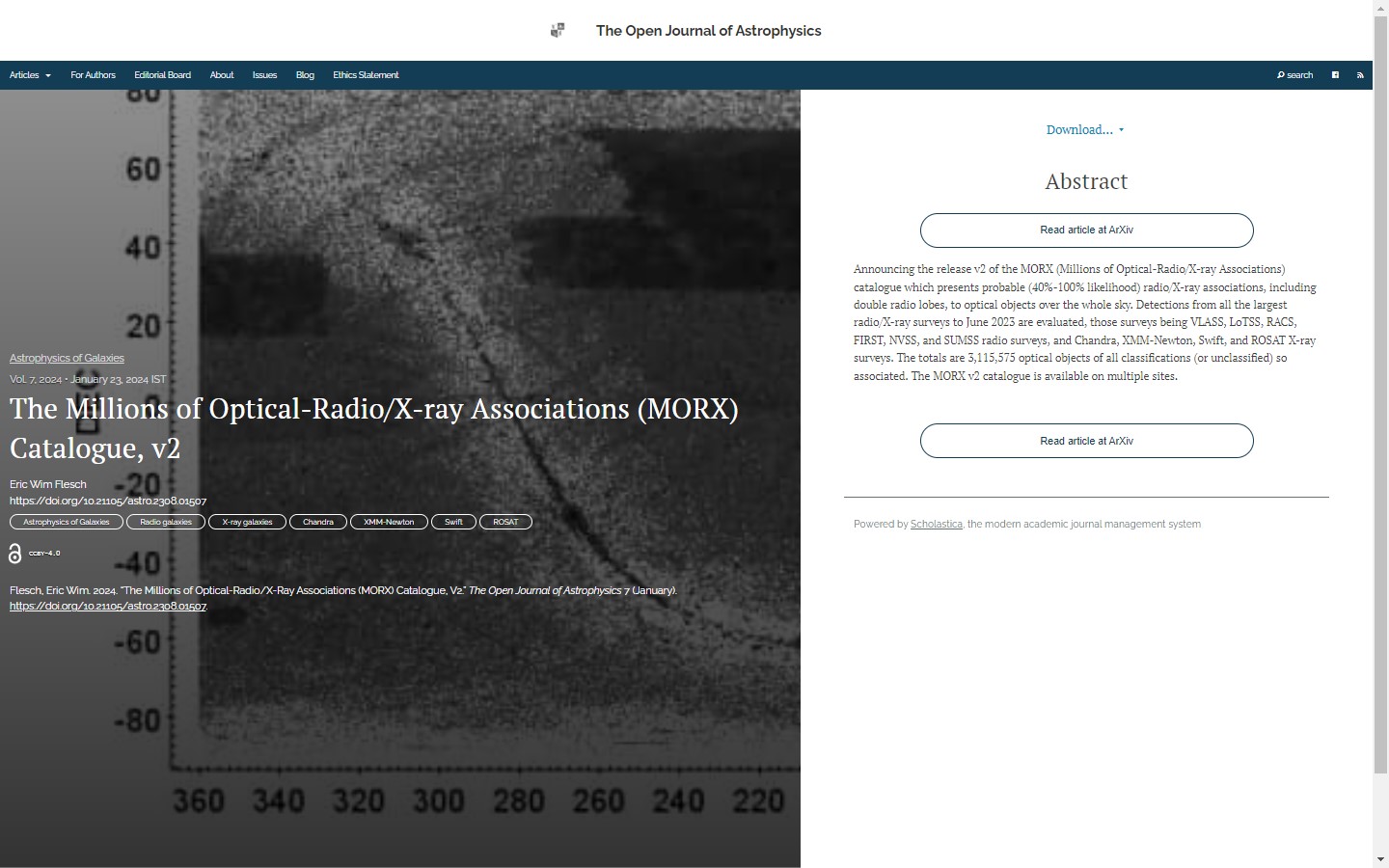
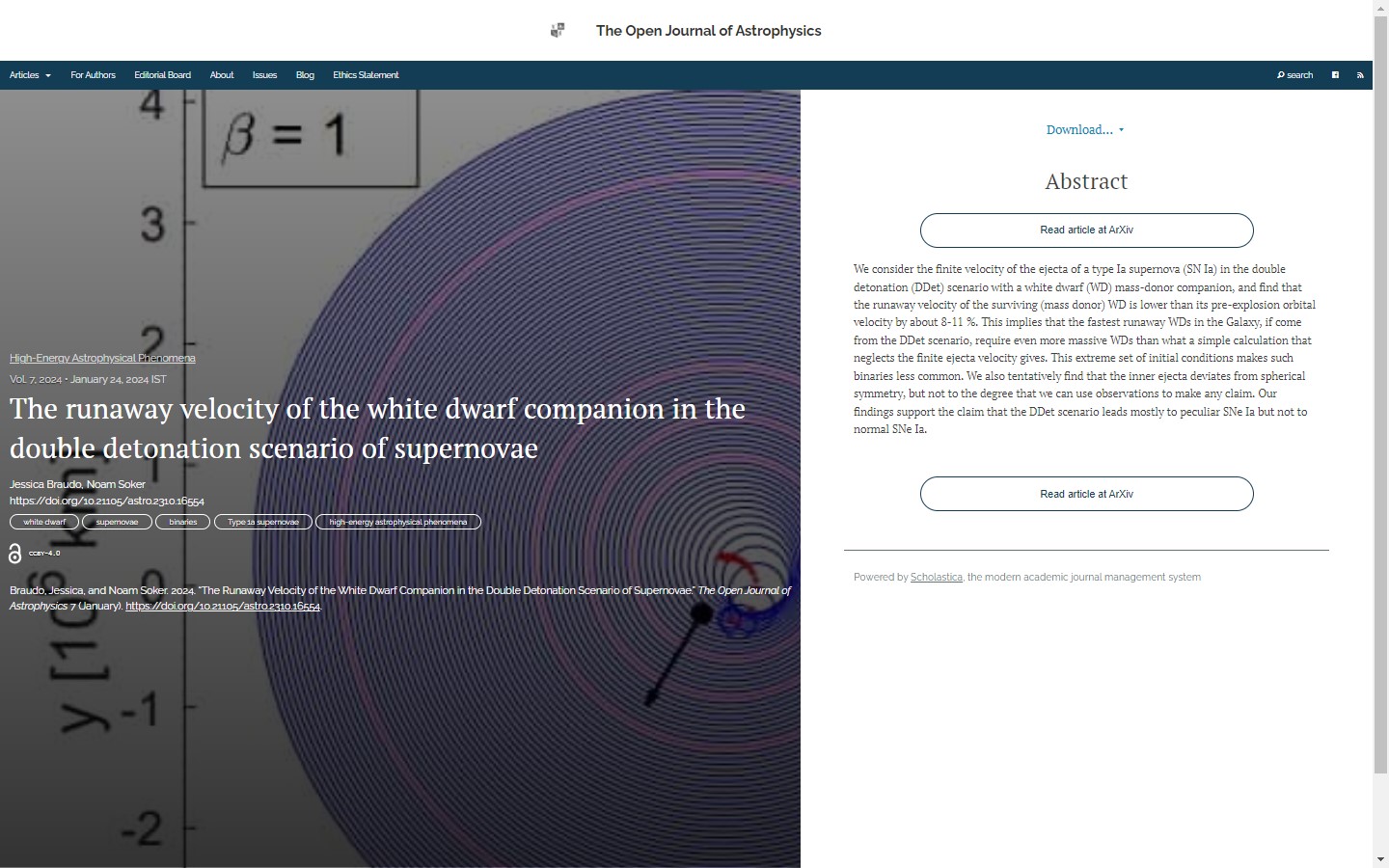
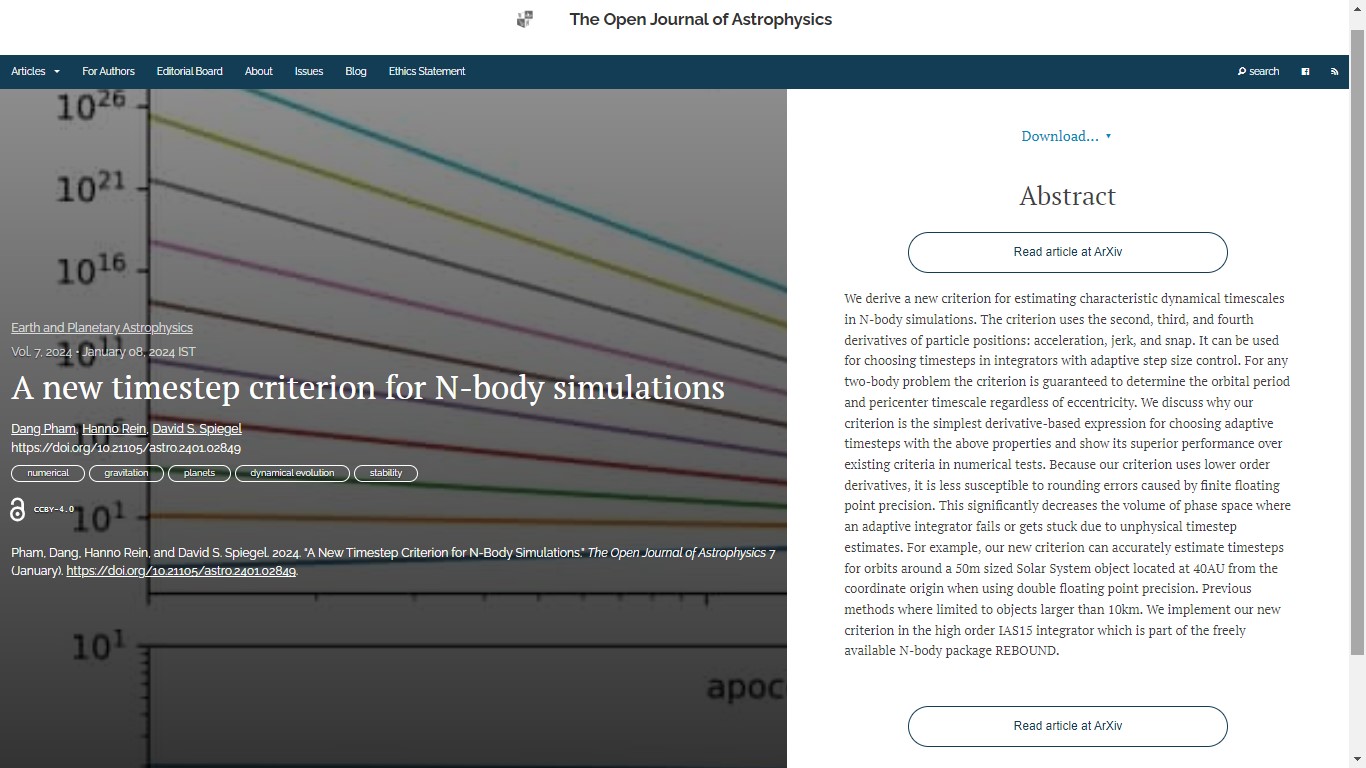
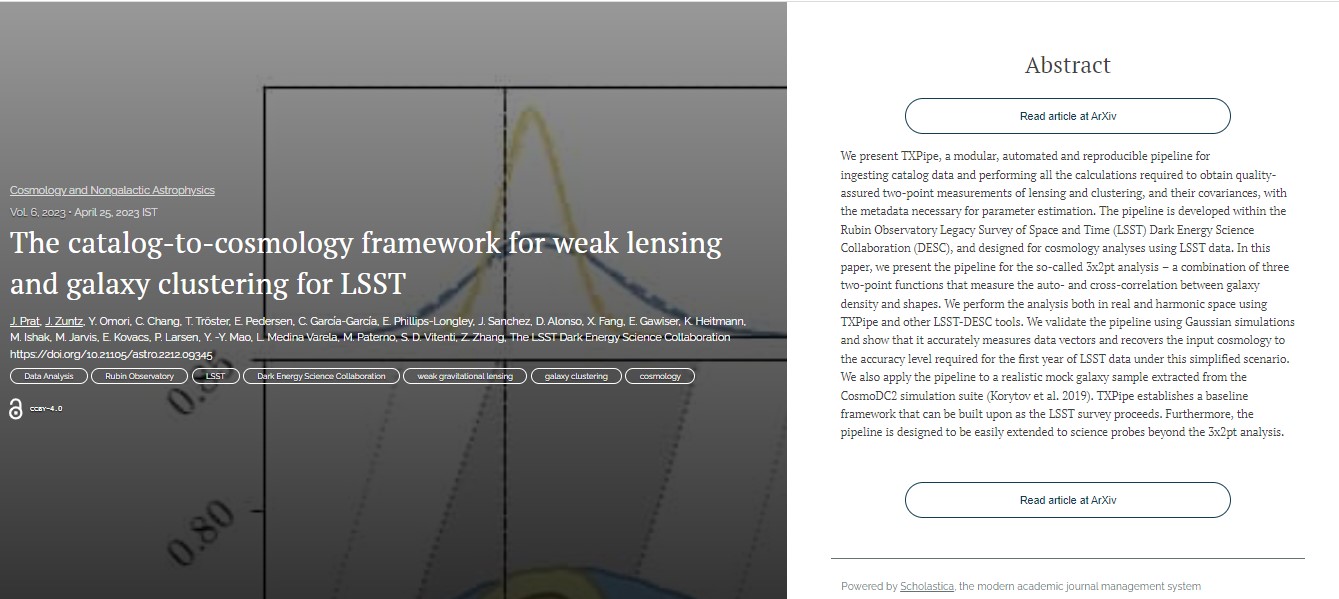
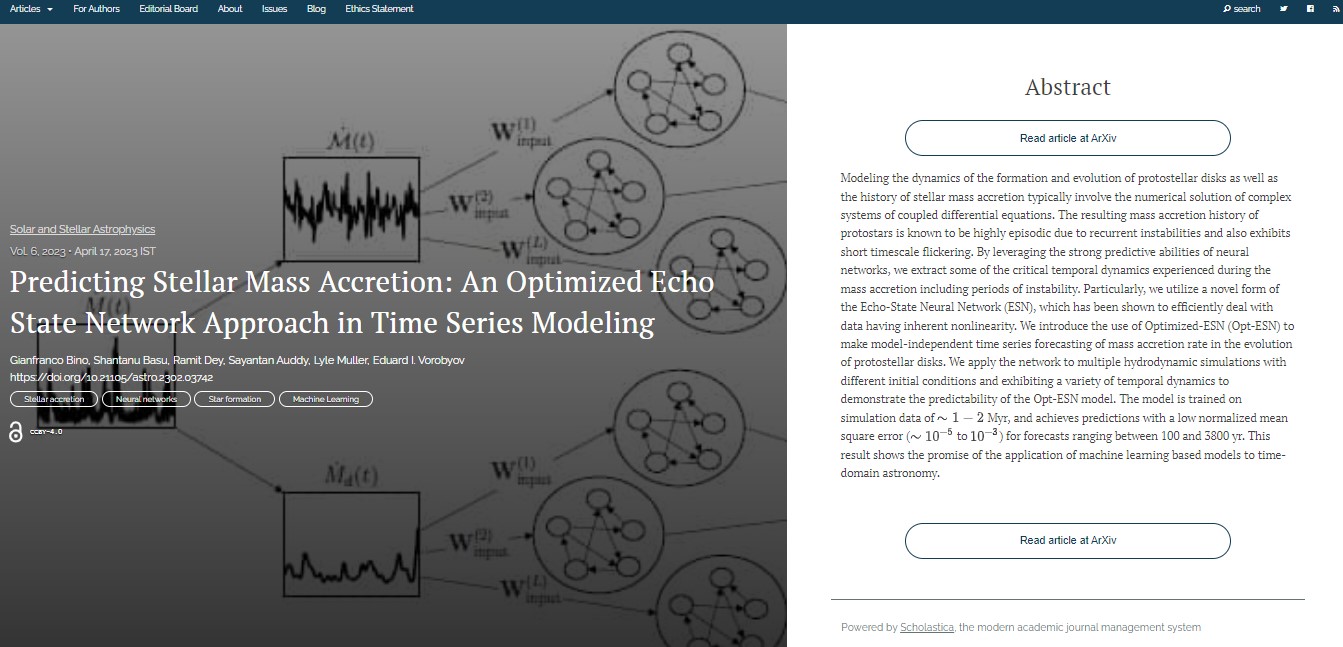
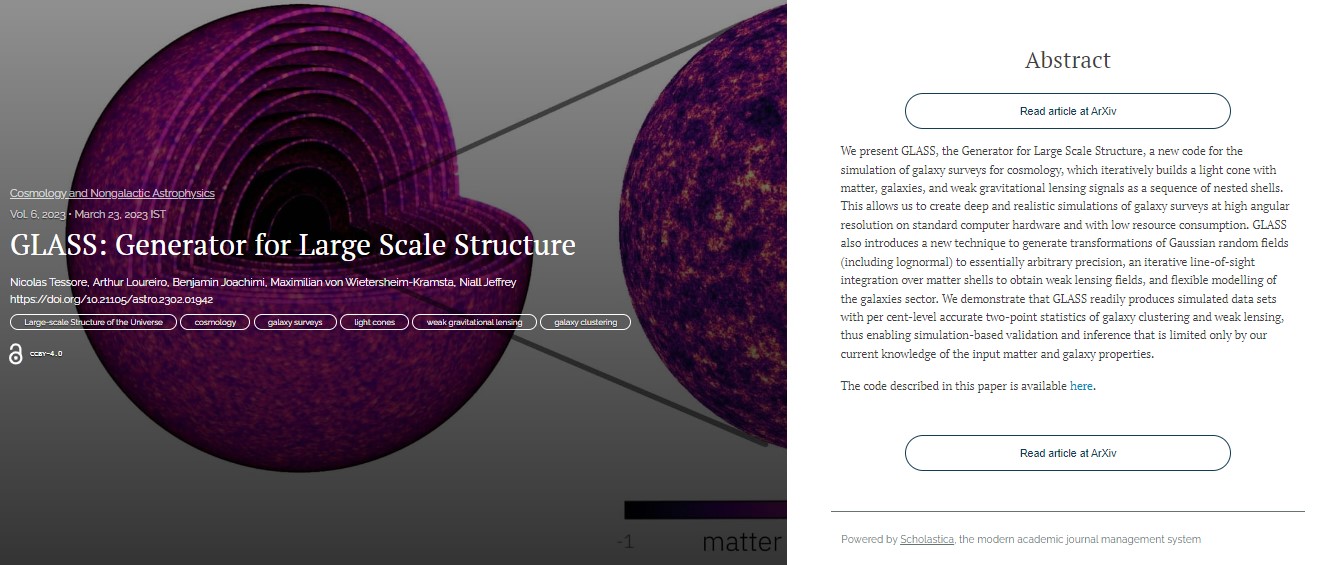
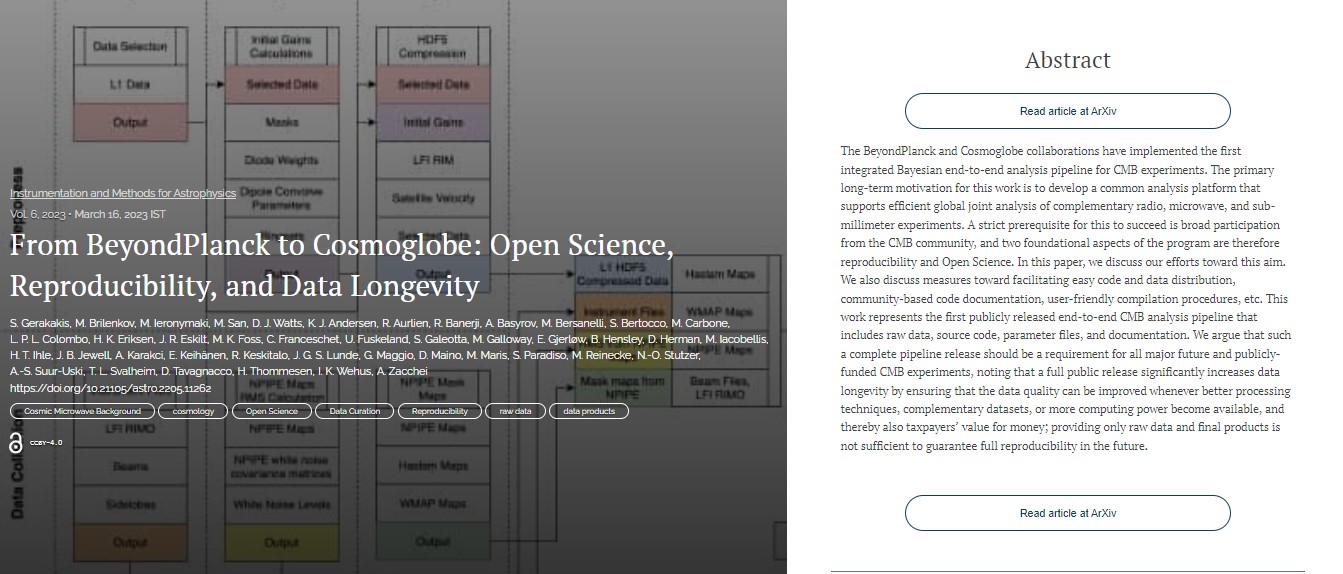
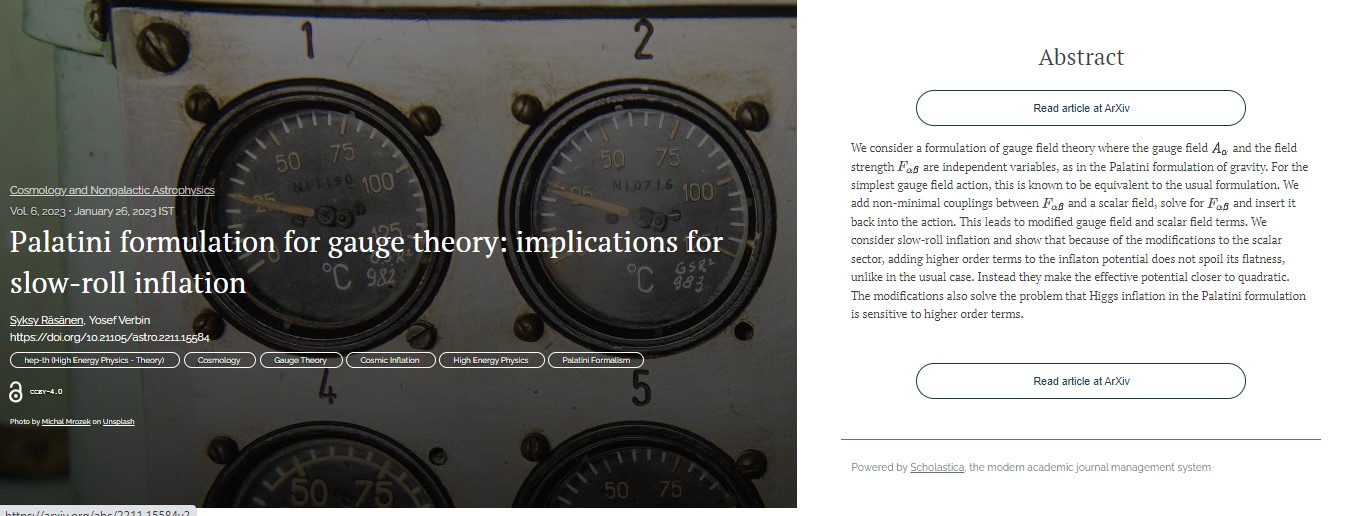
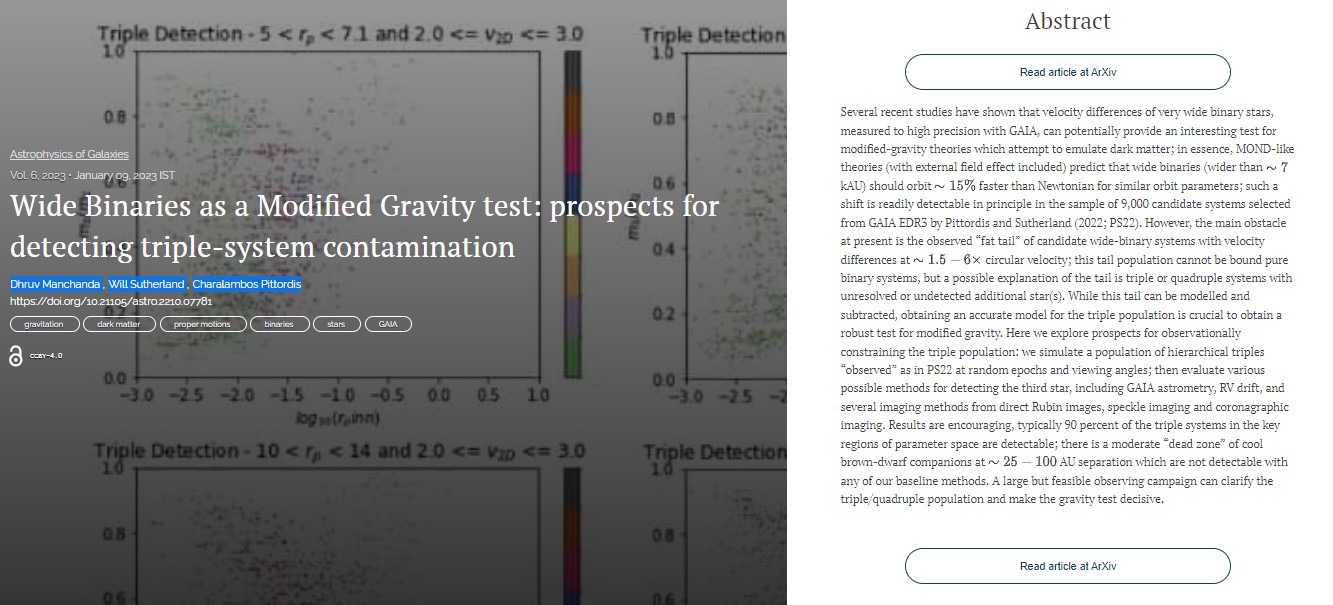
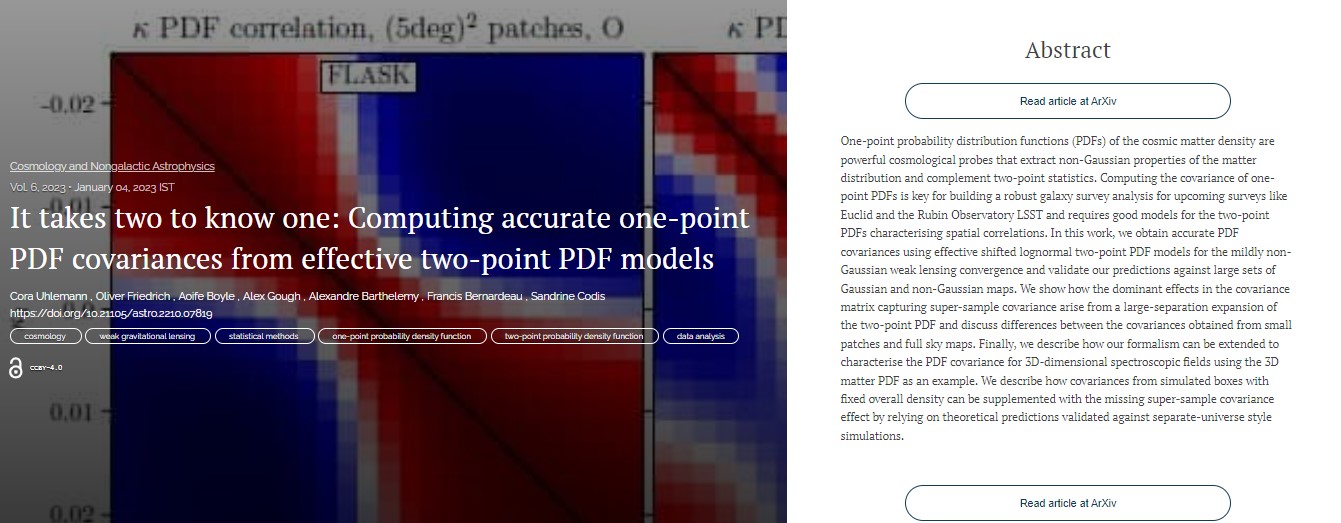
It’s New Year’s Eve and I just remembered that there was a paper at the Open Journal of Astrophysics site that we published before Christmas but that I haven’t yet announced on here, so for the sake of completeness here it is. It takes us to 50 papers published in 2023.
The paper in question is the 50th and final paper in Volume 6 (2023) and it’s the 115th altogether. This one was actually published on Friday 22nd December 2023 but owing to the vacations we had to wait a bit to get the metadata registered.
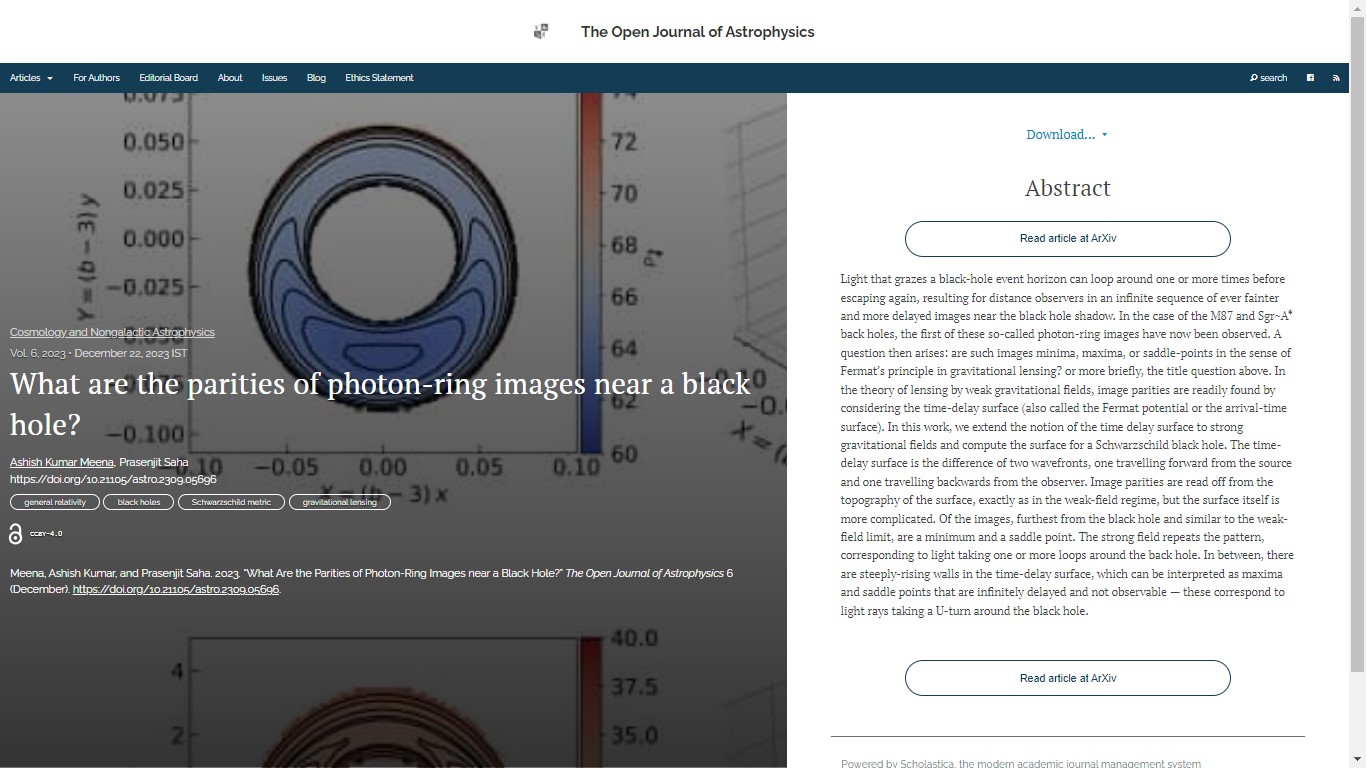
The title of this one is “What are the parities of photon-ring images near a black hole?” and is a discussion of the Fermat potential (also known as the arrival-time surface) in the context of gravitational lensing by strong gravitational fields and the implication for image parities thereby produced. This one is actually listed in General Relativity and Quantum Cosmology (gr-qc, on arXiv) but is cross-listed as Cosmology and Non-galactic Astrophysics so is eligible for publication here in the appropriate folder.
The authors are Ashish Kumar Meena (Ben Gurion University of the Negev, Israel) and Prasenjit Saha (University of Zurich, Switzerland).
Here is the overlay of the paper containing the abstract:
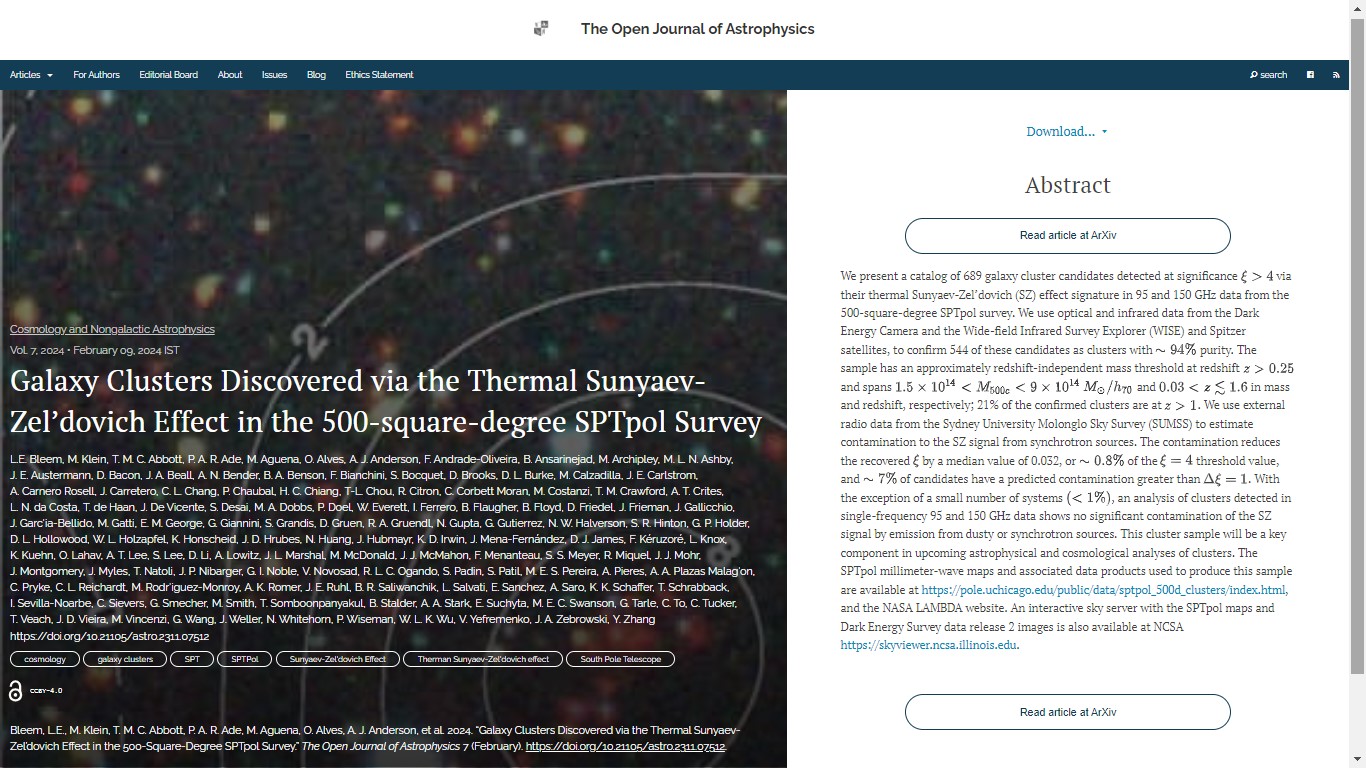
You can click on the image of the overlay to make it larger should you wish to do so. You can find the officially accepted version of the paper on the arXiv here.
And that concludes Volume 6 of the Open Journal of Astrophysics. Roll on Volume 7.
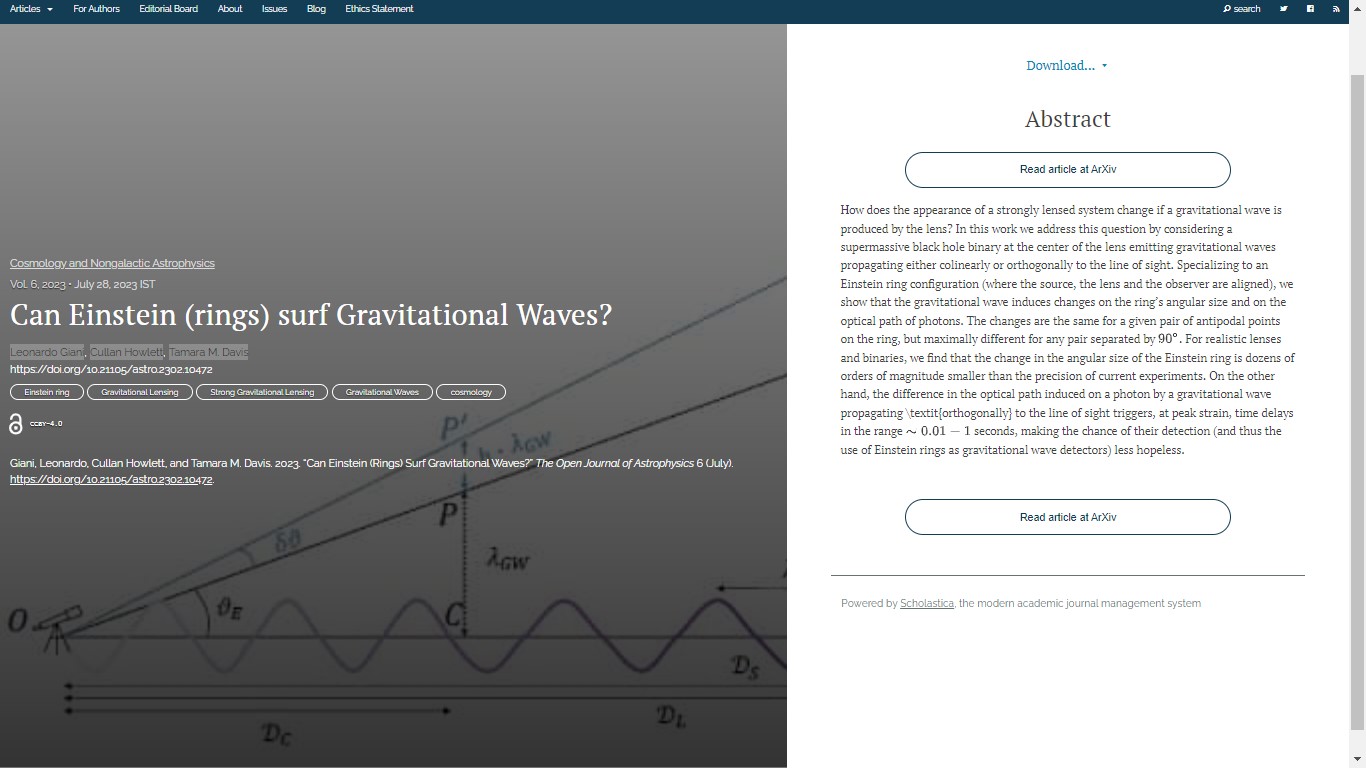
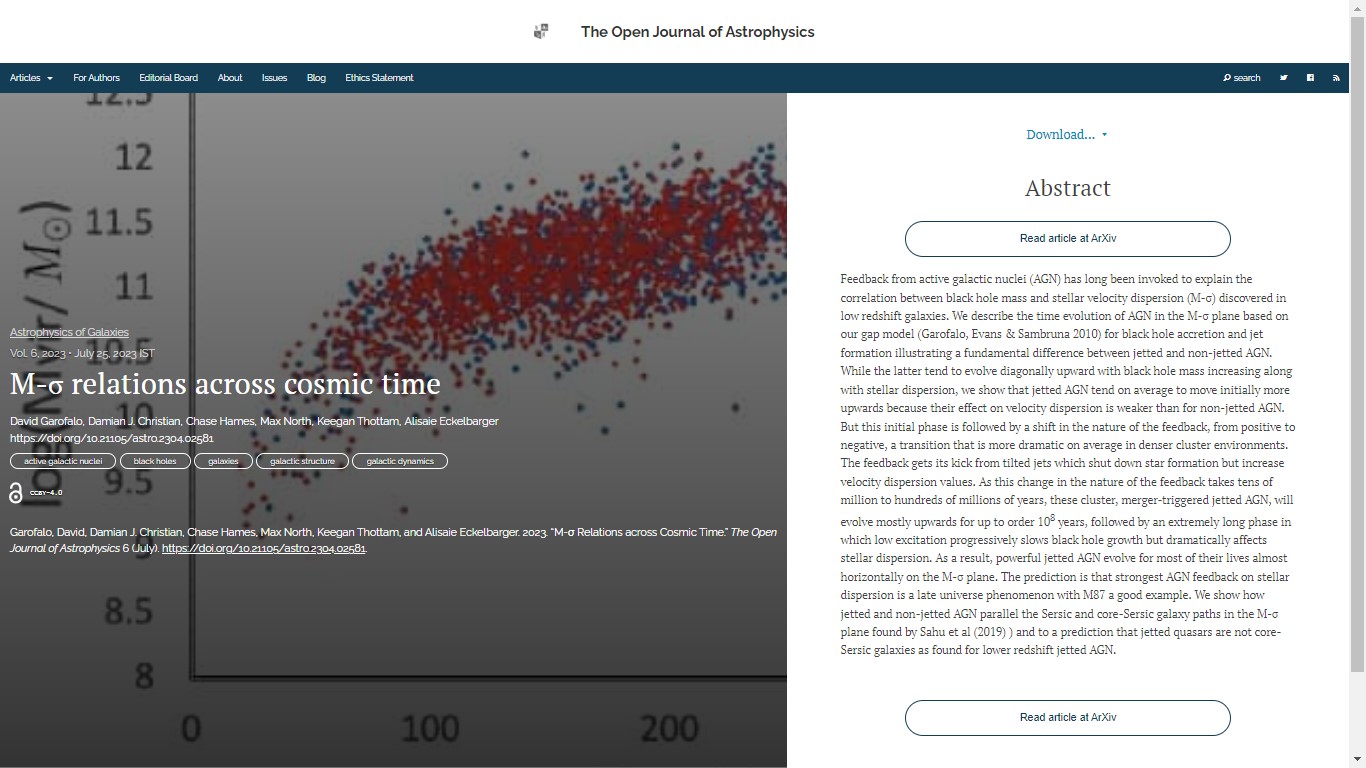
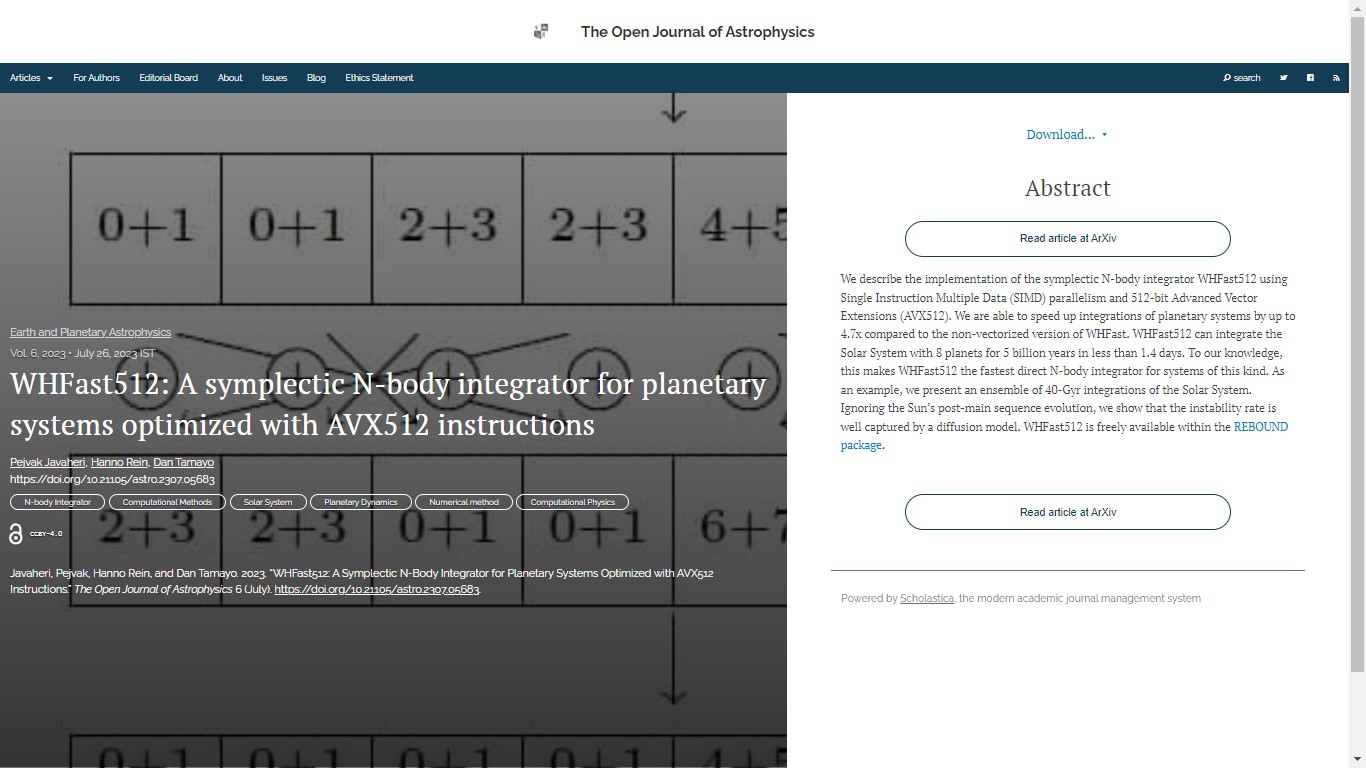
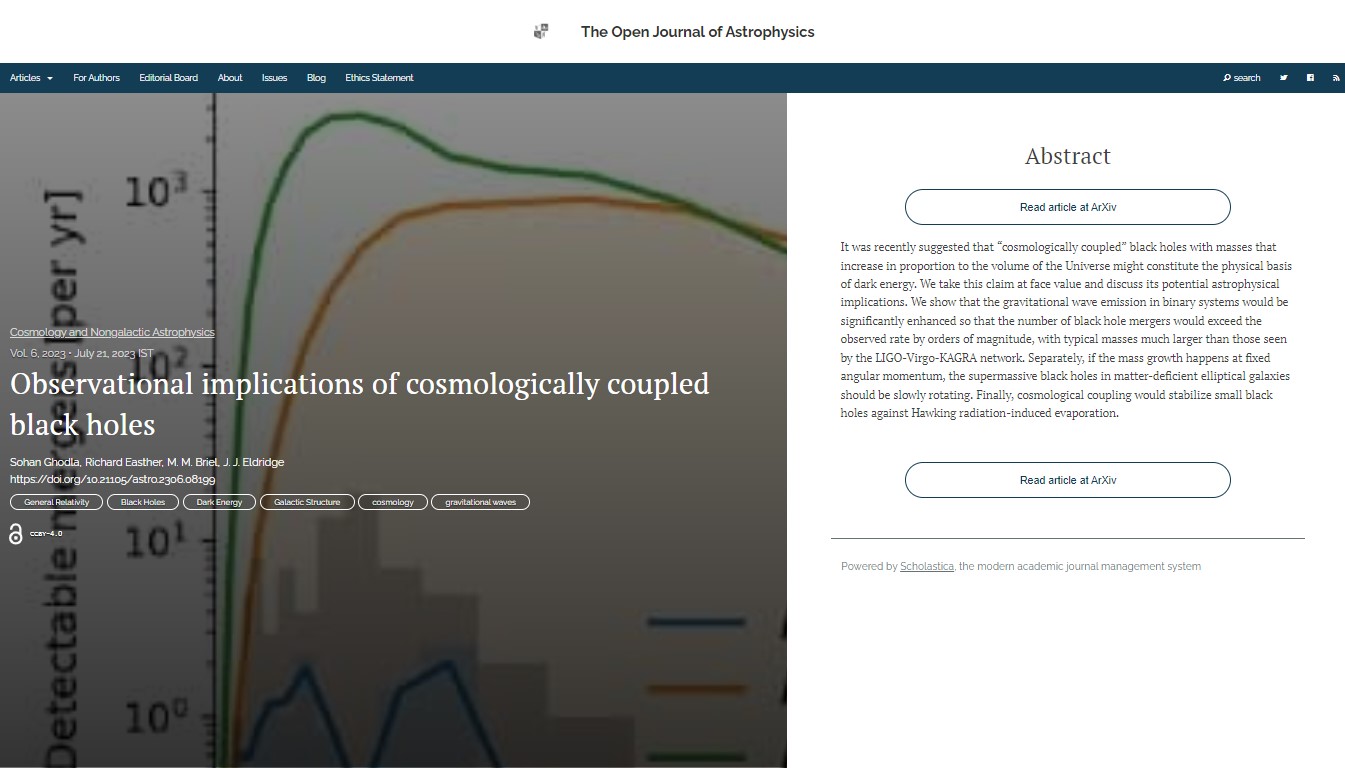
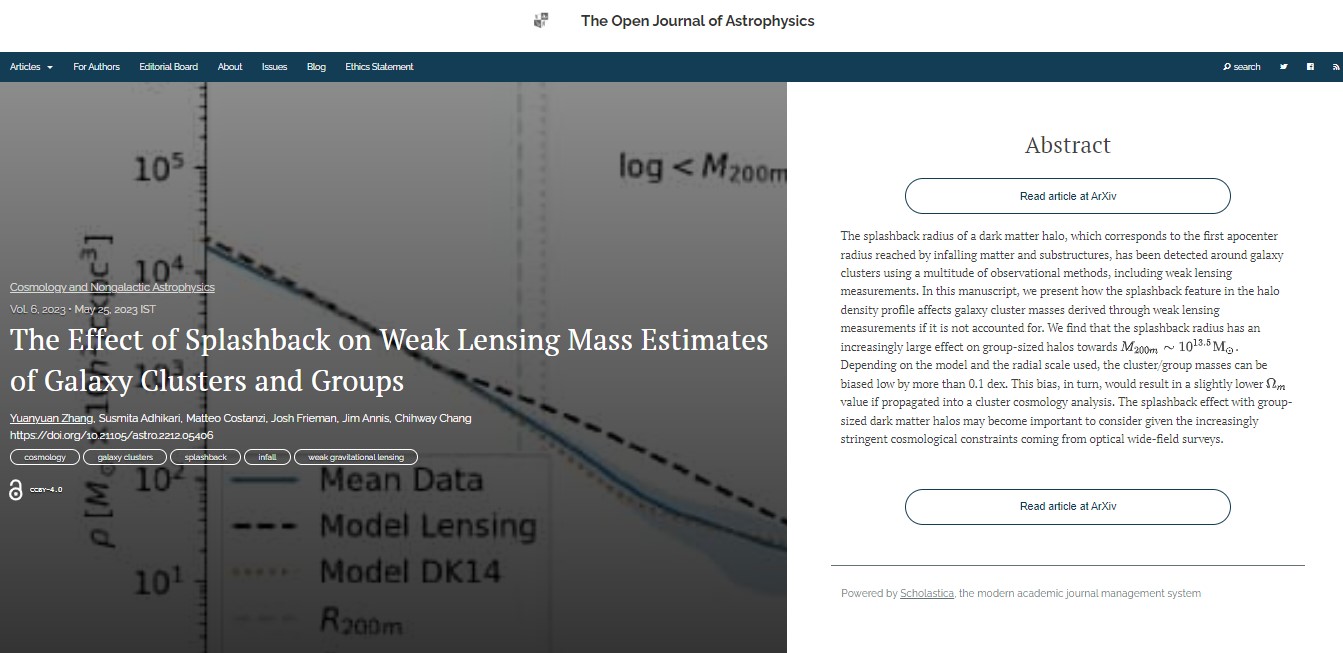
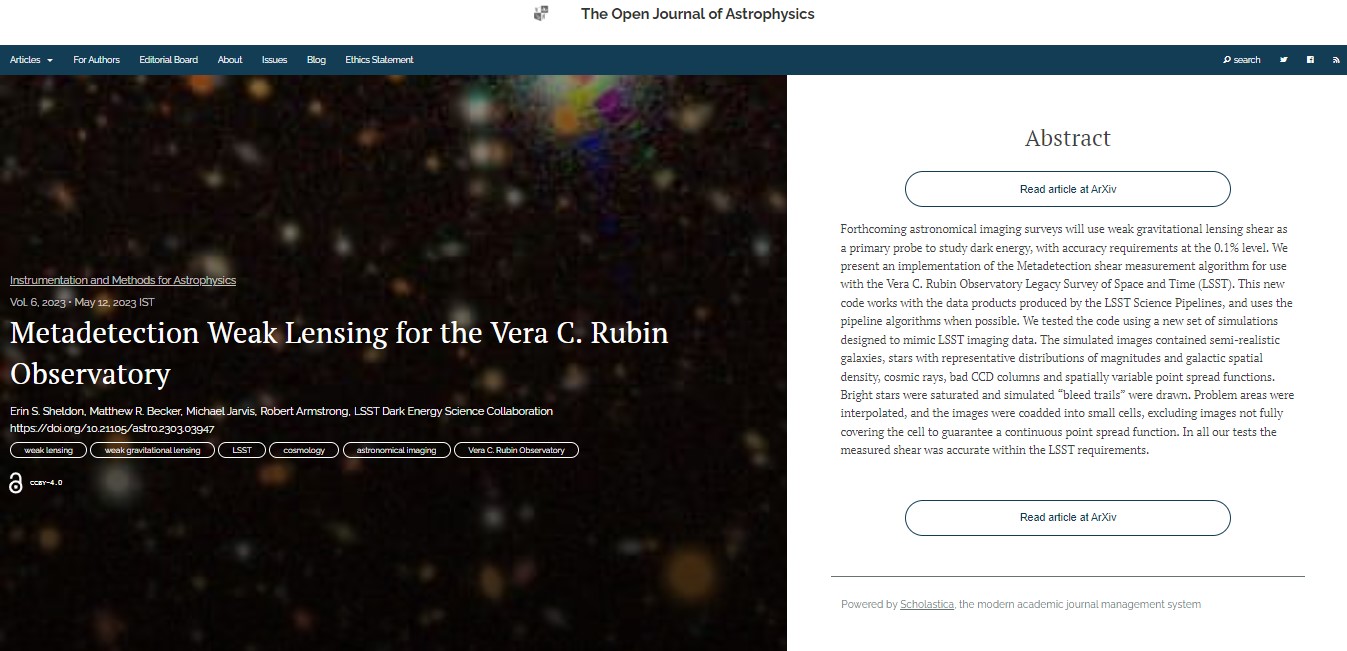
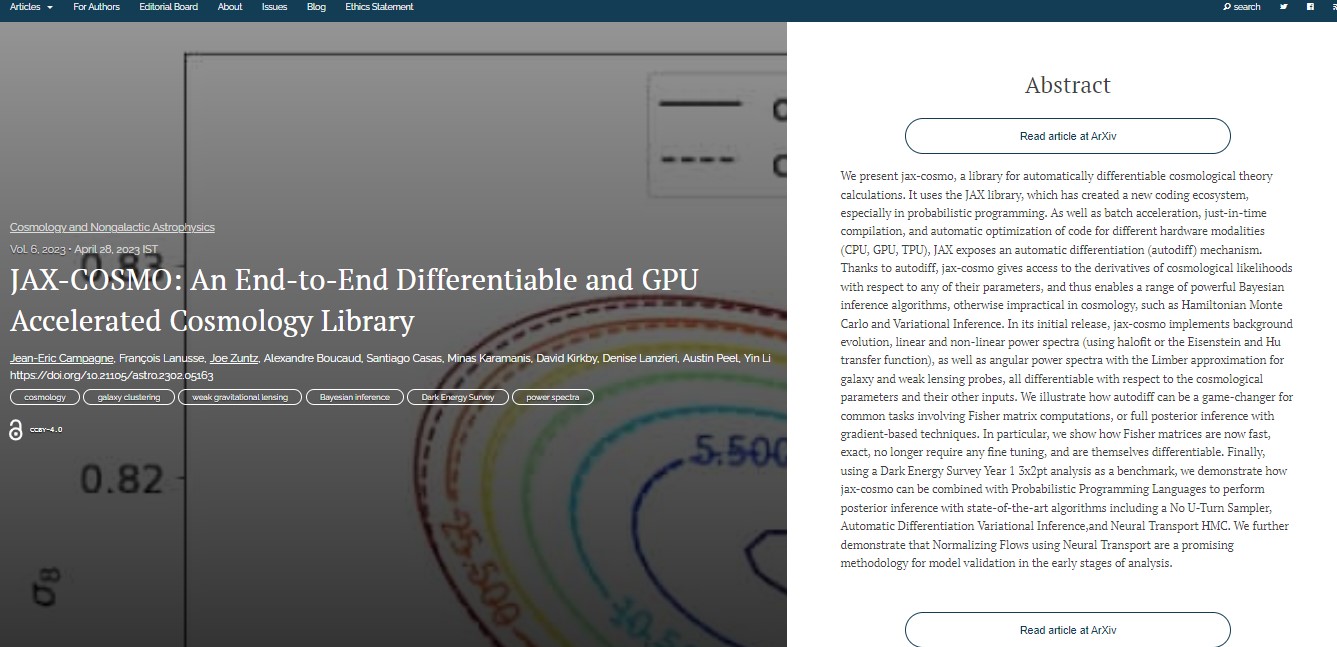
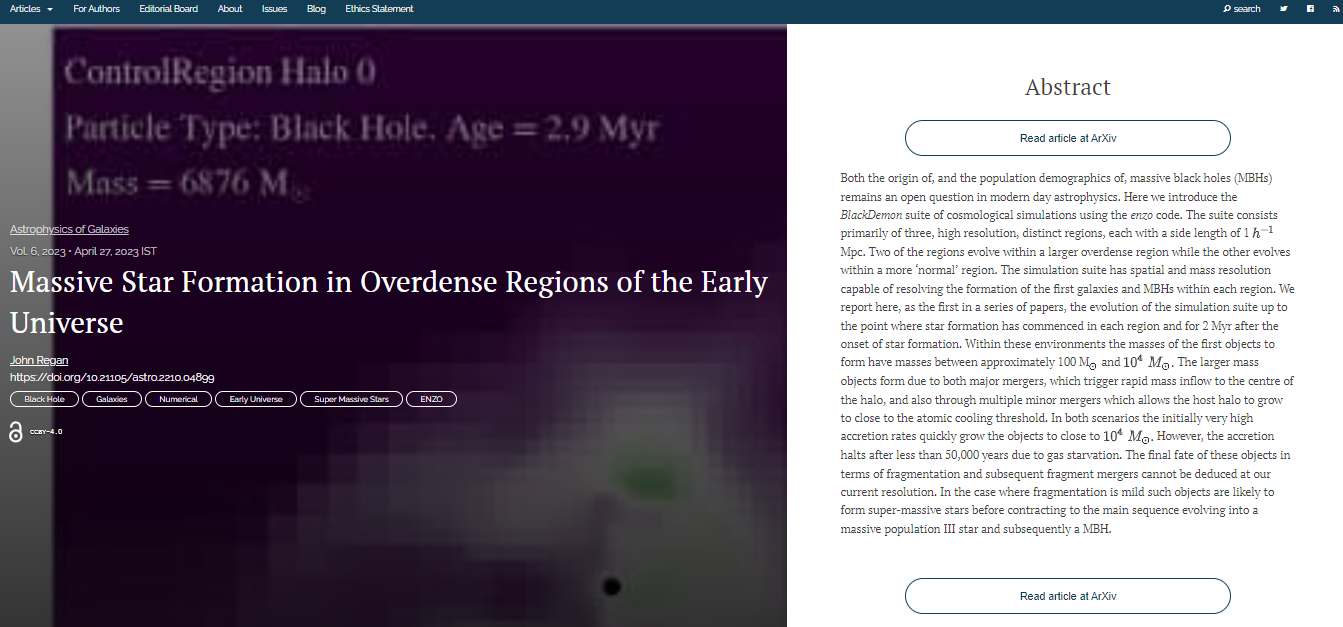
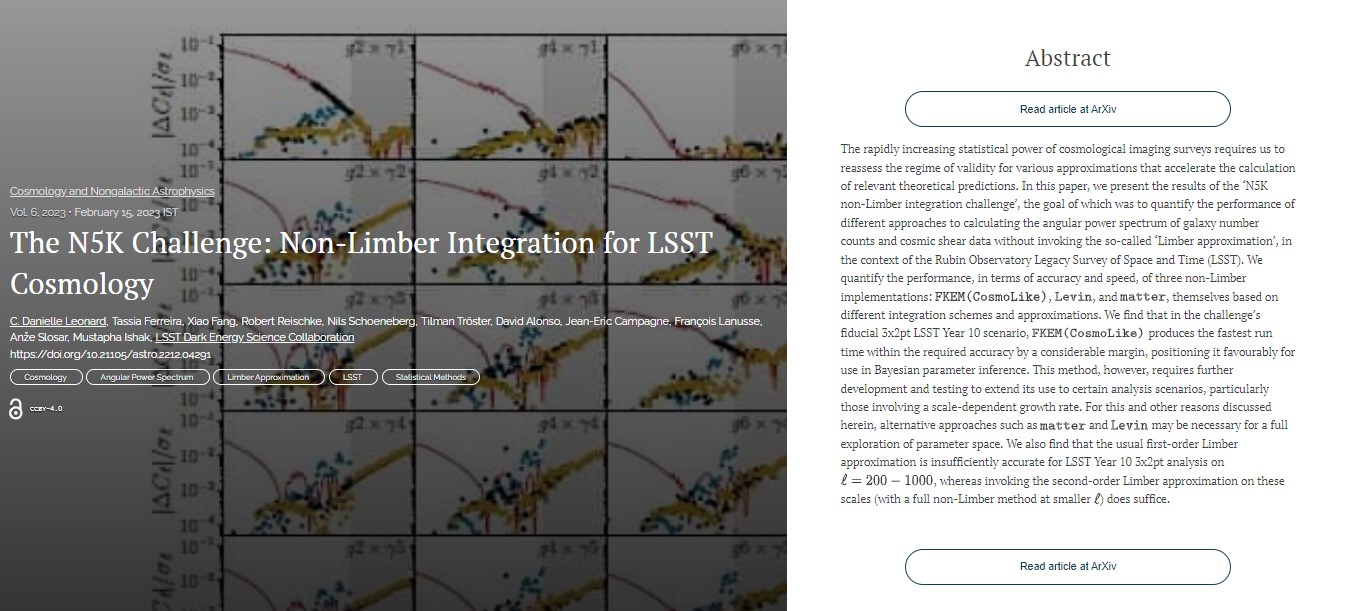
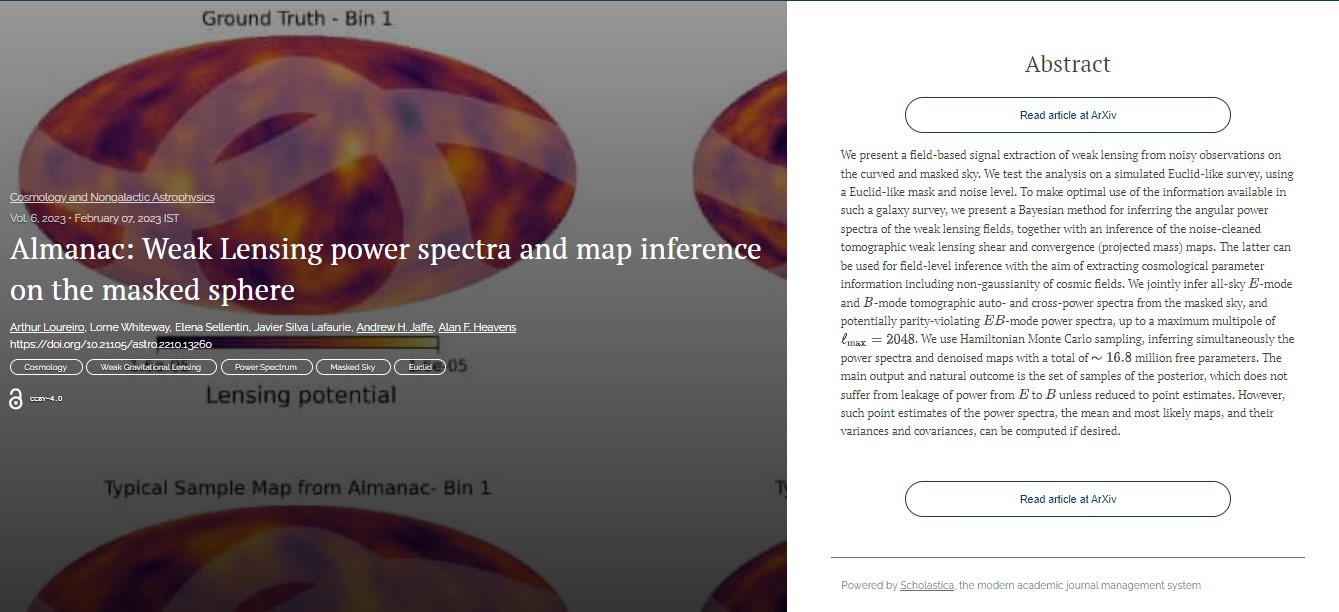
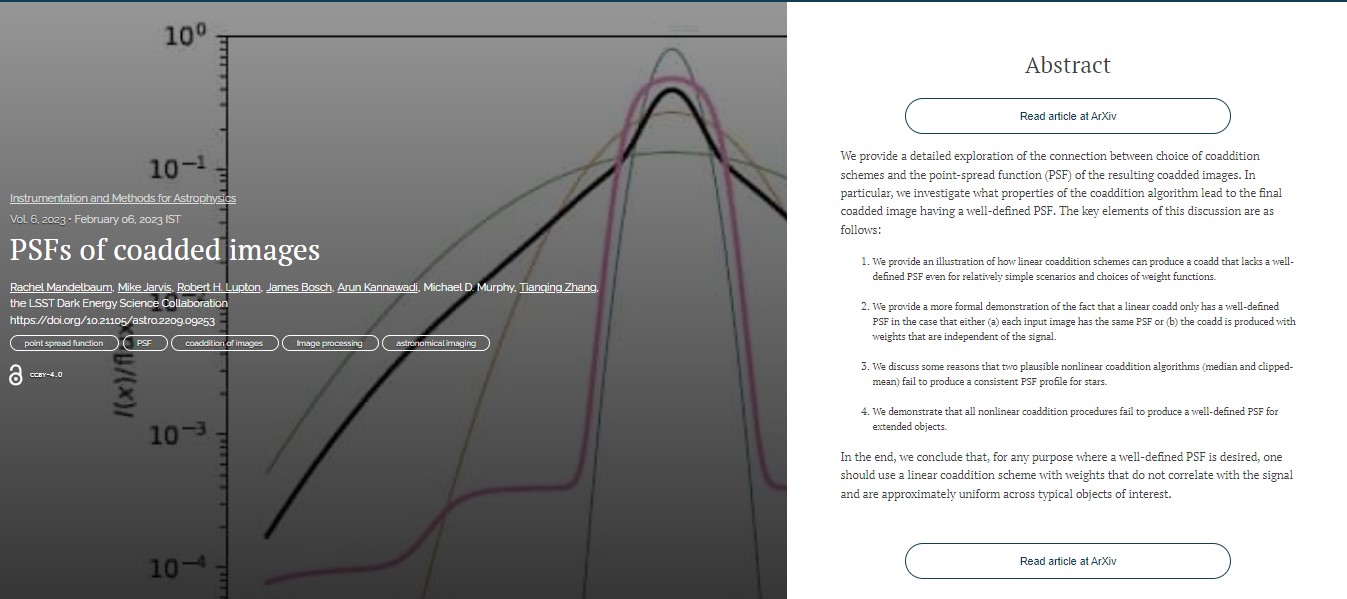
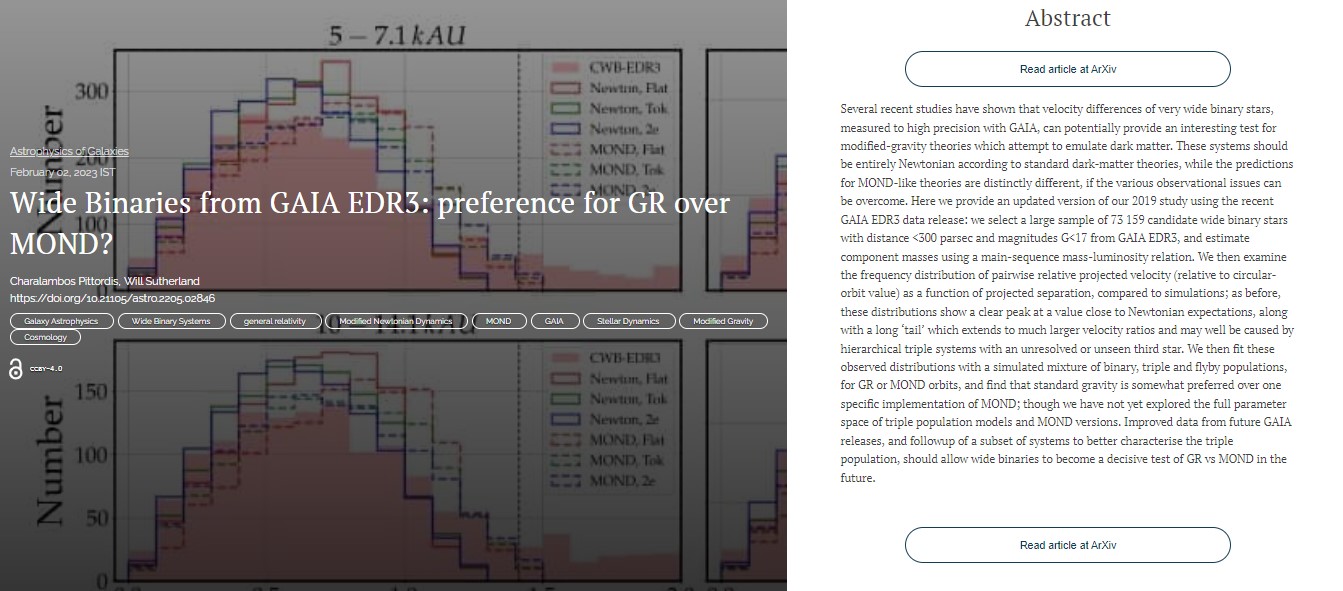
I was leafing through my copy of the 2023 Private Eye Annual and thought it would be fun to do a sort of annual for the Open Journal of Astrophysics, so here you are: all 50 of the papers in Volume 6 (2023) in glorious technicolour.
I could have linked each image to the relevant paper, but I’m way to lazy to do that!
In case you are interested here is the breakdown into different sections:
You can see that over half the papers we published are in Cosmology and Nongalactic Astrophysics, and just three arXiv categories account for 90% of the publications. I hope we can increase our diversity in 2024!
It would be nice if we could make it to 50 in Volume 6 (2023), but I have already decided to close the publishing platform from 22nd December until 5th January (inclusive), so there there isn’t much time to get the single needed for our half-century. While we will not be publishing new papers during this closure, the peer review platform will remain open for submission of new and revised manuscripts and the editorial processes will continue.
Whether or not we make 50 this year, it is worth remarking that 49 is already a significant figure, as it corresponds to the total number of papers we published in the previous three years: 15 (2020); 17 (2021); and 17 (2022). Things are definitely looking up!
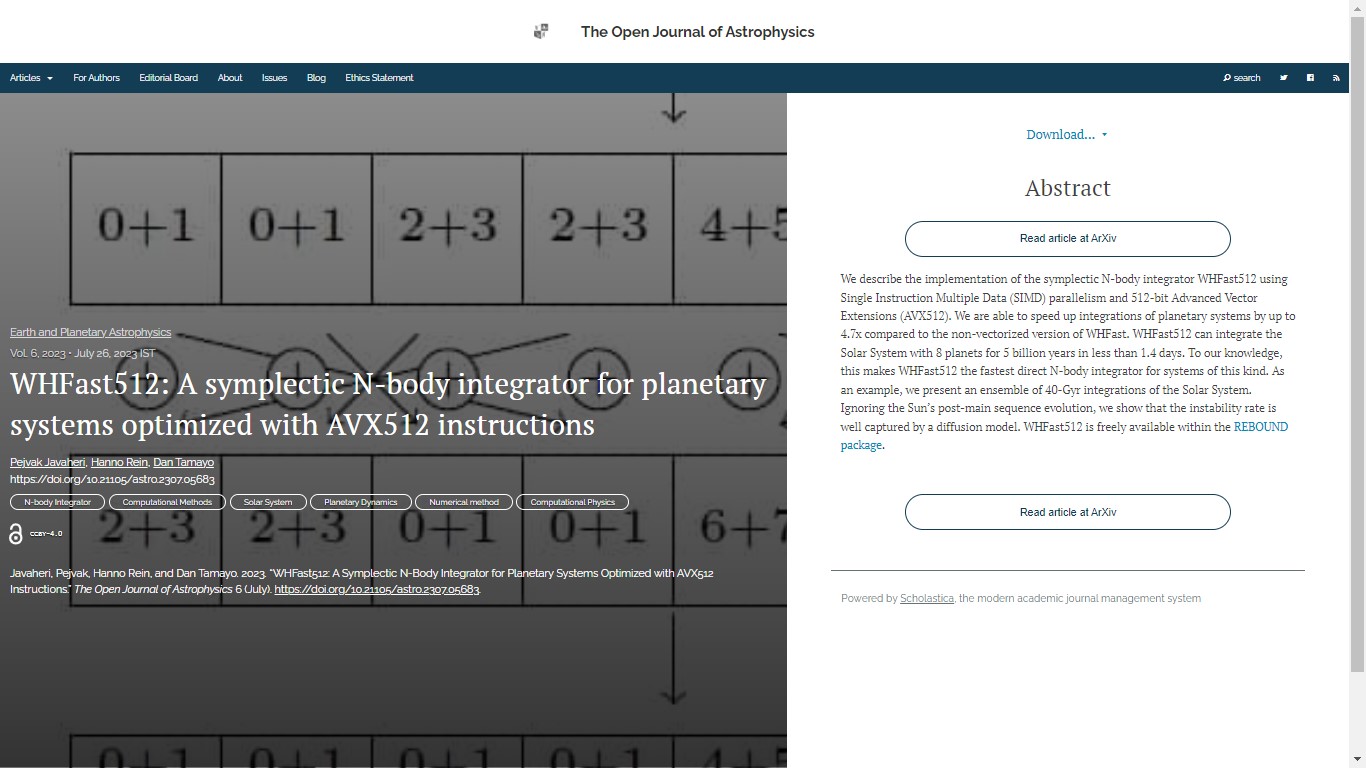
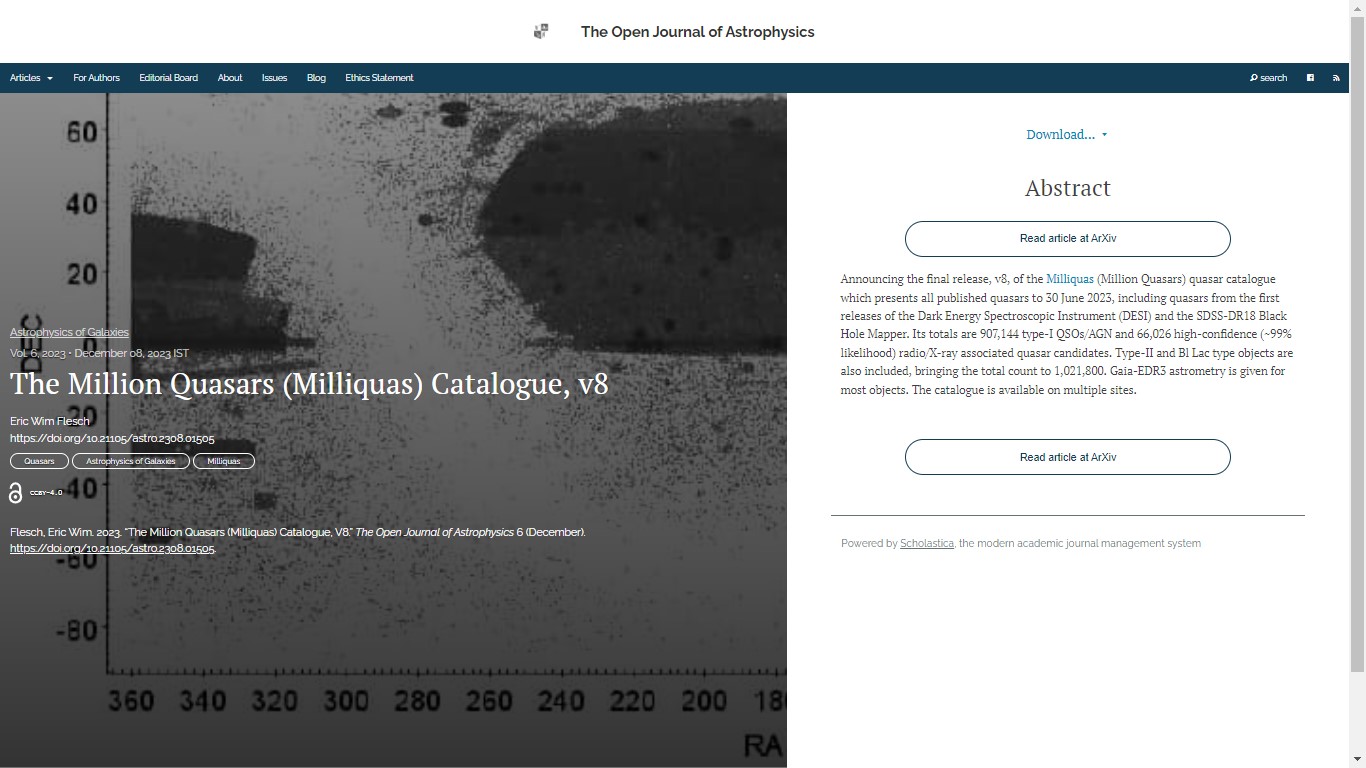
Anyway, the first paper of the most recent pair – published on December 8th – is “The Million Quasars (Milliquas) Catalogue, v8”; its primary classification is Astrophysics of Galaxies and the author is Eric Wim Flesch from New Zealand. The Milliquas catalogue includes quasars from the literature to 30 June 2023, including quasars from the DESI-EDR and SDSS-DR18Q surveys.
Here is a screen grab of the overlay which includes the abstract:
You can click on the image of the overlay to make it larger should you wish to do so. You can find the officially accepted version of the paper on the arXiv here.
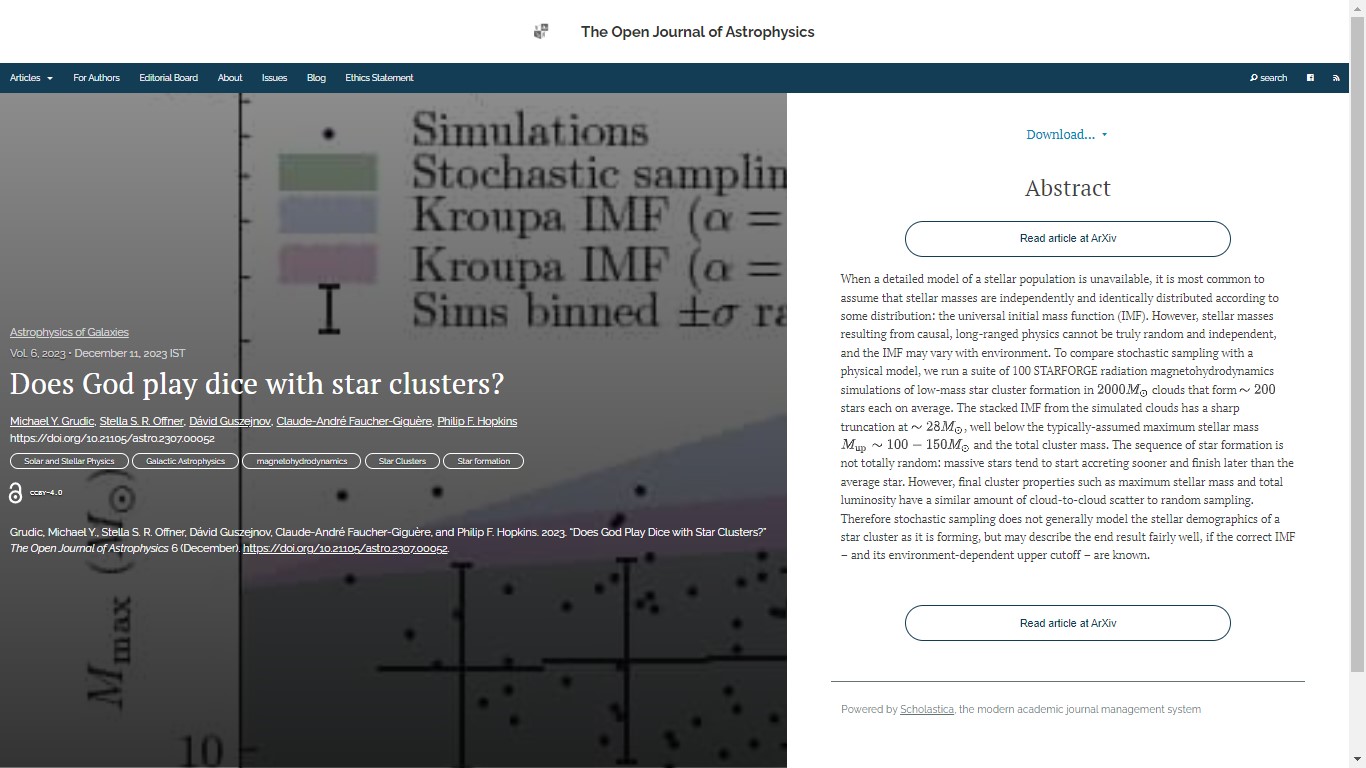
The authors are all from various institutions in the USA: Michael Grudić (Carnegie Observatories), Stella Offner (University of Texas at Austin); Dávid Guszejnov (Harvard); Claude-André Faucher-Giguère (Northwestern University); and Philip F. Hopkins (Caltech). The paper presents a comparison of full radiative magnetohydrodynamics simulations of the formation of star clusters with simple stochastic modelling showing the limitations of the latter.
Here is a screen grab of the overlay which includes the abstract:
You can click on the image of the overlay to make it larger should you wish to do so. You can find the officially accepted version of the paper on the arXiv here.
I was doing some work on the Open Journal of Astrophysics site and realized that there is a paper we published last week that I haven’t advertised on here yet, so I’m remedying that now.
The paper in question is the 47th so far in Volume 6 (2023) and it’s the 112th altogether. This one was actually published on Tuesday December 5th. Two further papers are imminent; I’m just waiting for their metadata to be registered with Crossref.
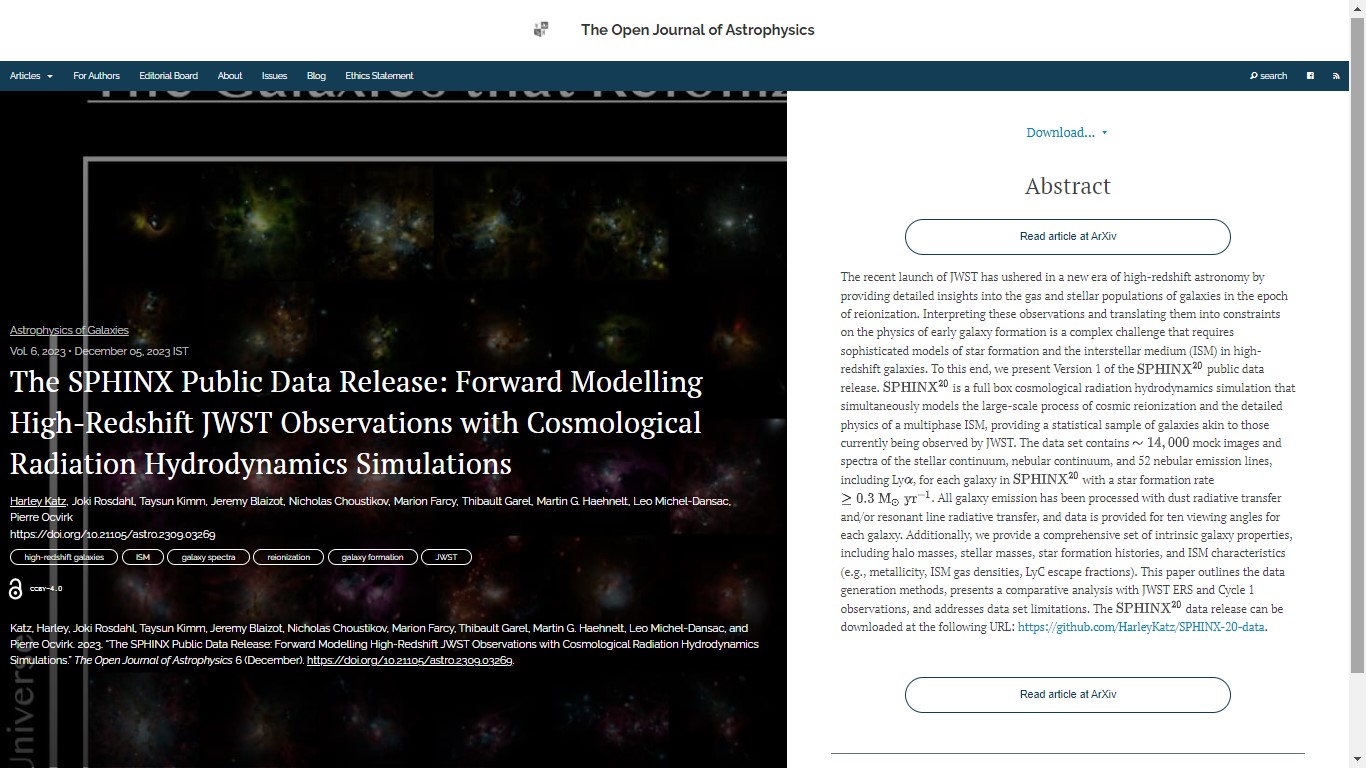
The title of this one is “The SPHINX Public Data Release: Forward Modelling High-Redshift JWST Observations with Cosmological Radiation Hydrodynamics Simulations” and it represents public data release of Sphinx20, a full box cosmological radiation-hydrodynamics simulation that provides a statistical sample of galaxies for comparison with those observed by JWST. It is in the folder marked Astrophysics of Galaxies.
There are 10 authors: Harley Katz (Oxford, UK); Joki Rosdahl (Lyon, France); Taysun Kimm (Seoul, Korea); Jeremy Blaizot (Lyon, France); Nicholas Choustikov (Oxford, UK); Marion Farcy and Thibault Garel (Geneva, Switzerland); Martin G. Haehnelt (Cambridge, UK); Leo Michel-Dansac (Lyon, France); and Pierre Ocvirk (Strasbourg, France).
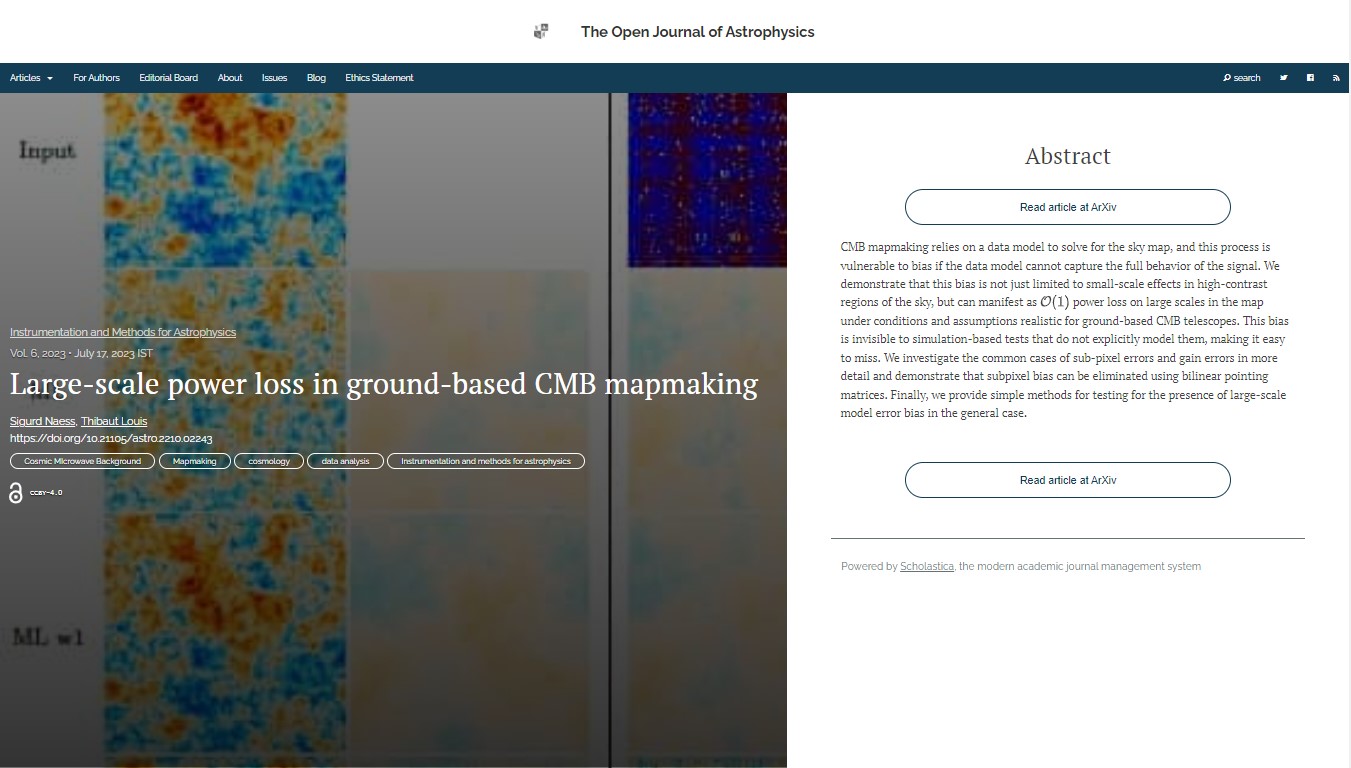
Here is the overlay of the paper containing the abstract:
You can click on the image of the overlay to make it larger should you wish to do so. You can find the officially accepted version of the paper on the arXiv here.
It’s Friday and I thought I’d take the opportunity before the weekend to announce yet another new paper at the Open Journal of Astrophysics.
The latest paper is the 46th so far in Volume 6 (2023) – just four to go for a half-century – and it’s the 111th altogether. This one was actually published on Wednesday November 29th.
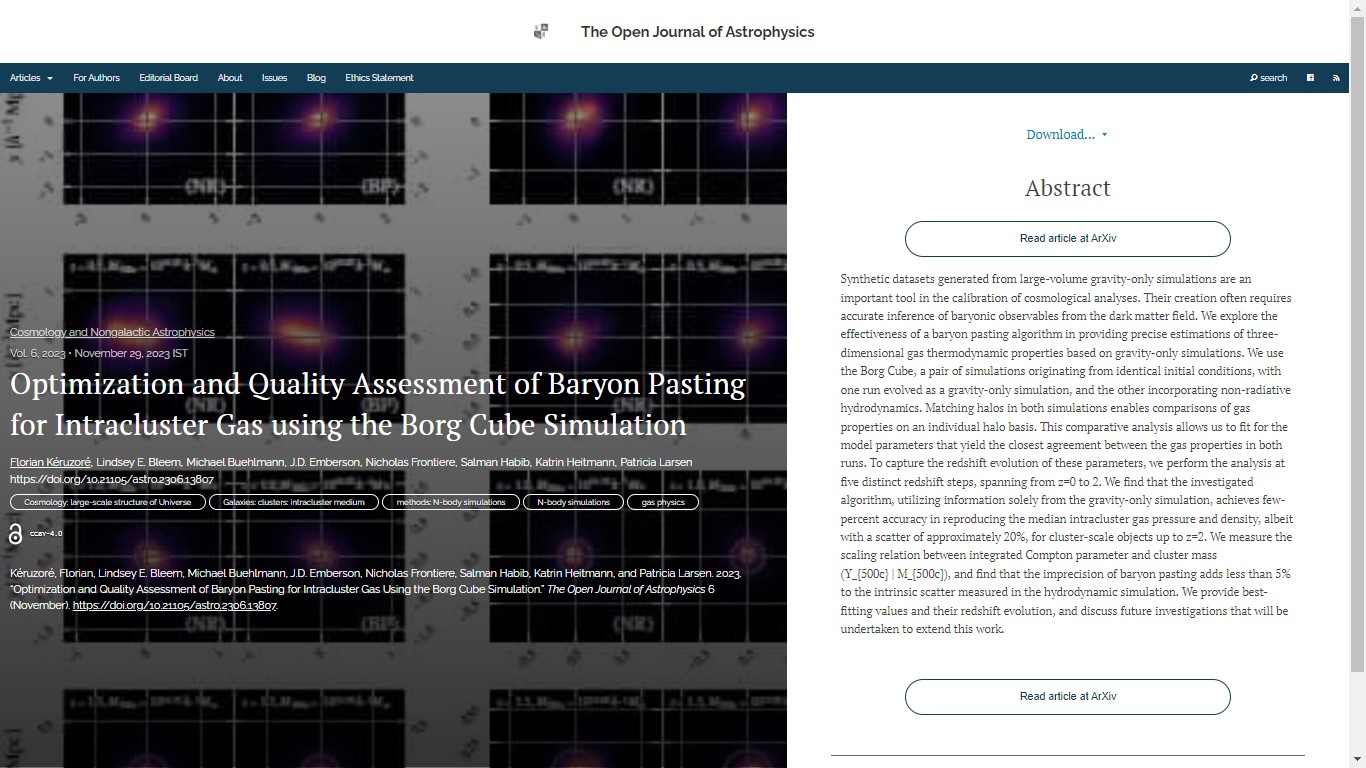
The title is “Optimization and Quality Assessment of Baryon Pasting for Intracluster Gas using the Borg Cube Simulation” and it presents an algorithm for adding baryons to gravity-only simulations via a “pasting” approach. It is in the folder marked Cosmology and Nongalactic Astrophysics.
There are 8 authors: F. Kéruzoré; L. Bleem; M. Buehlmann; J.D. Emberson; N. Frontiere; S. Habib; K. Heitmann; and P. Larsen; all of them based at the Argonne National Laboratory, in Illinois (USA).
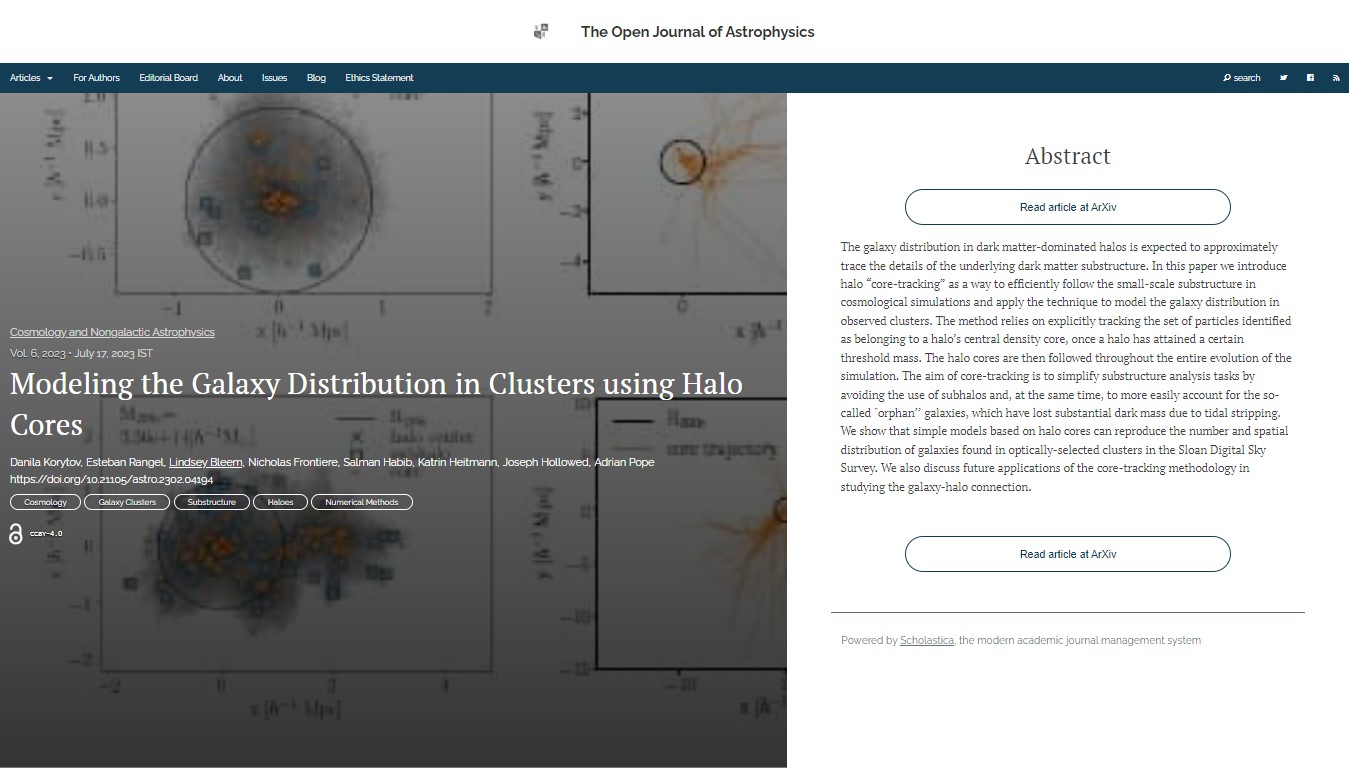
Here is the overlay of the paper containing the abstract:
You can click on the image of the overlay to make it larger should you wish to do so. You can find the officially accepted version of the paper on the arXiv here.
It’s Friday afternoon but before I collapse, exhausted, into the arms of the weekend I’ll take the opportunity to announce yet another new paper at the Open Journal of Astrophysics.
The latest paper is the 45th so far in Volume 6 (2023) – just five to go for a half-century – and it’s the 110th altogether. This one was actually published on Tuesday November 14th.
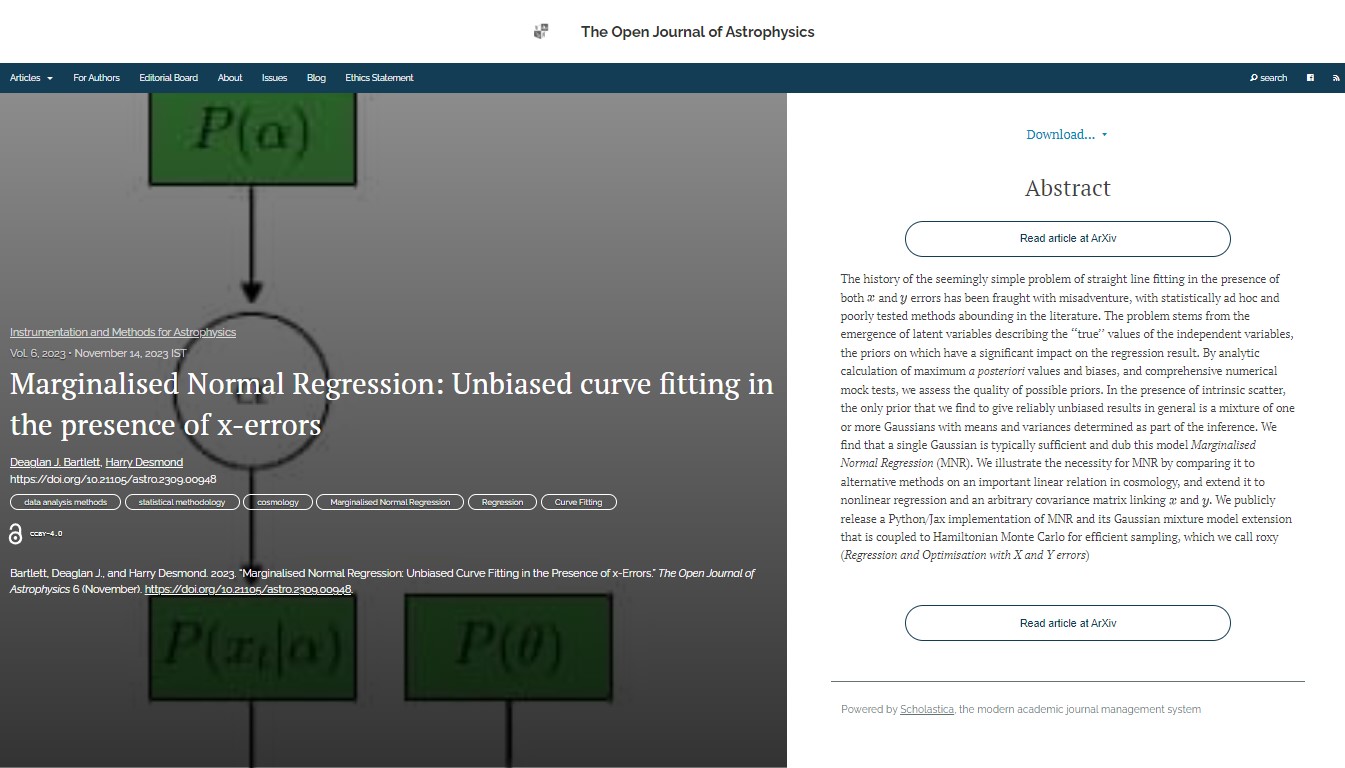
The title is “Marginalised Normal Regression: Unbiased curve fitting in the presence of x-errors” and it’s by Deaglan J. Bartlett (Institut d’Astrophysique de Paris, France) and Harry Desmond (Portsmouth, UK). It sounds like a statistical methods paper, and indeed it is, but remember that there’s a very long historical connection between astronomy and the development of statistical methods for data analysis, and this paper tackles a very longstanding issue: how best to fit curves in the presence of noisy data. This paper presents a new method for doing this, together with applications to cosmological and astrophysical data, and accompanying software. It is in the folder marked Instrumentation and Methods for Astrophysics.
Here is the overlay of the paper containing the abstract:
You can click on the image of the overlay to make it larger should you wish to do so. You can find the officially accepted version of the paper on the arXiv here.
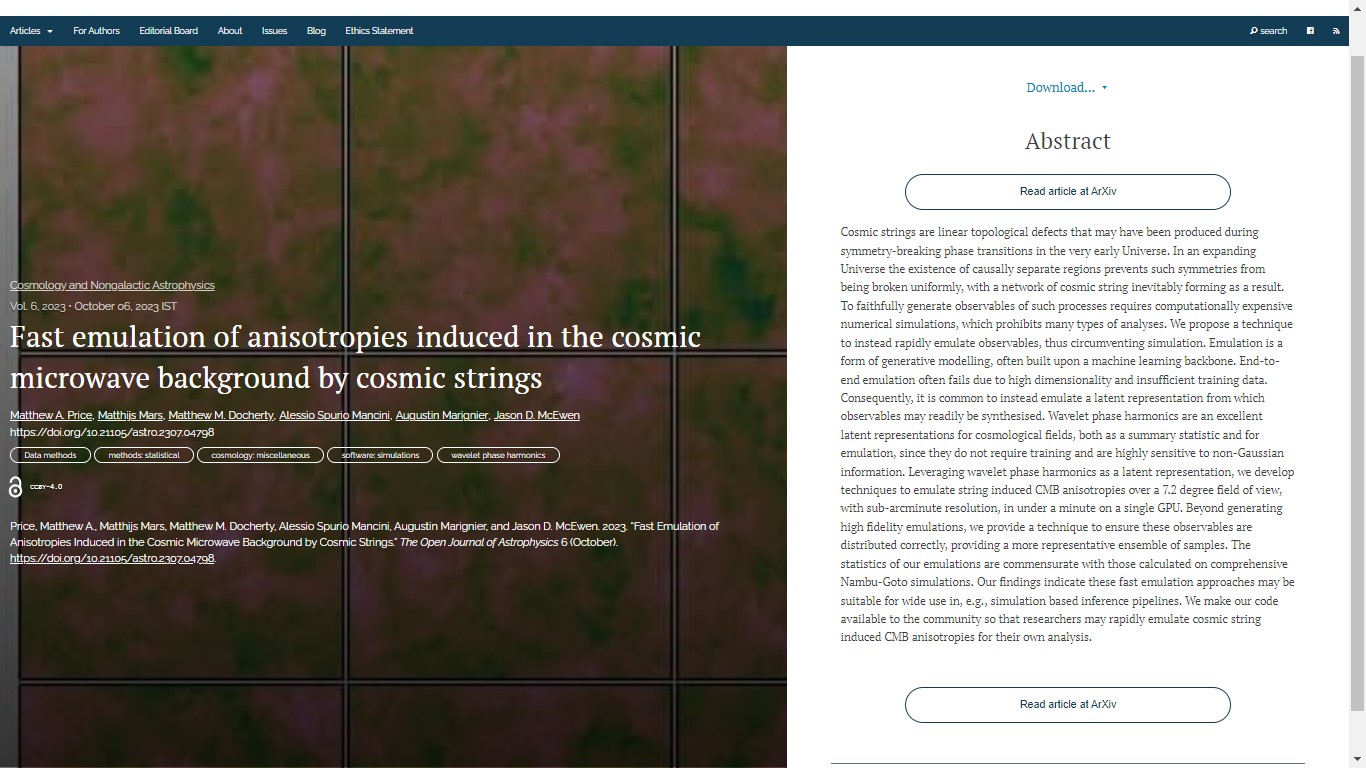
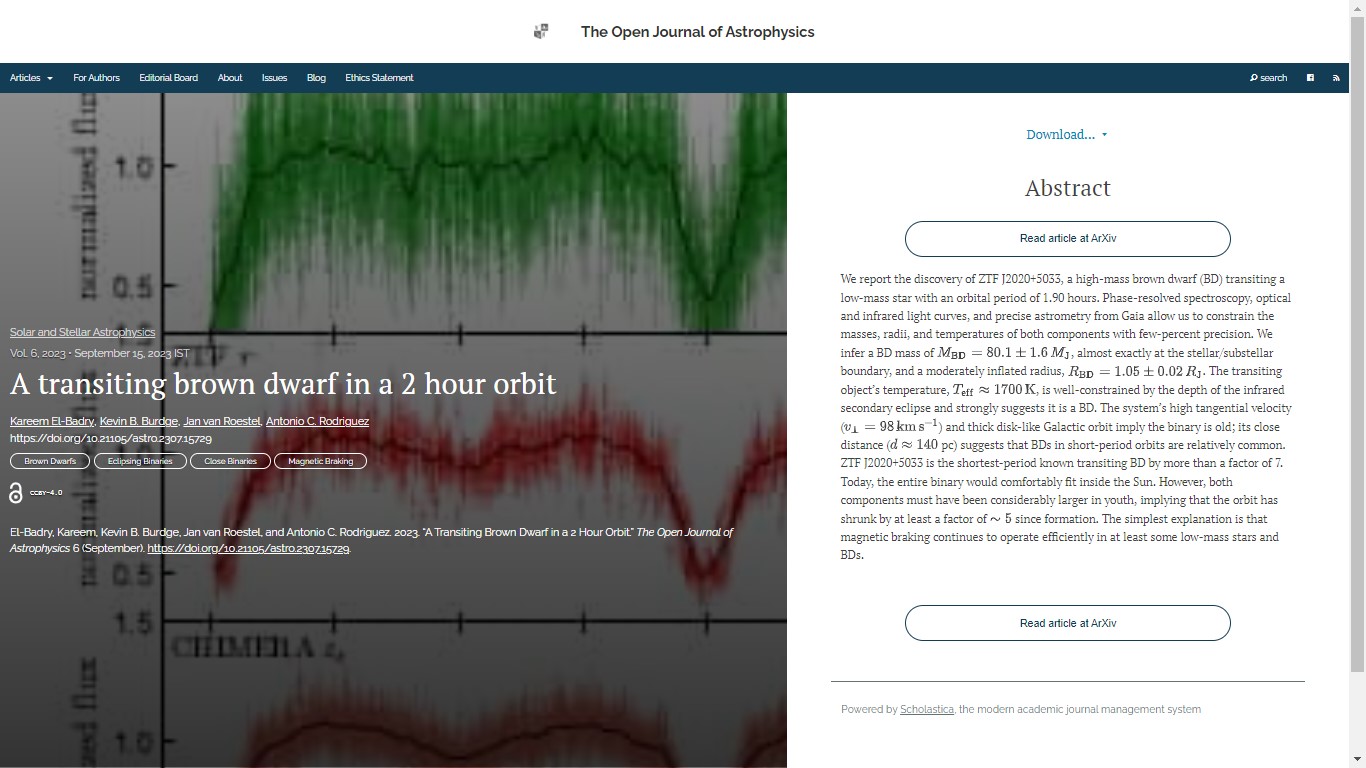
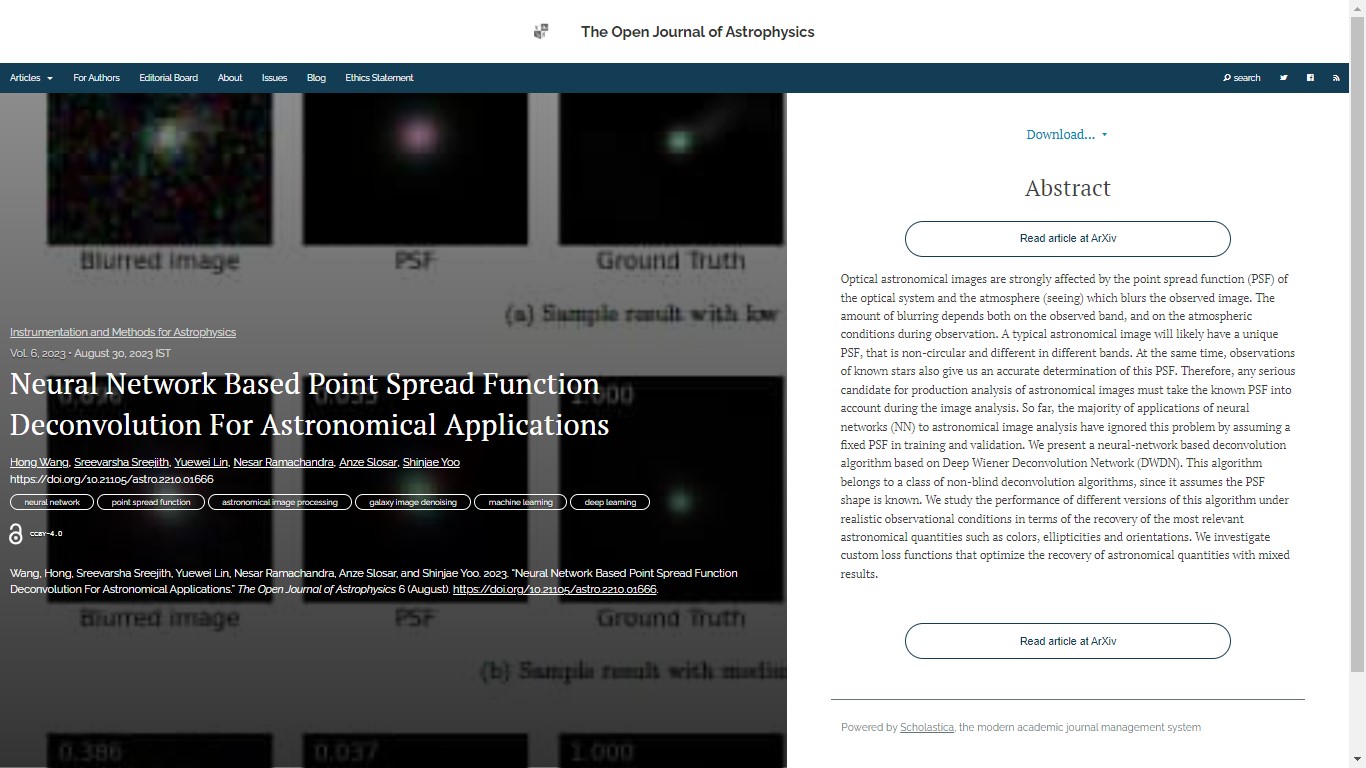
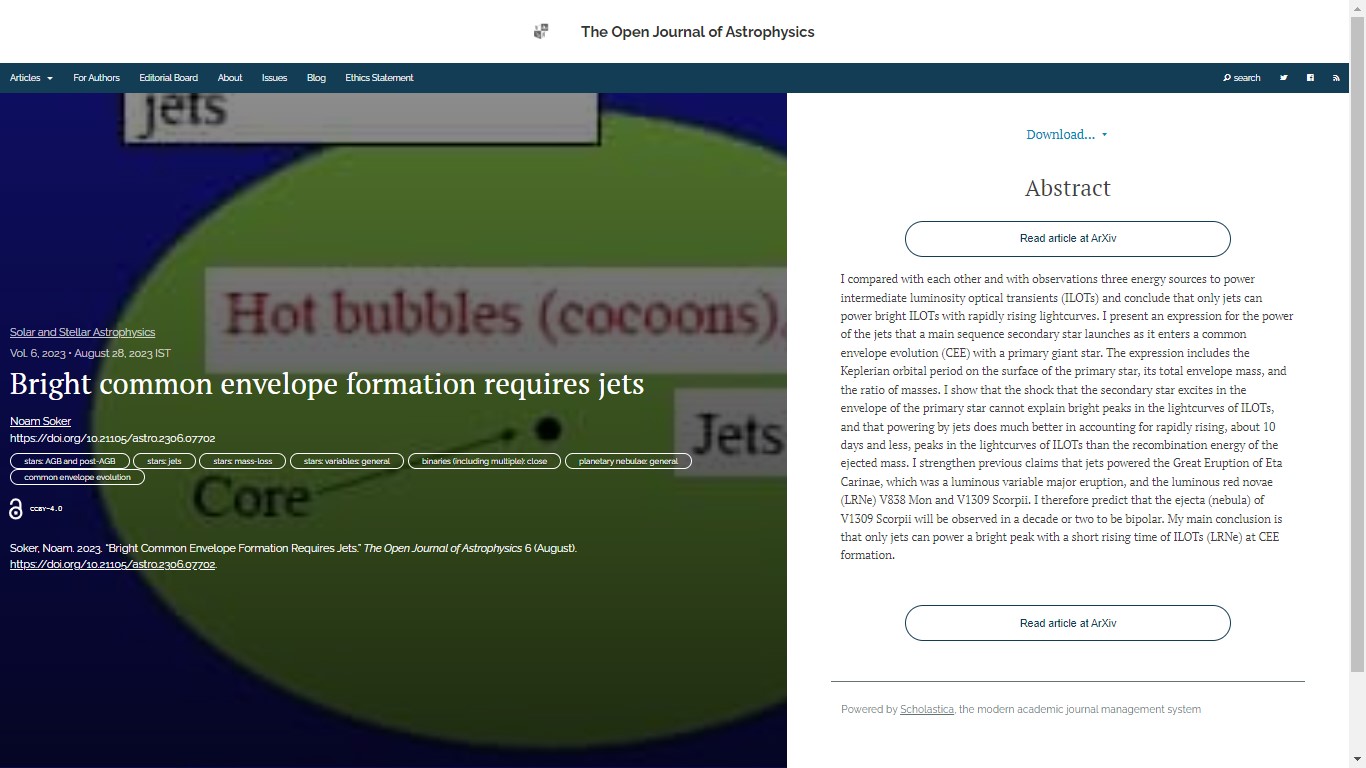
It’s been a busy week generally, and specifically at the Open Journal of Astrophysics. In fact, this week we have published three papers, which I didn’t have time to post here at the time we published them but now present to you. These take the count in Volume 6 (2023) up to 44 and the total published by OJAp up to 109. With many more in the pipeline we’re still on for 50 by the end of the year.
In chronological order, the three papers published this week, with their overlays, are as follows. You can click on the images of the overlays to make them larger should you wish to do so. All three of these papers are in the folder Cosmology and Nongalactic Astrophysics.
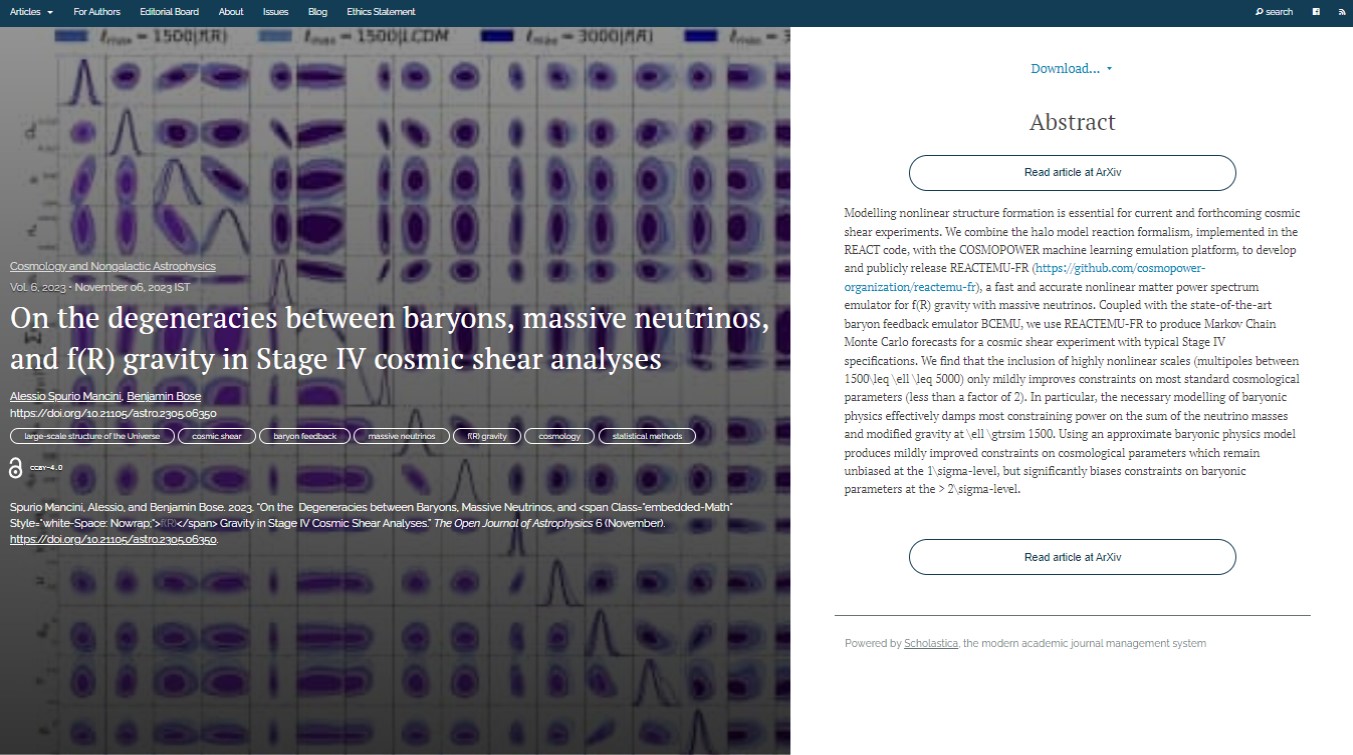
First one up is “On the degeneracies between baryons, massive neutrinos and f(R) gravity in Stage IV cosmic shear analyses” by Alessio Spurio Mancini (Mullard Space Sciences Laboratory, University College London, UK) and Benjamin Bose (Royal Observatory Edinburgh, UK). This presents a fast nonlinear matter power spectrum emulator for f(R) gravity with massive neutrinos, coupled with a baryon feedback emulator forecasts for a cosmic shear experiment with typical Stage IV specifications. This paper was published on 6th November 2023.
Here is a screen grab of the overlay, which includes the abstract:
You can find the officially accepted version of the paper on the arXiv here.
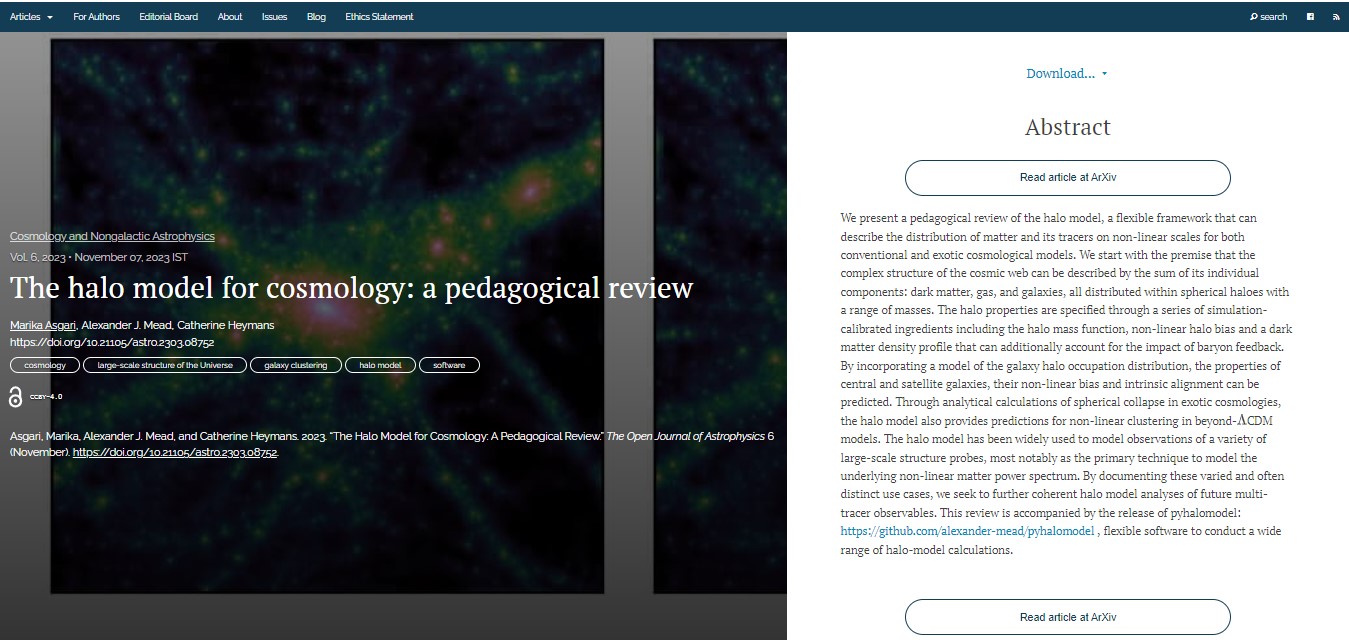
The second paper to announce is “” by Marika Asgari (Hull, UK), Alexander Mead (Bochum, Germany) and Catherine Heymans (Edinburgh, UK). This presents a thorough discussion of the popular halo model for cosmological structure with applications, accompanied by the release of a software suite called pyhalomodel (which you can download here). The paper was also published on 7th November 2023 and you can see the overlay here:
The accepted version of this paper can be found on the arXiv here.
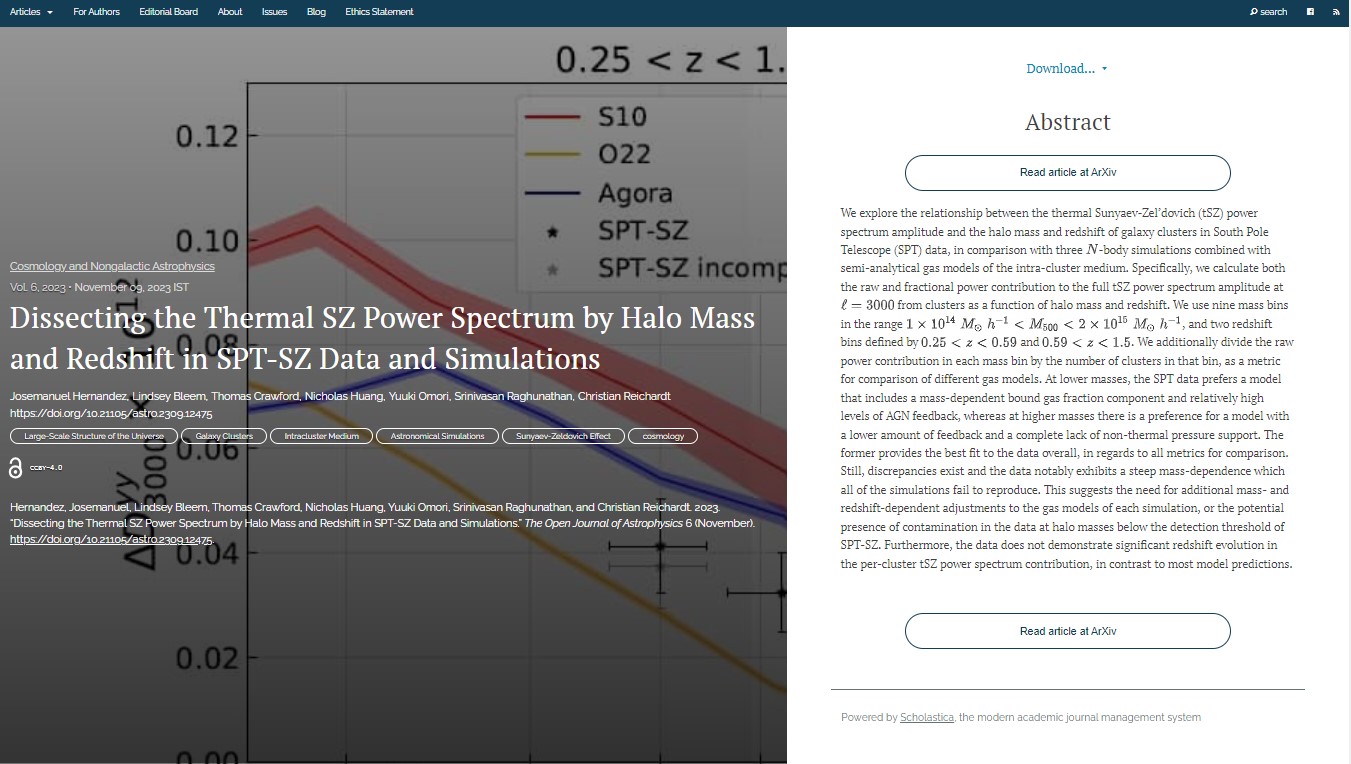
The last paper of this batch is entitled “Dissecting the Thermal SZ Power Spectrum by Halo Mass and Redshift in SPT-SZ Data and Simulations” and the authors are: by Josemanuel Hernandez (Chicago), Lindsey Bleem (Chicago) , Thomas Crawford (Chicago), Nicholas Huang (Berkeley), Yuuki Omori (Chicago), Srinivasan Raghunathan (NCSA, Urbana) & Christian Reichardt (Melbourne). This paper, a study of the mass and redshift dependence of the thermal Sunyaev-Zeldovich effect in South Pole Telescope data and a comparison thereof with theoretical calculations, was published on 9th November 2023.
Here is the overlay:
You can find the full text for this one on the arXiv here.
It’s Sunday but I’ll be a bit busy next week so I’m taking the opportunity today to announce yet another new paper at the Open Journal of Astrophysics. This one was published on Friday 20th October.
The primary classification for this paper is Cosmology and NonGalactic Astrophysics and its title is “DES Y3 + KiDS-1000: Consistent cosmology combining cosmic shear surveys”. The article presents a joint analysis of the Dark Energy Survey Year 3 data and the Kilo-Degree Survey data, with a discussion of the implications for cosmological parameters. The key figure – a very important one – is this:
If you want to know more about the result and why it is so important you could read the paper. It is, however, rather long: 40 pages including 21 figures and 15 tables. Do not despair, though, because here is a video explaining the work in the series of Cosmology Talks presented by Shaun Hotchkiss:
Anyway, here is the overlay of the paper containing the abstract:
You can click on the image of the overlay to make it larger should you wish to do so. You can find the officially accepted version of the paper on the arXiv here.
It’s Friday so it’s a good time to catch up with the week’s action at the Open Journal of Astrophysics, where there have been two new publications so far this week. These papers take us up to a total of 40 in Volume 6 (2023) and 105 in total since we started publishing.
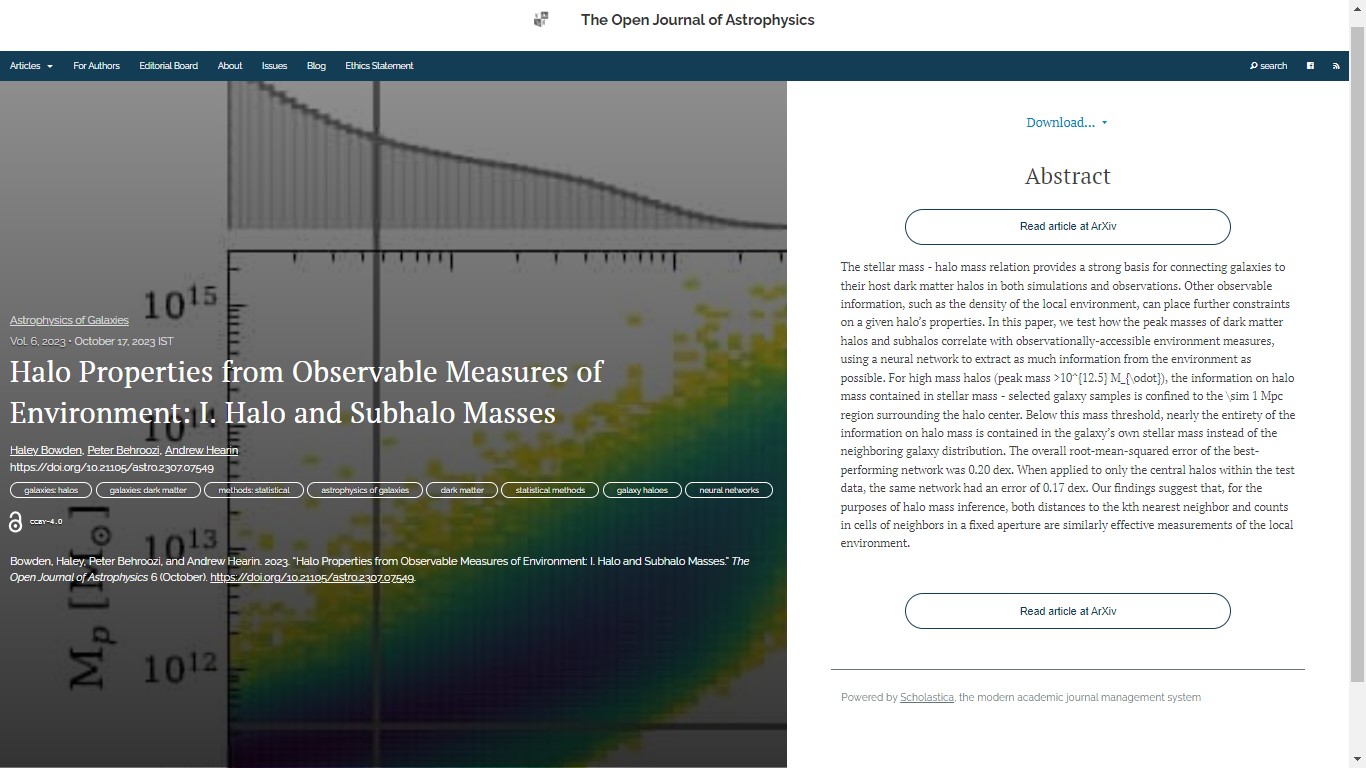
The title of the first paper is “Halo Properties from Observable Measures of Environment: I. Halo and Subhalo Masses” and its primary classification is Astrophysics of Galaxies. it is an exploration using neural networks of how the peak masses of dark matter halos and subhaloes correlate with observationally-accessible measures of their dependence on environment.
The authors based in the United States of America: Haley Bowden and Peter Behroozi of the University of Arizona, and Andrew Hearin of the Argonne National Laboratory
Here is a screen grab of the overlay which includes the abstract:
You can click on the image of the overlay to make it larger should you wish to do so. You can find the officially accepted version of the paper on the arXiv here.
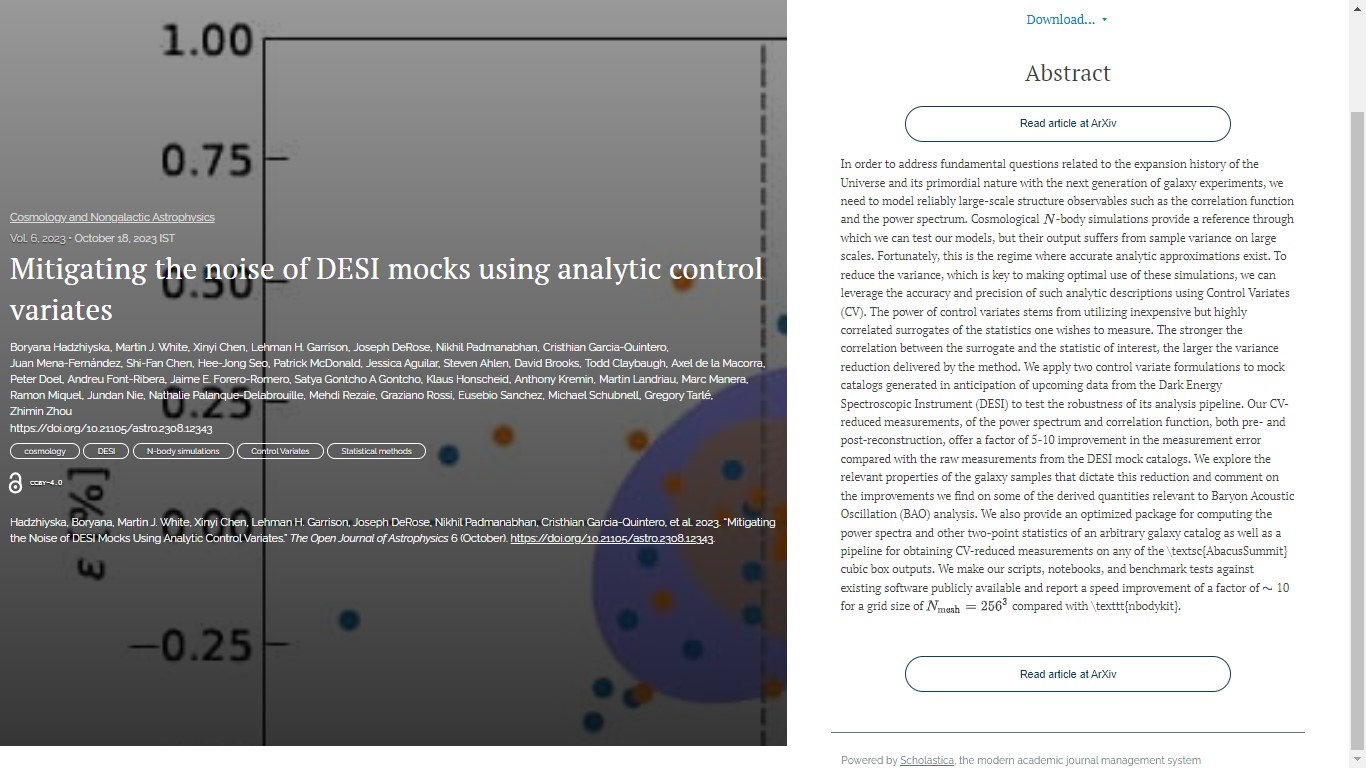
The second paper was published on 18th October 2023. The primary classification for this one is Cosmology and Nongalactic Astrophysics and is “Mitigating the noise of DESI mocks using analytic control variates”. For those of you not up with the lingo, DESI stands for the Dark Energy Spectroscopic Instrument and you can read more about it here.
The lead author for this one is Boryana Hadzhiyska of the Lawrence Berkeley Laboratory and the University of California, Berkeley (USA) and there are 32 other authors. This paper presents a method for reducing the effects of sample variance on cosmological simulations using analytical approximations and tests it using DESI data.
Here is a screen grab of the overlay which includes the abstract:
You can click on the image of the overlay to make it larger should you wish to do so. You can find the officially accepted version of the paper on the arXiv here.
Quite a few people have contacted me to ask about the Peer Review Process at the Open Journal of Astrophysics so I thought I’d do a quick post here to explain a bit about it here.
When a paper is submitted it is up to the Editor-in-Chief – that’s me! – to assign it to a member of the Editorial Board. Who that is depends on the topic of the paper and on the current availability due to workload. I of course take on some papers myself. I also reject some papers without further Peer Review if they clearer don’t meet the journal’s criteria of scientific quality, originality, relevance and comprehensibility. I usually run such papers past the Editorial Board before doing such a ‘Desk Reject’.
Once the paper has been assigned, the Editor takes control of the process, inviting referees (usually two) to comment and make recommendations. This is the rate-determining step, as potential referees are often busy. It can take as many as ten declined invitations before we get a referee to agree. Once accepted, a referee is asked to provide a report within three weeks. Sometimes they are quicker than that, sometimes they take longer. It depends on many factors, including the length of the manuscript.
Once all the referee reports are in the Editor can make a decision. Some papers are rejected upon refereeing, and some are accepted with only tiny changes. The most frequent decision is “Revise and Resubmit” – authors are requested to make changes in response to the referee comments. Sometimes these are minor, sometimes they are substantial. We never give a deadline for resubmission.
A resubmitted paper is usually sent to the same referee(s) who reviewed the original. The referees may be satisfied and recommend acceptance, or we go around again.
Once a paper is accepted, the authors are instructed to upload the final, accepted, version to arXiv. It normally takes a day or two to be announced. The article is then passed over from the Peer Review process to the Publication process. As Managing Editor, I make the overlay and prepare the metadata for the final version. This is usually done the same day as the final version appears on arXiv, but sometimes it takes a bit longer to put everything in order. It’s never more than a few days though.
Anyway, here are some “analytics” – it’s weird how anything that includes any quantitative information is called analytics these days to make it sound more sophisticated than it actually is – provided by the Scholastica platform:
These numbers need a little explanation.
The “average days to a decision” figure includes desk rejects as well as all submissions and resubmissions. Suppose a paper is submitted and it then takes 4 weeks to get referee reports and for the Editor to make a “Revise and Resubmit” request. That would count as 28 days. It might take the authors three months to make their revisions and resubmit the paper, but that does not count in the calculation of the “average days to decision” as during that period the manuscript is deemed to be inactive. If the revised version is accepted almost immediately, say after 2 days, then the average days to decision would be (28+2)/2 = 15 days. Also, being an average there are some shorter than 14 days and some much longer.
The acceptance rate is the percentage of papers eventually accepted (even after revision). The figure for ‘total submissions’ includes resubmissions, so the hypothetical paper in the preceding paragraph would add 2 to this total. That accounts for why the total number of papers accepted is not 50% of 388, which is 194; the actual figure is lower, at 105.
Finally, the number of manuscripts “in progress” is currently 23. That includes papers currently going through the peer review process. It does not include papers which are back with the authors for revisions (although it would be reasonable to count those as in progress in some sense).
There we are. I hope this clarifies the situation.
The views presented here are personal and not necessarily those of my employer (or anyone else for that matter).
Feel free to comment on any of the posts on this blog but comments may be moderated; anonymous comments and any considered by me to be vexatious and/or abusive and/or defamatory will not be accepted. I do not necessarily endorse, support, sanction, encourage, verify or agree with the opinions or statements of any information or other content in the comments on this site and do not in any way guarantee their accuracy or reliability.