Archive for the Open Access Category

Call for Editors at the Open Journal of Astrophysics

Posted in Open Access with tags , , , , , , , , , , , , , on July 7, 2024 by telescoper

Just over halfway into 2024 the number of papers submitted to the Open Journal of Astrophysics continues to rise, as demonstrated by this nice graphic which shows the submission stats for the last five years:

The increasing number of articles is of course very welcome indeed, but it is increasing the load on our Editorial Board and that includes me! We’re therefore looking for volunteers to join the team, in any area of astrophysics. As a reminder, here are the areas we cover, corresponding to the sections of astro-ph on the arXiv:

  1. astro-ph.GA – Astrophysics of Galaxies. Phenomena pertaining to galaxies or the Milky Way. Star clusters, HII regions and planetary nebulae, the interstellar medium, atomic and molecular clouds, dust. Stellar populations. Galactic structure, formation, dynamics. Galactic nuclei, bulges, disks, halo. Active Galactic Nuclei, supermassive black holes, quasars. Gravitational lens systems. The Milky Way and its contents
  2. astro-ph.CO – Cosmology and Nongalactic Astrophysics. Phenomenology of early universe, cosmic microwave background, cosmological parameters, primordial element abundances, extragalactic distance scale, large-scale structure of the universe. Groups, superclusters, voids, intergalactic medium. Particle astrophysics: dark energy, dark matter, baryogenesis, leptogenesis, inflationary models, reheating, monopoles, WIMPs, cosmic strings, primordial black holes, cosmological gravitational radiation
  3. astro-ph.EP – Earth and Planetary Astrophysics. Interplanetary medium, planetary physics, planetary astrobiology, extrasolar planets, comets, asteroids, meteorites. Structure and formation of the solar system
  4. astro-ph.HE – High Energy Astrophysical Phenomena. Cosmic ray production, acceleration, propagation, detection. Gamma ray astronomy and bursts, X-rays, charged particles, supernovae and other explosive phenomena, stellar remnants and accretion systems, jets, microquasars, neutron stars, pulsars, black holes
  5. astro-ph.IM – Instrumentation and Methods for Astrophysics. Detector and telescope design, experiment proposals. Laboratory Astrophysics. Methods for data analysis, statistical methods. Software, database design
  6. astro-ph.SR – Solar and Stellar Astrophysics. White dwarfs, brown dwarfs, cataclysmic variables. Star formation and protostellar systems, stellar astrobiology, binary and multiple systems of stars, stellar evolution and structure, coronas. Central stars of planetary nebulae. Helioseismology, solar neutrinos, production and detection of gravitational radiation from stellar systems.

We are looking for experienced scientists in any of these areas, and it would indeed be useful to have people who can cover a range of subjects (as some of our existing editors do), but there are two specific topics that have seen a big increase recently: (a) galaxy formation simulations (especially involving hydrodynamics) covered by astro-ph.CO; and (b) galactic dynamics, covered by astro-ph.GA. The latter increase is driven Gaia data, an immensely rich source for discovery science.

Since we don’t charge authors or readers we can not offer payment to Editors but it is nevertheless a way of providing a service to the community.

Please get in touch either through the Open Journal website here, or through a message Mastodon here, BlueSky here, or Facebook here. You could even send a message through this form:

← Back

Thank you for your response. ✨

Two New Publications at the Open Journal of Astrophysics

Posted in OJAp Papers, Open Access, The Universe and Stuff with tags , , , , , , , , , on July 6, 2024 by telescoper

My own laptop is still with the menders but I’ve managed to borrow one until I get it back so I don’t get too far behind. Anyway, it’s Saturday morning, and once again time to post another update relating to the  Open Journal of Astrophysics.  Since the last update we have published two more papers, taking  the count in Volume 7 (2024) up to 54 and the total published by OJAp up to 169.  There was one less arXiv update than usual last week, owing to the holiday on July 4th, so a couple of papers have been delayed.

The first paper of the most recent pair, published on July 3rd 2024,  is “Recovering 21cm Monopole Signals Without Smoothness” by Rugved Pund & Anže Slosar (Stony Brook, NY, USA) and Aaron Parsons (Berkeley, CA, USA) . This paper presents a new method for identifying the ‘Dark Ages’ trough contribution to the monopole of the 21cm radiation background that does not rely on the assumption that the spectrum is smooth. The paper is in the folder marked Cosmology and NonGalactic Astrophysics.

Here is a screen grab of the overlay which includes the abstract:


You can click on the image of the overlay to make it larger should you wish to do so. You can find the officially accepted version of the paper on the arXiv here.

The second paper, also published on 3rd July, has the title “LtU-ILI: An All-in-One Framework for Implicit Inference in Astrophysics and Cosmology”. There are fifteen authors with primary affiliations as follows: Matthew Ho (IAP, Paris, France), Deaglan J. Bartlett (IAP, Paris, France), Nicolas Chartier (Seoul National University, Korea),  Carolina Cuesta-Lazaro (Cfa, Harvard, USA),  Simon Ding (IAP, Paris, France), Axel Lapel (IAP, Paris, France), Pablo Lemos (Université de Montréal, Canada), Christopher C. Lovell (University of Portsmouth, UK),  T. Lucas Makinen (Imperial College, London, UK), Chirag Modi (Flatiron Institute, NY, USA), Viraj Pandya (Columbia University, NY, USA), Shivam Pandey (Columbia University, NY, USA), Lucia A. Perez (Flatiron Institute, NY, USA), Benjamin Wandelt (IAP, Paris, France),  and Greg L. Bryan (Sorbonne Université, Paris, France).

This paper, which is in the folder marked Instrumentation and Methods for Astrophysics, presents a suite of software for rapid, user-friendly, and cutting-edge inference using machine learning in astrophysics and cosmology. The software can be found on Github here.

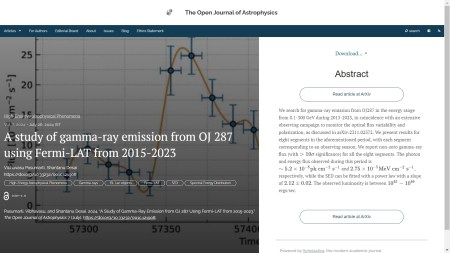
Here is a screen grab of the overlay which includes the abstract:


You can click on the image of the overlay to make it larger should you wish to do so. You can find the officially accepted version of the paper on the arXiv here.

That concludes this week’s update. No doubt I’ll have more for you next week!

New Publication at the Open Journal of Astrophysics

Posted in OJAp Papers, Open Access, The Universe and Stuff with tags , , , , , on June 29, 2024 by telescoper

It’s a rainy Saturday morning here in Barcelona, and here’s the last update from the Open Journal of Astrophysics before I depart these shores. In fact there is only one paper to report this week, being  the 52nd paper in Volume 7 (2024)  and the 167th altogether. It was published on June 24th 2024. With six months of the year now over, I predict we will have published about 52×12/6=104 papers by the end of the year.

The title is “Comparing Mass Mapping Reconstruction Methods with Minkowski Functionals” and it  is in the folder marked Cosmology and NonGalactic Astrophysics. The authors are: Nisha Grewal (U. Edinburgh, UK), Joe Zuntz (U. Edinburgh, UK) and Tilman Tröster (ETH Zurich, Switzerland);  the paper is about quantifying the accuracy, precision and efficiency of lensing reconstruction methods using topological characteristics known as Minkowski Fuctionals.

Here is the overlay of the paper containing the abstract:


You can click on the image of the overlay to make it larger should you wish to do so. You can also find the officially accepted version of the paper on the arXiv here.

P.S. Since I only had the one paper to publicize this week I took a few minutes to add the overlays to last week’s post, which I couldn’t do at the time because of computer problems.

Recent Citations in Astrophysics

Posted in Open Access with tags , , , , , , , on June 27, 2024 by telescoper

When I was on the train yesterday I thought I’d pass the time by looking up some numbers to answer a question someone asked me after my seminar in Valencia. I thought the results were Quite Interesting so I thought I would share them here. Just for fun I worked out the average number of citations so far for all papers published in 2023 in the “leading” astrophysics journals:

JournalMean citations per paperMedian citations per paper
ApJ6.23
MNRAS6.94
A&A7.74
OJAp8.45
Source: NASA/ADS

I suspect these numbers don’t turn out the way most people would have imagined! I don’t think you should infer too much from these figures because the window for citations is very narrow, but they do demonstrate that there’s no evidence that papers in the Open Journal of Astrophysics attract any less attention than those in more mainstream journals.

From Valencia

Posted in Biographical, Books, Talks and Reviews, Open Access on June 26, 2024 by telescoper
Torres de Serranos, Valencia

Here I am, on the train from Valencia back to Barcelona. I’ve been to Valencia many times but the last time was so long ago that I don’t remember when it was exactly. I only had time for a short walk about this morning before getting a lift to the University campus, which is a bit out of town.  I gave my talk as planned, had a nice lunch, and was personally driven back to the railway station, and am now on my way back to Barcelona.

I’ll probably doze off on the way, so I’ll just take this opportunity to thank Vicent  Martínez for inviting me (including last night’s dinner) and everyone for their hospitality and nice questions after my talk!

Update: I got back to Barcelona about 15 minutes late, which wasn’t a big deal, although it’s a notably slower route than the Madrid-Barcelona line I travelled on a couple of months ago.

To Valencia!

Posted in Barcelona, Open Access, Uncategorized on June 25, 2024 by telescoper

Ailing* laptop notwithstanding, I’ll shortly be taking the train to Valencia where I’ll be giving a talk tomorrow. The trip is about 350km each way and takes about 2 hours and 50 minutes. That’s a bit slower than the very fast train to Madrid but it looks like it’s all along the coast, so hopefully it will be quite enjoyable.

*I managed to get it to boot up into Windows, but it is running so extremely that I can’t do much on it. I have no idea what the issue is.

An All-Ireland Diamond Open Access Publishing Platform?

Posted in Maynooth, Open Access with tags , , , , , , on June 24, 2024 by telescoper

Here’s a report on an interesting development about Open Access in Ireland. The article belongs to the Special Issue 10th Anniversary Special Issue “PUBMET2023 Conference on Scholarly Communication in the Context of Open Science” and has the following abstract:

The Government of Ireland has set a target of achieving 100% open access to publicly funded scholarly publications by 2030. As a key element of achieving this objective, the PublishOA.ie project was established to evaluate the feasibility of establishing an all-island [Republic of Ireland and Northern Ireland] digital publishing platform for Diamond Open Access journals and monographs designed to advance best practice and meet the needs of authors, readers, publishers, and research funding organisations in Irish scholarly publishing. It should be noted in this context that there is substantial ‘north–south’ cooperation between public bodies in the Republic of Ireland and Northern Ireland in the United Kingdom, some of whom operate on what is commonly termed an ‘all-island’ basis. The project commenced in November 2022 and will run until November 2024, with the submission of a Final Report. This article originated as an interim project report presented in September 2023 at the PubMet2023 conference in Zadar, Croatia. The project is unique in its mandate to report on the feasibility of a shared platform that will encompass scholarly publishing across the two jurisdictions on the island of Ireland, which are now, post-Brexit, inside and outside the European Union (EU): the Republic of Ireland and Northern Ireland in the United Kingdom. The project is co-led by the Royal Irish Academy (RIA), Ireland’s leading body of experts in the Sciences and Humanities, and the Trinity Long Room Hub Arts & Humanities Research Institute of Trinity College Dublin. There are sixteen partners and affiliates from universities and organisations from the island of Ireland. The feasibility study will be based on a review of the publishing practices in the island of Ireland, with gap analysis on standards, technology, processes, copyright practices, and funding models for Diamond OA, benchmarking against other national platforms, and specifications of the requirements, leading to the delivery of a pilot national publishing platform. A set of demonstrator journals and monographs will be published using the platform, which will be actively trialled by the partner publishers and authors. PublishOA.ie aims to deliver an evidence-based understanding of Irish scholarly publishing and of the requirements of publishers to transition in whole or in part to Diamond OA. This paper provides an interim report on progress on the project as of September 2023, ten months after its commencement.

I think the idea of having a national Diamond Open Access publishing platform is a very interesting one. In principle it could facilitate the federated system of repositories linked by refereeing overlays which I think is the future of academic publishing. I think a national peer review platform would be more to the point than a publishing platform.

I have two comments:

  1. I am surprised that Maynooth University – publisher, among other things, of the Open Journal of Astrophysics (a Diamond Open Access journal) – is not among the partners in this project and does not even receive a mention as a publisher. I wonder how far this project will get if it excludes organizations that are already running Diamond Open Access Journals.
  2. Less of a comment, more of a question: why on Earth is the report published in a journal run by MDPI, a publisher that is controversial (to say the least)? It would be deeply ironic if they had to pay an APC to publish an article on Diamond Open Access!

Bogus Scopus

Posted in Open Access with tags , , , , on June 17, 2024 by telescoper

Just to show that I’m not alone in having severe doubts about the reliability and integrity of Scopus here is an article from Retraction Watch that points out that three of the top ten philosophy journals (according to that database) are fake. Among the facts that could easily have been checked by a competent agency is this:

The same editorial board serves for three journals, with 10 members who are dead. 

The article concludes:

Rankings based on Scopus frequently serve universities and funding bodies as indicators of the quality of research, including in philosophy. They play a crucial role in decisions regarding academic awards, hiring, and promotion, and thus may influence the publication strategies of researchers… Our findings show that research institutions should refrain from the automatic use of such rankings. 

Quite. Any institute that has signed up to the San Francisco Declaration on Research Assessment should not be basing any decisions on Scopus anyway, but I don’t think that goes far enough. Scopus is a corrupting influence. It is high time for universities and other agencies to stop paying their subscriptions and ditch it entirely.

Two New Publications at the Open Journal of Astrophysics

Posted in OJAp Papers, Open Access, The Universe and Stuff with tags , , , , , , , , , , , , , on June 15, 2024 by telescoper

It’s Saturday morning in Barcelona, and time to post another update relating to the  Open Journal of Astrophysics.  Since the last update we have published two more papers, taking  the count in Volume 7 (2024) up to 47 and the total published by OJAp up to 162. We actually accepted four papers last week, but so far only two final versions have appeared on the arXiv.

The first paper of the most recent pair – published on  Friday 14th June – is “Spectroscopic Confirmation of an Ultra-Massive Galaxy in a Protocluster at z 4.9″ . The author list has a strong University of California flavour: Stephanie M. Urbano Stawinski (UC Irvine), M. C. Cooper (UC Irvine), Ben Forrest (UC Davis) , Adam Muzzin (York University, Canada), Danilo Marchesini (Tufts University), Gillian Wilson (UC Merced), Percy Gomez (Keck Observatories, USA), Ian McConachie (UC Riverside), Z. Cemile Marsan (York University, Canada), Marianna Annuziatella (Centro de Astrobiología CSIC-INTA, Spain) and Wenjun Chang (UC Riverside).

This paper presents an investigation of a cluster system involving a massive galaxy using Keck spectroscopy with determination of its redshift and star formation properties. The results pose a challenge for theorists. The paper is in the folder marked Astrophysics of Galaxies.

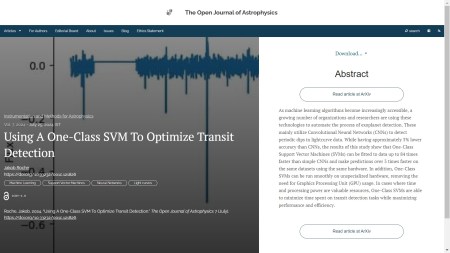
Here is a screen grab of the overlay which includes the abstract:


You can click on the image of the overlay to make it larger should you wish to do so. You can find the officially accepted version of the paper on the arXiv here.

The second paper, also published on Friday 14th June and has the title “Boil-off of red supergiants: mass loss and type II-P supernovae” by Jim Fuller (Caltech) and  Daichi Tsuna (Caltech, USA and University of Tokyo, Japan). This one, which is in the folder marked Solar and Stellar Astrophysics, discusses A new model for stellar mass loss which predicts that low-mass red supergiants lose less mass than commonly assumed, while high-mass red supergiants lose more.

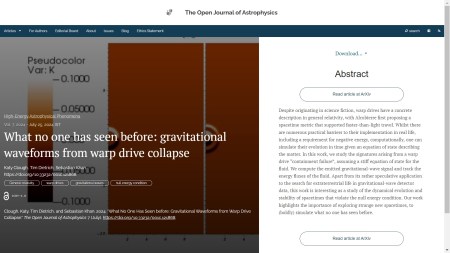
Here is a screen grab of the overlay which includes the abstract:


You can click on the image of the overlay to make it larger should you wish to do so. You can find the officially accepted version of the paper on the arXiv here.

That concludes this week’s update. Will we reach 50 for 20204 next week? Tune in next Saturday to find out!

Seriously, Scopus?

Posted in Open Access with tags , , , on June 10, 2024 by telescoper

Five months ago I wrote a blog post mentioning that the Open Journal of Astrophysics (OJAp) had been accepted for listing in Scopus. A couple of months later, I posted an update explaining that the process of was taking much longer than the 4 to 6 weeks I was told it would. Well, I can now report that, a full five months after acceptance, we have finally made it onto the Scopus database.

Great! I hear you say. Well, no actually. Despite taking an excessive length of time to index the Open Journal of Astrophysics, the Scopus crew have messed up the bibliometric data relating to it in a most ridiculous fashion.

Here is the entry:

I draw your attention first to the column marked Documents 2020-23 under which you will see the number 67. In fact we published 99 articles between 2020 and 2023, not 67. This is easily established here. The number 67 relates to the period 2022-23 only. Accidentally or deliberately, Scopus has omitted a third of our papers from its database.

But the error doesn’t end there. Papers published in OJAp between 2020 and 2023 have actually been cited 959 times, not 137. If you restrict the count to papers published in 2022-23 there are 526 citations. It’s no wonder that OJAp has such a low CiteScore, and consequently appears so far down the rankings, when the citation information is so woefully inaccurate.

Incidentally, CiteScores are marketed by Scopus as “metrics you can verify and trust”. Oh no you can’t.

When I first saw this travesty I thought very hard about asking to have OJAp removed from Scopus altogether, but on reflection I decided to contact them with the actual numbers and a request that they issue a correction as soon as possible. Given that it took 5 months to get this far, however, I’m not optimistic for a speedy response.

While I’m waiting for that I suggest you consider whether these egregious errors are simply incompetent or whether they are deliberate acts of sabotage by a front organization for the commercial publishing industry? And another question: how much else in the Scopus database is as badly wrong as the OJAp entry?