Archive for the Open Access Category

Connections and Submissions

Posted in Biographical, Open Access on November 30, 2023 by telescoper

If I have one gripe to make about the otherwise excellent train service between Barcelona and Paris (and back) , it’s that the Wi-Fi connection was very unreliable and at times unusable. That mean that I couldn’t do some of the fairly complicated things I needed to do online because of frequent disconnections. The upside of being disconnected is that I have a good excuse for not attending telecons!

I did manage to publish one paper at the Open Journal of Astrophysics yesterday, because I did the necessary before leaving my hotel in Paris. Unfortunately, I had to wait until I got back to Barcelona to check that everything had been correctly registered with Crossref. Only then could I promote the paper on social media. I’ll probably do a post here tomorrow about it.

These connectivity problems yesterday resulted in me spending most of my first day back in Barcelona catching up with such things as writing Google Docs and editing things via Overleaf but mainly dealing with new OJAp submissions.

There have been three four new submissions today alone, adding to the little backlog that developed over the short periods I was offline. These days we’re getting an average of one paper per day so if I can’t afford to miss many days as then it is difficult to catch up.

The two talks I gave while I was away were both about Open Access publishing in general, and the Open Journal of Astrophysics in particular, but I don’t think today’s little surge in submissions is a direct consequence of me touting for trade as I don’t think any of the authors concerned attended either talk even virtually.

It’s gratifying to see the number of submissions steadily increasing. I am sometimes frustrated – as I’m sure the authors are – by the slowness of the refereeing process but at least that’s no different from other journals I suppose.

Anyway, that’s enough reflections. Hopefully I’ll be able to spend this evening and tomorrow doing some writing of my own. Apart from tomorrow afternoon, when I’ll have yet another telecon…

To Saclay

Posted in Biographical, Open Access, Talks and Reviews with tags , on November 28, 2023 by telescoper

I am up early this morning ahead of a trip to Saclay, best known for CEA Saclay and the relatively new Paris-Saclay University, which involves an approximately 30-minute trip on an RER to Le Guichet, followed by road transport. It’s anomalous that Saclay itself is not served by either train or Metro, though I am told there are plans.

The only significant annoyance about yesterday’s journey was that the WIFI was hopeless, so I had to catch up with a lot of things last night and have more to do today. Still, my talk is this morning so I should have plenty time this afternoon and evening before heading back to Barcelona tomorrow.

Here are the slides I used for my talk, which was virtually identical to the one given at Montpellier last week.

Update: It has been a long day. I’m now back in the hotel in Port-Royal. The new Paris-Saclay campus is very impressive. The IPhT is a bit older and of a different style but is a nice working environment. Thanks to everyone there for their hospitality and especially for the splendid lunch after my talk!

Signatories of DORA

Posted in Maynooth, Open Access, Science Politics with tags , on November 22, 2023 by telescoper

Following on from comments on a number of previous posts I just wanted to encourage anyone involved in research of any kind who hasn’t done so already to sign the San Francisco Declaration on Research Assessment (DORA) as an individual and if your institution hasn’t done so yet please encourage them to do so. You can check whether your organization has signed it here.

The Number One recommendation of DORA is:

Do not use journal-based metrics, such as Journal Impact Factors, as a surrogate measure of the quality of individual research articles, to assess an individual scientist’s contributions, or in hiring, promotion, or funding decisions.

San Francisco Declaration on Research Assessment

You can read the other recommendations for funders, publishers, institutions, and researchers, here.

I am well aware that some institutions have signed DORA but don’t really pay attention to it in their internal processes. Maynooth University is a signatory and certainly does take it into consideration when dealing with, e.g., recruitment and promotion but it, along with other signatories, has to deal with inconsistencies in the outside world. One of these is that, while Science Foundation Ireland and the Irish Research Council are both signatories of DORA, the Irish Government itself is not, so the Department of Further and Higher Education, Research, Innovation and Science is not bound by it. That makes no sense to me at all!

SCOPUS SCOPUM

Posted in Open Access with tags , , on November 21, 2023 by telescoper

I’ve just spent the best part of two hours completing a lengthy and very tedious online form in order to apply to have the Open Journal of Astrophysics listed on Scopus. I did try this before, back in September, but the Scopus website crashed when I tried to submit the application. I emailed their helpline and they said they’d get back to me, but they never did.

One of the annoying things about the proposal form is the duplication of information. Almost every page requires the applicant to enter the name and email of the Managing Editor (that’s me). They could just carry that information forward from one page to the next.

An even more annoying thing is that one has to upload ten recent articles published by the Journal. It won’t accept weblinks, which would be more efficient for an online journal like OJAp. So I had to download ten papers from arXiv just to upload them again. Then I discovered they have a maximum file size of 10MB, which rules out several of our recent papers.

(All this reminds me that the next book on my reading list is Bullshit Jobs, by David Graeber…)

My personal feeling is that I couldn’t care less about getting listed by Scopus – which is run by racketeering publishing giant Elsevier as a gate-keeper for the academic publishing industry – but it seems that there are a lot of bean-counters around the world who think a journal isn’t a journal unless it is on their list, no doubt because Elsevier told them that is the case.

In fact it’s quite easy to look up citations, etc, for journals and individual articles without recourse to Scopus but administrators have been brainwashed into handing over large sums of money to Elsevier to inflate their already substantial profits. I don’t feel I should be asking for approval from the likes of them.

Anyway, the flakiness of their Scopus application platform – see paragraphs 1 to 3 above – does not fill me with confidence that Elsevier put much effort into the process. On the other hand, they have a captive audience so why should they? Now, however, at least I have an email confirming they received the application along with a tracking number and the statement

Please allow up to several months for the review process to be completed. 

The only reason for posting this here is to remind me to post if and when they respond. I won’t be holding my breath.

Thoughts of Retirement

Posted in Barcelona, Biographical, Maynooth, Open Access, The Universe and Stuff with tags , , , on November 19, 2023 by telescoper

I’ve been reviewing my situation while here in Barcelona. One of the themes that keeps popping into my head is well expressed by part of a little speech by Colonel Nicholson in The Bridge on the River Kwai:

But there are times… when suddenly you realize you’re nearer the end than the beginning. And you wonder, you ask yourself, what the sum total of your life represents. What difference your being there at any time made to anything – or if it made any difference at all, really. Particularly in comparison with other men’s careers. I don’t know whether that kind of thinking’s very healthy, but I must admit I’ve had some thoughts on those lines from time to time.

Healthy or not I’ve also had thoughts along those lines, and sometimes feel I should step aside and create a job opportunity for someone younger. I know my employer wouldn’t mind if I did that either. They’d much prefer replacing me with someone cheaper and more compliant than me. I think if I asked for early retirement they would probably jump at the chance. I’d miss the teaching and the students, of course,

The fact of the matter is though that I can’t afford to retire yet. I have a mortgage to pay and I’ve only had five full years of pensionable service in the Irish system, so won’t get much of a pension. I have the frozen residue of my UK pension, of course, but that is subject to an actuarial reduction if I take the benefit before I’m 65, which is also the standard retirement age for academic staff in Ireland. I can’t be made to retire here until I’m 70, in fact, but I think I’ll be well beyond my best-before date by then and am not keen to overstay my welcome.

So it looks like I’ll have to stay until I’m 65 at the earliest. In fact I won’t be able to collect the State Pension (SPC) until I’m 66, so I’ll probably have to stay another year. That means that when I get back from sabbatical I will have four or five years left until I can retire. I don’t know what I’ll be teaching when I return but I hope I get a chance to teach a few new modules before the end. In particular some cosmology or astrophysics would be particularly nice. All this is predicated on: (a) me living long enough; and (b) Physics at Maynooth not being closed down; neither of these is certain.

When I moved to the Emerald Isle in 2017 I supposed that I would carry on living in Ireland after retiring. Now I’m having some doubts about that. I have been advised by medical experts that my arthritis would be more tolerable in a warmer climate. And there’s the cost of living in Ireland, which is much higher than Spain. I can imagine living here, actually, though I think Barcelona itself might be a bit expensive for a pensioner. Somewhere in the surrounding countryside, or along the coast, might be nice. I’ve got a few years to think about that.

Another thing in my mind is what will happen to the Open Journal of Astrophysics when I retire? I would like some larger organization or community to take it over in the long term. It’s not expensive to run, actually, but someone would have to take over as Managing Editor. Moreover, I don’t think it’s really fair to expect one small University in Ireland to bear the full cost of a global astrophysics journal indefinitely.

New Publication at the Open Journal of Astrophysics

Posted in mathematics, OJAp Papers, Open Access, The Universe and Stuff with tags , , , on November 17, 2023 by telescoper

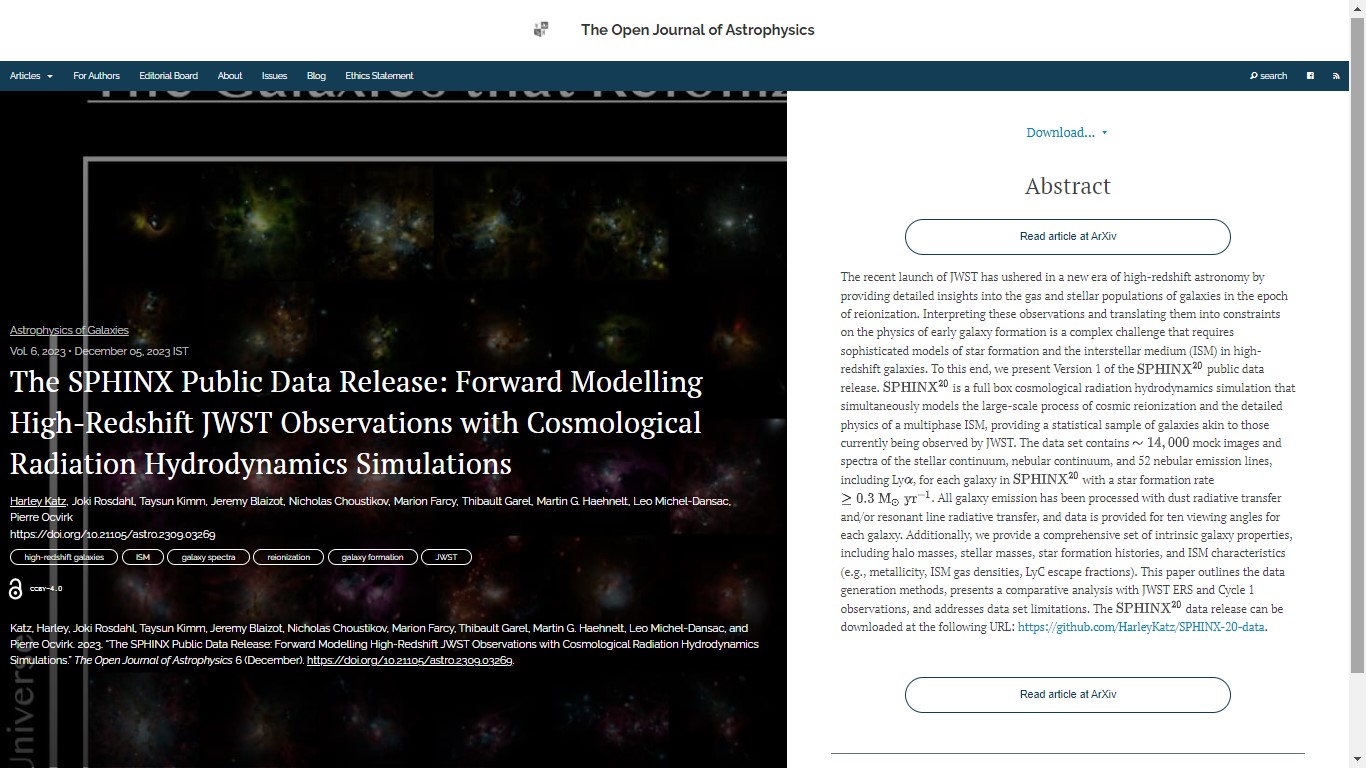
It’s Friday afternoon but before I collapse, exhausted, into the arms of the weekend I’ll take  the opportunity to announce yet another new paper at the Open Journal of Astrophysics.

The latest paper is the 45th so far in Volume 6 (2023) – just five to go for a half-century – and it’s the 110th altogether. This one was actually published on Tuesday November 14th.

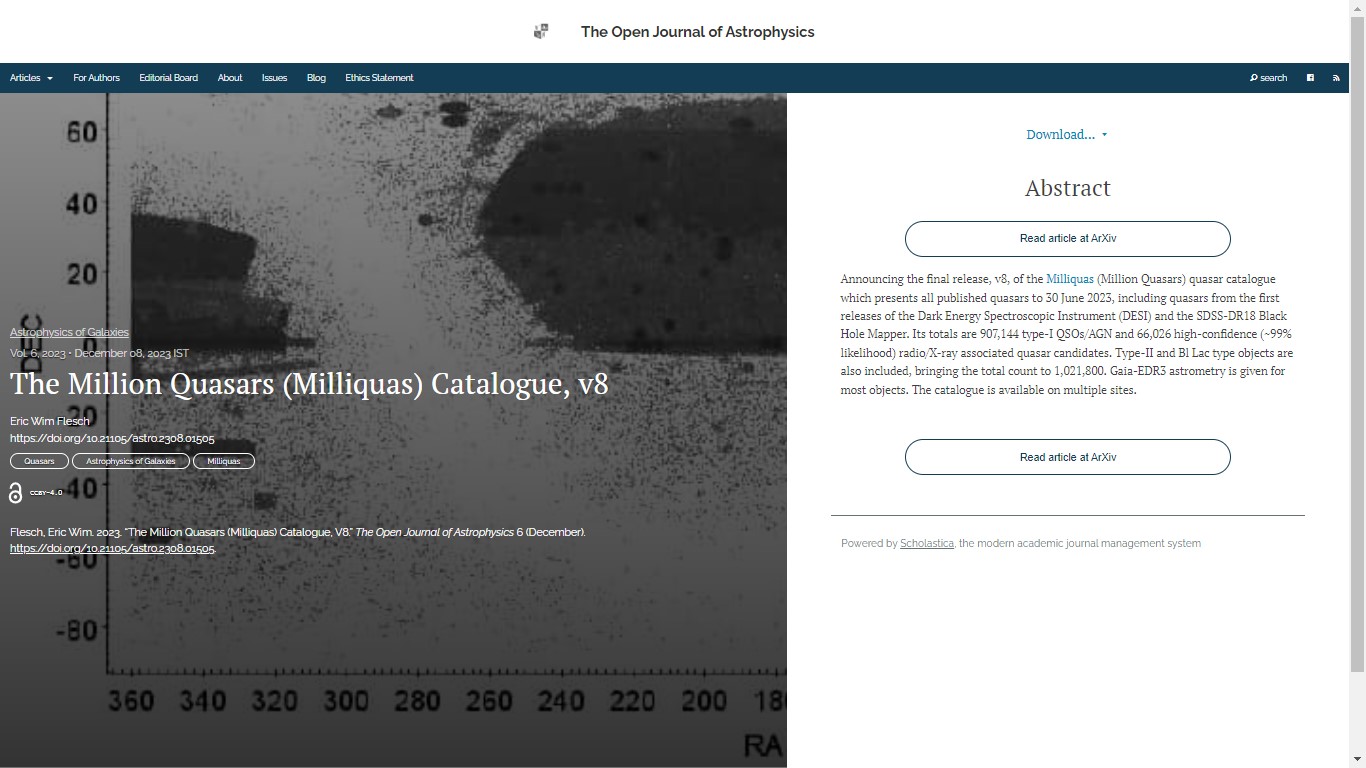
The title is “Marginalised Normal Regression: Unbiased curve fitting in the presence of x-errors” and it’s by Deaglan J. Bartlett (Institut d’Astrophysique de Paris, France) and Harry Desmond (Portsmouth, UK). It sounds like a statistical methods paper, and indeed it is, but remember that there’s a very long historical connection between astronomy and the development of statistical methods for data analysis, and this paper tackles a very longstanding issue: how best to fit curves in the presence of noisy data. This paper presents a new method for doing this, together with applications to cosmological and astrophysical data, and accompanying software. It is in the folder marked Instrumentation and Methods for Astrophysics.

Here is the overlay of the paper containing the abstract:

You can click on the image of the overlay to make it larger should you wish to do so. You can find the officially accepted version of the paper on the arXiv here.

Yet another problem with Journal Impact Factors

Posted in Open Access with tags , , , on November 9, 2023 by telescoper

I was at a meeting this morning in which the vexed issue of the journal Impact Factor (IF) came up. That reminded me of something that struck me when I was checking the NASA/ADS entry for a paper recently published by the Open Journal of Astrophysics, and I thought it would be worth sharing it here. First of all, here’s a handy slide showing how the Impact Factor (IF) for a journal is calculated for a given year:

It’s a fairly straightforward piece of information to calculate, which is one of its few virtues.

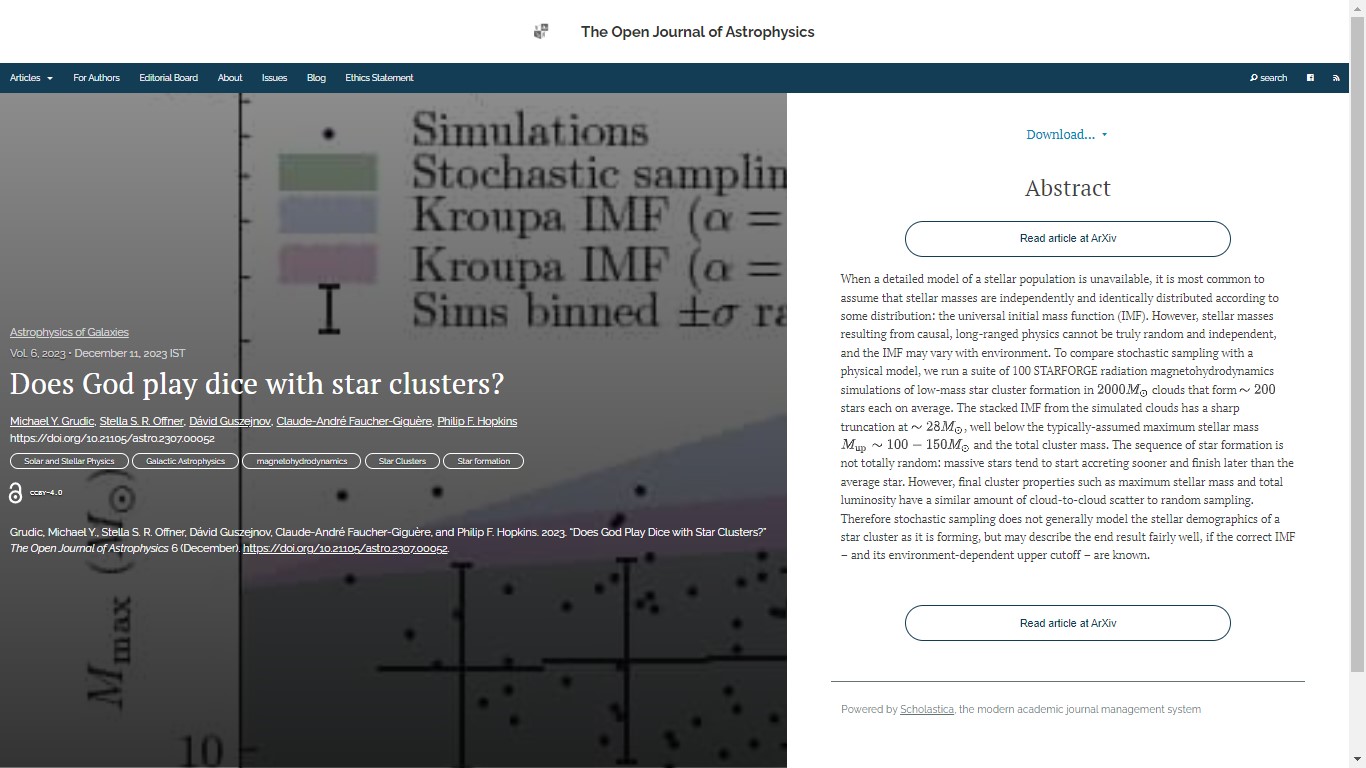
Now consider this paper we recently published in the Open Journal of Astrophysics:

As of today, according to the wonderful NASA/ADS system, this paper has 36 citations. That’s no bad considering that it was published less than a month ago. It’s obviously already quite an impactful paper. The problem is that if you look at the recipe given above you will see that none of those 36 citations – nor any more that this paper receives this year – will ever be included in the calculation of the Impact Factor for the Open Journal of Astrophysics. Only citations to this paper garnered in 2024 and 2025 will count to the impact factors (for 2025 and 2026 respectively). There’s every reason to think this paper will get plenty of citations over the next two years, but I think this demonstrates another bit of silliness to add to the already long list of silly things about the IF as a measure of citation impact.

My view of citation numbers is that they do contain some (limited) information about an article’s impact, but if you want to use them you should just use the citations for the article itself, not a peculiar and arbitrarily-constructed proxy like the IF. It is so easy to get article-level citation data that there is simply no need to use a journal-level metric for anything at all.

Gold or Green?

Posted in Open Access, Television with tags , , , on November 2, 2023 by telescoper

During my talk yesterday I mentioned the difference between “Green” and “Gold” forms of Open Access, which always makes me think of a scene from Blackadder II. I mentioned this in the talk and it seems not everyone in the audience was aware of the cultural reference, so here is the clip in question. It doesn’t have anything to do with Open Access, of course, but I think it is very funny.

Flying visit to Cardiff

Posted in Biographical, Cardiff, Open Access with tags , , , , on November 1, 2023 by telescoper

I got up at 3am this morning to take a bus to an airport, then a flight to Bristol Airport, then another bus to Bristol Temple Meads, and then a train to Cardiff in order to give a seminar. Now I’m in the middle of the reverse process, having a pint in Bristol Airport.

In case you’re thinking of using Bristol Airport at any time in the next 8 weeks, then please bear in mind that there are major roadworks on the approach road, so be sure to allow extra time. It took over an hour from Bristol Temple Meads this evening, more than double the usual time, and it’s only 8 miles…

I’m more than a little tired after all that, but it was still very nice to meet up with friends and former colleagues again. I was particularly delighted to learn that Professor Haley Gomez has been appointed Head of the School of Physics and Astronomy. Congratulations to Haley!

I’ll upload the slides from my talk when I get back to base. For the time being, however, I’m just going to chill in the departure lounge before my return flight.

Update: the return leg ran to schedule so here, as promised, are the slides for the talk I was invited to give:

P.S. I’ll be giving two talks on the same theme later this month in different institutes in France.

Open Access Week 2023

Posted in Open Access with tags , , on October 23, 2023 by telescoper

I’m reminded by multiple sources that this week is International Open Access Week 2023, with a theme of “Community over Commercialization”.

Of course, round my way, every week is Open Access Week.

The ongoing OA revolution should involve a radical reinvention/disruption of commercialized academic publishing instead of letting exploitative profit-making private publishing firms keep on fleecing the scholarly community. There is much still to do, and we’ll only succeed if more people turn words into actions.

P.S. You could always start by making a donation to arXiv.