Archive for the Open Access Category

A Clarivate Apology

Posted in Open Access with tags , , on July 19, 2022 by telescoper

Well, it seems that my recent post about Impact Factors has had some effect. Today I received an email from Clarivate, the salient part of which is appended below. I applied for inclusion on the Web of Science Collection in April 2021, so they have sat on this request for over a year.

Now I have to start the process  all over again. Sigh. I’m taking a wild guess here but I wonder if access to the Web of Science Publisher Portal might require the payment of a hefty subscription, so only big commercial publishers can afford it?

I suspect If I hadn’t posted about this on social media they would have ignored my submission request indefinitely.

To think so many people take this company seriously….

–0–

We are contacting you regarding the evaluation of the Open Journal of Astrophysics for the Web of Science Core Collection and following up from a recent post on social media.

Unfortunately we have not been able to evaluate your journal to this date due to the large amount of journal submissions we are continuously receiving and the implementation of new internal management systems. We are taking several actions to improve the efficiency of the editorial process, one of them is the migration of our submission platform to the Web of Science Publisher Portal. The Portal allows publishers to securely log in and submit journals for inclusion in the Web of Science Core Collection and provides a way to view the status of all journals submitted.

All journals previously submitted using the Journal Submission Form on the Master Journal List that have not received a decision regarding inclusion in the Web of Science Core Collection, have to be re-submitted through the Web of Science Publisher Portal; that is the case of the Open Journal of Astrophysics, which needs to be re-submitted. Please remember that only publishers can submit journals through the portal.


New Publication at the Open Journal of Astrophysics

Posted in Open Access, The Universe and Stuff with tags , , , on July 17, 2022 by telescoper

Today is ten years to the day that I wrote the blog post that first proposed setting up the Open Journal of Astrophysics. It took a bit longer than I’d expected to get it going. The prototype site opened at the end of 2015 but owing to personal issues the project didn’t get going in full until after I moved to Maynooth in 2017.

It couldn’t have happened without enormous help from Arfon Smith, Chris Lintott, Adam Becker, Robert Simpson, Stuart Lynn and Mark Rohloff so many thanks to them for assistance in getting it off the ground. I also thank the staff at Maynooth University Library, especially Fiona Morley-Clarke, for their support and assistance. I also acknowledge financial support from the Gordon and Betty Moore Foundation.

I’d also like to thank the Editorial Team at OJAp, all unpaid volunteers, for their efforts and of course to all the authors who have trusted their research findings what was, at least at the start, an experimental venture.

Now seems an appropriate time to announce yet another new publication in the Open Journal of Astrophysics! This one, published last week, is the 10th paper in Volume 5 (2022) and the 58th in all.

The latest publication is entitled “V889 Her: abrupt changes in the magnetic field or differential rotation?” and is written by Teemu Willamo (Helsinki), Thomas Hackman (Helsinki), Jyri J. Lehtinen (Turku), Maarit Korpi-Lagg (Aalto) and Oleg Kochukhov (Uppsala). The first four of these are based in Finland and the last in Sweden.

This is another paper in the Solar and Stellar Astrophysics folder; the subject of the paper V889 Herculis is a young and very active dwarf star with some intriguing properties.

Here is a screen grab of the overlay which includes the (very short) abstract:

You can click on the image to make it larger should you wish to do so. You can find the arXiv version of the paper here.

The (unofficial) 2021 Journal Impact Factor for the Open Journal of Astrophysics

Posted in Open Access, The Universe and Stuff with tags , , on July 16, 2022 by telescoper

Since a few people have been asking about the Journal Impact Factor (JIF) for the Open Journal of Astrophysics, I thought I’d do a quick post in response.

When asked about this my usual reply is (a) to repeat the arguments why the impact factor is daft and (b) point out that the official JIF is calculated by Clarivate so it’s up to them to calculate it – us plebs don’t get a say.

On the latter point Clarivate takes its bibliometric data from the Web of Science (which it owns). I have applied on behalf of the Open Journal of Astrophysics to be listed in the Web of Science but it has not yet been listed.

Anyway, the fact that it’s out of my hands doesn’t stop people from asking so I thought I’d proceed with my own calculation not using Web of Science but instead using NASA/ADS (which probably underestimates citation numbers but which is freely available, so you can check the numbers using the interface here); the official NASA/ADS abbreviation for the Open Journal of Astrophysics is OJAp.

For those of you who can’t be bothered to look up the definition of an impact factor for a given year it is defined the sum of the citations for all papers published in the journal over the previous two-year period divided by the total number of papers published in that journal over the same period. It’s therefore the average citations per paper published in a two-year window. Since our first full year of publication was 2019, the first year for which we can calculate a JIF is 2021 (i.e. last year) which is defined using data from 2019 and 2020.

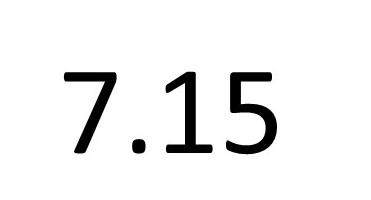
I stress again we don’t have an official Journal Impact Factor for the Open Journal of Astrophysics but one can calculate its value easily. In 2019 and 2020 we published 12 and 15 papers respectively, a 27. These papers were cited a total of 193 times in 2021. The journal impact factor for 2021 is therefore … roll on the drums… 193/27, which gives:

If you don’t believe me, you can check the numbers yourself. For comparison, the latest available Impact Factor (2020) for Monthly Notices of the Royal Astronomical Society is 5.29 and Astronomy & Astrophysics is 5.80. OJAp’s first full year of publication was 2019 (in which we published 12 papers) but we did publish one paper in 2018. Based on the 134 citations received to these 13 papers in 2020, our 2020 Journal Impact Factor was 10.31, much higher than MNRAS or A&A.

Furthermore, we published 32 papers in 2020 and 2021 which have so far received 125 citations in 2022. Our Journal Impact Factor for 2022 will therefore be at least 125/32= 3.91 and if those 32 papers are cited at the same for the rest of this year the 2022 JIF will be about 7.5.

Who knows, perhaps these numbers will shame Clarivate into giving us an official figure?

With so much bibliometric information available at the article level there is no reason whatsoever to pay any attention to such a crudely aggregated statistics at the journal level as the JIF. One should judge the contents, not the packaging. I am however fully aware that many people who hold the purse strings for research insist on publications in journals with a high JIF. If there was any fairness in the system they would be mandating astronomy publications in OJAp rather than MNRAS or A&A.

Anyway, it might annoy all the right people if I add a subtitle to the Open Journal of Astrophysics: “The World’s Leading Astrophysics Journal”…

New Publication at the Open Journal of Astrophysics

Posted in Open Access, The Universe and Stuff with tags , , , , , on July 10, 2022 by telescoper

Time to announce another new publication in the Open Journal of Astrophysics! This one, published last week, is the 9th paper in Volume 5 (2022) and the 57th in all.

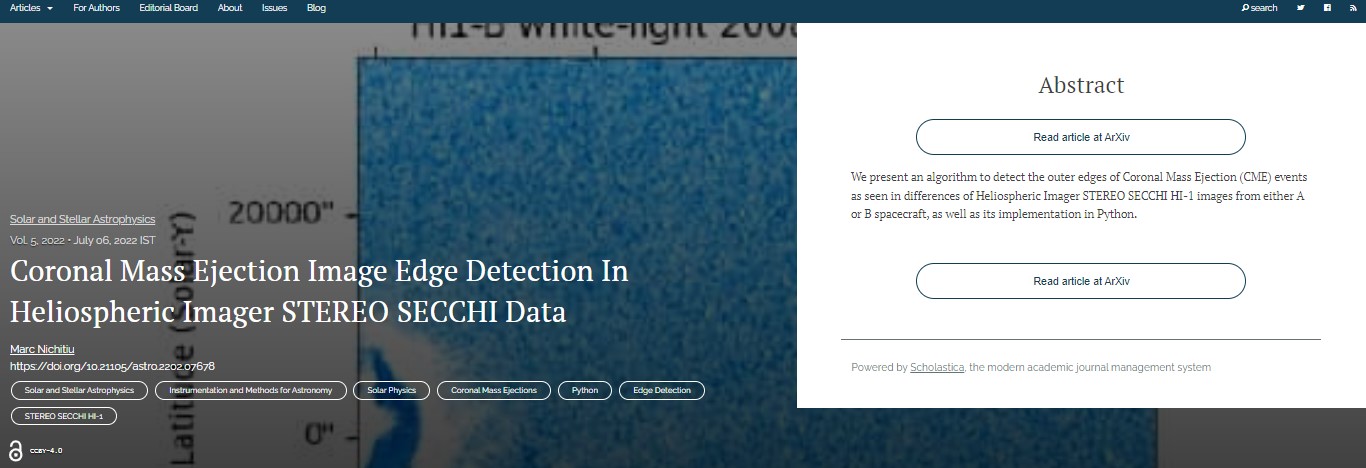
The latest publication is entitled “Coronal Mass Ejection Image Edge Detection In Heliospheric Imager STEREO SECCHI Data” and is written by Marc Nichitiu of the Stony Brook School (NY, USA).  If you want to know more about the Solar observatory STEREO you can look here. SECCHI stands for “Sun-Earth Connection Coronal and Heliospheric Investigation”, which is a camera array on the STEREO spacecraft.

This paper is in the Solar and Stellar Astrophysics folder. It’s a slightly unusual paper because it is mainly software, so could have been in the Instrumentation and Methods for Astrophysics section.

Here is a screen grab of the overlay which includes the (very short) abstract:


You can click on the image to make it larger should you wish to do so. You can find the arXiv version of the paper here.

New Publication at the Open Journal of Astrophysics

Posted in OJAp Papers, Open Access, The Universe and Stuff with tags , , , , , , , on July 5, 2022 by telescoper

Time to announce another new publication in the Open Journal of Astrophysics! This one, published on Sunday, is the 8th paper in Volume 5 (2022) and the 56th in all.

The latest publication is entitled “Search for a distance-dependent Baryonic Tully-Fisher Relation at low redshifts” and is written by by Aditi Krishak (IISER-Bhopal, India) and Shantanu Desai (IIT Hyderabad, India).

This paper is in the Cosmology and Nongalactic Astrophysics folder.

Here is a screen grab of the overlay which includes the abstract:


You can click on the image to make it larger should you wish to do so. You can find the arXiv version of the paper here.

Two New Publications at the Open Journal of Astrophysics

Posted in Open Access, The Universe and Stuff with tags , , , , , , on May 29, 2022 by telescoper

Last week was rather busy. Amongst other things I managed to complete the publication process for two more papers in the Open Journal of Astrophysics (one on Tuesday and one on Thursday) although there was a small delay in registering the metadata so I didn’t fully announce them until yesterday. I’ve only just managed to find time today to advertise them here. These two are the sixth and seventh papers in Volume 5 (2022) and the 54th and 55th in all respectively. Both the new papers are in the folder marked Cosmology and Nongalactic Astrophysics.

The first of these two new publications is entitled “The Impact of Quadratic Biases on Cosmic Shear” and is written by Tom Kitching and Anurag Deshpande of the Mullard Space Science Laboratory in Surrey (UK).

Here is a screen grab of the overlay which includes the abstract:

You can click on the image to make it larger should you wish to do so. You can find the arXiv version of this paper directly here.

The second new publication is entitled “Cosmo-Paleontology: Statistics of Fossil Groups in a Gravity-Only Simulation” and is written by Aurora Coissairt, Michael Buehlmann, Eve Kovacs, Xin Liu, Salman Habib and Katrin Heitmann all from the Argonne National Laboratory which is just outside Chicago in the USA.

Here is the overlay of that paper which includes the abstract:

Once again You can click on the image to make it larger should you wish to do so. You can find the arXiv version of the paper here.

We have quite a few more papers in the pipeline so expect to be announcing more quite soon, probably early next month.

New Publication at the Open Journal of Astrophysics

Posted in Open Access, The Universe and Stuff on May 14, 2022 by telescoper

The last couple of days have been very busy but at last I’ve got time to announce a new publication in the Open Journal of Astrophysics! This one is the 5th paper in Volume 5 (2022) and the 53rd in all. It was published on Thursday in fact but I’ve only just found time to mention it here.

The latest publication is entitled “Statistical Uncertainties of the NDW=1 QCD Axion Mass Window from Topological Defects” and is written by Sebastian Hoof & Jana Riess of the Georg-August-Universität Göttingen in Germany and David Marsh of King’s College London.

This paper is in the Cosmology and Nongalactic Astrophysics folder (cross-listed on arXiv from High-Energy Physics).

Here is a screen grab of the overlay which includes the abstract:


You can click on the image to make it larger should you wish to do so. You can find the arXiv version of the paper here.

P.S. We have quite a number of papers out there waiting for revised versions to be submitted. I get the feeling that everyone is very busy these days. Hopefully as we emerge from the pandemic things will improve.

A Road to Living Documents?

Posted in Open Access, The Universe and Stuff with tags on May 4, 2022 by telescoper

A few weeks ago I posted an item arguing that the scientific paper is an outdated concept and the whole business of research publishing should change to reflect more accurately how science is actually done. I’d argued previously that

the future for many fields will be defined not in terms of “papers” which purport to represent “final” research outcomes, but by living documents continuously updated in response to open scrutiny by the community of researchers. I’ve long argued that the modern academic publishing industry is not facilitating but hindering the communication of research. The arXiv has already made academic journals virtually redundant in many of branches of  physics and astronomy; other disciplines will inevitably follow.

I thought I would explain how the Open Journal of Astrophysics represents a small move in the direction of the “living document” idea.

Recently the author of a paper we published in 2019 contacted me to explain that readers had pointed some errors in that publication and he wished to amend it to correct the mistakes, which were typographical in nature but did propagate through a number of equations though they did not affect the main results. We had dealt with one post-publication amendment in the past and we handled this one in the same way:

  1. The author sent us a new version containing the proposed revisions;
  2. The Editor checked that they were reasonable (i.e. minor and without any significant changes to the scientific content);
  3. After getting the green light the author placed a revised version on arXiv with a comment explanation the revisions (in this case v3);
  4. We changed our overlay to point at the new version.

Here is the new overlay updated this morning.

You will see that there is a note on the overlay after the abstract. There is also a comment alongside the arXiv submission and another in the acknowledgements section of the revised paper. Owing to the separation between the overlay and the arXiv it is not necessary to change the Digital Object Identifier (DOI) or any of the article metadata.

This is a lot easier than the old-fashioned method of publishing an erratum. It may not represent the idea of a living document exactly, but it does demonstrate a way of feeding back to the publication after the “open scrutiny by the community of researchers” I referred to in my quote above.

It also demonstrates that peer review, however thorough, is never perfect and having wider scrutiny can find errors a referee might not.

Why we don’t need scientific papers

Posted in Open Access, Science Politics with tags , , on April 21, 2022 by telescoper

There’s a recent piece by Stuart Ritchie in The Grauniad that argues that the concept of the “scientific paper” has outlived its usefulness and should be scrapped. I think there’s a lot in the arguments presented and the article is well worth reading. Indeed, I have made similar points myself a number of times on this blog relating both to individual papers and to the journals in which they are published.

In this post from a couple of years ago, for example, I asked the question: what are scientific papers for? Here is an extract:

I can think of two main purposes (which aren’t entirely mutually exclusive): one is to disseminate knowledge and ideas; the other is to confer status on the author(s) .

The academic journal began hundreds of years ago with the aim of achieving the former through distribution of articles in print form. Nowadays the distribution of research results is achieved much less expensively largely through online means. Nevertheless, journals still exist (largely, as I see it, to provide editorial input and organize peer review) .

Alongside this there is the practice of using articles as a measure of the ‘quality’ of an author. Papers in certain ‘prestigious’ ‘high impact’ journals are deemed important because they are indicators of status, like epaulettes on a uniform, and bibliometric data, especially citation counts, often seem to be more important than the articles themselves.

By the way, I put up a poll in that piece, which is still open. You can vote here:

The point – also made by Stuart Ritchie – is that the traditional scientific journal is a 17th Century invention and, as such, does not reflect the way modern scientific is performed and disseminated.

In fields like astrophysics and particle physics this anachronistic approach leads to absurdities such as papers with thousands of authors, many of whom won’t have even read, let alone contributed any writing to, the article. Reflecting on the publication of a paper with 5000 authors back in 2015, I wrote this:

It seems quite clear to me that the academic journal is an anachronism. Digital technology enables us to communicate ideas far more rapidly than in the past and allows much greater levels of interaction between researchers. I agree with Daniel Shanahan that the future for many fields will be defined not in terms of “papers” which purport to represent “final” research outcomes, but by living documents continuously updated in response to open scrutiny by the community of researchers. I’ve long argued that the modern academic publishing industry is not facilitating but hindering the communication of research. The arXiv has already made academic journals virtually redundant in many of branches of  physics and astronomy; other disciplines will inevitably follow. The age of the academic journal is drawing to a close. Now to rethink the concept of “the paper”…

This is the closing paragraph of Ritchie’s piece, which says much the same thing:

We’ve made astonishing progress in so many areas of science, and yet we’re still stuck with the old, flawed model of publishing research. Indeed, even the name “paper” harkens back to a bygone age. Some fields of science are already moving in the direction I’ve described here, using online notebooks instead of journals – living documents instead of living fossils. It’s time for the rest of science to follow suit.

It seems to me that the barrier to opening up the processes of scientific publication to these is that the more accurately publications reflect how science is actually done in the digital age, the more difficult it is for the bean counters to assess research quality or productivity. The academic publishing industry has cornered the market on bibliometric indicators so it rather than the scientific community gets to dictate how scientific quality will be measured. The tail is wagging the dog. Until that ends – and it will only end when we fairer ways of evaluating research – we will be saddled with the broken system we have now.

Overlay journals: a study of the current landscape

Posted in Open Access with tags , , on April 11, 2022 by telescoper

There’s a recent paper on the arXiv by Rousi & Laakso (both based in Finland) with the above title and the following abstract:

Overlay journals are characterised by their articles being archived on public open access repositories, often already starting in their initial preprint form as a prerequisite for submission to the journal prior to initiating the peer-review process. In this study we aimed to identify currently active overlay journals and examine their characteristics. We utilised an explorative web search and contacted key service providers for additional information. The final sample consisted of 35 active overlay journals. While the results show an increase in the number of overlay journals in recent years, the current presence of overlay journals is diminutive compared to the overall number of open access journals. The majority of overlay journals publish articles in the natural sciences, mathematics or computer sciences. Overlay journals are commonly published by groups of scientists rather than formal organisations and overlay journals may also rank highly within the traditional journal citation metrics. Nearly none of the investigated journals charge fees from authors, which is likely related to the cost-effectiveness of the overlay publishing model. Both the growth in adoption of open access preprint repositories, and researchers willingness to publish in overlay journals will determine the models wider impact on scholarly publishing.

You can find a discussion of overlay journals in general here, where I learnt that the term “overlay journal” was coined back in 1996 but it obviously took quite a long time to implement the idea in functioning platforms. The paper is well worth reading. It contains some analysis of journal citation metrics but because most of the journals are young this information is very sparse. The Open Journal of Astrophysics of course gets a mention. It doesn’t yet have a Journal Impact Factor. Some of the journals in the Rousi-Laakso paper have a JIF but this dates from a time before the journal flipped to overlay state. For your information, the JIF for year n is based on citations received in that year for papers published in years n-1 and n-2. The Open Journal of Astrophysics should qualify for a JIF for 2021 based on papers published in 2019 and 2020 but Clarivate (who control such things) doesn’t seem to be in a hurry to issue one.

I think Journal Impact Factors are a waste of time. Why use journal level metrics when there is plenty of information at the article level? On the other hand the bean-counters in charge of science funding in several countries (including Italy) insist that papers resulting from this funding should be published in papers with a high JIF so I’m aware that not having a JIF is a limiting factor for some.

Of course many fields do not use the arXiv, but there is no reason why the principle of the overlay journal could not be applied to other forms of repository. There has been a culture in physics and astronomy of circulating preprints for a very long time now, and it may take a while for this to permeate into other disciplines.