Archive for the Open Access Category

New Publication at the Open Journal of Astrophysics!

Posted in OJAp Papers, Open Access, The Universe and Stuff with tags , , , , on August 4, 2020 by telescoper

Another new paper has been published in the Open Journal of Astrophysics! This one was actually published last Friday but it being the Bank Holiday weekend I just got round to blogging about it today. This is another one for the Cosmology and NonGalactic Astrophysics section. It’s called Cosmic event horizons and the light-speed limit for relative radial motion and is a sort of pedagogical review of the subject aimed at dispelling some common misconceptions about radial velocities and horizons. The author is Markus Pössel of the Max Planck Institute for Astronomy at Heidelberg.

Here is a screen grab of the overlay:

I’ve taken the liberty of adding the background teaser image in full here, as it is rather groovy:

You can click on the image to make it larger.

You can find the arXiv version of the paper here.

The Open Journal of Astrophysics is now in the Directory of Open Access Journals!

Posted in Open Access with tags , , on July 28, 2020 by telescoper

One of the things I did during the recent Covid-19 campus closure was to complete an application for the Open Journal of Astrophysics to be indexed in the Directory of Open Access Journals (DOJA).

I did apply late last year but there was an issue with the registration of the ISSN (International Standard Serial Number) which had not been done correctly when it was issued by the National Library of Ireland. That was easily fixed but DOAJ requires unsuccessful applicants to wait six months before applying again.

Getting listed on DOAJ is by no means trivial. The criteria are rather strict and the application form rather lengthy. All of which means that I was delighted to learn today that my application was successful this time, and we’re now listed.

To prove it here is our entry:

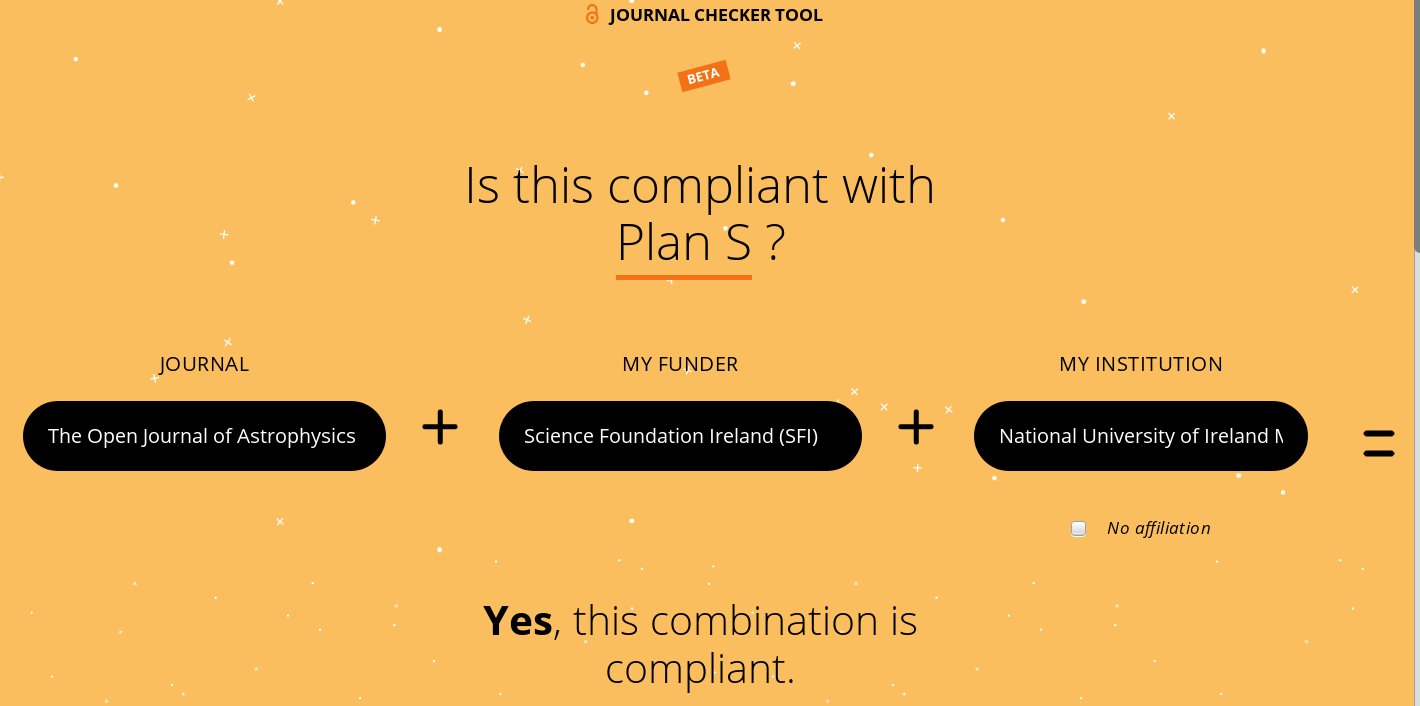
Apart from the intrinsic usefulness of being indexed, being listed on DOAJ is one of the criteria for being an acceptable Open Access publisher for some funding agencies, including those who have signed up for Plan S.

I also imagine that our being on DOAJ might convince new authors to submit to us!

All I have to do now is figure out how to add our papers and metadata to the DOAJ and find the time to do it.

P. S. The Directory of Open Access Journals also has a WordPress blog which you can find here!

More Lockdown Perspectives on the Hubble Tension and thoughts on the future of scientific publications

Posted in Open Access, The Universe and Stuff with tags , , , , on July 28, 2020 by telescoper

This is interesting. Remember last week when I posted about a paper by George Efstathiou on the Hubble Constant controversy. This is the abstract.

Well, a new version of the paper has just appeared on the arXiv that includes some comments in response from the SH0ES team.

It is of course interesting in itself to see the cut and thrust of scientific debate on a live topic such as this, but in my mind at least it raises interesting questions about the nature of scientific publication. To repeat something I wrote a a while ago, it seems  to me that the scientific paper published in an academic journal is an anachronism. Digital technology enables us to communicate ideas far more rapidly than in the past and allows much greater levels of interaction between researchers. I agree with Daniel Shanahan that the future for many fields will be defined not in terms of “papers” which purport to represent “final” research outcomes, but by living documents continuously updated in response to open scrutiny by the research community.

The Open Journal of Astrophysics is innovative in some ways but remains wedded to the paper as its fundamental object, and the platform is not able to facilitate interaction with readers. Of course one of the worries is that the comment facilities on many websites tend to get clogged up with mindless abuse, but I think that is manageable. I have some ideas on this, but for the time being I’m afraid all my energies are taken up with other things so this is for the future.

I’ve long argued that the modern academic publishing industry is not facilitating but hindering the communication of research. The arXiv has already made academic journals virtually redundant in many of branches of  physics and astronomy; other disciplines will inevitably follow. The age of the academic journal is drawing to a close, and it is consequently time to rethink the concept of a paper.

The Open Journal of Astrophysics & INSPIRE

Posted in Open Access, The Universe and Stuff with tags , , , , on July 1, 2020 by telescoper

After a busy morning I’ve got time for an update or two about the Open Journal of Astrophysics.

As well as the NASA Astrophysics Data System (ADS) many papers in astrophysics are also indexed by INSPIRE HEP the analogous information management system for high energy physics. Here is the logo for the latter:

Being indexed in INSPIRE  is particularly relevant for authors of papers in astroparticle physics and cosmology, but papers in other areas of astrophysics are also listed on INSPIRE HEP. I am given to understand that, e.g., postdoc selection committees often look at INSPIRE for bibliometric information about applications so this is potentially important for early career researchers.

I am very grateful to staff at Inspire for ensuring that all our papers are now fully indexed in INSPIRE HEP as refereed articles with metadata fully consistent with NASA/ADS. The back catalogue having been dealt with manually we can now set up a feed to ensure that future papers are indexed automatically by NASA/ADS and Inspire HEP.

It is worth noting that because our papers are only published online we do not use the standard referencing style of volumes and pages. We have volumes: Volume 3 is 2020, Volume 2 is 2019, and everything before that is Volume 1. Each paper published in a given year is allocated an numerical id which is just an integer.

For an example of this style, see here.

The main thing for proper cross-referencing and citation is the Digital Object Identifier, which is displayed on the overlay for each paper.

The final thing I wanted to say is that I’m now reliably informed that the correct name to be use for the form of Open Access Publishing offered by the Open Journal of Astrophysics is not Green (which has come to mean author self-archiving of papers) but Diamond Open Access, which means that neither authors nor readers are charged.

New Publication at the Open Journal of Astrophysics!

Posted in OJAp Papers, Open Access, The Universe and Stuff with tags , , , , , , on June 25, 2020 by telescoper

Proving further the point that the The Open Journal of Astrophysics is definitely fully open we have published yet another paper. This one was actually published yesterday, which means that we had two in two days..

This one is in the Cosmology and Nongalactic Astrophysics section and is entitled Source Distributions of Cosmic Shear Surveys in Efficiency Space. The authors are Nicolas Tessore and Ian Harrison, both from the University of Manchester. The paper is concerned with the extraction of cosmological information from cosmic shear surveys.

Here is a screen grab of the overlay:

You can find the arXiv version of the paper here.

New Publication at the Open Journal of Astrophysics!

Posted in OJAp Papers, Open Access, The Universe and Stuff with tags , , , , on June 23, 2020 by telescoper

Well, Maynooth University may well be still (partially) closed as a result of the Covid-19 pandemic but the The Open Journal of Astrophysics is definitely fully open.

In fact we have just published another paper! This one is in the Astrophysics of Galaxies section and is entitled A Bayesian Approach to the Vertical Structure of the Disk of the Milky Way. The authors are Phillip S Dobbie and Stephen J Warren of Imperial College, London.

Here is a screen grab of the overlay:


You can find the arXiv version of the paper here.

I’d like to take this opportunity to thank the Editorial team and various referees for their efforts in keeping the Open Journal of Astrophysics going in these difficult times.

Monthly Notices goes Online-only

Posted in Open Access with tags , , on June 14, 2020 by telescoper

I just heard that the journal Monthly Notices of the Royal Astronomical Society which has been publishing astronomy research since 1859, is no longer producing a print edition and instead will be publishing online.

The decision is in response to falling demand for the printed version which has made it no longer economically viable profitable to continue producing it. I choose the ‘profitable’ because the prime purpose of MNRAS is no longer the dissemination of scientific results but the generation of income to fund other activities of the Royal Astronomical Society. Despite the move to the much cheaper digital-only publishing mode, the annual cost of an institutional subscription to this journal is over $10,000. Most of that is goes as profit to Oxford University Press (the actual publisher) and to the Royal Astronomical Society.

Much of what the RAS does with this income is laudible of course, but I don’t think it is fair to inflate institutional subscription costs in order to fund it. University libraries are meant to provide access to research, not to act as cash cows to be milked by learned societies. The Royal Astronomical Society society isn’t the only learned society to use its journals this way, nor is it the most exploitative of those that do, but I believe the approach is indefensible.

My very first research paper was published in MNRAS way back in 1986 and I’ve published many others there over the years, so it’s with a certain amount of nostalgia that I look back on the old style journal. As. Fellow of the Royal Astronomical Society I used to get my own copy in the post at a discounted rate but had to stop and dispose of the old ones when I moved to Nottingham as they took up too much room.

My own belief is that it’s not only the print edition that has had its day but the whole idea of a traditional academic journal.

I’ll just take this opportunity to remind you that The Open Journal of Astrophysics publishes papers (online only) in all the areas of Astrophysics covered by MNRAS, and more, but is entirely free both for authors and readers.

What are scientific papers for?

Posted in Astrohype, Open Access with tags , , on May 30, 2020 by telescoper

Writing scientific papers and publishing them in academic journals is an essential part of the activity of a researcher. ‘Publish or perish’ is truer now than ever, and an extensive publication list is essential for anyone wanting to have a career in science.

But what are these papers actually for? What purpose do they serve?

I can think of two main purposes (which aren’t entirely mutually exclusive): one is to disseminate knowledge and ideas; the other is to confer status on the author(s) .

The academic journal began hundreds of years ago with the aim of achieving the former through distribution of articles in print form. Nowadays the distribution of research results is achieved much less expensively largely through online means. Nevertheless, journals still exist (largely, as I see it, to provide editorial input and organise peer review) .

Alongside this there is the practice of using articles as a measure of the ‘quality’ of an author. Papers in certain ‘prestigious’ ‘high impact’ journals are deemed important because they are indicators of status, like epaulettes on a uniform, and bibliometric data, especially citation counts, often seem to be more important than the articles themselves.

I thought it was just me getting cynical in my old age but a number of younger scientists I know have told me that the only reason they can see for writing papers is because you need to do it to get a job. There is no notion of disseminating knowledge just the need to establish priority and elevate oneself in the pecking order. In other words the original purpose of scientific publications has largely been lost.

I thought I’d test this by doing a (totally unscientific) poll here to see how my several readers think about this.

Page Charges at A&A…

Posted in Open Access, The Universe and Stuff with tags , , , , on May 27, 2020 by telescoper


It was recently drawn to my attention that UK-based astronomers and astrophysicists now have to pay a charge of €100 per page (!) to publish in the journal Astronomy & Astrophysics (usually known as A&A for short). See their page charges information for details.

Contrary to popular belief, A&A only waives page charges for authors from countries who are sponsors of A&A, not all countries who are members of the European Southern Observatory (ESO) project. Although the United Kingdom is a member of ESO, it is not and never has been a sponsor of A&A: see the list of sponsoring countries and their representatives here .

Until recently, however, UK authors did have their page charges waived on what seems to have been an ex gratia basis. For some reason, that exception has now apparently been removed.

UPDATE 1: It should have occurred to me that that this also applies to authors from Ireland.

UPDATE 2: Apparently the liability for page charges is determined by the nationality of the first author. I had previously thought that if any of the authors belonged to a sponsoring country then charges would be waived.

Meanwhile, the Open Journal of Astrophysics publishes entirely for free and we are committed to continuing that way. You know what to do.

Gruber Prize 2020: Volker Springel & Lars Hernquist

Posted in Open Access, The Universe and Stuff with tags , , , , , on May 8, 2020 by telescoper

I’m delighted to be able to pass on the news released yesterday that the 2020 Gruber Prize for Cosmology has been awarded to Lars Hernquist (left) and Volker Springel (right) for their work on numerical simulations.

The citation reads:

The Gruber Foundation is pleased to present the 2020 Cosmology Prize to Lars Hernquist and Volker Springel for their transformative work on structure formation in the universe, and development of numerical algorithms and community codes further used by many other researchers to significantly advance the field. The contributions of Hernquist and Springel have led to profound insights spanning billions of years of cosmic evolution, including simulations of the growth of early density fluctuations through to present-day galaxies, the influence of galaxy mergers on star formation, and the close coevolution of supermassive black holes with their host galaxies.

I’ll just add that as well as being enormously influential in purely scientific terms both these scientists have contributed to the culture of open science through making codes (such as GADGET) freely available to the community.

Heartiest congratulations to Volker Springel and Lars Hernquist on their very well deserved award.