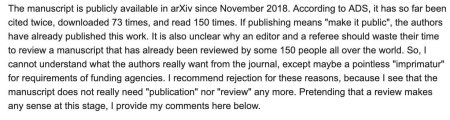
Archive for the Open Access Category

New Publication at the Open Journal of Astrophysics!

Posted in OJAp Papers, Open Access, The Universe and Stuff with tags , , , , , , on June 26, 2019 by telescoper

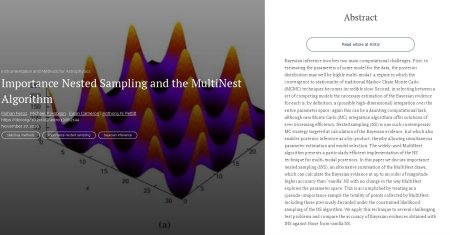
In a blog I posted just a couple of day ago I mentioned that there were a number of papers about to be published by the Open Journal of Astrophysics and, to show that I wasn’t making that up, the first of the latest batch has just appeared. Here is how it looks on the site!

There are thirteen authors altogether (from Oxford, Liverpool, Edinburgh, Leiden, British Columbia, Zurich and Munich); the lead other is Elisa

You can find the accepted version on the arXiv here. This version was accepted after modifications requested by the referee and editor.

This is another one for the `Cosmology and Nongalactic Astrophysics’ folder. We would be happy to get more submissions from other areas of astrophysics. Hint! Hint!

A few people have asked why the Open Journal of Astrophysics is not yet listed in the Directory of Open Access Journals. The answer to that is simple: to qualify for listing a journal must publish a minimum of five papers in a calendar year. Since OJA underwent a failure long hiatus after publishing its first batch of papers we haven’t yet qualified. However, this new one means that we have now published five papers so have reached the qualifying level.  I’ll put in the application as soon as I can, but will probably wait a little because we have a bunch of other papers coming out very soon to add to that number.

P.S. Please note that we now have an Open Journal of Astrophysics Facebook page where you can follow updates from the Journal should you wish..

Plan S and the Open Journal of Astrophysics

Posted in Open Access with tags , , , , on June 24, 2019 by telescoper

Things have been a little quiet on this side of the Open Journal of Astrophysics but rest assured it has been very busy behind the scenes, with a sizeable batch of papers going through peer review and a number of those are very near the finishing post.

My target was to build up to an average of about one submission a week by the end of 2019, and I think we’re on track to reach that comfortably by the end of summer.

I’ll report more on new publications as they are published, but before that I thought I’d report on a couple of bits of news to do with Plan S, following the issuance last month of revised guidelines.

First, here is a nice summary (taken from this article) of the different ways in principle one could deliver Open Access publishing in a manner consistent with Plan S:

You can click on the image to make it bigger.

The important thing is that the Open Journal of Astrophysics belongs in the column on the far right of the table. I draw your attention to the various comments, especially the one at the end that says the cost of overlay journals is substantially lower. It is, as I explain here.

the authors of this post think it is unclear whether these are compliant with Plan S. That’s a fair comment, but it can be clarified into a definite yes with very few tweaks. It is very encouraging on this point that the CEO of Scholastica (who provide our platform) has written a blog in which he describes the steps being taken to ensure that all Scholastica journals are indeed compliant with Plan S.

Over the coming months, we will announce new functionality that supports complying with Plan S guidelines, and we’re committed to updating our software to meet changes to the Plan S implementation rules as they come out.

I was very happy to read this plan as it includes adding a number of things to the Scholastica system that we currently have to do ourselves (e.g. registering DOIs with CrossRef).

Anyway, another notification from Scholastica has just come in so that will have to be that for now.


Open Access Publishing: Plan S Update

Posted in Open Access with tags , on May 31, 2019 by telescoper

I haven’t had time to go through the details yet, but yesterday saw the release of revised Principles and Implemenation for Plan S, which I have blogged about before, e.g. here. There’s also a rationale for the changes here.

For those of you who have never heard of Plan S, it For those that haven’t it is a proposal by funding agencies from 11 European Nations to give the public free access to publicly funded science. The 11 countries involved in this initiative are: France, Italy, Austria, Ireland, Luxembourg, the Netherlands, Norway, Poland, Slovenia, Sweden, and the UK. Together, these nations compise `cOAlition S’ – the `OA’ is for `Open Access’ – to carry out the plan.

The principal change is that the deadline for implementation has been moved back a year, which is sensible as the original deadline of January 2020 was never going to be feasible. The principal principle is however unchanged:

With effect from 2021, all scholarly publications on the results from research funded by public or private grants provided by national, regional and international research councils and funding bodies, must be published in Open Access Journals, on Open Access Platforms, or made immediately available through Open Access Repositories without embargo.

I’ll go through the revised guidelines when I get time but in the meantime if you can are so minded you can read them yourself and comment thereon through the comments box below.

The Great Science Publishing Scandal

Posted in Open Access with tags , , , , on May 1, 2019 by telescoper

There was a programme broadcast on BBC Radio 4 yesterday called The Great Science Publishing Scandal. It is now available on the interwebs here, which is how I listened to it this morning.

Here’s the blurb that goes with the programme:

Matthew Cobb, Professor of Zoology at the University of Manchester, explores the hidden world of prestige, profits and piracy that lurks behind scientific journals.

Each year, hundreds of thousands of articles on the findings on research are published, forming the official record of science. This has been going on since the 17th century, but recently a kind of war has broken out over the cost of journals to the universities and research institutions where scientists work, and to anyone else who wants to access the research, such as policy makers, patient support groups and the general public.

Traditionally journals charge their readers a subscription, but since the start of the 21st century there’s been a move to what’s called open access, where the authors pay to get their articles published but anyone can read them, without charge. In Europe Plan S has called for all research funded by the public purse to be open access, by 2020. If and when this is implemented it could have downsides on learned societies who depend on income from journal subscriptions to support young researchers and on scientists in the less developed world.

Some universities, and even countries, have recently refused to pay the subscriptions charged by some of the big science publishers. This has lead to some scientists using a service run by a Russian hacker, which has effectively stolen the whole of the scientific literature and gives it away, free, on the internet.

Matthew Cobb looks back at how the scientific publishing industry got to its current state and asks how it could change. He argues that scientists themselves need to break their addiction to wanting their articles to appear in a few well known journals, and instead concentrate on the quality of their research.

I think this programme is well worth listening to as it makes many of the right criticisms of the status quo. I did, however, find it very frustrating in that it doesn’t really even touch on any of the viable alternative ways of disseminating peer-reviewed scientific research. I didn’t expect a mention for the Open Journal of Astrophysics specifically, but this is one model that at least tries to challenge the status quo. I’m assuming that at least part of the reason for this is the presenter Matthew Cobb works in Zoology, and that is a field that perhaps does not have the established practice of sharing papers via repositories that we have in physics and astronomy via the arXiv. Anyway, it felt to me like he missed an open goal…

Promoting the Open Journal of Astrophysics

Posted in Open Access, The Universe and Stuff with tags , , , on March 24, 2019 by telescoper

The talk I gave at the meeting I attended last week to celebrate the retirement 60th Birthday of Alan Heavens was about the Open Journal of Astrophysics project. Here are the slides:

I decided a while ago that whenever I get the opportunity at conferences or other meetings I will talk about the Open Journal of Astrophysics (OJA for short) , mainly to encourage more submissions but also to raise OJA’s profile so people aren’t tempted to dismiss review invitations as spam from predatory journals.  At the moment, refereeing is the rate-limiting step in the publication process, at least part of the reason being that people don’t really know what we’re about and perhaps assume that it’s not a bona fide operation.

The talk I gave on Friday generated a fair amount of discussion, and was hopefully a small step along the way to establishing OJA as a mainstream journal and perhaps even the default choice for papers on astrophysics. Emma Chapman posted a tweet about my talk (including a picture of me in action) which got quite a lot of attention on Twitter:


https://twitter.com/DrEOChapman/status/1109125125411139584

I’ll just add that you can read more about the extent of the profiteering going on here.


Finally, and perhaps most importantly, let me mention I have some money (in a grant courtesy of the Gordon & Betty Moore Foundation) to help promote this project, and I can legitimately spend it on travel to give talks etc.. If anyone would like a talk about this project, please feel free to contact me!


New Publication at the Open Journal of Astrophysics!

Posted in OJAp Papers, Open Access, The Universe and Stuff with tags , , , , , , , , , on March 20, 2019 by telescoper

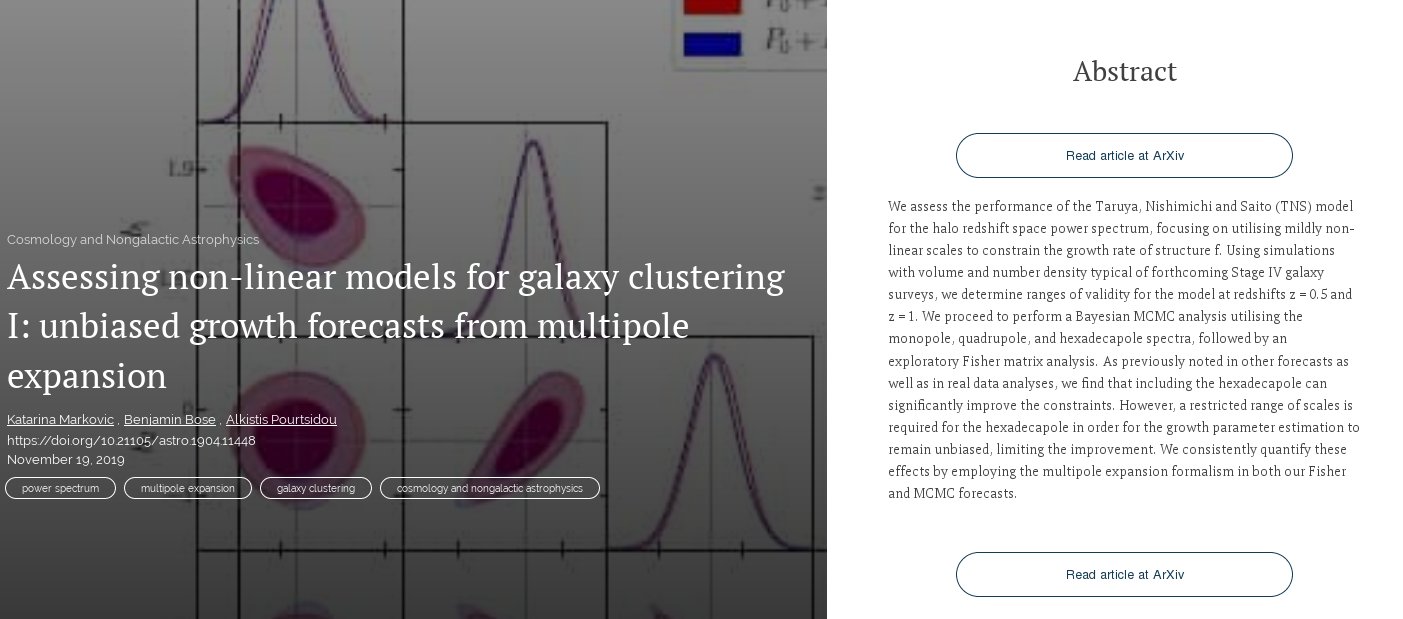
It’s nice to be able to announce that the Open Journal of Astrophysics has just published another paper. Here it is!

It’s by Darsh Kodwani, David Alonso and Pedro Ferreira from a combination of Oxford University and Cardiff University.

You can find the accepted version on the arXiv here. This version was accepted after modifications requested by the referee and editor.

This is another one for the `Cosmology and Nongalactic Astrophysics’ folder. We would be happy to get more submissions from other areas of astrophysics. Hint! Hint!

P.S. A few people have asked why the Open Journal of Astrophysics is not listed in the Directory of Open Access Journals. The answer to that is simple: to qualify for listing a journal must publish a minimum of five papers in a year. Since OJA underwent a failure long hiatus after publishing its first batch of papers we don’t yet qualify. However, so far in 2019 we have published four papers and have several others in the pipeline. We will reach the qualifying level soon and when we do I will put in the application!

New Publication at the Open Journal of Astrophysics!

Posted in OJAp Papers, Open Access, The Universe and Stuff with tags , , , , , on March 13, 2019 by telescoper

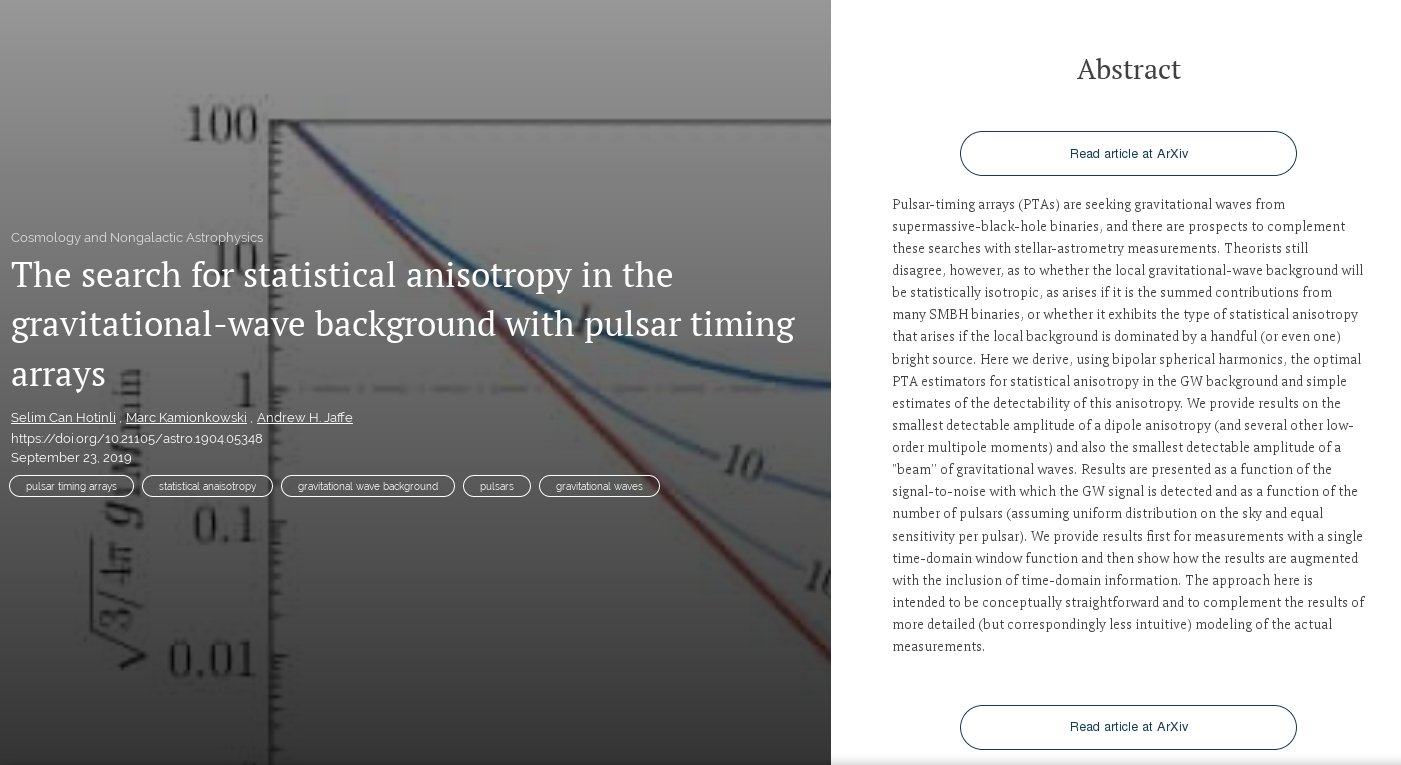
It’s nice to be able to announce that the Open Journal of Astrophysics has just published another paper. Here it is!

It’s by Pauline Barmby of the University of Western Ontario. You can find the accepted version on the arXiv here.

I think this paper is a good demonstration of the broad remit of the Open Journal of Astrophysics: our only rule is that if it’s suitable for the astro-ph section of the arXiv then we will consider if for publication. Rather than being a hardcore research paper, this is comprehensive and pedagogical review of observational techniques, instrumentation and data analysis in astronomy for use by researchers and educators in other disciplines, which we feel is a very useful addition to the literature

My thanks to the Editor and referees for dealing with this one so efficiently! We even have a Twitter testimonial from the author:

We have more publications in the pipeline but would be more than happy to receive more…!
I hope soon to get to the point where we have so many papers I can’t write a blog post about every one!

Splitting with Elsevier

Posted in Open Access with tags , , , , on March 7, 2019 by telescoper

Just time today to pass on a bit of Open Access news: the University of California has ended negotiations which academic publishing giant Elsevier and will no longer subscribe to Elsevier Journals. The negotiations broke down over two key points: a refusal by Elsevier to reduce its charges (currently $11M) and a failure to meet guarantees on Open Access. There’s another piece about this here.

The University of California should be congratulated on its firm position here, as should organizations in Sweden and Germany for their similar decisions last year.

I’ve made my views of the academic publishing racket very clear over a number of years so I won’t repeat that rant here. I’ll just remind readers of the staggering fact that the global revenues of the academic publishing industry amount to about, €22 billion per annum. This exceeds the global revenues of the recorded music industry. Profit margins for these publishers are much larger (up to 45%) than Apple, Google and BMW.

The research community is being fleeced, and the worst offenders are the `Big Four’: Elsevier, Springer, Wiley and Taylor & Francis. It’s taken a while but it seems many organizations are finally waking up to what is going on. I don’t think we need `for-profit’ publishers at all – there are far better and cheaper ways of disseminating scientific research in the digital era, such as the arXiv.

I’ll also make a small plea here. If there are any rich philanthropists out there who want to do something positive for science then let me suggest that instead of funding more prizes or awards they consider making a large donation to the arXiv? In my view that would do far more for science than throwing yet more money at a few eminent individuals!

New Publication at the Open Journal of Astrophysics!

Posted in OJAp Papers, Open Access, The Universe and Stuff with tags , , , , , , , , on February 27, 2019 by telescoper

It’s nice to be able to announce that the Open Journal of Astrophysics has just published another paper. Here it is!

It’s by Ben Maughan of the University of Bristol (UK) and Thomas Reiprich of the University of Bonn (Germany). You can find the accepted version on the arXiv here.

This is the first paper we have published in the section called High Energy Astrophysical Phenomena.

Thanks to the Editor and referees for dealing with this one so efficiently!

We have a few other papers coming up for publication soon, and some have been sent back to authors for revise and resubmit so we will almost certainly have further announcements to make soon.


P.S. Nobody spotted that I put the wrong DOI on the front page. I did that deliberately to see who was paying attention. Anyway, I’ve now put the right one on.

The Negative Mass Bug

Posted in Astrohype, Open Access, The Universe and Stuff with tags , , , , , on February 25, 2019 by telescoper

You may have noticed that some time ago I posted about  a paper by Jamie Farnes published in Astronomy & Astrophysics but available on the arXiv here which entails a suggestion that material with negative mass might account for dark energy and/or dark matter.

Here is the abstract of said paper:

Dark energy and dark matter constitute 95% of the observable Universe. Yet the physical nature of these two phenomena remains a mystery. Einstein suggested a long-forgotten solution: gravitationally repulsive negative masses, which drive cosmic expansion and cannot coalesce into light-emitting structures. However, contemporary cosmological results are derived upon the reasonable assumption that the Universe only contains positive masses. By reconsidering this assumption, I have constructed a toy model which suggests that both dark phenomena can be unified into a single negative mass fluid. The model is a modified ΛCDM cosmology, and indicates that continuously-created negative masses can resemble the cosmological constant and can flatten the rotation curves of galaxies. The model leads to a cyclic universe with a time-variable Hubble parameter, potentially providing compatibility with the current tension that is emerging in cosmological measurements. In the first three-dimensional N-body simulations of negative mass matter in the scientific literature, this exotic material naturally forms haloes around galaxies that extend to several galactic radii. These haloes are not cuspy. The proposed cosmological model is therefore able to predict the observed distribution of dark matter in galaxies from first principles. The model makes several testable predictions and seems to have the potential to be consistent with observational evidence from distant supernovae, the cosmic microwave background, and galaxy clusters. These findings may imply that negative masses are a real and physical aspect of our Universe, or alternatively may imply the existence of a superseding theory that in some limit can be modelled by effective negative masses. Both cases lead to the surprising conclusion that the compelling puzzle of the dark Universe may have been due to a simple sign error.

Well there’s a new paper just out on the arXiv by Hector Socas-Navarro with the abstract

A recent work by Farnes (2018) proposed an alternative cosmological model in which both dark matter and dark energy are replaced with a single fluid of negative mass. This paper presents a critical review of that model. A number of problems and discrepancies with observations are identified. For instance, the predicted shape and density of galactic dark matter halos are incorrect. Also, halos would need to be less massive than the baryonic component or they would become gravitationally unstable. Perhaps the most challenging problem in this theory is the presence of a large-scale version of the `runaway’ effect, which would result in all galaxies moving in random directions at nearly the speed of light. Other more general issues regarding negative mass in general relativity are discussed, such as the possibility of time-travel paradoxes.

Among other things there is this:

After initially struggling to reproduce the F18 results, a careful inspection of his source code revealed a subtle bug in the computation of the gravitational acceleration. Unfortunately, the simulations in F18 are seriously compromised by this coding error whose effect is that the gravitational force decreases with the inverse of the distance, instead of the distance squared.

Oh dear.

I don’t think I need go any further into this particular case, which would just rub salt into the wounds of Farnes (2018) but I will make a general comment. Peer review is the best form of quality stamp that we have but, as this case demonstrates, it is by no means flawless. The paper by Farnes (2018) was refereed and published, but is now shown to be wrong*. Just as authors can make mistakes so can referees. I know I’ve screwed up as a referee in the past so I’m not claiming to be better than anyone in saying this.

*This claim is contested: see the comment below.

I don’t think the lesson is that we should just scrap peer review, but I do think we need to be more imaginative about how it is used than just relying on one or two individuals to do it. This case shows that science eventually works, as the error was found and corrected, but that was only possible because the code used by Farnes (2018) was made available for scrutiny. This is not always what happens. I take this as a vindication of open science, and an example of why scientists should share their code and data to enable others to check the results. I’d like to see a system in which papers are not regarded as `final’ documents but things which can be continuously modified in response to independent scrutiny, but that would require a major upheaval in academic practice and is unlikely to happen any time soon.

In this case, in the time since publication there has been a large amount of hype about the Farnes (2018) paper, and it’s unlikely that any of the media who carried stories about the results therein will ever publish retractions. This episode does therefore illustrate the potentially damaging effect on public trust that the excessive thirst for publicity can have. So how do we balance open science against the likelihood that wrong results will be taken up by the media before the errors are found? I wish I knew!