Archive for the Open Access Category

Another Day, Another Open Access Talk..

Posted in Biographical, Maynooth, Open Access with tags , , on October 26, 2018 by telescoper

So having exercised my franchise earlier this morning, I found myself in Maynooth University Library giving yet another talk about Open Access publishing as part of Open Access Week.

I’ve got a lecture at noon, which will be the last one I give before the half-term `Study Week’ which begins with a bank holiday on Monday 29th October (Lá Saoire i mí Dheireadh Fómhair). It’s very nice to have a break before Christmas like this. Also the University study week is timed to be the same as School half-term holidays, which is good for those members of staff who have kids of school age.

Well, that’s enough blogging. I need to get my vector calculus notes together. I’m doing line integrals today, by the way

The Open Journal Tweets!

Posted in Open Access with tags , on October 19, 2018 by telescoper


I’ve got a busy day today with teaching and other things so I’m just taking a brief moment to let you know that the Open Journal of Astrophysics now has Twitter account which, if you are so minded, you can follow here


Open Journal Updates

Posted in Open Access, The Universe and Stuff with tags , on October 16, 2018 by telescoper

Just finished today’s teaching so I thought I’d chill for a few minutes and pass on a few quick updates about the Open Journal of Astrophysics, which was formally (re)launched last week.

The first thing is that at the weekend I sent an online training video and guide around the members of the Editorial Board and introduced them all to the new platform’s messaging system, which is a very convenient way for us to keep in touch. I had lots of volunteers for the Editorial Board and I couldn’t select everyone but I tried to choose members with a good geographical distribution, spread of expertise, and gender balance. We may add more in due course, as we’re still quite cosmologist-heavy, but I think we have enough to get started: we have editors in Australia, France, Italy, United States of America and Mexico as well as the United Kingdom.

We have received some submissions already and are dealing with them through the new platform, which is requiring the Editors to engage in some `on-the-job’ training. Hopefully they’ll get the hang of it soon!

Another relevant piece of news is that we have updated the DOIs associated with the papers we published with the old platform to point to the new site so they are now fully incorporated. For the record these are:

10.21105/astro.1708.00605

10.21105/astro.1603.07299

10.21105/astro.1602.02113

10.21105/astro.1502.04020

I’ll also take this opportunity to remind you that the Open Journal of Astrophysics is open for new submissions, so please feel free to give it a try!

Finally, I’d like to point you to an article about Open Access Publishing in the latest Physics Today, which begins

Publishers of scientific journals are facing renewed threats to their business models from both sides of the Atlantic.

You better believe it!

The Open Journal is Open for Submissions Again!

Posted in Open Access, The Universe and Stuff with tags , , on October 8, 2018 by telescoper

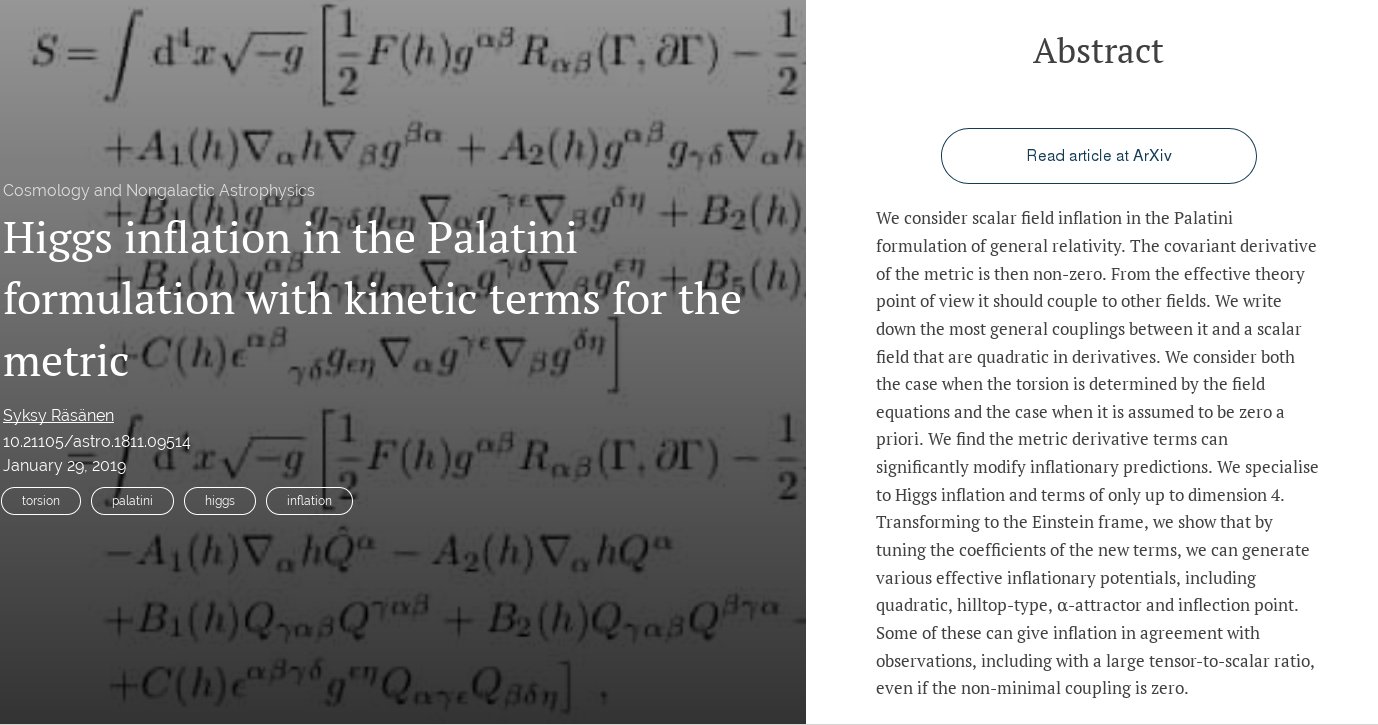
I have now finished moving the Open Journal of Astrophysics onto the new Scholastica platform, and it is now open again for submissions! It has taken a lot longer to get to this point than I thought it would when I first proposed the Open Journal of Astrophysics way back in 2012 but better late than never!

Full instructions for authors can be found here. It is there that you will find the `submit’ button shown above, which will take you to a form through which you can upload your paper. All you need to do is upload a few details and the arXiv ID of your paper and we’ll take it from there.

The membership of the Editorial Board is listed here.

The papers published so far can be found here.

Oh, and there’s a blog that will include topical posts about matters astrophysical here.

In a nutshell, any paper that’s suitable for the astro-ph section of the arXiv can be submitted to the Open Journal of Astrophysics. We will consider any `traditional’ papers as well as others which may find it difficult to publish in other journals, such as papers on astrophysics education and outreach, or technical papers relating to instrumentation, mission proposals, and other documents.

Well, that’s about it. I just remains for me to thank all the people without whom this project would never have got off the ground, chiefly Chris Lintott, Arfon Smith and Adam Becker, developers Stuart Lynn and Marc Rohloff, Fiona Morley and the team at Maynooth University Library, and of course the good folk of the wonderful arXiv!

The Open Journal of Astrophysics Blog

Posted in Open Access with tags , , , on October 5, 2018 by telescoper

Since I’ve recently been boring all my readers with a stream of stuff about the Open Journal of Astrophysics, I thought I might as well continue by pointing out that this journal also has a blog feature, on which we will include commentaries on some of the papers published and on wider issues in astrophysics. To illustrate this feature I’ve written a short post about the background to the Open Journal project, which you can find here. The text is as below.

I first proposed this idea several years ago and it has taken a while to make it happen, but here we are at last.

Astrophysics has taken the lead for many years in opening up access to scientific publications – all publications of any merit are available for free on the internet via the arXiv and, in my opinion, the traditional journals are already more-or-less redundant even without considering their “astronomical” cost. The one thing that seems a consistent objection to dispensing with journals altogether is the element of peer review.

My suggestion was that we set up a quick-and-easy system to circumvent the traditional (ruinously expensive) publishing route. The basic idea is that authors who submit papers to the arXiv can have their papers refereed by the community, outside the usual system of traditional journals. I was intially thinking of a website on which authors would simply have to post their arXiv ID and a request for peer review. Once accepted, the author would be allowed to mark the arXiv posting as “refereed” and an electronic version would be made available for free on the website. What we have now is a little more involved than that, but the basic idea remains the same.

Whether or not this idea is a success really depends partly on the willingness of the community to submit high-quality papers here, and partly on the performance of those of us involved on the Editorial Board at providing the community with what I hope will prove to be an effective resource.


The Open Journal of Astrophysics – Update

Posted in Maynooth, Open Access, The Universe and Stuff with tags , , , on October 4, 2018 by telescoper

Well, it was a bit fiddly importing the legacy papers from the earlier version of the Open Journal of Astrophysics website to the new platform, but I managed to do it this afternoon as planned. The result looks rather nice, I think,

The only things left to do now are (a) to train the members of the Editorial Board on how to handle the workflow through the journal site and (b) to open up for submission of new papers. Both these steps should be trivial so we’re definitely entering the final stages of this project. There is  an event at Maynooth University Library next Tuesday afternoon at which I am doing a talk about Open Science. This will represent the official launch of the Open Journal of Astrophysics.

All we will need then is for people to submit some papers!


Thoughts on `Plan S’, `cOAlition S’ and Open Access Publishing

Posted in Open Access with tags , , , , , , on September 22, 2018 by telescoper

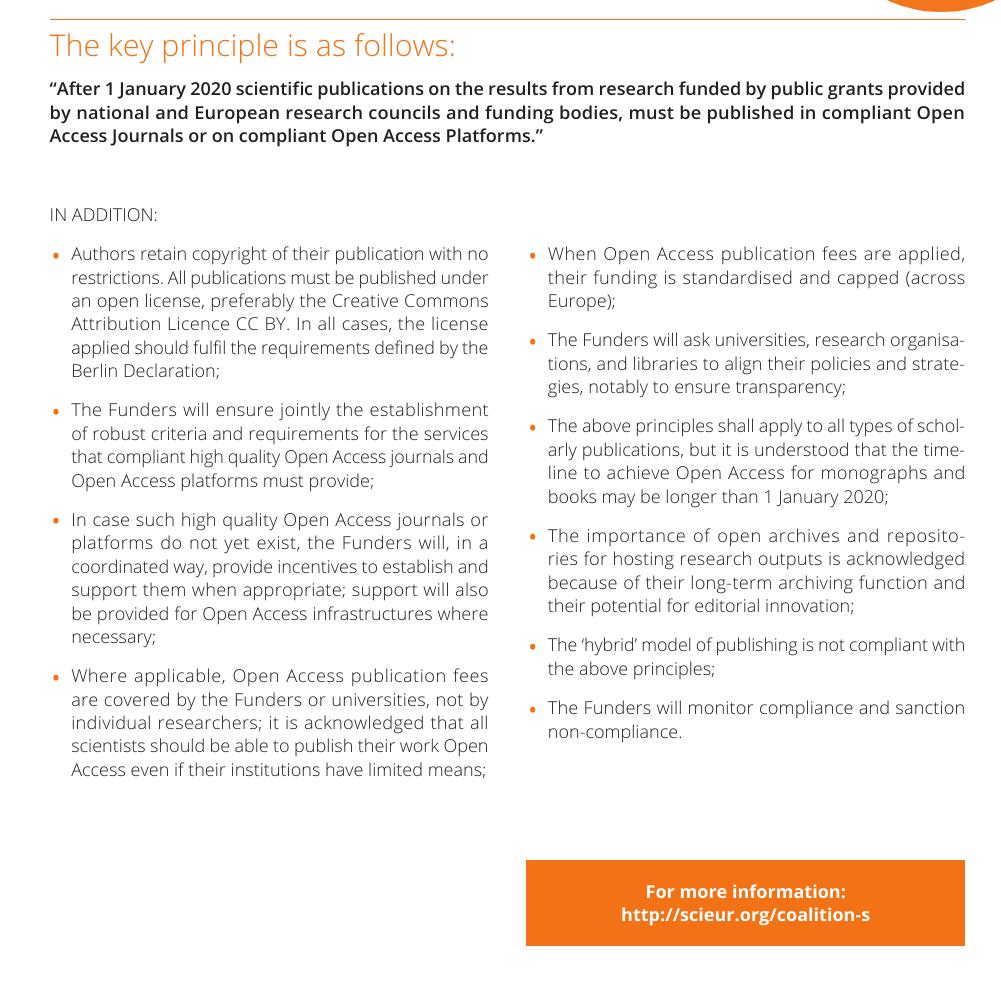
Those of you who have been following my recent updates on progress with The Open Journal of Astrophysics may be interested to hear about `Plan S’, which is a proposal by 11 European Nations to give the public free access to publicly funded science. The 11 countries involved in this initiative are: France, Italy, Austria, Ireland, Luxembourg, the Netherlands, Norway, Poland, Slovenia, Sweden, and the UK. Since the plan will not come into effect until 1st January 2020, which is after the UK leaves the EU it is by no means clear whether the UK will actually be involved in ERC initiatives after that. Norway is not in the EU but is associated to the ERC. It is unlikely that the UK will have a similar status after Brexit.

Anyway, these 11 countries have formed `cOAlition S’ – the `OA’ is for `Open Access’ – to carry out the plan, which can be found here.

Here is a summary:

You can read more about it here. I have not yet looked at the details of what will be regarded as `compliant’ in terms of Open Access but if the the Open Journal of Astrophysics is not fully compliant as it stands, I expect it can be made so (although we are a genuinely international journal not limited to the 11 countries involved in Plan S).

Anyway, although I support Plan S in general terms what I sincerely hope will not happen with this initiative is that researchers and their institutions get mugged into paying an extortionate `Gold’ Open Access Article Processing Charge (APC) which is simply a means for the academic publishing industry to maintain its inflated profit margins at the expense of actual research. The Open Journal of Astrophysics is Green rather than Gold. In fact the cost of maintaining and running the platform is about $1000 per annum, and the marginal cost for processing each paper is $10 or actually $11 if you count registering published articles with CrossRef (though we do not incur that cost if the article is rejected). In effect running the entire journal costs less than a typical APC for Gold Open Access for one physics paper. Those costs will be born by my institution, Maynooth University. The UK was conned into going down this route some years ago by the publishing lobby, and I hope the other cOAlition S partners do not fall for the same scam.

The Open Journal of Astrophysics – Call for Editors

Posted in Maynooth, Open Access with tags , , , on September 17, 2018 by telescoper

It’s nice to see that my recent post on the Open Journal of Astrophysics has been attracting some interest. The project is developing rather swiftly right now and it seems the main problems we have to deal with are administrative rather than technical. Fingers crossed anyway.

I thought I’d do a follow-up re-iterating a request in that recent post. As you will be aware, the Open Journal of Astrophysics is an arXiv overlay journal. We apply a simple criterion to decide whether a paper is on a suitable topic for publication, namely that if it it is suitable for the astro-ph section of the arXiv then it is suitable for the Open Journal of Astrophysics. This section of the arXiv, which is rather broad,is divided thuswise:

  1. astro-ph.GA – Astrophysics of Galaxies.
    Phenomena pertaining to galaxies or the Milky Way. Star clusters, HII regions and planetary nebulae, the interstellar medium, atomic and molecular clouds, dust. Stellar populations. Galactic structure, formation, dynamics. Galactic nuclei, bulges, disks, halo. Active Galactic Nuclei, supermassive black holes, quasars. Gravitational lens systems. The Milky Way and its contents
  2. astro-ph.CO – Cosmology and Nongalactic Astrophysics.
    Phenomenology of early universe, cosmic microwave background, cosmological parameters, primordial element abundances, extragalactic distance scale, large-scale structure of the universe. Groups, superclusters, voids, intergalactic medium. Particle astrophysics: dark energy, dark matter, baryogenesis, leptogenesis, inflationary models, reheating, monopoles, WIMPs, cosmic strings, primordial black holes, cosmological gravitational radiation
  3. astro-ph.EP – Earth and Planetary Astrophysics.
    Interplanetary medium, planetary physics, planetary astrobiology, extrasolar planets, comets, asteroids, meteorites. Structure and formation of the solar system
  4. astro-ph.HE – High Energy Astrophysical Phenomena.
    Cosmic ray production, acceleration, propagation, detection. Gamma ray astronomy and bursts, X-rays, charged particles, supernovae and other explosive phenomena, stellar remnants and accretion systems, jets, microquasars, neutron stars, pulsars, black holes
  5. astro-ph.IM – Instrumentation and Methods for Astrophysics.
    Detector and telescope design, experiment proposals. Laboratory Astrophysics. Methods for data analysis, statistical methods. Software, database design
  6. astro-ph.SR – Solar and Stellar Astrophysics.
    White dwarfs, brown dwarfs, cataclysmic variables. Star formation and protostellar systems, stellar astrobiology, binary and multiple systems of stars, stellar evolution and structure, coronas. Central stars of planetary nebulae. Helioseismology, solar neutrinos, production and detection of gravitational radiation from stellar systems.

The expertise of the current Editorial Board is concentrated in the area of (2), and a bit of (5), but we would really like to add some editors from different areas (i.e. 1, 3, 4 and 6).  We  would therefore really appreciate volunteers from other areas of astrophysics (especially stars/exoplanets, etc). If you’re interested please let me know. Please also circulate this call as widely as possible among your colleagues so we can recruit the necessary expertise. The journal is entirely free (both to publish in and to read) and we can’t afford to pay a fee, but there is of course the prestige of being in at the start of a publishing revolution of cosmic proportions!

If you join the Editorial Board we will invite you to an online training session to show you how the platform works.

Thank you in advance for your interest in this project, and I look forward to hearing from you.


The Open Journal of Astrophysics – Update

Posted in Maynooth, Open Access with tags , , , on September 13, 2018 by telescoper

The observant among you will have noticed that the website for the Open Journal of Astrophysics is currently offline. This emphatically does not mean that this project is dead so

In fact we’re in the process of moving the journal to a new platform (at the same web address) and the new site will be up and running as soon as we have completed the transfer, have tested the new configuration and done a few administrative things. All papers already published on the old site will be transferred to the new one and their DOI will remain unchanged. In fact the old site is still available, but at a secret location.

I’ll be blogging in a bit more detail about the new-look Open Journal of Astrophysics in due course, but in the mean time I’ll just make a few points.

First and foremost, if you don’t know what this project is about it is an idea I first floated over five years ago, shortly before I moved to Sussex. Although we got a website together and published a few papers, for one reason or another I didn’t have time to iron out some remaining bugs and the project stalled. However, after my move to Maynooth University I’ve been delighted to receive the support of the Maynooth University Library team and we’re now moving ahead. I know there have been a few false dawns on this project – for which I apologize – so I won’t announce the full re-opening until I’m absolutely sure everything works.

Second, and actually most importantly, the Editorial Board for the Open Journal of Astrophysics is looking for new members. We already have several distinguished editors, but the expertise we currently have is concentrated (not surprisingly) in cosmology, and we would really appreciate volunteers from other areas of astrophysics (especially stars/exoplanets, etc). If you’re interested please let me know.

Third, although the platform will look a little different (i.e. better) the overall philosophy of the Open Journal will remain as it always was, a fully `Green’ Open Access Journal, as defined by the following points:

  • There will be no charge for accessing or downloading OJA papers (i.e. no subscription fee).
  • There will be no charge for submitting, reviewing or publishing OJA papers (i.e. no `article processing charge’).
  • The OJA is a peer-reviewed journal; all papers accepted for publication will be assigned a DOI and registered with Crossref for citation tracking purposes.
  • The OJA is an arXiv overlay journal, so paper submitted to it must first be submitted to the arXiv.

Finally, I will mention that I was motivated to post this update by a piece by George Monbiot in todays’s Guardian. I don’t agree with everything Monbiot says, but he is dead right about this:

In the great majority of cases, the research reported has been funded by taxpayers. Most of the work involved in writing the papers, reviewing and editing them is carried out at public expense by people at universities. Yet this public asset has been captured, packaged and sold back to us for phenomenal fees. Those who pay most are publicly funded libraries. Taxpayers must shell out twice: first for the research, then to see the work they have sponsored. There might be legal justifications for this practice. There are no ethical justifications.

I’ve said as much myself on this blog. My point is that the academic publishing industry is not going to change of its own volition. If the Academic Journal Racket is to be rumbled, it is we (by which I mean academics and our institutions) who have to take control. Sitting on our hands while we get systematically fleeced is not an option. One way to do this is for institutions and organizations to themselves become Open Access publishers, which is precisely what my current institution is doing: Maynooth University will be the official publisher of the Open Journal of Astrophysics (and hopefully many more similar journals in the future).

Citation Analysis of Scientific Categories

Posted in Open Access, Science Politics with tags , on May 18, 2018 by telescoper

I stumbled across an interesting paper the other day with the title Citation Analysis of Scientific Categories. The title isn’t really accurate because not all the 231 categories covered by the analysis are `scientific’: they include many topics in the arts and humanities too. Anyway, the abstract is here:

Databases catalogue the corpus of research literature into scientific categories and report classes of bibliometric data such as the number of citations to articles, the number of authors, journals, funding agencies, institutes, references, etc. The number of articles and citations in a category are gauges of productivity and scientific impact but a quantitative basis to compare researchers between categories is limited. Here, we compile a list of bibliometric indicators for 236 science categories and citation rates of the 500 most cited articles of each category. The number of citations per paper vary by several orders of magnitude and are highest in multidisciplinary sciences, general internal medicine, and biochemistry and lowest in literature, poetry, and dance. A regression model demonstrates that citation rates to the top articles in each category increase with the square root of the number of articles in a category and decrease proportionately with the age of the references: articles in categories that cite recent research are also cited more frequently. The citation rate correlates positively with the number of funding agencies that finance the research. The category h-index correlates with the average number of cites to the top 500 ranked articles of each category (R2 = 0.997). Furthermore, only a few journals publish the top 500 cited articles in each category: four journals publish 60% (σ = ±20%) of these and ten publish 81% (σ = ±15%).

The paper is open access (I think) and you can find the whole thing here.

I had a discussion over lunch today with a couple of colleagues here in Maynooth about using citations. I think we agreed that citation analysis does convey some information about the impact of a person’s research but that information is rather limited. One of the difficulties is that publication rates and citation activity are very discipline-dependent so one can’t easily compare individuals in different areas. The paper here is interesting because it presents an interesting table showing how various statistical citation measures vary across fields and sub-fields;  physics is broken down into a number of distinct areas (e.g. Astronomy & Astrophysics, Particle Physics, Condensed Matter and Nuclear Physics) across which there is considerable variation. How to best to use this information is still not clear..