Archive for the Open Access Category

Weekly Update from the Open Journal of Astrophysics – 17/05/2025

Posted in OJAp Papers, Open Access, The Universe and Stuff with tags , , , , , , , , , , , , on May 17, 2025 by telescoper

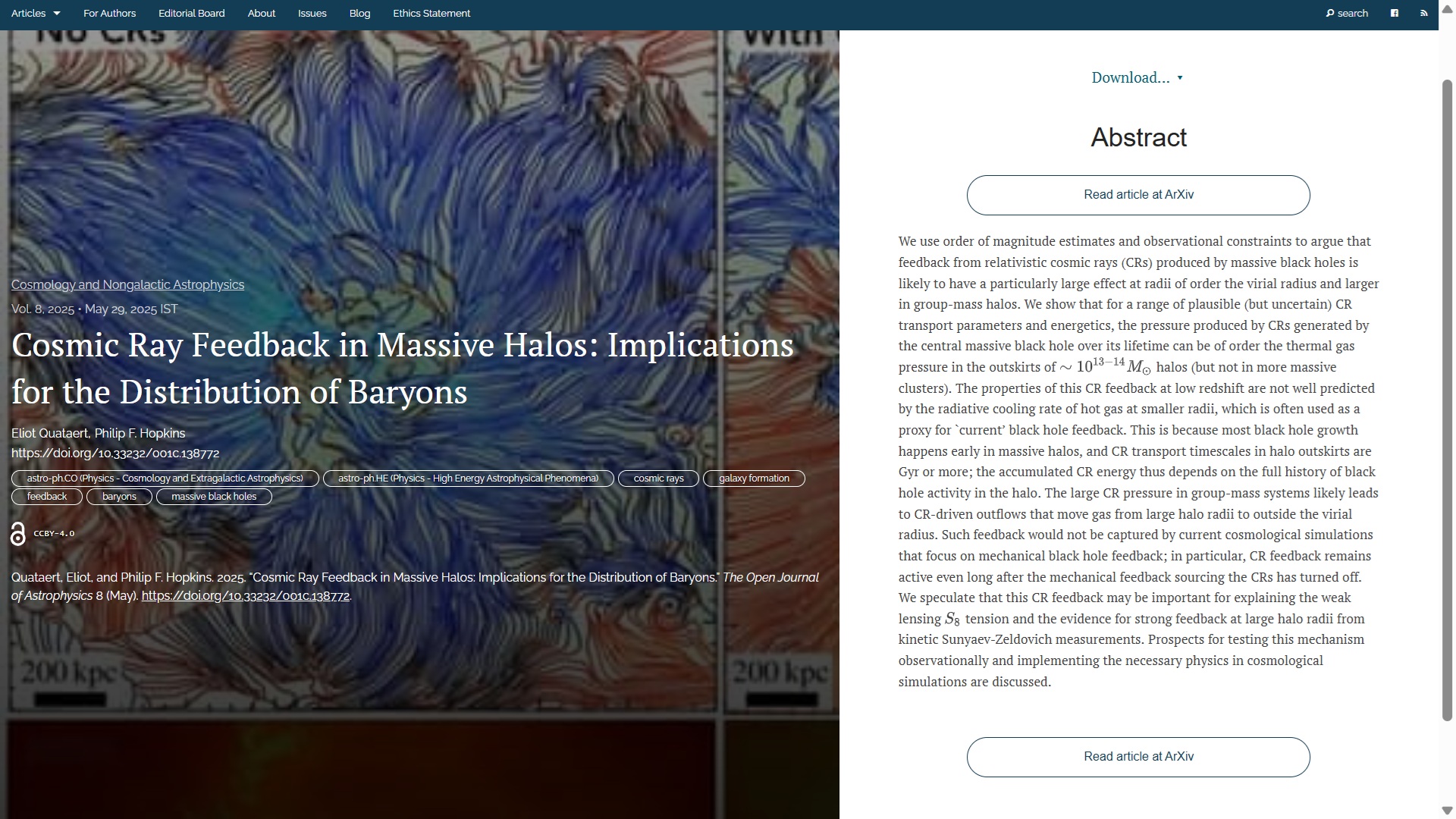
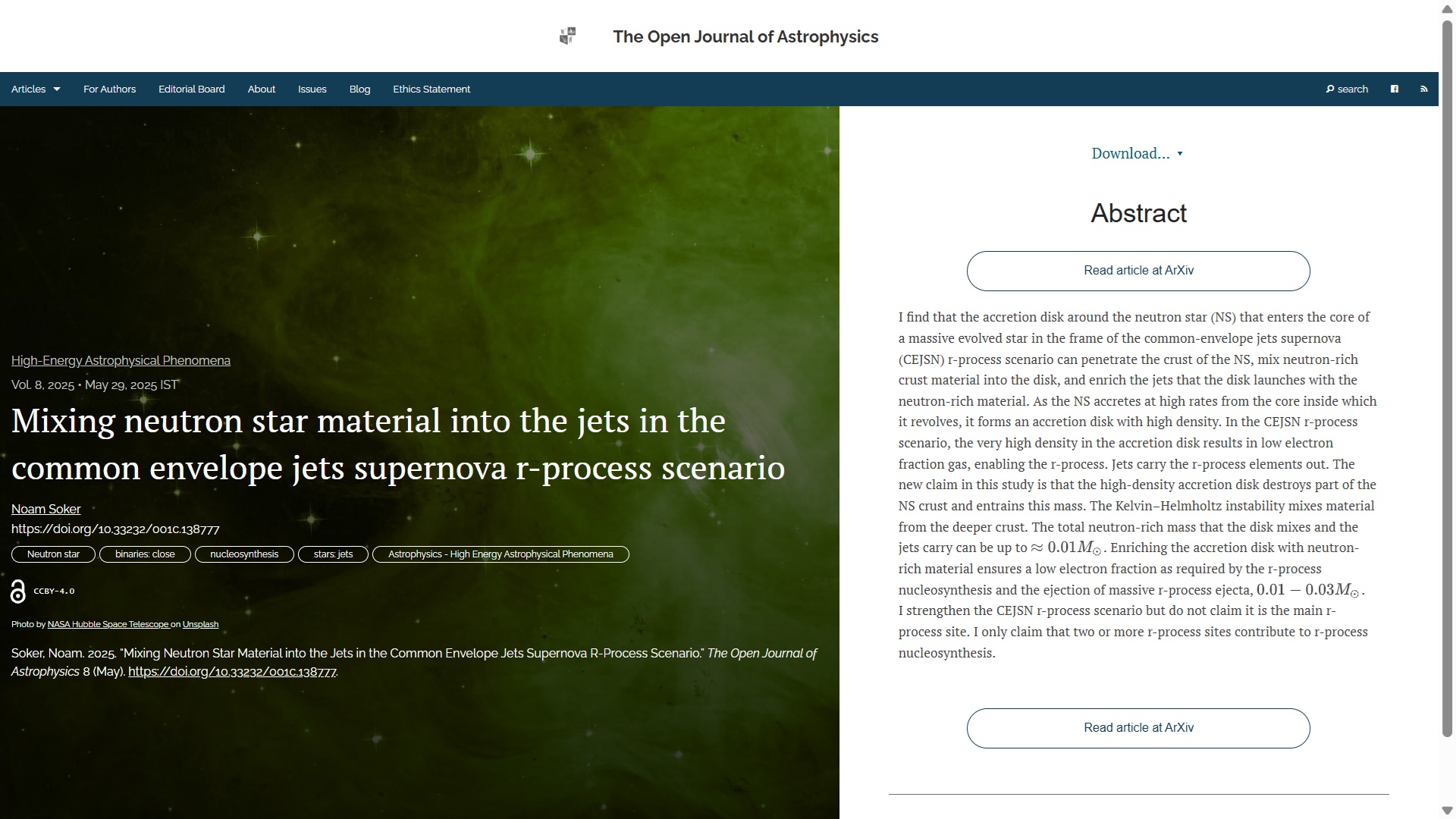
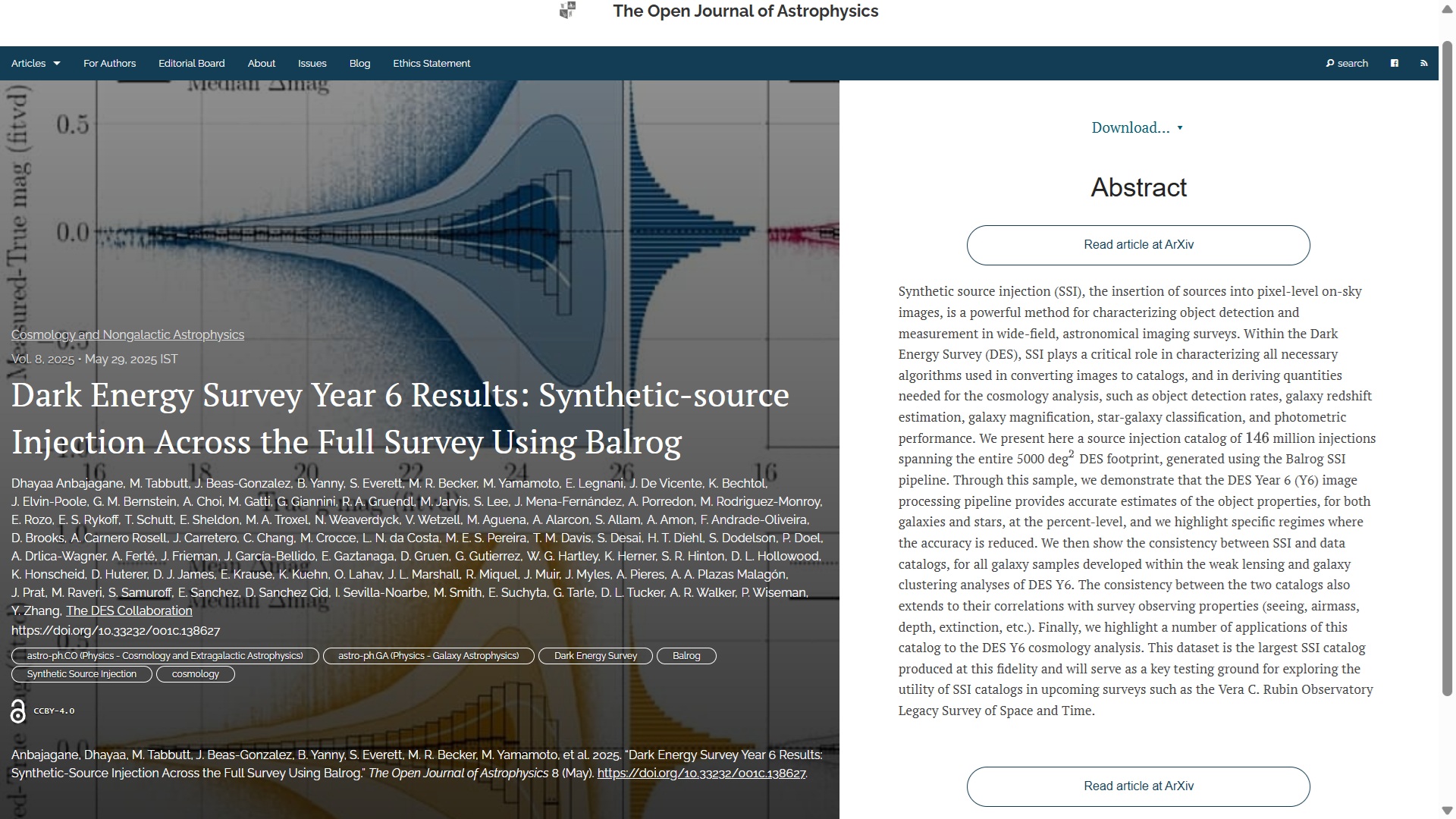
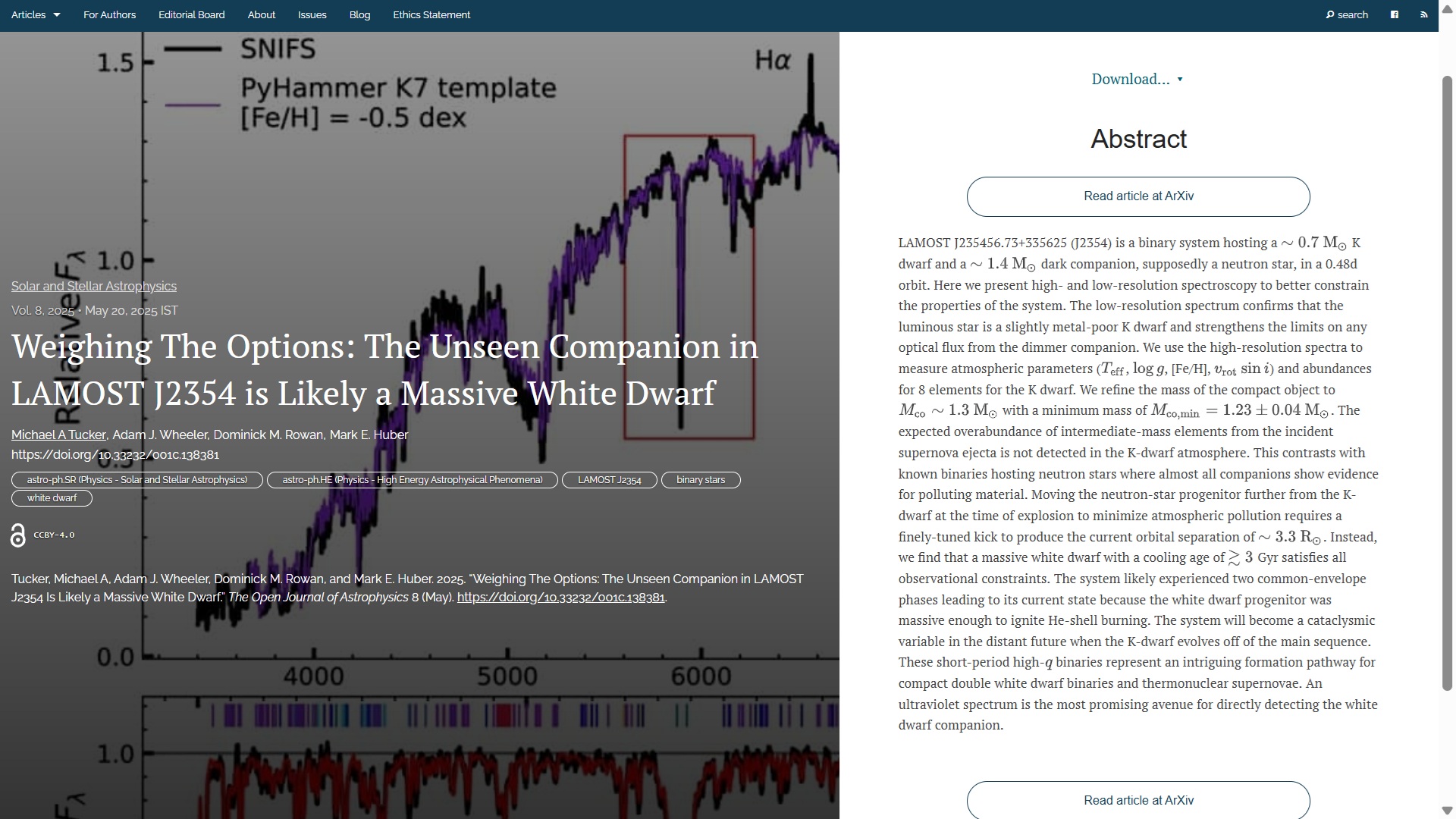
It’s a lovely Saturday morning in May, and it’s time for the weekly  update of papers published at the Open Journal of Astrophysics. Since the last update we have published four new papers, which brings the number in Volume 8 (2025) up to 59 and the total so far published by OJAp up to 294.

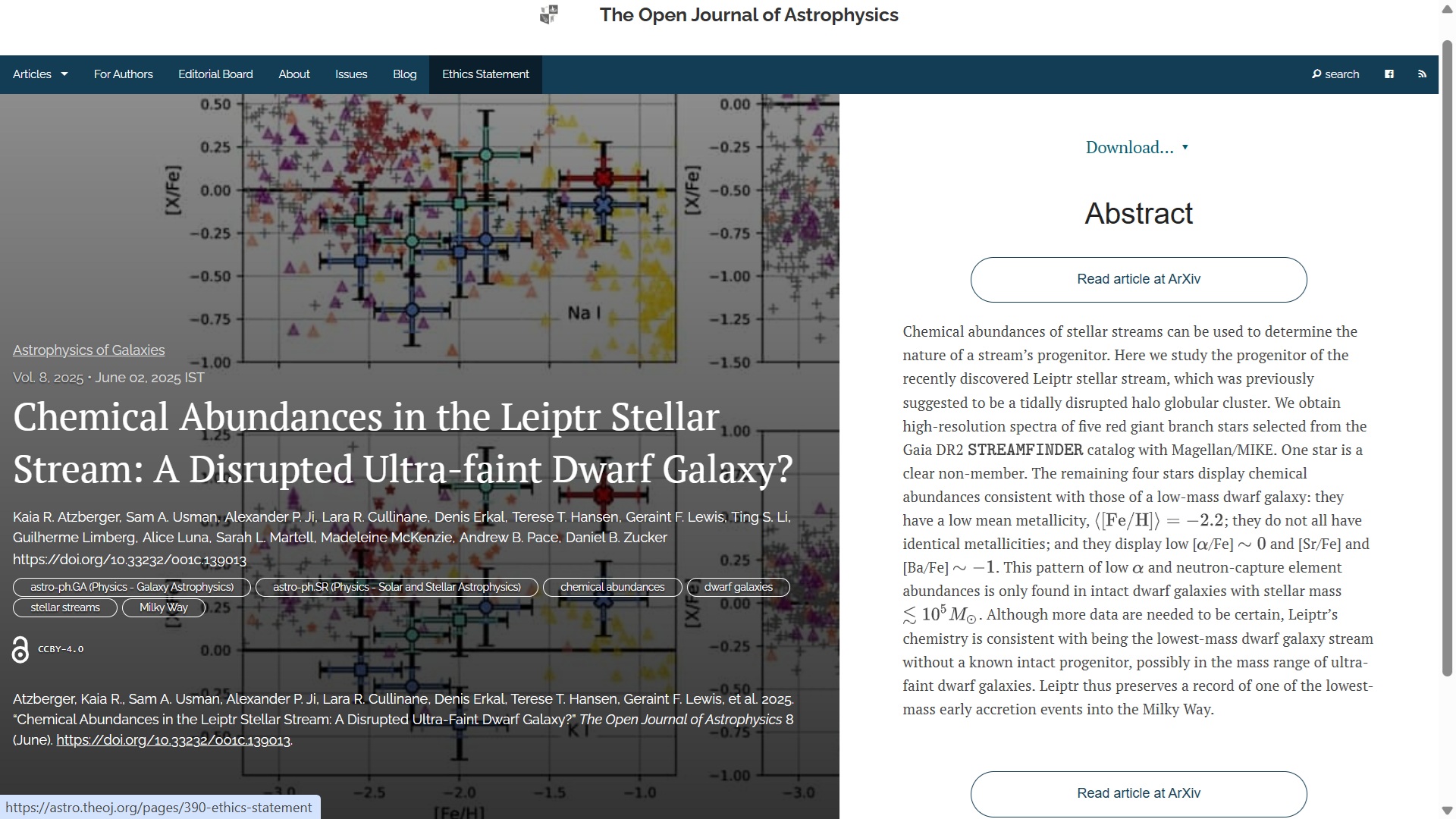
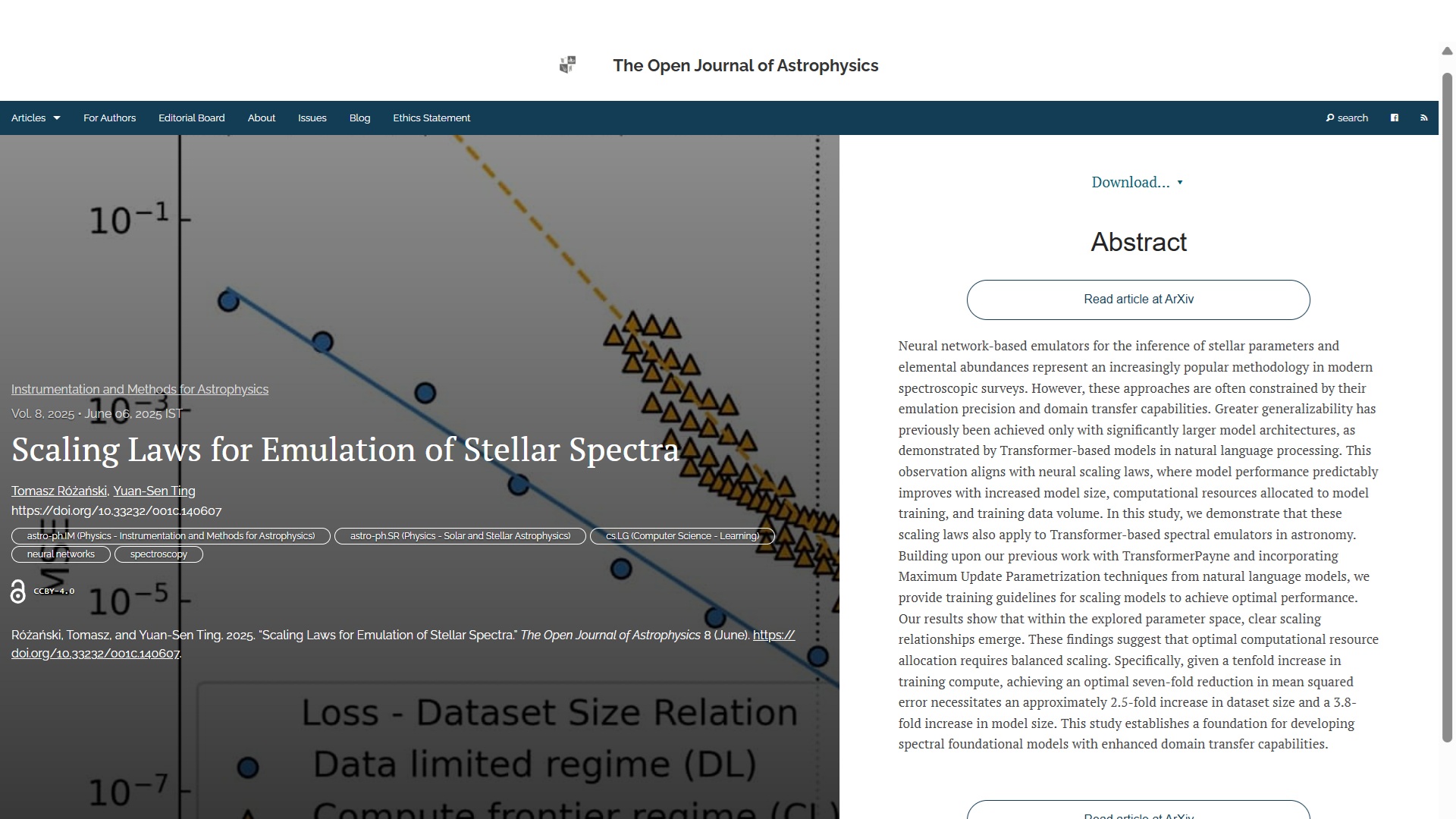
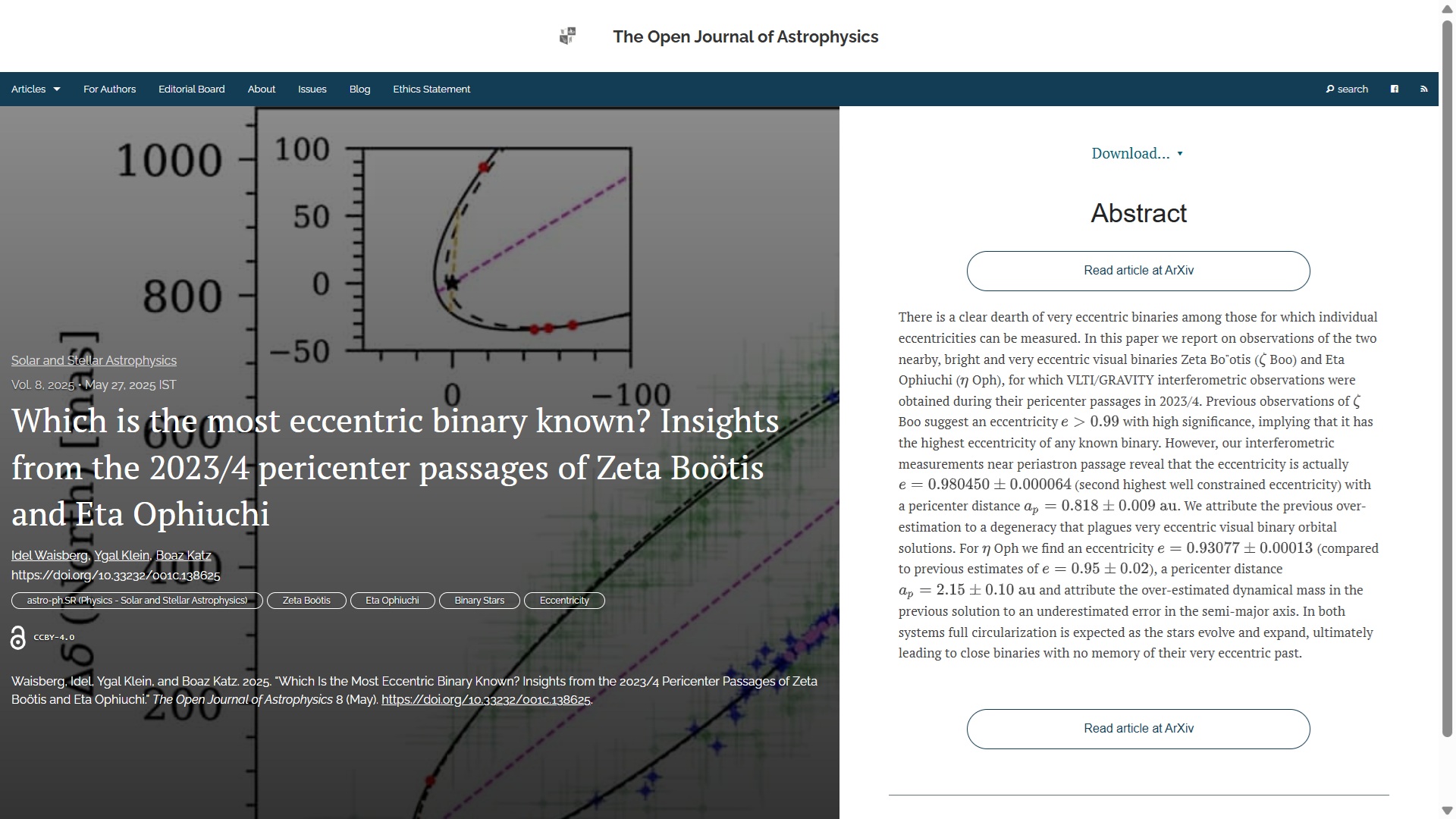
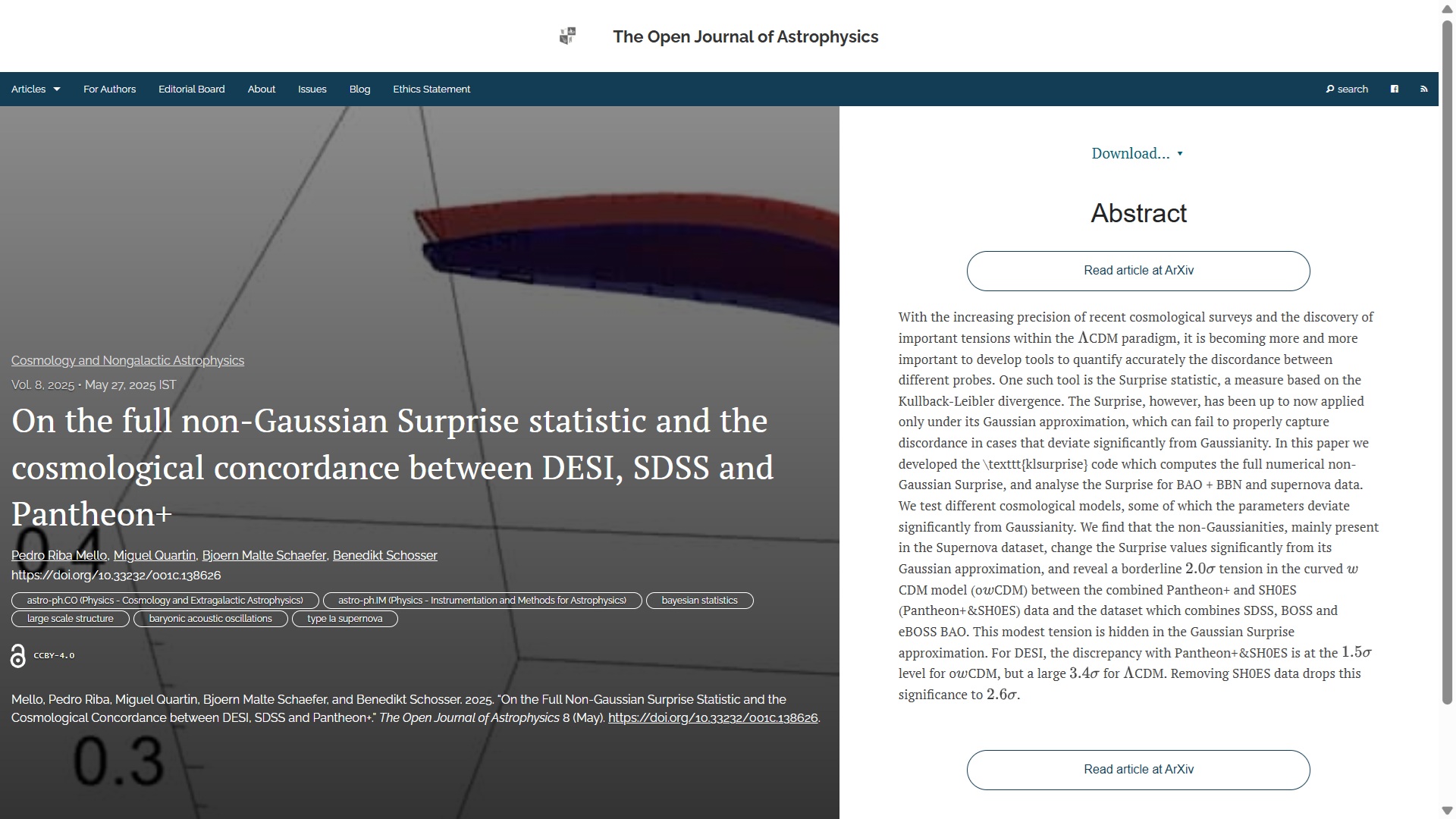
In chronological order of publication, the four papers published this week, with their overlays, are as follows. You can click on the images of the overlays to make them larger should you wish to do so.

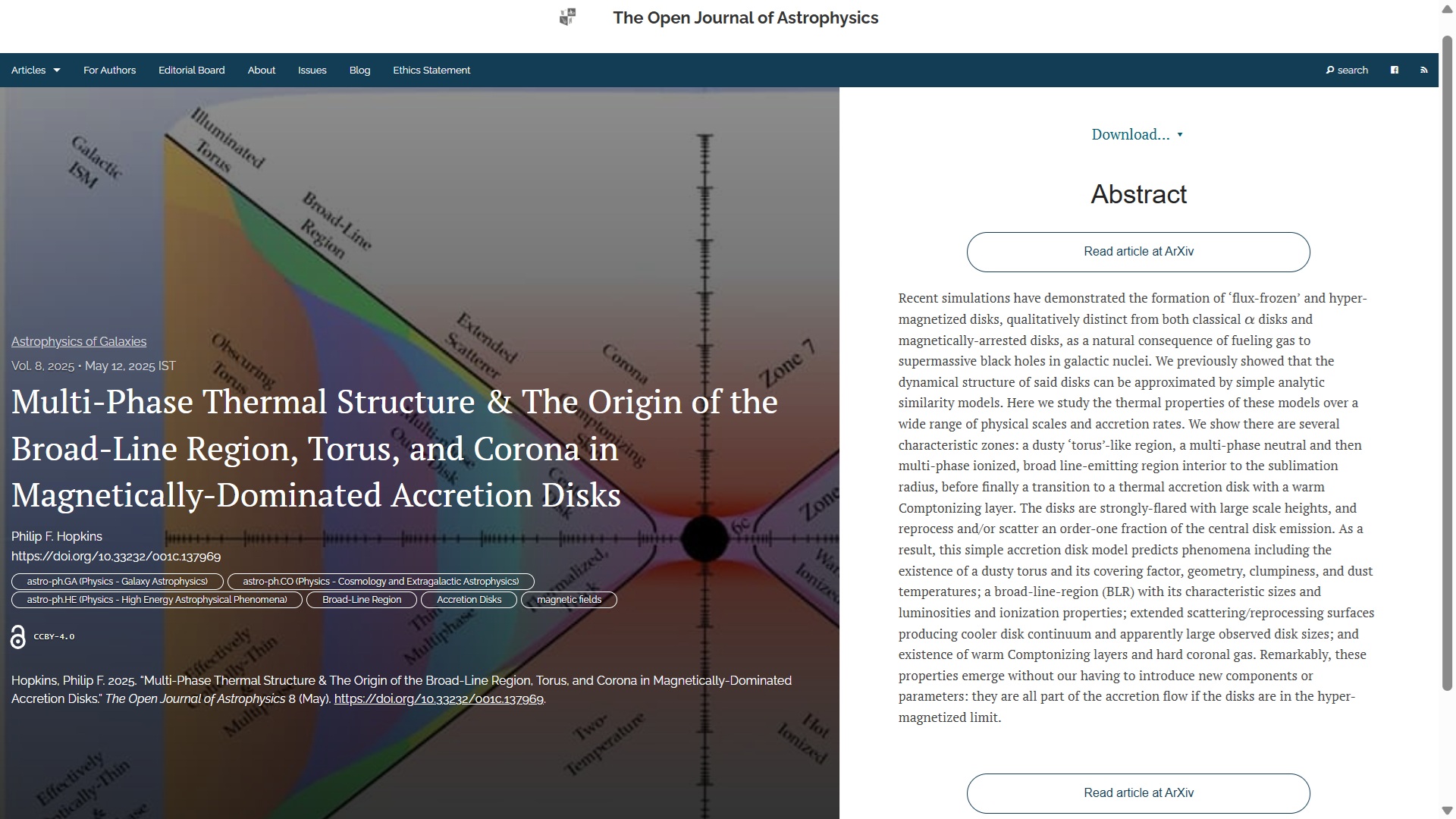
The first paper to report is: “Multi-Phase Thermal Structure & The Origin of the Broad-Line Region, Torus, and Corona in Magnetically-Dominated Accretion Disks” by Philip F. Hopkins (Caltech, USA). This was published on Monday May 12th in the folder Astrophysics of Galaxies. It presents simple accretion disk model that predicts the properties of many features including the dusty torus, broad-line region, continuum emission and coronal gas.

The overlay is here:

You can find the officially accepted version on arXiv here.

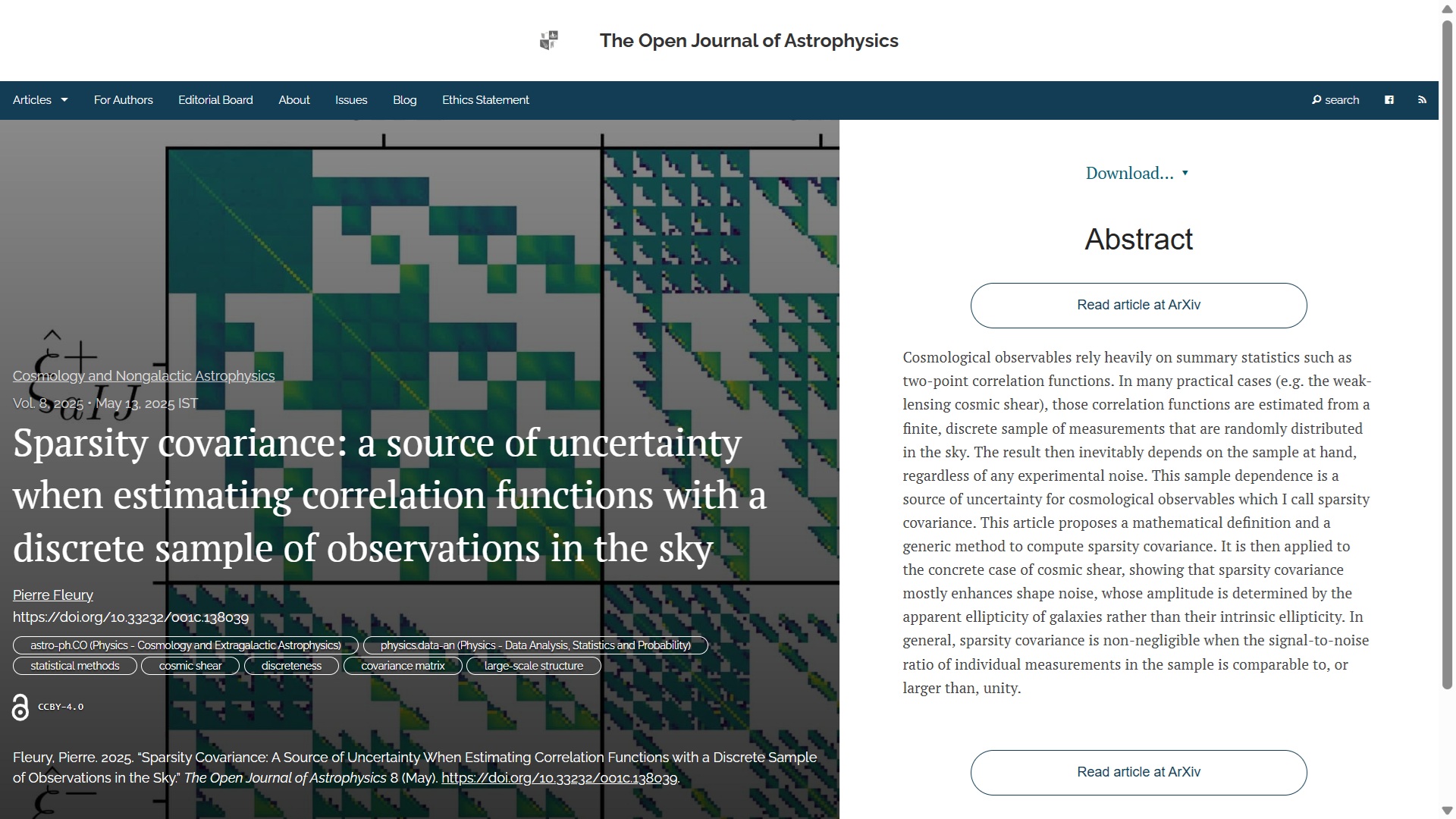
Second one up is “Sparsity covariance: a source of uncertainty when estimating correlation functions with a discrete sample of observations in the sky” by Pierre Fleury (U. Montpellier, France). This one was published on Tuesday 13th May 2025 in the folder Cosmology and NonGalactic Astrophysics.  This paper presents a discussion of the uncertainty in cosmological observables caused by discrete sampling and a method to compute the covariances resulting from this.

The overlay is here:

You can find the officially-accepted version of the paper on arXiv here.

The third paper of the week, published on Wednesday May 14th 2025,  is “Dark Matter Particle Flux in a Dynamically Self-consistent Milky Way Model” by Lucijana Stanic, Mark Eberlein, Stanislav Linchakovskyy, Christopher Magnoli, Maryna Mesiura, Luca Morf, Prasenjit Saha (University of Zurich, Switzerland) and Eugene Vasiliev (University of Surrey, UK). This one presents a study of the behaviour of dark matter in an anisotropic model for the Milky Way halo with implications for particle detection rates. It is in the folder Astrophysics of Galaxies.

Here is the overlay:

You can find the officially accepted version of this paper on arXiv here.

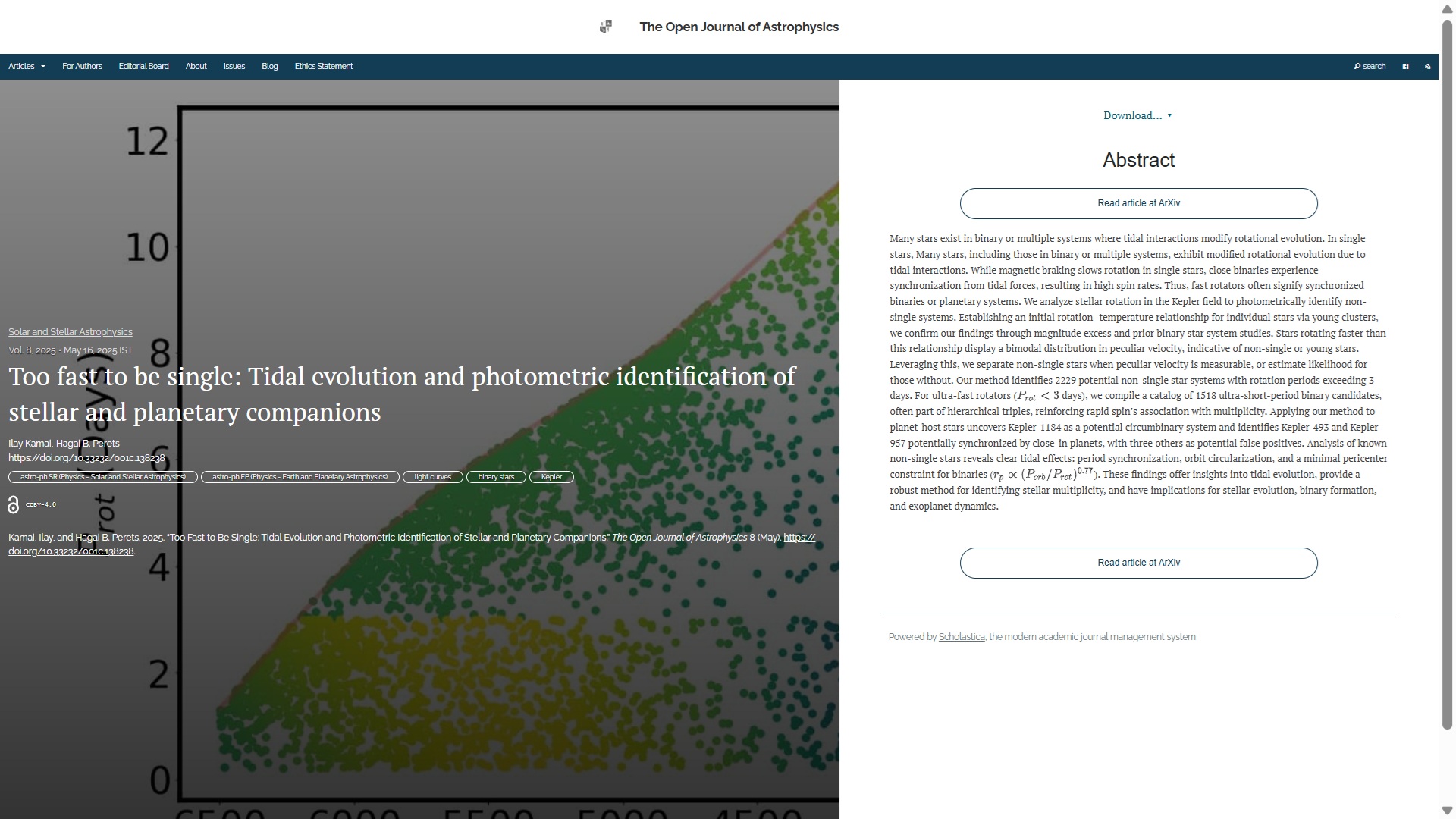
The last paper published this week is “Too fast to be single: Tidal evolution and photometric identification of stellar and planetary companions” by Ilay Kamai and Hagai B. Perets (Technion, Haifa, Israel). This one was published on Friday 16th May 2025 in the folder Solar and Stellar Astrophysics. It presents an analysis of the rotation of stars observed in the Kepler field to identify non-single systems with high spin rates resulting from tidal effects.

Here is the overlay:

The official published version can be found on the arXiv here.

That’s all the papers for this week. I’ll post another update next week.

An Archive for arXiv

Posted in Open Access with tags , , , on May 14, 2025 by telescoper

A few weeks ago I mentioned the concerning news that arXiv was changing the way it works and moving all of its content into cloud storage. Related to this was a decision made last year to shut down the previously existing arXiv mirror sites. At the time arXiv explained that

The arXiv mirror network served a role – acting as a backup for the corpus, allowing some degree of load distribution, and providing improved access for users who were geographically closer to a mirror – that is no longer necessary. arXiv now has multiple backups for the arXiv corpus in place, and the Fastly CDN (Content Delivery Network) that we use to deliver content provides excellent service throughout the world.

This decision, which puts all the eggs in one basket, is looking very questionable after in the Trump era. The already oppressive restrictions on academic freedom in the United States are expected to escalate further. These developments will affect research infrastructures worldwide. In other words, the USA has become a single-point failure. This ongoing and escalating risk can only be mitigated by moving to a more decentralized and thus more resilient infrastructure.

One move in this direction has been made by the German National Library for Science and Technology which, in German, is the Technische Informationsbibliothek or TIB for short; their website is here. As explained here, TIB is in the process of creating a “dark archive” of the arXiv, i.e. a backup of all the arXiv content. According to TIB,

The establishment of a “dark archive” is an expression of our long-standing commitment to reliable, international scientific provision and as a partner of arXiv. Even though the “dark archive” currently only operates in the background, it is a crucial building block for the long-term safeguarding of digital research content, because in the event of a crisis, we can open the archive.

In other words, there will be a backup that can be activated if the arXiv main site collapses.

I think this is a valuable precaution, and there should probably be more dark mirrors of this kind around the world. As well as this specific measure I also endorse the general philosophy of creating a “more decentralized and thus more resilient infrastructure”. Yesterday I did an interview with a journalist about the Open Journal of Astrophysics at the end of which I said that I thought the future of academic publishing was a federated system of overlays over a wide range of institutional and/or subject repositories. That’s the only way to spread the cost of maintaining the infrastructure in a reasonable way as well as reducing the clear vulnerability of the current system.

Weekly Update from the Open Journal of Astrophysics – 10/05/2025

Posted in OJAp Papers, Open Access, The Universe and Stuff with tags , , , , , , on May 10, 2025 by telescoper

It’s time for another update Saturday morning update of activity at the Open Journal of Astrophysics. After the record-breaking stats described in the last update , this week has been on the slow side with just one paper published. This brings the number in Volume 8 (2025) up to 55 and the total so far published by OJAp up to 290.

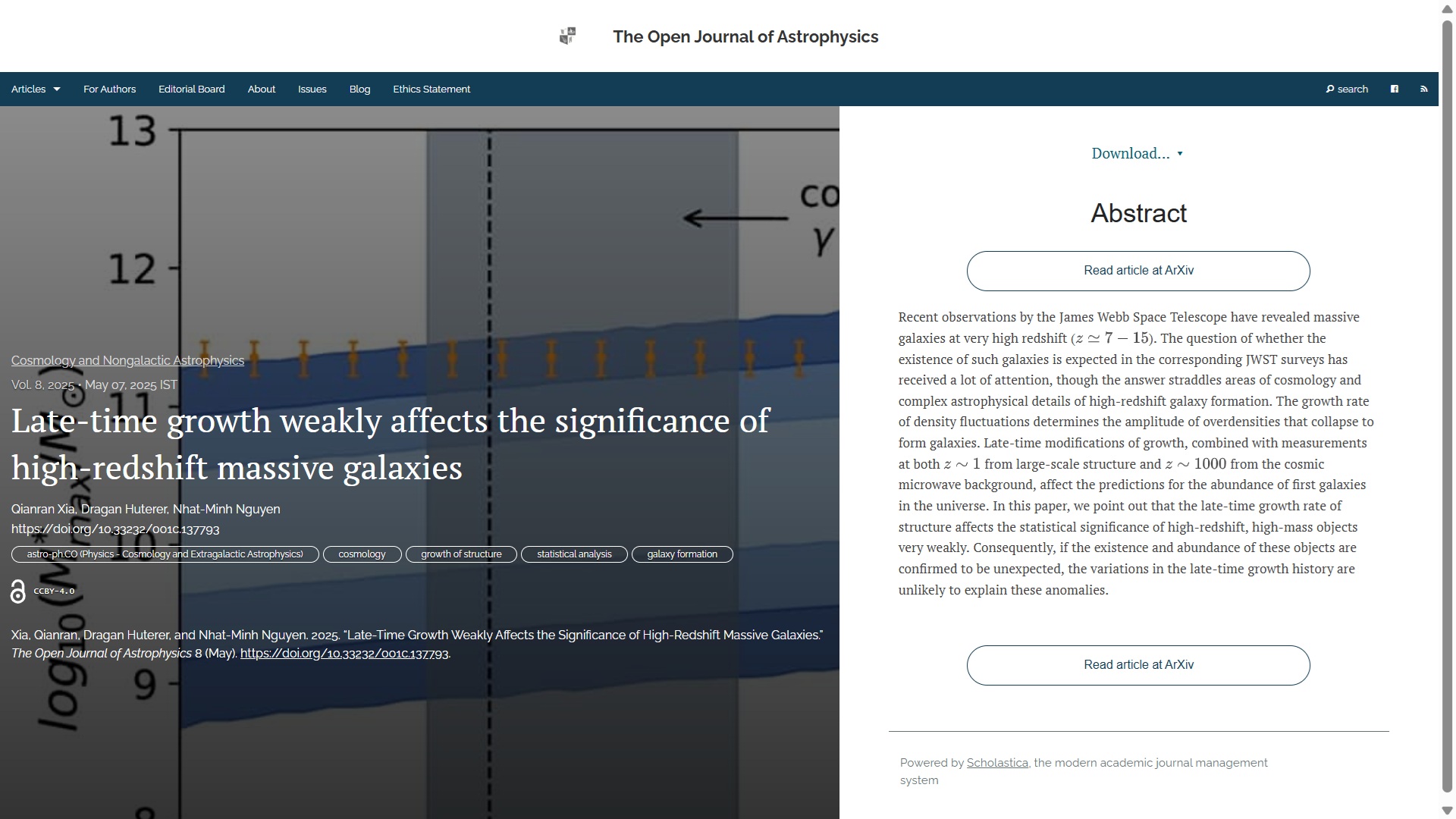
The paper to report is “Late-time growth weakly affects the significance of high-redshift massive galaxies” by Qianran Xia & Dragan Huterer (U. Michigan, USA) and Nhat-Minh Nguyen (U. Tokyo, Japan). This paper, which was published on Wednesday 7th May 2025,  is published in the folder Cosmology and NonGalactic Astrophysics. It presents an argument that changes in the growth rate of perturbations at low redshift do not have much effect on predictions of the abundance of lassive galaxies at high redshift.

The overlay is here:


You can find the officially accepted version on arXiv here.

That’s all for now. I’ll do another update next week.

Weekly Update from the Open Journal of Astrophysics – 03/05/2025

Posted in OJAp Papers, Open Access, The Universe and Stuff with tags , , , , , , , , , , , , , , , , , , , on May 3, 2025 by telescoper

Saturday morning once again, and time for another update of papers published at the Open Journal of Astrophysics. It’s been a recording-breaking week: since the last update we have published no fewer than ten papers, which brings the number in Volume 8 (2025) up to 54 and the total so far published by OJAp up to 289.

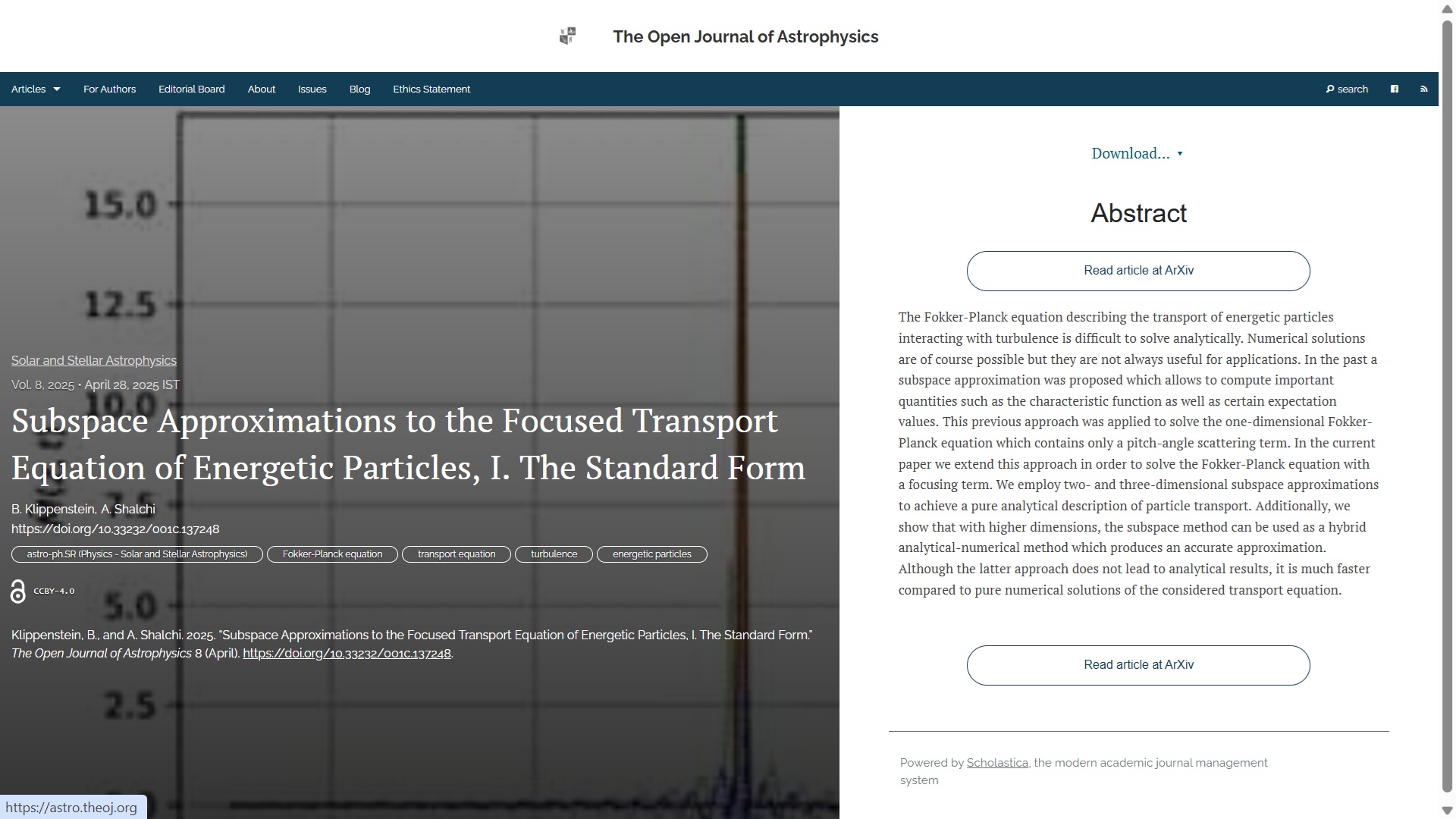
The first paper to report is “Subspace Approximations to the Focused Transport Equation of Energetic Particles, I. The Standard Form” by B. Kippenstein & A. Shalchi (U. Manitoba, Canada). This paper, which was published on Monday 28th April 2025, presents a hybrid analytical-numerical method to solve the Fokker-Planck equation for the transport of energetic particles. It is published in the folder Solar and Stellar Astrophysics.

The overlay is here:

You can find the officially accepted version on arXiv here.

Next is “The Importance of Subtleties in the Scaling of the ‘Terminal Momentum’ For Galaxy Formation Simulations” by Philip F. Hopkins (Caltech, USA). This presents a technical discussion of issues surrounding the proper modelling of supernova blast waves and their effects in numerical simulations of galaxy formation. It was published on Tuesday 29th April 2025 in the folder Astrophysics of Galaxies. The overlay is here:

The final version can be found on arXic here.

Next one up is “Local variations of the radial metallicity gradient in a simulated NIHAO-UHD Milky Way analogue and their implications for (extra-)galactic studies” by Sven Buder (ANU, Australia), Tobias Buck (U. Heidelberg, Germany), Qian-Hui Chen (ANU) and Kathryn Grasha (ANU). This one was also published on Tuesday 29th April 2025 in the folder Astrophysics of Galaxies. It describes a numerical study of the variation of chemical abundance with radial position in galaxies and the implications of this for galaxy formation. Here is the overlay:

and you can find the final accepted version on arXiv here.

The fourth paper this week is “Zooming In On The Multi-Phase Structure of Magnetically-Dominated Quasar Disks: Radiation From Torus to ISCO Across Accretion Rates” by Philip F. Hopkins (Caltech, USA) and 14 others based in the USA and Canada. This was also published on Tuesday 29th April 2025 in the folder Astrophysics of Galaxies. It presents very detailed numerical study of the structure of magnetized quasar accretion disks. The overlay is here:

You can find the official final version on arXiv here.

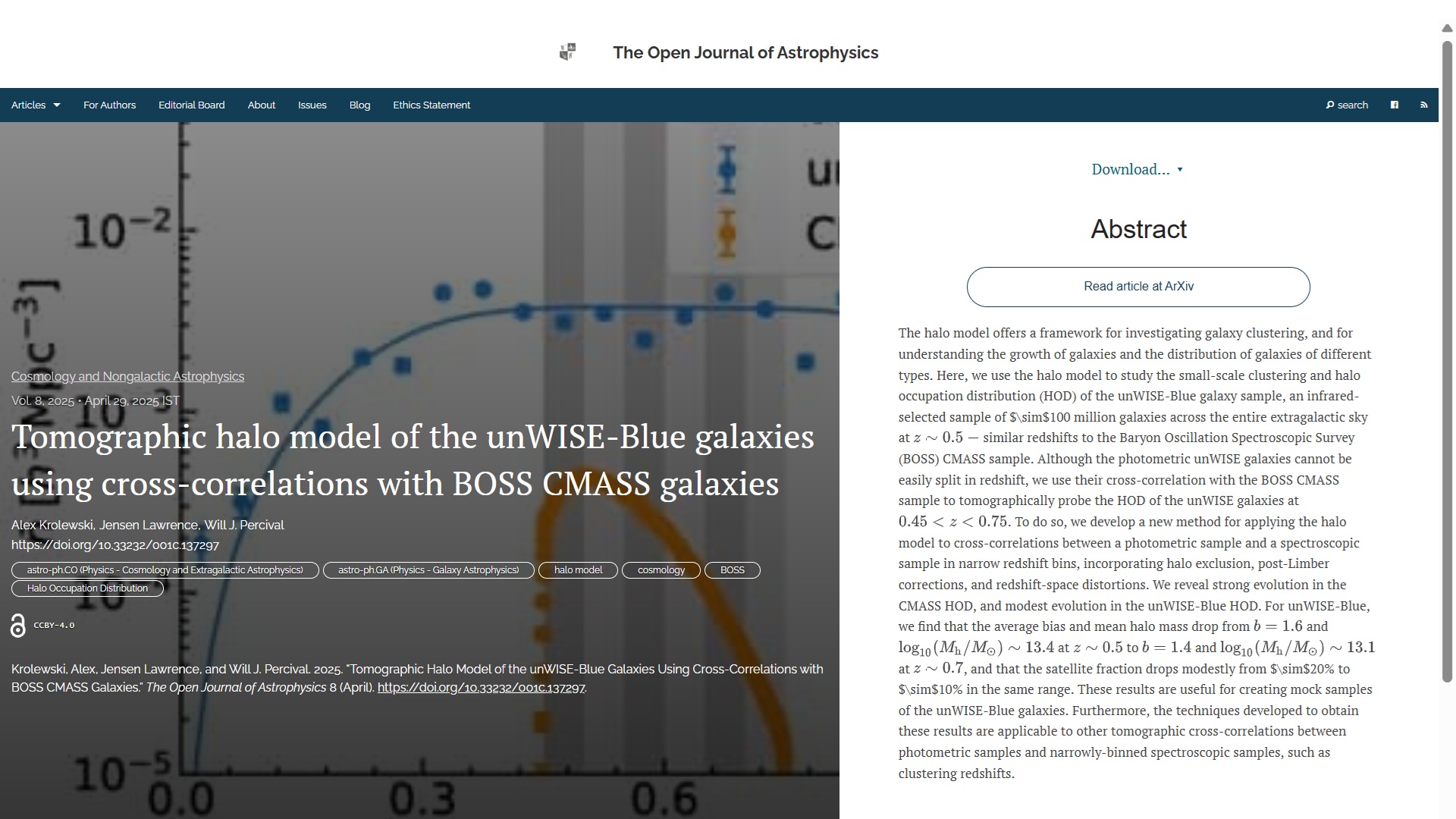
Next is “Tomographic halo model of the unWISE-Blue galaxies using cross-correlations with BOSS CMASS galaxies” by Alex Krolewski, Jensen Lawrence, and Will J. Percival (U. Waterloo, Canada). This one was also published on 29th April 2025, which was a busy day(!), but in the folder Cosmology and NonGalactic Astrophysics.  This paper describes using the halo model to create mock samples unWISE-Blue galaxies, applicable to other tomographic cross-correlations between photometric samples and narrowly-binned spectroscopic samples. The overlay is here:

The final version of this one can be found on the arXiv here.

Number six for this week is “StratLearn-z: Improved photo-estimation from spectroscopic data subject to selection effects” by Chiara Moretti (SISSA, Trieste, Italy), Maximilian Autenrieth (Imperial College, UK), Riccardo Serra (SISSA), Roberto Trotta (SISSA), David A. van Dyk (Imperial) and Andrei Mesinger (SNS Pisa, Italy). This was published on Thursday 1st May 2025 in the folder Cosmology and NonGalactic Astrophysics. This one is about estimating photometric redshifts using an approach that relies on splitting the source and target datasets into strata based on estimated propensity score. The overlay is here:


The official version can be found on arXiv here.

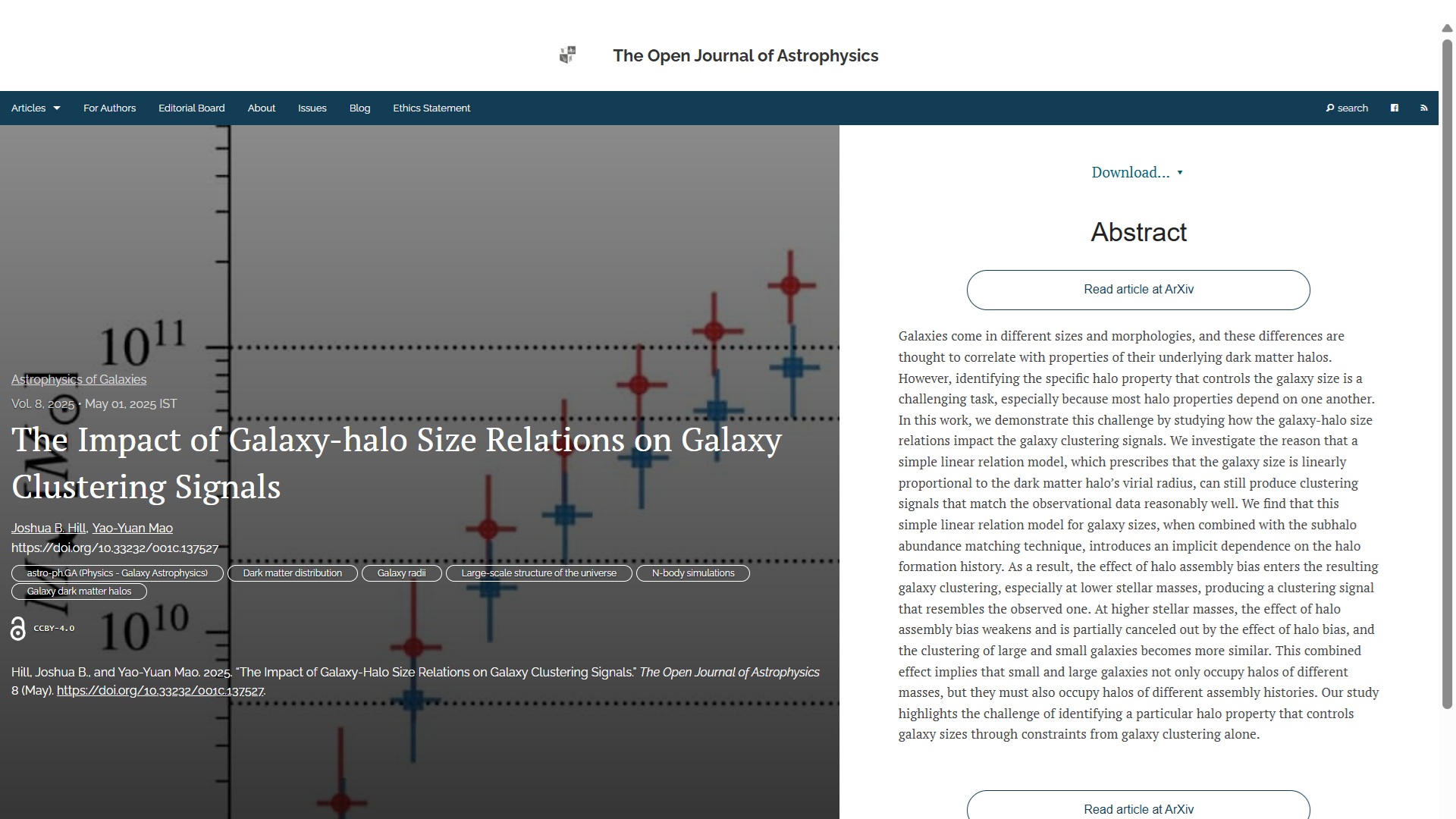
Next is “The Impact of Galaxy-halo Size Relations on Galaxy Clustering Signals” by Joshua B. Hill and Yao-Yuan Mao (U. Utah, USA). This one was also published on May 2nd 2025 and is in the folder Astrophysics of Galaxies. It discusses the challenge of identifying a specific galaxy halo property that controls galaxy sizes through constraints from galaxy clustering alone. The overlay is here:

You can find the official version of the paper on arXiv here.

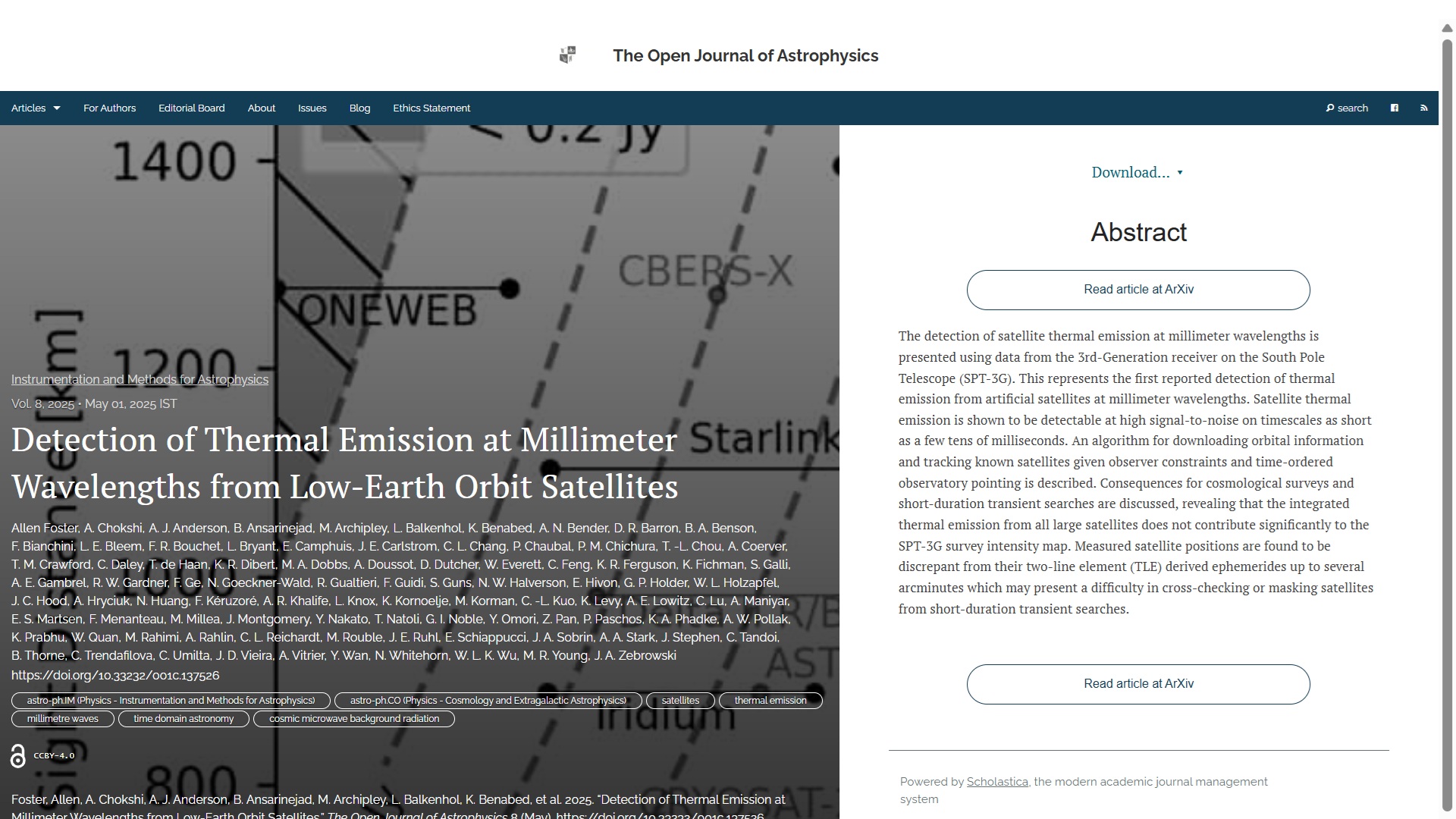
The next paper is “Detection of Thermal Emission at Millimeter Wavelengths from Low-Earth Orbit Satellites” by Allen Foster (Princeton, USA) and an international cast of 90 others, which is too many to list individually. This one was also published on Thursday May 1st but is in the folder Instrumentation and Methods for Astrophysics.  The paper discusses the experimental detection of thermal emission from satellites and a discussion of the implications for astrophysical observations, especially time-domain astronomy. The overlay is here:

You can find the final version of the paper on arXiv here.

The penultimate paper of this week is “Pseudo-Cls for spin-s fields with component-wise weighting” by David Alonso (U. Oxford, UK). This one was published yesterday (Friday 2nd May 2025).  The paper presents an approach to power spectrum estimation appropriate for data with anisotropic noise properties or for which complicated masks are required.  It can be found in the folder Cosmology and NonGalactic Astrophysics. The overlay is here:


The final version of this paper is on arXiv here.

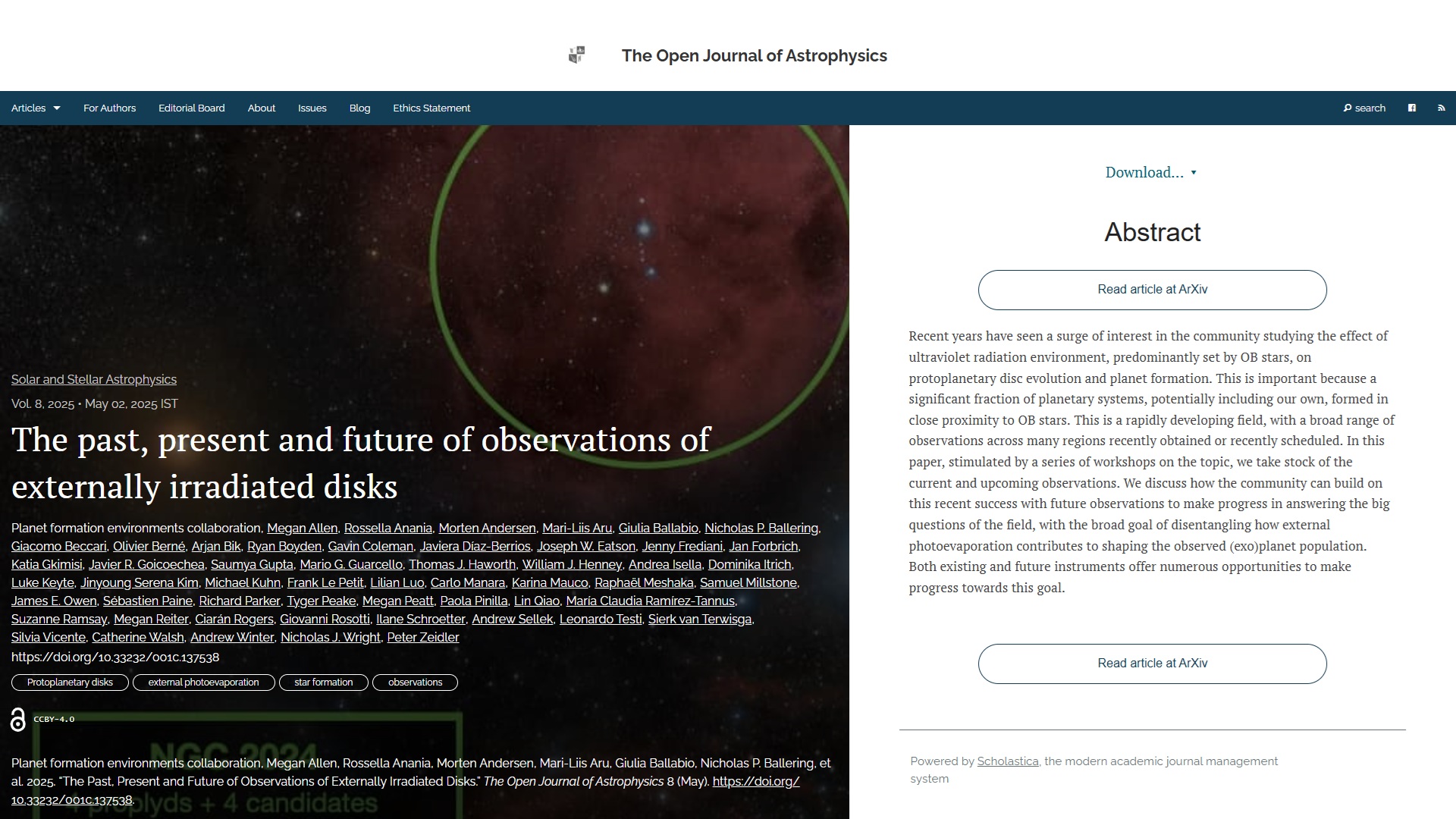
The last paper this week is “The past, present and future of observations of externally irradiated disks” by Planet formation environments collaboration: Megan Allen (U. Sheffield, UK) and 52 others. This paper was published on Friday 2nd May in the folder Solar and Stellar Astrophysics.  It presents a review of research on the effects of the ultraviolet radiation environment on protoplanetary disc evolution and planet formation. The overlay is here:

You can find the final version on arXiv here.

That’s all the papers for this week. I’ll just add that there were quite a few gremlins at Crossref this week, particularly yesterday. I usually do the publishing first thing in the morning but yesterday’s papers were held in a queue for most of the day pending registration. Usually it just takes a few minutes, but for these I had to wait several hours but we got there in the end. Although ten papers is more than we have ever published in a week, we still haven’t had a week in which we’ve published on every working day!

Anyway, that’s all for this week. I’ll post another update next Saturday.

Weekly Update from the Open Journal of Astrophysics – 26/04/2025

Posted in OJAp Papers, Open Access, The Universe and Stuff with tags , , , , , , , , , , , on April 26, 2025 by telescoper

It’s Satuday morning once again, and time for another update of papers published at the Open Journal of Astrophysics. Since the last update we have published two papers, which brings the number in Volume 8 (2025) up to 44 and the total so far published by OJAp up to 279.

The first paper to report is “Approximating non-Gaussian Bayesian partitions with normalising flows: statistics, inference and application to cosmology” by Tobias Röspel, Adrian Schlosser & Björn Malte Schäfer (Universität Heidelberg, Germany) which was published on April 23rd 2025 in the folder Cosmology and NonGalactic Astrophysics. It is an introduction to normalizing flows – a machine learning technique for transforming distributions – and its application to the extraction of cosmological parameters from supernova data.

The overlay is here:

You can find the officially accepted version on arXiv here.

The other paper this week is “Dwarf Galaxies in the TNG50 Field: connecting their Star-formation Rates with their Environments” by Joy Bhattacharyya & Annika H.G. Peter (Ohio State University, USA) and Alexie Leauthaud (UC Santa Cruz, USA).  This one was published on 24th April 2025 in the older Astrophysics of Galaxies and it studies dwarf galaxies with properties similar to the Large and Small Magellanic Clouds that form in different environments in the TNG50 simulation of the IllustrisTNG project.

The overlay is here:


and you can find the final accepted version on arXiv here.


That’s all for this week. I’ll have another update next Saturday.

ArXiv, the Cloud and Backups

Posted in Open Access with tags , , , on April 24, 2025 by telescoper

Hidden in a job advertisement on the arXiv website for software developers is the news that

arXiv is in the midst of technological modernization to ensure longevity and scalability, and to improve our ability to support the scientific community. We are currently hiring software engineers and developers to work on the arXiv CE (“Cloud Edition”) project and our tech modernization efforts.

It seems that arXiv is going to be moved from local infrastructure at Cornell University to some sort of Google Cloud Platform. I’m not sure what to make of this move. For one thing, I’m deeply suspicious of Google so I hope that measures will be taken to ensure that arXiv remains freely accessible to the global scientific community. I suspect too that Google will use arXiv submissions as it uses everything placed in its control, to train AI. On the other hand, everything on arXiv is currently in the public domain anyway, and there has been evidence of attempts by bots to scrape its content already, causing a (temporary) degradation of service.

What all this means for the Open Journal of Astrophysics, I don’t know. I have however over the past several weeks been setting up several backups of all the papers published by OJAp in various repositories. We are an arXiv-overlay journal, but there’s no reason at all why the overlay model cannot be used with other repositories.

The decision to take these precautions was not motivated by arXiv’s move to the Cloud but by more general worries about the state of affairs in the USA right now. American universities are facing a number of attacks, as the current “Government” pursues an explicitly anti-scientific agenda, so I think it’s wise to consider the risk to Cornell being non-negligible. Obviously we can’t back up the entire arXiv repository, but I think we’ve made all OJAp papers as safe as possible in the event that anything happens to arXiv. I still think it’s unlikely we will need to use them so we’ll continue with arXiv for the forseeable future. Better safe than sorry!

Weekly Update from the Open Journal of Astrophysics – 19/04/2025

Posted in OJAp Papers, Open Access, The Universe and Stuff with tags , , , , , , , , , , , , , , , , , , , on April 19, 2025 by telescoper

It may be the Easter holiday weekend, but it’s still time for the weekly Saturday morning update of papers published at the Open Journal of Astrophysics. Since the last update we have published five new papers, which brings the number in Volume 8 (2025) up to 42 and the total so far published by OJAp up to 277.

In chronological order of publication, the five papers published this week, with their overlays, are as follows. You can click on the images of the overlays to make them larger should you wish to do so.

The first paper to report is “Galaxy Clustering with LSST: Effects of Number Count Bias from Blending” by Benjamin Levine (Stony Brook, NY), Javier Sánchez (STScI, MD), Chihway Chang (Chicago, IL) Anja von der Linden (Stony Brook), Eboni Collins (Dillard, LA), Eric Gawiser (Rutgers, NJ), Katarzyna Krzyżańska (Cornell, NY), Boris Leistedt (Imperial College, UK) on behalf of the LSST Dark Energy Science Collaboration.

This presents a simulation-based study of the effect of source overlaps (blending) on galaxy counts expected for the Vera C. Rubin Legacy Survey of Space and Time (LSST). The paper is in the folder Cosmology and NonGalactic Astrophysics and was published on Monday 14th April 2025. The overlay is here:


You can find the officially-accepted version of the paper on arXiv here.

The second paper to announce, published onTuesday 15th April 2025,  “Rapid, strongly magnetized accretion in the zero-net-vertical-flux shearing box” by Jonathan Squire (Otago, New Zealand), Eliot Quataert (Princeton, USA) & Philip F. Hopkins (Caltech, USA). This  paper presents a numerical study of turbulence in a flux shearing box, with discussion of the implications of the results for global accretion disk models and simulations thereof. It was published in the folder High-Energy Astrophysical Phenomena and the overlay is here:


You can read the officially accepted version of this paper on arXiv here.

The third paper of the week, published on Wednesday April 16th 2025,   is “DeepDISC-photoz: Deep Learning-Based Photometric Redshift Estimation for Rubin LSST” by Grant Merz (University of Illinois at Urbana-Champaign, USA) and 13 others (all based in the USA) on behalf of the LSST Dark Energy Science Collaboration. This paper describes adding photometric redshift estimation to the DeepDISC framework for classification objects in co-added images for use with the Vera C. Rubin LSST survey. It can be found in the folder Instrumentation and Methods for Astrophysics.

Here is the overlay:


You can find the officially accepted version of this paper on arXiv here.

The next one to report is “Multidimensional Nova Simulations with an Extended Buffer and Lower Initial Mixing Temperatures” by Alexander Smith Clark and Michael Zingale (Stony Brook University, NY, USA). This paper presents new computer models of classical novae with improved ability to follow nucleosynthesis in the thermonuclear outburst and better treatment of convective transport. This one was also published on Wednesday 16th April 2025 but in the folder Solar and Stellar Astrophysics.

Here is the overlay:


The official published version can be found on the arXiv here.

The last paper of the five published this week is “Measurement of the power spectrum turnover scale from the cross-correlation between CMB lensing and Quaia” by David Alonso (Oxford, UK), Oleksandr Hetmantsev (Kyiv, Ukraine), Giulio Fabbian (Cambridge, UK), Anze Slosar (Brookhaven National Laboratory, USA) and Kate Storey-Fisher (Stanford, USA). This is a discussion of using the spatial correlations of quasars and their cross-correlations with cosmic microwave background lensing data to measure a feature corresponding to the matter-radiation equality scale with consequences for cosmological parameter estimation. It was published on Thursday 17th April 2025 in the folder Cosmology and NonGalactic Astrophysics.

The overlay is here:

You can find the officially accepted version on arXiv here.

That’s all the papers for this week. I’ll just add a couple of things.

One is that, although there have been weeks before in which we have published five or more papers, we still haven’t managed to have a week on which we’ve published a paper on every weekday. This week we had two on Wednesday 16th but didn’t have any yesterday (Friday).

The second is that tt has been a while since I last posted a breakdown of the running costs here at the Open Journal of Astrophysics. Today I received an email from Scholastica, our service provider, reminding me our costs will go up shortly (from 22nd April). In the interest of transparency I am passing this information on here.

The new prices will be as follows:

  • Peer Review System annual cost will be $425/year (was $350/year) plus $10 per submission (no change)
  • OA Publishing Platform annual cost will be $1,499/year (was $1,399/year)

Last year we published 120 papers with about 250 submissions. We’re a bit ahead of that this year, so I estimate that our next year’s costs will be a bit less than $5000. That’s still less than the typical APC for a single paper at many journals.

I hope this clarifies the situation.

Weekly Update from the Open Journal of Astrophysics – 12/04/2025

Posted in OJAp Papers, Open Access, The Universe and Stuff with tags , , , , , , , , , , , , , , , , on April 12, 2025 by telescoper

Time for the weekly Saturday morning update of papers published at the Open Journal of Astrophysics. Since the last update we have published four new papers, which brings the number in Volume 8 (2025) up to 37 and the total so far published by OJAp up to 272.

In chronological order of publication, the four papers published this week, with their overlays, are as follows. You can click on the images of the overlays to make them larger should you wish to do so.

The first paper to report is “Searching for new physics using high precision absorption spectroscopy; continuum placement uncertainties and the fine structure constant in strong gravity” by Chung-Chi Lee (Big Questions Institute (BQI), Sydney, Australia), John K. Webb (Cambridge, UK), Darren Dougan (BQI), Vladimir A. Dzuba & Victor V. Flambaum (UNSW, Australia) and Dinko Milaković (Trieste, Italy).

This presents a discussion of the problem of continuum placement in high-resolution spectroscopy, which impacts significantly on fine structure constant measurements, and a method for mitigating its effects. The paper is in the folder Solar and Stellar Astrophysics and was published on Tuesday 8th April 2025. The overlay is here:

You can find the officially-accepted version of the paper on arXiv here.

The second paper to announce, also published on 8th April 2025,  is “Deciphering Spatially Resolved Lyman-Alpha Profiles in Reionization Analogs: The Sunburst Arc at Cosmic Noon” by Erik Solhaug (Chicago, USA), Hsiao-Wen Chen (Chicago), Mandy C. Chen (Chicago),  Fakhri Zahedy (University of North Texas),  Max Gronke (MPA Garching, Germany),  Magdalena J. Hamel-Bravo (Swinburne, Australia), Matthew B. Bayliss (U. Cincinatti), Michael D. Gladders  (Chicago), Sebastián López (Universidad de Chile), Nicolás Tejos (Universidad Católica de Valparaíso, Chile).

This paper, which presents a study of the Lyman-alpha emission properties of a gravitationally-lensed galaxy at redshift z=2.37, appears in the folder Astrophysics of Galaxies. It was published


You can read the officially accepted version of this paper on arXiv here.

The third paper of the week  is “On the progenitor of the type Ia supernova remnant 0509-67.5” by Noam Soker (Technion, Haifa, Israel). This one was published on Wednesday 9th April 2025 in the folder High-Energy Astrophysical Phenomena. The author discusses possible ideas for the origin of a supernova that exploded inside a planetary nebula.

Here is the overlay:


You can find the officially accepted version of this paper on arXiv here.

Last (but certainly) not least for this week, published on April 11th 2025, we have “Are Models of Strong Gravitational Lensing by Clusters Converging or Diverging?” by Derek Perera (U. Minnesota), John H Miller Jr & Liliya L. R. Williams (U. Minnesota, USA), Jori Liesenborgs (Hasselt U., Belgium), Allison Keen (U. Minnesota), Sung Kei Li (Hong Kong University), Marceau Limousin (Aix Marseille Univ., France).  This papers study various models of a strong gravitational lensing system, the results suggesting that lens models are neither converging to nor diverging from a common solution for this system, regardless of method.

Here is the overlay:


The official published version can be found on the arXiv here.


That’s all the papers for this week. By way of a postscript I’ll just mention that the gremlins that have affected submissions to Crossref (which we rely on for registering the article metadata) have now been resolved and normal services have been restored.

A Master Class in Destroying Trust

Posted in Open Access with tags , on April 8, 2025 by telescoper

For (hopefully) obvious reasons, I’m taking the liberty of republishing, with permission, the following article, originally published here, about the egregious behaviour of the company Clarivate which, among other activities, is responsible for assigning Journal Impact Factors. Please read it if you want to understand why nothing Clarivate does should be trusted. The author, Sunshine Carter, is director of collection strategy and e-resource management at the University of Minnesota. The article represents the author’s personal views, not those of her employer. 

–0–

Clarivate’s “transformative subscription-based strategy” caught the library world flat-footed. How did this happen? And where do we go from here?


On February 18, 2025, Clarivate announced that as part of its “transformative strategy and following changes in demand from libraries” it would “phase out one-time perpetual purchases of print books” and ebooks on ProQuest’s Ebook Central platform. It would also end new perpetual archive license purchases of digital collections.

The removal of perpetual purchases from Clarivate’s sales models runs counter to library values of long-term preservation and access to information. Subscriptions might work for some libraries, but perpetual purchases are important for the preservation of the written record, especially at research institutions.

In the weeks that followed the announcement, librarians (including Siobhan Haimé and Isaac Wink) lamented the end of ownership; the loss of stable access; and the loss of a primary supplier for shelf-ready print books. They shared concerns about their ability to afford new subscriptions, the need to shift collection development strategies, and Clarivate’s fast timeline. Many pointed to Clarivate’s February 19, 2025 earnings call for 2024 Q4, which clearly articulated their goal to increase the bottom line. This was the “value creation plan (VCP)” Clarivate announced in late 2024 coming to fruition. Library and higher education consortia sent letters to Clarivate; libraries met with Clarivate, and with each other. EBSCO, a direct competitor, quickly reaffirmed its commitment to offering a variety of purchase options for libraries.

On March 4, two weeks after the initial announcement, Clarivate’s CEO, Matti Shem Tov, and president for academia and government, Bar Veinstein, issued an open letter to the library community in which they apologized that “the absence of community consultation created frustration, during already challenging times for libraries and higher education.” They also announced that Clarivate would delay the implementation date for the planned changes and guarantee perpetual access for previously purchased materials.

This response—a delay in implementation that ignores the library community’s deeper critique of the plan—rings hollow.

As we plan our next steps, we should reflect on how we got here.

Building a Community

In June 2007, I found myself in Spearfish, South Dakota at my first Ex Libris Users of North American (ELUNA) conference.

Formed in 2006 from the merger of two previous user groups, ELUNA is a not-for-profit organization representing Ex Libris customers in the Americas. Ex Libris develops and sells library software and management solutions like Alma, an integrated library management system used by over 2,500 libraries worldwide.

ELUNA members test and advocate for improvements to the Ex Libris products and have created a community of support for each other. ELUNA has a steering committee, eighteen working groups, four advisory groups, and seven communities of practice composed of staff from subscribing institutions; they interact directly with staff from Ex Libris. Over the past 20 years, through my institutions’ involvement in ELUNA, I’ve improved, conceptualized, and developed features for Ex Libris products.

At my first ELUNA conference, I was awed by how many libraries and library staff were users of and experts in Ex Libris tools and systems. I was also struck by how closely ELUNA attendees and member institutions collaborated with Ex Libris staff. Ex Libris leaders, product managers, developers, and customer support and service staff attend the ELUNA conference, where they lead trainings and give presentations.

Over the years, Ex Libris executives (including, during their tenures there, Shem Tov and Veinstein) often used the conference to announce and explain the rationale for new products or other major business decisions. During Q&A sessions, ELUNA members shared opinions—sometimes passionate—directly with Ex Libris staff and executives. There was a high level of collaboration and information-sharing between ELUNA member institutions, their staff, and Ex Libris employees.

The process of collaboration was not always smooth and didn’t always work out as ELUNA members preferred, but we worked with Ex Libris to make things happen and felt like a valued community.

A Shifting Tide

In October 2015, ProQuest, which had its own long history as a key provider of digitized primary materials and aggregator of research databases, ebooks, and streaming videos, acquired Ex Libris. This was a seismic transition for academic libraries. But despite fretting about what the acquisition would mean for both companies and their lines of products, from the outside, things seemed okay: There was some consolidation—for example, of customer support desks—but the products themselves didn’t change. Ex Libris retained its moniker, adding “A ProQuest Company” to its logo and branding. Several Ex Libris executives—including Shem Tov and Veinstein—made their way into ProQuest leadership.

And then, in late 2021, ProQuest was acquired by Clarivate.

Though Clarivate’s current leadership—including Shem Tov and Veinstein—have a strong history of collaborating with their customers, they didn’t consult with libraries or publishers before their February 18 announcement. Clarivate’s failure to involve their customers in this decision, especially those in government and academia, shows that they prioritized profit over relationships.

The exclusion of libraries was intentional, not an oversight. In a moment when university budgets are facing profound and intense technological, financial, and governmental pressures, Clarivate’s fast and furious timeline—even with a slight reprieve—is out of touch.

Vendors and publishers seek to make money. Library professionals promote the freedom to read and unfettered access to content. Of course the goals of vendors and library professionals can be in conflict. And yet, in our work with vendors, as exemplified in my experience with ELUNA—a service provided by libraries and their employees to a corporation, in the form of a nonprofit, which we described as a community—it has at times been easy to feel as if we all share a commitment to libraries and librarianship.

We do not.

Where Do We Go From Here?

Clarivate is omnipresent on academic campuses, although it is not alone. And, like other large content and information services providers, it has shifted its focus. In an article about Elsevier and its parent company, RELX, Christien Boomsma writes, “Publishing is no longer the main focus for RELX and its competitors; instead, they have become data brokers. They sell data to insurance companies for risk analysis, to banks for fraud detection, to universities to assess their performance, and, especially egregious, to the US Immigration Service to target illegal immigrants.” In addition to a new focus on data, Clarivate is investing heavily in artificial intelligence, an indicator of expected market and revenue gains.

Clarivate’s dismissal of one-time purchases is alarming, but when you consider the company’s larger strategy, it makes sense. On the Q4 earnings call, Shem Tov refers to one-time purchases as “a drain.” He also says that Clarivate has “retained financial advisers to help us in evaluating strategic alternatives to unlock value. This may include divesting business units or an entire segment.” He goes on to say, “There is no guarantee that anything actionable will arise from this process,” but considering Clarivate will no longer sell books, Clarivate’s furthering its investment in data should make us wary.

Going forward, libraries and library staff should approach vendors with absolute clarity about the values governing our respective work and the nature of our relationships. We must:

Increase bibliodiversity in the market and our collections (Haimé) by:

  • Purchasing materials directly from smaller and/or more diverse publishers
  • Investing in academy-owned open access infrastructure and publishing that is sustainable, equitable, and diverse
  • Investigating alternative software, tools, and content providers; consider developing options in-house (or in collaboration with other institutions)
  • Divesting from resources that no longer serve our needs or align with our values

Speak up by:

  • Sharing concerns with library leadership
  • Pushing vendors on issues that conflict with our values
  • Requesting meetings with vendor leadership

Use our collective voices to:

  • Discuss issues with institutional, system, regional, consortia, or association groups
  • Bring shared concerns to vendors, collectively
  • Reclaim our space; insist on being at the table (especially concerning the development of AI-integrated tools and the use of data collected about our institutions or our users)
  • Set guiding principles for interacting with publishers and vendors

Incorporate limitations into signed agreements. Make sure to:

  • Get everything in writing, via a contract
  • Limit vendors’ use of the data they collect from our users and institutions

Offer library staff training on:

  • Current vendor issues and trends with vendors
  • Ethics and conflicts of interest

We should remain open to collaboration but remember that profit drives many of the companies libraries rely on. Even in the face of great challenges and unbelievable changes, we can and should continue to advocate for our core values.

10.1146/katina031925-1

Weekly Update from the Open Journal of Astrophysics – 05/04/2025

Posted in OJAp Papers, Open Access, The Universe and Stuff with tags , , , , , on April 5, 2025 by telescoper

It’s time once more for the regular Saturday morning update of papers published at the Open Journal of Astrophysics. Since the last update we have published one new paper. The number of articles in Volume 8 (2025) is now up to 33 and the total so far published by OJAp up to 268.

The paper concerned, published on 2nd April 2025, is “The molecular gas content throughout the low-z merger sequence” by Mark T. Sargent (ISSI, Bern), S. L. Ellison (U. Victoria, Canada), J. T. Mendel (ANU), A. Saintonge (UCL), D. Cs. Molnár & T. Schwandt (U. Sussex), J. M. Scudder (Oberlin College, USA) and G. Violino (U. Hertfordshire). It is published in the folder Astrophysics of Galaxies and it discusses the observed properties of molecular gas in post-merger galaxies and interacting pairs and the physical origin of these properties.

Here is the overlay:

You can read the officially accepted version of this paper on arXiv here.

That’s all for this week. I’ll do another update next Saturday.