With the global financial markets falling steeply in response to Donald Trump’s tariff policy (as announced last week), world leaders will have to decide whether to introduce tariffs themselves or to try to bring the turmoil to an end through negotiation.
I’m not sure why the pound is collapsing against the euro, but it is…
As regular readers of this blog will know, I have a considerable reputation for tact and diplomacy and am therefore in a good position to offer advice. My considered opinion is that, although Trump is undoubtedly a jerk, and deserves to receive a knee in a suitably painful place, a knee-jerk response should be avoided at this stage. A more effective approach would be to act in a more considered way that reflects an understanding of the views of the President of the United States.
For example, Trump has insisted that the EU imposes 39% tariffs on goods from the USA. Although in reality the figure is only 3%, I feel it would be impolite and undiplomatic to contradict such an eminent person as the President of the United States of America. Therefore, as a mark of respect and reconciliation, the EU should immediately sets its tariffs at a level of 39%. I am confident that this will lead to a speedy clarification of the economic situation.
It’s probably also best to avoid mentioning too often that Donald Trump is a convicted felon.
I got up at Stupid O’Clock this morning to catch an early morning plane from Dublin to Cardiff. It was very cold when I arrived but it soon warmed up and turned into a lovely day.
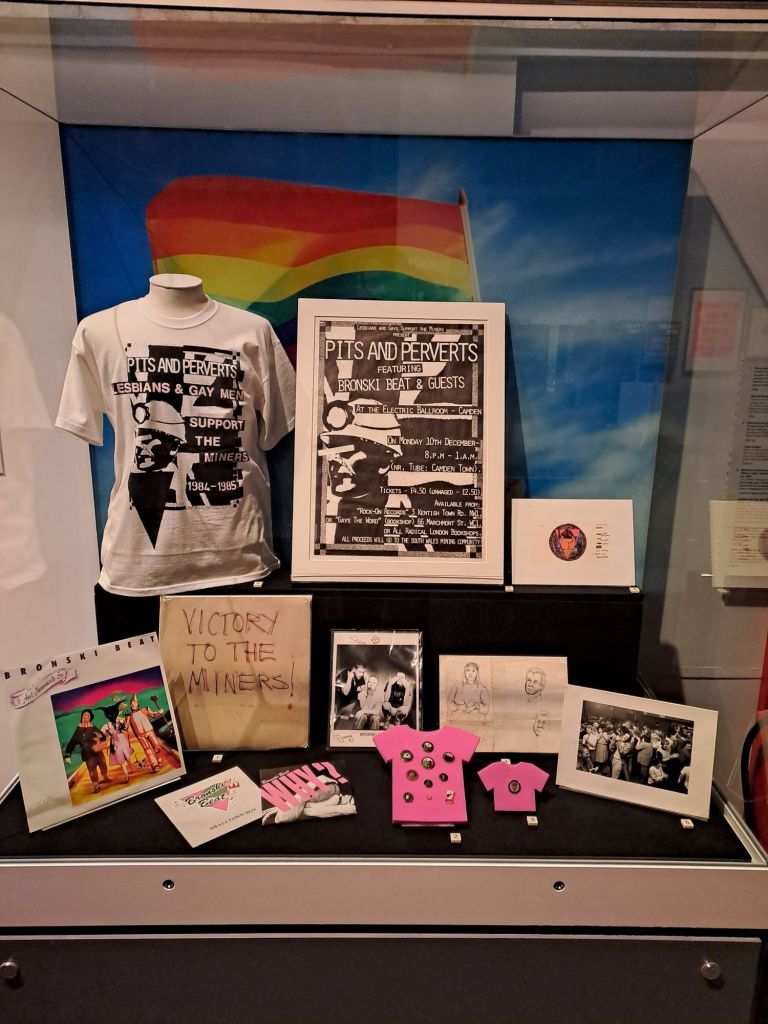
I had a nice breakfast at Bill’s when I arrived in the City then did tour of the National Museum of Wales where there is an exhibition about the Miners’ Strike of 1984/5, from which this display case caught my attention:
I also had time for a round of Name That Artist (scoring a miserable 3/12, for Sutherland, Ernst, and Magritte).
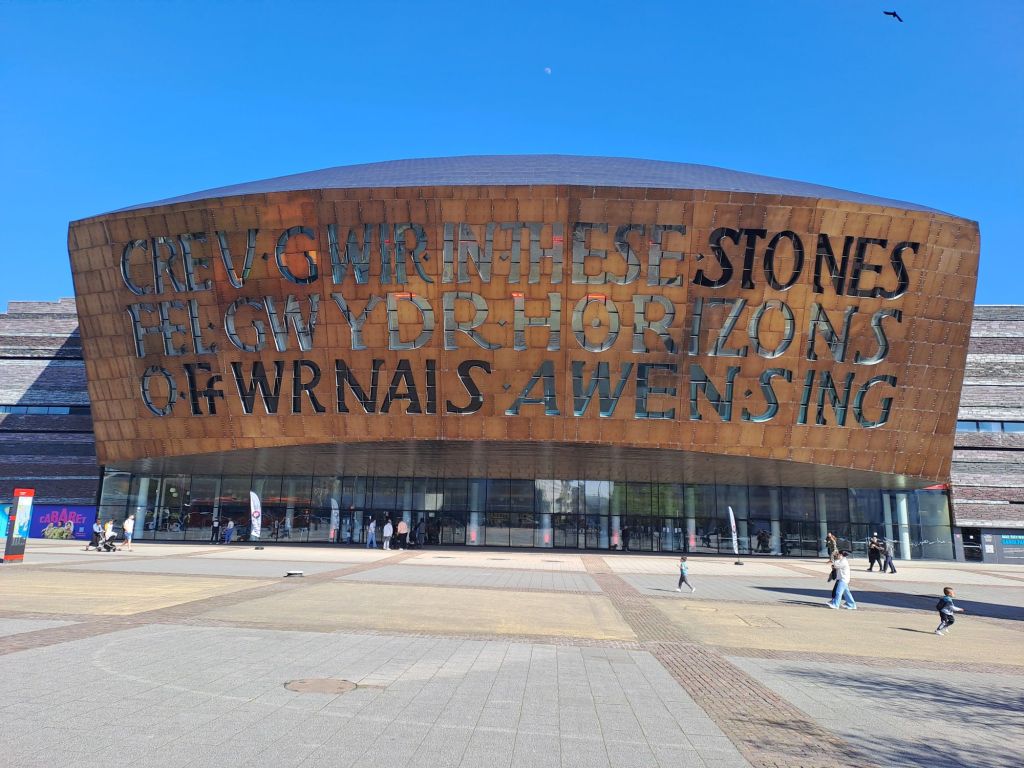
After that, I took a stroll around Bute Park before heading to my hotel in Cardiff Bay to check in and have a rest before the reason for my visit, an event which will take place here at 7pm:
I won’t be able to blog about that until I get back to Maynooth tomorrow afternoon.
I didn’t watch the speech tirade by “US President” Donald Trump* last night in which he unveiled his new tariff plan, but people have been talking about this all day so I couldn’t resist a quick comment. There’s a lot I don’t know about economics and trade policy but one thing I do know is that the trad-weighted average tariff on goods from the USA entering the EU is about 3%, not the 39% that Trump alleged. I did therefore wonder where he got this number and all his other “reciprocal tariffs” from. Fortunately a little digging around revealed the answer.
On the left you see part of the chart showing tariffs country-by-country and the second is an extract from the published methodology which would be hilarious were the consequences not so serious.
part of the list of “reciprocal tariffs”The magic formula
You will see that the second column on the chart is headed “Tariffs charged on the USA”, with 39% listed for the European Union. This number is calculated using the “formula” on the right which has absolutely nothing to do with tariffs charged. Moreover, the denominator contains the product εφ with the values ε=4 and φ=0.25 given in the text so εφ = 1. The expert mathematician who derived this formulae seems to have missed the fact that ε is not less than zero (first sentence) if it is equal to 4, but we’ll let that pass. In fact I can’t be bothered to point out the other errors because no matter how egregious they are, there is no chance of Trumpty Dumpty reversing his decisions anyway.
To sum up, the notional tariff in column 2 is just the difference between imports and exports (the country’s trade surplus) divided by imports. The numbers in the third column of the chart on the left are just half those in the second column (give or take rounding errors). There is also a minimum of 10%, which applies even to countries with which the USA has a trade surplus. China faces huge tariffs because it has a large trade surplus with the USA. The EU’s 20% tariff is nothing to do with the tariffs it charges but is due to the fact that it has a trade surplus with the USA; the UK has a lower tariff rate than the EU because it has a smaller trade surplus with the USA. That’s it.
I heard a Trump-supporting numpty attempting to justify the calculation shown in the chart on the grounds that it is really an “unfairness index”, it apparently being unfair and worthy of punishment if a country sells more to the USA than the USA sells to it. Following this line of reasoning, I have decided that all shops are unfair because I always buy more from them than they buy from me.
P.S. I was thinking that in future retaliation I should boycott goods from the USA but this would be an empty gesture because I don’t really buy any anyway. Looking up top imports from the USA to Ireland I find, for example, Bourbon (which I never buy because it is undrinkable) and confectionery (which I don’t buy because I don’t have a sweet tooth). Then I found peanuts, which I do buy occasionally, and will not buy in future. However in the grand scheme of world trade, peanuts are small potatoes.
*I apologize for forgetting to mention that Donald Trump is a convicted felon.
Just time for a quick post to pass on an Editorial by Masud Husain with the title On the responsibilities of intellectuals and the rise of bullshit jobs in universities which appeared in BRAIN magazine (which I buy for the Spot-the-Cell competition). I agree wholeheartedly with the article, which is available free of charge so I recommend you read it in full here, but I thought I’d give you a couple of tasters. The first is:
For some years now, it has become increasingly apparent to me that we are sleepwalking into a disaster. We are losing sight of the academic mission: to think, to enquire, to design and perform new research, to innovate, to teach and communicate our findings for the purpose of societal improvement. There are many reasons why this has occurred over just a quarter of century but a key contributor has been the corporatization of academic institutions.
The second is
To undertake corporatization, universities have borrowed principles that they think work in the private sector. These involve creating layers of administration to run different sectors of our institutions. In the UK, for example, between 1995 and 2019 while spending on university departments roughly doubled, the amount allocated to administration and central services more than quadrupled.
As you probably imagined, the piece borrows some themes from the book Bullshit Jobs (subtitled The Rise of Pointless Work and What We Can Do About It) by anthropologist David Graeber that I wrote about here.
The other day a colleague asked me if what I thought could be done about the underfunding of UK universities and the consequent job losses. I replied to say that I don’t think the problem so much that the universities as a whole are underfunded, but that the core missions of such institutions, by which I mean teaching and research, are. What is happening is that a huge slice of the money coming into universities is dissipated on bullshit jobs in a bloated management superstructure instead of being spent in the departments, which have become entirely subservient to “The Centre”. That is not only the case in the UK, but also here in Maynooth. Hardly a week goes by without some new bullshit job being advertised while our student-staff ratio soars and we academic underlings are starved of the resources we need to do our real jobs properly. It’s very dispiriting that Management continue to get away with this nonsense. If it continues, Ireland will undoubtedly encounter the same structural problems as are currently affecting the UK. I’m sure this is also the state of affairs in many other universities around the world.
It seems obvious to me that when your income falls, among the first things to do is reduce waste. If I were in charge of Higher Education funding my first priority would not be to increase funding but to impose penalties on universities that spend too little on what they’re actually supposed to be doing and too much on bullshit.
A while ago I posted an item about the Royal Society’s failure to take proper action against Elon Musk. The petition I linked to then gained almost 4,000 signatures – including quite a number of people I know. Well, yesterday evening that venerable institution held a meeting attended by over 150 of its Fellows. The meeting was behind closed doors but it seems to have been rather fractious. It also seems that Elon Musk remains a Fellow.
At a meeting this evening of the Royal Society, Fellows agreed on the need to stand up for science and for scientists around the world in the face of the growing challenges science faces.
Concern was expressed, in particular, about the fate of colleagues in the US who are reportedly facing the prospect of losing their jobs amid threats of radical cutbacks in research funding.
Fellows, over 150 of whom attended tonight’s meeting, were united in the need for the Society to step up its efforts to advocate for science and scientists at a time when these are under threat as never before and yet at the same time have never been more necessary for humanity at large.
The Society agreed to look at potential further actions that might help make the case for science and scientific research and counter the misinformation and ideologically motivated attacks on both science and scientists.
I’m taking the liberty of reblogging this post about the Royal Society’s inaction in the case of Elon Musk. I urge you to read the post. As I said in a previous article:
The venerable Royal Society still counts him as a Fellow, despite his overtly antiscientific dissemination of false information and his support for far-right extremism. I don’t know how Musk was elected an FRS in 2018, perhaps before the worst of his character became widely known, but the fact that he remains a Fellow tarnishes the reputation of that organization.
Saturday, 15th February (Open Day) Time to be confirmed
Wednesday, 19th February From 0830 to 1600
Thursday, 20th February From 0830 to 1600
I understand the students at BIMM are organizing demonstrations in support of staff threatened with redundancy. As an IFUT member I wish to take the opportunity provided by this blog express solidarity with those taking part in industrial action and hope for a negotiated resolution to the dispute. I am not based in Dublin, so I can’t attend the picket lines in person to show support on weekdays, but I am planning to attend on Saturday 15th February. I will also be wearing my IFUT badge…
The only thing that has surprised me about Donald Trump’s assault on Diversity, Equity and Inclusion is the speed with which he has imposed his bigotry on individuals and federal institutions. The first step came within hours of the Felon-in-Chief assuming office with an Executive Order intended to dismantle crucial protections for transgender people and deny the validity of gender identity itself. The new order withdraws a range of executive orders issued by Joe Biden, including those allowing transgender people to serve in the military, advancing the health and well-being of lesbian, gay, bisexual, and transgender (LGBT) youth, and interpreting federal sex discrimination protections in domains like education, housing, and immigration to prohibit discrimination based on sexual orientation or gender identity. And this is just the start, and I don’t think it will be confined to the USA for very long.
The attack on LGBTQ+ rights is part of a wider assault on the Diversity, Equity and Inclusion policies intended to create a level playing field for women and minorities. The intention is to turn the Federal government into a system of oppression operated by people of Trump’s hate-filled mindset that diversity is a threat to white male privilege and must be crushed. He and his crony Elon Musk got where they are not by merit but through inherited wealth. It’s no surprise that they wish to deny others the chance to succeed.
I have addressed the question “why should we care about diversity?” many times on this blog in many contexts, though usually in science and usually in reference to LGBTQ+ rights. The obvious answer _ think – is based on notions of fairness: we should do everything we can to ensure that people have equal opportunity to advance their career in whatever direction appeals to them. But I’m painfully aware that there are some people for whom arguments based on fairness simply don’t wash. Trumpists, for example. For them there’s another argument that should work better. As scientists whose goal is – or should be – the advancement of knowledge, the message is that we should strive as hard as possible to recruit the brightest and most creative brains into our subject. That means ensuring that the pool from which we recruit is as large and as diverse as possible. In large and complex research collaborations, such as the Euclid Consortium (of which I am a member), the range of ideas and perspectives is a real asset when it comes to solving problems. The problem is that this argument doesn’t work either as they are driven purely by mean-spirited ideology and the desire to fill the institutions of state with those of a similar ilk.
The effects of the latest reactionary steps are already starting to show in the area of astronomy. The Diversity and LGBT+ channels on the Vera Rubin-LSST Slack (which is a Federal project, funded by the National Science Foundation and the Department of Energy) have already been deleted. A similar fate has befallen the Space Telescope Science Institute (funded by NASA). It seems to me unlikely that NASA itself will survive long as Musk will have his eyes on dismantling it and using its resources for his own vanity projects.
Over the past year I have given a few talks about my own career in research as an LGBTQ+ person; see for example here. In giving these talks I tried to strike a relatively positive tone, showing how LGBTQ+ rights have improved over the 40 years or so I’ve been involved in cosmological research since I started my graduate studies in 1985. I have, however, ended with a warning that the forces of reaction were gathering, and all the progress we have made could easily be put into reverse. That is exactly what is happening now in the USA.
The question in my mind is who will stand up for diversity? I can quote examples from my own life that prove that some individual institutions have never really taken LGBTQ+ bullying and discrimination seriously. Others may be genuinely supportive, but perhaps that is wishful thinking. It is notable how enthusiastically some US organizations have preemptivly cooperated with Trump’s edicts, even when paused through legal challenge. I grew up in the 1980s when the climate was filled with homophobic hate. It is naive to imagination that all that hate simply disappeared. We will find out very soon whether our self-styled “allies” have only ever been fair weather friends who will happily abandon us when we become politically inconvenient.
This morning I saw an announcement (dated 19th December 2024) that the Université Paris-Saclay has, to its credit, ceased its activity on the social media platform formerly known as Twitter and now known as Elon Musk’s personal mouthpiece. I have written about why individuals and institutions should leave Twitter several times before, e.g. here.
According to the Saclay announcement:
It comes following changes to the platform’s content policy, which is no longer in compliance with the European Union’s Code of Practice on Disinformation, making the platform incompatible with the universal values that the university and its community share.
Bravo!
But why are so many other universities still supporting Twitter/X? I suppose it may be because many of them have specifically employed staff to broadcast news about themselves on this platform and without it they’d have nothing to do. That’s not a very good argument, in my opinion. I’m sure other bullshit jobs can be found. Another possibility, of course, is that they just don’t care. Given the prevalence of toxic management in higher education these days, this may well be the real reason. Whatever the motivation I find it deeply shaming to be working for an institution that is still happy to tout for trade in a neo-Nazi chatroom.
I very much doubt my own institution’s management will take the correct ethical course. The Maynooth University leadership doesn’t even follow the institution’s own Statutes, so I doubt that a mere EU Code of Conduct will have any influence on them. I do hope, however, the decision by the mega-University Saclay – one of the world’s top research institutions may influence others to do the right thing. As well all known, University “leadership” these days largely involves copying what others do.
It’s not only universities, and not only via Xitter, that institutions are being degraded by their association with Elon Musk. The venerable Royal Society still counts him as a Fellow, despite his overtly antiscientific dissemination of false information and his support for far-right extremism. I don’t know how Musk was elected an FRS in 2018, perhaps before the worst of his character became widely known, but the fact that he remains a Fellow tarnishes the reputation of that organization.
The dust is now settling on the 2024 General Election which took place on Friday. Counting didn’t start anywhere until the following morning, so in the absence of any actual results the Saturday newspapers were full of articles by Phil Space, most of them based on an exit poll that turned out not to be very accurate. It soon become clear what was going to happen. The Single Transferable Vote system does mean that counting takes a while – one constituency (Cavan-Monaghan) is yet to declare as I write this – but it is much fairer than the system used in the UK and the process is fascinating to follow. Since moving to Ireland 7 years ago, I think my two favourite spectator sports are hurling and election counts, though the former happens at a considerably faster pace than the latter!
I’ll begin with my own constituency, Kildare North, which returned 5 TDs. The chosen five are James Lawless (FF), Réada Cronin (SF), Aidan Farrelly (SD), Naoise Ó Cearúil (FF) and Joe Neville (FG). The big surprise was that Fine Gael grandee Bernard Durkan lost his seat to a younger colleague, the strategy of fielding three candidates backfired on him. At one stage it even looked like all three might be eliminated, which would have been very amusing, but it was not to be.
A surprise at least to me, though a lesser one than the defeat of Bernard Durkan, is that Aidan Farrelly won for the Social Democrats. Catherine Murphy (SD) was top of the poll last time but has now retired. There was no guarantee that Aidan Farrrelly would hold onto Catherine Murphy’s personal following, especially since a former Social Democrat turned Independent stood against him. In the end, however, Farrelly was elected quite comfortably, although with a smaller share of the vote than Catherine Murphy had achieved.
Of the two FF candidates elected, James Lawless and Naoise Ó Cearúil, the fomer is more familiar; the latter was elected to the County Council this summer and will be a new arrival in the Dáil. The Kildare North constituency has one extra TD this time because of population growth, and it went to FF who ended up with the most TDs nationally.
The successful Sinn Féin candidate was the incumbent Réada Cronin.
The wooden spoon for Kildare North went to Sean Gill of the Centre Party of Ireland, an ironic name for what is far-right splinter group of FG previously known as Renua. He received a majestic 67 votes and was eliminated on the first round. In fact, far-right candidates did very poorly not only in Kildare North but nationally. That’s a relief.
One of the fascinating things about the coverage of the election has been to see how people use their preferences. Voting is a much more nuanced thing here that it has ever been allowed to be in the UK by the electoral system there. Some of the transfers are very hard to fathom. I noticed in Kildare North, for example, that some voters put the left-wing People Before Profit first then Fine Gael second, skipping over the whole spectrum in between. I don’t understand that choice, but then I don’t have to. Folk are perfectly entitled to use their vote whichever way they wish. That’s how it works. It’s called democracy.
The big three parties look set to finish on FF 48, SF 39 and FG 38. This means that FG+FF add up to 86, which is two short of a majority. The overall outcome of the election will therefore be the Same Old Same Old government, a coalition of the two right wings of the Property Party, possibly with a smaller party to make up the numbers and to be contemptuously discarded at the next election. That fate befell the Green Party, part of the outgoing coalition, which lost 11 of its 12 TDs this time round. Labour and the Social Democrats are both on 11 TDs. Will one of them walk into the trap, or will some Independents be enough?
Incidentally, the only prediction I made in my earlier post about this election, turned out to be incorrect. I was confident that there would be more Independent TDs than last time. In fact there are fewer (16 versus 20). Though the predominantly rural, right-wing Independent Ireland won 4 seats, it is a party so its TDs are not Independent, if you see what I mean.
The State of Irish Politics (detail from Impossible Stairs by M.C. Escher)
Sinn Féin once again failed to break the deadlock of FFG government. They have done reasonably well in terms of seats, but their share of the vote fell by about 5% since the 2020 Election but in between then and now had risen to over 30%. only to fall back recently. I suspect the party leaders will be privately relieved at where they ended up, given that a few weeks ago things looked likely to be much worse for them.
Whatever the complexion of the final coalition, it seems clear to me that we’re in for five more years of housing crisis, crumbling infrastructure, under-investment in education and public services. I don’t know what it will take for a change of government to take place. Perhaps the next (inevitable) financial crash? Or perhaps not even that. Ireland is very set in its ways, politically speaking.
It has been remarked that this election has bucked two global trends. One is the rise of the far-right, whose failure is something I am very happy about. The other is anti-incumbent feeling. I’m much more ambivalent about that because in my opinion change is long overdue. Apparently the electorate were unconvinced that change of government would really make things better here.
P.S. The turnout – just under 60% – was the lowest it has been in a General Election in Ireland since 1923. I find it saddening that 40% of those eligible did not even bother to vote.
The views presented here are personal and not necessarily those of my employer (or anyone else for that matter).
Feel free to comment on any of the posts on this blog but comments may be moderated; anonymous comments and any considered by me to be vexatious and/or abusive and/or defamatory will not be accepted. I do not necessarily endorse, support, sanction, encourage, verify or agree with the opinions or statements of any information or other content in the comments on this site and do not in any way guarantee their accuracy or reliability.




 In the Dark