Interesting post, one of a series about the Philosophy of science by Alan Sokal (of the famous hoax). The other posts in the series are well worth reading, too…
Archive for the Politics Category
What is science and why should we care? — Part III
Posted in Politics, The Universe and Stuff with tags Alan Sokal, Philosophy of Sience on July 26, 2014 by telescoperCampaigners welcome first Tory Cabinet Minister with a beard since 1905
Posted in Beards, Politics on July 16, 2014 by telescoperAn important and under-reported aspect of yesterday’s Cabinet reshuffle…

Beard Liberation Front
PRESS RELEASE 15th July
Contact Keith Flett 07803 167266
CAMPAIGNERS WELCOME FIRST TORY CABINET MINISTER WITH A BEARD SINCE 1905
The Beard Liberation Front, the informal network of beard wearers, has welcomed David Cameron’s decision to appoint Preseli Pembrokeshire MP Stephen Crabb as Welsh Secretary in the new Cabinet.
Crabb becomes the first Tory Cabinet Minister with a beard since the 4th Earl of Onslow stepped down as President of the Board of Agriculture in March 1905*
The campaigners say that the Tory Party has had a reputation for pogonophobia, reinforced when John Selwyn Gummer was reputedly told by Mrs Thatcher to shave his beard off if he wanted a Cabinet seat. In more recent years there have been a few hirsute Tory MPs such as John Randall who has just signalled his intention to step down as MP for Uxbridge
.
BLF Organiser Keith Flett said…
View original post 53 more words
End of Term Report: David Willetts
Posted in Education, Politics, Science Politics with tags David Willetts, Department of Business Innovation and Skills, Higher Education, Reshuffle, Science is Vital on July 15, 2014 by telescoperNews broke yesterday that the Minister responsible for Universities and Science within the Department of Business, Innovation and Skills, David Willetts, had stepped down from his role and would be leaving Parliament at the next election.
Willetts’ departure isn’t particularly surprising in itself, but its announcement came along with a host of other sackings and resignations in a pre-Election cabinet reshuffle that was much wider in its scope than most expected. It seems to me that Prime Minster David Cameron has decided to play to the gallery again. After almost four years in which his Cabinet has been dominated by white males, most of them nondescript timeserving political hacks without beards, he has culled some of them at random to try to pretend that he does after all care about equality and diversity. Actually, I don’t think David Cameron cares for very much at all apart from his own political future and this is just a cynical attempt to win back some votes before the next Polling Day, presumably in May 2015. Rumour has it that one of the new Cabinet ministers may even have facial hair. Such progress.
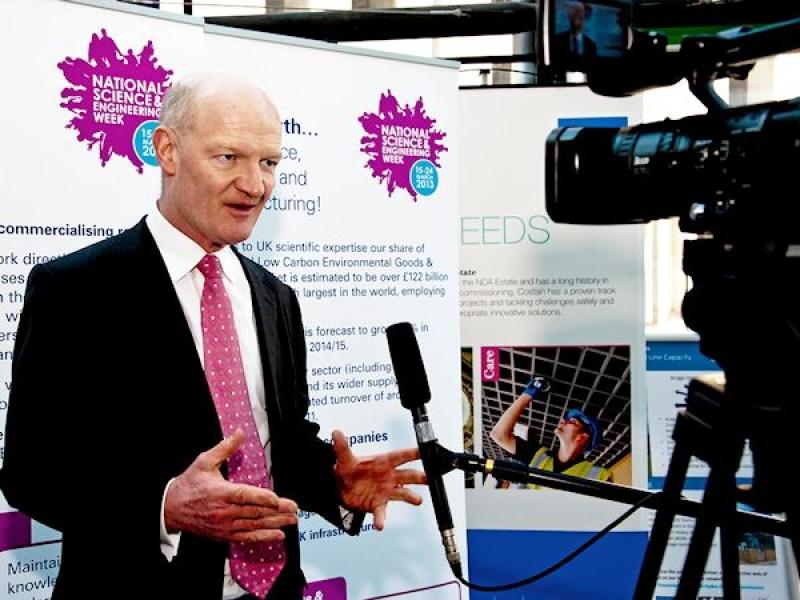
David Willetts was planning to step down at the next General Election anyway so his departure now was pretty much inevitable. I never agreed with his politics, but have to admit that he was a Minister who at least understood some things about Higher Education. In particular he knew the value of science and secured a flat cash settlement for the science budget at a time when other Whitehall budgets were suffering drastic cuts. He was by no means all bad. He even had the good taste – so I’m told – to read this blog from time to time….
The campaigning organization Science is Vital has expressed its sadness at his departure:
We’re sorry to see David Willetts moved from the Science Minister role. He listened, in person, to our arguments for increasing public funding for science, and we appreciated the support he showed for science within the government.
We look forward to renewed dialogue with his successor, in order to continue to press the case that science is vital for the UK.
Now that he has gone, my main worry is that the commitments he gave to ring-fence the science budget will go with him. I don’t know anything about his replacement, Greg Clark, though I hope he follows his predecessor at least in this regard.
Other aspects of Willetts’ tenure of the Higher Education office are much less positive. He has provided over an ideologically-driven rush to force the University sector into an era of chaos and instability, driven by a rigged quasi-market propelled by an unsustainable system of tuition fees funded by student loans, a large fraction of which will never be repaid.
Another of Willetts’ notable failures relates to Open Access. Although apparently grasping the argument and make all the right noises about breaking the stranglehold exerted on academia by outmoded forms of publication, he sadly allowed the agenda to be hijacked by vested interests in the academic publishing lobby. Fortunately, there’s still a very strong chance that academics can take this particular issue into their own hands instead of relying on the politicians who time and time again prove themselves to be in the pockets of big business.
My biggest fear for Higher Education at the moment is that the new Minister will turn out to be far worse and that if the Conservatives win the next election (which is far from unlikely), Science is Vital will have to return to Whitehall to protest against the inevitable cuts. If that happens, it may well be that David Willetts is remembered not as the man who saved British science, but the man who gave it a stay of execution.
Follow @telescoperThis Land is Mine
Posted in Art, History, Politics with tags Nina Paley, Palestine, This Land is Mine on July 11, 2014 by telescoperUncertain Attitudes
Posted in Bad Statistics, Politics with tags binomial distribution, British Social Attitudes Survey, racism, sampling uncertainty, statistics on May 28, 2014 by telescoperIt’s been a while since I posted anything in the bad statistics file, but an article in today’s Grauniad has now given me an opportunity to rectify that omission.
The piece concerned, entitled Racism on the rise in Britain is based on some new data from the British Social Attitudes survey; the full report can be found here (PDF). The main result is shown in this graph:
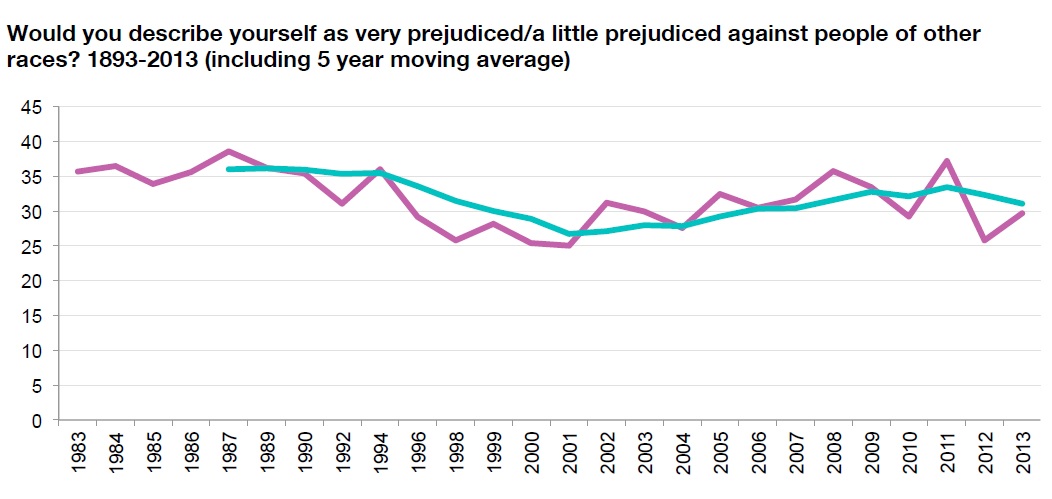
The version of this plot shown in the Guardian piece has the smoothed long-term trend (the blue curve, based on a five-year moving average of the data and clearly generally downward since 1986) removed.
In any case the report, as is sadly almost always the case in surveys of this kind, neglects any mention of the statistical uncertainty in the survey. In fact the last point is based on a sample of 2149 respondents. Suppose the fraction of the population describing themselves as having some prejudice is 


However, a little bit of mathematics involving the binomial distribution yields an answer for the uncertainty in this estimate of p in terms of the sampling error:

For the sample size given, and a value 

I don’t know whether racial prejudice is on the rise in the UK or not, nor even how accurately such attitudes are measured by such surveys in the first place, but there’s no evidence in these data of any significant change over the past year. Given the behaviour of the smoothed data however, there is evidence that in the very long term the fraction of population identifying themselves as prejudiced is actually falling.
Newspapers however rarely let proper statistics get in the way of a good story, even to the extent of removing evidence that contradicts their own prejudice.
Follow @telescoperWhat Nigel Farage did not say on beards
Posted in Beards, Politics with tags beards, Elections, Politics, UKIP on May 26, 2014 by telescoperIn the aftermath of yesterday’s European election results, the great political question of the day is where precisely does UKIP stand on facial hair?
What Nigel Farage did not say on beards
UKIP leader Nigel Farage who is perpetually clean shaven is very probably a pogonophobe although as the equally perpetually hirsute Michael Rosen has pointed out to me, UKIP has some supporters with beards.
Accuracy on matters UKIP is not easy to achieve. The party itself is an unreliable guide and the BBC guided by the follicly challenged Nick Robinson isn’t much better.
However at the end of the week which saw a supposed quote from Farage about Muslims and beards to the effect that either the beard went or the wearer did and that beards should be no more than two inches in length achieve wide currency, a small attempt at accuracy can surely do no harm.
There is no absolute proof that Farage did not make these remarks. He has not denied them despite opportunities to do so
It is however…
View original post 198 more words
EUROPE’S NEW FAULTLINE
Posted in Politics with tags European Elections, polittics, UKIP on May 23, 2014 by telescoperPerceptive analysis of the rise of UKIP et al….

The Front National is expected to win next week’s European election in France; UKIP may well do so in Britain. Both parties combine a visceral hostility to immigration with an acerbic loathing of the EU, a virulent nationalism and deeply conservative views on social issues such as gay marriage and women’s rights. The problems that such parties pose for mainstream politics goes, however, far beyond the odiousness of their policies. What their success expresses is the redrawing of the political map in Europe, and in ways in which mainstream parties often do not understand. The new populists seem to thrive on different political rules to mainstream parties.
Take UKIP. The electoral threat it poses to both Tory and Labour has in recent weeks led to a fierce assault from mainstream politicians of all hues and from the media. UKIP leader Nigel Farage has been accused of misusing his expenses and…
View original post 1,527 more words
Your Chance to Influence UK Government Investment in Science
Posted in Education, Finance, Politics, Science Politics with tags BIS, Capital, consultation, Department of Business Innovation and Skills, HEFCE on May 4, 2014 by telescoperA recent piece of bloggery by esteemed Professor Jon Butterworth 0f the Grauniad reminded me that an important government consultation has just opened. In fact it opened on 25th April, but I neglected to post about it then as I was on my Easter break. I’m now passing it on to you via this blog, by way of a sort of community service.
Anyway, the consultation, which is being adminstered through the Department of Business Innovation and Skills, can be found here; there’s a large (110 page) document as well as information on how to respond. Basically about £5.8 billion in capital expenditure has been set aside for science research, and the government is asking how it should be divvied up. Such funds could be used to build big ticket items such as new telescopes, particle accelerators, lasers or other infrastructure including new laboratory buildings. It has to be capital, though, which means it can’t be used on staffing for such facilities that are funded. You might argue that this is a weakness (because ultimately science is done by people not by facilities) but, on the other hand if the government stumps up additional money for capital that might free up funds for more people to be employed.
Anyway, do read the consultation document and submit your responses. You could do a lot worse than reading Jon Butterworth’s commentary on it too. The deadline is some way off, July 4th to be exact, but this is very important so you should all get your thinking caps on right away.
One thing I’ll be including in my response concerns funding for university laboratories. The funding body responsible for English universities, the Higher Education Funding Council for England (HEFCE), is currently underfunding STEM subjects across the country. I’ve blogged about this before so I won’t repeat the argument in detail, but severe reductions in the unit of resource applied to laboratory-based subjects have meant that the new tuition fee regime does not provide anything like sufficient income to cover the costs of, say, physics undergraduate teaching. All students pay a flat-rate fee of £9K across all disciplines (including arts, humanities and science subjects) but science subjects only get £1.4K per student on top of this. The withdrawal of capital allowances has also made it very difficult for universities to invest in teaching laboratory space.
The cost of educating a physics student is actually about twice that of educating a student of, say, English, so this differential acts as a deterrent for universities to expand STEM disciplines. Shortage of teaching laboratory space is a major factor limiting the intake of students in these areas, whereas other disciplines are able to grow without restriction.
So my vote will go for a sizeable chunk of the £5.8 billion capital to be allocated to improving, refurbishing, expanding and building new teaching laboratories across all STEM disciplines to train the next generation of scientists and engineers that will be vital to sustain the UK’s economic recovery.
I’d be interested in people’s views about other aspects of the consultation (e.g. what big new facilities should be prioritized). Please therefore feel free to use the comment box, but not as a substitute for participating in the actual consultation.
Over to you!
Follow @telescoper
On the Birth of his Son
Posted in Poetry, Politics with tags Su Dong-po, Su Shi, Sung Dynasty on May 2, 2014 by telescoperFamilies, when a child is born
Want it to be intelligent.
I, through intelligence,
Having wrecked my whole life,
Only hope the baby will prove
Ignorant and stupid.
Then he will crown a tranquil life
By becoming a Cabinet Minister.
by Su Shi (1037-1101); he is generally viewed as the greatest poet of the Sung dynasty in China and was also known as Su Dong-po or Si Tung-p’0.
Follow @telescoper
On the Buses in Brighton and Cardiff
Posted in Biographical, Politics with tags Brighton & Hove Bus Company, Cardiff Bus, Caroline Lucas, University of Sussex Student's Union on May 2, 2014 by telescoperRecently there was an Emergency General Meeting of the University of Sussex Student Union to discuss rises in bus fares in Brighton & Hove. I was a bit surprised at this because, although the prices charged by the Brighton & Hove Bus Company did go up on 13th April, they seemed to me to be quite cheap, at least given the general cost of living in Brighton. I should add that I use the bus every day to travel to and from work.
Caroline Lucas (MP for Brighton Pavilion) chipped in to say that the fare rise justified Green Party policy of taking buses back under the control of local councils. Given the disastrous management of Brighton & Hove’s Recycling and Refuse operation by Mrs Lucas’ colleagues in Brighton & Hove Council, I think the least said about that idea the better.
Anyway, out of interest, I decided to check the relative prices of bus tickets in Brighton & Hove relative to the city in which I used to live, Cardiff. That’s of interest for two reasons: (a) the general cost of living in Cardiff is very much lower than it is in Brighton (as someone who’s just moved here I can vouch for this); and (b) Cardiff Bus (or, if you prefer Bws Caerdydd) is one of the very few bus services in the United Kingdom was never privatised. While most local bus operations were taken over by private operators during the Thatcher era, but Cardiff Bus remains entirely owned and managed by Cardiff City Council.
It is very difficult to do a like-for-like comparison of fares, because Brighton & Hove Bus covers a much larger area (including Eastbourne, which is 22 miles from Brighton) and many discounted tickets offer unlimited travel within that. Also, the fare to Falmer from Brighton is most relevant for students and it’s not obvious what to compare that with in Cardiff. Since the distance from Brighton to Falmer is about 5 miles, but Cardiff University is right in the city centre, I’ve included a fare from Cardiff to Barry (also about 5 miles) for comparison as that’s the nearest fare I could find; the time for each journey is about 20 minutes.
| Fare Type | Brighton | Cardiff |
| Short Hop | £1.80 | £1.80 |
| ~5 miles from City | £2.00 | £2.50 |
| Day Rider (bought on bus) | £4.70 | £4.90 |
| Day Rider (phone or card) | £4.10 | £4.70 |
| 7 Day Saver | £18 | £19 |
| 1 Month Saver | £66 | £66 |
| Annual Saver | £510 | £485 |
I’ve only included the full adult fare here; discounted tickets for students are available in both cities. In fact the annual saver ticket for students in Brighton is £365. I use a 3-month saver which costs me £168, which I regard as very good value for money; the cost of this ticket for a student is only £90, which is a bargain!
Clearly, then, despite the recent price rises, Brighton & Hove Bus Fares are actually if anything cheaper than Cardiff, at least when you take into account the much bigger area covered by the saver tickets.
I should also mention that Brighton’s bus drivers give change for tickets bought on the bus whereas Cardiff’s demand the exact fare only…
I think I’ve made my point. I also checked Nottingham’s bus fares (as I’ve also lived there). A comparison is more difficult in this case because of the different fare structure, but as far as I can tell it’s broadly in line with Brighton.
Follow @telescoper

 In the Dark