Archive for the Politics Category

Save the Hume Scholarships!

Posted in Maynooth, Politics with tags , , on November 12, 2024 by telescoper

You may recall that I recently posted about the terrible decision by the Management of Maynooth University to scrap the John and Pat Hume Doctoral Scholarships and followed this up with another post suggesting the decision might be reversed.

As it turns out, the decision has not been reversed but, in a truly bizarre step, the scheme is to be paused for a “review” with the possibility that applications would be opened in June 2025 for PhDs starting in October 2025. The vast majority of qualified students intending to do PhDs will have accepted offers elsewhere by then so effectively the scheme is cancelled for 2025. Only students not able to secure a place elsewhere will be around to apply in June. A sensible decision would be to keep the scheme going until the review is complete, but clearly the University bosses want to divert the funds elsewhere. Perhaps the money saved will go towards the €500k luxury limousine service for self-defined VIP managers currently out to tender. Who knows?

Anyway, the decision and the manner in which it has been imposed by the University Executive is highly objectionable (though I’m afraid typical of the regime at Maynooth). Along with the union to which I belong, IFUT, I am therefore happy to support the Postgraduate Workers’ Organization (PWO) in their campaign on this issue. Please consider signing the petition either using the QR code or by following the link here.

Election News

Posted in Politics with tags , , , , , on November 10, 2024 by telescoper

On Friday 8th November Taoiseach Simon Harris (left) inspired Ireland’s rugby team to a very disappointing home defeat by New Zealand. Earlier on that day he had visited the President to request a dissolution of the  33rd Dáil and to call a General Election on November 29th 2024.

The Saturday newspapers were full of nonsense about how the “General Election campaign starts now” when in fact I’ve had canvassers knocking at my door for at least a fortnight already. Two of them were for Fine GaeI – far scarier than trick-or-treat! I made it abundantly clear that I wouldn’t be voting for their party and hoped that they wouldn’t bother me again.

Fine Gael’s opening gambit was to announce that if elected they would reduce VAT on the hospitality sector to 11%. There was a budget just a few weeks ago in which they could have announced such a reduction had they really wanted it to happen. If re-elected no doubt they will find an excuse for not doing it. If you believe what they say I have a 340k bike shed to sell you.

Talking about the budget, Ireland’s government is in a very different position from the UK, with a large fiscal surplus thanks to buoyant tax receipts. This year presented a great opportunity to use that cash for much-needed investment in public housing, transport, education, the health service, etc. Instead the Government decided to tinker here and there with allowances and bung some cash to middle-income families in order to buy votes. Simon Harris has the air of a man who would sell his Grandmother if he could buy votes with the proceeds. The FG approach may well work but, if it does, we’re in for many years more of decaying public services, homelessness and high rents. As the Landlord Party in all but name, this will suit Fine Gael very well.

My constituency is Kildare North which in 2020 elected four TDs: 1 Social Democrat, 1 Fianna Fáil, 1 Fine Gael, and 1 Sinn Féin. This time, owing to population growth in the area, the seat will return five TDs. Fine Gael is standing three. I won’t say anything about Fianna Fáil. To all intents and purposes they are indistinguishable from Fine Gael and I won’t be voting for either of them. For me “more of the same” is not an option. I hope it goes without saying that I won’t be voting for any neofascists who get onto the ballot paper either.

Catherine Murphy (SD) is not standing and since she had a strong personal following the SDs will struggle to keep that seat. Angela Feeney, who is very active on the Local Council, is standing for Labour and Réada Cronin for Sinn Féin will be trying to hold onto her seat. Nominations of candidates continue for another week, so I don’t know the final list of candidates. I’ll wait until then before deciding on my order of preferences.

Not that long ago Sinn Féin were riding high in the polls, but a series of missteps have left them trailing Fine Gael. They also did poorly in the local and European elections earlier this year, seeming to have lost supporters of the more extreme nationalist type to overtly right-wing candidates.

The only prediction I am willing to make at this stage is that, owing to disaffection with the mainstream political parties, the number of independent TDs is likely to increase considerably from the 20 last time. This will make the task of forming a government even more complicated than before.

The Morning After

Posted in Politics with tags , on November 6, 2024 by telescoper

Before anyone asks, no I didn’t stay up all night to see the US electoral disaster unfold. I was fairly sure what would happen and was not pleased to be proven right. I will never understand why anyone could vote for an individual so obviously unsuitable for high office as Donald Trump. I could say that about a number of other prominent national leaders too, but Trump is far worse. At least in 2016 there was an argument that he was an unknown quantity. Now everyone knows that he is a convicted felon – at least until he issues himself a pardon – and serial sexual predator whose outspoken bigotry appeals to the basest instincts of the electorate and who tried to stage an insurrection when he lost the last election. I don’t believe that Trump fans can’t see what a monster their idol is: they do see, but don’t care. It was the same in the UK with Boris Johnson.

However depressing it is to wake up and hear yet more evidence of the relentless march of fascism, there is no point in self-pity.  If you yield to despair, the bastards have won. In order to resist it is first necessary to endure. Brace yourselves. Things are going to get very nasty.

I’m just glad that I’m no longer young.

In the Dark on Social Media

Posted in Biographical, Politics with tags , , , , , , on August 12, 2024 by telescoper

It’s almost a year since I deactivated my Twitter account. Or should I call it X? Anyway, it doesn’t matter because I don’t use it any more. Over the past few weeks it seems quite a few more – especially in the UK – have had enough of the antics of Elon Musk (aka Space Karen), especially with his attempts to fan the flames of the recent Farage riots by spreading misinformation. The first thing I noticed was that my BlueSky account was suddenly getting quite a lot of new followers. I now have about 850, still a long way short of the over 7000 I used to have on Twitter, but the level of engagement is far higher. That’s because the algorithm Space Karen introduced on X makes it difficult for your own followers. let alone anyone else, to see your tweets. The one disadvantage of BlueSky is that it doesn’t have an API that allows me to post directly from this blog when I publish a post, so I have to copy the URL by hand.

I also have an account on Mastodon where I have over 1200 followers and similarly good engagement. When I first started there a couple of years ago it didn’t have a WordPress API but it does now, so everything I write here gets posted automatically on my feed. Not only that, this blog is now also now fully federated which means that there is an autonomous feed for the blog posts. Not just a link to each post, as the API produces, but the whole post. This is a nice feature because if I change a post on this WordPress platform it automatically gets changed on the Mastodon feed.

I also have a Facebook Page on which these

And now there’s Threads, which is like a version of Twitter bolted onto Instagram. When this first came out last year it wasn’t available in the EU for data protection issues so I didn’t bother with it. I only just found out at the weekend that has been available since December 2023 but I wasn’t paying much attention to social media then so didn’t catch the news. Anyway, since I already have a (very quiet) Instagram account so I set up a Threads account which you can find here if you like that sort of thing. My first impressions of Threads are not very favourable, but let’s see how it goes. At least it’s not as bad as Twitter. I still think it is indefensible that my employer, along with most other universities, has decided to maintain a presence on that site.

Imane Khelif: a Manufactured Scandal

Posted in Politics, Sport with tags , , , , , , on August 4, 2024 by telescoper

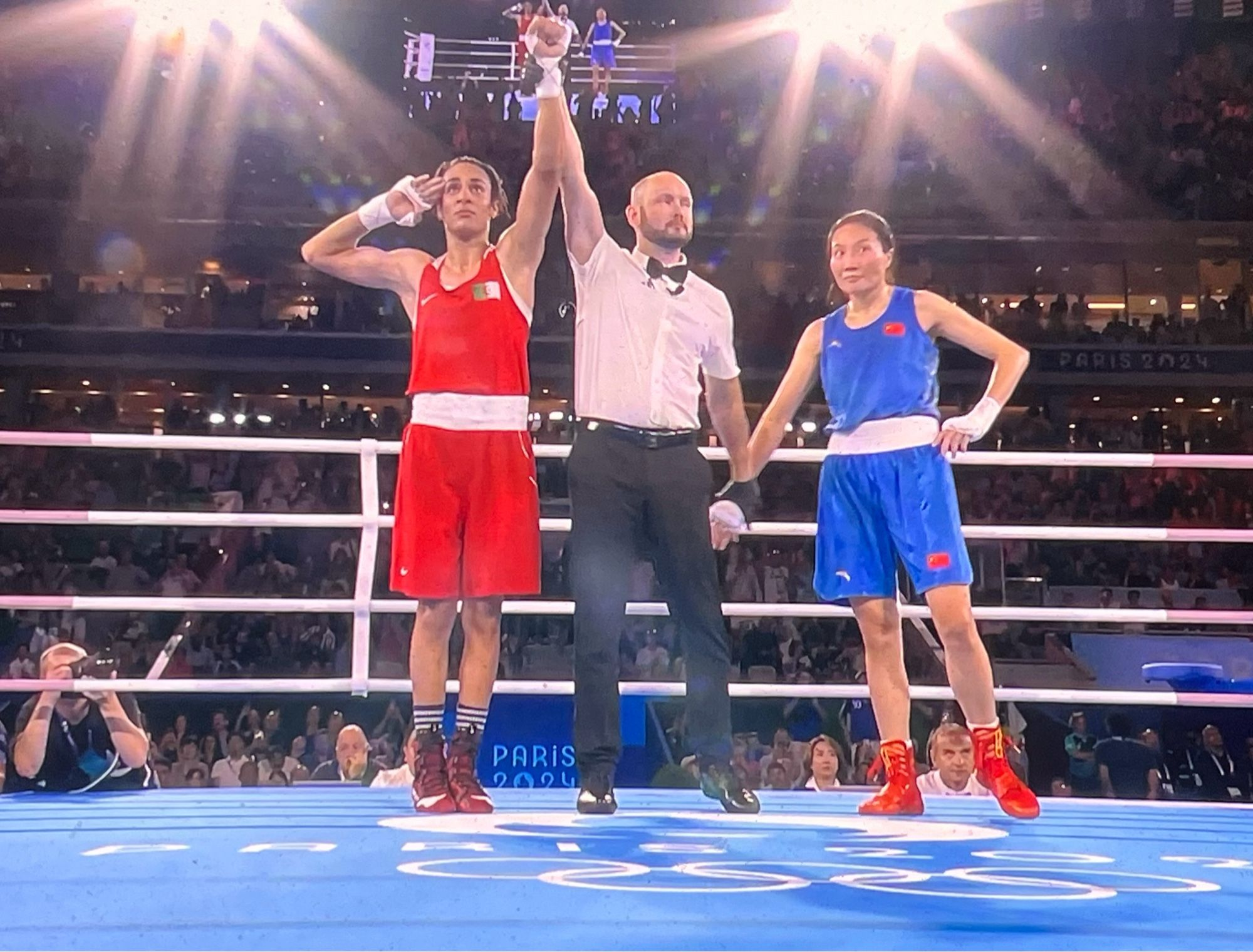
Last week’s news from the 2024 Olympics was dominated by the story of Algerian boxer Imane Khelif who defeated her Italian opponent Angela Carini in the Women’s 66kg (Welterweight) division. Carini quit after 46 seconds saying that she was hit so hard that it hurt. It is surprising that she would even enter the Hitting Each Other In The Face event if she were going to complain that her opponent hit her in the face, Anyway, Khelife subsequently won her next bout against Hungarian Luca Hamori to proceed to the semi-finals and is thereby guaranteed a medal. I hope she wins the Gold for all she’s had to put up, not only for the past few days. She seems to have had a tough life generally.

Khelif’s deserved success has ignited what has been called a “gender row”, based on the fact that she and Taiwanese boxer Lin Yu-ting (who is also competing in the 2024 Olympics, in the 57kg category) were disqualified from the IBA World Championships allegedly for failing “gender eligibility tests”. This decision was made suddenly by the Secretary General of the IBA without any due process and the only documentation available is a message on the dodgy social media platform Telegram. The IOC has commented on these so-called “tests”, see here. Here’s an excerpt:

Those tests are not legitimate tests. The tests themselves, the process of the tests, the ad hoc nature of the tests are not legitimate…

There is a thorough piece by Reuters, which links to the IBA’s own statements here (PDF).

You can draw your own inferences about the motivation for the deliberate manufacture of a scandal by the International Boxing Association, but my own view is that it reeks of sour grapes: the IBA, which has been mired in corruption scandals for decades, is no longer recognized by the International Olympic Committee. I think this whole row was deliberately manufactured.

Such are the levels of ignorance and prejudice about anything to do with gender these days that the usual bigots lined up to condemn Khelif and the IOC on the basis of no evidence whatsoever. Widely circulated claims that Khelif has XY chromosomes and/or high levels of testosterone are neither documented nor verified, but that doesn’t seem to matter to the haters.

I’ve seen posts and comments all over the place asserting that women don’t produce testosterone at all. They do. Men produce oestrogen, too. In both cases it’s a question of quantity. Some women have higher testosterone levels than others. So what? If that makes them better at boxing then so be it.

(I even saw a photograph on social media showing that Khelif wears a groin guard under her boxing shorts. Indeed she does: that’s actually mandatory in both men’s and women’s boxing. The person who posted the image however said that wearing a groin guard is something only men do. Clearly he is unaware that a women’s private parts are also sensitive. I guess he’s never had the opportunity to find out.)

It has been argued that “biological factors” have given Imane Khelif an unfair intrinsic biological advantage over competitors. If that were the case then you would expect her to have been an outstanding boxer from the outset. She wasn’t. In fact she had a poor start to her boxing career, losing her first two competitive bouts; she has lost to other women 9 times altogether. Hardly the performance of some kind of superhuman monster as she is being portrayed. She has improved because she has worked hard on her fitness and technique. She is quite tall for her weight division – 1.78 m (5 ft 10 in) –  and has learnt to make use of her long reach, but how is that unfair? I think she might well struggle against an opponent who can get inside and fight at close range. Tall and rangy versus short and powerful is a contrast you often find in these mid-range weight divisions, which is one of the things that make such contests so interesting.

In any case, don’t all athletes have some sort of intrinsic advantage over the rest of us? Michael Phelps certainly did. People who excel at sports often have extreme physical characteristics, whether physical size, muscular strength, cardio-vascular endurance or whatever. Usain Bolt certainly had the advantage of being born Usain Bolt rather than someone else. Which is not to say that he didn’t have to work on making the most of his physique.

There being no documentary evidence to support their claims that Khelif is a man, others have resorted to crude stereotypes based on her looks. I’ve seen the same sort of comments about black female athletes who are accused of looking like men because they don’t conform to white ideals of femininity. A summary of this type of argument is “women should be banned from boxing if they display masculine characteristics, such as being good at boxing”.

None of this alters the fact that Imane Khelif is a woman and indeed a woman who deserves to be celebrated not only her success in her chosen sport, but also for the dignified way she has braved the abuse she has received. I hope she wins Gold and sends the haters into a state of apoplexy.

UPDATE: Imane Khelif did indeed win Olympic Gold by a unanimous decision. Congratulations to her!

 J. K. Rowling is 59.

Opinion Polls, Exit Polls and Election Results

Posted in Politics with tags , , , , , , , , , on July 8, 2024 by telescoper

It has been quite an eventful week for voters either side of the English channel. In the United Kingdom, Keir Starmer’s Labour Party were victorious in the General Election, turfing out the Tories after 14 years of misrule, while in France a left-wing coalition managed against the odds to beat Marine Le Pen’s fascist National Rally into third place in their runoff election. In both elections tactical voting clear played a big role. In France many third-placed candidates of the centre or left stood aside to help defeat the Far Right. What happens now with regard to forming a government is anyone’s guess, even for people who know far more about French politics than me.

In the runup up to the UK general election, opinion polls had Labour much further ahead in terms of popular vote. As it turned out, however, Labour won 411 seats on a share of the vote of just 33.7% compared to the Conservatives 23.7% and a smaller number of votes than in 2019 when they won just 202 seats. The UK system is not proportional – and doesn’t pretend to be – so this kind of outcome is not surprising. Pundits have rightly pointed to the fact that the far-right Reform party got 14.3% of the vote which undoubtedly took seats from the Tories, but only managed 5 seats and that Labour profited greatly from the collapse of the SNP vote in Scotland.

There are other factors, however. One is that the turnout was 59.9%, well down on 2019 (67.35). That may well be partly due to voters generally not being enthused. But there may be more to it than that. The last time the turnout was below 60% in a UK general election was in 2001. In that year, Labour were miles ahead in the opinion polls so I suppose many Labour voters thought the result was a foregone conclusion and didn’t bother to turn out. It seems likely to me that there was a similar effect on the Labour vote this time. Rather than merely predicting the final result, opinion polls often influence it.

Another factor is that there may have been higher levels of tactical voting, especially with Labour voters switching to the Liberal Democrats to remove the Tory. That might account for why the LibDems did so well. Opinion polls play a role in this too. Yet another is that Labour lost several seats to Independents, standing against the stance on Gaza, and former Labour leader Jeremy Corbyn won his seat standing as an Independent.

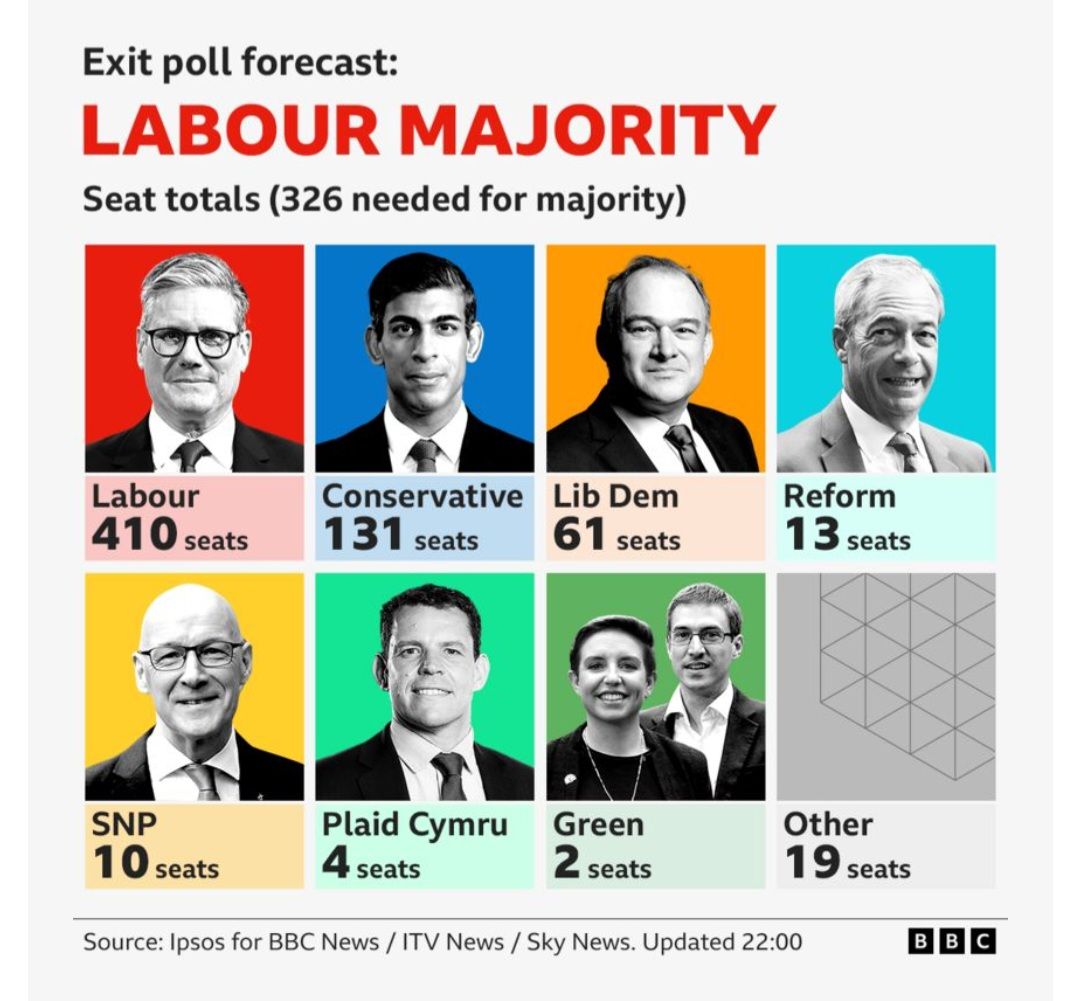
That brings me to the exit polls in the UK and France. Here the projections, the first released at 10pm on Thursday and the second at 9pm on Sunday:

Both are pretty accurate, but I’ve always been annoyed by the way the UK exit poll projection (left) is presented as a point estimate without any indication of the uncertainty (which must be considerable, especially for the smaller parties). The final results were Labour 411, Conservative 121, Lib Dem 72, Reform 5, SNP 9, Plaid Cymru 4, Green 4.

The French method of presenting the results (right) is much better in my opinion. In this case the results were 182, 168 and 143 respectively – all within the range presented.

I have to say that I greatly prefer the voting system used here in Ireland to those deployed in either France or the United Kingdom. Elections here are held under Proportional Representation (Single Transferable Vote) which seems to me a very sensible system. One ranks the candidates in order of preference; you can rank all the candidates or just some. In the system employed here in Ireland, votes are progressively reallocated in various rounds until one ends up with the top n candidates to fill the available seats. The STV system involves a quota for automatic election which is N/(m+1) + 1 votes, where N is the number of valid ballots cast and m is the number of seats in the constituency.  To see why this is the case consider a four-seat constituency, where the quota would be 20% of the votes cast plus one. No more than four candidates can reach this level so anyone managing to get that many votes is automatically elected. Surplus votes from candidates exceeding quota, as well as those of eliminated candidates, are reallocated to lower-preference candidates in this process. This system returns representatives with a local constituency connection but is also (approximately) proportional.

One problem with the First Past The Post system deployed in the UK is that if a Reactionary party (Reform) gets 5 seats while a Progressive party (Green) gets only 4, the former gets all the press coverage and the latter gets none..

P.S. I didn’t vote in the UK general election, but the four constituencies in which I lived before moving to Ireland (Cardiff West, Brighton Kemptown, Broxtowe, and Bethnal Green & Stepney) all voted in Labour MPs.


Local Election Result

Posted in Maynooth, Politics with tags , , , , , , , , , , on June 9, 2024 by telescoper

Following Friday’s vote, counting in Ireland’s local elections began Saturday morning. As it happened, Maynooth was one of the first LEAs to start counting and, the electorate being fairly small, was completed last night.

In the system employed in these elections, votes are progressively reallocated in various rounds until one ends up with the top n candidates to fill the available seats. The STV system involves a quota for automatic election which is N/(m+1) + 1 votes, where N is the number of valid ballots cast and m is the number of seats in the constituency.  To see why this is the case consider a four-seat constituency, where the quota would be 20% of the votes cast plus one. No more than four candidates can reach this level so anyone managing to get that many vote is automatically elected. Surplus votes from candidates exceeding quota, as well as those of eliminated candidates, are reallocated to lower-preference candidates in this process.

I thought it might be interesting to show how it went. Here is the state of the poll after the initial count of first preference votes:

Incumbent Councillor Naoise Ó Cearúil (Fianna Fáil) led the first preference votes, exceeding the quota of 1566, and was therefore immediately elected. When his surplus votes were reallocated to second-preference candidates they did not result in anyone else exceeding quota, so Peter Hamilton (who finished last) was eliminated and his votes reallocated, etc. And so it came to pass that Tim Durkan (Fine Gael) was elected on the third count, Angela Feeney (Lab) and Peter Melrose (Social Democrats) on the 6th Count, and Paul Ward (FF) on the 7th Count. Durkan, by the way, is the son of sitting Fine Gael TD Bernard Durkan. For those outside Ireland I should mention that the Irish Social Democrats are quite progressive – in contrast to some parties with the same name in other countries – and they have a TD in the form of Caroline Murphy who has strong local support.

The turnout in Maynooth, by the way, was 45.3%. That’s quite high by the standards of local elections in the UK, but I always find it disappointing when people can’t be bothered to vote.

Anyway, of the five councillors elected (2 FF, 1 FG, 1 Lab & 1 SD) four are incumbent. The only change was sitting Green candidate Hamilton was replaced by newbie Peter Melrose for the Social Democrats. It was a disappointing result for Sinn Féin, similar to what happened five years ago in this LEA. The losing candidate then, however, Réada Cronin, went on to win a seat as TD for North Kildare in the General Election of 2020.

As I write, under a quarter of LEAs have completed their counts but it is fairly clear that it has been a disappointing election for Sinn Féin who, despite riding high in the opinion polls a few months ago, have not really recovered significantly from their poor showing in the 2019 Local Elections. Of course the question asked in opinion polls is about a General Election, which is quite a different kettle of fish compared to a Local election. Lots of pundits are trying to interpret these local results as a kind of opinion poll on the General Election which must happen before next year. They do this in the UK too. I don’t think that is wise. I think most people vote in the Local Elections on the local and rather mundane issues which are actually what the County Councils can actually deal with. Councils have very little power in Ireland and candidates who have grandiose plans far beyond the scope of what a councillor can actually achieve are not likely to do well. There is also a definite advantage on being an incumbent who has done a good job for the past five years. A problem for Sinn Féin is that it had to put up new faces in many LEAs to replace those lost five years ago, and few have been successful.

Anyway, it seems the status quo parties have done better than expected, and a variety of Independents have done well. Fianna Fáil and Fine Gael – to me, indistinguishable conservative neoliberal parties – are currently governing Ireland in coalition with the Greens. It surprises me that there is so much support for establishment parties that have presided over a housing shortage, ever-increasing homelessness and steadily deteriorating public services, but there you go.

We’ll have to wait a considerable time for the European Election count to finish, as it hasn’t even started yet, but it seems likely that Sinn Fein will struggle and that Independent will do well.

Voting Matters

Posted in Biographical, Maynooth, Politics with tags , , on June 7, 2024 by telescoper
Straffan Road, Maynooth

I’m briefly back in Maynooth in order to cast my vote in the Local and European Parliament Elections being held today, which I did earlier this morning. Both elections are held under Proportional Representation (Single Transferable Vote) which seems to me a very sensible system. One ranks the candidates in order of preference; you can rank all the candidates or just some. In the system employed here in Ireland, votes are progressively reallocated in various rounds until one ends up with the top n candidates to fill the n available seats. The STV system involves a quota for automatic election which is N/(m+1) + 1 votes, where N is the number of valid ballots cast and m is the number of seats in the constituency.  To see why this is the case consider a four-seat constituency, where the quota would be 20% of the votes cast plus one. No more than four candidates can reach this level so anyone managing to get that many vote is automatically elected. Surplus votes from candidates exceeding quota, as well as those of eliminated candidates, are reallocated to lower-preference candidates in this process.

The Local Elections involve filling 40 seats on Kildare County Council, with five councillors representing Maynooth. The nine candidates are listed here, in case you’re interested. Some of the councillors applying for re-election have been diligent in dealing with local issues over the last five years and have in my opinion earned a vote. Other have only appeared since the election notice was given.

For the European Parliament Elections things are a bit more complicated. For the purposes of the EU elections Ireland is divided into three constituencies: Dublin, Ireland South and Midlands North West. I am in the latter, which elects four MEPs. There were 17 candidates for 4 MEPs in this constituency in 2019 but there are 27 this time round, for 5 MEPs, listed here. A sizeable fraction of these are sundry far-right loons, anti-vaxers, and general dickheads, whom I hope will be eliminated. The long list of candidates, however, means that it will take some time to complete the counting for the European elections, which won’t even start until Sunday. The Local election count will start tomorrow morning, and is expected to be completed by Sunday.

Exit Nolan

Posted in Covid-19, Harassment Bullying etc, Maynooth, Politics, Science Politics with tags , , , , on May 28, 2024 by telescoper
Simon Harris and Philip Nolan at the launch of Research Ireland

I just saw the news that Prof. Philip Nolan has left his post as Director General of Science Foundation Ireland (SFI) after allegations of misconduct (including bullying). Prof. Nolan was the previous President of Maynooth University, a post he left at the end of September 2021; for 18 months while still President he was also chair of the the Epidemiological Modelling as part of National Public Health Emergency Team dealing with the Covid-19 pandemic. He moved to SFI in January 2022 when Simon Harris, who is now Taoiseach, was Minister for Further and Higher Education, Research, Innovation and Science. Prof. Nolan was due to take charge of a new entity (Taighde Éireann– Research Ireland) formed by the merger of SFI with the Irish Research Council when the legislation required to create it it passes through the Oireachtas.

It seems there were no fewer than five serious complaints about Prof. Nolan’s conduct made under protected disclosure legislation, and an investigation found that he had displayed “inappropriate behaviour” towards the staff concerned, which was at the “upper level” in respect of two senior staff.

As an outsider I have no idea what has been going on at SFI, so have no dirt to dish, but it must have been rather serious for Prof. Nolan to have been forced out so quickly. I suppose it is reassuring in a way that SFI – unlike many organizations – takes bullying allegations seriously, but it is not at all good for the science ecosystem in Ireland for its main funding agency to be rocked by a scandal of these dimensions. I hope whoever takes over can steady the ship. It’s not an auspicious situation for the embryonic Research Ireland either. The first question that needs to be answered is whether Prof. Nolan will lead it despite being removed from SFI and, if not, who will?

Revolução dos Cravos

Posted in History, Music, Politics with tags , , , , , , on April 25, 2024 by telescoper

My office mate in Barcelona is Portuguese and he very proudly reminded me this morning that today, 25th April 2024, is the 50th anniversary of the Carnation Revolution that ultimately overthrew a fascist dictatorship and led Portugal towards becoming a progressive democracy. Just over a year later, General Franco died and Spain began its transition to democracy too. Both countries joined the European Community in 1986 and are now members of the European Union. It’s hard to believe, only 50 years on, that fascism is on the rise once more in Europe (and elsewhere). That makes it all the more important to remember the struggles of the not-so-distant past.

The signal for the Revolução dos Cravos in Portugal to begin was a song played on the radio. The result was remarkable. Although led by military officers dissatisfied with the ruling regime, it garnered a huge level of popular support and morphed into a coordinated campaign of mass civil resistance. When regime change was achieved, it was largely peaceful. The name “Carnation Revolution” refers to the flowers given to soldiers by people celebrating their liberation from authoritarianism.

Fascismo nunca mais! Vinte e cinco de abril sempre!

I couldn’t help sharing the song that triggered that huge historical moment. It is Grândola, Vila Morena by Zeca Afonso. Few people can lay claim to have written a song that brought down a dictatorship.