I’m still a bit depressed after the events I blogged about yesterday. Some days you wonder why you bother, and this has been one of them. However, at least it’s got me rattled enough to stand back and think about the state of the UK university system in more general terms so I thought I’d jot down an idea which is probably barking mad, but has been at the back of my mind for some time.
The basic point is that universities essentially do two things, teaching and research. However, when you think about it, there’s a fundamental inconsistency in the way these are funded. It seems to me that correcting this anomaly could significantly improve both the main benefits universities contribute to the UK economy.
First, research. I wrote yesterday about using taxpayer’s money to fund research in universities:
If it’s going to pay off in the short term it should be funded by private investors or venture capitalists of some sort. Dragon’s Den, even. When the public purse is so heavily constrained, it should only be asked to fund those things that can’t in practice be funded any other way.
I’ve just remembered that a similar thing was said in in the Times Higher recently, in a piece about the new President of the Royal Astronomical Society:
Notwithstanding the Royal Academy of Engineering’s “very unfortunate” recent submission to the government spending review – which argued that the need to rebalance the UK economy required public spending to be concentrated on applied science – Professor Davies is confident he can make a good case for spending on astrophysics to be protected.
Research with market potential can already access funding from venture capitalists, he argued, while cautioning the government against attempting to predict the economic impact of different subjects.
This is pretty much the opposite of what the Treasury thinks. It wants to concentrate public funds in projects that can demonstrate immediate commercial potential. Taxpayer’s money used in this way ends up in the pockets of entrepreneurs if the research succeeds and, if it doesn’t, the grant has effectively been wasted. My proposal, therefore, is to phase out research grants for groups that want to concentrate on commercially motivated research and replace them with research loans. If the claims they make to secure the advance are justified they should have no problem repaying it from the profits they make from patent income or other forms of exploitation. If not, then they will have to pay back the loan from their own funds (as well as being exposed as bullshit merchants). In the current economic situation the loans could be made at very low interest rates and still save a huge amount of the current research budget for higher education. Indeed after a few years – suggest the loans should be repayable in 3-5 years, it would be self-financing. I think a large fraction of research in the Applied Sciences and Engineering should be funded in this way.
The money saved by replacing grants to commercially driven research groups with loans could be re-invested in those areas where public investment is really needed, such as pure science and medicine. Here grants are needed because the motivation for the research is different. Much of it does, in fact, lead to commercial spin-offs, but that is accidental and likely to appear only in the very long term. The real motivation of doing this kind of research is to enrich the knowledge base of the UK and the world in general. In other words, it’s for the public good. Remember that?
Most of you probably think that this is a crazy idea, but if you do I’ll ask you to now think about how the government funds teaching in universities and ask yourself why research is handled in such a different way.
Way back in the mists of time when I was a student, I didn’t have to pay fees and even got a maintenance grant from the government that was more-or-less sufficient to live on. That system changed so that students don’t get grants any more, but may qualify for loans. They also have to pay a contribution to their fees, but the government still pays an amount directly to the university on their behalf.
This change of policy happened because the (then) Labour government wanted to boost the rate of participation in universities, but didn’t think the taxpayer should pay the whole cost. The logic goes that the students benefit from their education, e.g. in terms of increased earnings over their working lifetime, so they should pay a contribution to it.
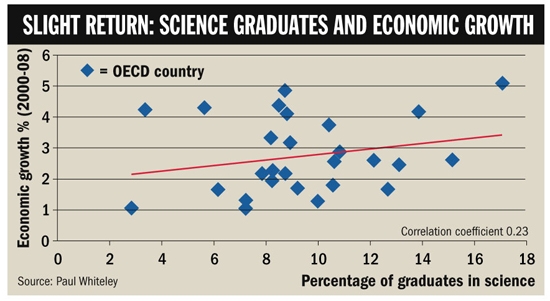
The problem with all this is that it has led to a huge increase in enrolment on degree courses in “vocational” areas such as Leisure & Tourism, Media Studies, and Business while traditional courses, such as those in STEM disciplines, providing the sort of rigorous intellectual training that is essential for many sectors of the economy, have struggled to keep up. This is partly because subjects like Mathematics and Physics are difficult, partly because they are expensive, and partly because the UK school system has ceased to function as preparation for such courses.
I’m by no means against universities supplying training in vocational subjects, but because these are the areas where the primary beneficiary is indeed the student, I don’t think the government should subsidise them as much as the more rigorous courses that we really need to encourage the brightest students to take up.
The fix I’d propose for this within the current tightly constrained budget is to cut government funding for vocational subjects and use the money to subsidise those courses contributing to the intellectual wealth of the country. I don’t mean just science, incidentally, I think we have a big problem with participation many other areas, such as modern languages. The best students – in chosen areas – should not only get their fees paid, they should also get maintenance grants as in the old days. Students should not be prevented from doing, e.g., a Business studies degree, or from doing anything without a state scholarship, but should understand that they have to pay for it.
If it’s fair to ask students to contribute to their teaching, it’s fair to ask commercial companies to pay for the research that they exploit. Just as student grants should be re-introduced for certain disciplines, so should research loans be introduced for others. You know it makes sense.
However, if you want to tell me why it doesn’t, via the comments box, please feel free!




 In the Dark