Archive for the Politics Category

Skepsis

Posted in Politics, The Universe and Stuff with tags , , , , , , on May 1, 2010 by telescoper

This past week was the final week of proper teaching at Cardiff University, so I’ve done my last full lectures, tutorials and exercise classes of the academic year. Yesterday I assessed a bunch of 3rd-year project talks, and soon those students will be handing in their written reports for marking.  Next week will be a revision week, shortly after that the examinations begin. And so the cycle of academic life continues, in a curious parallel to the  football league season – the other routine that provides me with important markers for the passage of the year.

Anyway, this week I gave the last lecture to my first-year class on Astrophysical Concepts. This is a beginning-level course that tries to introduce some of the theory behind astronomy, focussing on the role of gravity. I cover orbits in newtonian gravity, gravity and hydrostatic equilibrium in extended bodies, a bit about stellar structure, gravitational collapse, and so on. In the last part I do a bit of cosmology. I decided to end this time with a lecture about dark energy as, according to the standard model, this accounts for about 75% of the energy budget of the Universe. It’s also something we don’t understand very well at all.

To make a point, I usually show the following picture (credit to the High-z supernova search team).

 What is plotted is the redshift of each supernova (along the x-axis), which relates to the factor by which the universe has expanded since light set out from it. A redshift of 0.5 means the universe was compressed by a factor 1.5 in all dimensions at the time when that particular supernova went bang. The y-axis shows the really hard bit to get right. It’s the estimated distance (in terms of distance modulus) of the supernovae. In effect, this is a measure of how faint the sources are. The theoretical curves show the faintness expected of a standard source observed at a given redshift in various cosmological models. The bottom panel shows these plotted with a reference curve taken out so the trend is easier to see.

The argument from this data is that the high redshift supernovae are fainter than one would expect in models without dark energy (represented by the \Omega_{\Lambda}  in the diagram. If this is true then it means the luminosity distance of these sources is greater than it would be in a decelerating universe. They can be accounted for, however, if the universe’s expansion rate has been accelerating since light set out from the supernovae. In the bog standard cosmological models we all like to work with, acceleration requires that \rho + 3p/c^2 be negative. The “vacuum” equation of state p=-\rho c^2 provides a simple way of achieving this but there are many other forms of energy that could do it also, and we don’t know which one is present or why…

This plot contains the principal evidence that has led to most cosmologists accepting that the Universe is accelerating.  However, when I show it to first-year undergraduates (or even to members of the public at popular talks), they tend to stare in disbelief. The errors are huge, they say, and there are so  few data points. It just doesn’t look all that convincing. Moreover, there are other possible explanations. Maybe supernovae were different beasties back when the universe was young. Maybe something has absorbed their light making them look fainter rather than being further away. Maybe we’ve got the cosmological models wrong.

The reason I show this diagram is precisely because it isn’t superficially convincing. When they see it, students probably form the opinion that all cosmologists are gullible idiots. I’m actually pleased by that.  In fact, it’s the responsibility of scientists to be skeptical about new discoveries. However, it’s not good enough just to say “it’s not convincing so I think it’s rubbish”. What you have to do is test it, combine it with other evidence, seek alternative explanations and test those. In short you subject it to rigorous scrutiny and debate. It’s called the scientific method.

Some of my colleagues express doubts about me talking about dark energy in first-year lectures when the students haven’t learned general relativity. But I stick to my guns. Too many people think science has to be taught as great stacks of received wisdom, of theories that are unquestionably “right”. Frontier sciences such as cosmology give us the chance to demonstrate the process by which we find out about the answers to big questions, not by believing everything we’re told but by questioning it.

My attitude to dark energy is that, given our limited understanding of the constituents of the universe and the laws of matter, it’s the best explanation we have of what’s going on. There is corroborating evidence of missing energy, from the cosmic microwave background and measurements of galaxy clustering, so it does have explanatory power. I’d say it was quite reasonable to believe in dark energy on the basis of what we know (or think we know) about the Universe.  In other words, as a good Bayesian, I’d say it was the most probable explanation. However, just because it’s the best explanation we have now doesn’t mean it’s a fact. It’s a credible hypothesis that deserves further work, but I wouldn’t bet much against it turning out to be wrong when we learn more.

I have to say that too many cosmologists seem to accept the reality of dark energy  with the unquestioning fervour of a religious zealot.  Influential gurus have turned the dark energy business into an industrial-sized bandwagon that sometimes makes it difficult, especially for younger scientists, to develop independent theories. On the other hand, it is clearly a question of fundamental importance to physics, so I’m not arguing that such projects should be axed. I just wish the culture of skepticism ran a little deeper.

Another context in which the word “skeptic” crops up frequently nowadays is  in connection with climate change although it has come to mean “denier” rather than “doubter”. I’m not an expert on climate change, so I’m not going to pretend that I understand all the details. However, there is an interesting point to be made in comparing climate change with cosmology. To make the point, here’s another figure.

There’s obviously a lot of noise and it’s only the relatively few points at the far right that show a clear increase (just as in the first Figure, in fact). However, looking at the graph I’d say that, assuming the historical data points are accurate,  it looks very convincing that the global mean temperature is rising with alarming rapidity. Modelling the Earth’s climate is very difficult and we have to leave it to the experts to assess the effects of human activity on this curve. There is a strong consensus from scientific experts, as monitored by the Intergovernmental Panel on Climate Change, that it is “very likely” that the increasing temperatures are due to increased atmospheric concentrations of greenhouse gas emissions.

There is, of course, a bandwagon effect going on in the field of climatology, just as there is in cosmology. This tends to stifle debate, make things difficult for dissenting views to be heard and evaluated rationally,  and generally hinders the proper progress of science. It also leads to accusations of – and no doubt temptations leading to – fiddling of the data to fit the prevailing paradigm. In both fields, though, the general consensus has been established by an honest and rational evaluation of data and theory.

I would say that any scientist worthy of the name should be skeptical about the human-based interpretation of these data and that, as in cosmology (or any scientific discipline), alternative theories should be developed and additional measurements made. However, this situation in climatology is very different to cosmology in one important respect. The Universe will still be here in 100 years time. We might not.

The big issue relating to climate change is not just whether we understand what’s going on in the Earth’s atmosphere, it’s the risk to our civilisation of not doing anything about it. This is a great example where the probability of being right isn’t the sole factor in making a decision. Sure, there’s a chance that humans aren’t responsible for global warming. But if we carry on as we are for decades until we prove conclusively that we are, then it will be too late. The penalty for being wrong will be unbearable. On the other hand, if we tackle climate change by adopting greener technologies, burning less fossil fuels, wasting less energy and so on, these changes may cost us a bit of money in the short term but  frankly we’ll be better off anyway whether we did it for the right reasons or not. Of course those whose personal livelihoods depend on the status quo are the ones who challenge the scientific consensus most vociferously. They would, wouldn’t they? Moreover, as Andy Lawrence pointed out on his blog recently, the oil is going to run out soon anyway…

This is a good example of a decision that can be made on the basis of a  judgement of the probability of being right. In that respect , the issue of how likely it is that the scientists are correct on this one is almost irrelevant. Even if you’re a complete disbeliever in science you should know  how to respond to this issue, following the logic of Blaise Pascal. He argued that there’s no rational argument for the existence or non-existence of God but that the consequences of not believing if God does exist (eternal damnation) were much worse than those of behaving as if you believe in God when he doesn’t. For “God” read “climate change” and let Pascal’s wager be your guide….
House of Cards

Posted in Finance, Politics with tags , , , on April 29, 2010 by telescoper

There’s now only a week left until polling day in the General Election, and I’ve managed to avoid blogging about it as much as possible. The main reason for this is that I feel almost entirely disconnected from the whole thing, as if it’s all a bit unreal. One of the things in the news this week sparked a memory of something I wrote a few weeks ago which, in turn, made me realise why I find it difficult to take this election seriously.

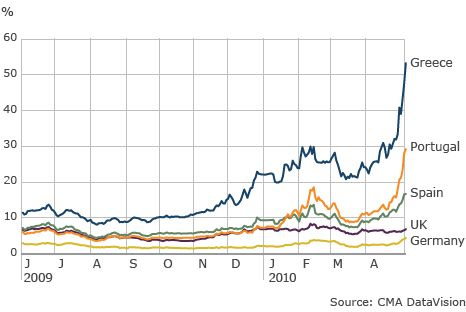
It emerged on Tuesday that the international money markets had downgraded Greece’s credit rating to “junk” status. Portugal and, more recently, Spain have since been downgraded too, but not as far as Greece. Yet. The reason for this downgrading is that analysts doubt whether these countries will be able to control their public spending sufficiently in order for them to honour huge levels of sovereign debt. The probability that Greece in particular will default in a big way has been growing steadily, according to the calculations of financial experts, and has now reached the level at which traders are adopting strategies that essentially involve betting on this actually happening.

The consequence of all this turmoil is that Greece would have to borrow money at huge levels of interest – over 15% – in order to carry on. The eurozone countries – particularly Germany – are trying to put together a package that that can be paid back at less ruinous rates, but while they continue to debate the details the panic continues.

The knock-on effect of a Greek default would be to remove money from the balance sheets of banks and financial institutions around the world. If a  bank has holdings of Greek debt, and the Greeks default, then the bonds become worthless and billions of pounds disappear off its balance sheet. Some British banks are exposed in this way, but nowhere near as much as France, Germany and Switzerland.

The baleout of Greece may work, but if it doesn’t it looks likely that Greece will be ejected from the euro and will have to take drastic measures to set its house in order. Fine, you might say. They’ve been living beyond their means for too long. That’s true. But so has Spain, which suffered even more than the UK from a housing bubble that went pop and is left with a huge budget deficit.  Spain is too large an economy to be rescued, even by Germany.  A default there, and there’s a real possibility of a chain reaction that will probably mean  curtains for the euro and possibly a real meltdown of the global financial system.  I’m just surprised that it has taken since 2007 for phase 2 of the global financial crisis to start. I think the contagion is still spreading.

 By some measures, our economy is in even worse shape than Spain’s.  However, the reason the markets haven’t downgraded us yet is that we’ve been given a stay of execution by the imminent general election. I’m sure analysts will be looking for very prompt and effective action to tackle our budget deficit if they are not going to put us through the wringer like they did with Greece. Greece, Portugal and Spain are all relatively recent democracies and it’s not obvious their governments can deliver huge public spending cuts and survive the resulting social unrest intact. They certainly haven’t managed to convince the markets they can anyway.

 What’s clear from the UK general election campaign is that none of the main political parties is willing to go public about the scale of the challenge facing whoever takes office after the election. The recent budget did a bit of trim around the edges here and there, and the party manifestos talk about the odd billion here and there in savings, but these are dwarfed by the real scale of our deficit. It seems the politicians have agreed to keep quiet about this to avoid frightening the electorate. When the votes are counted we’re going to get a rude awakening. The general election campaign is just a bizarre masquerade that’s too ridiculous to get involved in.

The scale of what could happen here is indicated by what’s happening in Ireland. Politicians here are talking about a public sector pay freeze. Ireland is actually cutting salaries in the public sector by up to 20%. I think the next UK government is going to have to do something similar or we’ll suffer the same fate as Greece. These next three years are going to be very grim for those of us working in the public sector, or at least for those who decide to stay in the UK.

We generally like to think we’re a mature democracy that’s a bit more sensible that all those mediterranean hotheads and that we’ll be able to grin and bear it for the sake of the economy. However, I’m old enough to remind the Winter of Discontent and it’s by no means obvious to me that cuts on the necessary scale will go through without sustained opposition. If – as seems likely – we end up with a coalition government with a fragile majority, this sort of thing could easily bring it down. If the markets see political instability in the UK they will certainly start downgrading our credit rating too. Public borrowing will  become more expensive, deeper spending cuts will be needed, and Britain be well and truly scuppered.

How to Vote: A Helpful Flowchart

Posted in Politics with tags on April 23, 2010 by telescoper

General Purpose Election Blog Post

Posted in Bad Statistics, Politics with tags , , on April 14, 2010 by telescoper

A dramatic new <insert name of polling organization, e.g. GALLUP> opinion poll has revealed that the <insert name of political party> lead over <insert name of political party> has WIDENED/SHRUNK/NOT CHANGED dramatically. This almost certainly means a <insert name of political party> victory or a hung parliament. This contrasts with a recent <insert name of polling organization, e.g. YOUGOV> poll which showed that the <insert name of political party> lead had WIDENED/SHRUNK/NOT CHANGED which almost certainly meant a <insert name of political party> victory or a hung parliament.

Political observers were quick to point out that we shouldn’t read too much into this poll, as tomorrow’s <insert name of polling organization> poll shows the <insert name of political party> lead over <insert name of political party> has WIDENED/SHRUNK/NOT CHANGED dramatically, almost certainly meaning a <insert name of political party> victory or a hung parliament.

(adapted, without permission, from Private Eye)

Fears for the Future

Posted in Finance, Politics, Science Politics with tags , , on April 10, 2010 by telescoper

Just came back from a lovely cycle ride to find that my polling card arrived through my letterbox while I was out. Gordon Brown announced the election earlier this week, so it’s quite impressive how efficiently the electoral system swings into action.  It’s a pity so much else is screwed up.  Anyway, Parliament now goes into limbo and we have three weeks of heightened tedium to endure while the politicians try to convince us that, despite all the mess they’ve made of things so far, they do actually know what they’re doing.

I still don’t know how I’m going to cast my vote on May 6th (polling day). I can’t see myself voting for the incumbents – for more reasons than I have time to list. My experience of Thatcher’s Britain in the 1980s convinced me that I’ll never vote Conservative either. And the Lib Dems are just, well, a bit pathetic. I will vote. I just don’t know who I’ll vote for. I’ll have to look at my constituency’s history carefully to see if tactical voting might help. Perhaps more on that in due course…

Anyway, whatever the result of the election turns out to be, I’m pretty scared about what the next three or four years has in store.  The huge budget deficit that the government has built up saving the banks from collapse is going to have to be dealt with. The recent budget didn’t really do anything to tackle it, but everybody knows that was just a holding operation until the election is over. Whoever takes power afterwards will have to take serious measures to fix things. It won’t be pretty. Tax rises and public spending cuts are both inevitable as  the international bond markets threaten to downgrade Britains AAA credit rating. If that happens we will end up with runaway debts and increasingly expensive borrowing.  Don’t think we won’t go the way of Greece.

In the meantime our economy is carrying on as if it is in a trance. House prices continue to rise, the FTSE index is climbing, interest rates are at the astonishingly low level of 0.5%. It can’t possibly go on. Houses are clearly still overvalued, at immense social cost to people wanting to start a family. The stock market is gaining because investors are not getting any return from cash deposits, and companies are boosting their profits by sacking staff and cutting costs rather than generating new demand. As soon as interest rates go up again – which they surely must – I think there’s a good chance the stock market will fall again. If you don’t hold any shares yourself you may think that’s not important. However, it directly affects the pensions of millions of people, most of whom are not wealthy, because that’s where a lot of their pension schemes’ money is invested.

The most pressing issue is not who wins the election but whether there is a winner. If the election turns out indecisively – which at the moment seems quite likely – then we’re going to see turmoil on a scale that makes the banking nightmare of 2007 look like a tea party. And even if there is an outright winner, there’s no guarantee that they will have the gumption to even begin tackling the problem.

Of course, as a scientist working in a University, I’m also concerned about what’s going to happen to my own livelihood after the election. The recent mess this government has made of science funding has blotted its record on this, which was previously not bad. However, the true scale of this country’s economic problems seems to be too much for our political leaders, both present and future, to cope with. I don’t see any of the parties having the vision to manage the current crisis as well as putting together a coherent plan to build a better future. I’m not the only person to think so, in fact, as a letter in The Times today from a group of distinguished astronomers made clear. Other nations (especially the USA and France) are all investing heavily in science as a means to secure future economic growth. We’ve already started cutting back, and don’t see any strong political voice to reverse that policy.

Of course people don’t just vote for their immediate self-interest. Science is important to me, and I think it’s important for the country too, but there are other issues. There’s more to life than economics too. This country has been in a post-Imperial sleepwalk for too long and it needs to snap out of it. We need to renew our political system, which has grown distant and unaccountable. We need to deal with a looming energy crisis. We need to develop a proper education system that is fit for the 21st century. And we need to deal with the problems of a rapidly ageing population. For these reasons, and more, I hope the next Parliament will contain politicians with the vision necessary to see this country through the tough times ahead. Unfortunately, I don’t think it will.

I’m just glad I’m no longer young.

The Athenian Option

Posted in Politics with tags , , on August 25, 2009 by telescoper

I’ve just finished reading a very interesting an provocative little book called The Athenian Option, which offers a radical vision of how to renew Britain’s democracy.

The context within which this book was written was the need to reform Britain’s unelected second chamber, the House of Lords. The authors of the book, Anthony Barnett and Peter Carty, were proposing a way to do this even before Tony Blair’s New Labour party came to power in 1997, promising to reform  the House of Lords in its manifesto. Despite being well into it’s third Parliament, New Labour hasn’t done much about it yet, and has even failed to offer any real proposals. Although it has removed voting rights from the hereditary peers, the result of this is that the House of Lords is still stuffed full of people appointed by the government.

The need for reform is now greater than ever.

Over the past year or so, we have seen dramatically increasing disillusionment with the political establishment, which has been handing out billions of pounds of tax payers’ money to the profligate banking sector causing a ballooning public debt and the imminent prospect of savage cuts in public spending with consequent reductions in jobs and services.

Meanwhile, under New Labour, the culture of cronyism has led to the creation of a myriad pointless quangos doing their best to strangle the entire country with red tape. Although Gordon Brown stated in 2004 that he was going to reduce  bureaucracy, the number of civil servants in the UK has grown by about 12% (from 465,7000 to 522,930) between then and now. If the amount of bureaucracy within the British university system is anything to go by, the burden of the constant processes of evaluation, assessment and justification is out of all proportion to what useful stuff actually gets done. This isn’t all the fault of New Labour . It started with previous Conservative governments who viewed the public services as a kind of enemy within, to be suspected, regulated and subdued. However, there’s no denying that it has got worse in recent years.

There is an even more sinister side to all this, in the steady erosion of civil liberties through increased clandestine surveillance, detention without trial and the rest of the paraphernalia of paranoid goverment. Big Brother isn’t as far off as we’d all like to think.

The recent furore over MP’s expenses has led to further disgust with the behaviour of our elected representatives, many of whom seem to be more interested in lining their own pockets than in carrying out their duties as our elected representatives.

The fact is that the political establishment has become so remote from its original goal of serving the people that it is now regarded with near-total contempt by a large fraction of the population. Politics now primarily serves itself and, of course, big business. It needs to be forced to become more accountable to ordinary people. This is why I think the suggestion of radical reform along the lines suggested by Barnett and Carty is not only interesting, but something like it is essential if we are to survive as a democracy.

What they propose is to abolish the House of Lords as the Second Chamber, and replace it with a kind of jury selected by lottery from the population in much the same way that juries are selected for the crown courts except that they would be much larger, of order a thousand people or so.  This is called the Athenian Option because in ancient Athens all citizens could vote (although I should add that there were about 5000 citizens and about 100,000 slaves, and women couldn’t vote even if they weren’t slaves, so the name isn’t at all that appropriate).

Selection of representatives from the electoral roll would be quite straightforward to achieve.  Service should be mandatory, but the composition of the Second Chamber could be refreshed sufficiently frequently that participation should not be too onerous for any individual. It may even be possible for the jury not to have to attend a physical `house’ anyway. They could vote by telephone or internet, although safeguards would be needed to prevent fraud or coercion. It would indeed probably be better if each member of the panel voted independently and in secret anyway.

The central body of government would continue to be a representative Parliament similar to the current House of Commons. The role of the jury would be  limited to voting on legislation sent to it by the House of Commons, which would continue to be elected by a General Election as it is at present. Laws passed by the Commons could not become law unless approved by the juries.

Turnout at British general elections has been falling steadily over the past two decades. Apathy has increased  because the parliamentary machine has become detached from its roots. If nothing is done to bring it back under popular control, extremist parties like the British National Party will thrive and the threat to our democracy will grow further.

Living in Wales, I would add another element to the argument. The creation of regional assemblies in Wales, Scotland and Northern Ireland has not been as successful as it might have been because it has resulted not in more democracy, but in more politicians. The Welsh Assembly has little real power, but has fancy offices and big salaries for its members and we have it as well as Westminster and the local Councils.

We also have a European Parliament, again with very little real power but with its own stock of overpaid and self-important politicians elected by the tiny fraction of the electorate that bothers to vote.

My solution to this mess would be to disband the regional assemblies and create regional juries in their place. No legislation would be enacted in Wales unless passed by the Welsh jury, likewise elsewhere.

To be consistent, the replacement House of Lords should be an English jury, although perhaps there could be regional structures within England too. We would therefore have one representative house, The House of Commons, and regional juries for Wales, Scotland, England and Northern Ireland. This would create a much more symmetrical structure for the governance of the United Kingdom, putting an end to such idiocies as the West Lothian Question.

Of course many details would need to be worked out, but it seems to me that this proposal makes a lot of sense. It retains the political party system in the House of Commons where legislation would be debated and amended before being sent to the popular juries. The new system would, however, be vastly cheaper than our current system. It would be much fairer and more democratic. It would make the system of government more accountable, and it would give citizens a greater sense of participation in and responsibility for the United Kingdom’s political culture. Politics is too important to be left to politicians.

On the other hand, in order to set it up we would need entire sections of the current political structure to vote themselves out of existence. Since they’re doing very nicely out of the current arrangements, I think change is unlikely to be forthcoming through the usual channels.

Anyone care for a revolution?