Archive for the Science Politics Category

Nobel Prize for Physics Speculation

Posted in Science Politics, The Universe and Stuff with tags , on October 2, 2023 by telescoper

Just  to mention that tomorrow morning (Tuesday, October 3rd 2023) will see the announcement of this year’s Nobel Prize for Physics. I must remember to make sure my mobile phone is fully charged so I can be easily reached.

Of course this is just one of the announcements. This morning, for example, there is the announcement of the Prize for Physiology or Medicine, and on Wednesday is the Prize for Chemistry: both of these sometimes go to physicists too. You can find links to all the announcements here.

I do, of course, already have a Nobel Prize Medal of my own already, dating from 2006, when I was lucky enough to attend the prize-giving ceremony and banquet.

I was, however, a guest of the Nobel Foundation rather than a prizewinner, so my medal is made of chocolate rather than gold. I think after 17 years the chocolate is now inedible, but it serves as a souvenir of a very nice weekend in Stockholm!

Regular readers of this blog, Sid and Doris Bonkers, may recall that I called it correctly last year when Alain Aspect, John F. Clauser and Anton Zeilinger won. I had however predicted them every year for many years until they won, and they won’t win it again, so I can’t follow my usual strategy. I’ll suggest that there’s an outside chance for Michael Berry and Yakir Aharonov for their work on the geometric phase, although if they were going to win they probably would have done so by now. Feel free to make your predictions through the comments box below.

To find out you’ll have to wait for the announcement, around about 10.45 (UK/Irish time) tomorrow morning. I’ll update this post when the wavefunction has collapsed.

UPDATE: The 2023 Nobel Prize for Physics goes to:

Pierre Agostini
The Ohio State University, Columbus, USA

Ferenc Krausz
Max Planck Institute of Quantum Optics, Garching and Ludwig-Maximilians-Universität München, Germany

Anne L’Huillier
Lund University, Sweden

“for experimental methods that generate attosecond pulses of light for the study of electron dynamics in matter”

Congratulations to them! The full press release containing the citation can be found here.

Anyway, for the record, I’ll reiterate my opinion that while the Nobel Prize is flawed in many ways, particularly because it no longer really reflects how physics research is done, it does at least have the effect of getting people talking about physics. Surely that at least is a good thing?

P.S. My own claim for the 2023 Physics Nobel Prize is based on the discovery of the Coles Law.

Enquiring into UK Astronomy

Posted in Science Politics, The Universe and Stuff with tags , , , on September 14, 2023 by telescoper

Apparently I still have a few readers in the UK, so I thought I’d share a bit of news aimed at them.

It seems the Science, Innovation and Technology Committee of the House of Commons has initiated an inquiry into ” how well placed the UK astronomy sector is to showcase the UK as a science superpower and maximise its leadership in international programmes”. Apparently this will examine the status of the UK’s astronomical research base and assets, UK access to international astronomical facilities and contribution to international programmes. It will also explore astronomy’s potential contribution to the UK economy and what considerations should inform the Science and Technology Facilities Council’s next Strategic Delivery Plan, due in 2026. 

I don’t know why STFC doesn’t just use ChatGPT to write its strategic plan like everyone else, but there you go.

Anyway, the Committee welcomes submissions addressing any or all of the following:

  • The strengths and weaknesses of UK astronomy and how these compare to other nations
  • The opportunities and challenges facing UK astronomy and whether it is receiving sufficient support
  • What the aims and focus of UK astronomy should be
  • The extent to which UK astronomy contributes to the UK’s status as a science superpower
  • Whether the UK is maximising the contribution that astronomy can make to the wider UK economy
  • What role astronomy is playing in encouraging greater diversity and inclusion in STEM and public interest in science

To find out more information and/or submit a submission go here. The deadline is 27th October.

Have fun!

Research Matters

Posted in Science Politics, The Universe and Stuff with tags , , , , , on September 10, 2023 by telescoper

One of the things that happened last week while I was preoccupied with ITP2023 is that, finally, the UK Government has decided to re-join the European Union’s Horizon 2020 project. I’m very happy about this, and can’t understand why it has taken so long to reach an agreement. I know many researchers in the UK who will be mightily relieved too. Of course things won’t immediately get back to normal. It’s not just that the UK contributions will start in January 2024 so there will have to be some sort of transitional arrangement. More importantly it remains to be seen how long it takes to repair the damage done to goodwill by all the political shenanigans.

While I’m on about research I should also mention that there was a short talk at ITP2023 by a particle physicist by the name of Ronan McNulty who is based at University College Dublin. The topic of that talk was the history of Ireland’s non-membership of CERN; I have blogged about this before, for example here. Currently Ireland is in the anomalous position of not having any form of association agreement with CERN; the list of Full and Associate Member states can be found here. It does seem, however, that Ireland is at last about to lodge an application for Associate Membership, perhaps as early as January 2024.

Ronan made a particularly important point about membership, which I hope is not sidelined in the discussions. The case for joining CERN made at political levels is largely about the return in terms of the potential in contracts to technology companies based in Ireland from instrumentation and other infrastructure investments. This was also the case for Ireland’s membership of the European Southern Observatory, which Ireland joined about five years ago. The same thing is true for involvement in the European Space Agency, which Ireland joined in 1975. These benefits are of course real and valuable and it is entirely right that arguments should involve them.

Looking at CERN membership from a scientific point of view, however, the return to Ireland will be negligible unless there is a funding to support scientific exploitation of the facility. That would include funding for academic staff time, and for postgraduate and postdoctoral researchers to build up an active community as well as, e.g., computing facilities. This need not be expensive even relative to the modest cost of associate membership (approximately  €1.5M). I would estimate a figure of around half that would be needed to support CERN-based science.

The problem is that research funding for fundamental science (such as particle physics) in Ireland is so limited as to be virtually non-existent by a matter of policy at Science Foundation Ireland, which basically only funds applied research. Even if it were decided to target funding for CERN exploitation, unless there is extra funding that would just lead to the jam being spread even more thinly elsewhere.

As I have mentioned before, Ireland’s membership of ESO provides a cautionary tale. The Irish astronomical community was very happy about the decision to join ESO, but it was not accompanied by significant funding to exploit the telescopes. Few astronomers have therefore been able to benefit from ESO membership. While there are other benefits of course, the return to science has been extremely limited. The phrase “to spoil a ship for a ha’porth of tar” springs to mind.

Although Ireland joined ESA almost fifty years ago, the same issue applies there. ESA member countries pay into a mandatory science programme which includes, for example, Euclid. However, did not put any resources on the table to allow full participation in the Euclid Consortium. There is Irish involvement in other ESA projects (such as JWST) but this is somewhat piecemeal. There is no funding programme in Ireland dedicated to the scientific exploitation of ESA projects.

Under current arrangements the best bet in Ireland for funding for ESA, ESO or CERN exploitation is via the European Research Council but to get a grant from that one has to compete with much better developed communities in those areas.

A significant shake-up of research funding in Ireland is in view, with Science Foundation Ireland and the Irish Research Council set to merge into a single entity. If I had any say in the new structure I would set up a pot of money specifically for the purposes I’ve described above. Funding applications would have to be competitive, of course, and I would argue for a panel with significant international representation to make the decisions. But for this to work the overall level of public sector research funding will have to increase dramatically from its current level, well below the OECD average. Ireland is currently running a huge Government surplus which is projected to continue growing until at least 2026.

Only a small fraction of that surplus would be needed to build viable research communities not only in fundamental science but also across a much wider range of disciplines. Failure to invest now would be a wasted opportunity.

Calling out Entitlement

Posted in Harassment Bullying etc, Science Politics with tags , , , on July 4, 2023 by telescoper

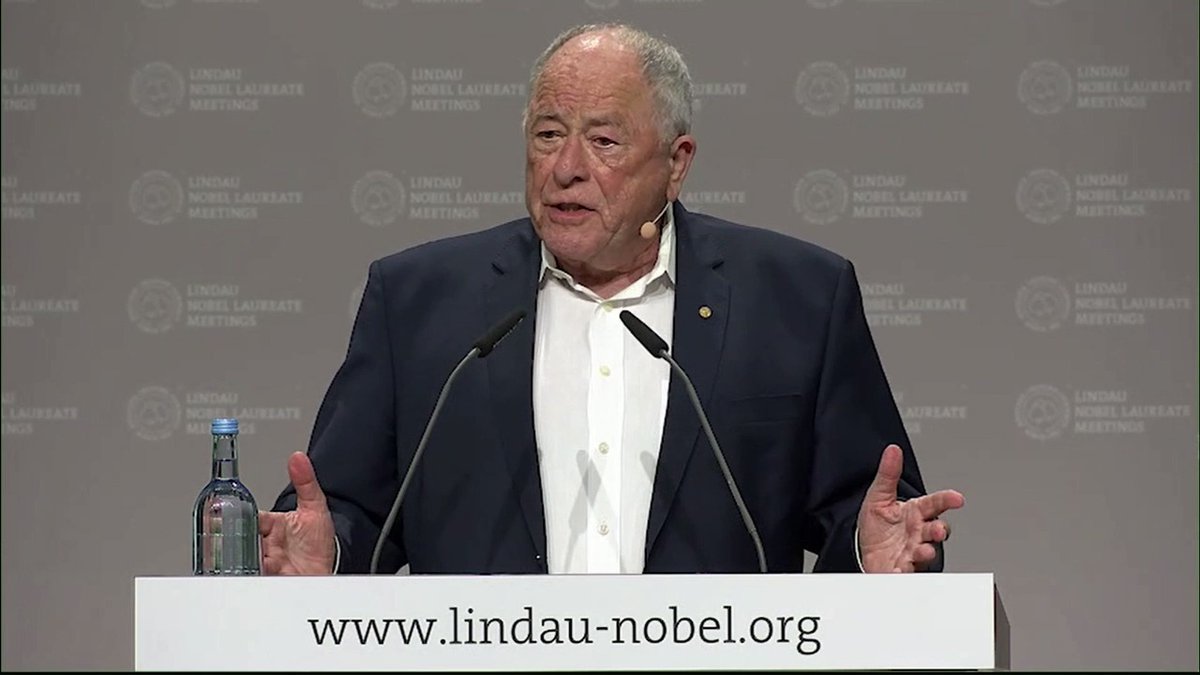
Looking around for topical material beyond Euclid to include in tomorrow’s plenary presentation at the National Astronomy Meeting in Cardiff in the session on Equality, Diversity and Inclusion in Astronomy and Geophysics I came across a story about Nobel Laureate Kurt Wüthrich.

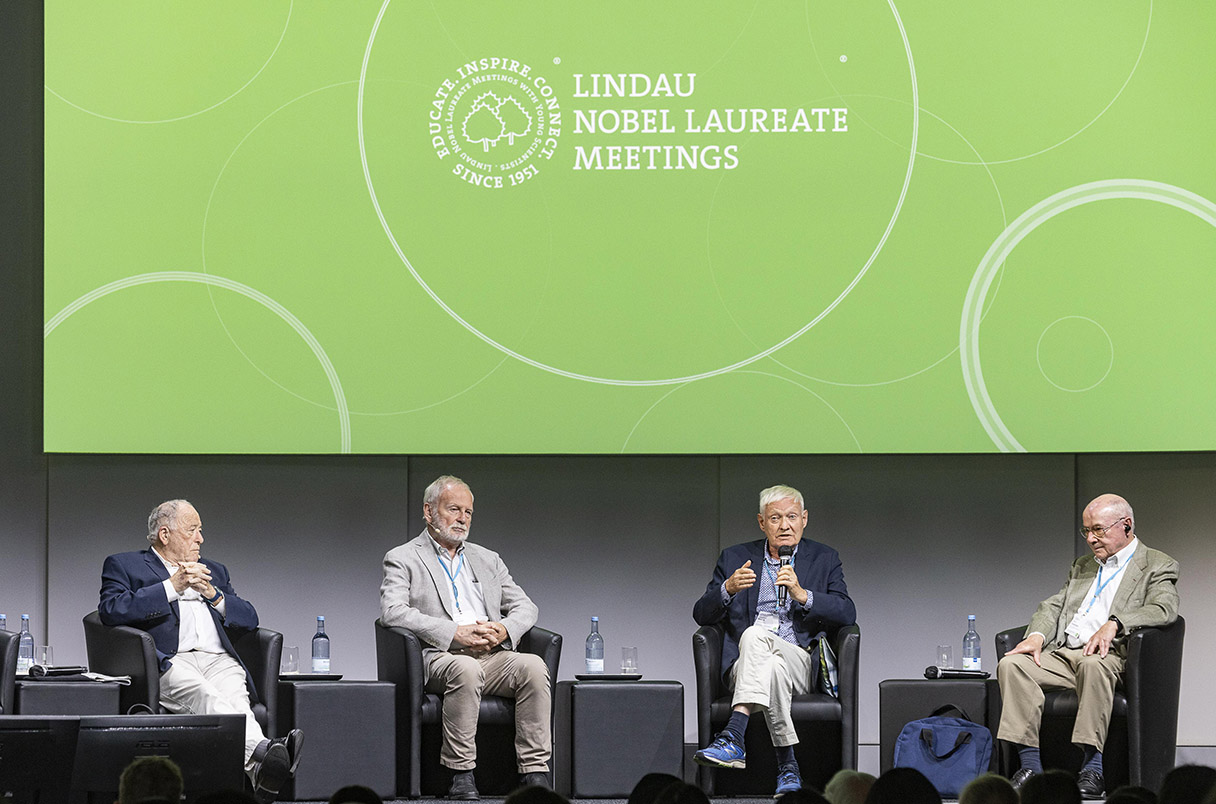
Professor Kurt Wüthrich gave a talk at the Lindau Meeting last week during which he claimed there was anti-male discrimination in modern science. I have uncovered further relevant evidence. Here is a picture of four old white men from the same meeting being discriminated against by being forced to participate in a panel consisting entirely of old white men:

Setting aside Kurt Wüthrich’s ridiculously elevated sense of entitlement, the really serious issue is that it was a (female) early career researcher that called him out. One point that I want to make tomorrow is that those of us who are old white men have a vitally important role to play in calling out this sort of nonsense. More generally, whatever your scientific status it is important for you to ask yourself “what can I do to make the research environment as good as possible for people who are not like me?”.

Pushing Euclid

Posted in Biographical, Euclid, Science Politics, The Universe and Stuff with tags , , , on June 30, 2023 by telescoper

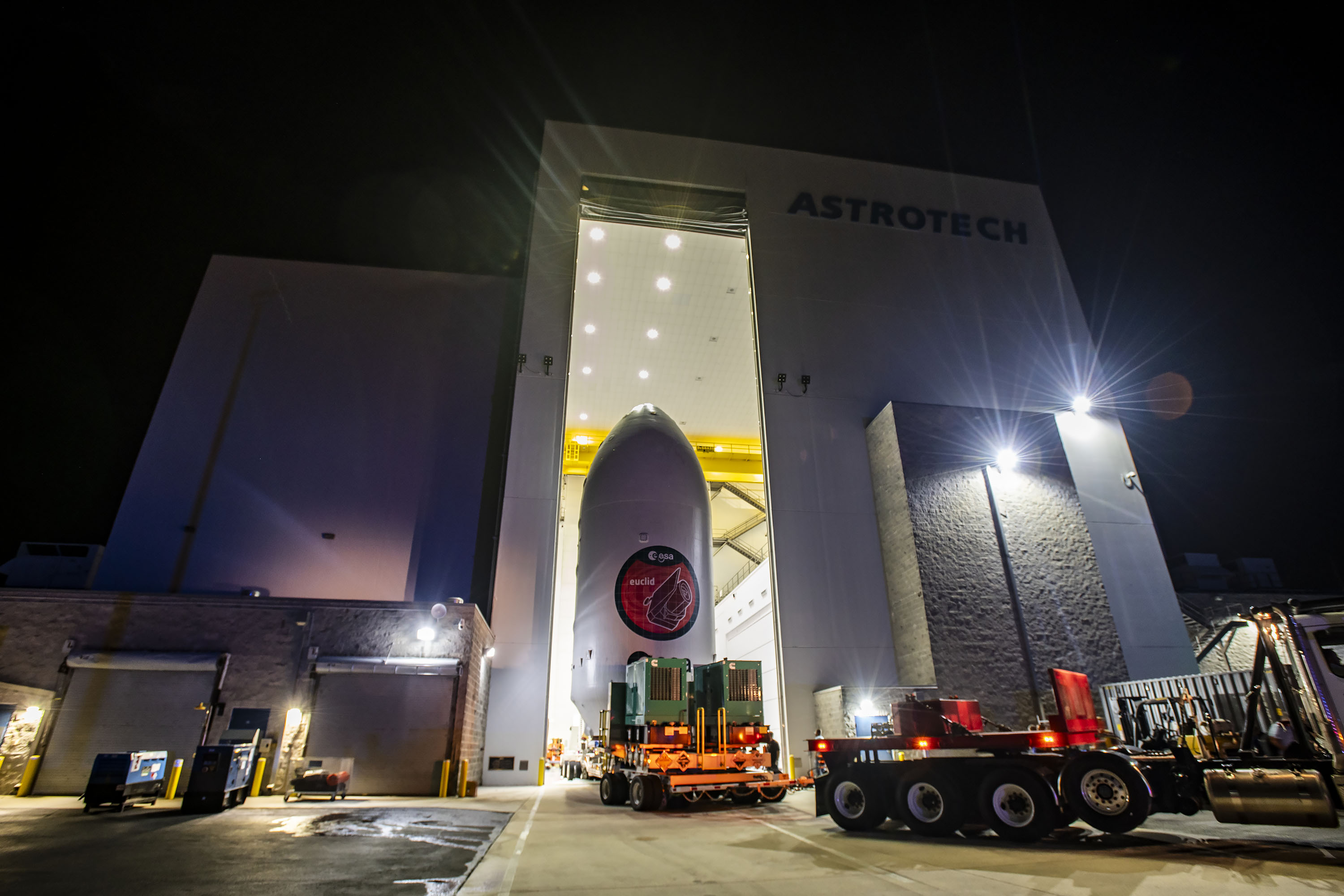
I’ve spent a sizeable chunk of the last two days answering press enquiries concerning the Euclid mission, due to be launch about 24 hours from now. Here is a picture of Euclid in the Falcon 9 fairing, getting ready to be moved to the launch facility. It’s all getting very real!

After talking with their researcher yesterday, this morning I did a short interview on Morning Ireland, which is on RTÉ Radio 1. It was shorter than I imagined because the previous item – about the ongoing ructions at RTÉ over various financial scandals – understandably overran quite a bit. The presenter, Rachel English, was very nice though and I think it went fairly well. I did another short interview on Newstalk Radio on a programme called Hard Shoulder, which took place at 5.48pm. I also spoke to a journalist from the Sunday Times Irish Edition, who I think will run a story on Sunday.

Anyway, the purpose of this media stuff is not to try to grab headlines – my involvement in Euclid is very small, really – but to generate some interest in the hope that Ireland takes a more active role in future space missions. I don’t know whether it will work, but I hope it does, and I feel obliged to try although it has made for a very busy day indeed!

The Cyclic Universe of the UK Astronomy Grant System

Posted in Biographical, Science Politics, The Universe and Stuff with tags , , , on April 17, 2023 by telescoper

I stumbled by accident yesterday on a bit of news relating to UK Astronomy Grant funding via the Science and Technology Facilities Council (STFC). I am of course completely out of that system, and have been for years, but I am nevertheless quite nosy so was interested to find out about the changes. Thanks to Alan Heavens and Paul Crowther for enlightening me.

Way back in 2010 I wrote in somewhat critical terms about the new-style Consolidated Grants that STFC was planning to introduce. This system replaced a dual approach of so-called “Standard Grants” – which were typically rather small, usually funding one postdoctoral researcher and bits and bobs – and “Rolling Grants” – which were usually larger, covering all the activities of a department or institution – with a single system of “Consolidated Grants”. The Standard Grants were “responsive”, in that investigators could put in an application whenever they wanted, whereas Rolling Grants were on a fixed timetable. After the change, the responsive mode went out the window and Departments were forced to apply collectively, once every three years.

Much of the reason for the change was the administrative cost of the system. There were huge numbers of standard grant applications. Back in the mists of time there were two application deadlines per year so it was a heavy burden on the panels and the Swindon office, especially since so little funding was available in the first place. Standard grants were also the first to get squeezed when there was a funding shortfall, whereas Rolling grants generally carried on rolling.

Well, the news is that the current Astronomy grant round, with applications in 2022 and grants starting in 2023, will see the last of these Consolidated Grants. From this year on, there will be a new system of – wait for it – “Small” and “Large” grants, thought these are officially called Type 1 and Type 2. The Small Awards scheme is described here and it looks very much like the old Standard Grant system. Details of the Large grants scheme are not yet available, but I believe they will start next year. You can find more details here (PDF).

So now it seems something very like the old system is returning, and there are no doubt the same worries that Large grants will eat up most of the money, leaving very little for the Small grants. Déjà vu.

Anyway, the way I came across this piece of news was via the announcement of a clutch of PDRA positions in cosmology and extragalactic astrophysics at the University of Sussex (where I worked from 2013-16). It seems the Astronomy Centre must have done pretty well in the (final) STFC Consolidated Grant round, which is very good to hear! It seems there might be a bit more money generally in the grant line this year too, which is also good news.

Ireland and CERN

Posted in Maynooth, Politics, Science Politics, The Universe and Stuff with tags , , , on December 30, 2022 by telescoper

Not long ago I posted an item about Ireland’s potential membership of CERN. There seems to have been some progress at political levels in this direction. In Mid-December, the Seanad called for a detailed proposal for CERN membership to be drawn up. More recently still, Minister Simon Harris has indicated that he will bring such a proposal to Cabinet on the matter.

There’s an article in yesterday’s Irish Times by Cormac O’Raifeartaigh reviewing the situation.

As I understand things, if the Irish Government were to decide to take Ireland into CERN then it would first have to become an Associate Member, which would cost around €1.5 million per year. That’s a modest contribution, and the financial returns to Irish industry and universities are likely to far exceed that. This Associate member stage would last up to 5 years, and then to acquire full membership a joining fee of around €16.8 million would have to be paid, though that could be spread out over ten years, along with an annual contribution of around €13.5m.

While I support the idea of Ireland joining CERN I feel obliged to stress my concerns. The most important of these is that there seems to me to be a real danger that the Government would simply appropriate funding for CERN membership from within existing programmes leaving even less for other forms of scientific research. In order to reap the scientific reward of CERN membership the Government will have to invest the additional resources needed to exploit the access to facilities membership would provide. Without a related increase in research grant funding for basic science, the opportunity to raise the level of scientific activity in Ireland would be lost and science overall may end up worse off.

Ireland recently joined the European Southern Observatory (ESO), a decision which gave Irish astronomers access to some amazing telescopes. However, there is no sign at all of Irish funding agencies responding to this opportunity by increasing funding for academic time, postdocs and graduate students needed to do the actual science. In one respect ESO is very like CERN: the facilities do not themselves do the science. We need people to do that. CERN membership could turn out to be like a very expensive Christmas gift that looks very exciting until you open the box and find that the batteries are not included.

P.S. At least Cormac’s employers in Waterford have been quick off the mark in exploiting the potential of CERN by renaming their entire institution after it…

Is Ireland about to join CERN?

Posted in Politics, Science Politics, The Universe and Stuff with tags , , on November 16, 2022 by telescoper

Way back in 2019 I posted a piece about the case for Ireland to join CERN and revived the discussion about six months ago after talking about it to particle physicist John Ellis.

Well it seems there has been progress and, according to the Irish Times, a proposal to join CERN is going to be tabled by the Minister Simon Harris. This follows a long hiatus after a move reported in the news here in Ireland several years ago of a report from a Committee of the Houses of the Oireachtas making the case for Ireland to join CERN. You can download the report here (PDF) and you’ll find this rather striking graphic therein:

You will see that there are only three European countries other than Ireland that don’t have any form of membership or other agreement with CERN: Latvia, Bosnia-Herzegovina, Moldova. The fact that almost everyone else is in is not in itself necessarily a good argument for Ireland to join, but it does make one wonder why so many other countries have found it important to join or have an agreement with CERN while Ireland has not.

As the document explains, if the Irish government  were to decide to take Ireland into CERN then  it would first have to become an Associate Member, which would cost around €1.2 million per year. That’s small potatoes really, and  the financial returns to Irish industry and universities are likely to far exceed that, so the report strongly recommends this step be taken. This Associate member stage would last up to 5 years, and then to acquire full membership a joining fee of around €15.6 million would have to be paid, which is obviously a much greater commitment but in my view still worthwhile.

There were some positive noises when the document came out, but that was near the end of 2019. Not far into 2020 the pandemic struck and the idea sank without trace. Now it looks like the idea is alive again. It’s not exactly a done deal but at least there’s some movement.

While I strongly support the idea of Ireland joining CERN I do have a couple of concerns about the case as presented in the Oireachtas report.

One is that I’m very sad that the actual science done at CERN is downplayed in that report. Most of it is about the cash return to industry, training opportunities, etc. These are important, of course, but it must not be forgotten that big science projects like those carried out at CERN are above all else science projects. The quest for knowledge does have collateral benefits, but it a worthy activity in its own right and we shouldn’t lose sight of that.

My other (related) concern is that joining CERN is one thing, but in order to reap the scientific reward the government has to invest in the resources needed to exploit the access to facilities membership would provide. Without a related increase in research grant funding for basic science the opportunity to raise the level of scientific activity in Ireland would be lost.

Ireland recently joined the European Southern Observatory (ESO), a decision which gave Irish astronomers access to some amazing telescopes. However, there is no sign at all of Irish funding agencies responding to this opportunity by increasing funding for academic time, postdocs and graduate students needed to do the actual science. In one respect ESO is very like CERN: the facilities do not themselves do the science; we need people to do that. The jam for research is already spread very thinly in Ireland so having an extra thing to spread it on will not necessarily be a good thing for science in general.

Simons Observatory News

Posted in Cardiff, Science Politics, The Universe and Stuff with tags , , , on October 18, 2022 by telescoper

It seems a lot longer than four years ago that I drew the attention of readers of this blog to the science case for the Simons Observatory, the next big thing in ground-based studies of the cosmic microwave background.

The Simons Observatory Site in Chile, as it appeared four years ago

Obviously a couple of years of pandemic have intervened, amongst other things, but I was delighted to read yesterday that the UK has invested £18M in the Simons Observatory, which will enable further development of the facility at Cerro Toco, high above the Atacama Desert in Chile.

Simons Observatory in May 2022

The project was already a large international collaboration led from the USA, but the new funds from UKRI mean that six UK institutions will now join. These are (in alphabetical order): Cambridge; Cardiff; Imperial College London; Manchester; Oxford; and Sussex. Although I’m not involved in this project myself I know many people at these institutions (two of which I have worked at) and elsewhere who will be absolutely thrilled to be able to participate in this exciting project. Congratulations to them!

It would have been great if Ireland had been able to get involved in the Simons Observatory, but sadly fundamental science of this type is not a priority for the powers that be in Irish science funding. This is unfortunate because I think membership of international consortia like this would enable a small country to punch above its weight in science. Still, at least the UK PI, Prof. Michael Brown (Manchester), is an Irishman…

How well-intentioned white male physicists maintain ignorance of inequity and justify inaction

Posted in Science Politics with tags , , , , , on October 10, 2022 by telescoper

I just noticed a paper on arXiv by Melissa Dancy and Apriel Hodari, which will probably annoy many people who deserve to be annoyed. Here is the abstract:

Background: We present an analysis of interviews with 27 self-identified progressive white-male physics faculty and graduate students discussing race and gender in physics. White men dominate most STEM fields and are particularly overrepresented in positions of status and influence (i.e. full professors, chairs, deans, etc.), positioning them as a potentially powerful demographic for enacting systemic reform. Despite their proclaimed outrage at and interest in addressing inequity, they frequently engage in patterns of belief, speech and (in)action that ultimately support the status quo of white male privilege in opposition to their intentions.


Results: The white male physicists we interviewed used numerous discourses which support racist and sexist norms and position them as powerless to disrupt their own privilege. We present and discuss three overarching themes, seen in our data, demonstrating how highly intelligent, well-intentioned people of privilege maintain their power and privilege despite their own intentions: 1) Denying inequity is physically near them, 2) Locating causes of inequity in large societal systems over which they have little influence and 3) Justifying inaction.


Conclusions: Despite being progressively minded, well-meaning, and highly intelligent, these men are frequently complicit in racism and sexism in physics. We end with recommendations for helping these men to engage the power they hold to better work with women and people of color in disrupting inequity in physics.

(I added the spacing and underlining.)

The paper does not mention the additional issue that not all white male professors are even well-intentioned…