Archive for the The Universe and Stuff Category

BepiColombo goes to Mercury

Posted in The Universe and Stuff with tags , , , on October 24, 2018 by telescoper

You may have missed the news that the joint Japanese-European (JAXA-ESA) Mission BepiColombo was successfully launched on October 19th 2018 and is now on its way to the planet Mercury, where it will arrive in December 2025.

As it happens I’ve just finished delivering a set of lectures on gravitational dynamics, part of which was devoted to orbital mechanics. One of the problems I worked out during these lectures was the Hohmann Transfer Orbit which is the simplest way to get a spacecraft from Earth to, e.g., Mars (which take 8 to 9 months to reach).

Since the radius of Mercury’s orbit is 0.39 AU (compared with Mars’s 1.52 AU) you might think it would take a similar time to reach Mercury, but designing a trajectory that results in a controlled encounter with Mercury in an efficient manner is much harder than for Mars (largely because Mercury is moving much faster). The solution to this problem involves a series of encounters with VEarth, Venus and Mercury each of which results in an adjustment to BepiColombo’s orbit until it finally encounters the target planet at a reasonable speed. This approach takes over seven years, but it saves an enormous amount on fuel – using the gravitational boost from planetary encounters instead of firing rockets.

Here’s a video showing this complex but fascinating example of orbital mechanics in action:

p.s. the dates in the video correspond to the originally planned launch date of 5th October, so are off by a couple of weeks.

The Signs of Age

Posted in Biographical, The Universe and Stuff with tags , , , , on October 23, 2018 by telescoper

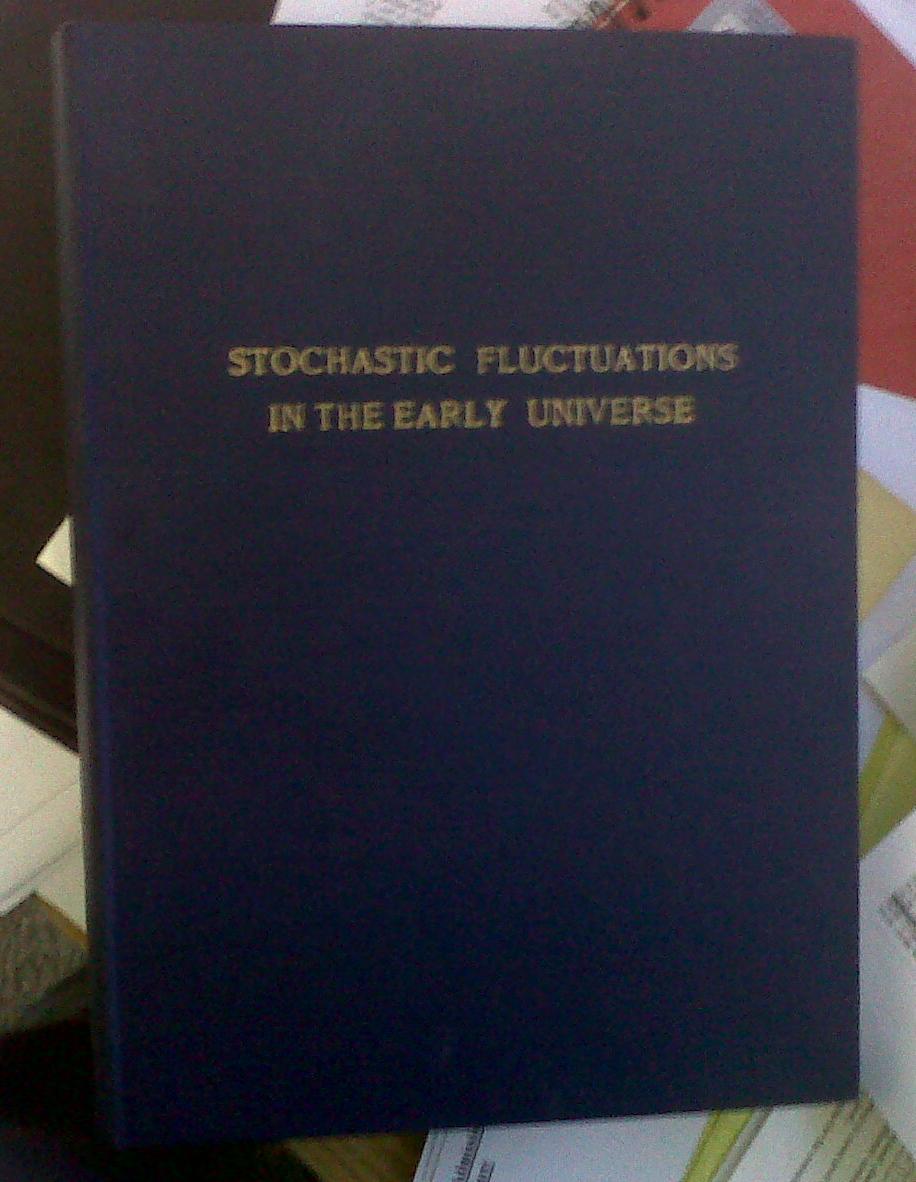
I was feeling very tired yesterday evening and in my vegetative state I suddenly realised that last month I missed a significant personal anniversary. In September 1988, now over thirty years ago I submitted my DPhil thesis at the University of Sussex. Here it is..

It was to be another couple of months until I had my viva (an experience I’d definitely rather forget) so I didn’t get to receive the postgraduate degree formally until the following summer, but at least I finished and submitted within the three years my funding allowed. Incidentally, mine was one of the first generation of theses at the University of Sussex to be typeset in LaTeX. At least I avoided the hassle of having carbon copies made!

The field of cosmology has changed so much in the three intervening decades that I’m sure current graduate students would find my thesis as incredibly simple-minded as I do. There weren’t any measurements of CMB temperature patterns in those days (the COBE results were not announced not until 1992) so I had to generate simulated observations, for example. Still, a few of the things in my thesis have stood the test of time, in the form of papers that still get cited to this day. I was lucky that my research  was in an area that was about to take off, rather than one that was already in decline, and that there will still problems around that were easy enough for me to tackle!

The way of working was very different too: the fact that my generation didn’t have computers on our desks makes younger graduate students wonder how we managed to do anything at all! I still amuse my colleagues with my habit of writing out bits of code in longhand on paper  and `desk-checking’ them before typing them in.

The fact that I now have over 30 years’ postdoctoral experience definitely adds to the feeling of getting very old, along with the all-pervading fatigue, the random aches and pains that afflict me from time to time, failing eyesight, and the tendency of Facebook to send me advertisements about stairlifts, hearing aids, and (worst of all) golf equipment.

The start of University term in late September brings with it a new intake of students that always looks even  younger than the last. That produces a strange alternation of feelings. On the one hand, working in a University means that you’re always surrounded by bright young students which is a good thing when you’re getting on a bit in that it reminds you that you were once like that. On the other, the proliferation of young persons around does force you to face up to how old you actually are.

I remember some years ago I was teaching a module on astrophysics as part of which I did a lecture on supernovae. In the middle of that I said to my class: “of course, you will all remember SN 1987A” (which was detected while I was a PhD student). Blank faces. I then realized that none of them had even been born in 1987. Nowadays it is the case that I was already a Professor when all my undergraduate students were born.

But these signs of age are as nothing compared to the shock I underwent when a few months ago I discovered that I’m older than Nigel Farage.

Counting String Theory Standard Models

Posted in The Universe and Stuff with tags , on October 22, 2018 by telescoper

I saw a paper on the arXiv and couldn’t resist a (snarky) comment. Here is the abstract:

We derive an approximate analytic relation between the number of consistent heterotic Calabi-Yau compactifications of string theory with the exact charged matter content of the standard model of particle physics and the topological data of the internal manifold: the former scaling exponentially with the number of Kahler parameters. This is done by an estimate of the number of solutions to a set of Diophantine equations representing constraints satisfied by any consistent heterotic string vacuum with three chiral massless families, and has been computationally checked to hold for complete intersection Calabi-Yau threefolds (CICYs) with up to seven Kahler parameters. When extrapolated to the entire CICY list, the relation gives about 1023 string theory standard models; for the class of Calabi-Yau hypersurfaces in toric varieties, it gives about 10723 standard models.

Isn’t  10723 also the number of angels that can dance on the head of a pin? That number of models for the price of one theory looks like a bargain to me!

But, seriously, people often complain that string theory isn’t really scientific because it isn’t predictive. That clearly isn’t true. String theory is the most predictive theory ever: it can predict anything you want!


A Breakthrough for a Bigot

Posted in Biographical, LGBTQ+, The Universe and Stuff with tags , , , on October 18, 2018 by telescoper

You may recall that a few months ago I wrote a post about Dr Aron Wall, whose research speciality is Black Hole Thermodynamics, and who is moving to Cambridge next year to take up a Lectureship. Yesterday I heard the news that Dr Wall (who is currently at Stanford) has been awarded a New Horizons Breakthrough Prize of $100,000. Three such prizes are awarded each year for outstanding early career researchers.

This is just a reminder that, when he isn’t doing theoretical physics, Dr Wall also runs a blog in which he expresses outspokenly homophobic views. For example, one piece included bigoted generalizations such as:

…the notoriously promiscuous, reckless, and obscene lifestyle characteristic of the cultural venues of the gay community.

It sounds like he knows a lot about these places. Does he visit them often? The press release from Stanford does not say.

You can read his whole piece for yourself* and decide what you think. As a gay man I found it thoroughly offensive, but what I think is not as important as what effect this person’s presence in the teaching staff will mean for any LGBT+ students at DAMTP. I hope Dr Wall enjoys the compulsory Equality and Diversity Training he will be required to undergo as a new member of staff and that he does not let his extremist beliefs interfere with his responsibility as a lecturer to treat all staff and students with the respect they deserve.

(*He’s deleted it, so I linked to an archived version…)

Some people have said that Dr Wall’s private beliefs are his own business, as long as he is good at his job. I agree with that. However his beliefs are no longer private. He has himself chosen to make them public. I think that makes a big difference. His views are known publicly, and that does not help to provide a welcoming environment for LGBT+ students (which I would have thought was part of his job). You might say that `It’s OK. Just keep him away from LGBT+ students’. That seems to me a pathetic response, no different from saying that it’s acceptable to employ a serial sexual harasser as long as you keep him away from female students. The duty of a member of academic staff is to the entire academic community (staff and students), not just the fraction of it that the staff member isn’t bigoted against.

I just wonder whether the Breakthrough Prize would have been awarded to a person with outspoken racist or sexist views? And should prizes be awarded to people who are good at science regardless of attitudes that cast severe doubt on their ability or willingness to foster a spirit of inclusivity within which other scientists can flourish?

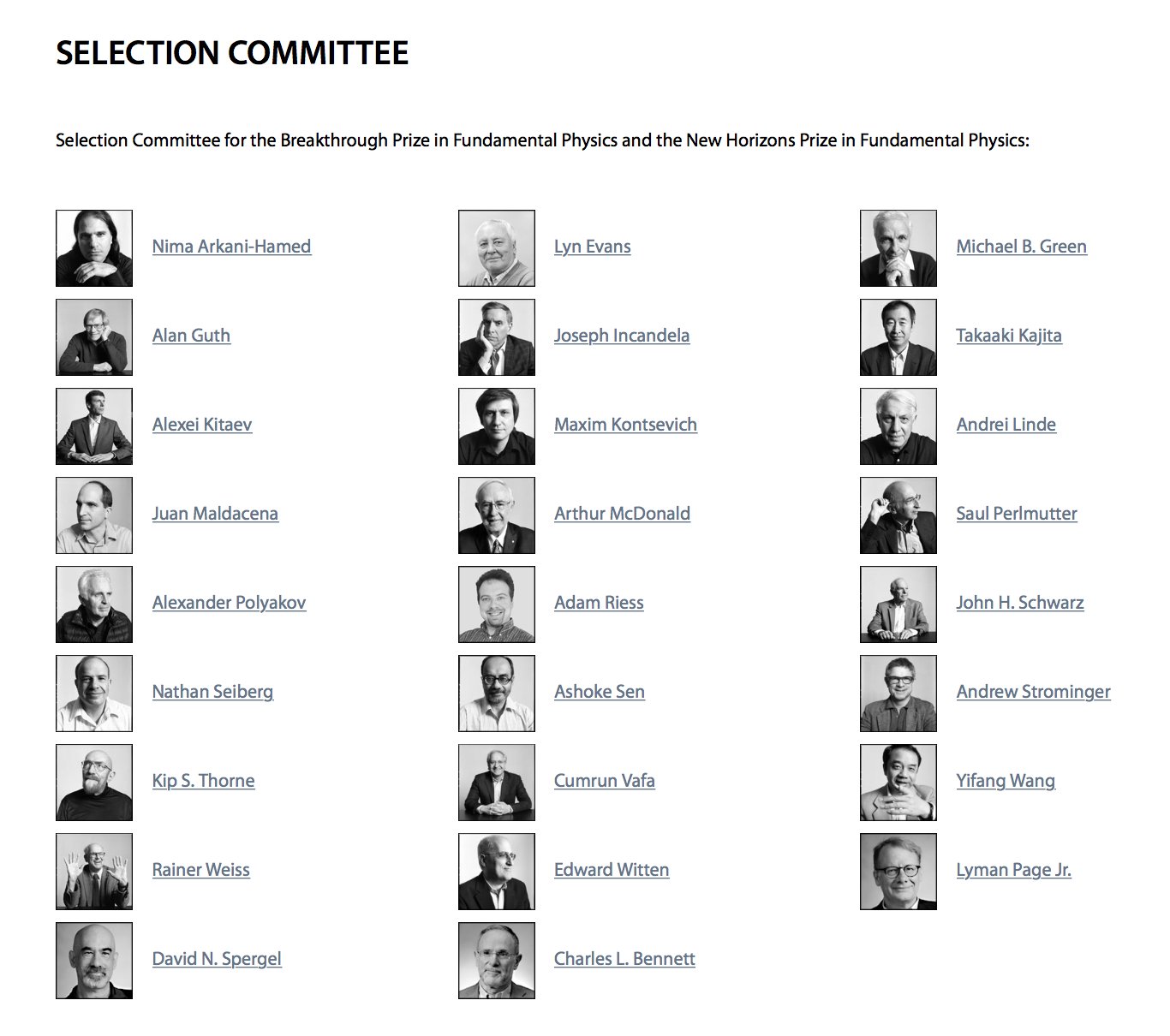
P.S. Note the diversity of the panel that made this award!

R.I.P. Prof. Michael J Thompson

Posted in Biographical, The Universe and Stuff with tags , , , on October 17, 2018 by telescoper

I just returned from giving a lecture to find an email in my inbox delivering the awful news that Professor Michael J. Thompson (pictured above) passed away unexpectedly on 15th October 2018, while at a scientific meeting in Tokyo.

Thompson’s scientific research activity was primarily in the field of helioseismology, astroseismology, solar physics, and inverse problems. He worked extensively in developing and applying inverse techniques in helioseismology and, in particular, measuring the stratification, rotation, and large-scale flows in the solar interior.

Along with being the Deputy Director and Chief Operating Officer of the National Centre for Atmospheric Research (NCAR) in Boulder, Colorado, Michael Thompson was also an NCAR senior scientist. From 2010 to 2014 he directed the High Altitude Observatory and was an associate director of NCAR. Prior to joining NCAR, Mike Thompson was Head of the School of Mathematics and Statistics in the University of Sheffield, and was formerly a Professor of Physics at Imperial College London. I knew him very well personally from the time before that, as we worked together for many years in the Astronomy Unit in the School of Mathematical Sciences at Queen Mary, University of London. Although we didn’t work in the same topics we had many interesting discussions about inverse problems in our respective fields, as well as many other topics (especially cricket). I recall that he taught an MSc course on cosmology, which he volunteered to do as he was interested in learning more about the subject.

More recently we kept in touch regularly via dinners at the RAS Club, of which he was a member, until he moved to the USA. It is through the Club mailing list that I learnt the sad news of his death.

I know I can speak for everyone who knew him in saying that he was not only a first-rate scientist but also a greatly valued colleague and an extremely nice man. Mike will be greatly missed by everyone who knew him, and I extend my deepest condolences to his family at what must be a very difficult time.


UPDATE: Here’s a news item about Mike’s death from the local paper in Boulder Colorado.

Open Journal Updates

Posted in Open Access, The Universe and Stuff with tags , on October 16, 2018 by telescoper

Just finished today’s teaching so I thought I’d chill for a few minutes and pass on a few quick updates about the Open Journal of Astrophysics, which was formally (re)launched last week.

The first thing is that at the weekend I sent an online training video and guide around the members of the Editorial Board and introduced them all to the new platform’s messaging system, which is a very convenient way for us to keep in touch. I had lots of volunteers for the Editorial Board and I couldn’t select everyone but I tried to choose members with a good geographical distribution, spread of expertise, and gender balance. We may add more in due course, as we’re still quite cosmologist-heavy, but I think we have enough to get started: we have editors in Australia, France, Italy, United States of America and Mexico as well as the United Kingdom.

We have received some submissions already and are dealing with them through the new platform, which is requiring the Editors to engage in some `on-the-job’ training. Hopefully they’ll get the hang of it soon!

Another relevant piece of news is that we have updated the DOIs associated with the papers we published with the old platform to point to the new site so they are now fully incorporated. For the record these are:

10.21105/astro.1708.00605

10.21105/astro.1603.07299

10.21105/astro.1602.02113

10.21105/astro.1502.04020

I’ll also take this opportunity to remind you that the Open Journal of Astrophysics is open for new submissions, so please feel free to give it a try!

Finally, I’d like to point you to an article about Open Access Publishing in the latest Physics Today, which begins

Publishers of scientific journals are facing renewed threats to their business models from both sides of the Atlantic.

You better believe it!

The Big Bang Exploded?

Posted in Biographical, The Universe and Stuff with tags , , , on October 15, 2018 by telescoper

I suspect that I’m not the only physicist who receives unsolicited correspondence from people with wacky views on Life, the Universe and Everything. Being a cosmologist, I probably get more of this stuff than those working in less speculative branches of physics. Because I’ve written a few things that appeared in the public domain, I probably even get more than most cosmologists (except the really famous ones of course).

Many “alternative” cosmologists have now discovered email, and indeed the comments box on this blog, but there are still a lot who send their ideas through regular post. Whenever I get a envelope with an address on it that has been typed by an old-fashioned typewriter it’s a dead giveaway that it’s going to be one of those. Sometimes they are just letters (typed or handwritten), but sometimes they are complete manuscripts often with wonderfully batty illustrations. I remember one called Dark Matter, The Great Pyramid and the Theory of Crystal Healing. I used to have an entire filing cabinet filled with things like his, but I took the opportunity of moving from Cardiff some time ago to throw most of them out.

One particular correspondent started writing to me after the publication of my little book, Cosmology: A Very Short Introduction. This chap sent a terse letter to me pointing out that the Big Bang theory was obviously completely wrong. The reason was obvious to anyone who understood thermodynamics. He had spent a lifetime designing high-quality refrigeration equipment and therefore knew what he was talking about (or so he said). He even sent me this booklet about his ideas, which for some reason I have neglected to send for recycling:

His point was that, according to the Big Bang theory, the Universe cools as it expands. Its current temperature is about 3 Kelvin (-270 Celsius or thereabouts) but it is now expanding and cooling. Turning the clock back gives a Universe that was hotter when it was younger. He thought this was all wrong.

The argument is false, my correspondent asserted, because the Universe – by definition – hasn’t got any surroundings and therefore isn’t expanding into anything. Since it isn’t pushing against anything it can’t do any work. The internal energy of the gas must therefore remain constant and since the internal energy of an ideal gas is only a function of its temperature, the expansion of the Universe must therefore be at a constant temperature (i.e. isothermal, rather than adiabatic). He backed up his argument with bona fide experimental results on the free expansion of gases.

I didn’t reply and filed the letter away. Another came, and I did likewise. Increasingly overcome by some form of apoplexy his letters got ruder and ruder, eventually blaming me for the decline of the British education system and demanding that I be fired from my job. Finally, he wrote to the President of the Royal Society demanding that I be “struck off” and forbidden (on grounds of incompetence) ever to teach thermodynamics in a University. The copies of the letters he sent me are still will the pamphlet.

I don’t agree with him that the Big Bang is wrong, but I’ve never had the energy to reply to his rather belligerent letters. However, I think it might be fun to turn this into a little competition, so here’s a challenge for you: provide the clearest and most succint explanation of why the temperature of the expanding Universe does fall with time, despite what my correspondent thought.

Answers via the comment box please!
Vector Calculus Weather

Posted in mathematics, The Universe and Stuff with tags , , on October 12, 2018 by telescoper

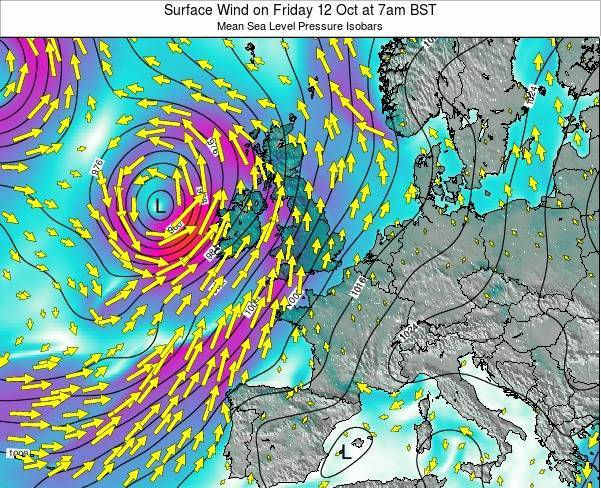
As it happens I did a lecture today about vector fields as part of my module on vector calculus. Whenever I did similar lectures in the past I used the day’s weather map as an illustration, so this morning I downloaded what turned out to be a particularly dramatic example. The curl of the velocity field around the weather system off the west coast of Ireland this morning was definitely non-zero…

Storm Callum turned out to be not as damaging as feared. Apparently it was rather windy in Maynooth overnight, but I slept right through it.

Hubble Problems

Posted in Cute Problems, The Universe and Stuff with tags , on October 12, 2018 by telescoper

Here I am, only connecting again.

Almost every day I get a spam message from a certain person who thinks he can determine the Hubble constant from first principles using  biblical references. The preceding link takes you to an ebook. I was thinking of buying it, but at 99c* I considered it prohibitively expensive.

*I am informed that it has now gone up to £1.30.

My correspondent also alleges that in writing this blog I am doing the Devil’s work. That may be the case, of course, but I can’t help thinking that there must be more effective ways for him to get his work done. Either that or he’s remarkably unambitious.

Anyway, to satisfy my correspondent here is one for the problems folder:

Using  the information provided in Isaiah Chapter 40 verse 22, show that the value of the Hubble constant is precisely 70.98047 km s-1 Mpc-1.

You may quote the relevant biblical verse without proof. In the King James version it reads:

40.22. It is he that sitteth upon the circle of the earth, and the inhabitants thereof are as grasshoppers; that stretcheth out the heavens as a curtain, and spreadeth them out as a tent to dwell in.

By the way, please note that the inverse of the Hubble constant has dimensions of time, not distance.

Answers into my spam folder please (via the comments box).


While I am on the subject of Hubble, I will mention the news that the Hubble Space Telescope is having a few technical problems as a result of a failure of one of its gyros. In fact a few days ago it went into `safe mode’ to help engineers diagnose and fix the problem, during which time no observations are being taken. I’m told by people who know about such things that the spacecraft can actually operate on only one gyro if necessary, using information from other systems for attitude control, so this problem is not going to be terminal, but it will slow down the pointing quite a bit thus make it less efficient. With a bit of luck HST will be back in operation soon.


Moon Child – Pharaoh Sanders

Posted in Jazz, The Universe and Stuff with tags , , , , on October 11, 2018 by telescoper

Following the advice of novelist E.M. Forster to `only connect’, I thought I’d do just that by only connecting  two bits of news. The first is that legendary saxophonist Pharaoh Sanders is playing at the National Concert Hall in Dublin next month and the second is that astronomers have been discussing whether or not a moon can have a moon and, if it can, whether it should be called a moonmoon or a submoon or something else. Well, I think such an object should be called a Moon Child, after the album by Pharaoh Sanders from which this is the title track. With a link like that, I’m sure it’s only a matter of time before I get offered a job as a radio presenter!