Archive for the The Universe and Stuff Category

The Open Journal is Open for Submissions Again!

Posted in Open Access, The Universe and Stuff with tags , , on October 8, 2018 by telescoper

I have now finished moving the Open Journal of Astrophysics onto the new Scholastica platform, and it is now open again for submissions! It has taken a lot longer to get to this point than I thought it would when I first proposed the Open Journal of Astrophysics way back in 2012 but better late than never!

Full instructions for authors can be found here. It is there that you will find the `submit’ button shown above, which will take you to a form through which you can upload your paper. All you need to do is upload a few details and the arXiv ID of your paper and we’ll take it from there.

The membership of the Editorial Board is listed here.

The papers published so far can be found here.

Oh, and there’s a blog that will include topical posts about matters astrophysical here.

In a nutshell, any paper that’s suitable for the astro-ph section of the arXiv can be submitted to the Open Journal of Astrophysics. We will consider any `traditional’ papers as well as others which may find it difficult to publish in other journals, such as papers on astrophysics education and outreach, or technical papers relating to instrumentation, mission proposals, and other documents.

Well, that’s about it. I just remains for me to thank all the people without whom this project would never have got off the ground, chiefly Chris Lintott, Arfon Smith and Adam Becker, developers Stuart Lynn and Marc Rohloff, Fiona Morley and the team at Maynooth University Library, and of course the good folk of the wonderful arXiv!

Kenneth Williams does Thermocouples

Posted in Television, The Universe and Stuff with tags , , , on October 7, 2018 by telescoper

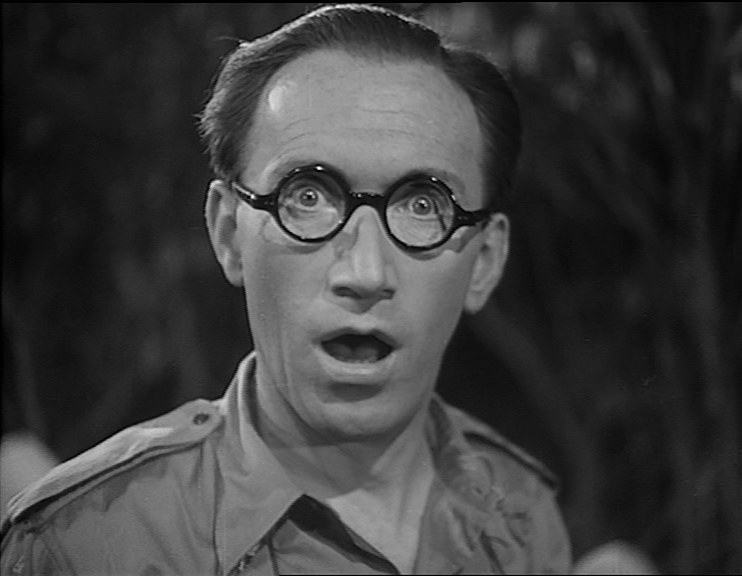
Not a lot of people know that the late and very great Kenneth Williams appeared as a guest presenter on the popular and long-running BBC science and technology television programme Tomorrow’s World. This sort of presenting was not really his thing at all – Williams hated working with props of any kind, for example – but he’s word perfect on the script and manages to put his own very distinctive personality into this piece. Why aren’t all science programmes as fabulous as this?

For much of its existence, Tomorrow’s World was broadcast live to air, often immediately after a brief (and sometimes disastrous) tech rehearsal with the gadgets. With his vast experience of live performances in revue, I don’t think that have bothered Kenneth Williams very much. I almost wish that something had gone badly wrong, as he would not doubt have improvised in characteristically hilarious fashion. His familiarity with film and TV work enabled him to use the camera very effectively. He’s certainly very camp, but also very obviously very professional.

Here is a clip from the programme, first broadcast on January 2nd 1981. Enjoy!


The Open Journal of Astrophysics – Update

Posted in Maynooth, Open Access, The Universe and Stuff with tags , , , on October 4, 2018 by telescoper

Well, it was a bit fiddly importing the legacy papers from the earlier version of the Open Journal of Astrophysics website to the new platform, but I managed to do it this afternoon as planned. The result looks rather nice, I think,

The only things left to do now are (a) to train the members of the Editorial Board on how to handle the workflow through the journal site and (b) to open up for submission of new papers. Both these steps should be trivial so we’re definitely entering the final stages of this project. There is  an event at Maynooth University Library next Tuesday afternoon at which I am doing a talk about Open Science. This will represent the official launch of the Open Journal of Astrophysics.

All we will need then is for people to submit some papers!


Voting Matters

Posted in Maynooth, Politics, The Universe and Stuff with tags , , , , , on October 4, 2018 by telescoper

At last I have this afternoon free of teaching and other commitments, and having fortified myself with lunch in Pugin Hall, I’m preparing to make an attempt on the summit of the Open Journal of Astrophysics now that all the outstanding administrative obstacles have been cleared. Before shutting myself away to do up the loose ends, however, I thought I’d do a quick post about a couple of electoral matters.

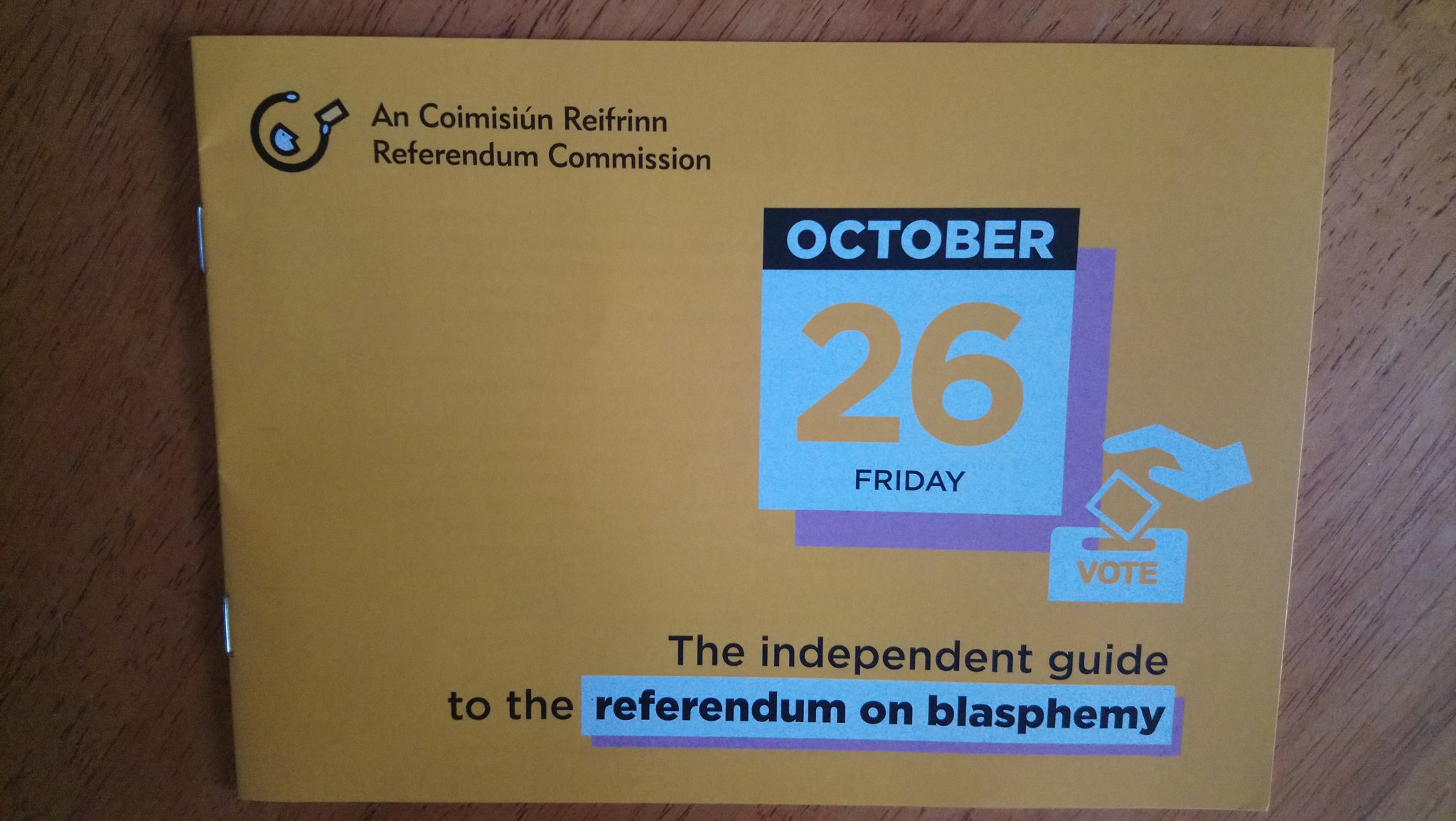
The first relates to this, which arrived at my Maynooth residence the other day:

This document reminded me that there is a referendum in Ireland on the same day as the Presidential election I mentioned at the weekend. The contents of the booklet can be found here. In brief,

At present, the Constitution says that publishing or saying something blasphemous is an offence punishable under law. Blasphemy is currently a criminal offence. The referendum will decide if the Constitution should continue to say that publishing or saying something blasphemous is a criminal offence. If the referendum is passed, the Oireachtas will be able to change the law so that blasphemy is no longer a criminal offence.

Having read the booklet thoroughly and thereby having understood all the issues, and the implications of the vote,  I have decided that I will vote in favour of making blasphemy compulsory.

The other matter being put to a vote is something I just found out about today when I got an email from the International Astronomical Union concerning an electronic vote on Resolution B4, that the Hubble Law be renamed the Hubble-Lemaître law. For background and historical references, see here. I don’t really have strong opinions on this resolution, nor do I see how it could be enforced if it is passed but, for the record, I voted in favour because I’m a fan of Georges Lemaître


The Strumia Affair

Posted in Politics, The Universe and Stuff with tags , , , , on October 3, 2018 by telescoper

I’m very late to this story as it broke over the weekend when I was preoccupied with many things, but it has triggered quite a reaction in the media (including here in Ireland). The story involves a physicist by the name of Alessandro Strumia who works at the University of Pisa in Italy. This person used the opportunity provided by a Conference on Theory and Gender to deliver a talk that contained highly inflammatory comments about gender and physics ability.

As a service to the community I’ve uploaded the slides for Strumia’s talk to Slideshare so you can read them here if you’re interested in his argument:

There are detailed discussions of Strumia’s talk by fellow bloggers Philip Moriarty here and Jon Butterworth here. Between them they cover most of what I’d say on the topic if I had time so I’ll direct you to them rather than repeat the arguments here. There are a host of other reaction pieces elsewhere, and I won’t attempt to summarize them either. Suffice to say that the old argument that `women are intrinsically not as good at physics as men’ has been refuted many times using solid empirical evidence; see the above post by Philip. It’s no wonder, though, that women get put off doing physics, when there are people like Alessandro Strumia in the field and potentially responsible for evaluating the performance of female staff.

What I will do add is that, for someone who purports to be a scientist, Strumia’s use of evidence is shockingly unscientific. His argument is riddled with non sequitur, unjustified assumptions and formulaic prejudice. Apart from everything else I think this is symptomatic of a malaise that is a widespread affliction in the field theoretical physics nowadays, which is worst among string theorists (which Strumia is not), namely a lack of basic understanding of, or even interest in, the proper application of scientific method.

The Brexit Wormhole

Posted in Politics, The Universe and Stuff with tags , , , on October 2, 2018 by telescoper

Since I have been passed over yet again for the physics Nobel Prize, I thought I’d pull out all the stops for next year and reveal my latest research which will surely satisfy the necessary criteria by conferring the “greatest benefit on mankind”.

One of the concerns facing those hoping to be involved in trade between post-Brexit Britain and the civilized world is the necessity of customs checks, especially at Dover, which will bring gridlock to the M20 and jeopardize the `just-in-time’ delivery systems used by most modern manufacturing enterprises e.g. the car industry.

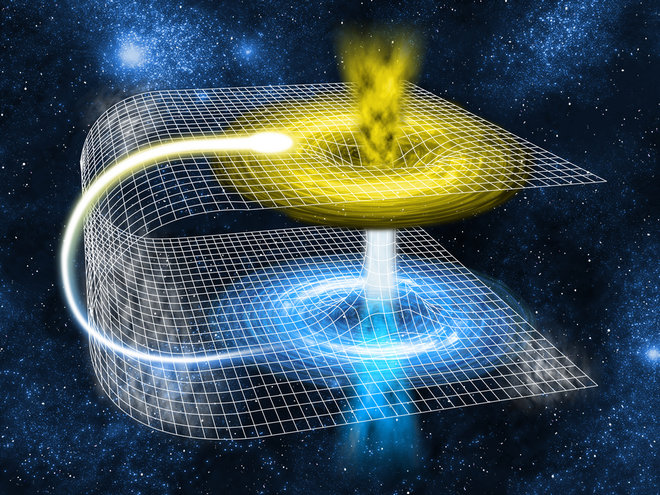
My solution to this problem is to install at Dover a series of Einstein-Rosen Bridges (as illustrated above), connecting the United Kingdom to various points in the space-time continuum. Travelling through traversible wormholes will effectively allow British lorries to reach superluminal velocity, thereby not only avoiding delays on the M20 but also allowing goods to be delivered even before they have been ordered.

I am willing to lease the Brexit Wormhole device to representatives of the UK government for the modest fee* of £350 million per week, in the hope that the extent of this generosity will put me in line for the Nobel Peace Prize in addition to the Nobel Prize for Physics.

*Payment to be made in Euros only please.

In addition to fulfilling this important geopolitical function, it will also be possible for wealthy individuals to lease smaller versions of the device for their own use, e.g. Mr Rees-Mogg may be interested in using one to travel back in time to the 18th Century.

P.S. As if the Brexit wormhole were not enough to garner these prestigious awards, I can further announce that I have found a most marvelous solution of the Irish Border Problem but this blog post is too narrow to contain it.

Nobel Prize for Physics Matters

Posted in Biographical, The Universe and Stuff with tags , , , , on October 1, 2018 by telescoper

I’ve been a bit tied up writing lecture notes and participating in telecons today, so I’ve just got time for a little post to mention that tomorrow morning (October 2nd 2018) will see the announcement of this year’s Nobel Prize for Physics.

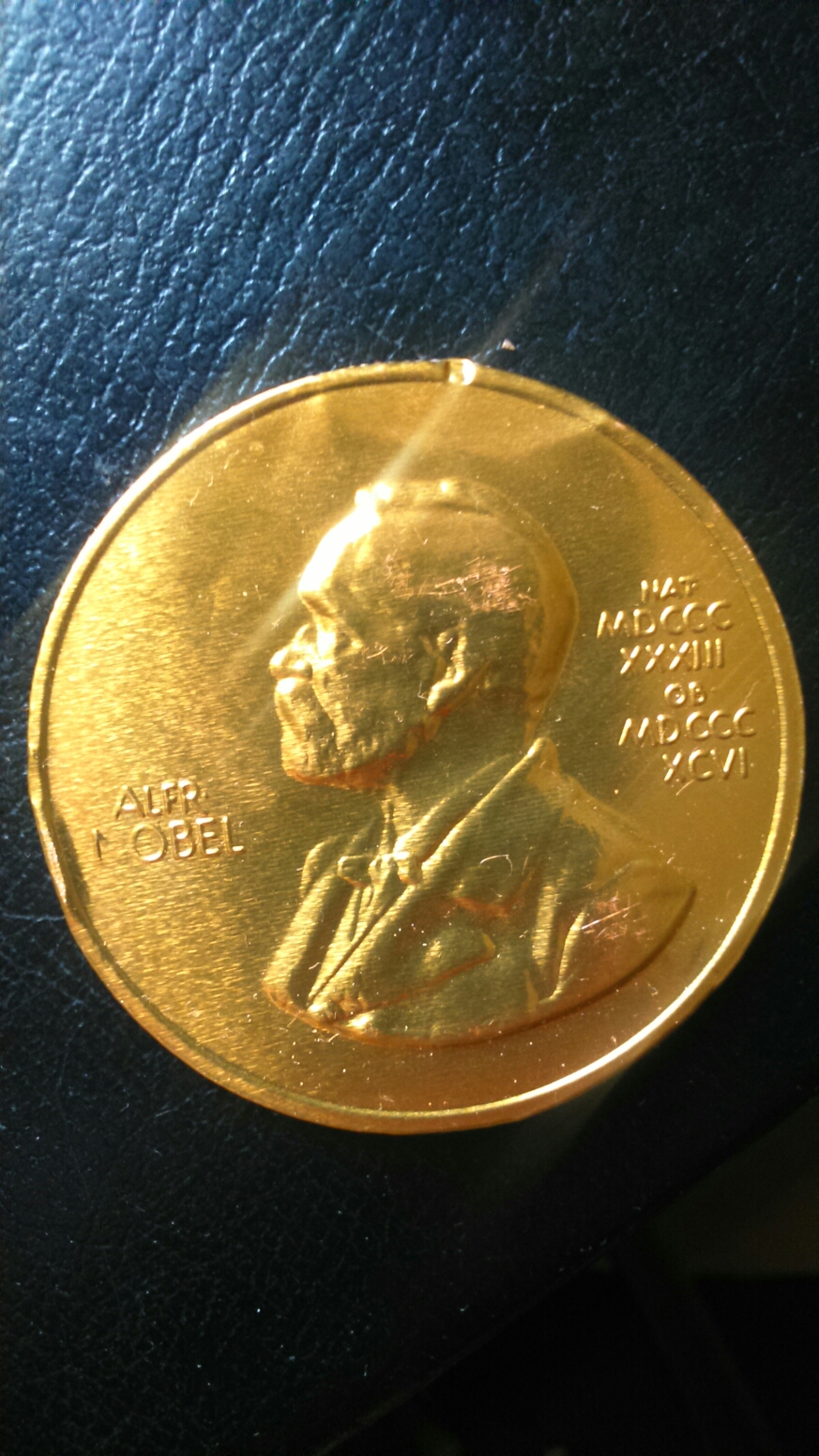
I do, of course, already have a Nobel Prize of my own, dating from 2006, when I was lucky enough to attend the prize-giving ceremony and banquet.

I was, however, a guest of the Nobel Foundation rather than a prizewinner, so my medal is made of chocolate rather than gold. Still, it was a very nice weekend!

I have no idea who will win the Physics Nobel Prize tomorrow. If you have any suggestions please put then forward through the comments box.

I’d say there’s an outside chance that there might be an award for the discovery of exoplanets, as that has certainly altered humanity’s perception of its place in the Universe. It’s by no means obvious to me who should win it, however. Possibilities are Possible winners include Didier Queloz, Aleksander Wolszczan, Dale Frail, and Michel Mayor, but which? It may also be too soon after the gravitational waves prize last year. Perhaps it’s time for something less exotic this year? To find out you’ll have to wait for the announcement, around about 10.45 (UK/Irish time) tomorrow morning.

Anyway, for the record, I’ll reiterate my opinion that while the Nobel Prize is flawed in many ways, particularly because it no longer really reflects how physics research is done, it does at least have the effect of getting people talking about physics. Surely that at least is a good thing?

UPDATE: And the winner is…

One half to Arthur Askey Ashkin, and the other half jointly to Gérard Mourou and Donna Strickland, for “groundbreaking inventions in the field of laser physics.”

So there are you are. The rumours were, as usual, completely wrong.

Oh, and Donna Strickland is the first woman to win the physics Nobel since Maria Goeppert-Mayer in 1963. Congratulations to her, and indeed to all this year’s winners!

From Phase Walks to Undergraduate Research

Posted in Education, The Universe and Stuff with tags , , , , , on September 28, 2018 by telescoper

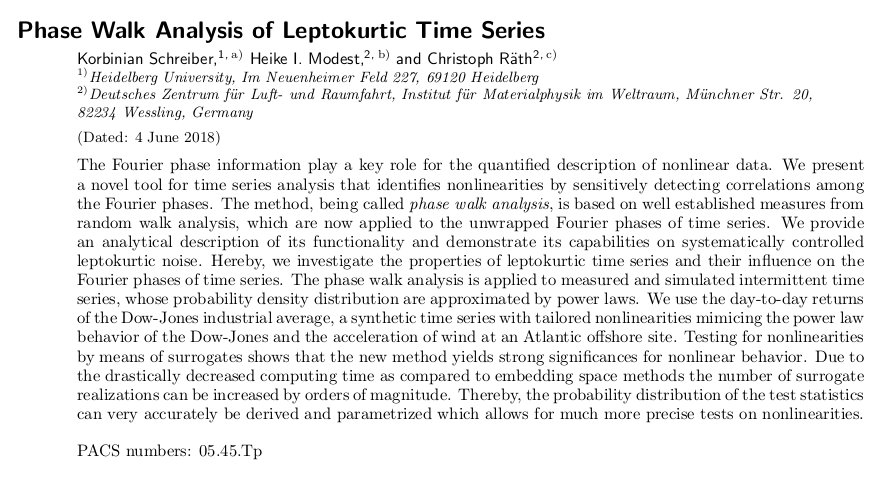
This week I put together a couple of brief descriptions for possible research projects for final-year undergraduate and/or Masters students in the Department of Theoretical Physics at Maynooth University, and I was reminded of the value of projects like this when I found this paper on the arXiv:

In fact the `Phase Walk Analysis’ developed here is based on an original idea I had for an undergraduate summer research project when I was at Nottingham University and have mentioned before on this blog. The student who did the project with me was Andrew Stannard (who is now at King’s College, London) and the work led to a paper that was published in a refereed journal in 2005 and has now been cited 21 times by various authors including the Planck Team.

Although Andrew is now working in a completely different area (Condensed Matter Physics), I like to think this taste of research was of at least some assistance in developing his career. Above all, though, it relates to something I read in the Times Higher by astronomer, Nobel Prize winner, and Vice-Chancellor of the Australian National University, namely that the idea that many politicians seem to have of separating teaching from research in universities is at best misguided and at worst threatens the very idea of a university.

Newsflash: Ireland and ESO

Posted in Science Politics, The Universe and Stuff with tags , , on September 26, 2018 by telescoper

Some good news was waiting for me when I got back to the office after my lecture just now, namely that Astronomy in Ireland will shortly receive an enormous boost, as the Republic has joined the European Southern Observatory (ESO).

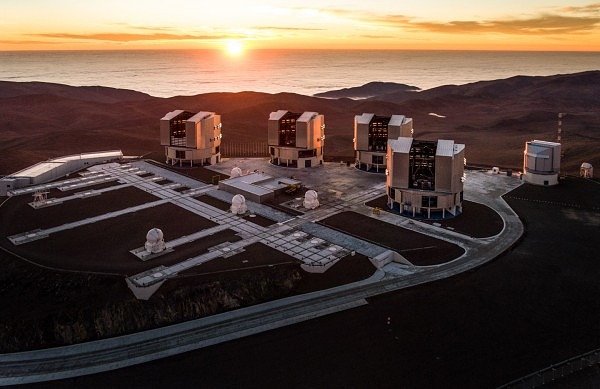
For those of you not in the know, ESO is an intergovernmental astronomy organisation and is the world’s most productive astronomical observatory. Founded in 1962, its headquarters are in Garching (near Munich, Germany), and it currently has 15 member states. On October 1st, Ireland will become the 16th. Its main work is conducted using a variety of large optical and radio telescopes which are all located in the southern hemisphere, notably at Paranal in Chile.

ESO’s VLT telescopes at Paranal (in the Andes Mountains).

The official press release includes the following:

We are delighted to welcome Ireland as the newest member of our organisation” stated ESO’s Director General, Xavier Barcons. “Ireland’s mature and thriving astronomical community will add to the broad variety of expertise in the ESO Member States, strengthening ESO’s position at the forefront of global astronomy. Irish astronomers will gain access to a suite of the world’s most advanced ground-based astronomical telescopes and will have the opportunity to be part of the construction of the next generation of ESO instruments in partnership with other ESO Member States. We are also very much looking forward to working with Irish industrial partners to build and operate ESO’s state-of-the-art telescopes.

It was probably the industrial opportunities afforded by ESO membership that persuaded the Irish government to stump up the subscription fee, but this decision is also extremely positive news for the relatively small but vibrant community in Ireland working on observational astronomy which I’m sure will make the most of the chance to do ever more exciting research using these facilities.

A Problem with a Geostationary Orbit

Posted in Cute Problems, The Universe and Stuff with tags , , , on September 26, 2018 by telescoper

I’ve been sorting through some old problem sets for my course on Astrophysics and Cosmology, and thought I would post this one in the Cute Problems folder for your amusement. The first part is easy, the second part not so much…

  1. Verify that the radius of a circular geostationary orbit around the Earth is about 42,000 km, i.e. find the radius of a circular  orbit around the Earth which has a period of 24 hours so it is always above the same point on the Earth’s surface . (You will need to look up the mass of the Earth.)
  2. Use the answer to (1)  to estimate what fraction of the Earth’s surface is visible at any  time from a satellite in such an orbit. (You will need to look up the radius of the Earth.)

Answers to (2) through the comments box please – and don’t forget to explain your working!