Archive for the The Universe and Stuff Category

The Success of LISA Pathfinder

Posted in The Universe and Stuff with tags , on February 8, 2018 by telescoper

Back in Maynooth, in between lecture and computer lab session, I only have time for a quick post so I’ll take the opportunity to share the recent news from LISA Pathfinder (which is basically a technology demonstrator mission intended to establish the feasibility of a proposed space-based gravitational wave facility called LISA). LISA Pathfinder is ostensibly an extremely simple experiment, consisting of two metal cubes (made of a gold-platinum mixture) about 38cm apart. The question it tries to answer is how accurately these two cubes can be put an ideal “free-fall” state, i.e. when the only force acting on them is gravity. I say `ostensibly’ however, in full knowledge that is an extremely challenging task that requires lots of clever design and painstaking work.

Initial signs were promising, and the confidence has now been justified by a paper in Physical Review Letters. Here is the abstract:

This is the key figure:

This confirms that the spacecraft has more than matched the sensitivity requirement demanded of it. Congratulations to the LISA Pathfinder mission on an outstanding success!


R.I.P. Donald Lynden-Bell (1935-2018)

Posted in The Universe and Stuff with tags , on February 6, 2018 by telescoper

I woke this morning to the very sad news that we have lost one of our great astrophysicists, Donald Lynden-Bell (above). He had suffered a stroke before Christmas but despite the best efforts of the medical staff at Addenbrooke’s Hospital in Cambridge, he never fully recovered. He passed away peacefully, at home, yesterday at the age of 82. The Cambridge University announcement of his death can be found here.

I saw Donald qjust a few months ago at the RAS Club where he seemed in good health. I was lucky enough to sit with him for dinner and he was excellent company, as he always was on such occasions. It’s very sad that he is no more. Sincere condolences to his family, friends and colleagues and especially to his wife Ruth (herself a distinguished chemist).

Donald is probably best known for his theoretical work on the idea that galaxies contain massive black holes at their centre, and that such black holes are the principal source of energy in quasars. He was also a member of a group of astronomers that became known as the ‘Seven Samurai’ who postulated the existence of the Great Attractor, a concentration of matter that might explain the observed peculiar motion of the Local Group of galaxies. What was most remarkable about him, however, was the creativity he brought to a huge range of disparate topics, from data analysis to telescope design, and from thermodynamics to general relativity. Donald refused to be pigeonholed, and worked on whatever took his fancy. He brought unique imagination and insight to everything he did.

I first encountered Donald Lynden-Bell when I was an undergraduate at Cambridge. He taught a first year Mathematics course for Natural Sciences students on how to solve Ordinary Differential Equations. I wouldn’t say he was the most organized lecturer I’ve ever had, but he was enormously entertaining and his remarkably loud voice meant you could never doze off! That was in 1983. I remember being terrified to see he was in the audience when I gave a talk at a conference in Cambridge as a PhD student a few years later, in 1987. He asked a question at the end that completely wrong-footed me, but I soon realised that he had a habit of doing that and it wasn’t at all malicious: he just had an unexpectedly different way of looking at things. It was quite extraordinary in that he stayed that way all through his career. It’s also remarkable how little he seemed to change in the thirty-odd years I knew him. In fact, in pictures of him taken in the 1960 he looks much the same as he did last year. I think that’s at least partly why his death was such a shock. He seemed timeless. One assumed he would live forever.

At first I found Donald Lynden-Bell intellectually intimidating but it didn’t take long to find that, inside, he was actually a very amiable and kind-hearted character who was extremely generous with his time, especially with early career researchers. A couple of years ago in the occasion of his 80th birthday, a friend and former student of Donald’s, Manuela Magliocchetti, wrote an open letter to him on here. Many of his former students have posted similar messages on social media. The sense of loss is everywhere.

I find then when I know someone a bit personally, no matter how much I admire them as a scientist, it’s often other things about them that I remember better than their scientific work. My most vivid memory of Donald is from a visit to India over twenty years ago. I ended up playing croquet with him on the lawn of the Director’s House at the Inter-University Centre for Astronomy and Astrophysics in Pune (where I visited last year). Donald seemed entirely unconcerned with his own progress in the game but concentrated fiercely on sending his opponents’ balls into the shrubbery whenever the rules allowed. That is, of course, a major part of the game but I didn’t expect a distinguished Cambridge Professor to take such impish delight. The game was a blast, but had to be called off in the deepening twilight, with bats circling overhead, as we could no longer see well enough to continue but I’ll remember Donald’s constant laughter. A very serious and brilliant scientist he may have been, but he also had an intensely human capacity for having a bit of fun.

Rest in peace, Donald Lynden-Bell (1935-2018).

The Effect of Gravity on the Muon Magnetic Moment

Posted in The Universe and Stuff with tags , , , , , on February 3, 2018 by telescoper

Only time for a short post today, but I think this may turn out to be an important result. There’s a paper by Morishima et al. on the arXiv with the rather dry title Post-Newtonian effects of Dirac particle in curved spacetime – III : the muon g-2 in the Earth’s gravity, which suggests that the anomalous magnetic dipole moment of the muon.

Here is the abstract of the paper. You can click on it to make it bigger.

In a nutshell the anomaly is that according to basic relativistic quantum theory in the form of the Dirac equation, the muon (and any other charged spin-1/2 fermion) should have a magnetic dipole moment μ of magnitude (given in terms of its mass m and fundamental constants) by μ=geħ/4m with the g-factor g=2 for Dirac fermions. The anomaly is that this can be measured and it appears that g differs from zero by a small but significant amount, i.e. (g-2) is not zero. It has been widely suggested that this discrepancy suggests the existence of physics beyond the Standard Model of Partlce Physics. Well, gravity is not included in the Standard Model so I suppose this could still be right, but the it this calculation may well disappoint those who were hoping that (g-2) might provide evidence for, e.g., supersymmetry when it looks like it might be something rather more mundane, ie the Earth’s gravity!

UPDATE: It appears there is an error in the paper; see here. You may stand down.

UPDATE: Well, that was pretty fast. There’s now a paper on the arXiv by Matt Visser that gives a detailed refutation of the above claim. Here is the abstract:

In three very recent papers, (an initial paper by Morishima and Futamase, and two subsequent papers by Morishima, Futamase, and Shimizu), it has been argued that the observed experimental anomaly in the anomalous magnetic moment of the muon might be explained using general relativity. It is my melancholy duty to report that these articles are fundamentally flawed in that they fail to correctly implement the Einstein equivalence principle of general relativity. Insofar as one accepts the underlying logic behind these calculations (and so rejects general relativity) the claimed effect due to the Earth’s gravity will be swamped by the effect due to Sun (by a factor of fifteen), and by the effect due to the Galaxy (by a factor of two thousand). In contrast, insofar as one accepts general relativity, then the claimed effect will be suppressed by an extra factor of [(size of laboratory)/(radius of Earth)]^2. Either way, the claimed effect is not compatible with explaining the observed experimental anomaly in the anomalous magnetic moment of the muon.

That’s how science goes!

The Quickening of the Year

Posted in Education, Maynooth, Music, The Universe and Stuff with tags , , , , on February 1, 2018 by telescoper

It’s 1st February 2018, which means that today is Imbolc, a Gaelic festival marking the point halfway between the winter solstice and vernal equinox. This either happens 1st or 2nd February, and this year it is the former. In this part of the world – I’m in Ireland as I write- this day is sometimes regarded as the first day of spring, as it is roughly the time when the first spring lambs are born. It corresponds to the Welsh Gŵyl Fair y Canhwyllau and is also known as the `Cross Quarter Day’ or (my favourite) `The Quickening of the Year’.

So, talking of quickening, the pace of things is increasing for me now too. This morning at 9am I gave my first ever lecture in Maynooth University in a lecture theatre called Physics Hall, which is in the old (South) part of campus as opposed to the newer North Campus where the Science Building that contains my office is situated.

After that it was back to the Department for some frantic behind-the-scenes activity setting up accounts for the students for the afternoon lab session, which is in a computer room near to my office. Students attend one two-hour lab session in addition to the lecture, on either Thursday or Tuesday. The first lecture being this morning (Thursday) the first lab session was this afternoon, with the same material being covered next Tuesday.

I was far more nervous about this afternoon’s lab session than I was about this morning’s lecture as there seemed to be many things that could go wrong in getting the students up and running on our Linux cluster and getting them started on Python. Quite a few things did go wrong, in fact, but they were fewer in number and less drastic in outcome that I had feared.

So there we are, my first full day teaching in Maynooth. I think it went reasonably well and it was certainly nice to meet my first group of Maynooth students who, being physics students, are definitely la crème de la crème. I’ve got another 6 weeks like this (teaching on Tuesday in Cardiff and on Thursday in Maynooth) before the Easter break so it’s going to be a hectic period. Just for tonight, however, I’ve got time to relax with a glass or several of wine.

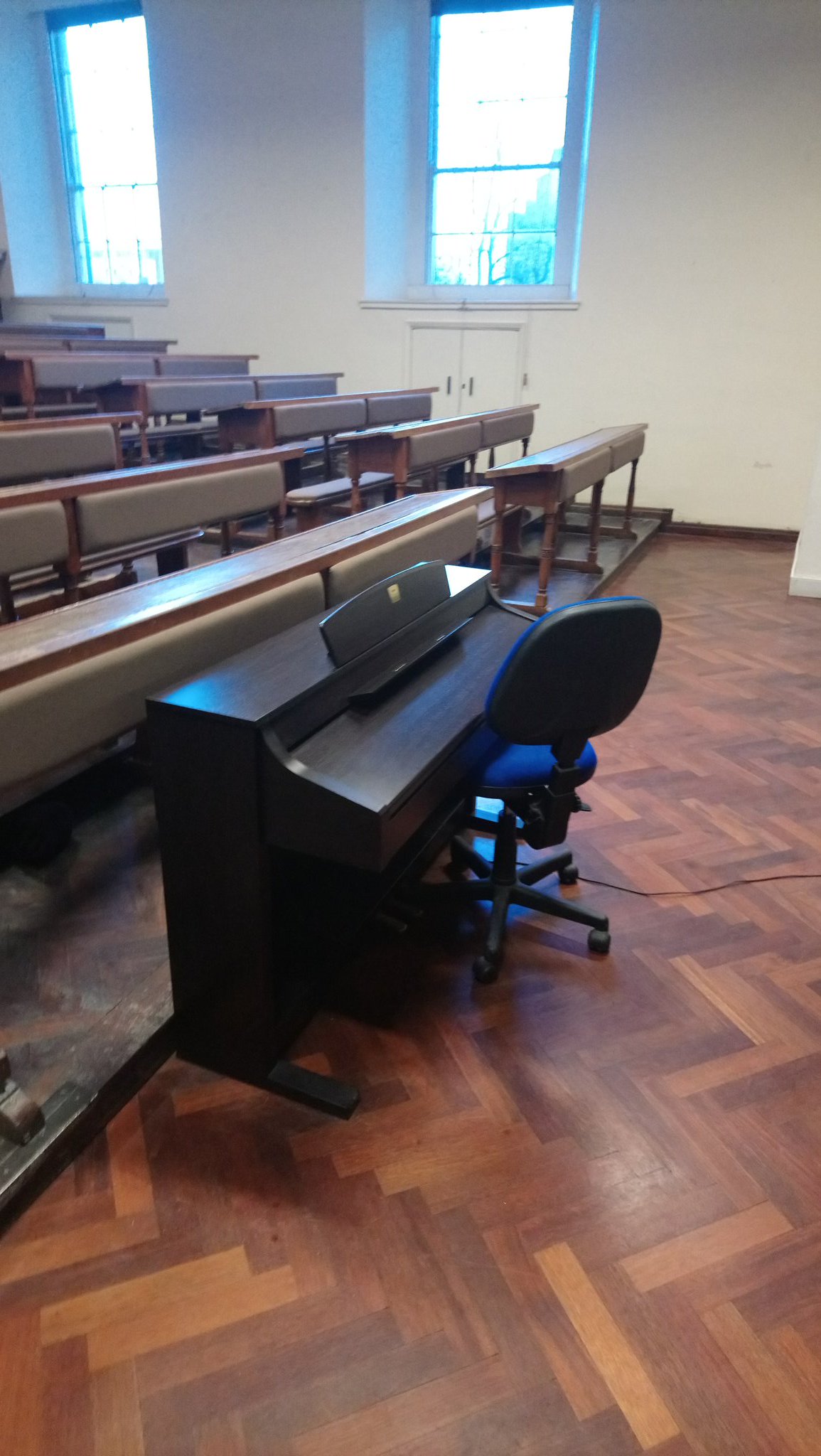
Incidentally, I was impressed that Physics Hall (where I did this morning’s lecture) is equipped with an electric piano:

I wonder if anyone can suggest appropriate musical numbers to perform for a class of computational physicists? Suggestions are hereby invited via the Comments Box!

Hirsute cosmologist Peter Coles beards broadcaster James O’Brien to win Beard of Winter vote

Posted in Beards, The Universe and Stuff on January 30, 2018 by telescoper

Wow. Fame at last!


kmflett's avatarKmflett's Blog

Beard Liberation Front

PRESS RELEASE 30th January

Contact Keith Flett     07803 167266

Hirsute cosmologist Peter Coles beards broadcaster James O’Brien to win Beard of Winter vote

The Beard Liberation Front, the informal network of beard wearers, has said that leading hirsute cosmologist Peter Coles has bearded broadcaster James O’Brien to win the Beard of Winter poll.

Mr Coles, of Cardiff University and Maynooth University in Ireland was previously a contender for Beard of the Year in 2014.

The Beard of Winter is the first of four seasonal awards that lead to the Beard of the Year Award in December 2018.

It focuses both on fuller organic beards, suitable for winter weather but also on beards that have made an early New Year impact in the public eye.

BLF Organiser Keith Flett said, Peter Coles has one of the most distinguished of scientific beards. Clearly his victory was in the stars but…

View original post 56 more words

The IKEA Universe

Posted in Biographical, The Universe and Stuff with tags , , , on January 29, 2018 by telescoper

I heard yesterday the sad news of Ingvar Kamprad, the founder of Swedish furniture chain IKEA.  People can be very snobbish about IKEA, but its emphasis on affordable design has been a boon for people on low incomes for many years. When I was an impoverished postdoc living in London I used it a lot, especially their Billy bookcases. I also have a very sturdy Omar in my bedroom…

I remember years ago  that while shopping in the IKEA at Neasden I discovered that they were running a competition, for which entrants had to complete the sentence:

I shop at IKEA because…

My entry completed it thus:

I shop at IKEA because it’s as cheap as fuck.

I didn’t win.

But I digress. Not many people are aware that IKEA also furnishes  important insights into modern cosmology, so I’ll try to explain here. I’ve blogged before about the current state of cosmology, but it’s probably a good idea to give a quick reminder before going any further. We have a standard cosmological model, known as the concordance cosmology, which accounts for most relevant observations in a pretty convincing way and is based on the idea that the Universe began with a Big Bang.  However, there are a few things about this model that are curious, to say the least.
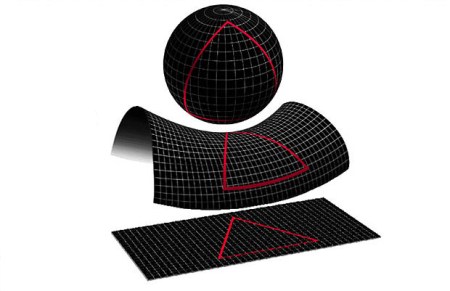
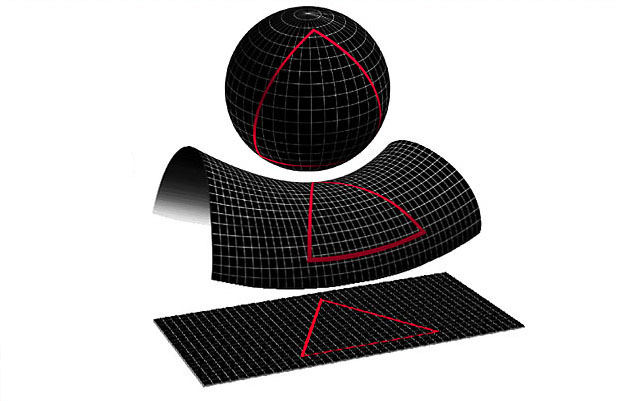
First, there is the spatial geometry of the Universe. According to Einstein’s general theory of relativity, universes come in three basic shapes: closed, open and flat. These are illustrated to the right. The flat space has “normal” geometry in which the interior angles of a triangle add up to 180 degrees. In a closed space the sum of the angles is greater than 180 degrees, and  in an open space it is less. Of course the space we live in is three-dimensional but the pictures show two-dimensional surfaces.

But you get the idea.

The point is that the flat space is very special. The two curved spaces are much more general because they can be described by a parameter called their curvature which could in principle take any value (either positive for a closed space, or negative for an open space). In other words the sphere at the top could have any radius from very small (large curvature) to very large (small curvature). Likewise with the “saddle” representing an open space. The flat space must have exactly zero curvature. There are many ways to be curved, but only one way to be flat.

Yet, as near as dammit, our Universe appears to be flat. So why, with all the other options theoretically available to it, did the Universe decide to choose the most special one, which also happens in my opinion to be also the most boring?

Then there is the way the Universe is put together. In order to be flat there must be an exact balance between the energy contained in the expansion of the Universe (positive kinetic energy) and the energy involved in the gravitational interactions between everything in it (negative potential energy). In general relativity, you see, the curvature relates to the total amount of energy.
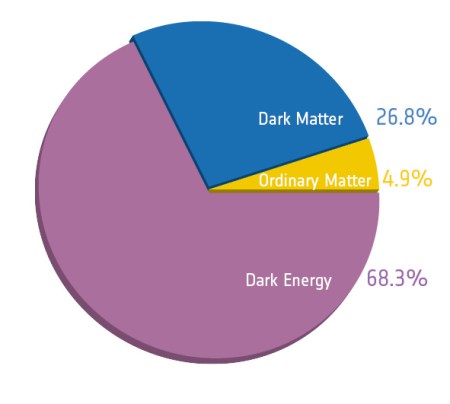
On the left you can see the breakdown of the various components involved in the standard model with the whole pie representing a flat Universe. You see there’s a vary strange mixture dominated by dark energy (which we don’t understand) and dark matter (which we don’t understand). The bit we understand a little bit better (because we can sometimes see it directly) is only 5% of the whole thing. The proportions do look very peculiar.

And then finally, there is the issue that I have ablogged about (here and there) previously, which is why the Universe appears to be a bit lop-sided and asymmetrical when we’d like it to be a bit more aesthetically pleasing.

All these curiosities are naturally accounted for in my New Theory of the Universe, which asserts that the Divine Creator actually bought  the entire Cosmos  in IKEA.

This hypothesis immediately explains why the Universe is flat. Absolutely everything in IKEA comes in flat packs. Curvature is not allowed.

But this is not the only success of my theory. When God got home He obviously opened the flat pack, found the instructions and read the dreaded words “EASY SELF-ASSEMBLY”. Even the omnipotent would struggle to follow the bizarre set of cartoons and diagrams that accompany even the simplest IKEA furniture. The result is therefore predictable: strange pieces that don’t seem to fit together, bits left over whose purpose is not at all clear, and an overall appearance that is not at all like one would have expected.

It’s clear  where the lop-sidedness comes in too. Probably some of the parts were left out so the whole thing isn’t  held together properly and is probably completely unstable. This sort of thing happens all the time with IKEA stuff. And why is it you can never find the right size Allen Key to sort it out?

So there you have it. My new Theory of the Universe. Some details need to be worked out, but it is as good an explanation of these issues as I have heard. I claim my Nobel Prize.

If anything will ever get me another trip to Sweden, this will…

Light, I know, treads the ten million stars

Posted in Poetry, The Universe and Stuff with tags , on January 22, 2018 by telescoper

Light, I know, treads the ten million stars,
And blooms in the Hesperides. Light stirs
Out of the heavenly sea onto the moon’s shores.
Such light shall not illuminate my fears
And catch a turnip ghost in every cranny.
I have been frightened of the dark for years.
When the sun falls and the moon stares,
My heart hurls from my side and tears
Drip from my open eyes as honey
Drips from the humming darkness of the hive.
I am a timid child when light is dead.
Unless I learn the night I shall go mad.
It is night’s terrors I must learn to love,
Or pray for day to some attentive god
Who on his cloud hears all my wishes,
Hears and refuses.
Light walks the sky, leaving no print,
And there is always day, the shining of some sun,
In those high globes I cannot count,
And some shine for a second and are gone,
Leaving no print.
But lunar night will not glow in my blackness,
Make bright its corners where a skeleton
Sits back and smiles, A tiny corpse
Turns to the roof a hideous grimace,
Or mice play with an ivory tooth.
Stars’ light and sun’s light will not shine
As clearly as the light of my own brain,
Will only dim life, and light death.
I must learn night’s light or go mad.

by Dylan Thomas (1914-1953)

Newsflash: New Chair at STFC

Posted in Science Politics, The Universe and Stuff with tags , , , on January 22, 2018 by telescoper

As a quick piece of community service I thought I’d pass on the news of the appointment of a new Executive Chair for the Science and Technology Facilities Council (STFC), namely Professor Mark Thomson of the University of Cambridge. Developments at STFC will cease to be relevant to me after this summer as I’m moving to Ireland but this is potentially very important news for many readers of this blog.

Professor Thomson is an Experimental Particle Physicist whose home page at Cambridge describes his research in thuswise manner:

My main research interests are neutrino physics, the physics of the electroweak interactions, and the design of detectors at a future colliders. I am co-spokesperson of the DUNE collaboration, which consists of over 1000 scientiests and engineers from over 170 institutions in 31 nations across the globe. The Cambridge neutrino group splits its acivities between MicroBooNE and DUNE and is using advanced particle flow calorimetry techniques to interpret the images from large liquid argon TPC neutrino detector.

I’ve added a link to the DUNE collaboration for those of you who don’t know about it – it’s a very large neutrino physics experiment to be based in the USA.

On the announcement, Prof. Thomson stated:

I am passionate about STFC science, which spans the smallest scales of particle physics to the vast scales of astrophysics and cosmology, and it is a great honour be appointed to lead STFC as its new Executive Chair. The formation of UKRI presents exciting opportunities for STFC to further develop the UK’s world-leading science programme and to maximise the impact of the world-class facilities supported by STFC.

This appointment needs to be officially confirmed after a pre-appointment hearing by the House of Commons Science and Technology Committee but, barring a surprise offer of the position to Toby Young, he’s likely to take over the reins at STFC in April this year. He’ll have his work cut out trying to make the case for continued investment in fundamental science in the United Kingdom, in the face of numerous challenges, so I’d like to take this opportunity to wish him the very best of luck in his new role!

Cosmology: The Professor’s Old Clothes

Posted in Education, The Universe and Stuff with tags , , , , , , , on January 19, 2018 by telescoper

After spending  a big chunk of yesterday afternoon chatting the cosmic microwave background, yesterday evening I remembered a time when I was trying to explain some of the related concepts to an audience of undergraduate students. As a lecturer you find from time to time that various analogies come to mind that you think will help students understand the physical concepts underpinning what’s going on, and that you hope will complement the way they are developed in a more mathematical language. Sometimes these seem to work well during the lecture, but only afterwards do you find out they didn’t really serve their intended purpose. Sadly it also  sometimes turns out that they can also confuse rather than enlighten…

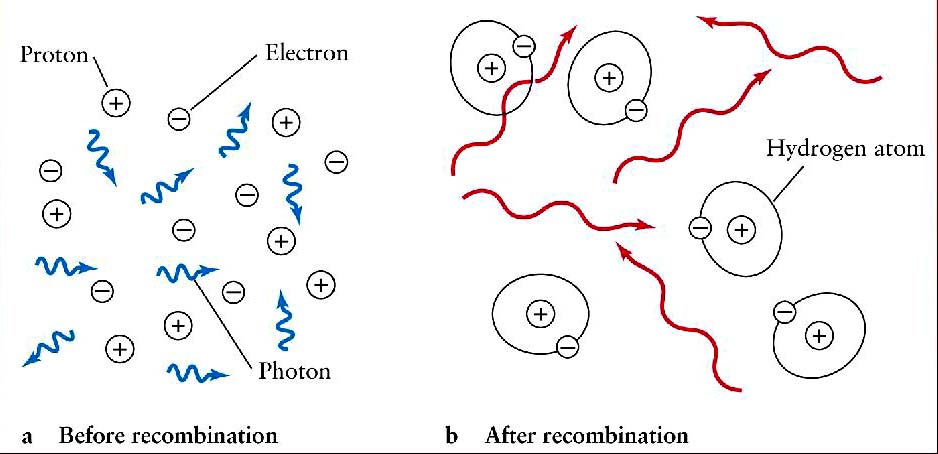
For instance, the two key ideas behind the production of the cosmic microwave background are recombination and the consequent decoupling of matter and radiation. In the early stages of the Big Bang there was a hot plasma consisting mainly of protons and electrons in an intense radiation field. Since it  was extremely hot back then  the plasma was more-or-less  fully ionized, which is to say that the equilibrium for the formation of neutral hydrogen atoms via

p+e^{-} \rightarrow H+ \gamma

lay firmly to the left hand side. The free electrons scatter radiation very efficiently via Compton  scattering

\gamma +e^{-} \rightarrow \gamma + e^{-}

thus establishing thermal equilibrium between the matter and the radiation field. In effect, the plasma is opaque so that the radiation field acquires an accurate black-body spectrum (as observed). As long as the rate of collisions between electrons and photons remains large the radiation temperature adjusts to that of the matter and equilibrium is preserved because matter and radiation are in good thermal contact.


Image credit: James N. Imamura of University of Oregon.

Eventually, however, the temperature falls to a point at which electrons begin to bind with protons to form hydrogen atoms. When this happens the efficiency of scattering falls dramatically and as a consequence the matter and radiation temperatures are no longer coupled together, i.e. decoupling occurs; collisions can longer keep everything in thermal equilibrium. The matter in the Universe then becomes transparent, and the radiation field propagates freely as a kind of relic of the time that it was last in thermal equilibrium. We see that radiation now, heavily redshifted, as the cosmic microwave background.

So far, so good, but I’ve always thought that everyday analogies are useful to explain physics like this so I thought of the following.

When people are young and energetic, they interact very extensively with everyone around them and that process allows them to keep in touch with all the latest trends in clothing, music, books, and so on. As you get older you don’t get about so much , and may even get married (which is just like recombination, not only that it involves the joining together of previously independent entities, but also in the sense that it dramatically  reduces their cross-section for interaction with the outside world).  As time goes on changing trends begin to pass you buy and eventually you become a relic, surrounded by records and books you acquired in the past when you were less introverted, and wearing clothes that went out of fashion years ago.

I’ve used this analogy in the past and students generally find it quite amusing even if it has modest explanatory value. I wasn’t best pleased, however, when a few years ago I set an examination question which asked the students to explain the processes of recombination and decoupling. One answer said

Decoupling explains the state of Prof. Coles’s clothes.

Anyhow, I’m sure there’s more than one reader out there who has had a similar experience with an analogy that wasn’t perhaps as instructive as hoped or which came back to bite you. Feel free to share through the comments box…

Beyond Falsifiability: Normal Science in a Multiverse

Posted in The Universe and Stuff with tags , , , , , , on January 17, 2018 by telescoper

There’s a new paper on the arXiv by Sean Carroll called Beyond Falsifiability: Normal Science in a Multiverse. The abstract is:

Cosmological models that invoke a multiverse – a collection of unobservable regions of space where conditions are very different from the region around us – are controversial, on the grounds that unobservable phenomena shouldn’t play a crucial role in legitimate scientific theories. I argue that the way we evaluate multiverse models is precisely the same as the way we evaluate any other models, on the basis of abduction, Bayesian inference, and empirical success. There is no scientifically respectable way to do cosmology without taking into account different possibilities for what the universe might be like outside our horizon. Multiverse theories are utterly conventionally scientific, even if evaluating them can be difficult in practice.

I’ve added a link to `abduction’ lest you think it has something to do with aliens!

I haven’t had time to read all of it yet, but thought I’d share it here because it concerns a topic that surfaces on this blog from time to time. I’m not a fan the multiverse because (in my opinion) most of the arguments trotted out in its favour are based on very muddled thinking. On the other hand, I’ve never taken seriously any of the numerous critiques of the multiverse idea based on the Popperian criterion of falsifiability because (again, in my opinion) that falsifiability has very little to do with the way science operates.

Anyway, Sean’s papers are always interesting to read so do have a look if this topic interests you. And feel free to comment through the box below.