Archive for the The Universe and Stuff Category

Merging Galaxies in the Early Universe

Posted in The Universe and Stuff with tags , , , , on November 14, 2017 by telescoper

I just saw this little movie circulated by the European Space Agency.

The  source displayed in the video was first identified by European Space Agency’s now-defunct Herschel Space Observatory, and later imaged with much higher resolution using the ground-based Atacama Large Millimeter/submillimeter Array (ALMA) in Chile. It’s a significant discovery because it shows two large galaxies at quite high redshift (z=5.655) undergoing a major merger. According to the standard cosmological model this event occurred about a billion years after the Big Bang. The first galaxies are thought to have formed after a few hundred million years, but these objects are expected to have been be much smaller than present-day galaxies like the Milky Way. Major mergers of the type seen apparently seen here are needed if structures are to grow sufficiently rapidly, through hierarchical clustering, to produce what we see around us now, about 13.7 Gyrs after the Big Bang.

The ESA press release can be found here and for more expert readers the refereed paper (by Riechers et al.) can be found here (if you have a subscription to the Astrophysical Journal or for free on the arXiv here.

The abstract (which contains a lot of technical detail about the infra-red/millimetre/submillimetre observations involved in the study) reads:

We report the detection of ADFS-27, a dusty, starbursting major merger at a redshift of z=5.655, using the Atacama Large Millimeter/submillimeter Array (ALMA). ADFS-27 was selected from Herschel/SPIRE and APEX/LABOCA data as an extremely red “870 micron riser” (i.e., S_250<S_350<S_500<S_870), demonstrating the utility of this technique to identify some of the highest-redshift dusty galaxies. A scan of the 3mm atmospheric window with ALMA yields detections of CO(5-4) and CO(6-5) emission, and a tentative detection of H2O(211-202) emission, which provides an unambiguous redshift measurement. The strength of the CO lines implies a large molecular gas reservoir with a mass of M_gas=2.5×10^11(alpha_CO/0.8)(0.39/r_51) Msun, sufficient to maintain its ~2400 Msun/yr starburst for at least ~100 Myr. The 870 micron dust continuum emission is resolved into two components, 1.8 and 2.1 kpc in diameter, separated by 9.0 kpc, with comparable dust luminosities, suggesting an ongoing major merger. The infrared luminosity of L_IR~=2.4×10^13Lsun implies that this system represents a binary hyper-luminous infrared galaxy, the most distant of its kind presently known. This also implies star formation rate surface densities of Sigma_SFR=730 and 750Msun/yr/kpc2, consistent with a binary “maximum starburst”. The discovery of this rare system is consistent with a significantly higher space density than previously thought for the most luminous dusty starbursts within the first billion years of cosmic time, easing tensions regarding the space densities of z~6 quasars and massive quiescent galaxies at z>~3.

The word `riser’ refers to the fact that the measured flux increases with wavelength from the range of wavelengths measured by Herschel/Spire (250 to 500 microns) and up 870 microns. The follow-up observations with higher spectral resolution are based on identifications of carbon monoxide (CO) and water (H20) in the the spectra, which imply the existence of large quantities of gas capable of fuelling an extended period of star formation.

Clearly a lot was going on in this system, a long time ago and a long way away!


Unprofessional Astronomy – arXiv:1711.02090

Posted in Harassment Bullying etc, The Universe and Stuff with tags , , , on November 8, 2017 by telescoper

It is essential to the way that science works that published results are challenged by independent scrutiny and by confrontation with rival analysis. New facts and new theoretical explanations are often established and previously existing misapprehensions eliminated through this form of critical dialogue. More often than not this process of claim and counter-claim is carried out in a collegiate spirit because all parties are mindful that this kind of debate is part and parcel of the scientific method. To behave otherwise as a scientist is unprofessional.

Regrettably, however, sometimes scientists overstep the mark and engage in behaviour which falls short of this expectation, particularly when it is by a senior scientist directed towards a junior colleague because then unnecessarily aggressive criticism can take on the mantle of bullying.

Today I saw a paper on the arXiv by Bouwens et al. that contains criticism of a previous paper by Livermore et al. (2017) (arXiv version here) which I think oversteps the mark in this way, especially because the lead author of the first paper, Rychard Bouwens, is an established (male) academic and the first author of the second, Rachael Livermore, is a (female) postdoctoral researcher.

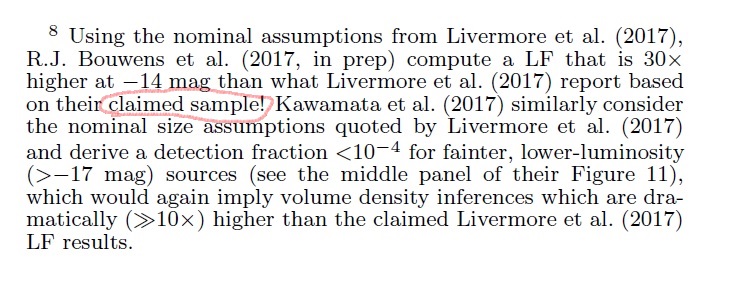
Two footnotes from the Bouwens et al. paper suffice to give a flavour of the tone. This is footnote 8:

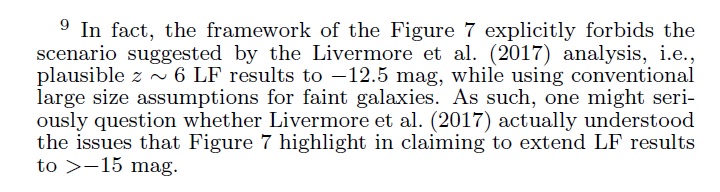
This is footnote 9:

There are a number of inappropriate aspects of these comments (and others made elsewhere in the paper). I’ll mention just two.

First, note the highlighted `claimed sample’ in Footnote 8. The only way I can read this phrase is as an insinuation that the Livermore et al. sample has somehow been fabricated. In other words, it is a snide allegation of research misconduct. This may not be what Bouwens et al intended to say, but that’s certainly how it reads. And the phrase `claimed sample’ appears more than once in their paper. If they don’t mean it that way then I strongly suggest they edit the paper to clarify, as it is potentially extremely defamatory.

Second, note that the Livermore et al. results are published in the Astrophysical Journal. That means that they have therefore passed peer review and are in the public domain. That does not mean that they cannot be challenged, of course, but note that in Footnote 8, Bouwens et al. refer to an article that is not public, not refereed and not even finished.  I don’t think this it is fair to include this in the current paper as the evidence to back up the criticism is simply not available. Note also the implication in Footnote 9 that the referee of this paper did not understand the issues presented in the paper, either.

Now I don’t know who (if anyone) is right about the luminosity function results in these papers. Luminosity function determinations are difficult, being prone to all kinds of selection biases and other problems. I am not going to side with either set of authors on the technicalities. I just think it’s extremely regrettable that Bouwens have adopted this tone towards another group of authors whom they should regard as colleagues. It is perfectly reasonable to criticise the work of another group in the literature, but in my experience this usually only happens after the two teams have discussed the issues in private and failed to reconcile their differences. That can and does happen, but here there does not seem to have been any attempt to sort this out amicably before going on the offensive. I find that deeply regrettable.

By the way, this is the AAS Policy on Professional and Ethical Standards for its journals (including the Astrophysical Journal, to which the Bouwens et al. paper has been submitted):


Dark Matter Day

Posted in History, The Universe and Stuff with tags , , , , , on October 31, 2017 by telescoper

As a welcome alternative to the tedium of Hallowe’en (which I usually post about in this fashion), I notice that today (31st October 2017) has been officially designated Dark Matter Day. I would have sent some appropriate greetings cards but I couldn’t find any in the shops…

All of which gives me the excuse to post this nice video which shows (among other things) how dark matter plays a role in the formation of galaxies:

P.S. Lest we forget, today is also the 500th anniversary of the day that Martin Luther knocked on the door of All Saints’ Church in Wittenberg and said `Trick or Theses?’ (Is this right? Ed.)

National STFC Data-Intensive Science Launch Event

Posted in Science Politics, The Universe and Stuff with tags , , , , , on October 27, 2017 by telescoper

It’s been a very busy week here in Cardiff, as we have been hosting a National Event to launch the Science and Technology Facilities Council (STFC)’s new Centres for Doctoral Training in Data-Intensive Science. There are eight new CDTs involving 19 institutions across the country (including the local one that involved the Universities of Cardiff, Bristol and Swansea). We were delighted to be chosen to host this event, which has had a tremendous buzz about it, as 120 new PhD students met with academics from all the CDTs, STFC staff, and representatives of industry partners, for a mixture of training and networking activities. I took part in a panel discussion this morning about careers, which was very interesting.

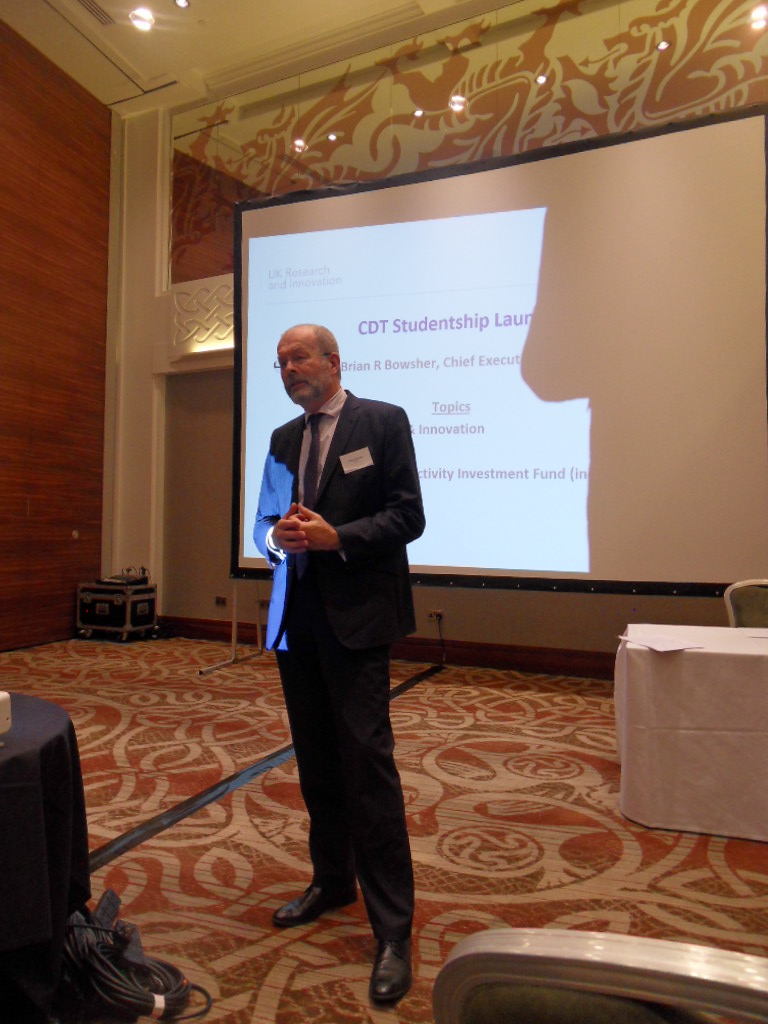
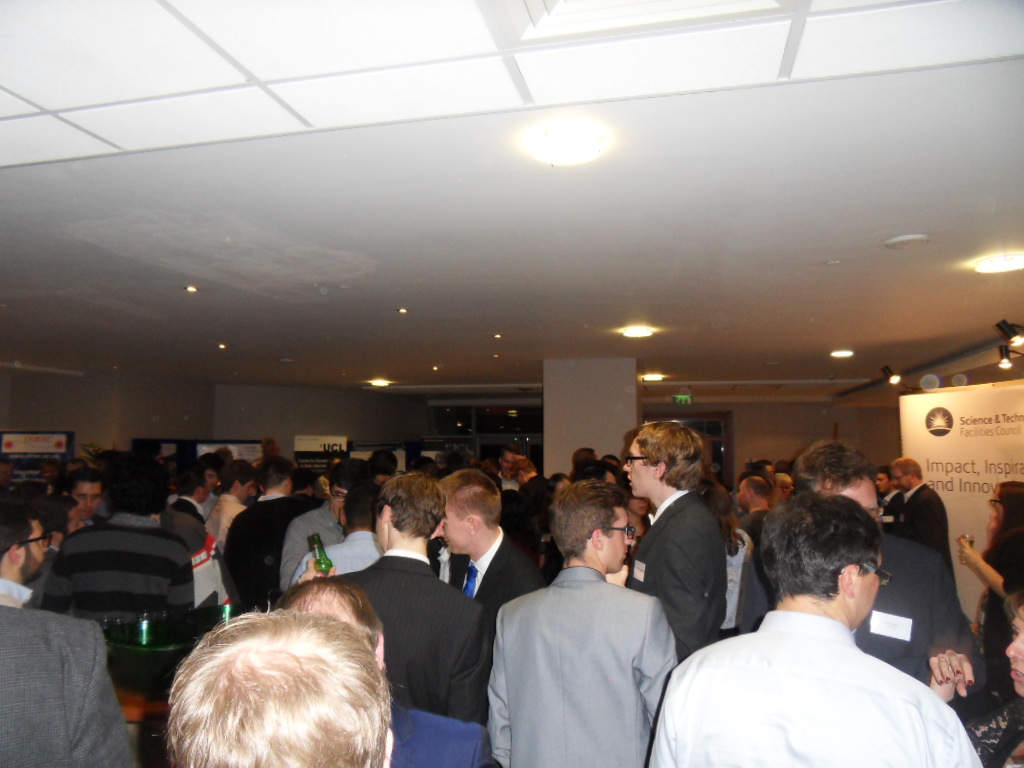
Last night we had a dinner at the Mercure Hotel in Cardiff (where the Real Madrid team stayed just before this summer’s UEFA Champions League Final in Cardiff). The dinner was preceded by a welcome from Professor Karen Holford (Deputy Vice-Chancellor of Cardiff University), a talk by Brian Bowsher (Chief Executive of STFC) and Prof. Patrick Sutton of the Gravitional Physics group at Cardiff who gave an outstanding talk about the latest developments in gravitational waves. There was then a `showcase’ event to allow students and staff to talk about their work over a few drinks.

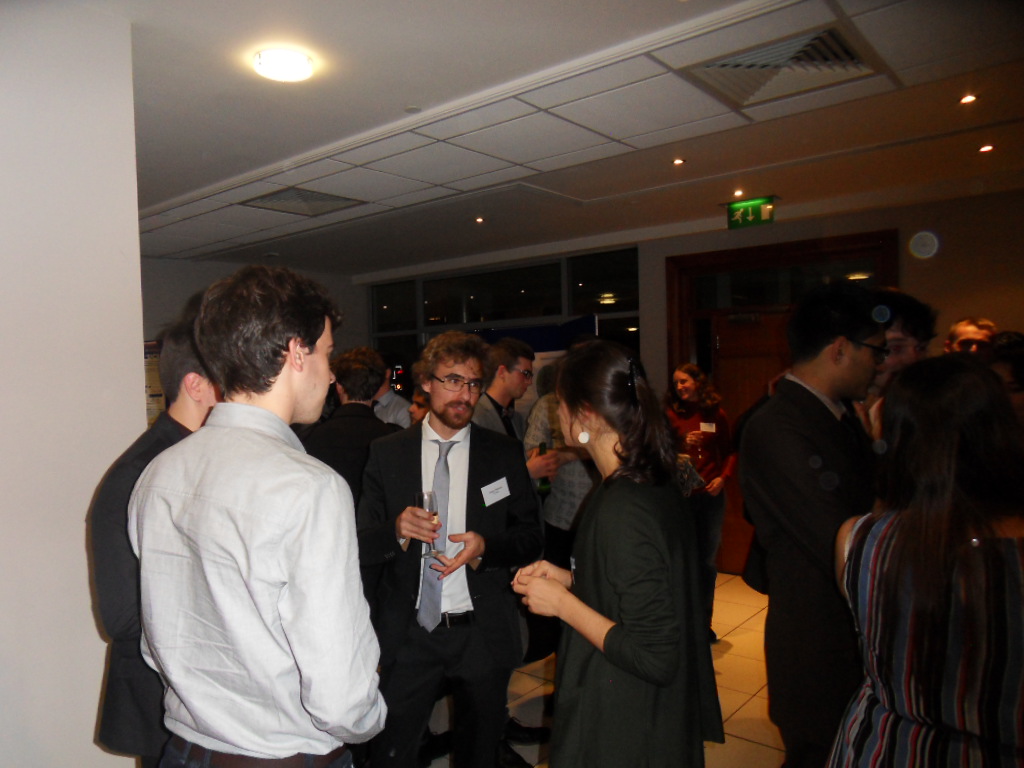
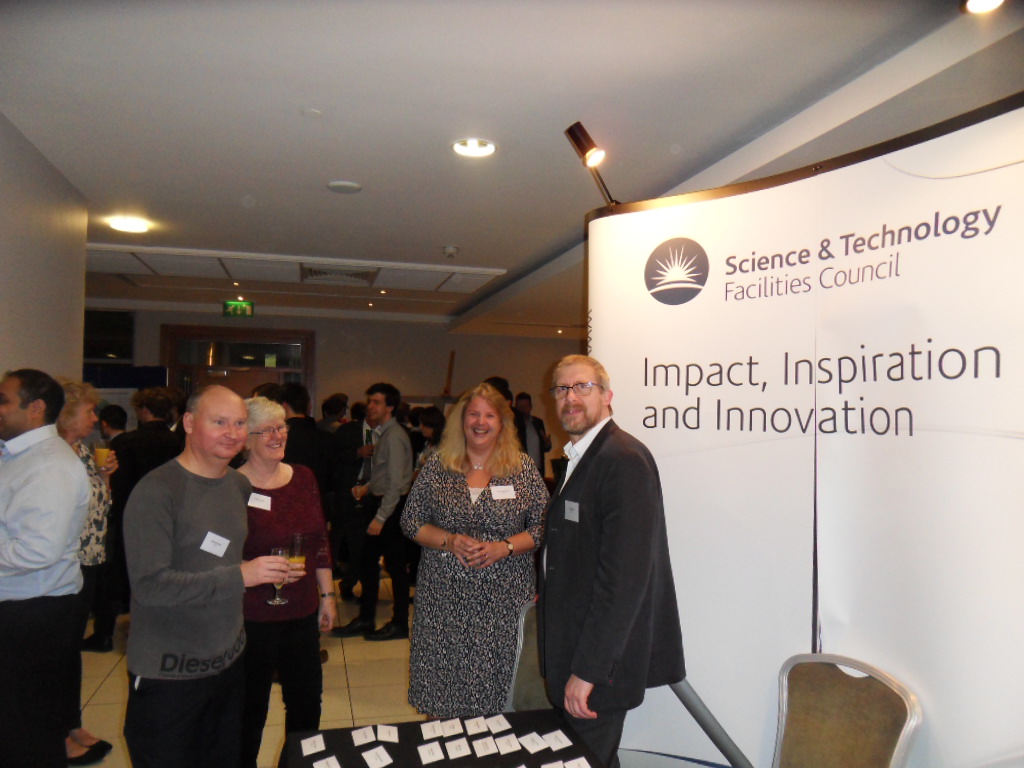
Here are some pictures of yesterday’s activities.

Prof. Karen Holford giving her welcome speech.

Dr Bian Bowsher, STFC Chief Executive

I noticed in Dr Bowsher’s talk that STFC has apparently moved the Boulby Mine from North Yorkshire (near Whitby) to Northumberland:

STFC sites (some of them in the correct geographical location).

Professor Mark Walport was unable to attend the event in person but did at least appear on a slide about the new UK Research and Innovation entity, which formally comes into existence in April 2018!

Professor Sir Mark Walport

Patrick Sutton doing his gravitational waves talk…

The Showcase Event

Showcase Event

And here are some of the members of the team from STFC who did most of the organization for this very successful and enjoyable event.

Some members of the STFC team!

The event finishes this afternoon, after which I think I’ll have a lie down!

Update: there’s a Cardiff University News item about this here.

Physics of the EU – Revised Syllabus

Posted in Politics, The Universe and Stuff with tags , , on October 25, 2017 by telescoper

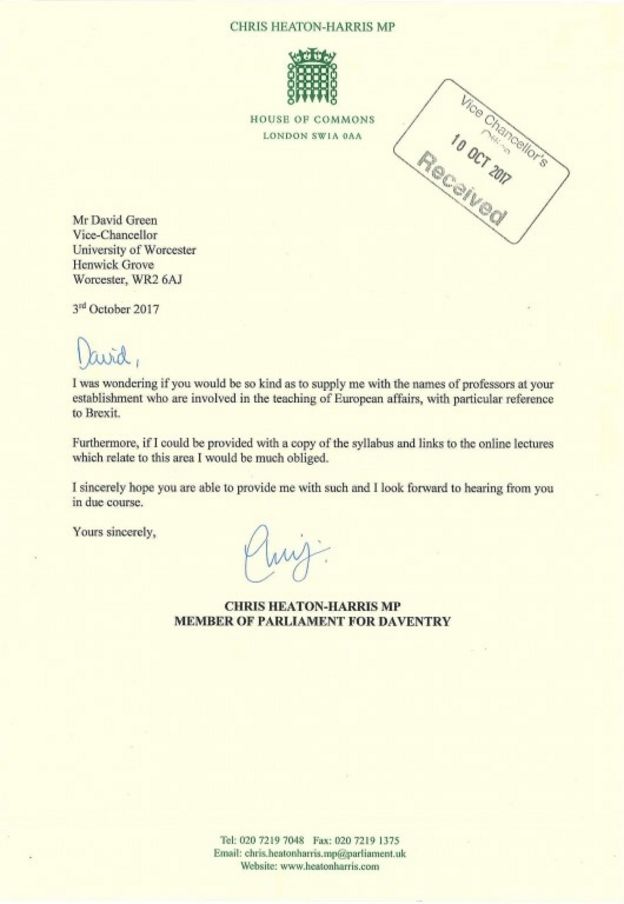
Yesterday, Tory MP Christopher Heaton-Harris wrote to all Vice-Chancellors of UK universities asking them to send him the names of professors teaching about “European affairs” together with links to relevant syllabuses and course materials. There has been an overwhelmingly negative response to this sinister request, which comes from an arch-Brexiteer apparently intent on thought control.

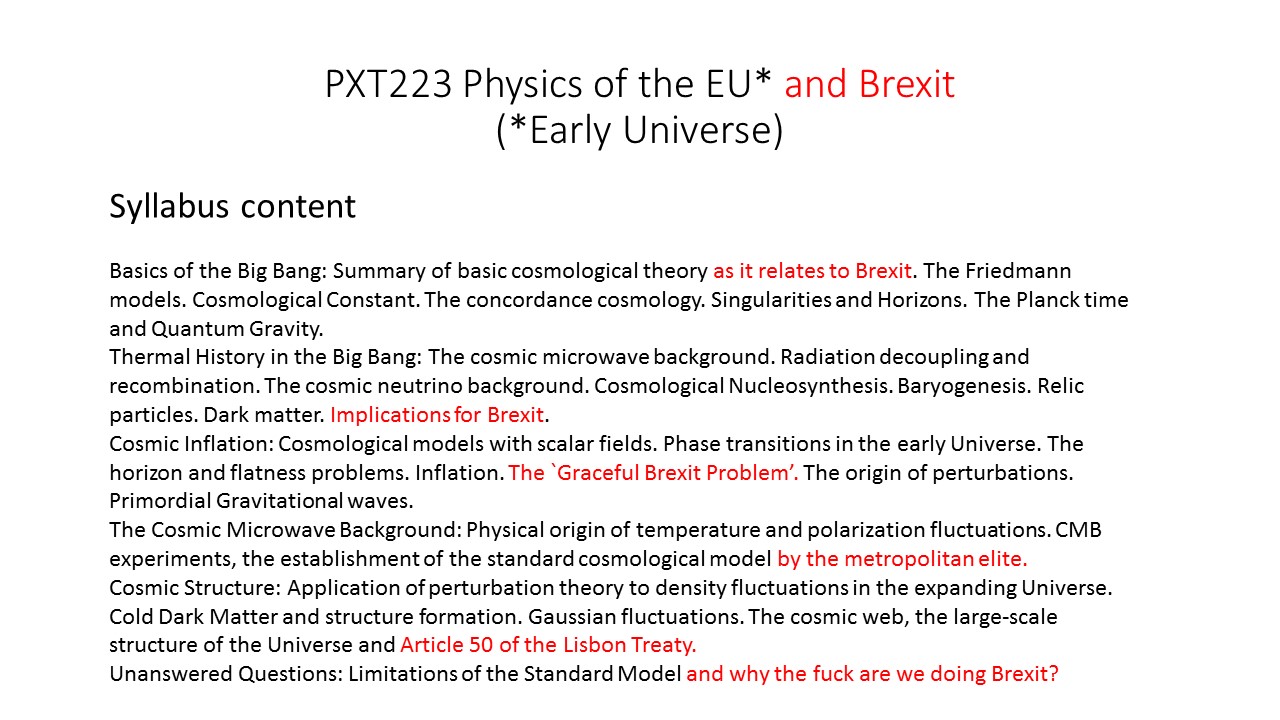
Not wishing to fall foul of the Brexit Police, I have updated my syllabus for next term and include it here so Mr McCarthy Heaton-Harris can read it:

I’m afraid that, for any further information and/or course materials relating to this module, Mr Heaton-Harris will have to register and pay the requisite fee which, thanks to his government is £9250.

P.S. I posted this slide on Twitter yesterday, and it got as close as any of my tweets have ever done to going viral (with over 800 retweets).

Strong constraints on cosmological gravity from GW170817 and GRB 170817A

Posted in The Universe and Stuff with tags , , , , , on October 24, 2017 by telescoper

One of the many interesting scientific results to emerge from last week’s announcement of a gravitational wave source (GW170817) with an electromagnetic counterpart (GRB 170817A) is the fact that it provides constraints on departures from Einstein’s General Theory of Relativity. In particular the (lack of a) time delay between the arrival of the gravitational and electromagnetic signals can be used to rule out models that predict that gravitational waves and electromagnetic waves travel with different speeds. The fractional time delay associated with this source is constrained to be less than 10-17 which actually rules out many of the proposed alternatives to general relativity. Modifications of Einstein’s gravity have been proposed for a number of reasons, including the desire to explain the dynamics of the expanding Universe without the need for Dark Energy or Dark Matter (or other exotica), but many of these are now effectively dead.

Anyway, I bookmarked a nice paper about this last week while I was in India but forgot to post it then, so if you’re interested in reading more about this have a look at this arXiv paper by Baker et al., which has the following abstract:

The detection of an electromagnetic counterpart (GRB 170817A) to the gravitational wave signal (GW170817) from the merger of two neutron stars opens a completely new arena for testing theories of gravity. We show that this measurement allows us to place stringent constraints on general scalar-tensor and vector-tensor theories, while allowing us to place an independent bound on the graviton mass in bimetric theories of gravity. These constraints severely reduce the viable range of cosmological models that have been proposed as alternatives to general relativistic cosmology.

Determining the Hubble Constant the Bernard Schutz way

Posted in The Universe and Stuff with tags , , , , , on October 19, 2017 by telescoper

In my short post about Monday’s announcement of the detection of a pair of coalescing neutron stars (GW170817), I mentioned that one of the results that caught my eye in particular was the paper about using such objects to determine the Hubble constant.

Here is the key result from that paper, i.e. the posterior distribution of the Hubble constant H0 given the data from GW170817:

You can also see latest determinations from other methods, which appear to be in (slight) tension; you can read more about this here. Clearly the new result from GW170817 yields a fairly broad range for H0 but, as I said in my earlier post, it’s very impressive to be straddling the target with the first salvo.

Anyway, I just thought I’d mention here that the method of measuring the Hubble constant using coalescing binary neutron stars was invented by none other than Bernard Schutz of Cardiff University, who works in the Data Innovation Institute (as I do). The idea was first published in September 1986 in a Letter to Nature. Here is the first paragraph:

I report here how gravitational wave observations can be used to determine the Hubble constant, H 0. The nearly monochromatic gravitational waves emitted by the decaying orbit of an ultra–compact, two–neutron–star binary system just before the stars coalesce are very likely to be detected by the kilometre–sized interferometric gravitational wave antennas now being designed1–4. The signal is easily identified and contains enough information to determine the absolute distance to the binary, independently of any assumptions about the masses of the stars. Ten events out to 100 Mpc may suffice to measure the Hubble constant to 3% accuracy.

In in the paper, Bernard points out that a binary coalescence — such as the merger of two neutron stars — is a self calibrating `standard candle’, which means that it is possible to infer directly the distance without using the cosmic distance ladder. The key insight is that the rate at which the binary’s frequency changes is directly related to the amplitude of the gravitational waves it produces, i.e. how `loud’ the GW signal is. Just as the observed brightness of a star depends on both its intrinsic luminosity and how far away it is, the strength of the gravitational waves received at LIGO depends on both the intrinsic loudness of the source and how far away it is. By observing the waves with detectors like LIGO and Virgo, we can determine both the intrinsic loudness of the gravitational waves as well as their loudness at the Earth. This allows us to directly determine distance to the source.

It may have taken 31 years to get a measurement, but hopefully it won’t be long before there are enough detections to provide greater precision – and hopefully accuracy! – than the current methods can manage!

Above all, congratulations to Bernard for inventing a method which has now been shown to work very well!

Back to Blighty

Posted in Biographical, The Universe and Stuff with tags , , on October 18, 2017 by telescoper

Just a brief post today to say that I got back safe and sound last night. I was up at 4am Tuesday Pune time (which was 11.30pm Monday UK time) and finally got to bed at about 11.30pm UK time last night, so apart from about 45 minutes doze on the flight I had been awake for 24 hours. Not surprisingly, I slept in this morning!

After another white-knuckle taxi ride (with the added complication of thick fog) I got Mumbai airport in good time. The flight itself was almost empty. Not only did I get a row of seats to myself in economy class, but the two rows in front in and the two rows behind were also unoccupied. I’m not entirely sure why the flight was so underbooked – as the outbound flight was absolutely crammed – but it may be that the festival of Diwali takes place this week (on Thursday or even today in some regions). Relatively few people are probably leaving India at this time compared with the many coming home to celebrate with friends and family. It’s a nice coincidence that Monday’s announcement of simultaneous detection of gravitational waves and electromagnetic radiation came so close to the Festival of Light, traditionally celebrated with fireworks and gifts of gold!

Despite liberal helpings of wine from the drinks trolley and the ability to lie down across three seats I still didn’t really sleep. I just don’t have the knack for sleeping on planes. Still, I did get to watch the film The Imitation Game which I hadn’t seen before and thought was very good.

We arrived back on schedule without the (usually) obligatory air traffic delays around Heathrow and, the arrivals hall being empty, I was out of the airport less than half an hour after landing. That’s a bit of record for me!

Anyway, I’ve various things to catch up on now that I’m back so I’ll try to get on with them. I’ll just end by thanking my hosts at IUCAA again for their hospitality and, while I’m at it, send a Happy Diwali message in Marathi to them and anyone else celebrating at this special time:


GW News Day

Posted in The Universe and Stuff with tags , , on October 16, 2017 by telescoper

Well, it has certainly been an eventful last day in India!

Over a hundred people gathered at IUCAA to see this evening’s press conference, which basically confirmed most of the rumours that had been circulating that a Gamma Ray Burst had been detected in both GW and EM radiation. I won’t write in detail about today’s announcement because (a) a really useful page of resources has been prepared by the group at IUCAA. Check out the fact sheet and (b) I haven’t really had time to digest all the science yet.

I will mention a couple of things, however. One is that the signal-to-noise ratio of this detection is a whopping 32.4, a value that astronomers can usually only dream of! The other is that neutron star coalescence offer the possibility to bypass the traditional `distance ladder’ approaches to get an independent measurement of the Hubble constant. The value obtained is in the range 62 to 107 km s-1 Mpc-1, which is admittedly fairly broad, but is based on only one observation of this type. It is extremely impressive to be straddling the target with the very first salvo.

The LIGO collaboration is over a thousand people. Add to that the staff of no fewer than seventy observatories (including seven in space). With all that’s going in the world, it’s great to see what humans of different nations across the globe can do when they come together and work towards a common goal. Scientific results of this kind will remembered long after the silly ramblings of our politicians and other fools have been forgotten.

I took part in a panel discussion after the results were presented, but sadly I won’t be here to see tomorrow’s papers. I hope people will save cuttings or post weblinks if there are any articles!

UPDATE: Here is a selection of the local press coverage.

Indian LIGO

As if these thrilling science results weren’t enough I finally managed to meet my old friend and former collaborator Varun Sahni (who was away last week). An invitation to dinner at his house was not to be resisted on my last night here, which explains why I didn’t write a post immediately after the press conference. Still, of got plenty of papers to read on the plane tomorrow so maybe I’ll do something when I get back.

Tomorrow morning I get up early to return to Mumbai for the flight home, and am not likely to be online again until Wednesday UK time.

Thanks to all at IUCAA (and TIFR) for making my stay so pleasant and interesting. It’s been 23 years since I was last here. I hope it’s not so long before I’m back again!

Homes from Home in Pune

Posted in Biographical, History, The Universe and Stuff with tags , , , on October 16, 2017 by telescoper

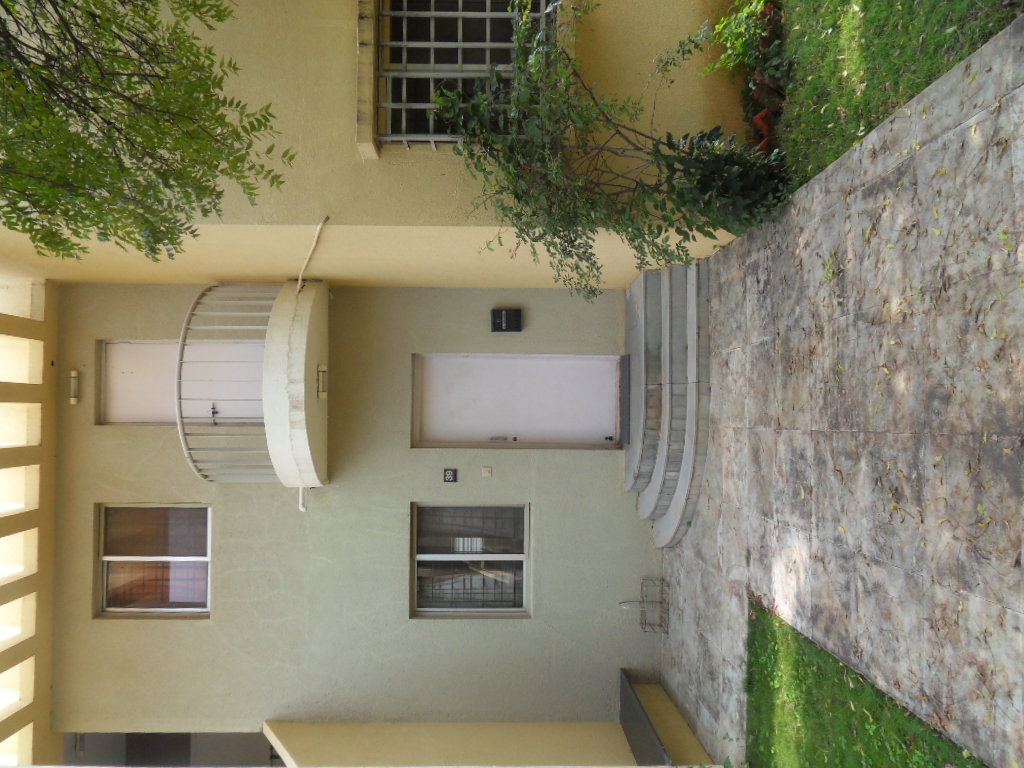
Since I’m coming back tomorrow I thought I’d wander around this morning and take a few pictures of where I’ve been staying most of the last 10 days or so. First, this is a snap of the housing complex which contains my guest apartment.

I’m actually in the first building on the right. Here is the front door.

The faculty at both IUCAA (Pune) and TFIR (Mumbai) live in housing areas provided by their respective institutions, so they form quite a close-knit community. Some of the senior staff in IUCAA are housed just round the corner from my place.

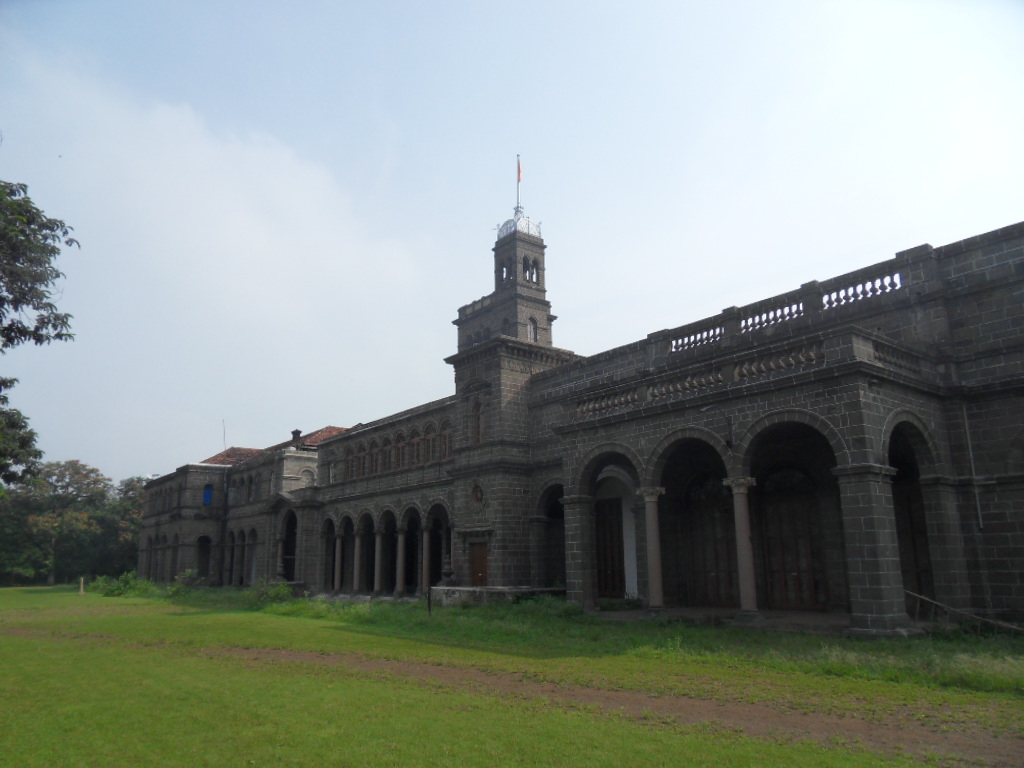
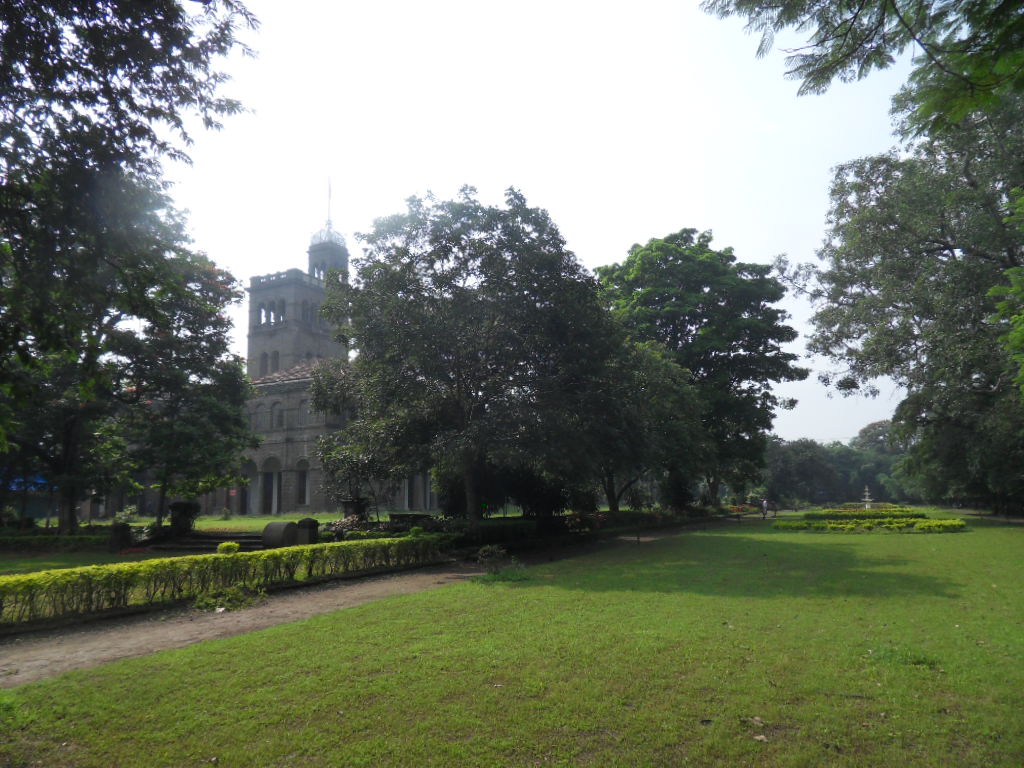
IUCAA is on the Pune University Campus (except that it has its own entrance from the main road that runs along the Northern edge of the campus, where there is a security post. There are a few of these around the IUCAA site itself, so it is very secure and quite private. The campus is large with many tree-lined roads. At its heart, on a small hill, you can find this building:

This is (or was) the Raj Bhavan (`Government House’) and it was essentially the Governor of Maharashtra’s residence during the Monsoon season. Built in 1866, it was a sort of home-from-home when Bombay (the state capital) became too unbearable.

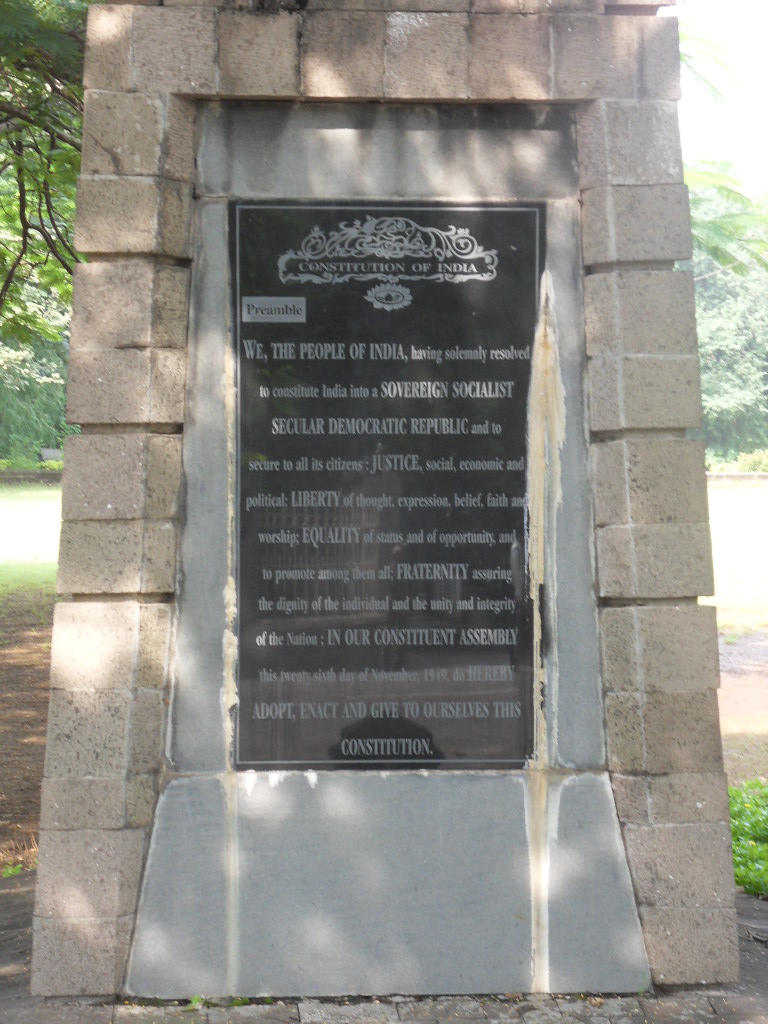
When I was last here in 1994, this was the Main Building of the University and was quite busy. Now, however, it seems to be disused and is in a state of some disrepair, the gardens also need a bit of love and attention. There are many new buildings around the University of Pune campus (including a modern administration block nearby). Since this building is a relic of the old colonial days it may be that it will be demolished to make way for something that better suits modern India. By the way, there’s a stone slab just next to the site of this building that displays the preamble to the Constitution of India, as adopted in 1949.

Anyway, this afternoon and evening promise to be quite busy. There is a press conference at IUCAA at 6.30pm about the gravitational waves discovery I mentioned a few days ago. There will be presentations before a viewing of the live feed from Washington DC then there’ll be a panel answering questions from the press. They’ve asked me to be on the panel, so I might appear in the India media, but as I’m leaving first thing tomorrow morning I probably won’t see any of the coverage!