Archive for the The Universe and Stuff Category

Nine Years In The Dark!

Posted in Biographical, The Universe and Stuff with tags on September 15, 2017 by telescoper

When I logged onto WordPress today  I received a message that it was the 9th anniversary of my registration with them as a blogger, which is when I took my first step into the blogosphere; that was way back on 15th September 2008. I actually wrote my first post that day too. Unfortunately I didn’t really know what I was doing on my first day at blogging – no change there, then –  and I didn’t actually manage to figure out how to publish this earth-shattering piece. It was only after I’d written my second post that I realized that the first one wasn’t actually visible to the general public because I hadn’t pressed the right buttons, so the two appear in the wrong order in my archive.

I’d like to take this opportunity to send my best wishes, and to thank, everyone who reads this blog, however occasionally. According to the WordPress stats, I’ve got readers from all round the world, including one in the Vatican! If you’re interested in statistics then, as of 14.30 BST today, I have published 3,806 blog posts, and have received 3,220,896 hits altogether; I get an average of about 1200 per day, but this varies in a very erratic fashion. The greatest number of hits I have received in a day is 8,864 (at the peak of the BICEP2 controversy). There have been 27,590 comments published on here and  1,705,410 rejected. Most of the rejected comments were from automated spam bots, but a small number have been removed for various violations, usually for abuse of some kind. Yes, I do get to decide what is published. It’s my blog!

While I am on the subject of comments, I’ll just repeat here my comments policy as stated on the home page of this blog:

Feel free to comment on any of the posts on this blog but comments may be moderated; anonymous comments and any considered by me to be abusive will not be accepted. I do not necessarily endorse, support, sanction, encourage, verify or agree with the opinions or statements of any information or other content in the comments on this site and do not in any way guarantee their accuracy or reliability.

It does mean a lot to me to know that there are people who find my ramblings interesting enough to look at, and sometimes even to come back for more, so I’d like to take this opportunity to send my best wishes to all those who follow this blog and especially those who take the trouble to comment on it in such interesting and unpredictable ways!


Incidentally, I noticed that another auspicious anniversary falls today. It is now thirty years to the day since my second refereed paper was published!  Here’s the front page:


Reading through it again now it seems incredibly simplistic and dated. It may not exactly be a classic, but it still gets the odd citation!

Countdown to Cassini’s Grand Finale

Posted in The Universe and Stuff with tags , , , , on September 12, 2017 by telescoper

In case you didn’t realise, this week sees the end of the superbly successful NASA mission Cassini, which has been exploring Saturn, its ring systems and its many satellites since it arrived there in 2004, including sending the Huygens probe into the largest moon Titan. Its final act will be to plunge into Saturn itself, which it will do on Friday 15th September, taking measurements all the way until it is destroyed. It has already started the final manoeuvre that will end when it enters the planet’s atmosphere. Radio contact with the spacecraft is expected to be lost  just before 1pm GMT.  For further information about this final act, see here.

Cassini was launched in on October 15 1997, so its mission will have lasted  one month shy of twenty years (although there were many years of preparation before that). Although I don’t work on Solar System studies, I have followed the progress of Cassini with great interest over the years primarily because there was a group (led by Carl Murray) working on Cassini (specifically on its imaging system) at Queen Mary when I was there during the 1990s.  I was there in 1997 when the spacecraft was launched, but at that time the rendezvous date with Saturn of 2004 seemed in the unimagineably distant future. Seven years seems a very long time when you’re young!

Anyway, I’m sure Carl (along with all the other scientists working on the Cassini mission) will feel sadness when it all finally comes to an end, but the consolation will be that the mission  has been such a spectacular scientific triumph. Here’s a video about the end of Cassini, showing some of the highlights of the mission and some of the thoughts of the scientists that have been working in it for so long.


On the Edgeworth Series…

Posted in Bad Statistics, The Universe and Stuff with tags , , on September 12, 2017 by telescoper

There’s a nice paper on the arXiv today by Elena Sellentin, Andrew Jaffe and Alan Heavens about the use of the Edgeworth series in statistical cosmology; it is evidently the first in a series about the Edgeworth series.

Here is the abstract:

Non-linear gravitational collapse introduces non-Gaussian statistics into the matter fields of the late Universe. As the large-scale structure is the target of current and future observational campaigns, one would ideally like to have the full probability density function of these non-Gaussian fields. The only viable way we see to achieve this analytically, at least approximately and in the near future, is via the Edgeworth expansion. We hence rederive this expansion for Fourier modes of non-Gaussian fields and then continue by putting it into a wider statistical context than previously done. We show that in its original form, the Edgeworth expansion only works if the non-Gaussian signal is averaged away. This is counterproductive, since we target the parameter-dependent non-Gaussianities as a signal of interest. We hence alter the analysis at the decisive step and now provide a roadmap towards a controlled and unadulterated analysis of non-Gaussianities in structure formation (with the Edgeworth expansion). Our central result is that, although the Edgeworth expansion has pathological properties, these can be predicted and avoided in a careful manner. We also show that, despite the non-Gaussianity coupling all modes, the Edgeworth series may be applied to any desired subset of modes, since this is equivalent (to the level of the approximation) to marginalising over the exlcuded modes. In this first paper of a series, we restrict ourselves to the sampling properties of the Edgeworth expansion, i.e.~how faithfully it reproduces the distribution of non-Gaussian data. A follow-up paper will detail its Bayesian use, when parameters are to be inferred.

The Edgeworth series – a method of approximating a probability distribution in terms of a series determined by its cumulants – has found a number of cosmological applications over the years, but it does suffer from a number of issues, one of the most important being that it is not guaranteed to be a proper probability distribution, in that the resulting probabilities can be negative…

I’ve been thinking about how to avoid this issue myself, and mentioned a possibility in the talk I gave at South Kensington Technical Imperial College earlier this summer. The idea is to represent the cosmological density field (usually denoted δ) in terms of the square of the modulus of a (complex) wave function ψ i.e. |ψψ*|. It then turns out that the evolution equations for cosmic fluid can be rewritten as a kind of Schrodinger equation. One powerful advantage of this approach is that whatever you do in terms of approximating ψ, the resulting density ψψ* is bound to be positive. This finesses the problem of negative probabilities but at the price of introducing more complexity (geddit?) into the fluid equations. On the other hand, it does mean that even first-order perturbative evolution of ψ guarantees a sensible probability distribution whereas first-order evolution of δ does not.

A Year Back

Posted in Biographical, The Universe and Stuff with tags , on September 1, 2017 by telescoper

So, with the summer drawing to a close, and the contents of my weekly veggie box changing to autumnal varieties, I realise that today is the first anniversary  of my first day back in the School of Physics and Astronomy at Cardiff University. In other words, I’ve now been in office in the Data Innovation Research Institute for a full year.  Very soon we get to the official launch of a couple of things that have started during this time – including a new Centre for Doctoral Training in Data-Intensive Science and two new MSc course which have recruited their first students for entry this year.


I seem to remember this day last year mainly involving running around dealing with administrative matters: taking my P45 to the Human Resources Department, getting my new Staff ID card, trying to get myself set up on the University computer network, and so on. I moved into a large empty office, but it’s now gradually filling up with staff: a couple of Research Software Engineers have been appointed, together with an administrators, and two members of Supercomputing Wales are joining us soon too.

Anyway, I’m shortly off to London for the weekend to catch up with an old friend I haven’t seen for ages. I’m currently pissed off with Great Western Railways for failing to pay a compensation claim I lodged back in June and for slow running on the mainline to Paddington today due to planned engineering to works, so I’ll be travelling to the Big Smoke and back by National Express Coach.


LIGO/VIRGO Update

Posted in The Universe and Stuff with tags , , on August 30, 2017 by telescoper

Judging by by the WordPress blog statistics page, there’s been a lot of traffic here in the past week owing to my post about the rumours of a new gravitational wave source detected by LIGO (and possibly VIRGO). In the interest of completeness I’ll just post a quick update to mention that the latest Observation run at LIGO  finished as planned on 25th August, and this has been marked by an official announcement which I have taken the liberty of presenting here in full:

The Virgo and LIGO Scientific Collaborations have been observing since November 30, 2016 in the second Advanced Detector Observing Run ‘O2’ , searching for gravitational-wave signals, first with the two LIGO detectors, then with both LIGO and Virgo instruments operating together since August 1, 2017. Some promising gravitational-wave candidates have been identified in data from both LIGO and Virgo during our preliminary analysis, and we have shared what we currently know with astronomical observing partners. We are working hard to assure that the candidates are valid gravitational-wave events, and it will require time to establish the level of confidence needed to bring any results to the scientific community and the greater public. We will let you know as soon we have information ready to share.

The last two sentences can be translated roughly as “Back off, and give us time to analyse the data!”, which is not an unreasonable request. Judging by the timescale between detection and publication of the previous LIGO events, it will probably be a matter of months before a formal announcement is made.

I hope this clarifies the situation.


LIGO, Leaks and NGC 4993

Posted in Open Access, The Universe and Stuff with tags , , , , on August 23, 2017 by telescoper

No matter what the official policy may be, the more people there are in a collaboration the more likely it is that someone will let their excitement get to their head and start leaking news and starting rumours either directly or indirectly via social media. And so it came to pass last Friday that the following tweet appeared:

I didn’t comment on the time as I thought it might be unreliable – as it indeed it still may be – but now New Scientist has amplified the signal I feel I can’t really be blamed for mentioning it here.

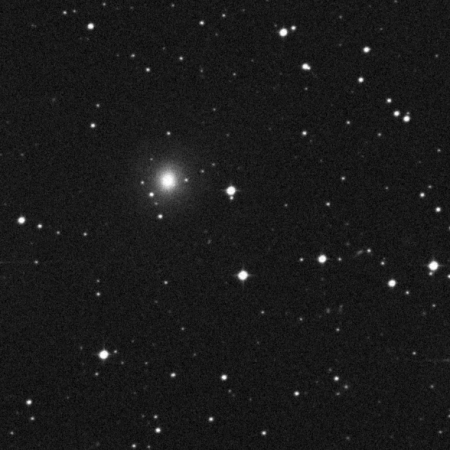
The rumours going round identify the optical counterpart as being in the galaxy NGC 4993 , a red band image of which, from the Second Digitized Sky Survey (DSS2) is shown below:

NGC 4993 is the fuzzy blob slightly above and to the left of the centre of the image. It’s a fairly nondescript lenticular galaxy in a group that can be found in the constellation of Hydra. It lies in the constellation of Hydra, was actually first discovered by William Herschel and it is about 10 arcmin across on the sky. It’s quite nearby, as these things go, with a distance of about 124 million light years (i.e. 40 Mpc or so) and is about 14th magnitude.

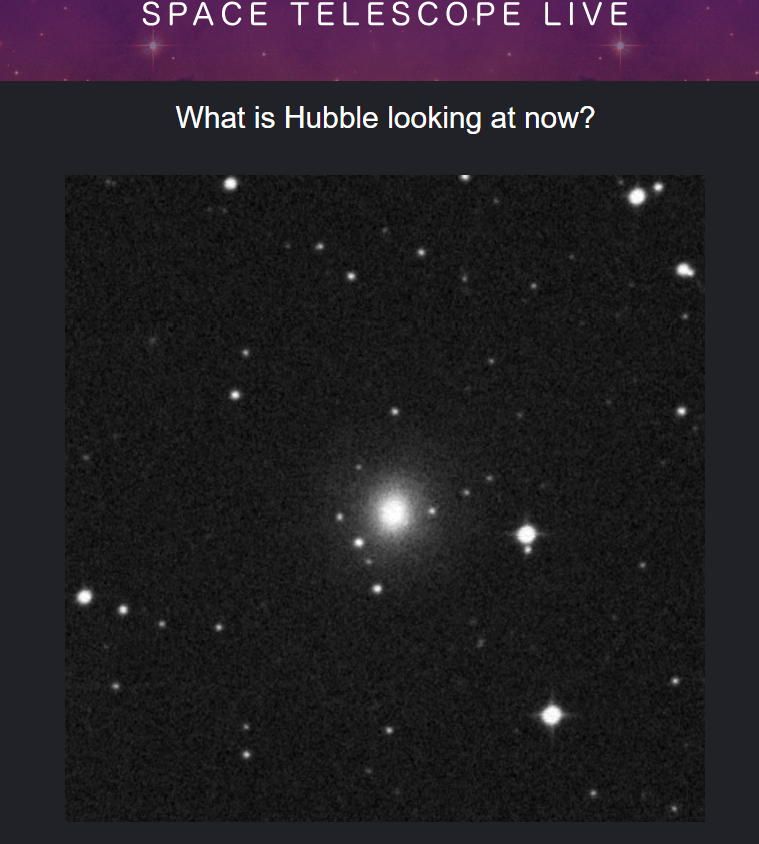
If there is an optical counterpart to a gravitational wave event coming from this galaxy then that suggests it may be a coalescence of neutron stars. The black hole mergers that appear to be responsible to the three existing gravitational wave signals that are claimed to have been detected are not expected to release optical light. Confirmation of this interpretation can be found by where the Hubble Space Telescope was pointed yesterday:

Look familiar? HST was, in fact, observing a `BNS-Merger’ (which is short for `Binary Neutron Star’)…

BNS

If this rumour is true then it’s obviously exciting, but there are questions to be asked. Chief among these is how sure is the identification of the counterpart? A transient optical source in NGC4993 may have been observed at the same time as a gravitational wave signal was detected,  but the ability of LIGO to resolve positions on the sky is very poor. On the other hand, the European VIRGO experiment joined Advanced LIGO for the ongoing `O2′ observing run (which ends in a couple of days). Although VIRGO is less sensitive than LIGO having a third detector does improve the localization of the source – assuming, of course, that it detects a signal. Even in that case it certainly won’t be possible to pinpoint the GW source to within 10 arc minutes, which is the precision needed to place it definitely within NGC 4993.

Anyway, we wait and see what, if anything, has been found. If it is a claimed detection then I hope that LIGO and VIRGO will release sufficient data to enable the analysis to be checked and verified. That’s what most of the respondents to my poll seem to hope too!

The Story of the 1919 Eclipse Expeditions

Posted in Books, Talks and Reviews, History, The Universe and Stuff with tags , , , , , , on August 21, 2017 by telescoper

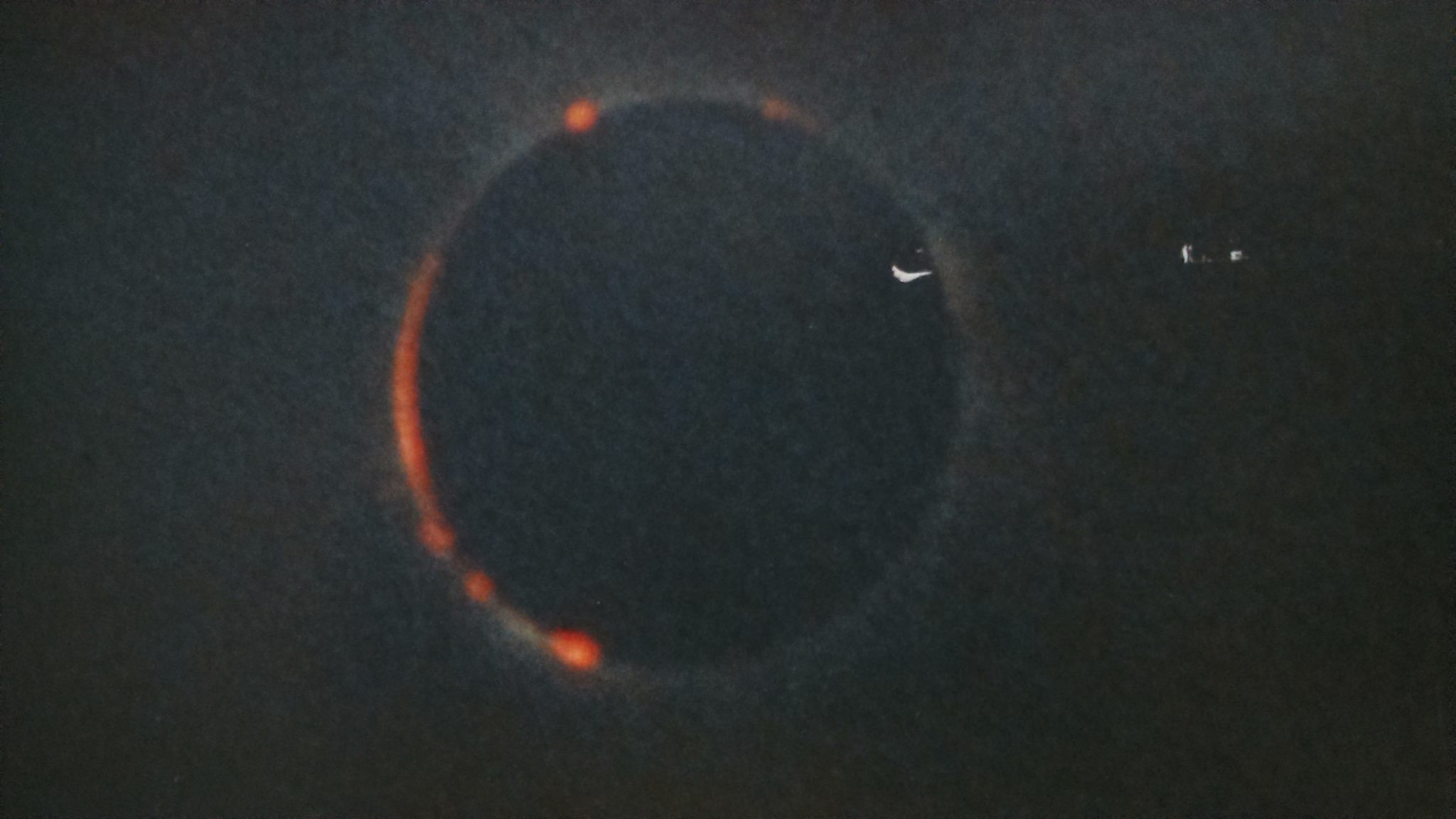
Unless you have been living on another planet, you will know that today there will be an eclipse of the Sun although from the UK it will be rather underwhelming, as only about 4% of the Sun’s disk will be covered by the moon; for totality you have to be in the United States.  For the record, however, the eclipse will begin 15:46 GMT on August 21 out over the Pacific. It will reach the coast of Oregon at Lincoln City, just west of Salem, at 16:04 GMT (09:04 local time) where it will reach its maximum  at 17:17 GMT (10:17 local time). The path of totality will then track right across the United States to South Carolina. For more details see here. Best wishes to all who are hoping to see this cosmic spectacle! I saw the total eclipse of August 11, 1999 from Alderney in the Channel Islands, and it was a very special experience.

Here’s a (not very good and slightly damaged) scan of a picture from that eclipse that I found last night in a box of old photographs:

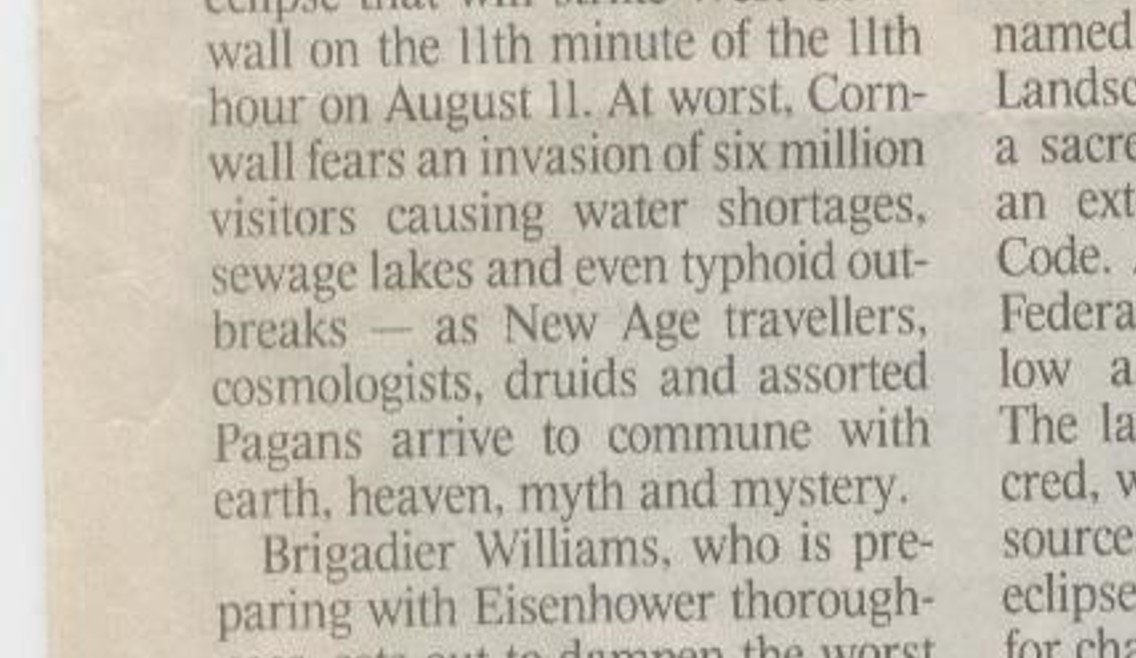
Before starting I can’t resist adding this excerpt from the Times warning about the consequences of a mass influx of people to Cornwall for the 1999 eclipse. No doubt there are similar things going around about today’s eclipse:

I did write a letter to the Times complaining that, as a cosmologist, I felt this was very insulting to druids. They didn’t publish it.

This provides me with a good excuse to repost an old item about the famous expedition during which, on 29th May 1919, measurements were made that have gone down in history as vindicating Einstein’s (then) new general theory of relativity. I’ve written quite a lot about this in past years, including a little book and a slightly more technical paper. I decided, though, to post this little piece which is based on an article I wrote some years ago for Firstscience.


–0–


The Eclipse that Changed the Universe

A total eclipse of the Sun is a moment of magic: a scant few minutes when our perceptions of the whole Universe are turned on their heads. The Sun’s blinding disc is replaced by ghostly pale tentacles surrounding a black heart – an eerie experience witnessed by hundreds of millions of people throughout Europe and the Near East last August.

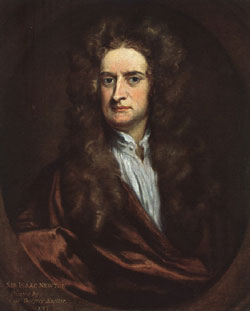
But one particular eclipse of the Sun, eighty years ago, challenged not only people’s emotional world. It was set to turn the science of the Universe on its head. For over two centuries, scientists had believed Sir Isaac Newton’s view of the Universe. Now his ideas had been challenged by a young German-Swiss scientist, called Albert Einstein. The showdown – Newton vs Einstein – would be the total eclipse of 29 May 1919.

Newton’s position was set out in his monumental Philosophiae Naturalis Principia Mathematica, published in 1687. The Principia – as it’s familiarly known – laid down a set of mathematical laws that described all forms of motion in the Universe. These rules applied as much to the motion of planets around the Sun as to more mundane objects like apples falling from trees.

At the heart of Newton’s concept of the Universe were his ideas about space and time. Space was inflexible, laid out in a way that had been described by the ancient Greek mathematician Euclid in his laws of geometry. To Newton, space was the immovable and unyielding stage on which bodies acted out their motions. Time was also absolute, ticking away inexorably at the same rate for everyone in the Universe.

Sir Isaac Newton, painted by Sir Godfrey Kneller. Picture Credit: National Portrait Gallery,

For over 200 years, scientists saw the Cosmos through Newton’s eyes. It was a vast clockwork machine, evolving by predetermined rules through regular space, against the beat of an absolute clock. This edifice totally dominated scientific thought, until it was challenged by Albert Einstein.

In 1905, Einstein dispensed with Newton’s absolute nature of space and time. Although born in Germany, during this period of his life he was working as a patent clerk in Berne, Switzerland. He encapsulated his new ideas on motion, space and time in his special theory of relativity. But it took another ten years for Einstein to work out the full consequences of his ideas, including gravity. The general theory of relativity, first aired in 1915, was as complete a description of motion as Newton had prescribed in his Principia. But Einstein’s description of gravity required space to be curved. Whereas for Newton space was an inflexible backdrop, for Einstein it had to bend and flex near massive bodies. This warping of space, in turn, would be responsible for guiding objects such as planets along their orbits.

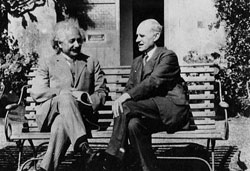
Albert Einstein (left), pictured with Arthur Stanley Eddington (right). Picture Credit: Royal Greenwich Observatory.

By the time he developed his general theory, Einstein was back in Germany, working in Berlin. But a copy of his general theory of relativity was soon smuggled through war-torn Europe to Cambridge. There it was read by Arthur Stanley Eddington, Britain’s leading astrophysicist. Eddington realised that Einstein’s theory could be tested. If space really was distorted by gravity, then light passing through it would not travel in a straight line, but would follow a curved path. The stronger the force of gravity, the more the light would be bent. The bending would be largest for light passing very close to a very massive body, such as the Sun.

Unfortunately, the most massive objects known to astronomers at the time were also very bright. This was before black holes were seriously considered, and stars provided the strongest gravitational fields known. The Sun was particularly useful, being a star right on our doorstep. But it is impossible to see how the light from faint background stars might be bent by the Sun’s gravity, because the Sun’s light is so bright it completely swamps the light from objects beyond it.


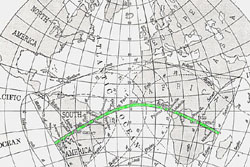
A scientific sketch of the path of totality for the 1919 eclipse. Picture Credit: Royal Greenwich Observatory.

Eddington realised the solution. Observe during a total eclipse, when the Sun’s light is blotted out for a few minutes, and you can see distant stars that appear close to the Sun in the sky. If Einstein was right, the Sun’s gravity would shift these stars to slightly different positions, compared to where they are seen in the night sky at other times of the year when the Sun far away from them. The closer the star appears to the Sun during totality, the bigger the shift would be.

Eddington began to put pressure on the British scientific establishment to organise an experiment. The Astronomer Royal of the time, Sir Frank Watson Dyson, realised that the 1919 eclipse was ideal. Not only was totality unusually long (around six minutes, compared with the two minutes we experienced in 1999) but during totality the Sun would be right in front of the Hyades, a cluster of bright stars.

But at this point the story took a twist. Eddington was a Quaker and, as such, a pacifist. In 1917, after disastrous losses during the Somme offensive, the British government introduced conscription to the armed forces. Eddington refused the draft and was threatened with imprisonment. In the end, Dyson’s intervention was crucial persuading the government to spare Eddington. His conscription was postponed under the condition that, if the war had finished by 1919, Eddington himself would lead an expedition to measure the bending of light by the Sun. The rest, as they say, is history.

The path of totality of the 1919 eclipse passed from northern Brazil, across the Atlantic Ocean to West Africa. In case of bad weather (amongst other reasons) two expeditions were organised: one to Sobral, in Brazil, and the other to the island of Principe, in the Gulf of Guinea close to the West African coast. Eddington himself went to Principe; the expedition to Sobral was led by Andrew Crommelin from the Royal Observatory at Greenwich.

British scientists in the field at their observing site in Sobral in 1919. Picture Credit: Royal Greenwich Observatory

The expeditions did not go entirely according to plan. When the day of the eclipse (29 May) dawned on Principe, Eddington was greeted with a thunderstorm and torrential rain. By mid-afternoon the skies had partly cleared and he took some pictures through cloud.

Meanwhile, at Sobral, Crommelin had much better weather – but he had made serious errors in setting up his equipment. He focused his main telescope the night before the eclipse, but did not allow for the distortions that would take place as the temperature climbed during the day. Luckily, he had taken a backup telescope along, and this in the end provided the best results of all.

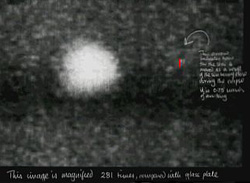
After the eclipse, Eddington himself carefully measured the positions of the stars that appeared near the Sun’s eclipsed image, on the photographic plates exposed at both Sobral and Principe. He then compared them with reference positions taken previously when the Hyades were visible in the night sky. The measurements had to be incredibly accurate, not only because the expected deflections were small. The images of the stars were also quite blurred, because of problems with the telescopes and because they were seen through the light of the Sun’s glowing atmosphere, the solar corona.

Before long the results were ready. Britain’s premier scientific body, the Royal Society, called a special meeting in London on 6 November. Dyson, as Astronomer Royal took the floor, and announced that the measurements did not support Newton’s long-accepted theory of gravity. Instead, they agreed with the predictions of Einstein’s new theory.

The final proof: the small red line shows how far the position of the star has been shifted by the Sun’s gravity. Each star experiences a tiny deflection, but averaged over many exposures the results definitely support Einstein’s theory. Picture Credit: Royal Greenwich Observatory.

The press reaction was extraordinary. Einstein was immediately propelled onto the front pages of the world’s media and, almost overnight, became a household name. There was more to this than purely the scientific content of his theory. After years of war, the public embraced a moment that moved mankind from the horrors of destruction to the sublimity of the human mind laying bare the secrets of the Cosmos. The two pacifists in the limelight – the British Eddington and the German-born Einstein – were particularly pleased at the reconciliation between their nations brought about by the results.

But the popular perception of the eclipse results differed quite significantly from the way they were viewed in the scientific establishment. Physicists of the day were justifiably cautious. Eddington had needed to make significant corrections to some of the measurements, for various technical reasons, and in the end decided to leave some of the Sobral data out of the calculation entirely. Many scientists were suspicious that he had cooked the books. Although the suspicion lingered for years in some quarters, in the end the results were confirmed at eclipse after eclipse with higher and higher precision.

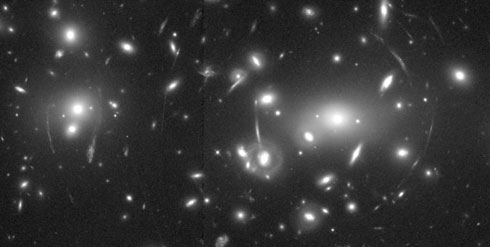
In this cosmic ‘gravitational lens,’ a huge cluster of galaxies distorts the light from more distant galaxies into a pattern of giant arcs.  Picture Credit: NASA

Nowadays astronomers are so confident of Einstein’s theory that they rely on the bending of light by gravity to make telescopes almost as big as the Universe. When the conditions are right, gravity can shift an object’s position by far more than a microscopic amount. The ideal situation is when we look far out into space, and centre our view not on an individual star like the Sun, but on a cluster of hundreds of galaxies – with a total mass of perhaps 100 million million suns. The space-curvature of this immense ‘gravitational lens’ can gather the light from more remote objects, and focus them into brilliant curved arcs in the sky. From the size of the arcs, astronomers can ‘weigh’ the cluster of galaxies.

Einstein didn’t live long enough to see through a gravitational lens, but if he had he would definitely have approved….

On the Time Lags of the LIGO signals

Posted in Bad Statistics, The Universe and Stuff with tags , , , on August 10, 2017 by telescoper

It seems that a lot of rumours are flying around on social media and elsewhere about the discussions that have been going on here in Copenhagen between members of the Niels Bohr Institute and of the LIGO scientific collaboration concerning matters arising from the `Danish Paper‘.  The most prominent among these appears to be the LIGO team and the Danish team have agreed on everything and that the Danish authors have conceded that they were mistaken in their claims. I have even been told that my recent blog posts gave the impression that this was the case. I’m not sure how, as all I’ve said is that the discussions reached agreement on some matters. I did not say what matters or whose position had changed.

I feel, therefore, that some clarification is necessary. Since I am a member of neither party to this controversy I have to tread carefully, and there are some things which I feel I should not discuss at all. I was invited to participate in the discussions as a neutral observer as a courtesy and I certainly don’t want to betray any confidences. On one thing, however, I can be perfectly clear. The Danish team (Cresswell et al.) have not retracted their claims and they reject the suggestion that their paper was wrong.

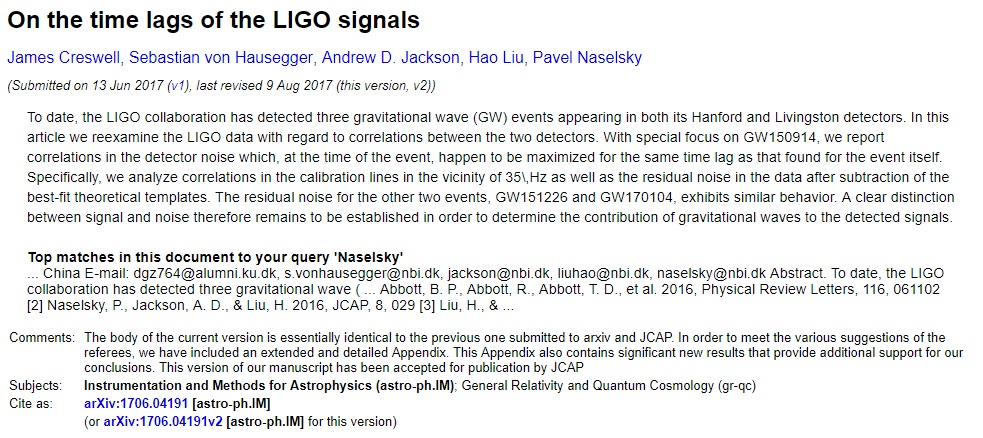
To reinforce this, I draw your attention to the fact that a revised version of `The Danish Paper’ has now been accepted for publication (in the Journal of Cosmology and Astroparticle Physics) and that this paper is now available on the arXiv. The referees raised a large number of queries, and in response to them all the revised version is almost double the length of the original.

Here is the arXiv entry page:

The main body of the paper has not been significantly modified and their main result – of an unexplained 7ms correlation in the background signal (referred to in the abstract as `noise’) – has not “gone away”. If you want to understand more, read the paper!

I’m sure there will be much more discussion of this and I will comment as appropriate when appropriate. In the meantime this remains very much a live issue.

P.S. In the interest of full disclosure I should mention that I did read over part of the revised version of the Danish paper and made some suggestions with regard to style and flow. I therefore have a mention in the acknowledgments of the final version. I was warned that I might expect some trouble for agreeing to be associated with the paper in this way but, as  Sam Spade says in The Maltese Falcon `I don’t mind a reasonable amount of trouble’…

LIGO and Open Science

Posted in Open Access, Science Politics, The Universe and Stuff with tags , , , , on August 8, 2017 by telescoper

I’ve just come from another meeting here at the Niels Bohr Institute between some members of the LIGO Scientific Collaboration and the authors of the `Danish Paper‘. As with the other one I attended last week it was both interesting and informative. I’m not going to divulge any of the details of the discussion, but I anticipate further developments that will put some of them into the public domain fairly soon and will comment on them as and when that happens.

I think an important aspect of the way science works is that when a given individual or group publishes a result, it should be possible for others to reproduce it (or not as the case may be). In normal-sized laboratory physics it suffices to explain the experimental set-up in the published paper in sufficient detail for another individual or group to build an equivalent replica experiment if they want to check the results. In `Big Science’, e.g. with LIGO or the Large Hadron Collider, it is not practically possible for other groups to build their own copy, so the best that can be done is to release the data coming from the experiment. A basic problem with reproducibility obviously arises when this does not happen.

In astrophysics and cosmology, results in scientific papers are often based on very complicated analyses of large data sets. This is also the case for gravitational wave experiments. Fortunately in astrophysics these days researchers are generally pretty good at sharing their data, but there are a few exceptions in that field. Particle physicists, by contrast, generally treat all their data as proprietary.

Even allowing open access to data doesn’t always solve the reproducibility problem. Often extensive numerical codes are needed to process the measurements and extract meaningful output. Without access to these pipeline codes it is impossible for a third party to check the path from input to output without writing their own version, assuming that there is sufficient information to do that in the first place. That researchers should publish their software as well as their results is quite a controversial suggestion, but I think it’s the best practice for science. In any case there are often intermediate stages between `raw’ data and scientific results, as well as ancillary data products of various kinds. I think these should all be made public. Doing that could well entail a great deal of effort, but I think in the long run that it is worth it.

I’m not saying that scientific collaborations should not have a proprietary period, just that this period should end when a result is announced, and that any such announcement should be accompanied by a release of the data products and software needed to subject the analysis to independent verification.

Now, if you are interested in trying to reproduce the analysis of data from the first detection of gravitational waves by LIGO, you can go here, where you can not only download the data but also find a helpful tutorial on how to analyse it.

This seems at first sight to be fully in the spirit of open science, but if you visit that page you will find this disclaimer:


In other words, one can’t check the LIGO data analysis because not all the data and tools necessary to do that are not publicly available.  I know for a fact that this is the case because of the meetings going on here at NBI!

Given that the detection of gravitational waves is one of the most important breakthroughs ever made in physics, I think this is a matter of considerable regret. I also find it difficult to understand the reasoning that led the LIGO consortium to think it was a good plan only to go part of the way towards open science, by releasing only part of the information needed to reproduce the processing of the LIGO signals and their subsequent statistical analysis. There may be good reasons that I know nothing about, but at the moment it seems to me to me to represent a wasted opportunity.

I know I’m an extremist when it comes to open science, and there are probably many who disagree with me, so I thought I’d do a mini-poll on this issue:

Any other comments welcome through the box below!

Mapping the Universe

Posted in The Universe and Stuff with tags , , on August 5, 2017 by telescoper

Following yesterday’s post, here’s a nice visualisation of how much (and indeed how little) of the Universe the latest galaxy surveys have mapped.

In this animation the Earth is at the centre, and the dots represent observed galaxies, with distances are estimated using redshifts Every blue dot in the animation is a galaxy measured by the Dark Energy Survey. Gold dots are galaxies in the DES supernova fields (measured by OzDES) and red dots are from the Sloan Digital Sky Survey. The dark space in between the surveys is yet to be mapped….