Archive for the The Universe and Stuff Category

On the Importance of School Experiments

Posted in Biographical, Education, The Universe and Stuff with tags , , on February 27, 2017 by telescoper

Twitter drew my attention this afternoon to a series of videos produced by the Royal Society designed to give teachers in schools some additional resources to encourage their pupils to do science experiments. They star the ubiquitous Professor Brian Cox, and they cover a wide range of science. You can see the whole playlist on Youtube here (although it is unfortunately back-to-front):

Although I ended up doing primarily theoretical work in my scientific career, there’s no question that ‘hands-on’ experiments played a big part in the development of my understanding of, especially, physics and chemistry. I remember vividly when I was about 12 years old doing a simple series of experiments in which we weighed out samples of chemical material of various types, then burned it somehow (usually over a bunsen burner) and weighed what was left. Commonsense based on experience with burning stuff like wood and paper is that the process reduces the amount of material so I expected the mass remaining at the end to be less than the initial mass. The first stuff that I did was a few grains of calcium. I couldn’t believe it when the residue turned out to weigh more than the stuff I started with. I was sure I was wrong and got quite upset for failing such an elementary practical exercise, but the same thing happened every time whatever the material.

Of course, the explanation is that the process going on was oxidation, and the calcium was actually combining with oxygen from the air to form an oxide. It did look as if some kind of destruction had happened, but the oxygen taken from the atmosphere had bonded to the calcium atoms and this increased the mass of the residue.

The teacher could have talked about this and explained it, but it wouldn’t have had anything like the impact on my understanding of discovering it for myself.

That’s a personal story of course, but I think it’s probably a widespread educational experience. These days few students seem to have the chance to do their own experience, either because of shortage of facilities or the dreaded ‘Health and Safety’ so I think any effort to encourage more teachers to allow their students to do more experiments is thoroughly worthwhile!

To Lincoln via Storm Doris

Posted in Biographical, Talks and Reviews, The Universe and Stuff with tags , on February 23, 2017 by telescoper

What a day!

This morning I set out from Cardiff to travel here to Lincoln for my public lecture. I took the 9.45 train via Birmingham which, after a change of trains in Nottingham, should have got me into Lincoln at 14.23, with plenty of time to have a look around and chat to people before the scheduled start of my talk at 18.00 hours.

That was the plan, but it omitted an important factor: Storm Doris. Fallen trees, broken down trains and general disorganisation meant that it took nine hours to get to Lincoln, even including getting a taxi from Nottingham because I missed my connection.

The strangest thing was that I never actually saw any particularly bad weather. In fact there was quite a lot of sunshine en route. All the chaos was caused elsewhere, apparently.

Anyway I finally turned up almost an hour late for my talk, but thankfully the audience had waited patiently so we went ahead with the lecture. I can’t say I was entirely unflustered after the journey but I hope at least some people found something of interest. There  certainly were some very nice and interesting questions at the end.

So now after a pleasant dinner with my host Andrei, I am safely installed in a charming guest house right beside Lincoln Cathedral. I certainly think I’ll sleep well tonight! 

Let’s hope my journey back to Cardiff is a bit less eventful. 

Robert Grosseteste and the Ordered Universe

Posted in History, The Universe and Stuff with tags , , on February 22, 2017 by telescoper

Tomorrow I’m off to the historic city of Lincoln to give a public lecture, the inaugural Robert Grosseteste Lecture on Astrophysics/Cosmology.

This new series of lectures is named in honour of Robert Grosseteste (c. 1175 – 9 October 1253), a former Bishop of Lincoln, who (among many other things) played a key role in the development of the Western scientific tradition. His De Luce seu de Inchoatione Formarum (“On Light or the Beginning of the Forms”), written around 1220, includes pioneering discussions about cosmogony, which contains many ideas that resonate what I shall be talking about in my lecture. In particular, De Luce explores the nature of matter and the cosmos. Seven centuries before the Big Bang theory, Grosseteste described the birth of the Universe in an explosion and the crystallisation of matter to form stars and planets in a set of nested spheres around Earth. It therefore probably represents the first attempt to describe the ordered system of the Heavens and Earth using a single set of physical laws.

Anyway, this led me to an interesting website about an interdisciplinary project that involves discussing Robert Grosseteste in the context of mediaeval science, called “Ordered Universe”. Here’s an interesting video from that site, which features both historians and scientists.

Emergent gravity in galaxies and in the Solar System [GA]

Posted in The Universe and Stuff with tags , , on February 17, 2017 by telescoper

I’ve been meaning to do a blog post about Erik Verlinde’s  very interesting “Emergent Gravity” theory since it was first aired in November 2016, but never got round to it. However, this recent paper suggests that the new theory fails badly on scales of the Solar System. And when I say “badly”, I mean by seven orders of magnitude. That’s pretty bad.

Unless there’s something wrong with this analysis, this looks pretty terminal …

arxiver's avatararXiver

http://arxiv.org/abs/1702.04358

It was recently proposed that the effects usually attributed to particle dark matter on galaxy scales are due to the displacement of dark energy by baryonic matter, a paradigm known as emergent gravity. This formalism leads to predictions similar to Modified Newtonian Dynamics (MOND) in spherical symmetry, but not quite identical. In particular, it leads to a well defined transition between the Newtonian and the modified gravitational regimes, a transition depending on both the Newtonian acceleration and its first derivative with respect to radius. Under the hypothesis of the applicability of this transition to aspherical systems, we investigate whether it can reproduce observed galaxy rotation curves. We conclude that the formula leads to marginally acceptable fits with strikingly low best-fit distances, low stellar mass-to-light ratios, and a low Hubble constant. In particular, some unobserved wiggles are produced in rotation curves because of the dependence of the transition on the…

View original post 104 more words

A Blueprint for a Quantum Computer

Posted in The Universe and Stuff with tags , , , , on February 16, 2017 by telescoper

I’m a little bit late blogging about this topic, as it relates to a paper published on 1st February 2017, but it’s a pleasure to be able to draw your attention to an important paper by a group led by a former colleague of mine from the University of Sussex, Prof. Winfried Hensinger, known to his friends as “Winni”. In essence they have constructed a practical way to build a working quantum computer.

Here is the abstract of the latest paper which explains the significance of the work:

The availability of a universal quantum computer may have a fundamental impact on a vast number of research fields and on society as a whole. An increasingly large scientific and industrial community is working toward the realization of such a device. An arbitrarily large quantum computer may best be constructed using a modular approach. We present a blueprint for a trapped ion–based scalable quantum computer module, making it possible to create a scalable quantum computer architecture based on long-wavelength radiation quantum gates. The modules control all operations as stand-alone units, are constructed using silicon microfabrication techniques, and are within reach of current technology. To perform the required quantum computations, the modules make use of long-wavelength radiation–based quantum gate technology. To scale this microwave quantum computer architecture to a large size, we present a fully scalable design that makes use of ion transport between different modules, thereby allowing arbitrarily many modules to be connected to construct a large-scale device. A high error–threshold surface error correction code can be implemented in the proposed architecture to execute fault-tolerant operations. With appropriate adjustments, the proposed modules are also suitable for alternative trapped ion quantum computer architectures, such as schemes using photonic interconnects.

Here’s a short video explaining the setup

This result has generated a lot of good publicity for the group at Sussex, including a piece in the Financial Times and a personal appearance by Winni himself on Sky News.

It’s great to see the  Ion Quantum Technology group continuing to do really well and I’m sure the investments made in physics research at the University of Sussex over the last few years will bring even more exciting developments in the near future!


Cosmological Parameters from pre-Planck CMB Measurements: a 2017 Update [CEA]

Posted in The Universe and Stuff on February 15, 2017 by telescoper

Via arXiver, here’s a nice summary of the (strong) constraints on cosmological parameters that can be achieved from Cosmic Microwave Background experiments other than Planck. This is an important thing to do for a number of reasons, including that it might reveal interesting systematic differences between pre- and post-Planck data which merit further study.

The first author of this paper, Erminia Calabrese, will be joining us on the staff of the School of Physics & Astronomy at Cardiff University in May 2017!

arxiver's avatararXiver

http://arxiv.org/abs/1702.03272

We present cosmological constraints from the combination of the full mission 9-year WMAP release and small-scale temperature data from the pre-Planck ACT and SPT generation of instruments. This is an update of the analysis presented in Calabrese et al. 2013 and highlights the impact on $Lambda$CDM cosmology of a 0.06 eV massive neutrino – which was assumed in the Planck analysis but not in the ACT/SPT analyses – and a Planck-cleaned measurement of the optical depth to reionization. We show that cosmological constraints are now strong enough that small differences in assumptions about reionization and neutrino mass give systematic differences which are clearly detectable in the data. We recommend that these updated results be used when comparing cosmological constraints from WMAP, ACT and SPT with other surveys or with current and future full-mission Planck cosmology. Cosmological parameter chains are publicly available on the NASA’s LAMBDA data archive.

Read this…

View original post 32 more words

Haydn and the Herschels

Posted in History, Music, The Universe and Stuff with tags , , , , , on February 14, 2017 by telescoper

Last night I was listening to a broadcast of a concert performance of Haydn’s “Creation” on BBC Radio 3, featuring the London Philharmonic under the direction of Sir Roger Norrington. During the interval (between Parts I and II) the presenter Sara Mohr-Pietsch cast doubt in the story (which I’ve heard quite often), that Joseph Haydn was at least partly inspired to write The Creation by a trip he took during a stay in England to see the observatory of astronomer William Herschel. This story is repeated in a number of places around the web, including here, from which source I quote:

On 15 June 1792. Joseph Haydn visited William Herschel – basoonist, composer, astronomer – at his observatory near Slough. Herschel introduced Haydn to the Milky Way and, quite possibly, the planet Uranus, which he’d discovered ten years earlier. Some say Haydn took this glimpse of the infinite as the inspiration for his oratorio The Creation. Seems plausible.

It does indeed seem plausible. It is a matter of record that Haydn did  visit the Observatory House in Slough on 15th June 1792, which is where William Herschel lived with his sister Caroline at the time. (Interestingly, the day before this visit Haydn was at Ascot watching the horse-racing.)

However, according to William Herschel’s own records he wasn’t at the Observatory House on this day. In fact he had been away since May 1792 visiting various locations in England and Wales, before eventually arriving in Glasgow to receive an honorary degree. The notion that Herschel provided Haydn with the inspiration to write The Creation is therefore false.

Or is it?

William Herschel may not have been at home when Haydn called on 15th June 1792, but Caroline certainly was: Haydn’s name is recorded in her visitor’s book on that date. In his diary Haydn makes a note of the dimensions of the telescope (40ft) but does not mention actually looking through it, which is not surprising if he was there during the day.  There’s no other record of this visit of which I’m aware that says for sure what happened on that day, but Caroline certainly could have described what she had observed during her career as an astronomer, both on her own and with William, and also shown Haydn drawings, catalogues and star charts. Caroline Herschel was an extremely accomplished astronomer in her own right, so who’s to say it was not she rather than her brother who provided Haydn with the inspiration for his oratorio?

So it could well be that it was Herschel that inspired The Creation after all, but Caroline rather than William…

Cosmological perturbation effects on gravitational-wave luminosity distance estimates [CL]

Posted in The Universe and Stuff on February 13, 2017 by telescoper

Interesting paper about the effect of cosmological inhomogeneity on gravitational wave propagation. The effect could be import for the more distant sources likely to be detected with future experiments.

arxiver's avatararXiver

http://arxiv.org/abs/1702.01750

Waveforms of gravitational waves provide information about a variety of parameters for the binary system merging. However, standard calculations have been performed assuming a FLRW universe with no perturbations. In reality this assumption should be dropped: we show that the inclusion of cosmological perturbations translates into corrections to the estimate of astrophysical parameters derived for the merging binary systems. We compute corrections to the estimate of the luminosity distance due to velocity, volume, lensing and gravitational potential effects. Our results show that the amplitude of the corrections will be negligible for current instruments, mildly important for experiments like the planned DECIGO, and very important for future ones such as the Big Bang Observer.

Read this paper on arXiv…

D. Bertacca, A. Raccanelli, N. Bartolo, et. al.
Wed, 8 Feb 17
18/65

Comments: 16 pages, 3 figures

View original post

One Hundred Years of the Cosmological Constant

Posted in History, The Universe and Stuff with tags , , , , , , on February 8, 2017 by telescoper

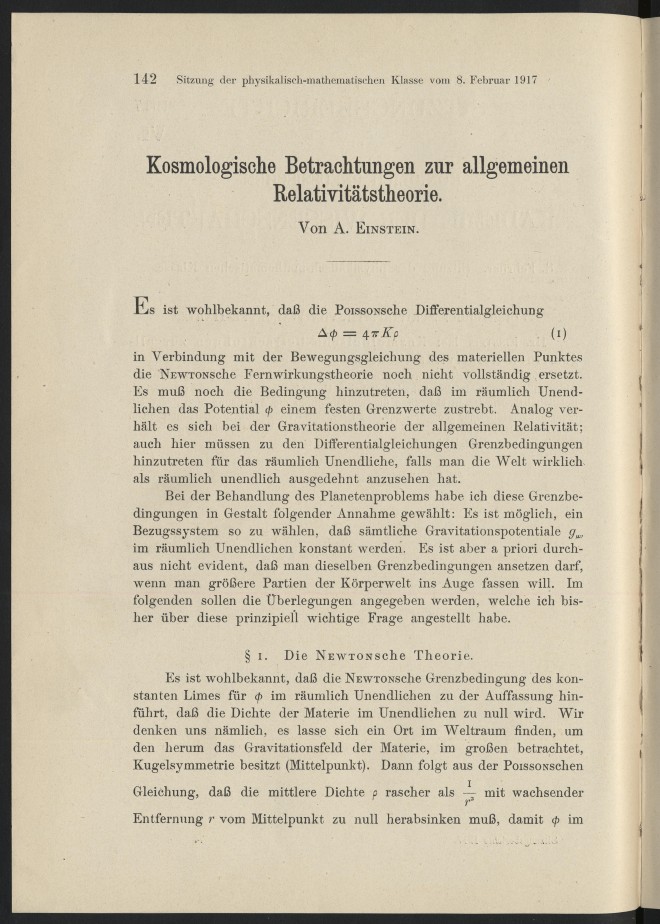
It was exactly one hundred years ago today – on 8th February 1917 – that a paper was published in which Albert Einstein explored the cosmological consequences of his general theory of relativity, in the course of which he introduced the concept of the cosmological constant.

For the record the full reference to the paper is: Kosmologische Betrachtungen zur allgemeinen Relativitätstheorie and it was published in the Sitzungsberichte der Königlich Preußischen Akademie der Wissenschaften. You can find the full text of the paper here. There’s also a nice recent discussion of it by Cormac O’Raifeartaigh  and others on the arXiv here.

Here is the first page:

cosmo

It’s well worth looking at this paper – even if your German is as rudimentary as mine – because the argument Einstein constructs is rather different from what you might imagine (or at least that’s what I thought when I first read it). As you see, it begins with a discussion of a modification of Poisson’s equation for gravity.

As is well known, Einstein introduced the cosmological constant in order to construct a static model of the Universe. The 1917 paper pre-dates the work of Friedman (1923) and Lemaître (1927) that established much of the language and formalism used to describe cosmological models nowadays, so I thought it might be interesting just to recapitulate the idea using modern notation. Actually, in honour of the impending centenary I did this briefly in my lecture on Physics of the Early Universe yesterday.

To simplify matters I’ll just consider a “dust” model, in which pressure can be neglected. In this case, the essential equations governing a cosmological model satisfying the Cosmological Principle are:

\ddot{a} = -\frac{4\pi G \rho a }{3} +\frac{\Lambda a}{3}

and

\dot{a}^2= \frac{8\pi G \rho a^2}{3} +\frac{\Lambda a^2}{3} - kc^2.

In these equations a(t) is the cosmic scale factor (which measures the relative size of the Universe) and dots are derivatives with respect to cosmological proper time, t. The density of matter is \rho>0 and the cosmological constant is \Lambda. The quantity k is the curvature of the spatial sections of the model, i.e. the surfaces on which t is constant.

Now our task is to find a solution of these equations with a(t)= A, say, constant for all time, i.e. that \dot{a}=0 and \ddot{a}=0 for all time.

The first thing to notice is that if \Lambda=0 then this is impossible. One can solve the second equation to make the LHS zero at a particular time by matching the density term to the curvature term, but that only makes a universe that is instantaneously static. The second derivative is non-zero in this case so the system inevitably evolves away from the situation in which $\dot{a}=0$.

With the cosmological constant term included, it is a different story. First make \ddot{a}=0  in the first equation, which means that

\Lambda=4\pi G \rho.

Now we can make \dot{a}=0 in the second equation by setting

\Lambda a^2 = 4\pi G \rho a^2 = kc^2

This gives a static universe model, usually called the Einstein universe. Notice that the curvature must be positive, so this a universe of finite spatial extent but with infinite duration.

This idea formed the basis of Einstein’s own cosmological thinking until the early 1930s when observations began to make it clear that the universe was not static at all, but expanding. In that light it seems that adding the cosmological constant wasn’t really justified, and it is often said that Einstein regard its introduction as his “biggest blunder”.

I have two responses to that. One is that general relativity, when combined with the cosmological principle, but without the cosmological constant, requires the universe to be dynamical rather than static. If anything, therefore, you could argue that Einstein’s biggest blunder was to have failed to predict the expansion of the Universe!

The other response is that, far from it being an ad hoc modification of his theory, there are actually sound mathematical reasons for allowing the cosmological constant term. Although Einstein’s original motivation for considering this possibility may have been misguided, he was justified in introducing it. He was right if, perhaps, for the wrong reasons. Nowadays observational evidence suggests that the expansion of the universe may be accelerating. The first equation above tells you that this is only possible if \Lambda\neq 0.

Finally, I’ll just mention another thing in the light of the Einstein (1917) paper. It is clear that Einstein thought of the cosmological as a modification of the left hand side of the field equations of general relativity, i.e. the part that expresses the effect of gravity through the curvature of space-time. Nowadays we tend to think of it instead as a peculiar form of energy (called dark energy) that has negative pressure. This sits on the right hand side of the field equations instead of the left so is not so much a modification of the law of gravity as an exotic form of energy. You can see the details in an older post here.

A Challenge for Inflationary Cosmologists

Posted in The Universe and Stuff with tags , , on February 6, 2017 by telescoper

A few days ago I wrote a very sceptical post about an alternative to the present standard cosmological which is called the holographic universe. After an interesting discussion thread on that post I thought I’d pose a challenge here. It might be a bit specialist as it is for inflationary theorists and model-builders (a club to which I do not belong) but I thought I’d try it as it might prove education for me as for other readers.

Anyway, the point is that in the inflationary paradigm there is a fairly generic prediction that the primordial scalar power spectrum (related to the spectrum of density fluctuations) takes the form of a power law:

equation-1

The wavenumber is denoted q. There are two free parameters here: the spectral index ns (which is usually close to unity); and an overall normalization amplitude parametrised here at an arbitrary “pivot” scale q*.

In the holographic model the functional form of the spectrum is quite different:
equation-2

This has two different free parameters: g and β, both of which relate to properties of a dual Quantum Field Theory which appears in the model.

The second model is motivated by very different considerations from those behind the inflationary model, but my suspicion is that in fact one could create a version of inflation that produces a spectrum of the form (2) rather than (1). There is an imtimate relationship between the scalar perturbation spectrum and the inflationary dynamics which means that there is considerable freedom to “design” the perturbation spectrum by building features into the potential.

Anyway, that’s the challenge. Would any cosmologists out there with time on their hands please make me an inflationary model that produces the spectrum (2). Alternatively, if this can’t be done, give me a proof why it can’t!

