Archive for the The Universe and Stuff Category

Back to Cosmology, Data Analysis and Cardiff

Posted in Biographical, The Universe and Stuff with tags , on September 1, 2016 by telescoper

Today is my first day back in the School of Physics and Astronomy at Cardiff University. Although my job title, Professor of Theoretical Astrophysics, is the same as it was when I was here in a previous incarnation it will be quite a different job and I’m going to be located in a different building (though not far from my old office). In fact my office is in a newly refurbished space connected with the Data Innovation Research Institute just on the other side of a car park from my old office. It looks like being an exciting time over the next few months and years as new staff across a range of disciplines join the Institute, expanding its research portfolio from astrophysics (especially gravitational wave research) into biomedical sciences and beyond.

Here’s a little video about the Data Innovation Research Institute, which is about conducting fundamental research into the aspects of managing, analysing and interpreting massive volumes of textual and numerical information:

But for the moment it’s been a day for administrative matters: taking my P45 to the Human Resources Department, getting my new Staff ID card, trying to get myself set up on the University computer network, and so on. Oh, and I’ve agreed to do some teaching in the Spring Semester, a Level 4 module on The Physics of the Early Universe. It will be nice to be teaching some cosmology again!


Worrying Times for UK Physics

Posted in Education, The Universe and Stuff with tags , on August 19, 2016 by telescoper

As I’m more-or-less in between jobs at the moment, this is the first August in many that I haven’t been involved the clearing and confirmation process that helps students find places at university after the A-level results are released. I know how stressful it is for admissions staff and prospective students alike, so I’m not sorry to be out of it for once!

On the other hand I did notice something worrying that seems to be the continuation of a trend I noticed last year.  I quote from a piece issued by the Institute of Physics about the number of students taking A-level physics last year:

Although there was an overall rise of 2% in the number of A-level entries, the number taking physics fell to 36,287 compared with 36,701 last year – the first time numbers have fallen since 2006. The number of girls taking physics rose by 0.5%, however.

That decline is slight, of course, and it was  obviously too early to decide whether it indicated whether or not the UK has reached “Peak Physics”. Well, this year has confirmed that trend. According to a piece by the Wellcome Trust the number of entrants for physics A-level has fallen further this year, from 36,287 in 2015 to 35,344 in 2016. The Institute of Physics has also commented.

Virtually all students who get a Physics A-level do go to university, but by no means all do physics. It is also a qualifying subject for engineering and technology programmes, as well as medicine. It’s not clear yet whether the decline in A-level entry reflects a decline in the number of students going to start physics degrees at University this year, but this seems probable. This is good news if you’re an applicant with a Physics A-level, of course, because it increases the chances of you getting a place, but it’s no so good for physics as academic discipline.

Physics departments in UK universities are already competing for a very small pool of students with a Physics A-level.  The removal of student number controls allows  large universities to recruit as many students as they like, so the competition between universities for such a small number of applicants is extremely intense. Moreover, some universities, e.g. Newcastle and Hull, have opened up physics courses that they had previously closed, and others have started  new programmes based on what was anticipated to be an overall increase in demand. To support this expansion, many institutions have recruited extra numbers of teaching faculty assuming the salary costs would be covered from tuition fees. If the decline in overall student numbers continues then the budgets of many physics departments are going to look pretty grim, with potentially serious  consequences for the long-term sustainability of physics in many institutions.

I have to confess I’m worried. The physics community urgently needs to find out what is behind this fall. It’s not restricted to physics, in fact. Both biology and chemistry have also experienced a decline in the number of A-level entrants (from 44,864 to 43,242 and from 52,644 to 51,811 respectively), but the effect on physics is likely to be greater for the reasons I discussed above.

Mathematics numbers have also fallen, but by a much smaller percentage and from a much higher level: from 92,711 to 92,163.  I‘ve argued before that there’s a case on a number of grounds for scrapping the physics A-level as a requirement for entry to university as long as the student has mathematics. That may be a step too far for some, but it’s clear that if physics is to prosper we all have to think more creatively about how to increase participation. But how? Answers on a postcard – or through the comments box – please!


The Integrated Bispectrum and Beyond [CEA]

Posted in Biographical, The Universe and Stuff on August 17, 2016 by telescoper

I just came across this wordpress site which automatically posts about new submissions to the arXiv. This has presented me with an opportunity to try it out with a reblog of a recent submission by yours truly!

arxiver's avatararXiver

http://arxiv.org/abs/1608.04345

The position-dependent power spectrum has been recently proposed as a descriptor of gravitationally induced non-Gaussianity in galaxy clustering, as it is sensitive to the “soft limit” of the bispectrum (i.e. when one of the wave number tends to zero). We generalise this concept to higher order and clarify their relationship to other known statistics such as the skew-spectrum, the kurt-spectra and their real-space counterparts the cumulants correlators. Using the {em Hierarchical Ansatz} (HA) as a toy model for the higher order correlation hierarchy, we show how in the soft limit, polyspectra at a given order can be identified with lower order polyspectra with the same geometrical dependence but with {em renormalised} amplitudes expressed in terms of amplitudes of the original polyspectra. We extend the concept of position-dependent bispectrum to bispectrum of the divergence of the velocity field $Theta$ and mixed multispectra involving $delta$ and $Theta$ in the 3D perturbative…

View original post 103 more words

Simone Manuel and the Racism of Fred Hoyle

Posted in Biographical, Politics, Sport, The Universe and Stuff with tags , , , , , , on August 14, 2016 by telescoper

Reading just now about Simone Manuel, the first black person to win an Olympic Gold medal in swimming, I suddenly remembered a bizarre event that has been lurking in the back of my mind since 1985.

In September of that year I attended a Summer School for new PhD students in Astronomy, held in Durham. I have posted about this before actually, primarily because it is interesting how many others who attended that School are still around, in senior academic positions.

Anyway, one evening during the course of this meeting there was a public lecture by non other than Sir Fred Hoyle, many of whose books on cosmology I had borrowed from the public library when I was at school and played a big part in encouraging me to study physics at university.

But Fred Hoyle’s talk that evening (to a packed lecture theatre) was not about physics but about his pet theories about the evolution of life, most of which are now generally regarded as nonsense.

At one point in his somewhat rambling discourse he digressed into the subject of the sporting abilities of different racial groups. His first assertion was that black people (by which he meant people of African origin) do not make good swimmers because their bones are too dense and the consequent lack of buoyancy is a significant disadvantage. “Have you ever seen a black swimmer in the Olympics?” he asked. None of us had, of course, but couldn’t that be because of other reasons such as lack of access to swimming pools? No. Fred was adamant. It was down to biology. I assumed he knew what he was talking about, so kept quiet.

He went on to argue that black people were also disadvantaged at tennis – not because of social factors limiting access to tennis courts – but for reasons of “poor hand-eye coordination” which he also asserted to be an inherited characteristic. This time I knew straight away he was talking drivel. The previous summer I had watched the brilliant West Indies cricketers thrash England 5-0 in a test series; their hand-eye coordination certainly wasn’t poor. And neither was that of Arthur Ashe who had  beaten Jimmy Connors in the Men’s Singles Final at Wimbledon a decade earlier,  nor the majestic Serena Williams who is probably the greatest female tennis player the world has ever seen.

These examples left me not only deeply suspicious of Hoyle’s racist attitudes but also staggered by his completely unscientific attitude to evidence. Great theoretical physicist he was – at least early in his career – but being expert about one thing doesn’t mean can’t make an utter fool of yourself if you blunder into another field. Sadly, theoretical physicists do have a greater tendency than most scientists to forget this.

Uccello and the Problem of Space

Posted in Art, Television, The Universe and Stuff with tags , , , , on August 12, 2016 by telescoper

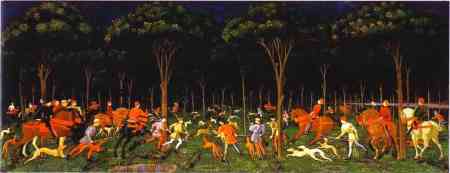
The other night I was watching an old episode of the detective series Lewis and it reminded me of something I wanted to blog about but never found the time. The episode in question, The Point of Vanishing, involves a discussion of a painting which can be found in the Ashmolean Museum in Oxford:
Uccello_TheHunt

I won’t spoil the plot by explaining its role in the TV programme, but this work – called “The Hunt in the Forest” or “The Night Hunt” or some other variation on that title –  is by one of the leading figures of the Early Renaissance, Paolo Uccello, who was born in Florence and lived from about 1396 until 1475. He was most notable for his explorations of the use of perspective in painting, and specifically in “The Problem of Space”, i.e. how to convey the presence of three dimensions when the paint is confined to only two. This picture accomplishes this not only by having a clear vanishing point in the centre of the composition, but also by the arrangement of the figures. Notice how the figures in the foreground are generally moving in the plane of the canvas, but towards the centre they are heading away from the observer. The composition thus acts like a funnel, drawing the viewer’s eye into the centre of the picture and then off into the distance, and the darkness.

Two other things are of interest here. One is that it’s not at all clear what is being hunted, or even whether there’s anything out there in the darkness at all. Is the hunt a metaphor for something else, perhaps the pursuit of something unattainable?

It’s also clear that Uccello wasn’t as interested in realism as he was in geometry and proportion. The horses, dogs and people are drawn in a rather primitive style reminiscent of mediaeval painting.  I think that suggests a metaphorical interpretation of the subject matter.

I see this painting as  a brilliant experiment in geometry rather than an attempt to depict a likeness of an actual event.  Reading about Uccello reveals him to have been somewhat obsessive about perspective – his  friend, the great artist Donatello, remarked that Uccello  spent too much time studying and not enough painting – but his contribution to the development of painting techniques during the Renaissance period was immense.

Although Uccello may have taken it to an extreme, interest in the formal, geometric, aspects of art wasn’t at all unusual in this period. I blogged a while ago about another favourite Renaissance artist, Piero della Francesca (c. 1415-1492) whose life overlapped with Uccello. He combined his work as an artist with a distinguished career as a Mathematician. It would be surprising if Uccello and Piero della Francesca never met, but a quick search didn’t find any definitive evidence that they did.

Another great example of Uccello’s art is this:

g013_uccello_rout

It is one of the three panels of The Battle of San Romano. Again, the living figures are simply drawn – the bodies, weapons and bits of armour on the ground look like they might be toys on a nursery floor – but the way the painting gives the impression that everything is receding into the distance is remarkably effective.

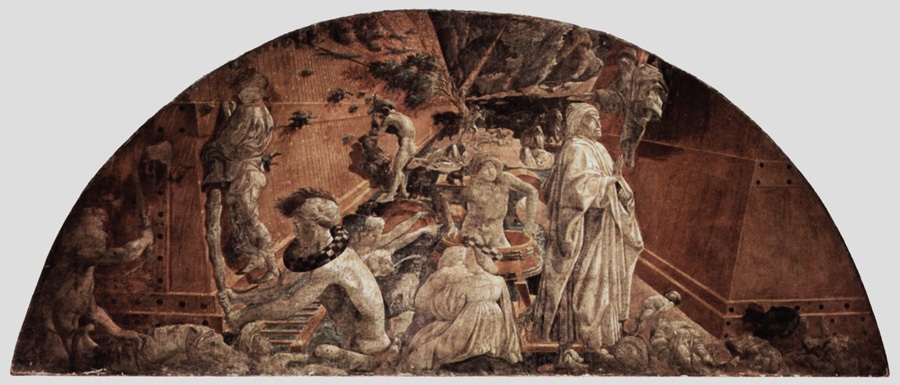
But the best example of Uccello’s work that I’ve seen in the flesh (so to speak) is this:
Paolo_Uccello_Deluge_web

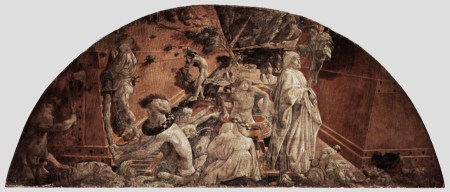
This – Flood and Waters Subsiding –  is a fresco located in the Church of Santa Maria Novella in Florence. Unfortunately it’s quite badly damaged – not only have the colours faded badly but parts of the plaster have crumbled away entirely. Fresco is a notorious fragile medium and it’s sad that so many great Renaissance works of this type have been lost over the years. However, despite the disrepair, this is still an amazing piece. Perhaps helped by the semi-circular space into which it was designed to fit, this work manages to convey a sense of vorticity; There’s not so  much a vanishing point as a point of origin and the action seems to swirl around it as well as to emerge from it. Note also that in contrast to the previous two paintings, the figures in this one are very lifelike, although the fading of the colours gives them a rather ghostly appearance. It’s also interesting that this work pre-dates The Hunt in the Forest by at least twenty years so the movement away from realism was something that happened in later life.

I’ve often wondered why I feel so intrigued by Early Renaissance Art. Of course these works are beautiful or exciting or in some other way pleasurable to look at, but there’s much more to it than that. They inspire curiosity. What is going on? Who are these figures? What is being hunted? Why is everything arranged in that particular way? And the act of looking at a painting like that , and being curious, perhaps reminds us that curiosity is so important for its own sake.


Human collective intelligence as distributed Bayesian inference

Posted in The Universe and Stuff on August 9, 2016 by telescoper

And now for something completely different. I came across an interesting paper (by Krafft et al) on the arXiv and thought I would share it here. You can download the full text from the link above, but here is the abstract:

Collective intelligence is believed to underly the remarkable success of human society. The formation of accurate shared beliefs is one of the key components of human collective intelligence. How are accurate shared beliefs formed in groups of fallible individuals? Answering this question requires a multiscale analysis. We must understand both the individual decision mechanisms people use, and the properties and dynamics of those mechanisms in the aggregate. As of yet, mathematical tools for such an approach have been lacking. To address this gap, we introduce a new analytical framework: We propose that groups arrive at accurate shared beliefs via distributed Bayesian inference. Distributed inference occurs through information processing at the individual level, and yields rational belief formation at the group level. We instantiate this framework in a new model of human social decision-making, which we validate using a dataset we collected of over 50,000 users of an online social trading platform where investors mimic each others’ trades using real money in foreign exchange and other asset markets. We find that in this setting people use a decision mechanism in which popularity is treated as a prior distribution for which decisions are best to make. This mechanism is boundedly rational at the individual level, but we prove that in the aggregate implements a type of approximate “Thompson sampling”—a well-known and highly effective single-agent Bayesian machine learning algorithm for sequential decision-making. The perspective of distributed Bayesian inference therefore reveals how collective rationality emerges from the boundedly rational decision mechanisms people use.

It’s an interesting question how Bayesian inference relates to the multitude of ways in which individual humans update their understanding of and beliefs about various aspects of the world in the light of new information. This is not always a  rational process! This paper extends the discussion to how collective beliefs are shaped, and how this process relates to what happens at the level of the individual.

High-resolution Observation of the Sunyaev-Zel’dovich Effect With ALMA

Posted in The Universe and Stuff with tags , , on August 1, 2016 by telescoper

I just saw a very interesting paper (by Kitayama et al.) on the arXiv, which I’m pretty sure presents the highest-ever resolution observations of the (Thermal) Sunyaev-Zel’dovich Effect in a galaxy cluster taken with the Atacama Large Millimetre Array (ALMA). This is basically a distortion of the spectrum of the cosmic microwave background seen in the direction of the cluster caused by scattering of CMB photons off electrons in the extremely hot plasma that pervades such an object. The key parameter to be measured along each line of sight is the Compton y-parameter, which is defined as

y = \tau \frac{kT}{m_ec^2},

where \tau the optical depth of the cluster (which in this case is essentially the fraction of CMB photons that get scattered) and T is the plasma temperature; for a more technical discussion of the process see here.
Here is the abstract of the paper:

We present the first image of the thermal Sunyaev-Zel’dovich effect (SZE) obtained by the Atacama Large Millimeter/submillimeter Array (ALMA). Combining 7-m and 12-m arrays in Band 3, we create an SZE map toward a galaxy cluster RXJ1347.5-1145 with 5 arc-second resolution (corresponding to the physical size of 20 kpc/h), the highest angular and physical spatial resolutions achieved to date for imaging the SZE, while retaining extended signals out to 40 arc-seconds. The 1-sigma statistical sensitivity of the image is 0.017 mJy/beam or 0.12 mK_CMB at the 5 arc-second full width at half maximum. The SZE image shows a good agreement with an electron pressure map reconstructed independently from the X-ray data and offers a new probe of the small-scale structure of the intracluster medium. Our results demonstrate that ALMA is a powerful instrument for imaging the SZE in compact galaxy clusters with unprecedented angular resolution and sensitivity. As the first report on the detection of the SZE by ALMA, we present detailed analysis procedures including corrections for the missing flux, to provide guiding methods for analyzing and interpreting future SZE images by ALMA.

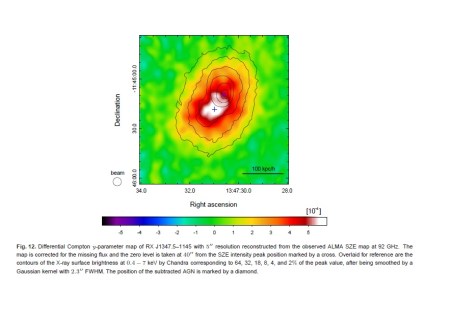
And here is the key image, a map of the variation of the Compton y-parameter across the cluster:

SZ

It’s not at all easy to isolate the Sunyaev-Zeld’dovich effect, so this is an impressive result and the paper is well-worth reading. Observations at such high resolution will help greatly to understand the behaviour of hot gas in rich clusters, especially when combined with observations of the emission from the cluster plasma itself, which is hot enough to radiate in the X-ray part of the spectrum.

Henry Draper’s Photograph of M42

Posted in History, The Universe and Stuff with tags , , , , on July 29, 2016 by telescoper

I just remembered that last night I happened across an interesting episode of The Essay on Radio 3. It was about the first ever photograph of an astronomical nebula, which happened to be of the Orion Nebula (M42). The programme features Omar Nasim, a lecturer in History at Kent University, and is available on iPlayer or as a download here. It’s only 15 minutes long, but absolutely fascinating.

Here is the photograph concerned, taken by Henry Draper in 1880:

Henry_Drape_Orion_nebula_1880_inverted

The stars of the constellation Orion are clearly over-exposed in order to reveal the much fainter light from the nebula, and the resolution is poor compared to, e.g., this glorious Hubble Space Telescope image:

Hubble's sharpest view of the Orion Nebula

The Orion Nebula seen by Hubble. Credit: ESA/NASA/Hubble Space Telscope

Nevertheless the Draper photograph is of great historical importance, as it changed the way astronomers made images of such objects (by photography rather than by drawing) and ushered in a new era of scientific research.

Hat’s off to Henry Draper!

Should we worry about the Hubble Constant?

Posted in The Universe and Stuff with tags , , , , on July 27, 2016 by telescoper

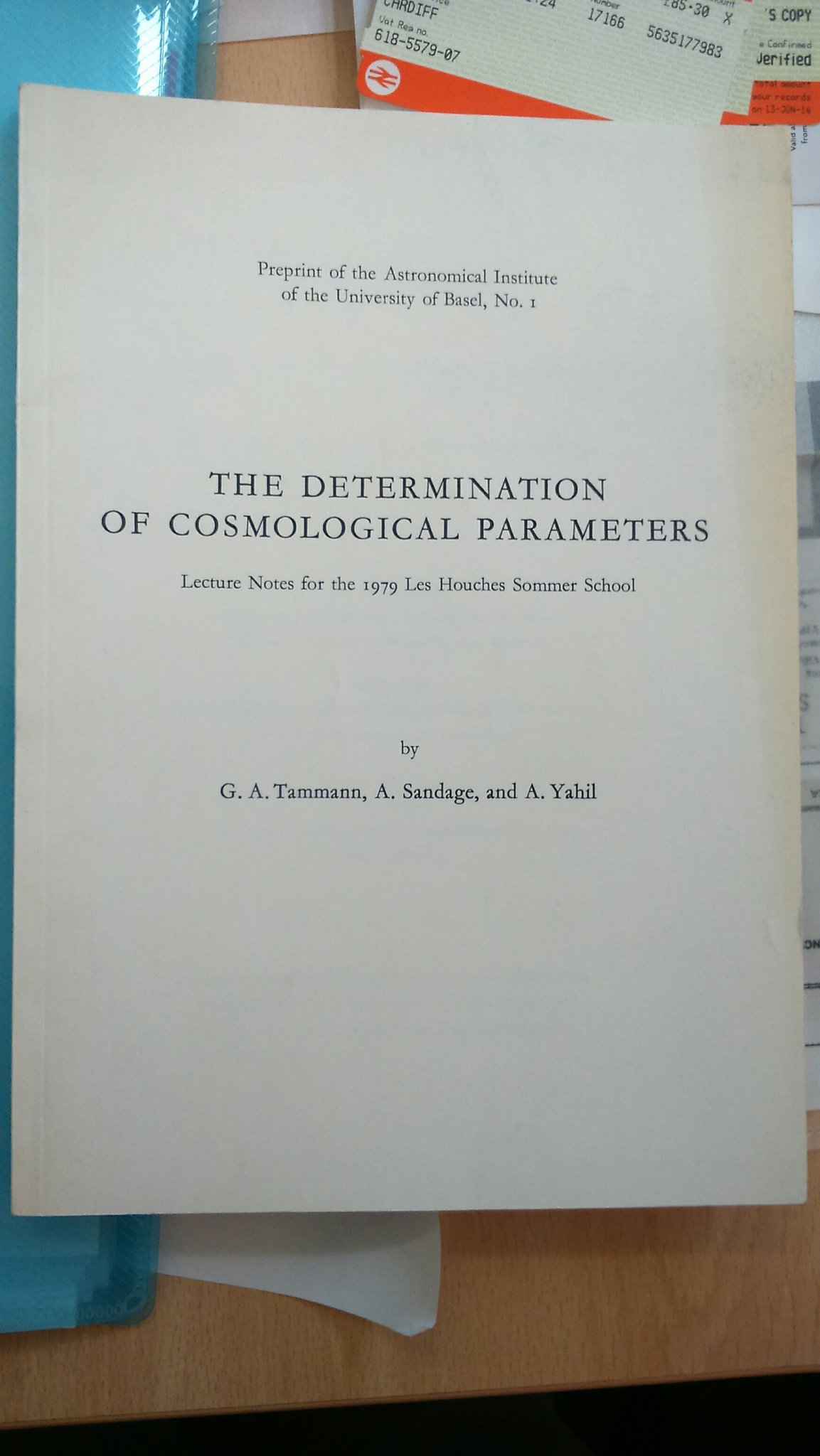
One of the topics that came up in the discussion sessions at the meeting I was at over the weekend was the possible tension between cosmological parameters, especially relating to the determination of the Hubble constant (H0) by Planck and by “traditional” methods based on the cosmological distance ladder; see here for an overview of the latter. Coincidentally, I found this old preprint while tidying up my office yesterday:

Cosmo_params

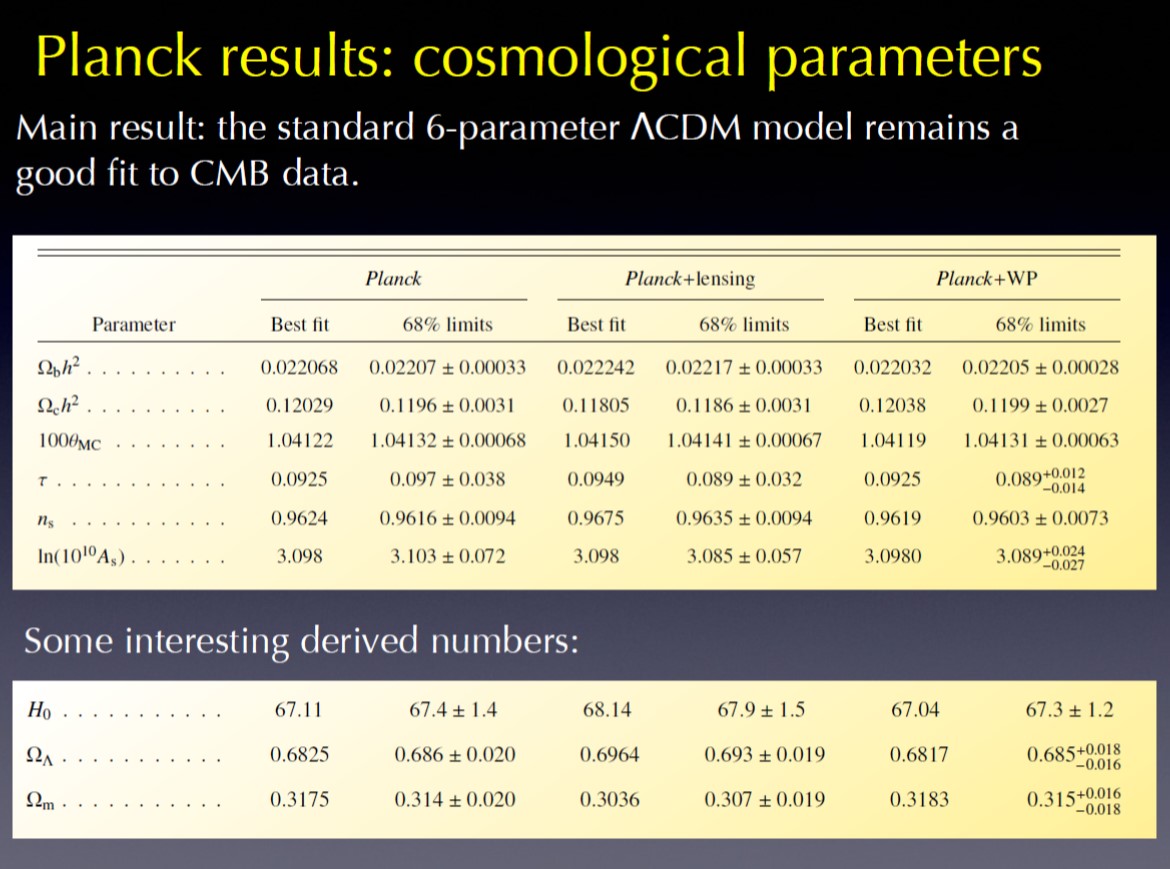
Things have changed quite a bit since 1979! Before getting to the point I should explain that Planck does not determine H0 directly, as it is not one of the six numbers used to specify the minimal model used to fit the data. These parameters do include information about H0, however, so it is possible to extract a value from the data indirectly. In other words it is a derived parameter:

Planck_parameters

The above summary shows that values of the Hubble constant obtained in this way lie around the 67 to 68  km/s/Mpc mark, with small changes if other measures are included. According to the very latest Planck paper on cosmological parameter estimates the headline determination is H0 = (67.8 +/- 0.9) km/s/Mpc.

Note however that a recent “direct” determination of the Hubble constant by Riess et al.  using Hubble Space Telescope data quotes a headline value of (73.24+/-1.74) km/sec/Mpc. Had these two values been obtained in 1979 we wouldn’t have worried because the errors would have been much larger, but nowadays the measurements are much more precise and there does seem to be a hint of a discrepancy somewhere around the 3 sigma level depending on precisely which determination you use. On the other hand the history of Hubble constant determinations is one of results being quoted with very small “internal” errors that turned out to be much smaller than systematic uncertainties.

I think it’s fair to say that there isn’t a consensus as to how seriously to take this apparent “tension”. I certainly can’t see anything wrong with the Riess et al. result, and the lead author is a Nobel prize-winner, but I’m also impressed by the stunning success of the minimal LCDM model at accounting for such a huge data set with a small set of free parameters. If one does take this tension seriously it can be resolved by adding an extra parameter to the model or by allowing one of the fixed properties of the LCDM model to vary to fit the data. Bayesian model selection analysis however tends to reject such models on the grounds of Ockham’s Razor. In other words the price you pay for introducing an extra free parameter exceeds the benefit in improved goodness of fit. GAIA may shortly reveal whether or not there are problems with the local stellar distance scale, which may reveal the source of any discrepancy. For the time being, however, I think it’s interesting but nothing to get too excited about. I’m not saying that I hope this tension will just go away. I think it will be very interesting if it turns out to be real. I just think the evidence at the moment isn’t convincing me that there’s something beyond the standard cosmological model. I may well turn out to be wrong.

It’s quite interesting to think  how much we scientists tend to carry on despite the signs that things might be wrong. Take, for example, Newton’s Gravitational Constant, G. Measurements of this parameter are extremely difficult to do, but different experiments do seem to be in disagreement with each other. If Newtonian gravity turned out to be wrong that would indeed be extremely exciting, but I think it’s a wiser bet that there are uncontrolled experimental systematics. On the other hand there is a danger that we might ignore evidence that there’s something fundamentally wrong with our theory. It’s sometimes a difficult judgment how seriously to take experimental results.

Anyway, I don’t know what cosmologists think in general about this so there’s an excuse for a poll:


The 3.5 keV “Line” that (probably) wasn’t…

Posted in Bad Statistics, The Universe and Stuff with tags , , , , , , , on July 26, 2016 by telescoper

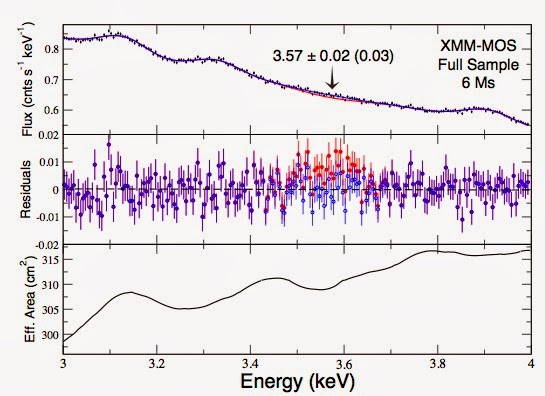
About a year ago I wrote a blog post about a mysterious “line” in the X-ray spectra of galaxy clusters corresponding to an energy of around 3.5 keV. The primary reference for the claim is a paper by Bulbul et al which is, of course, freely available on the arXiv.

The key graph from that paper is this:

XMMspectrum

The claimed feature – it stretches the imagination considerably to call it a “line” – is shown in red. No, I’m not particularly impressed either, but this is what passes for high-quality data in X-ray astronomy!

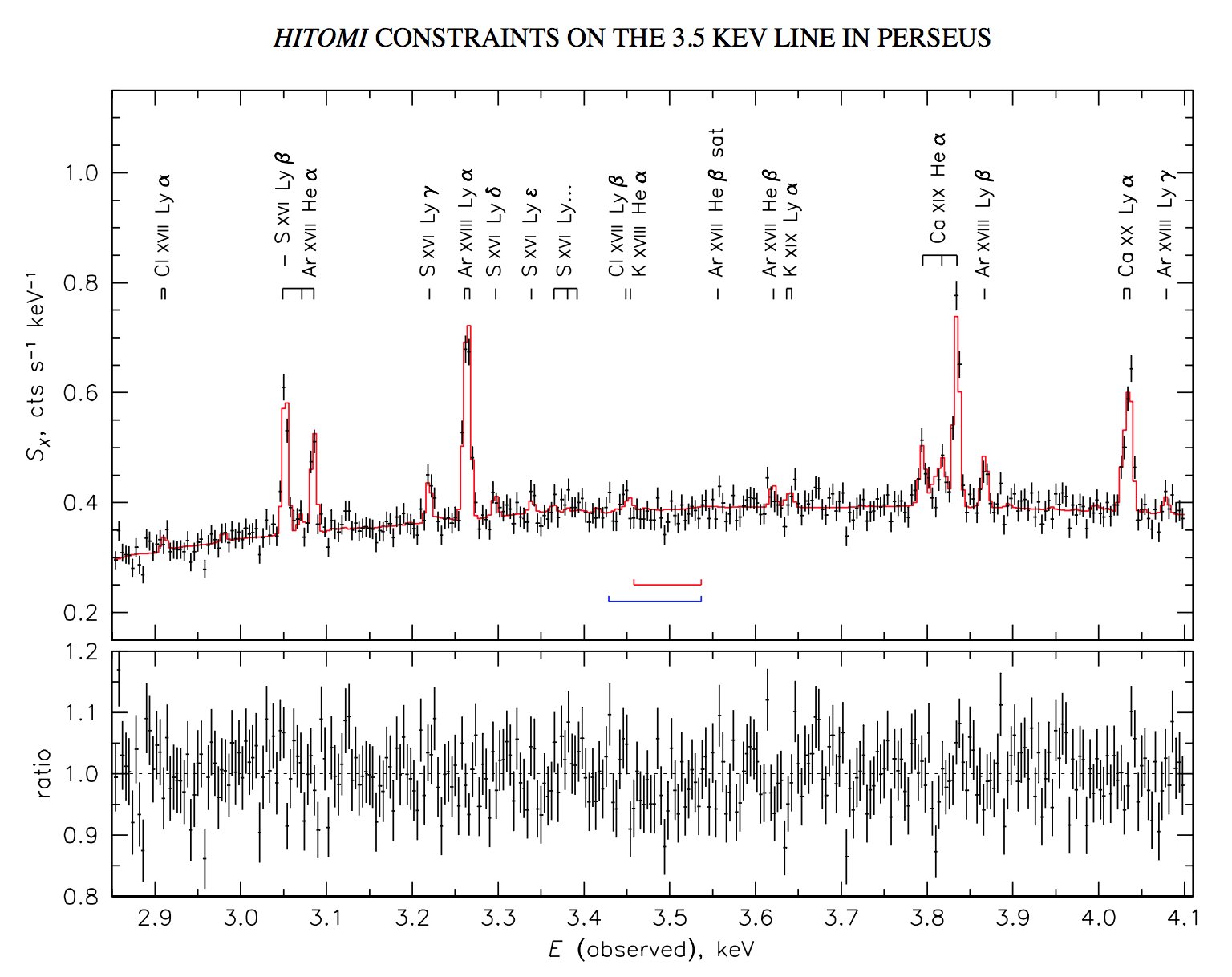
Anyway, there has just appeared on the arXiv a paper by the Hitomi Collaboration describing what are basically the only set of science results that the Hitomi satellite managed to obtain before it fell to bits earlier this year. These were observations of the Perseus Cluster.

Here is the abstract:

High-resolution X-ray spectroscopy with Hitomi was expected to resolve the origin of the faint unidentified E=3.5 keV emission line reported in several low-resolution studies of various massive systems, such as galaxies and clusters, including the Perseus cluster. We have analyzed the Hitomi first-light observation of the Perseus cluster. The emission line expected for Perseus based on the XMM-Newton signal from the large cluster sample under the dark matter decay scenario is too faint to be detectable in the Hitomi data. However, the previously reported 3.5 keV flux from Perseus was anomalously high compared to the sample-based prediction. We find no unidentified line at the reported flux level. The high flux derived with XMM MOS for the Perseus region covered by Hitomi is excluded at >3-sigma within the energy confidence interval of the most constraining previous study. If XMM measurement uncertainties for this region are included, the inconsistency with Hitomi is at a 99% significance for a broad dark-matter line and at 99.7% for a narrow line from the gas. We do find a hint of a broad excess near the energies of high-n transitions of Sxvi (E=3.44 keV rest-frame) – a possible signature of charge exchange in the molecular nebula and one of the proposed explanations for the 3.5 keV line. While its energy is consistent with XMM pn detections, it is unlikely to explain the MOS signal. A confirmation of this interesting feature has to wait for a more sensitive observation with a future calorimeter experiment.

And here is the killer plot:

Perseus_Hitomi

The spectrum looks amazingly detailed, which makes the demise of Hitomi all the more tragic, but the 3.5 keV is conspicuous by its absence. So there you are, yet another supposedly significant feature that excited a huge amount of interest turns out to be nothing of the sort. To be fair, as the abstract states, the anomalous line was only seen by stacking spectra of different clusters and might still be there but too faint to be seen in an individual cluster spectrum. Nevertheless I’d say the probability of there being any feature at 3.5 keV has decreased significantly after this observation.

P.S. rumours suggest that the 750 GeV diphoton “excess” found at the Large Hadron Collider may be about to meet a similar fate.