Archive for the The Universe and Stuff Category

The Student Education Paradox

Posted in Education, The Universe and Stuff with tags , , , on January 24, 2014 by telescoper

An exciting new paper by a leading theoretical physicist prominent educationalist has just appeared on the arXiv. In it the author addresses the important question of whether information is destroyed in black holes students actually learn anything during lectures.

Until recently it was generally believed that any information falling into a black hole entering the mind of a student was lost forever even though black holes do evaporate students do take examinations after a finite time. This belief is motivated by the properties of Hawking radiation produced by black holes observations of examination scripts written by students, which some claim to be entirely random, i.e. devoid of any information content whatsoever.

This picture has however been challenged by a number of educationalists theorists with a variety of counter-arguments. For example, some have argued for a statistical interpretation in terms of the multiverse a very large class; although information may be destroyed in individual black holes students, in a infinite multiverse large enough class, there may be a finite number of examples in which some information is retained.

The latest article (referred to above) offers a different resolution of the Black Hole Information Student Education Paradox which rests on the idea that information radiated by black holes examination scripts written by students are not in fact entirely random, just produced so chaotically that, although information is present, for any practical purposes such information is so garbled that it is impossible to decipher.

This intriguing suggestion has led to a number of interesting, if somewhat speculative, extensions. Some have even argued that there may after all be some information present in the speeches of Education Minister Michael Gove, though this idea obviously remains highly controversial.

Stephen Hawking is 72.

Hot News! Supernova in M82

Posted in The Universe and Stuff with tags , , , , , on January 22, 2014 by telescoper

Very exciting news today – a supernova has gone off in Messier 82. In fact, according to this sequence of images from Japan it actually started to brighten about a week ago:

psn-m82

Being arranged in Japanese fashion, you have to read these from top to bottom but starting at the right, so the supernova can be seen to be steadily brightening, i.e. decreasing in magnitude from 17.0 to 11.9. That means it’s now visible with binoculars and will have been seen already by many amateur astronomers. The exciting question this time is whether we’ll get any neutrinos from it!

UPDATE: I’m told that, close as it is, M82 is probably too far to detect neutrinos. Boo.

This is the nearest supernova since 1987a which was observed in, er, 1987. This is the nearest Type Ia supernova for a very long time (possibly 1937), so it’s of considerable interest for the use of such objects in cosmology. There have been other close ones since the nearest one I can remember, 1987a, which was observed in, er, 1987 but all have been Type II.

UPDATE: Thanks for the people who pointed out my error which I’ve left in to show that I don’t know much about supernovae so you shouldn’t phone me up to ask.

Cosmology and the Constants of Nature

Posted in The Universe and Stuff with tags , , , , on January 20, 2014 by telescoper

Just a brief post to advertise a very interesting meeting coming up in Cambridge:

–o–

Cosmology and the Constants of Nature

DAMTP, University of Cambridge

Monday, 17 March 2014 at 09:00 – Wednesday, 19 March 2014 at 15:00 (GMT)

Cambridge, United Kingdom

The Constants of Nature are quantities, whose numerical values we know with the greatest experimental accuracy – but about the rationale for those values, we have the greatest ignorance. We might also ask if they are indeed constant in space and time, and investigate whether their values arise at random or are uniquely determined by some deep theory.

This mini-series of talks is part of the joint Oxford-Cambridge programme on the Philosophy of Cosmology which aims to introduce philosophers of physics to fundamental problems in cosmology and associated areas of high-energy physics.

The talks are aimed at philosophers of physics but should also be of interest to a wide range of cosmologists.  Speakers will introduce the physical constants that define the standard model of particle physics and cosmology together with the data that determine them, describe observational programmes that test the constancy of traditional ʽconstantsʼ, including the cosmological constant, and discuss how self-consistent theories of varying constants can be formulated.

Speakers:

John Barrow, University of Cambridge

John Ellis, King’s College London

Pedro Ferreira, University of Oxford

Joao Magueijo, Imperial College, London

Thanu Padmanabhan, IUCAA, Pune

Martin Rees, University of Cambridge

John Webb, University of New South Wales, Sydney

Registration is free and includes morning coffee and lunch. Participants are requested to register at the conference website where the detailed programme of talks can be found:

http://www.eventbrite.co.uk/e/cosmology-and-the-constants-of-nature-registration-9356261831

For enquiries about this event please contact Margaret Bull at mmp@maths.cam.ac.uk

For the sake of a seminar..

Posted in Biographical, Books, Talks and Reviews, The Universe and Stuff with tags , , , on January 17, 2014 by telescoper

Just a quick post while I drink my morning coffee. Yesterday afternoon I gave a seminar here in the Kobayashi-Maskawa Institute at Nagoya University. It was actually at 5pm; I almost made a mistake when I saw it on the the high-tech digital display screen shown here (see top right) because I thought that 16 meant 1600 hours:

IMG-20140116-00264

Although I’ve got used to the time difference pretty well, I am still struggling to work out what day it is. The 16 stands for 16th January of course…

Anyway, it seemed to go fairly well and was pretty well attended by the students and postdocs as well as faculty. The lecture theatre was extremely well equipped with AV equipment and I got distracted quite often playing with the various gadgets. Also there were two projector screens, side by side, so the audience got my slides in stereo, so to speak.

In case you’re interested, here are the slides from my talk – complete with artistic flourishes:

For the cosmologists among you, the main protagonists here are Naoshi Sugiyama, who has a joint appointment here and at the Kavli Institute in Tokyo, Takahiko Matsubara, and Chiaki Hikage. The latter was a postdoc working with me at Nottingham and Cardiff; he then worked in Princeton before returning to Japan; Chiaki has been my host during my stay here.

After my talk, and a question-and-answer session, the staff treated me to dinner. We had some discussion about where to go during which I mentioned that I’d seen a place called Hamakin, which claimed to be a Japanese-Italian restaurant:

640x640_rect_21510962

I wasn’t convinced by the concept but it turned out that, although it was a new place, Takahiko had been there before and thought it was very good. We ended up there and, much to my surprise, it was excellent. It was a lot more Japanese than Italian, I have to say, but we did try an interesting take on pizza with cod roe as part of the topping. They had an English menu, with some curious choices of English words. I wasn’t really tempted by “Economic Steak”, and “Cod Ovum” suggested, by use of the Latin singular of “egg”, an extremely small portion. I still don’t know what “pastured chicken” is, either.

As a special treat some sake from a bamboo container was served for me in a bamboo cup; the bamboo is supposed to make it taste nicer but I wasn’t able to discern a difference between the special sake and normal sake. I clearly don’t have a sufficiently cultivated palate. Apologies for the pun in the title of the post too!

Today, Friday, is the last working day of my visit so I’d better get on and finish what I’m here to do because there’s another seminar this afternoon which I’d like to attend. Tomorrow, if I can get myself organized, I might take a trip on the bullet train for a day’s sightseeing in Kyoto, which I am told is a must-see city.

Toodle-pip!

Living in the Vortices of Infinity

Posted in Biographical, Literature, The Universe and Stuff with tags , , , , on January 16, 2014 by telescoper

As a boyhood fan of influential American horror writer Howard Phillips Lovecraft (known to his friends as “H.P.”), I was dismayed to discover some time ago a poem which revealed his obnoxiously racist attitudes. I always find it difficult knowing what to do when someone whose artistic work you admire turns out to have a dark side to his or her personality. It’s always hard to separate the creation from the creator. In the case of H.P. Lovecraft I’ve maintained an interest in him and his work, I suppose in an attempt to find some redeeming features.

Anyway, in Lovecraft’s Selected Letters, I came across a passage which is reminiscent of the following quotation from an interview with physicist Steven Weinberg:

I believe that there is no point in the universe that can be discovered by the methods of science. I believe that what we have found so far, an impersonal universe in which it is not particularly directed toward human beings is what we are going to continue to find. And that when we find the ultimate laws of nature they will have a chilling, cold impersonal quality about them.

I don’t think this means [however] there’s no point to life. Usually the remark is quoted just as it stands. But if anyone read the next paragraph, they would see that I went on to say that if there is no point in the universe that we discover by the methods of science, there is a point that we can give the universe by the way we live, by loving each other, by discovering things about nature, by creating works of art. And that — in a way, although we are not the stars in a cosmic drama, if the only drama we’re starring in is one that we are making up as we go along, it is not entirely ignoble that faced with this unloving, impersonal universe we make a little island of warmth and love and science and art for ourselves. That’s not an entirely despicable role for us to play.

This is the passage in Lovecraft’s Selected Letters

As you are aware, I have never been able to soothe myself with the sugary delusions of religion; for these things stand convicted of the utmost absurdity in light of modern scientific knowledge. With Nietzsche, I have been forced to confess that mankind as a whole has no goal or purpose whatsoever, but is a mere superfluous speck in the unfathomable vortices of infinity and eternity. Accordingly, I have hardly been able to experience anything which one could call real happiness; or to take as vital an interest in human affairs as can one who still retains the hallucination of a “great purpose” in the general plan of terrestrial life. … However, I have never permitted these circumstances to react upon my daily life; for it is obvious that although I have “nothing to live for”, I certainly have just as much as any other of the insignificant bacteria called human beings. I have thus been content to observe the phenomena about me with something like objective interest, and to feel a certain tranquillity which comes from perfect acceptance of my place as an inconsequential atom. In ceasing to care about most things, I have likewise ceased to suffer in many ways. There is a real restfulness in the scientific conviction that nothing matters very much; that the only legitimate aim of humanity is to minimise acute suffering for the majority, and to derive whatever satisfaction is derivable from the exercise of the mind in the pursuit of truth (from Letter to Reinhardt Kleiner  (14 September 1919), in Selected Letters I, 1911-1924 edited by August Derleth and Donald Wandrei, pp. 86-87).

I think my own philosophy of life is some sort of juxtaposition of these two…

Early Junction: Door of the Cosmos

Posted in Jazz, The Universe and Stuff with tags , , , on January 15, 2014 by telescoper

One of the quirks of being in Japan is the 9 hour time difference between here and the UK, which means I’m just getting up when folk back home are going to bed; and one of the consequences is that BBC Radio 3’s Late Junction is on (via the internet) in the morning. It’s playing as a write this, in fact. Yesterday morning there was a track by Sun Ra, which reminded me that 2014 is the centenary of his birth. It prompted me to look back at an old post I’d written about him where I found the track included there had been deleted from Youtube. I therefore decided to post a new version, including a different track.

Sun Ra was one of the most extraordinary composers and bandleaders of the 20th Century,  was born Herman Poole Blount in Bimingham, Alabama, on 22nd May 1914. From the 1950s, until his death in 1993, he led various combinations of musicians in bands with various permutations of names involving the word Arkestra, such as the Blue Universe Arkestra and the Solar Myth Arkestra. He himself played keyboards, sometimes solo and sometimes with huge bands  of over 30 musicians; his music touched on virtually the entire history of jazz, from ragtime to swing music, from bebop to free jazz, as well as soul and pop. He was also  one of the first musicians, in any genre, to make extensive use of electronic keyboards.

He never achieved mainstream commercial success, but was a prolific recording artist with a cult following, partly fuelled by his outrageous claims to have been born not on Earth but on Saturn and the fact that much of his music was to do with space travel. Quoted in Jazziz magazine

They really thought I was some kind of kook with all my talk about outer space and the planets. I’m still talking about it, but governments are spending billions of dollars to go to Venus, Mars, and other planets, so it’s no longer kooky to talk about space

Quite. In fact, Sun Ra developed a complex performing identity based on his music, “cosmic” philosophy, and poetry. He abandoned his birth name, took on the persona of Sun Ra (Ra being the ancient Egyptian god of the sun), and often dressed in the style of an ancient Egyptian pharoah, as in the video clip. In other words, he was very odd.

Sun Ra’s music is eclectic, outrageous and sometimes downright mystifying, but it also has a marvellous coherence to it maintained as his style evolved over four decades and is consistently imbued with a powerful sense of the Jazz tradition.  Anyway, whatever I think, the music of Sun Ra has withstood its skeptics and detractors for generations and long may it continue to do so. The world needs more of his kind of eccentric.

Here’s a number called Door of the Cosmos. See what you think.

Cosmological Tanka

Posted in Poetry, The Universe and Stuff with tags , , , on January 14, 2014 by telescoper

Most readers of this blog will be familiar with the form of Japanese poetry known as Haiku. I’ve even had a go at producing some cosmological Haiku myself. I suspect rather fewer will have come across another form known as Tanka. Being 31 syllables long rather than the 17 of Haiku, these are not quite as short but still quite a challenge to write.  They comprise 5 lines with a 5-7-5-7-7 pattern of syllables. I’m told by Japanese friends that Tanka are specifically written to celebrate a special event or to capture the mood of a particular moment. Here is an exquisite example by a famous poet called Otomo No Yakamochi:

From outside my house,
only the faint distant sound
of gentle breezes
wandering through bamboo leaves
in the long evening silence.

I’ve had a go at composing a couple of Tanka to do with specific moments in cosmology. Here’s one about the epoch of recombination:

An electron finds
a proton and marries it;
they make hydrogen.
Simultaneous weddings
free light across the cosmos.

I was talking to some students about the spherical collapse model so here’s a Tanka for that:

I was more dense than
my surroundings, expanded
more slowly, then stopped.
Now I must start to collapse;
soon I shall virialize.

Further attempts welcome through the comments box!

A Summer of Undergraduate Physics Research

Posted in Biographical, Education, The Universe and Stuff with tags , , , , on January 14, 2014 by telescoper

I was compiling a bibliography for a new paper yesterday and noticed that a paper published in December 2013 cited one I wrote in 2005 with Andrew Stannard while I was working at the University of Nottingham; the rarity of anyone actually referring to any of my papers caught my attention. I include the abstract of the Stannard-Coles paper here for reference:

We investigate the properties of the (complex) coefficients obtained in a spherical harmonic representation of temperature maps of the cosmic microwave background (CMB). We study the effect of the coefficient phase only, as well as the combined effects of phase and amplitude. The method used to check for anomalies is to construct a `random walk’ trajectory in the complex plane where the step length and direction are given by the amplitude and phase (respectively) of the harmonic coefficient. If the fluctuations comprise a homogeneous and isotropic Gaussian random field on the sky, the path so obtained should be a classical `Rayleigh flight’ with very well known statistical properties. We illustrate the use of this random-walk representation by using the net walk length as a test statistic, and apply the method to the coefficients obtained from a Wilkinson Microwave Anisotropy Probe (WMAP) preliminary sky temperature map.

This seems like ancient history now, particularly with regard to the use of “preliminary” WMAP data, but it was only just over 8 years ago. I never imagined during the time that we were working on this paper that I’d be moving twice! By contrast, Andrew Stannard remained in Nottingham, doing a PhD there and is now employed as a Research Fellow, although he switched fields after the project and moved into nanoscience.

Anyway, I wasn’t posting this so I could take a trip down memory lane. I thought I’d post it in order to point out that this paper actually came about as an undergraduate research project that Andrew did under my supervision during the summer of 2005, funded by a Mary Cannell Summer Studentship. Mary Cannell was the author of a book about the life of George Green (the famous mathematician who came from Nottingham); she passed away in 2000 leaving some money to the School of Physics & Astronomy to fund summer research placements for undergraduates. If I recall correctly, we completed the analysis and wrote the paper during the summer of 2005, submitting it in August and having it accepted in September. If only it were always so straightforward! Since publication it has garnered 15 citations according to the ADS website; not exactly earth-shattering, but respectable enough, especially given the background. I think it may get a few more in the next few years because the quality of data from Planck may now be good enough to actually detect the features we were looking for all those years ago!

It’s worth mentioning that in the School of Physics and Astronomy at the University of Sussex we have a degree programme in which students receive a stipend to cover living expenses during a summer vacation placement with one of the research groups each and every year of their studies. This is in addition to the usual lectures and laboratory work of the standard  course. This involves many more students than was the case back in Nottingham in 2005, but since I’ve only been at the University of Sussex for  a year I don’t know how many such placements have led to actual publications.

Does anyone know of any really important papers out there that came from undergraduate research projects? If so, please let me know through the comments box..

Physics World Plug

Posted in Books, Talks and Reviews, The Universe and Stuff with tags , , , on January 7, 2014 by telescoper

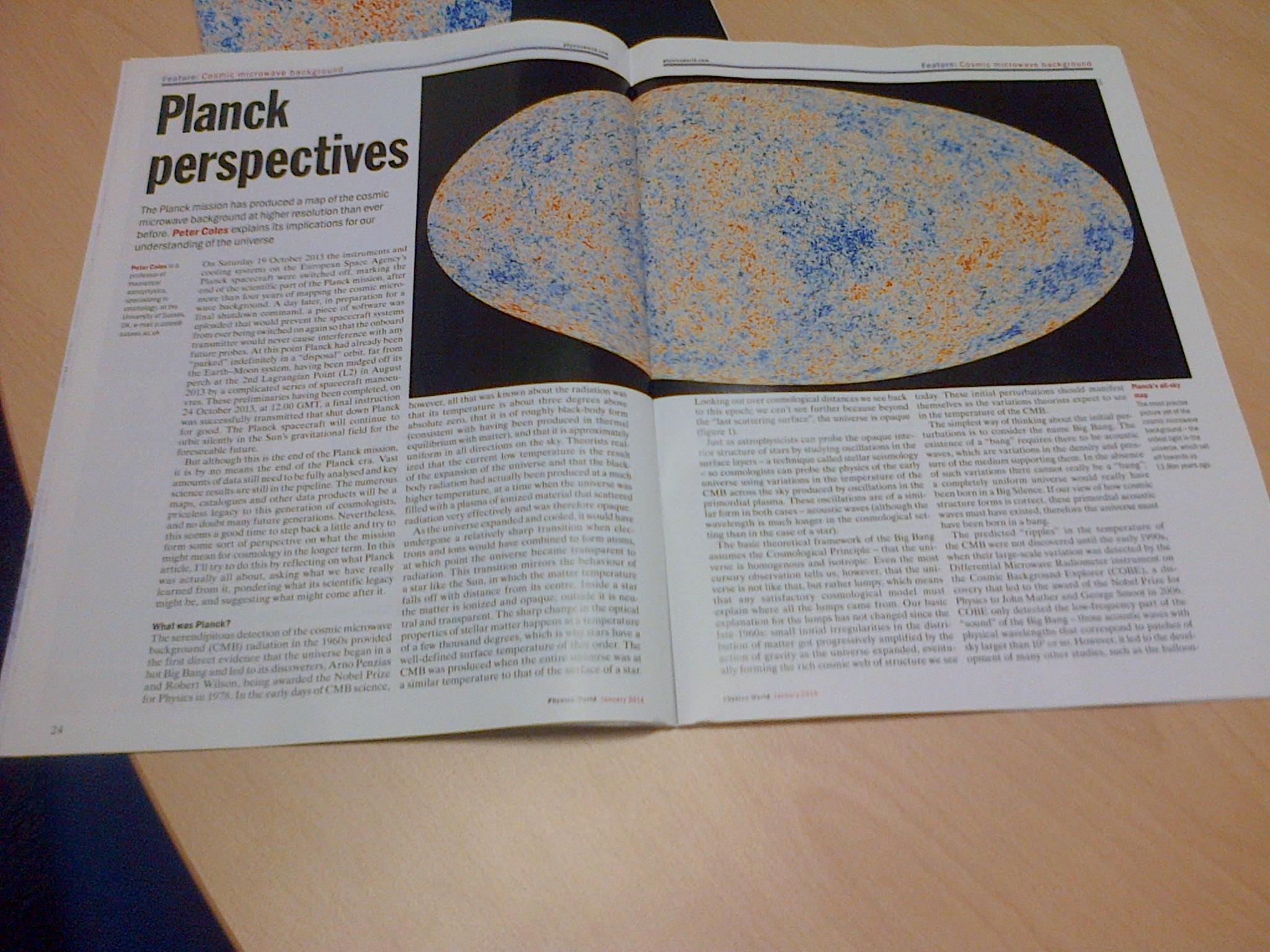
Just time for a quick bit of shameless self-promotion. This month’s Edition of Physics World has an article by me as cover feature. Here’s a sneak preview, but to read the whole thing you’ll have to rush out and buy a copy! Alternatively, you can find it online here.

IMG-20140107-00256

Inflation and the Multiverse

Posted in Astrohype, The Universe and Stuff with tags , , , , , , on January 6, 2014 by telescoper

I was quite excited when I discovered, via Twitter, a paper on the arXiv with the title Quantum Fluctuations in Cosmology and How They Lead to a Multiverse, which was written by one of the architects of the inflationary universe scenario, Alan Guth. Despite numerous attempts to understand the argument how inflation leads to a Multiverse I’ve never really succeeded. To me it always seemed like  a version of the Mind Projection Fallacy inspired by a frequentist interpretation of probability: the construction of notional ensembles for the purposes of calculation in quantum mechanics does not imply that such ensembles are realized in nature. In fact I’ve never found much more substance in articles about this issue than the assertion that Quantum Physics = Woo! = Multiverse.

Anyway, since the paper I found is a review article I hoped it would help teach me the error of my ways. Here is the abstract

This article discusses density perturbations in inflationary models, offering a pedagogical description of how these perturbations are generated by quantum fluctuations in the early universe. A key feature of inflation is that that rapid expansion can stretch microscopic fluctuations to cosmological proportions. I discuss also another important conseqence of quantum fluctuations: the fact that almost all inflationary models become eternal, so that once inflation starts, it never stops.

My eye was drawn to the phrase “almost all inflationary models”.  I had hoped to see “almost all” used in its strict mathematical sense, ie “apart from a set of measure zero” with the measure being fully specified. Disappointingly, it isn’t.   Guth discusses the consequences of the tail  the inflationary potential V (for large values of the inflaton field ϕ) on the long-term evolution of inflationary dynamics and then states

Since V3/2/|V ′| grows without bound as ϕ → ∞ for most potentials under consideration, almost all models allow for eternal inflation.

This means, to me, most models people have constructed but doesn’t mean all possible models. I don’t doubt that some inflationary models  become eternal, but would have preferred a more rigorous statement.  This is particularly strange because Guth spends the last section of his paper discussing the “measure problem”:

While the multiverse picture looks very plausible in the context of inflationary cosmology — at least to me — it raises a thorny and unsolved problem, known as the “measure problem.” Specifically, we do not know how to define probabilities in the multiverse.

The measure problem to my mind also extends to the space of all possible inflationary theories.

And then there’s the title, which, I remind you, is Quantum Fluctuations in Cosmology and How They Lead to a Multiverse. Guth’s argument consists of going through the (standard) calculation of the spectrum of cosmological density fluctuations (which does fit a host of observational data). He then states:

Since the density perturbation calculations have been incredibly successful, it seems to make sense to take seriously the assumptions behind these calculations, and follow them where they lead. I have to admit that there is no clear consensus among cosmologists, but to many of us the assumptions seem to be pointing to eternal inflation, and the multiverse.

I have to admit that I get a bit annoyed when I read a paper in which the actual conclusions are much weaker than implied by the title, but that seems to be par for the course in this field.

For the record, I’ll state that I am an agnostic about the multiverse. It may be a correct idea, it may not. I will say, however, that I still haven’t found any article that puts it on a firm scientific footing. That may well, of course, just be a measure of my ignorance. If you know of one, please let me know through the comments box.