Archive for the The Universe and Stuff Category

The Mystery of Cosmic Magnetism

Posted in The Universe and Stuff with tags , , , , , , on May 13, 2013 by telescoper

I came across an article in New Scientist recently on the topic of cosmological magnetism. The piece is about an article by Leonardo Campanelli, which is available on the arXiv and which is apparently due to be published in Physical Review Letters. So it must be right.

Here’s the abstract

We calculate, in the free Maxwell theory, the renormalized quantum vacuum expectation value of the two-point magnetic correlation function in de Sitter inflation. We find that quantum magnetic fluctuations remain constant during inflation instead of being washed out adiabatically, as usually assumed in the literature. The quantum-to-classical transition of super-Hubble magnetic modes during inflation, allow us to treat the magnetic field classically after reheating, when it is coupled to the primeval plasma. The actual magnetic field is scale independent and has an intensity of few \times 10^(-12) G if the energy scale of inflation is few \times 10^(16) GeV. Such a field account for galactic and galaxy cluster magnetic fields.

So why is this interesting? Let me explain….

If you’re stuck for a question to ask at the end of an astronomy seminar and don’t want to reveal the fact that you were asleep for most of it, there are some general questions that you can nearly always ask regardless of the topic of the talk without appearing foolish. A few years ago, “how would the presence of dust affect your conclusions?” was quite a good one, but the danger these days is that with the development of far-infrared and submillimetre instrumentation and the proliferation of people using it, this could actually have been the topic of the talk you just dozed through. However, no technological advances have threatened the viability of another old stalwart: “What about magnetic fields?”.

In theory, galaxies condense out of the Big Bang as lumps of dark matter. Seeded by primordial density fluctuations and amplified by the action of gravity, these are supposed to grow in a hierarchical, bottom-up fashion with little blobs forming first and then merging into larger objects. The physics of this process is relatively simple (at least if the dark matter is cold) as it involves only gravity.

But, by definition, the dark matter can’t be seen. At least not directly, though its presence can be inferred indirectly by dynamical measurements and gravitational lensing. What astronomers generally see is starlight, although it often arrives at the telescope in an unfamiliar part of the spectrum owing to the redshifting effect of the expansion of the Universe. The stars in galaxies sit inside the blobs of dark matter, which are usually called “haloes” although blobs is a better name. In art the whole purpose of a halo is that you can see it.

How stars form is a very complicated question to answer even when you’re asking about nearby stellar nurseries like the Orion Nebula. The basic idea is that a gas cloud cools and contracts, radiating away energy until it gets sufficiently hot that nuclear burning switches on and pressure is generated that can oppose further collapse. The early stages of this processs, though, involve very many imponderables. Star formation doesn’t just involve gravity but lots of other processes, including additional volumes of Landau & Lifshitz, such as hydrodynamics, radiative transfer and, yes, magnetic fields. Naively, despite the complicated physics, it might still be imagined that stars form in the little blobs of dark matter first and then gradually get incorporated in larger objects.

Unfortunately, it is becoming increasingly obvious that this naive picture doesn’t quite work. Deep surveys of galaxies suggest that the most massive galaxies formed their stars quite early in the Big Bang and have been relatively quiescent since then, while smaller objects contain younger stars. In other words, pretty much the opposite of what one might have thought. This phenomenon (known as “downsizing”) suggests that something inhibits star formation early on in all but the largest of the largest haloes. It could be that powerful feedback from activity in the nuclear regions associated with a central black hole might do this, or it could be something a little less exotic such as stellar winds. Or it could be that the whole scheme is wrong in a more fundamental way. I personally wouldn’t go so far as to throw out the whole framework, as it has scored many successes, but it is definitely an open question what is going on.

A paper  in Nature a few years ago by Art Wolfe and collaborators revealed the presence of an enormously strong magnetic field in a galaxy at the relatively high redshift of 0.692. Actually it’s about 84 microGauss. OK, so this is just one object but the magnetic field in it is remarkably strong. It could be a freak occurrence resulting from some kind of shock or bubble, but it does seem to fit in a pattern in which young galaxies generally seem to have much higher magnetic fields than previously expected. Obviously we need to know how many more such magnetic monsters are lurking out there.

So why are these results so surprising? Didn’t we already know galaxies have magnetic fields in them?

Well, yes we did. The Milky Way has a magnetic field with a strength of about 10 microGauss, much lower than that discovered by Wolfe et al. But the point is that if we understand them properly, galactic magnetic fields are supposed to be have been much lower in the past than they are now. The standard theoretical picture is that a (tiny) initial seed field is amplified by a kind of dynamo operating by virtue of the strong differential rotation in disk galaxies. This makes the field grow exponentially with time so that only a few rotations of the galaxy are needed to make a large field out of a very small one. Eventually this dynamo probably quenches when the field has an energy density comparable to the gas in the galaxy (which is roughly the situation we find in our own Galaxy).

Hopefully you now see the problem. If the field is being wound up quickly then younger galaxies (those whose light comes to us from a long way away) should have much smaller magnetic fields than nearby ones. But they don’t seem to behave in this way.

A few years ago, I wrote a paper about a model in which the galactic fields weren’t produced by a dynamo but were primordial in origin and quite large from the start. If that’s the case then the magnetic field need not evolve as quickly as it needs to if the initial field is very tiny.

The problem is that it has previously been thought very difficult for any cosmological model involving inflation to generate a significant primordial magnetic field without invoking very exotic physics, such as breaking the conformal invariance of electrodynamics (which would mean, among other things, giving the photon a rest mass).

The interesting thing about Campanelli’s paper is that it suggests a straightforwardmechanism for inflation to generate interesting magnetic phenomena. I’m not an expert on the techniques used in this paper, so can’t comment on the accuracy of the calculations. I’d be very grateful for any comments on this, actually. Me, I’m an old fogey who’s very suspicious of anything that relies too heavily on renormalization. I do however agree with Larry Widrow, quoted in the New Scientist piece.

But even if primordial magnetic fields can be generated by inflation, their impact on the origin and evolution of galaxies and other cosmic structures remains unsolved. Although we know magnetism exists, it is notoriously difficult to understand its behaviour when it is coupled to all the other messy things we have to deal with in astrophysics. It’s a kind of polar opposite of dark matter, which we don’t know (for sure) exists but which only acts through gravity, so its behaviour is easier to model. This is the main reason why cosmological theorists prefer to think about dark matter rather than magnetic fields. I’d hazard a guess that this is one problem that won’t be resolved soon either. Things are complicated enough already!

It is also worth considering the possibility that magnetic fields might play a role in moderating the processes by which gas turns into stars within protogalaxies. At the very least, a magnetic field generates stresses that influence the onset of collapse. Although the evidence is mounting that they may be important, it is still by no means obvious that magnetic fields do provide the required missing link between dark matter haloes and stars. On the other hand, we now have fewer reasons for ignoring them.

Cute Nuclear Physics Problem

Posted in Cute Problems, The Universe and Stuff with tags , , on May 2, 2013 by telescoper

It’s been quite a while since I posted anything in the cute physics problems folder – mostly because the problems I’m generally dealing with these days are neither cute nor related to physics – but here’s one from an old course I used to teach on Nuclear and Particle Physics.

In the following the notation A(a,b)B means the reaction a+A→b+B and the you might want to look here for a definition of what a Q-value is. The Atomic Number of Phosphorus (P) is 15, and that of Silicon (Si) is 14. The question doesn’t require any complicated mathematics, or any knowledge of physics beyond A-level; the rest is up to your little grey cells!

nuclear

Lines on the Death of Herschel

Posted in Poetry, The Universe and Stuff with tags on April 30, 2013 by telescoper

So farewell, then,
Herschel
Space
Observatory.

You were named after
William Herschel,
Who lived
During the reign of
George III.
The mad King
Who went blind,
Then died.

You went blind
Then died.
But there the
Similarity
Ends.

You ran out
Of Helium;
He had no
Need of He.

And he was neither
In Space
Nor an
Observatory,
So forget
It.

by Peter Coles (aged 49 11/12).

Breaking down a breakdown

Posted in Biographical, The Universe and Stuff with tags , , , , , on April 25, 2013 by telescoper

A blog piece by Dean Burnett  I read on on the Grauniad website yesterday set me thinking about whether I should post a personal comment in reaction to it. I never know what is the appropriate way to draw the line between the private and the public on In the Dark but since having a blog is clearly an exercise in self-indulgence anyway I thought I’d go ahead and write a piece.

Dean’s piece is about nervous breakdowns, but it’s really about why “nervous breakdown” is not a very good name for what it purports to describe. Regular readers of this blog  (both of them) will know that I went through one last year, and one thing I do remember is the disapproval that the term “nervous breakdown” provoked when I used it during my subsequent course of therapy. Apparently it’s a bit frowned-upon among professionals in the field.

Here is Dean (who is a neuroscientist in his day job) on the subject:

The term nervous breakdown is actually surprisingly old, and stems from a time when both “nervous” and “breakdown” arguably had different meanings to their modern ones. It seems the “breakdown” element refers to a breakdown in the same way that cars or other machines can break down. And nervous just refers to the nervous tissue. So originally it meant a fault or error in the nervous tissue that controls the body. And suddenly my interpretation doesn’t seem so literal.

But this doesn’t mean it’s an invalid term, it’s just more of a rule-of-thumb or generalisation used to refer to what happens when someone becomes psychologically unable to function as normal. In the simplest sense it could be said that, mentally speaking, a nervous breakdown occurs when an individual finds that the number of things that they are able to cope with is lower than the number of things that they have to cope with.

That seems to me to sum up very sensibly why the term is not very useful for an expert: it’s too vague, in that there are so many quite different things that might cause a person to become “psychologically unable to function as normal”. But it also explains quite well why its usage persists in popular language, in that the state of being “”psychologically unable to function as normal” is not as uncommon you might think. Anyway, if someone says they’ve had a nervous breakdown it gives at least a general idea of what they’ve experienced, although the specifics vary widely from individual to individual.

I hope you’ll bear with me if I illustrate this with some personal observations in the light of my own experiences.

I’ve suffered from a form of panic disorder for many years. Actually even that term has a very broad definition, so that different individuals experience different forms of panic attacks and they can also take very different forms for the same individual. For me, a “typical” panic episode begins with a fairly generalized feeling of apprehension or dread. Sometimes that’s as far as it goes. However, more often, there follows a period of increasingly heightened awareness of things moving  in my peripheral vision that I can’t keep track of. This leads to a sense of being surrounded by threats of various kinds and panic ensues. Usually, at that point, I run.

A typical panic episode lasts only a few minutes, but that’s not the end of it. For a considerable period (hours) afterwards I find myself in a state of hypervigilance during which I’m such a bundle of nerves that the slightest sound or movement can trigger a repeat.

I tend to think of these episodes as being a bit like earthquakes. The milder ones happen fairly frequently, but they’re quite easy to cope with. I have altered my behaviour to avoid places likely to trigger them (see below) and to be aware of appropriate exit strategies. The more severe episodes are much harder to deal with, though, and when one starts there’s nothing I can do apart from try to find somewhere that feels safe, wait for it to pass and then just get through the aftermath, hoping for no aftershocks.

In Dean’s piece he writes about the different stressors that can trigger a breakdown. In my case it was a bit more complicated than that.  Thinking about the milder attacks I find it very difficult to identify specific triggers – they seem to occur more-or-less randomly. However,  I can cope with this low-level “noise” pretty well. I’ve had plenty of time to get used to it, at least.  The more severe attacks seem more likely to be triggered by specific places, especially if they’re crowded with people moving around – although I don’t always have a problem in places like that. To give an example, crossing the main concourse at Victoria Station is, for me, like descending into the abyss; I simply can’t do it, and have to go outside the station to get between the trains and the underground station. Paddington Station, on the other hand, is fine. Weird.

I think the probability of one of these episodes is also influenced by background levels of stress arising from other independent things. Anyway, last year I got into a state in which I was experiencing multiple episodes per day. I couldn’t sleep or eat for over a week, and couldn’t leave the house for fear of experiencing another major problem. I think “nervous breakdown” is a pretty apt description for that period, but my breakdown was caused not by a new problem, but the amplification of an old problem to completely intolerable levels.

The reason for writing about the anatomy of my breakdown in this context is twofold. One part is just to reinforce Dean’s point that a “nervous breakdown” can be triggered by many different circumstances and conditions. Mine is probably an unusual example, but I think everybody else’s  is too.

The other reason is to confess how frustrating it is to be a physicist who has experienced a thing like that. It seems natural that having experienced such an episode I should want or need to try to make sense of it, but I’ve struggled to do that. The way we’re used to thinking about things in physics is to make simple models that capture the relatively simple cause-and-effect relationships between relatively few variables, usually based on the objective analysis of data controlled experiments and/or systematic observations.   This all involves trying to break down a phenomenon into its component parts so as to look at their separate action and thus establish the simple rules (if there are any) that govern the overall behaviour.

The trouble with this analytic approach is that the human brain and its interactions with the external world are far too complicated and non-linear to be approached in the simple-minded way we physicists usually do things. Even if you accept that the brain is basically a collection of atoms communicating with each other using electrical impulses, that doesn’t mean that it’s useful to try to describe its action using atomic physics and electromagnetic theory.

On top of all that, there’s the issue that neuroscience is a subject I know very little about at a technical level. There’s only room in my feeble little brain for my own specialism, so I lack the knowledge needed even to understand the literature.

So although I got over my breakdown, it has left me with a huge number of questions I don’t even know how to begin to answer. What is happening in my brain when a panic episode begins? What is going on with my peripheral vision when it goes awry like it does? Why do some particular places  or circumstances trigger an attack but other, apparently similar, ones don’t?

I don’t suppose anyone out to answer these questions, but if any neuroscientists out there happen to read this piece I would be grateful if they could recommend appropriate literature, as long as it’s simple enough for an astrophysicist to read…

HFLS3: the earliest Starburst yet!

Posted in The Universe and Stuff with tags , , , , on April 24, 2013 by telescoper

Once again I’ve spent all day engaged in the enjoyable but exhausting task of interview for new faculty positions, which means that I haven’t really got time for a proper blog today. What I can do, however, is shamelessly rip off a nice press release produced by the good folks here at the University of Sussex about a discovery that has been attracting a lot of press coverage since it was published last week in Nature; the paper is also available on the arXiv. If you’ve followed this blog for a while you will know than when I was at Cardiff I got interested in a large project called the Herschel Atlas survey, which is a large area galaxy survey carried out using the Herschel Space Observatory. This result is not from Herschel ATLAS but from a complementary deeper survey called Hermes, also performed using the Herschel Space Observatory and it is of a very distant and very bright starburst galaxy (a type of galaxy which, as its name suggests, in which stars are forming at a much higher rate than a “normal” galaxy).

Incidentally, although Herschel is now extremely short of the Helium it needs to keep itself cool, it is still making observations running on empty, as it were.

Anyway, that’s all I’ve got time to write. The rest is just copied from the press release I mentioned…

–o–

University of Sussex astronomers using the Herschel Space Observatory are part of an international team that has discovered a distant star-forming galaxy that challenges the current theories of galaxy evolution.

Seen when the Universe was less than a billion years old (880 million years) the galaxy, known only as “HFLS3”, is forming stars at a much faster rate than should be possible according to existing predictions. In the infant Universe, galaxies should have been forming stars at a much slower rate than is observed in HFLS3.

HFLS3 is so distant that the light we see from it has taken 13 billion years to get to Earth.

The Herschel observatory1 has been surveying the distant cosmos and finding hundreds of thousands of distant galaxies. Images produced by Herschel show how fast these distant galaxies are forming stars.

By determining the ages of the galaxies, astronomers have been building up a cosmic timeline of star formation, searching for when the first massive galaxies started churning out stars.

University of Sussex PhD student Peter Hurley, Dr Isaac Roseboom, Dr Anthony Smith, Dr Lingyu Wang and Professor Seb Oliver, who leads the HerMES2 survey that found the galaxy, analysed data from Herschel and built the HFLS3 galaxy as a computer model to discover what conditions are like in the galaxy.

Peter says: “The stars being born in HFLS3 heat up the surrounding material within the galaxy. This material contains gas molecules such as carbon monoxide and water, which emit their own unique signatures when heated. By comparing the telescope observations with models, we can gain a better understanding of the conditions within this extreme galaxy.”

The galaxy “HFLS3” was first seen as a small red dot in the Herschel images, and its colour is what first intrigued the team because red galaxies might be very distant.

2499.item

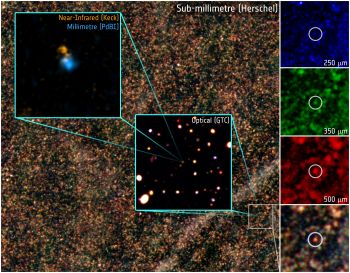
The galaxy HFLS3 as revealed by Herschel and further ground-based telescope observations. Images: ESA/Herschel/HerMES/IRAM/GTC/W.M. Keck Observatory

Further investigations using optical and near-infrared telescopes the Gran Telescopio Canarias in the Canary Islands and the Keck Telescope in Hawaii helped to rule out any other effects that might cause the HFLS3 galaxy to look so bright.

It was observations with radio and millimetre-wave telescopes, such as the Plateau de Bure Interferometer in the French Alps, which determined that this tiny galaxy, only around one twentieth the size of our Milky Way, is seen at such an immense distance. These additional observations also showed that HFLS3 is incredibly rich in carbon, nitrogen and oxygen, forming compounds such as carbon monoxide, water and ammonia. These compounds reveal the physical processes at work in this distant galaxy.

Combined with the Herschel observations, these measurements allow the astronomers to deduce that this tiny star factory is producing stars around two thousand times faster than our own Milky Way, making it a type of galaxy known as a “starburst”. Environments like this do not exist on galaxy-wide scales in the Universe today.

Professor Oliver says: “We’ve shown that Herschel data can find these extreme examples. “The next step is to sift through the Herschel data more carefully, and try to deduce just how common such galaxies were in the early Universe. I am also very pleased that a Sussex PhD student has been able to make an important contribution to this work.”

Jamie Bock (Caltech, USA), who co-leads the HerMES survey with Professor Oliver, says: “This galaxy is just one spectacular example, but it’s telling us that early star formation like this is possible,” explains Jamie Bock, Caltech, and one of the leaders.

Dominik Riechers (Cornell University, USA), who led the HFLS3 study, says: “Looking for the first examples of these massive star factories is like searching for a needle in a haystack. We were hoping to find a galaxy at such vast distances, but we could not expect that they even existed that early on in the Universe.”

Neutrino Physics in a Small Universe

Posted in Biographical, The Universe and Stuff with tags , , , , , , , on April 23, 2013 by telescoper

I’ve only just got time for a quick lunchtime post before I head off to attend an afternoon of Mathematics presentations, but it’s a one of those nice bits of news that I like to mention on here from time to time.

It is my pleasure to pass on the wonderful news that one of my colleagues in the School of Mathematical and Physical Sciences here at the University of Sussex,  Dr Jeff Hartnell,. has been awarded  the High Energy Particle Physics prize of the Institute of Physics, which means that his name has now been added to the illustrious list of previous winners. The prize is awarded annually by the HEPP Group, a subject group in the Nuclear and Particle Physics Division of the IOP, to a researcher in the UK who has made an outstanding contribution to their field of study early in their career (within 12 years of being awarded their first degree).

There’s a very nice piece about this award here which reveals, amongst other things, that many moons ago at Nottingham I was Jeff’s undergraduate tutor! In fact Jeff also attended a third-year course on Theoretical Elementary Particle Physics I taught in those days. That he survived those experience and went on to be a world-leading physicist speaks volumes! Not only that, it’s also evidence that the world of physics is smaller than we sometimes suppose. I’ve crossed paths with a number of my new colleagues at various times in the past, but it’s particularly rewarding to see someone you taught as an undergraduate go on to a highly successful career as a scientist. Jeff was awarded a prestigious ERC grant this year too!

Jeff is currently in the USA helping to set up the largest-ever experiment in neutrinos to be built there, called NOvA. You can click on the preceding links for more technical details, and I also found this interesting video showing the NOvA detector being assembled. Particle physics experiments are never small, are they?

p.s. Why do they insist on writing “metric ton” instead of “tonne”?

Remembering David Axon

Posted in The Universe and Stuff with tags , , , on April 19, 2013 by telescoper

Over the past couple of days there has been a special Memorial Event to remember David Axon, my predecessor as Head of  the School of Mathematics and Physical Sciences at the University of Sussex, who passed away suddenly on 5th April 2012. The memorial event has consisted of a two-day specialist discussion meeting of the Royal Astronomical Society about David’s primary research interest – Massive Black Holes in Galaxies – here on the Sussex campus and will end this afternoon with a Memorial Service in the Meeting House Chapel, which will include music and poetry.


IMG-20130419-00094

Professor David John Axon (1951-2012)

Professor David John Axon (1951-2012)

Although I knew David Axon through his published work I didn’t know him very well at all personally. In fact we only met a couple of times. The first of those occasions was when we’d both applied for a certain job. He was interviewed before me and came into the room in which I was waiting when he had finished. You would never expect such a situation to be comfortable, but it turned out to be so because David was very friendly and direct. Those are precisely the qualities that I’ve heard described over the last few days by many people who knew him far better than I did. People say these qualities reflect his Northern heritage. I won’t argue with that, except to point out that he was born in Doncaster, i.e. in the Midlands….

As David’s successor here at Sussex all I can do is say that he clearly left the School of Mathematical and Physical Sciences in excellent shape, which is testament to the energy and ability he brought to the job that I now hold.  He set a very high standard. Equally clearly, David Axon is sorely missed, by staff and students alike, not just in MPS but throughout the University.

Such occasions are inevitably a bit sad, but this occasion is, as it should be, very much the celebration of a life and I’m sure David will live on in the memories of those who knew him closely, as it will for one person who met him only briefly. Remembering David Axon is something many people will do for a very long time.

Dirac Lectures

Posted in The Universe and Stuff with tags , , on April 11, 2013 by telescoper

Earlier this year I posted a review of a book about the great theoretical physicist Paul Dirac. Presumably by a complete coincidence, on the very same day that I wrote that piece, somebody put the following video on Youtube. It’s very rare footage of the man himself giving some lectures in Christchurch, New Zealand in 1975 (when he was in his 70s). A great deal of conflicting stuff has been written about what Dirac was like as a lecturer – now you can see for yourself. The video isn’t very high quality – it breaks up entirely in a few places – but it’s nevertheless fascinating to hear Dirac talk physics!

My opinion? I’ve had worse!

p.s thanks to Ian Harrison (@itrharrison) for drawing this to my attention!

A Small Problemette related to Cosmological non-Gaussianity

Posted in Cute Problems, The Universe and Stuff with tags , , , on April 8, 2013 by telescoper

Writing yesterday’s post I remembered doing a calculation a while ago which I filed away and never used again. Now that it has come back to my mind I thought I’d try it out on my readers (Sid and Doris Bonkers). I think the answer might be quite well known, as it is in a closed form, but it might be worth a shot if you’re bored.

The variable x has a normal distribution with zero mean and variance \sigma^{2}. Consider the variable

y = x + \alpha \left( x^2 - \sigma^2 \right),

where \alpha is a constant. What is the probability density of y?

Answers on a postcard through the comments box please..

Has Planck closed the window on the Early Universe?

Posted in The Universe and Stuff with tags , , , , , , , , on April 7, 2013 by telescoper

A combination of circumstances – including being a bit poorly – has made me rather late in getting around to reading the papers released by the Planck consortium a couple of weeks ago. I’ve had a bit of time this Sunday so I decided to have a look. Naturally I went straight for, er, paper No. 24, which you can find on the arXiv, here.

I picked this one to start with because it’s about primordial non-Gaussianity. This is an important topic because the simplest theories of cosmological inflation predict the generation of small-amplitude irregularities in the early Universe that form a statistically homogeneous and isotropic Gaussian random field. This means that the perturbations (usually defined in terms of departures of the metric from a pure Robertson-Walker form) are defined by probability distributions which are invariant under translations and rotations in 3D space.

In a nutshell, such perturbations arise quite simply in inflationary cosmology as zero-point oscillations of a scalar quantum field, in a very similar way the Gaussian distributions that arise from the quantized harmonic oscillator. Assuming the fluctuations are small in amplitude the scalar field evolves according to

\ddot{\Phi} +3H\dot{\Phi} + V^{\prime}(\Phi),

which is similar to that describing a ball rolling down a potential V, under the action of a force given by the derivative V^{\prime}, opposed by a “frictional” force depending on the ball’s speed; in the inflationary context the frictional force depends on the expansion rate H(\Phi, \dot{\Phi}). If the slope of the potential is relatively shallow then there is a slow-rolling regime during which the kinetic energy of the field is negligible compared to its potential energy; the term in \ddot{\phi} then becomes negligible in the above equation. The universe then enters a near-exponential phase of expansion, during which the small Gaussian quantum fluctuations in \Phi become Gaussian classical metric perturbations.

On the one hand, Gaussian fluctuations are great for a theorist because so many of their statistical properties can be calculated analytically: I played around a lot with them in my PhD thesis many moons ago, long before Planck, in fact long before any fluctuations in the cosmic microwave background were measured at all! The problem is that if we keep finding that everything is consistent with the Gaussian hypothesis then we have problems.

The point about this slow-rolling regime is that it is an attractor solution that resembles the physical description of a body falling through the air: eventually such a body reaches a terminal velocity defined by the balance between gravity and air resistance, but independent of how high and how fast it started. The problem is that if you want to know where a body moving at terminal velocity started falling from, you’re stumped (unless you have other evidence). All dynamical memory of the initial conditions is lost when you reach the attractor solution. The problem for early Universe cosmologists is similar. If everything we measure is consistent with having been generated during a simple slow-rolling inflationary regime, then there is no way of recovering any information about what happened beforehand because nothing we can observe remembers it. The early Universe will remain a closed book forever.

So what does all this have to do with Planck? Well, one of the most important things that the Planck collaboration has been looking for is evidence of non-Gaussianity that could be indicative of primordial physics more complicated than that included in the simplest inflationary models (e.g.  multiple scalar fields, more complicated dynamics, etc).  Departures from the standard model might just keep the window on the early Universe open.

A simple way of defining a parameter that describes the level of non-Gaussianity is as follows:

\phi = \phi_{G} + f_{NL} \left( \phi_{G}^2 -< \phi_{G}^2 > \right)

the parameter f_{NL} describes a quadratic contribution to the overall metric perturbation \phi: you can think of this as being like a power series expansion of the total fluctuation in terms of a Gaussian component \phi_{G}; the term in angle brackets is just there to ensure the whole thing averages to zero. This definition of non-Gaussianity is not the only one possible, but it’s the simplest and it’s the one for which Planck has produced the most dramatic result:

f_{NL}=2.7 \pm 5.8,

which is clearly consistent with zero. If this doesn’t look impressive, bear in mind that the typical fluctuation in the metric inferred from cosmological measurements is of order 10^{-5}. The quadratic terms are therefore of order 10^{-10}, so the upper limit on the level of non-Gaussianity allowed by Planck really is minuscule. This is one of the reasons why some people have described the best-fitting model emerging from Planck as the Maximally Boring Universe

So it looks like only very unwise investors will be buying shares in cosmological non-Gaussianity at least in the short-term. More fundamentally we may be approaching the limit of what we can learn about inflation in particular, or even the early Universe in general, using the traditional techniques of observational cosmology. But there remain very intriguing questions that may yet shed light on the pre-inflationary epoch. Among these are the large-scale anomalies seen in the very same Planck data that have put such stringent limits on non-Gaussianity. But that question, described in Planck Paper 23, will have to wait for another day…