Archive for the The Universe and Stuff Category

Open Access and Closed Telescopes

Posted in Science Politics, The Universe and Stuff with tags , , , on February 22, 2013 by telescoper

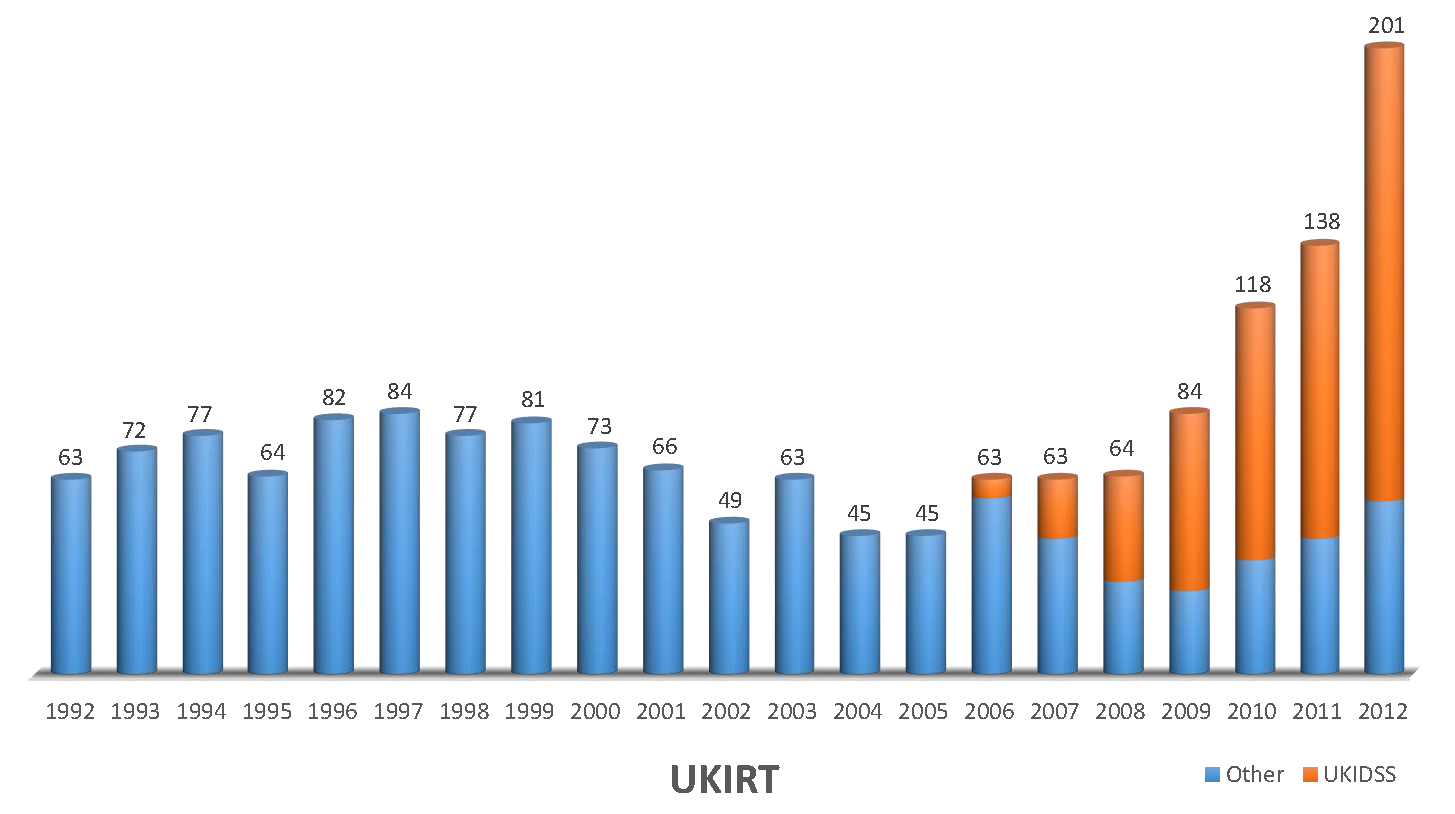
Interesting to note that 2012 was a bumper year for productivity at the UK Infra-Red Telescope (UKIRT), as demonstrated by the following nice graphic.

UKIRT-pubs-2012

Some of my colleagues have expressed a measure of consternation at the fact that unless some individual or organization steps in and offers to take over the running costs, this facility will be closed down at the end of this year (2013). Why shut down a telescope that is generating so many publications?

The answer is of course that, under the UK Government’s new plans for  Gold Open Access, astronomers will be forced to pay Article Processing Charges, possibly exceeding £1000 per paper, in order to disseminate the fruits of their research. The Science and Technology Facilities Council (STFC), which administers the budget for the UK’s astronomy research,  simply can’t afford the level of expenditure required to cover the costs associated with the number of articles being generated by the wanton exploitation of this facility. Indeed, in future, STFC will only be able to operate facilities that produce very few results worthy of publication.

I hope this clarifies the situation.

The End of Cosmology?

Posted in Biographical, The Universe and Stuff with tags , , on February 21, 2013 by telescoper

A very busy day interviewing candidates for a job in Experimental Particle Physics was made even busier by the arrival by the boxes containing all my books and other knick-knacks from Cardiff. Anyway, the net result of all this is that I only have time for a brief post before I go home and lapse into a coma. I can at least do something useful, however, which is to pass on the following announcement:

Presentation of the first cosmologic results of Planck mission as well as its first all-sky images of the Cosmic Microwave Background

Launched in 2009, Planck studies the Cosmic Microwave Background – the relic radiation from the Big Bang – to allow cosmologists to zero-in on theories that describe the Universe’s birth and evolution. The first all-sky images of the Cosmic Microwave Background will be presented at the press conference held in Paris ESA HQ on March 21st, 2013.

We’ve been expecting that the “cosmologic” results from Planck would be announced sometime early this year. Now we know when. March 21st 2013 is the date to put in your diary, and that’s only about a month from now. Exciting times.

Will Planck confirm the standard cosmological model and measure its parameters more precisely? Or will there be the first hints of physics outside the standard model? Will cosmology be all done and dusted, or will we find out that we didn’t understand the Universe as well as we originally thought?

I don’t know. Yet.

Emotion and the Scientific Method

Posted in Biographical, Music, The Universe and Stuff with tags , , , , on February 10, 2013 by telescoper

There was an article in today’s Observer in which four scientists from different disciplines talk about how in various ways they all get a bit emotional about their science. The aim appears to correct “the mistaken view that scientists are unemotional people”. It’s quite an interesting piece to read, but I do think the “mistaken view” is very much a straw man. I think most people realize that scientists are humans rather than Vulcans and that as such they have just as many and as complex emotions as other people do. In fact it seems to me that the “mistaken view” may only be as prevalent as it is because so many people keep trying to refute it.

I think anyone who has worked in scientific research will recognize elements of the stories discussed in the Observer piece. On the positive side, cracking a challenging research problem can lead to a wonderful sense of euphoria. Even much smaller technical successes lead to a kind of inner contentment which is most agreeable. On the other hand, failure can lead to frustration and even anger. I’ve certainly shouted in rage at inanimate objects, but have never actually put my first through a monitor but I’ve been close to it when my code wouldn’t do what it’s supposed to. There are times in that sort of state when working relationships get a bit strained too. I don’t think I’ve ever really exploded in front of a close collaborator of mine, but have to admit that one one memorable occasion I completely lost it during a seminar….

So, yes. Scientists are people. They can be emotional. I’ve even known some who are quite frequently also tired. But there’s nothing wrong with that not only in private life but also in their work. In fact, I think it’s vital.

It seems to me that the most important element of scientific research is the part that we understand worst, namely the imaginative part. This encompasses all sorts of amazing things, from the creation of entirely new theories, to the clever design of an experiment, to some neat way of dealing with an unforeseen systematic error. Instances of pure creativity like this are essential to scientific progress, but we understand very little about how the human brain accomplishes them. Accordingly we also find it very difficult to teach creativity to science students.

Most science education focuses on the other, complementary, aspect of research, which is the purely rational part: working out the detailed ramifications of given theoretical ideas, performing measurements, testing and refining the theories, and so on. We call this “scientific method” (although that phrase is open to many interpretations). We concentrate on that aspect because we at have some sort of conception at least of what the scientific method is and how it works in practice. It involves the brain’s rational functions, and promotes the view of a scientist as intellectually detached, analytic, and (perhaps) emotionally cold.

But what we usually call the scientific method would be useless without the creative part. I’m by no means an expert on cognitive science, but I’d be willing to bet that there’s a strong connection between the “emotional” part of the brain’s activities and the existence of this creative spark. We’re used to that idea in the context of art, and I’m sure it’s also there in science.

That brings me to something else I’ve pondered over for a while. Regular readers of this blog will know that I post about music from time to time. I know my musical tastes aren’t everyone’s cup of tea, but bear with me for a moment. Some of the music (e.g. modern Jazz)  I like isn’t exactly easy listening – its technical complexity places a considerable burden on the listener to, well, listen. I’ve had comments on my musical offerings to the effect that it’s music of the head rather than of the heart. Well, I think music isn’t an either/or in this respect. I think the best music offers both intellectual and emotional experiences. Not always in equal degree, of course, but the head and the heart aren’t mutually exclusive. If we didn’t have both we’d have neither art nor science.

In fact we wouldn’t be human.

Infinities in Cosmology

Posted in The Universe and Stuff with tags , , , , on February 7, 2013 by telescoper

Only time to post a quick advertisement I received in an email from the one of the organizers of a 4-day series of talks on Infinities in Cosmology, at the Department of Applied Mathematics and Theoretical Physics (DAMTP), Centre for Mathematical Sciences, Cambridge, from 18-21 March 2013.

This is one in a series of thematic programmes on Cosmology and Philosophy organised by a collaboration of cosmologists and philosophers of science at Oxford and Cambridge Universities. Speakers include A. Aguirre, M. Dafermos, M.R. Douglas, G.F.R. Ellis, M. Hogarth, and S. Saunders.

This is taken from the conference website:

Cosmology involves infinities, or at least the prospect of infinities, in various ways: the most obvious being the potentially infinite age and size of the universe, and the possible occurrence of actual infinities at local spacetime singularities or at the beginning of the Universe. But there are also other kinds of infinity to consider; for example, the possibility of enhanced spatiotemporal scope for computation, or the unlimited proliferation inherent in the concept of the multiverse and the problems encountered in defining probabilities in this context. These topics will be explored in this three-day series and the following full-day workshop.

Looks quite interesting to me, although I don’t think I’ll be able to make time to go!

Further details and online registration for the conference are now available at

http://www.damtp.cam.ac.uk/events/infinities2013/

A Lab of Honour

Posted in Education, The Universe and Stuff with tags , , on February 5, 2013 by telescoper

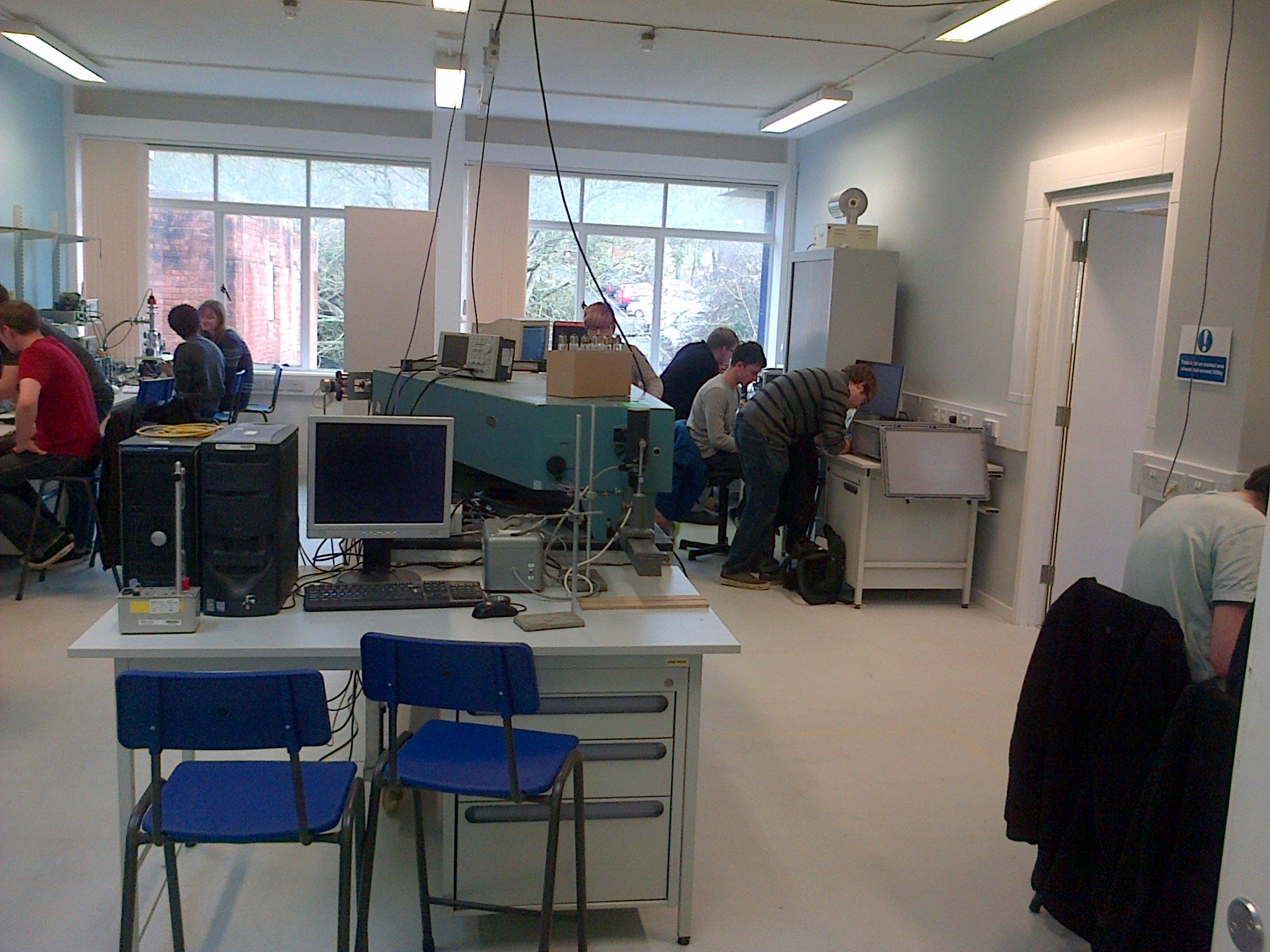
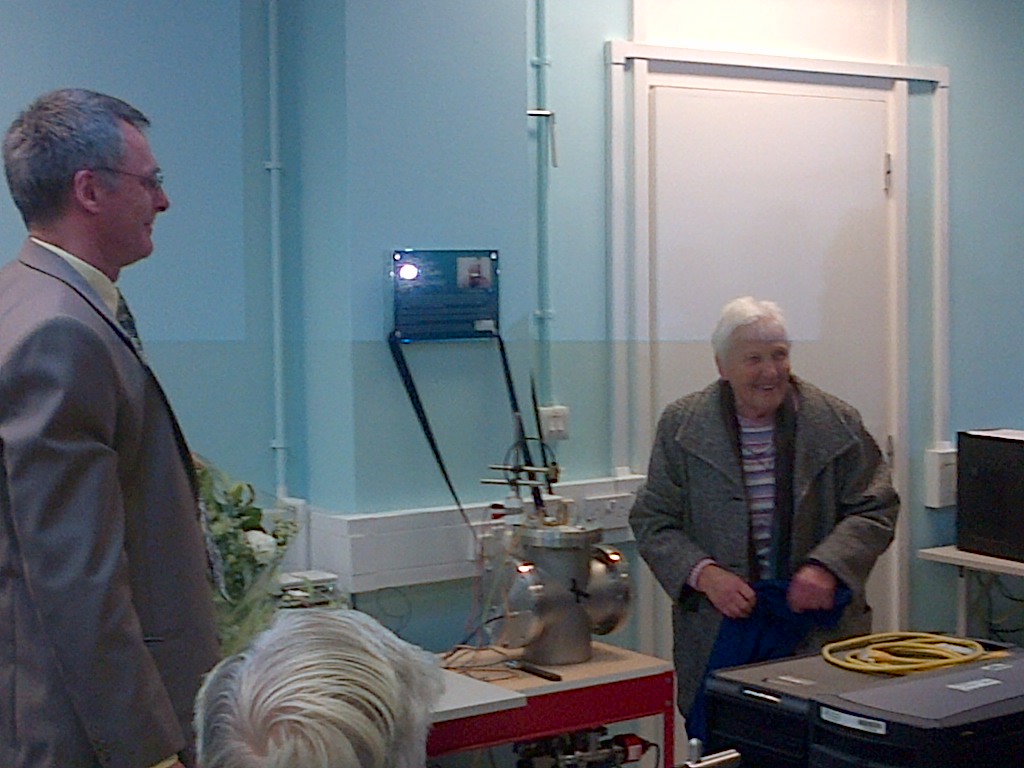
Last Friday, my first day in post here at the University of Sussex, there was a small ceremony to mark the formal opening of a new undergraduate teaching laboratory. Appropriately, it was named after Professor Ken Smith who died last year. Professor Smith was an outstanding experimental physicist who joined the University of Sussex way back in 1960 before the campus had even been built. Over the next three decades, as well as developing a new research activity in which the Department is now world-leading, he made substantial contributions to laboratory teaching in particular. He also played his part in the administration of the Department, serving as the first Chairman of Physics, and then as Dean of the School of Mathematical and Physics Sciences (MAPS) and later as Laboratory Director. Prof. Smith retired in 1988, which was the year I finished my DPhil from the (then) School of Mathematics and Physical Sciences.

IMG-20130201-00049

Anyway, it was a pleasant occasion at which Prof. Philip Harris (to the left of the picture), Head of the Department of Physics & Astronomy, spoke of Professor Ken Smith’s many achievements, Ken’s widow Verena unveiled the commemorative plaque, and we all gathered for tea and cakes in the foyer so as not to disturb further the students still hard at work at their experiments…

IMG-20130201-00050

Should Open Access Include Open Software?

Posted in Open Access, Science Politics, The Universe and Stuff with tags , , , , on February 4, 2013 by telescoper

Very busy today, so just time for a quick post (and associated poll) about Open Science.

As you all know I’ve been using this blog for a while to bang on about Open Access to scientific publications. I’m not going to repeat my position in detail here except to say that I’m in favour of Open Access but not at the immense cost envisaged by the Finch Report.

I thought however that it might be useful to float some opinions about wider issues related to open science. In particular, the question that often troubles me is that is open access to scientific results actually enough, or do we have to go a lot further?

I think an important aspect of the way science works is that when a given individual or group publishes a result, it should be possible for others to reproduce it (or not as the case may be). Traditional journal publications don’t always allow this. In my own field of astrophysics/cosmology, for example, results in scientific papers are often based on very complicated analyses of large data sets. This is increasingly the case in other fields too. A basic problem obviously arises when data are not made public. Fortunately in astrophysics these days researchers are pretty good at sharing their data, although this hasn’t always been the case.

However, even allowing open access to data doesn’t always solve the reproducibility problem. Often extensive numerical codes are needed to process the measurements and extract meaningful output. Without access to these pipeline codes it is impossible for a third party to check the path from input to output without writing their own version assuming that there is sufficient information to do that in the first place. That researchers should publish their software as well as their results is quite a controversial suggestion, but I think it’s the best practice for science. There isn’t a uniform policy in astrophysics and cosmology, but I sense that quite a few people out there agree with me. Cosmological numerical simulations, for example, can be performed by anyone with a sufficiently big computer using GADGET the source codes of which are freely available. Likewise, for CMB analysis, there is the excellent CAMB code, which can be downloaded at will; this is in a long tradition of openly available numerical codes, including CMBFAST and HealPix.

I suspect some researchers might be reluctant to share the codes they have written because they feel they won’t get sufficient credit for work done using them. I don’t think this is true, as researchers are generally very appreciative of such openness and publications describing the corresponding codes are generously cited. In any case I don’t think it’s appropriate to withhold such programs from the wider community, which prevents them being either scrutinized or extended as well as being used to further scientific research. In other words excessively proprietorial attitudes to data analysis software are detrimental to the spirit of open science.

Anyway, my views aren’t guaranteed to be representative of the community, so I’d like to ask for a quick show of hands via a poll…

…and you are of course welcome to comment via the usual box.

The Strangest Man

Posted in Literature, The Universe and Stuff with tags , , , , , on January 27, 2013 by telescoper

Since getting rid of my telly a few weeks ago I’ve reverted to a previous incarnation as a bookworm, and have been tackling the backlog of unread volumes sitting on my coffee table at home. Over the last couple of days I’ve spent the evenings reading The Strangest Man by Graham Farmelo, a biography of the great theoretical physicist Paul Dirac.

I’m actually quite ashamed that it has taken me so long to get around to reading this. I’ve had it for two years or more and really should have found time to do it before now. Dirac has long been one of my intellectual heroes, for his unique combination of imagination and mathematical rigour; the Dirac equation is one of the topics I most enjoy lecturing about to physics students. I am also immensely flattered to be one of his academic descendants: Paul Dirac was the PhD supervisor of Dennis Sciama, who supervised my supervisor John Barrow, making me (in a sense) his great-grandson. Not that I’ll ever achieve anything of the magnitude he did.

The book is pretty long, and I suppose one of the factors putting me off reading it was that I thought it might be heavy going. That turned out to be far from the case. It’s wonderfully well written, never getting bogged down in details, and cleverly interweaving Dirac’s life and scientific career together against a vivid historical backdrop dominated by the rise of Nazism in Germany and the tragedy of World War 2. It also beautifully conveys the breathless sense of excitement as the new theory of quantum mechanics gradually fell into place. Altogether it’s a gripping story that had me hooked from the start, and I devoured the 400+ pages in just a couple of evenings (which is quick by my standards). I’ve never read a scientific biography so pacey and engaging before, so it’s definitely hats off to Graham Farmelo!

Among the book’s highlights for me were the little thumbnail sketches of famous physicists I knew beforehand mostly only as names. Niels Bohr comes across as a splendidly warm and avuncular fellow, Werner Heisenberg as a very slippery customer of questionable political allegiance (likewise Erwin Schrödinger), Ernest Rutherford as blunt and irascible. I was already aware of the reputation of Wolfgang Pauli had for being an absolute git; this book does nothing to dispel that opinion. We tend to forget that the names we came to know through their association with physics also belonged to real people, with all that entails.

I was also interested to learn that Dirac and his wife Manci spent their honeymoon in 1937, as the clouds of war gathered on the horizon, in Brighton, which Farmelo describes as

..a peculiarly raffish town., famous for its two Victorian piers jutting imperiously out to sea, for the pale green domes of its faux-oriential pavilions, its future-robot and a host of other tacky attractions.

So in most respects it hasn’t changed much, although one of the two piers  has since gone for a Burton.

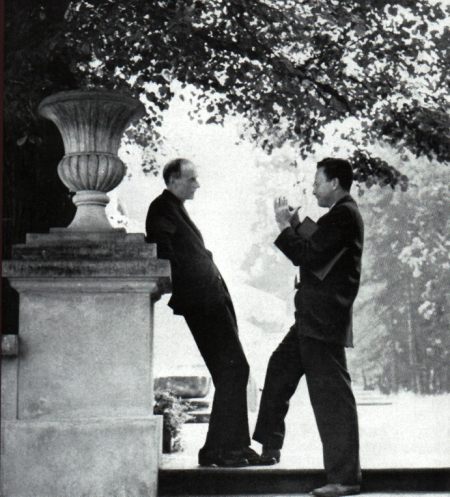
So what of Dirac himself? Most of what you’re likely to hear about him concerns his apparently cold and notoriously uncommunicative nature. I never met Dirac. He died in 1984. I was an undergraduate at Cambridge at the time, but he had moved to Florida many years before that. I have, however, over the years had occasion to talk to quite a few people who knew Dirac personally, including Dennis Sciama. All of them told me that he wasn’t really anything like the caricature that is usually drawn of him. While it’s true that he had no time for small talk and was deeply uncomfortable in many social settings, especially formal college occasions and the like, he very much enjoyed the company of people more extrovert than himself and was more than willing to talk if he felt he had anything to contribute. He got on rather well with Richard Feynman, for example, although they couldn’t have had more different personalities. This gives me the excuse to include this wonderful picture of Dirac and Feynman together, taken in 1962 – the body language tells you everything there is to know about these two remarkable characters:
feyndir2

Feynman is also an intellectual hero of mine, because he was outrageously gifted not only at doing science but also at communicating it. On the other hand, I suspect (although I’ll obviously never know) that I might not have liked him very much at a personal level. He strikes me as the sort of chap who’s a lot of fun in small doses, but by all accounts he could be prickly and wearingly egotistical.

On the other hand, the more I read The Strangest Man the more I came to think that I would have liked Dirac. He may have been taciturn, but at least that meant he was free from guile and artifice. It’s not true that he lacked empathy for other people, either. Perhaps he didn’t show it outwardly very much, but he held a great many people in very deep affection. It’s also clear from the quotations peppered throughout the book that people who worked closely with him didn’t just admire him for his scientific work; they also loved him as a person. A strange person, perhaps, but also a rather wonderful one.

In the last Chapter, Farmelo touches on the question of whether Dirac may have displayed the symptoms of autism. I don’t know enough about autism to comment usefully on this possibility. I don’t even know whether the term autistic is defined with sufficient precision to be useful. There is such a wide and multidimensional spectrum of human personality that it’s inevitable that there will be some individuals who appear to be extreme in some aspect or other. Must everyone who is a bit different from the norm be labelled as having some form of disorder?

The book opens with the following quote from John Stuart Mill’s On Liberty, which says it all.

Eccentricity has always abounded when and where strength of character has abounded; and the amount of eccentricity in a society has generally been proportional to the amount of genius, mental vigor, and courage which it contained. That so few now dare to be eccentric, marks the chief danger of the time.

Another thought occurred to me after I’d finished reading the book. Dirac’s heyday as a theoretical physicist was the period 1928-1932 or thereabouts. Comparatively speaking, his productivity declined significantly in later years; he produced fewer original results and became increasingly isolated from the mainstream. Eddington’s career followed a similar pattern: he did brilliant work when young, but subsequently retreated into the cul-de-sac of his Fundamental Theory. Fred Hoyle is another example – touched by greatness early in his career, but cantankerous and blinded by his own dogma later on. Even Albert Einstein, genius-of-geniuses, spent his later scientific life chasing shadows.

I think there’s a tragic inevitability about the mid-life decline of these geniuses of theoretical physics, because the very same determination and intellectual courage that allowed them to break new ground also rendered them unwilling to be deflected by subsequent innovations elsewhere. And break new ground Dirac certainly did. The word genius is perhaps over-used, but it certainly applies to Paul Dirac. We need more like him.
Fire Escapes

Posted in Biographical, The Universe and Stuff with tags , , , , , on January 13, 2013 by telescoper

When I checked into Twitter this morning I was perturbed to see a flurry of panicky messages from astronomers down under. No wonder. The bush fires that have been raging in New South Wales for some time yesterday threatened to engulf the world-famous Siding Spring Observatory – the largest optical observatory in Australia – where 12 important telescopes are located, not to mention the people that operate them.

I’ll direct you to Amanda Bauer’s blog piece for dramatic coverage of what was obviously a terrifying and exhausting night, as flames and smoke crept remorsely closer to the observatory buildings.

SSO_fire1

At about 3.30pm local time, the buildings were evacuated and soon afterwards the fire penetrated the perimeter of the Observatory itself and subsequently swept through the complex. Temperatures inside some of the domes went as high as 100 °C and a lot of the electrical equipment has clearly been damaged.

Scary stuff but, most importantly of all, at least nobody was hurt. It also seems that damage to the observatory buildings and equipment was relatively slight. That however is a preliminary assessment, and may well be revised when it’s safe to enter the area again. Wildfires of this sort are extremely frightening things, so this must have been a very difficult time for those involved but, fingers crossed, it seems not to have turned out as badly as some feared.

Coincidentally, I had a little fire drama at home myself last night, although I hasten to add it was not on the same scale as the goings-on in Siding Spring. The weather in Cardiff being rather inclement I decided to complete my Saturday afternoon shopping with the purchase of a sack of logs for the fire. I have central heating, so don’t actually need the open fire for warmth, but it does add an extra level of cosiness on a winter evening. It also provides something to look at which is more interesting than the television I no longer possess…

It’s not all that easy to get a fire started in my grate, but I managed at the first attempt yesterday. Wood has a tendency to spit and crackle while burning so I put the fireguard around..
IMG-20130112-00037

(The flames weren’t actually that purple colour, more of a reddish orange; I think the flash on the camera is responsible for the change of hue.)

Anyway, I kept the fire going all through the evening which meant by the time I was ready for my nightcap I had no logs left. I then remembered a bit of wood (or, more accurately, MDF) that was left over when I had some shelves fitted. I found it in a cupboard and chucked it on the fire and left the room to make a drink.

A couple of minutes later my smoke alarm went off. Bemused, I ran back into the living room and found it filled with acrid smoke, produced by the veneer that coated the bit of surplus shelf, which was being produced in quantities too large for the chimney to cope with.

I hastily switched off the alarm and opened all the windows and doors on the ground floor, much to the amusement of the folk passing my house on the way home from the pub. Ironically my attempts to stay warm and cosy all through the evening had ended with arctic winds blowing through the house. The smoke cleared fairly soon, although the smell of it was still lingering this morning.

Still, nobody was hurt and there was no serious damage to buildings or equipment. And at least now I know my smoke alarm does actually work…

Mingus – Oh Yeah!

Posted in Jazz, The Universe and Stuff with tags , , , , , on January 10, 2013 by telescoper

I noticed a news item this morning which explains that the Supernova Cosmology Project have found a supernova with a redshift of 1.71, which makes it the most distant one found so far  (about 10 billion light-years away).  That – and hopefully others at similar distances – should prove immensely useful  for working out how the expansion rate of the Universe has changed over its history and hence yield important clues about the nature of its contents, particularly the mysterious dark energy.

Of particular relevance to this blog is the name given to this supernova, Mingus, after the jazz musician and composer Charles Mingus. Both the discovery and the great choice of name are grounds for celebration, so here’s one of my favourite Mingus tracks – the delightfully carefree and exuberant Eat that Chicken, from the Album Oh Yeah. Enjoy!

Sathya’s Cosmic Sirens

Posted in The Universe and Stuff, Uncategorized with tags , , , on January 7, 2013 by telescoper

Bit busy today so I thought I’d just post this talk by Cardiff’s own Prof. Bangalore Sathyaprakash at last year’s TEDX event in Cardiff.
The title is Cosmic Sirens although given that the topic is gravitational waves I hope that “sirens” isn’t intended to mean those entirely mythical entities that lure unsuspecting PhD students to their ultimate destruction…

Anyway, here’s the blurb:

In 1916 Einstein predicted that dynamical mass distribution generates ripples in the very fabric of spacetime that propagates outwards at the speed of light.

For over two decades B.S. Sathyaprakash (Sathya for his family and friends) is engaged in research to detect these ripples called gravitational waves, from cataclysmic cosmic events such as exploding stars, colliding black holes and the big bang. His personal goal is to observe and understand black holes and gravity using gravitational radiation. He is the head of the gravitational physics group at Cardiff University — a centre for modelling astronomical sources of gravitational radiation, discovering innovative algorithms to search for this radiation and analyzing data from gravitational-wave detectors using massive computer clusters.

Although there is firm indirect evidence that certain astronomical systems do emit gravitational waves, so far no one has detected them directly. Sathya and his team are part of a worldwide effort, called the LIGO Scientific Collaboration, to detect these elusive waves using kilometer long laser interferometers in the US, Europe and Japan. Recently, Sathya helped develop the science case for building such a detector in India. He has been involved in the European design study of a third generation underground detector with a 30 km baseline called the Einstein Telescope, chairing the group that developed the science case for this ambitious venture.

And here is the actual talk..