Archive for the The Universe and Stuff Category

To my own correspondents…

Posted in Biographical, The Universe and Stuff with tags , on November 26, 2012 by telescoper

So. Today I finally finished a stack of things I should have done weeks ago, including compiling the teaching timetable for next semester (when I won’t even be here) Anyway, that means I can now move onto the next stack of things that I should also have done weeks ago, after I’ve finished marking the batch of 100 second-year coursework scripts sitting on my desk. There’s no rest for the <insert appropriate adjective>.

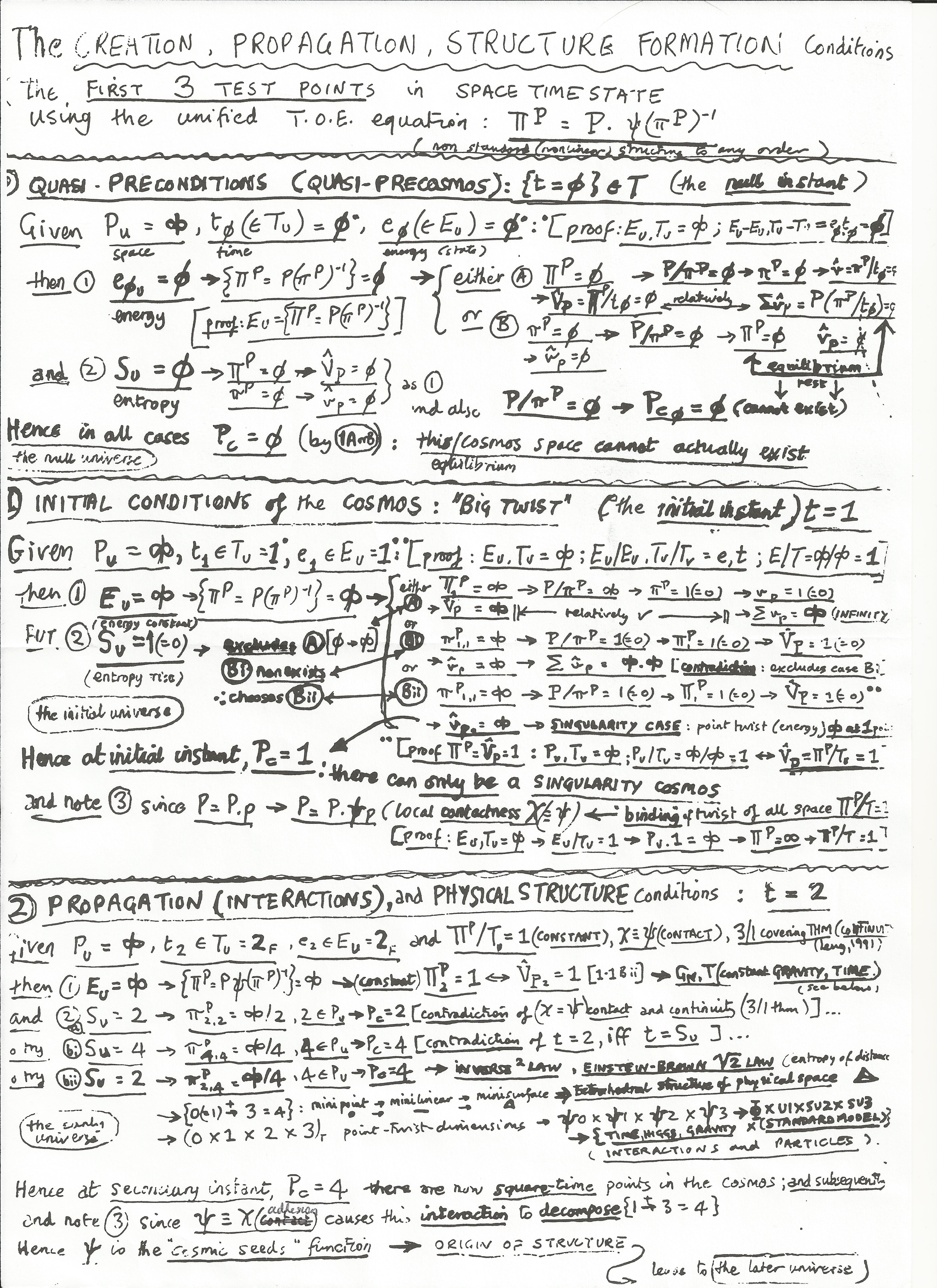
Anyway, it’s now just a couple of months before I shuffle off the coil of Cardiff, and the enormity of the impending move becomes more apparent every time I go into my office and observe the quantity of books and papers filling the groaning shelves. Today, however, I made a decision that will make moving simpler: I decided to ditch all the drawer-loads of correspondence marked “Other”, i.e. all the unsolicited letters and manuscripts I’ve accumulated over the years about “alternative” theories of cosmology and whatnot. Here’s an example:

I can’t really make head nor tail of this one, but sometimes have a vague feeling that it might just be a sort of cosmic Rosetta Stone, offering up the Secrets of the Universe in diverse languages. Sadly, however, it’s more likely that the languages involved are Balderdash, Gibberish and Gobbledegook.

I regret to announce, therefore, that the plethora of papers telling me why Einstein was wrong, how the Universe is really in the shape of a spiral, how the Great Pyramid of Giza explains the Higgs Boson, and why the Big Bang couldn’t have happened, will have to go to the Great Shredder in the Sky (if that’s where it is).

Anyway, to all my correspondents all I can say is that I’ve enjoyed reading your letters – you must be very fond of your old typewriters – and I’m grateful for the time you took to draw the diagrams by hand in so many lovely colours. And I’m impressed by your qualifications as Electrical Engineers. Really. I’m sorry I didn’t reply to you all individually, but I just didn’t have the time. And now it pains me to realise I don’t have the space either…

Physics and other things that make life worth living…

Posted in Biographical, Education, Jazz, Music, The Universe and Stuff with tags , , , , , on November 24, 2012 by telescoper

Yesterday we hosted a seminar by João Magueijo from Imperial College. It was a really interesting talk but the visit also a number of staff and students, including myself, the chance to chat to João about various things. In my case that primarily meant catching up on one another’s news, since we haven’t talked since early summer and a lot has happened since then. Then we had drinks, more drinks, dinner, drinks and then cocktails, finishing about 2am. A fairly standard night out with João, actually.

Among the topics discussed in the course of an increasingly drunken conversation was the fact that physicist Stephon Alexander had recently moved to Dartmouth College, a prestigious Ivy League institution in New Hampshire. I don’t know Stephon very well at all as I don’t really work in the same area as him. In fact, we’ve only ever met once – at a Cosmology School in Morocco (in 1996 or thereabouts); he was a graduate student and I was giving some lectures. On the left you can see a snap of him I took at that time. Can that really have been so long ago?

Anyway, I’ll resist the temptation to bemoan the passage of time and all that and get back to the point which is the connection that formed in my head between Stephon, yesterday’s post about the trials and tribulations facing prospective PhD students, and an older post of mine about  the importance of not forgetting to live a life while you do a PhD.

The point is that although there are many things that may deter or prevent an undergraduate from taking the plunge into graduate studies, one thing shouldn’t put you off and that is the belief that doing a PhD is like joining a monastery in that it requires you to give up a lot of other things and retreat from the outside world. Frankly, that’s bollocks. If I’m permitted to quote myself:

I had plenty of outside interests (including music, sport and nightlife)  and took time out regularly to indulge them. I didn’t – and still don’t – feel any guilt about doing that. I’m not a robot. And neither are you.

In other words, doing a PhD does not require you to give up the things that make life worth living. Actually, if you’re doing a physics PhD then physics itself should be one of the things that make life worth living for you, so I should rephrase that as “giving up any of the other things that make life worth living”.

Having a wide range of experiences and interests to draw on can even help with your research:

In fact, I can think of many times during my graduate studies when I was completely stuck on a problem – to the extent that it was seriously bothering me. On such occasions I learned to take a break. I often found that going for a walk, doing a crossword, or just trying to think about something else for a while, allowed me to return to the problem fresher and with new ideas. I think the brain gets into a rut if you try to make it work in one mode all the time.

I’d say that to be a good research student by no means requires you to be a monomaniac. And this is where Stephon comes in. As well as being a Professor of Theoretical Physics, Stephon is an extremely talented Jazz musician. He’s even had saxophone lessons from the great Ornette Coleman. I have to admit he has a few technical problems with his instrument in this clip, but I’m using him as an example here because I also love Jazz and, although I have a negligible amount of talent as a musician, have rudimentary knowledge of how to play the saxophone. In fact, I remember chatting to him in a bar in Casablanca way back in ’96 and music was the sole topic of conversation.

Anyway, in the following clip Stephon talks about how music actually helped him solve a research problem. It’s basically an extended riff on the opening notes of the John Coltrane classic Giant Steps which, incidentally, I posted about here.

Probing the Higgs-like Particle

Posted in The Universe and Stuff with tags , , on November 21, 2012 by telescoper

After my little dabble in particle physics yesterdays I thought I’d reblog this from a proper particle physicist – it’s a long and rather technical post about the Higgs-like Boson recently discovered at the LHC. Enjoy.

Michael Schmitt's avatarCollider Blog

We are in the process of ascertaining the properties of the Higgs-like particle discovered by CMS and ATLAS last July 4th. It must be a boson because it decays to pairs of bosons. Since it decays to a pair of massless photons, it cannot be spin-1. The relative rates of decays to WW and ZZ on the one hand, and γγ on the other, are close to what is expected for spin-0 boson and not what is expected for a spin-2 graviton. John Ellis, Veronica Sanz and Tevong You wrote a nice paper about this earlier this week (arXiv:1211.3068, 13-Nov).

So let’s assume that the new particle X(126) is a Higgs boson (and I will use the symbol “H” for it). If it is the standard model Higgs boson, then its CP eigenvalue must be +1. If it is a member of a two-Higgs-doublet model, then its CP…

View original post 1,086 more words

Time will say nothing but I told you so…

Posted in The Universe and Stuff with tags , , , , , , , , , , , on November 20, 2012 by telescoper

A blog post at Nature News just convinced me that it’s time to post something about science for a change.

The paper (just published in Physical Review Letters) that inspired the Nature piece is entitled Observation of Time-Reversal Violation in the B0 Meson System and its publication gave me an excuse find the answer to a question that I’d wondered about for a while.

Although I’m not a real particle physicist, I have in the past been called upon to teach courses on particle theory (first at Nottingham and then here in Cardiff). One of the things I’ve emphasized in lectures on this subject is the importance of symmetries in particle physics and, perhaps even more important, the idea that symmetries you might think would hold in theory might actually be violated in the real world.

A good starting point is to think about parity. A parity transformation involves flipping the sign of all the spatial coordinates used to define a system; this operation involves the reflection of a system through the origin of the coordinate system so is connected with the notion of “handedness”. In quantum mechanics, an eigenstate of the parity operator P has two possible eigenvalues: +1 (even) or -1 (odd). One might expect this to be a “good”  quantum number in the sense that it is a quantity that is conserved during particle interactions. This is the case in many situations, but turns out not to be true in weak interactions; parity violation has been known about since the 1950s, in fact.

Another interesting symmetry relates to the operator C which represents charge conjugation. The charge-conjugation operation involves changing particles into anti-particles, e.g. inverting the electrical charge on the electron to make a positron.  Since the electron and positron seem to be identical apart from the different charge one suspects a general symmetry might apply here too. However, weak interactions are also known to violate C-symmetry (for example because under the action of C on a left-handed neutrino would turn into a left-handed anti-neutrino, which doesn’t exist in the standard model).

So if C and P aren’t conserved separately could the combined operation (CP)  represent a symmetry? CP acting on a left-handed neutrino would create a right-handed anti-neutrino, which does exist in the standard model so this seems a promising possibility. But no. CP is also violated in certain weak interactions. It’s always the weak interactions that mess things up, actually. Very irritating of them.

Now we come to the crux. In any model of particle interactions based on quantum field theory, the combination CPT has to be an exact symmetry. In this composite operator T represents time-reversal, so if you change particles into antiparticles, perform a parity flip, and run the clock backwards everything should look exactly the same. A corollary of this, since we know that CP is not an exact symmetry is that T can’t be either (otherwise it couldn’t restore the violation caused by CP). But how to test whether T is violated?

In fact, in lecturing on this topic I’ve always ended there and moved onto something else.  I’ve often wondered how one might test for T-violation but never arrived at an answer.  You can’t know everything.

Anyway, the answer is explained nicely in an explanatory article published with the paper. The B-mesons discussed in the paper are electrically neutral particles, but they can nevertheless exist as distinct particles and antiparticles. In this respect they are similar to their (lighter) cousins the neutral Kaons which played an important role in establishing CP violation back in the 60s.

Mesons comprise  a quark and an anti-quark bound together by the strong force. The neutral Kaon comprises a down quark and an anti-strange quark (or, if you prefer, a strange antiquark) whereas the anti-Kaon is an anti-down and a strange. Although these combinations have the same electrical charge (zero) they carry different overall quark flavour numbers and are therefore discernibly different. The B-mesons involve the bottom anti-quark and a down quark (and vice-versa for the anti-B).

The experiment analysed here, called BaBar and situated at the Stanford Linear Accelerator facility, detected B-mesons initially created as entangled pairs of B and anti-B each of which subsequently decays into either a CP-eigenstate or a pure flavour eigenstate.  To study T reversal, the physicists selected just those events in which  one meson decayed into a flavour state and the other  into a CP eigenstate.  These decays can happen in either order, but if T symmetry were to hold, then the decay rate of the second particle should not depend on whether the first particle decayed into a CP-eigenstate or a pure flavour state.  The experiment showed that there is a difference in these rates and therefore T-symmetry is broken. A time machine is not needed after all; the direction of time is supplied by the particles’ own spontaneous decays.

This isn’t an unexpected result. I reckon most particle physicists were pretty sure proof of T-violation would be found at some point. But it’s certainly a very clever experiment and it goes down as another success for the standard model of particle physics.

Leonids over us

Posted in Poetry, The Universe and Stuff with tags , , , on November 17, 2012 by telescoper

The sky is streaked with them
burning hole in black space —
like fireworks, someone says
all friendly in the dark chill
of Newcomb Hollow in November,
friends known only by voices.

We lie on the cold sand and it
embraces us, this beach
where locals never go in summer
and boast of their absence. Now
we lie eyes open to the flowers
of white ice that blaze over us

and seem to imprint directly
on our brains. I feel the earth,
rolling beneath as we face out
into the endlessness we usually
ignore. Past the evanescent
meteors, infinity pulls hard.

by Marge Piercy (b. 1936)

P.S. In case you didn’t know, the Leonids is an often prolific meteor shower that has its radiant in the constellation of Leo and which peaks at about this time of year.

LHC Lights up NBI

Posted in Art, Biographical, The Universe and Stuff with tags , , , on November 16, 2012 by telescoper

Well, first things first. Congratulations to Dr Sabir Ramazanov on his successful thesis defence today! I’ll perhaps write a bit more about the process in due course.

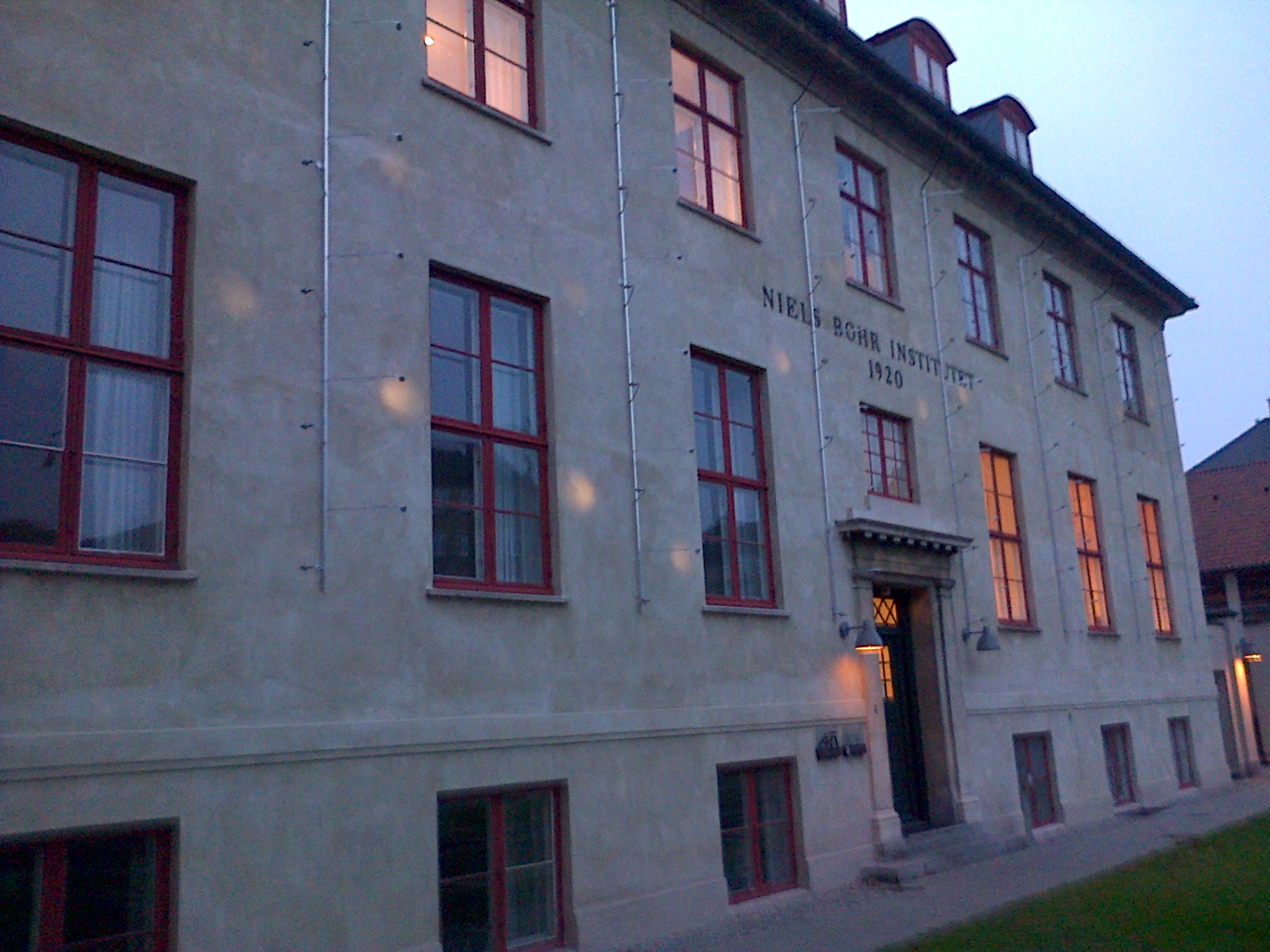
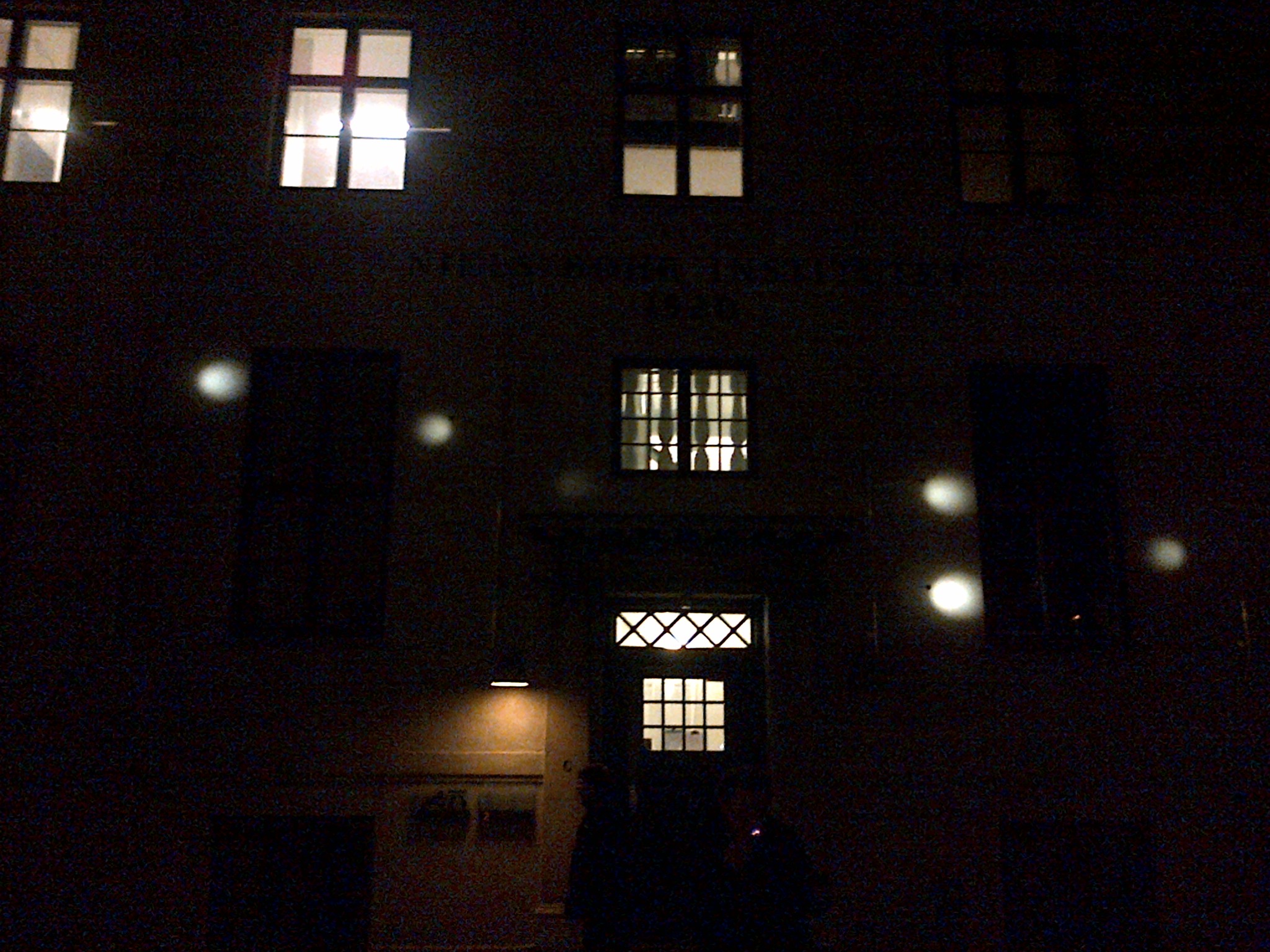
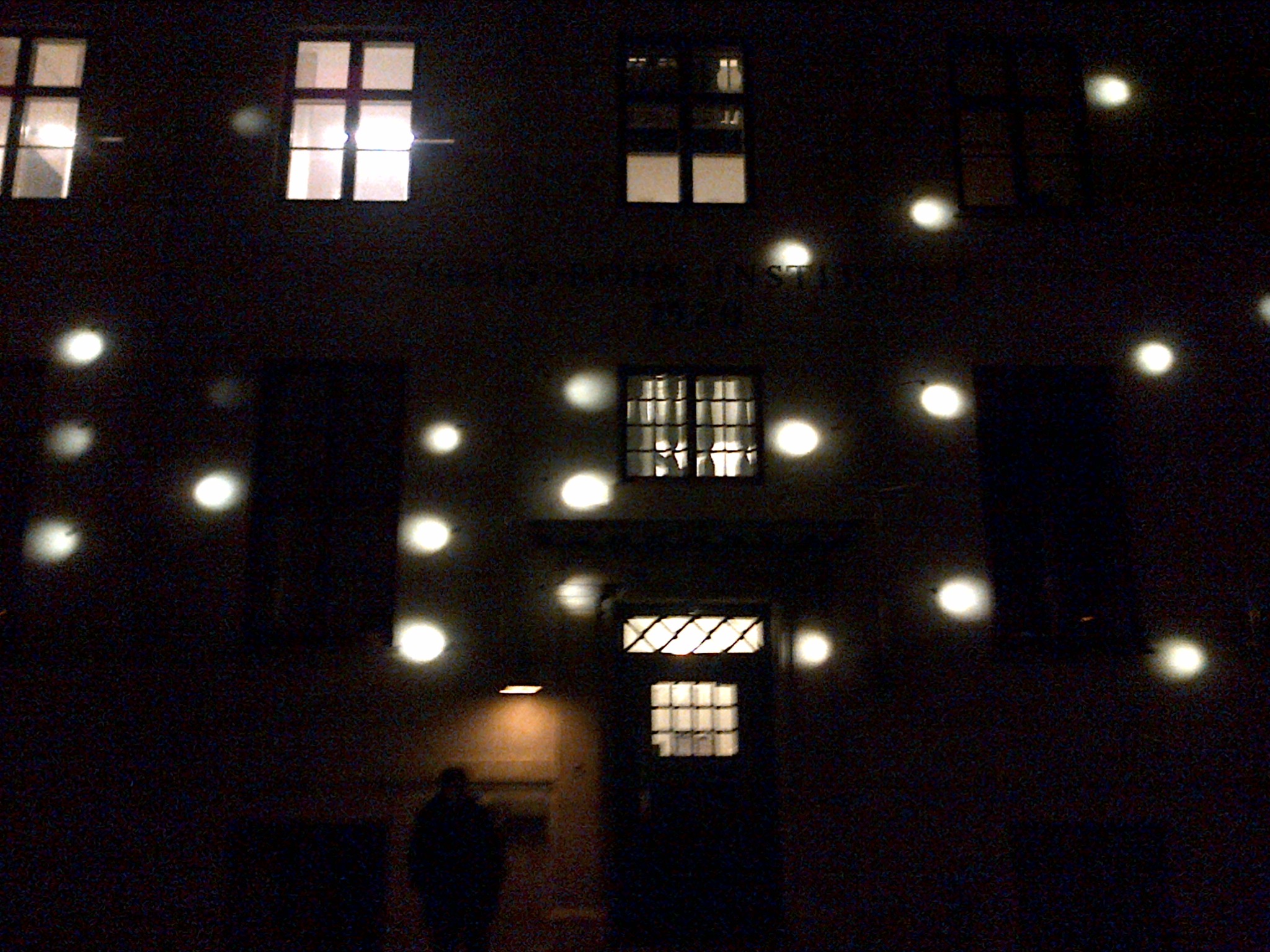
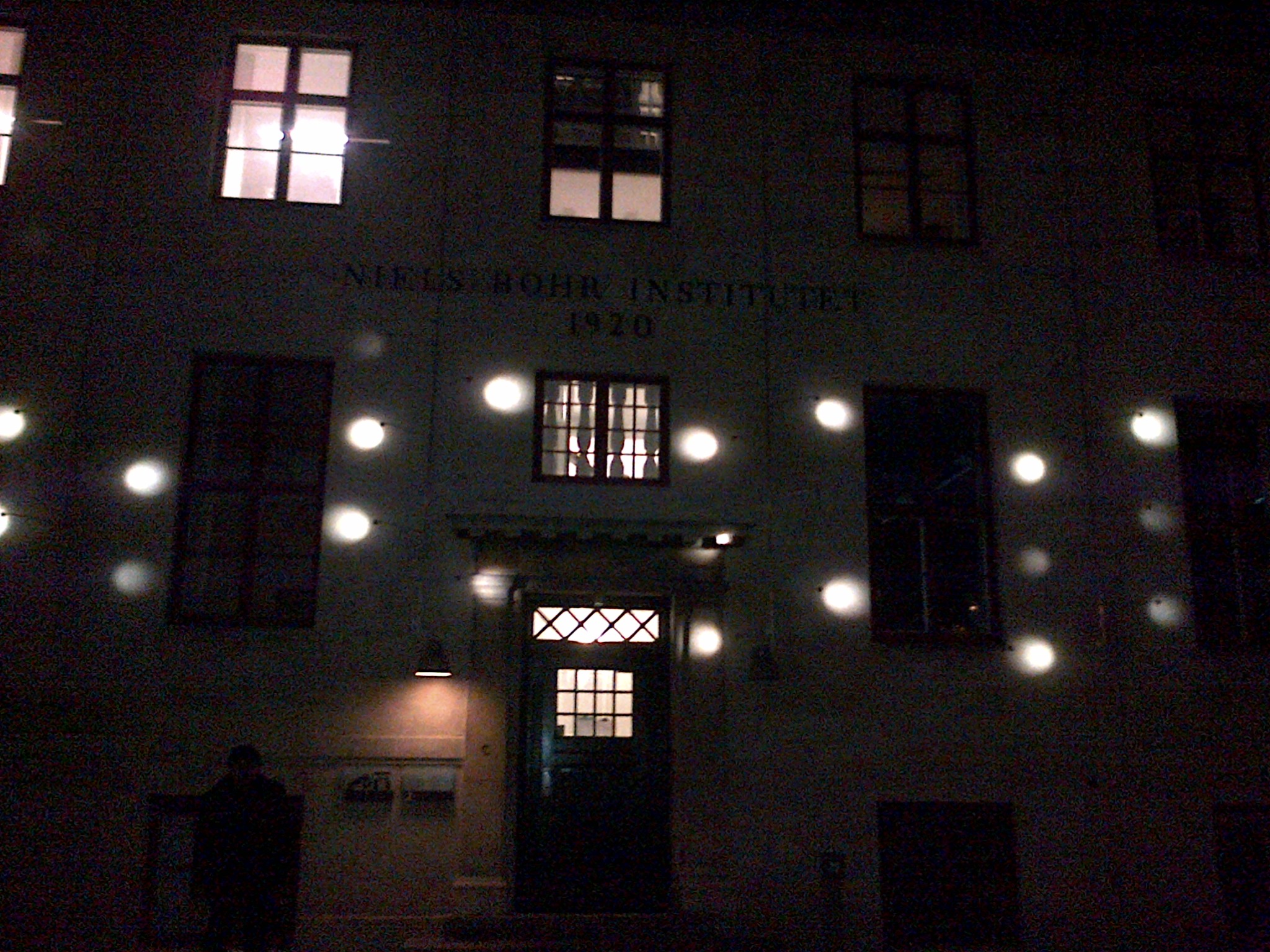
After the formalities were concluded, however, the committee took a breath of fresh air outside the Niels Bohr Institute where, in the fading November twilight, we were treated to a peculiar light show; a set of small spotlights on the front wall of the NBI building is hooked up directly to the ATLAS experiment on the Large Hadron Collider at CERN so that every time an event registers in Geneva it is displayed almost immediately in public here in Copenhagen. Quite appropriate for a place so steeped in physics history. The resolution of the particle tracks is of course not marvellous, but it’s actually quite a remarkable thing to see, although not all that easy to catch it on camera, especially if you’ve had a couple of glasses of wine!

Flying Visit

Posted in Biographical, Education, Politics, The Universe and Stuff with tags , , on November 15, 2012 by telescoper

I’m still at home at 10am on a weekday, which is unusual, but that’s because I’m soon going to be doing the familiar schlepp to Heathrow airport in order to get a flight to Copenhagen. The purpose of this little trip is to participate in a PhD examination at the Niels Bohr Institute. I’ve never taken part in a Thesis Defence in the Danish system before, although I’ve done many equivalent examinations elsewhere, so I’m quite looking forward to finding out how it works. Will it be much different from the system we have in the UK? Probably, as it is a much more public occasion. Will that necessarily make it better? I don’t know. I was reading the thesis last night, actually, and it’s very interesting which is another reason to look forward to the occasion. I might even get time for some shopping too.

Anyway, before going to the airport I am going to pop along to the local polling station. Today is the day for the Election of the Police and Crime Commissioner for the South Wales Police Area. I’m going to the polling station not because I have a burning desire to vote – the list of candidates is extremely uninspiring – but because I feel I should register a protest at this farcical waste of public money at what is supposed to be a time of austerity. The political class in this country has never been held in lower esteem than at present and the last thing we need is more politicians, helping themselves to six-figure salaries at taxpayers’ expense.  More politicians does not mean more democracy. We already have local council elections, Welsh Assembly elections, General (Parliamentary) Elections and European Parliament Elections. We don’t need any more! This Election is a complete waste of time and money.

I intend, therefore, to visit the polling station and, instead of putting a cross in a box, write a strongly (but politely) worded message voicing my opinion on the matter thus spoiling my ballot paper. It will be the first time I’ve ever done such a thing, but this is the first time we’ve had such a stupid election.

Skepsis Revived

Posted in Politics, The Universe and Stuff with tags , , , , , , , , on November 14, 2012 by telescoper

I appear to be in recycling mode this week, so I thought I’d carry on with a rehash of an old post about skepticism.  The excuse for this was an item in one of the Guardian science blogs about the distinction between Skeptic and sceptic. I must say I always thought they were simply alternative spellings, the “k” being closer to the original Greek and “c” being Latinised (via French). The Oxford English dictionary merely states that “sceptic” is more widespread in the UK and Commonwealth whereas “skeptic” prevails in North America. Somehow, however, this distinction has morphed into one variant meaning a person who has a questioning attitude to or is simply unconvinced by what claims to be knowledge in a particular area, and another meaning a “denier”, the latter being an “anti-sceptic” who believes wholeheartedly and often without evidence in whatever is contrary to received wisdom. A scientists should, I think, be the former, but the latter represents a distinctly unscientific attitude.

Anyway, yesterday I blogged a little bit about dark energy as, according to the standard model, this accounts for about 75% of the energy budget of the Universe. It’s also something we don’t understand very well at all. To make a point, take a look at the following picture (credit to the High-z supernova search team).

 What is plotted is the redshift of each supernova (along the x-axis), which relates to the factor by which the universe has expanded since light set out from it. A redshift of 0.5 means the universe was compressed by a factor 1.5 in all dimensions at the time when that particular supernova went bang. The y-axis shows the really hard bit to get right. It’s the estimated distance (in terms of distance modulus) of the supernovae. In effect, this is a measure of how faint the sources are. The theoretical curves show the faintness expected of a standard source observed at a given redshift in various cosmological models. The bottom panel shows these plotted with a reference curve taken out so the trend is easier to see. Actually, this is quite an old plot and there are many more points now but this is the version that convinced most cosmologists when it came out about a decade ago, which is why I show it here.

The argument drawn from these data is that the high redshift supernovae are fainter than one would expect in models without dark energy (represented by the \Omega_{\Lambda}  in the diagram. If this is true then it means the luminosity distance of these sources is greater than it would be in a decelerating universe. Their observed properties can be accounted for, however, if the universe’s expansion rate has been accelerating since light set out from the supernovae. In the bog standard cosmological models we all like to work with, acceleration requires that \rho + 3p/c^2 be negative. The “vacuum” equation of state p=-\rho c^2 provides a simple way of achieving this but there are many other forms of energy that could do it also, and we don’t know which one is present or why…

This plot contains the principal evidence that has led to most cosmologists accepting that the Universe is accelerating.  However, when I show it to first-year undergraduates (or even to members of the public at popular talks), they tend to stare in disbelief. The errors are huge, they say, and there are so  few data points. It just doesn’t look all that convincing. Moreover, there are other possible explanations. Maybe supernovae were different beasties back when the universe was young. Maybe something has absorbed their light making them look fainter rather than being further away. Maybe we’ve got the cosmological models wrong.

The reason I have shown this diagram is precisely because it isn’t superficially convincing. When they see it, students probably form the opinion that all cosmologists are gullible idiots. I’m actually pleased by that.  In fact, it’s the responsibility of scientists to be skeptical about new discoveries. However, it’s not good enough just to say “it’s not convincing so I think it’s rubbish”. What you have to do is test it, combine it with other evidence, seek alternative explanations and test those. In short you subject it to rigorous scrutiny and debate. It’s called the scientific method.

Some of my colleagues express doubts about me talking as I do about dark energy in first-year lectures when the students haven’t learned general relativity. But I stick to my guns. Too many people think science has to be taught as great stacks of received wisdom, of theories that are unquestionably “right”. Frontier sciences such as cosmology give us the chance to demonstrate the process by which we find out about the answers to big questions, not by believing everything we’re told but by questioning it.

My attitude to dark energy is that, given our limited understanding of the constituents of the universe and the laws of matter, it’s the best explanation we have of what’s going on. There is corroborating evidence of missing energy, from the cosmic microwave background and measurements of galaxy clustering, so it does have explanatory power. I’d say it was quite reasonable to believe in dark energy on the basis of what we know (or think we know) about the Universe.  In other words, as a good Bayesian, I’d say it was the most probable explanation. However, just because it’s the best explanation we have now doesn’t mean it’s a fact. It’s a credible hypothesis that deserves further work, but I wouldn’t bet much against it turning out to be wrong when we learn more.

I have to say that too many cosmologists seem to accept the reality of dark energy  with the unquestioning fervour of a religious zealot.  Influential gurus have turned the dark energy business into an industrial-sized bandwagon that sometimes makes it difficult, especially for younger scientists, to develop independent theories. On the other hand, it is clearly a question of fundamental importance to physics, so I’m not arguing that such projects should be axed. I just wish the culture of skepticism ran a little deeper.

Another context in which the word “skeptic” crops up frequently nowadays is  in connection with climate change although it has come to mean “denier” rather than “doubter”. I’m not an expert on climate change, so I’m not going to pretend that I understand all the details. However, there is an interesting point to be made in comparing climate change with cosmology. To make the point, here’s another figure.

There’s obviously a lot of noise and it’s only the relatively few points at the far right that show a clear increase (just as in the first Figure, in fact). However, looking at the graph I’d say that, assuming the historical data points are accurate,  it looks very convincing that the global mean temperature is rising with alarming rapidity. Modelling the Earth’s climate is very difficult and we have to leave it to the experts to assess the effects of human activity on this curve. There is a strong consensus from scientific experts, as monitored by the Intergovernmental Panel on Climate Change, that it is “very likely” that the increasing temperatures are due to increased atmospheric concentrations of greenhouse gas emissions.

There is, of course, a bandwagon effect going on in the field of climatology, just as there is in cosmology. This tends to stifle debate, make things difficult for dissenting views to be heard and evaluated rationally,  and generally hinders the proper progress of science. It also leads to accusations of – and no doubt temptations leading to – fiddling of the data to fit the prevailing paradigm. In both fields, though, the general consensus has been established by an honest and rational evaluation of data and theory.

I would say that any scientist worthy of the name should be skeptical about the human-based interpretation of these data and that, as in cosmology (or any scientific discipline), alternative theories should be developed and additional measurements made. However, this situation in climatology is very different to cosmology in one important respect. The Universe will still be here in 100 years time. We might not.

The big issue relating to climate change is not just whether we understand what’s going on in the Earth’s atmosphere, it’s the risk to our civilisation of not doing anything about it. This is a great example where the probability of being right isn’t the sole factor in making a decision. Sure, there’s a chance that humans aren’t responsible for global warming. But if we carry on as we are for decades until we prove conclusively that we are, then it will be too late. The penalty for being wrong will be unbearable. On the other hand, if we tackle climate change by adopting greener technologies, burning less fossil fuels, wasting less energy and so on, these changes may cost us a bit of money in the short term but  frankly we’ll be better off anyway whether we did it for the right reasons or not. Of course those whose personal livelihoods depend on the status quo are the ones who challenge the scientific consensus most vociferously. They would, wouldn’t they?

This is a good example of a decision that can be made on the basis of a  judgement of the probability of being right. In that respect , the issue of how likely it is that the scientists are correct on this one is almost irrelevant. Even if you’re a complete disbeliever in science you should know  how to respond to this issue, following the logic of Blaise Pascal. He argued that there’s no rational argument for the existence or non-existence of God but that the consequences of not believing if God does exist (eternal damnation) were much worse than those of behaving as if you believe in God when he doesn’t. For “God” read “climate change” and let Pascal’s wager be your guide….
A Dark Expletive

Posted in Poetry, The Universe and Stuff with tags , , , , , , , on November 13, 2012 by telescoper

A news item today about BOSS (yet another observational cosmology survey) gives me an excuse to recycle an idea from an old post.

The phrase expletive deleted was made popular at the time of Watergate after the release of the expurgated tapes made by Richard Nixon in the Oval Office when he was President of the United States of America. These showed that, as well as been a complete crook, he was practically unable to speak a single sentence without including a swear word.

Nowadays the word expletive is generally taken to mean an oath or exclamation, particularly if it is obscene, but that’s not quite what it really means. Derived from the latin verb explere (“to fill out”) from which the past participle is expletus, the meaning of the word in the context of English grammar is  “something added to a phrase or sentence that isn’t strictly needed for the grammatical sense”.  An expletive is added either to fill a syntactical role or, in a poem, simply to make a line fit some metrical rule.

Examples of the former can be found in constructions like “It takes two to Tango” or “There is a lot of crime in Nottingham”; neither  “it” nor “there” should really be needed but English just seems to like to have something before the verb.

The second kind of use is illustrated wonderfully by Alexander Pope in his Essay on Criticism, which is a kind of guide to what to avoid in writing poetry. It’s a tour de force for its perceptiveness and humour. The following excerpt is pricelessly apt

These equal syllables alone require,
Tho’ oft the open vowels tire;
While expletives their feeble aid do join;
And ten low words oft creep in one dull line

Here the expletive is “do”,  and it is cleverly incorporated in the line talking about expletives, adding  the syllable needed to fit with a strict pentameter. Apparently, poets often used this construction before Pope attacked it but it quickly fell from favour afterwards.

His other prosodic targets are the “open vowels” which means initial vowels that produce an ugly glottal sound, such as in “oft” (especially ugly when following “Tho”). The last line is brilliant too, showing how using only monosyllabic “low” words makes for a line that plods along tediously just like it says.

It’s amazing how much Pope managed to fit into this poem, given the restrictions imposed by the closed couplet structure he adopted. Each idea is compressed into a unit of twenty syllables, two lines of ten syllables with a rhyme at the end of each. This is such an impressive exercise in word-play that it reminds me a lot of the skill showed by the best cryptic crossword setters. Needless to say I’m no more successful at writing poetry than I am at setting crossword clues.

Anyway, what’s all this got to do with cosmology?

Well, I was reminded of it when I attended the 2012 Gerald Whitrow Lecture by Andrew Liddle last Friday at the Royal Astronomical Society, during which he talked, amongst other things, about Dark Energy.

The Dark Energy is an ingredient added to the standard model of cosmology to reconcile  observations of a flat Universe with a matter density that seems too low to account for it.

Other than that it makes the  cosmological metric work out satisfactorily (geddit?), we don’t understand what Dark Energy really is  or why there is as much of it. Indeed, many of us would rather it wasn’t there at all, because we think the resulting model is inelegant or even ugly, and are trying to think of other cosmological models that do not require  its introduction.

In other words, Dark Energy is an expletive (though not one that’s been deleted).

Incidentally, one of the things Andrew said in his talk – and I agree with him 100% – is that in some sense we already know enough about dark energy from observations that we know we don’t understand it at all from a theoretical point of view. Bigger and better surveys, such as Euclid, producing more and more data will characterize its properties with greater statistical accuracy, but they won’t on their own solve the Dark Energy puzzle. For that we need better theoretical understanding.

My own view is that the problem of the vacuum energy is of the same character as the ultraviolet catastrophe that ushered in the era of quantum physics: a big problem that needs a big solution. What I mean by that is that it’s not something that can be resolved by tinkering with the existing theoretical framework. Something much more radical is needed.

Dond’escono quei vortici?

Posted in Education, Opera, The Universe and Stuff with tags , , , , on November 10, 2012 by telescoper

Just time for a quickie today. I seem to be writing that virtualy every day at this time, in fact. Anyway, yesterday I gave the last of a series of lectures on Fluid Dynamics during which I talked a little bit about the Navier-Stokes equation, and introduced the concept of turbulence, topic that Richard Feynman described as “the most important unsolved problem in classical physics”. Given that the origin of turbulence is so poorly understood, I had to cover it all fairly qualitatively but did at least explain that its onset is associated with high values of the Reynold’s Number, an interesting dimensionless number that characterizes the properties of viscous fluid flow in such a way as to bring out the dynamical similarity inherent in the equations. The difficulty is that there is no exact theory that allows one to calculate the critical value of the Reynold’s number and in any particular situation; that has to be determined by experiments, such as this one which shows turbulent vortices (or “eddies”) forming downstream of a cylindrical obstacle placed in flowing fluid. The (laminar) flow upstream, and in regions far from the cylinder, has no vorticity.

What happens is obviously extremely complicated because it involves a huge range of physical scales – the vorticity is generated by very small-scale interactions between the fluid elements and the boundary of the object past which they flow. It’s a very frustrating thing for a physicist, actually, because one’s gut feeling is that it should be possible to figure it out. After all, it’s “just” classical physics. It’s also of great practical importance in a huge range of fields. Nevertheless, despite all the progress in “exotic” field such as particle physics and cosmology, it remains an open question in many respects.

That’s why it’s important to teach undergraduates about it. Physics isn’t just about solved problems. It’s a living subject, and it’s important for students to know those fields where we don’t really know that much about what is going on…

PS. The title is a quotation from the libretto of Mozart’s opera, Don Giovanni, uttered by the eponymous Count as he is dragged down to hell. It translates as “Whence come these vortices?” Pretentious, moi?