Archive for the The Universe and Stuff Category

Astronomy Advice Please!

Posted in Science Politics, The Universe and Stuff with tags , , , on September 4, 2012 by telescoper

I’m up at the crack of dawn this morning in order to travel to Swindon for a meeting of the Astronomy Grants Panel of the Science and Technology Facilities Council. Three days in Swindon beckon.

Anyways, while I’m thinking STFC stuff let me put my community service hat on and remind astronomers that the Astronomy Advisory Panel (yes, there is one) is consulting, and the deadline for folks to fill in the consultation questionnaire is tomorrow (Wednesday 5th September 2012). Please upload your input forthwith.

As a prompt, you might like to have a look at this figure that shows the breakdown of STFC expenditure generally, and specifically within the astronomy programme.

Do these pie charts provide you with food for thought?

The Return of Professor Who

Posted in Biographical, Music, Television, The Universe and Stuff with tags , , , , , on September 1, 2012 by telescoper

Since the new series of Doctor Who is to start this evening on BBC1, I thought I’d mark the occasion by posting this old blog item again:

–0–

As a Professor of Astrophysics I am often asked “Why on Earth did you take up such a crazy subject?”

I guess many astronomers, physicists and other scientists have to answer this sort of question. For many of them there is probably a romantic reason, such as seeing the rings of Saturn or the majesty of the Milky Way on a dark night. Others will probably have been inspired by TV documentary series such as The Sky at Night, Carl Sagan’s Cosmos or even Horizon which, believe it or not, actually used to be quite good but which is nowadays uniformly dire. Or it could have been something a bit more mundane but no less stimulating such as a very good science teacher at school.

When I’m asked this question I’d love to be able to put my hand on my heart and give an answer of that sort but the truth is really quite a long way from those possibilities. The thing that probably did more than anything else to get me interested in science was a Science Fiction TV series or rather not exactly the series but the opening titles.

The first episode of Doctor Who was broadcast in the year of my birth, so I don’t remember it at all, but I do remember the astonishing effect the credits had on my imagination when I saw later episodes as a small child. Here is the  opening title sequence as it appeared in the very first series featuring William Hartnell as the first Doctor.

To a younger audience it probably all seems quite tame, but I think there’s a haunting, unearthly beauty to the shapes conjured up by Bernard Lodge. Having virtually no budget for graphics, he experimented in a darkened studio with an old-fashioned TV camera and a piece of black card with Doctor Who written on it in white. He created the spooky kaleidoscopic patterns you see by simply pointing the camera so it could see into its own monitor, thus producing a sort of electronic hall of mirrors.

What is so fascinating to me is how a relatively simple underlying concept could produce a rich assortment of patterns, particularly how they seem to take on an almost organic aspect as they merge and transform. I’ve continued to be struck by the idea that complexity could be produced by relatively simple natural laws which is one of the essential features of astrophysics and cosmology. As a practical demonstration of the universality of physics this sequence takes some beating.

As well as these strange and wonderful images, the titles also featured a pioneering piece of electronic music. Officially the composer was Ron Grainer, but he wasn’t very interested in the commission and simply scribbled the theme down and left it to the BBC to turn it into something useable. In stepped the wonderful Delia Derbyshire, unsung heroine of the BBC Radiophonic Workshop who, with only the crudest electronic equipment available, turned it into a little masterpiece. Ethereal yet propulsive, the original theme from Doctor Who is definitely one of my absolute favourite pieces of music and I’m glad to see that Delia Derbyshire is now receiving the acclaim she deserves from serious music critics.

It’s ironic that I’ve now moved to Cardiff where new programmes of Doctor Who and its spin-off, the anagrammatic Torchwood, are made. One of the great things about the early episodes of Doctor Who was that the technology simply didn’t exist to do very good special effects. The scripts were consequently very careful to let the viewers’ imagination do all the work. That’s what made it so good. I’m pleased that the more recent incarnations of this show also don’t go overboard on the visuals. Perhaps thats a conscious attempt to appeal to people who saw the old ones as well as those too young to have done so. It’s just a pity the modern opening title music is so bad…

Anyway, I still love Doctor Who after all these years. It must sound daft to say that it inspired me to take up astrophysics, but it’s truer than any other explanation I can think of. Of course the career path is slightly different from a Timelord, but only slightly.

At any rate I think The Doctor is overdue for promotion. How about Professor Who?

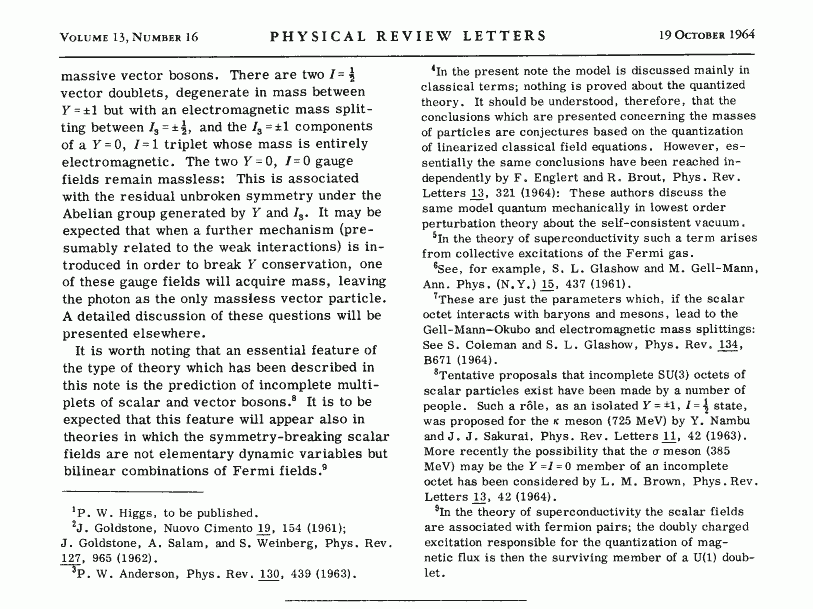
Short but sweet – Higgs (1964)

Posted in The Universe and Stuff with tags , , , , on August 31, 2012 by telescoper

In the light of all this Malarkey about the (claimed) discovery of the Higgs Boson at the Large Hadron Collider, I thought you might be interested to see the original paper by Higgs (1964) in its entirety. As you can see, it’s surprisingly small. The paper, I mean, not the boson…

p.s. The paper is freely available to download from the American Physical Society website; no breach of copyright is intended.

p.p.s. The manuscript was received by Physical Review Letters on 31st August 1964, i.e. 48 years ago today.

The Importance of Being Homogeneous

Posted in The Universe and Stuff with tags , , , , , , , , on August 29, 2012 by telescoper

A recent article in New Scientist reminded me that I never completed the story I started with a couple of earlier posts (here and there), so while I wait for the rain to stop I thought I’d make myself useful by posting something now. It’s all about a paper available on the arXiv by Scrimgeour et al. concerning the transition to homogeneity of galaxy clustering in the WiggleZ galaxy survey, the abstract of which reads:

We have made the largest-volume measurement to date of the transition to large-scale homogeneity in the distribution of galaxies. We use the WiggleZ survey, a spectroscopic survey of over 200,000 blue galaxies in a cosmic volume of ~1 (Gpc/h)^3. A new method of defining the ‘homogeneity scale’ is presented, which is more robust than methods previously used in the literature, and which can be easily compared between different surveys. Due to the large cosmic depth of WiggleZ (up to z=1) we are able to make the first measurement of the transition to homogeneity over a range of cosmic epochs. The mean number of galaxies N(<r) in spheres of comoving radius r is proportional to r^3 within 1%, or equivalently the fractal dimension of the sample is within 1% of D_2=3, at radii larger than 71 \pm 8 Mpc/h at z~0.2, 70 \pm 5 Mpc/h at z~0.4, 81 \pm 5 Mpc/h at z~0.6, and 75 \pm 4 Mpc/h at z~0.8. We demonstrate the robustness of our results against selection function effects, using a LCDM N-body simulation and a suite of inhomogeneous fractal distributions. The results are in excellent agreement with both the LCDM N-body simulation and an analytical LCDM prediction. We can exclude a fractal distribution with fractal dimension below D_2=2.97 on scales from ~80 Mpc/h up to the largest scales probed by our measurement, ~300 Mpc/h, at 99.99% confidence.

To paraphrase, the conclusion of this study is that while galaxies are strongly clustered on small scales – in a complex `cosmic web’ of clumps, knots, sheets and filaments –  on sufficiently large scales, the Universe appears to be smooth. This is much like a bowl of porridge which contains many lumps, but (usually) none as large as the bowl it’s put in.

Our standard cosmological model is based on the Cosmological Principle, which asserts that the Universe is, in a broad-brush sense, homogeneous (is the same in every place) and isotropic (looks the same in all directions). But the question that has troubled cosmologists for many years is what is meant by large scales? How broad does the broad brush have to be?

I blogged some time ago about that the idea that the  Universe might have structure on all scales, as would be the case if it were described in terms of a fractal set characterized by a fractal dimension D. In a fractal set, the mean number of neighbours of a given galaxy within a spherical volume of radius R is proportional to R^D. If galaxies are distributed uniformly (homogeneously) then D = 3, as the number of neighbours simply depends on the volume of the sphere, i.e. as R^3, and the average number-density of galaxies. A value of D < 3 indicates that the galaxies do not fill space in a homogeneous fashion: D = 1, for example, would indicate that galaxies were distributed in roughly linear structures (filaments); the mass of material distributed along a filament enclosed within a sphere grows linear with the radius of the sphere, i.e. as R^1, not as its volume; galaxies distributed in sheets would have D=2, and so on.

We know that D \simeq 1.2 on small scales (in cosmological terms, still several Megaparsecs), but the evidence for a turnover to D=3 has not been so strong, at least not until recently. It’s just just that measuring D from a survey is actually rather tricky, but also that when we cosmologists adopt the Cosmological Principle we apply it not to the distribution of galaxies in space, but to space itself. We assume that space is homogeneous so that its geometry can be described by the Friedmann-Lemaitre-Robertson-Walker metric.

According to Einstein’s  theory of general relativity, clumps in the matter distribution would cause distortions in the metric which are roughly related to fluctuations in the Newtonian gravitational potential \delta\Phi by \delta\Phi/c^2 \sim \left(\lambda/ct \right)^{2} \left(\delta \rho/\rho\right), give or take a factor of a few, so that a large fluctuation in the density of matter wouldn’t necessarily cause a large fluctuation of the metric unless it were on a scale \lambda reasonably large relative to the cosmological horizon \sim ct. Galaxies correspond to a large \delta \rho/\rho \sim 10^6 but don’t violate the Cosmological Principle because they are too small in scale \lambda to perturb the background metric significantly.

The discussion of a fractal universe is one I’m overdue to return to. In my previous post  I left the story as it stood about 15 years ago, and there have been numerous developments since then, not all of them consistent with each other. I will do a full “Part 2” to that post eventually, but in the mean time I’ll just comment that this particularly one does seem to be consistent with a Universe that possesses the property of large-scale homogeneity. If that conclusion survives the next generation of even larger galaxy redshift surveys then it will come as an immense relief to cosmologists.

The reason for that is that the equations of general relativity are very hard to solve in cases where there isn’t a lot of symmetry; there are just too many equations to solve for a general solution to be obtained.  If the cosmological principle applies, however, the equations simplify enormously (both in number and form) and we can get results we can work with on the back of an envelope. Small fluctuations about the smooth background solution can be handled (approximately but robustly) using a technique called perturbation theory. If the fluctuations are large, however, these methods don’t work. What we need to do instead is construct exact inhomogeneous model, and that is very very hard. It’s of course a different question as to why the Universe is so smooth on large scales, but as a working cosmologist the real importance of it being that way is that it makes our job so much easier than it would otherwise be.

P.S. And I might add that the importance of the Scrimgeour et al paper to me personally is greatly amplified by the fact that it cites a number of my own articles on this theme!

A Hero of Our Time

Posted in The Universe and Stuff with tags on August 25, 2012 by telescoper

R.I.P. Neil Armstrong (August 5, 1930 – August 25, 2012)

Pathways to Research

Posted in Education, The Universe and Stuff with tags , , , , , on August 24, 2012 by telescoper

The other day I had a slight disagreement with a colleague of mine about the best advice to give to new PhD students about how to tackle their research. Talking to a few other members of staff about it subsequently has convinced me that there isn’t really a consensus about it and it might therefore be worth a quick post to see what others think.

Basically the issue is whether a new research student should try to get into “hands-on” research as soon as he or she starts, or whether it’s better to spend most of the initial phase in preparation: reading all the literature, learning the techniques required, taking advanced theory courses, and so on. I know that there’s usually a mixture of these two approaches, and it will vary hugely from one discipline to another, and especially between theory and experiment, but the question is which one do you think should dominate early on?

My view of this is coloured by my own experience as a PhD (or rather DPhil student) twenty-five years ago. I went directly from a three-year undergraduate degree to a three-year postgraduate degree. I did a little bit of background reading over the summer before I started graduate studies, but basically went straight into trying to solve a problem my supervisor gave me when I arrived at Sussex to start my DPhil. I had to learn quite a lot of stuff as I went along in order to get on, which I did in a way that wasn’t at all systematic.

Fortunately I did manage to crack the problem I was given, with the consequence that got a publication out quite early during my thesis period. Looking back on it I even think that I was helped by the fact that I was too ignorant to realise how difficult more expert people thought the problem was. I didn’t know enough to be frightened. That’s the drawback with the approach of reading everything about a field before you have a go yourself…

In the case of the problem I had to solve, which was actually more to do with applied probability theory than physics, I managed to find (pretty much by guesswork) a cute mathematical trick that turned out to finesse the difficult parts of the calculation I had to do. I really don’t think I would have had the nerve to try such a trick if I had read all the difficult technical literature on the subject.

So I definitely benefited from the approach of diving headlong straight into the detail, but I’m very aware that it’s difficult to argue from the particular to the general. Clearly research students need to do some groundwork; they have to acquire a toolbox of some sort and know enough about the field to understand what’s worth doing. But what I’m saying is that sometimes you can know too much. All that literature can weigh you down so much that it actually stifles rather than nurtures your ability to do research. But then complete ignorance is no good either. How do you judge the right balance?

I’d be interested in comments on this, especially to what extent it is an issue in fields other than astrophysics.

The Return of the Inductive Detective

Posted in Bad Statistics, Literature, The Universe and Stuff with tags , , , , , , , , on August 23, 2012 by telescoper

A few days ago an article appeared on the BBC website that discussed the enduring appeal of Sherlock Holmes and related this to the processes involved in solving puzzles. That piece makes a number of points I’ve made before, so I thought I’d update and recycle my previous post on that theme. The main reason for doing so is that it gives me yet another chance to pay homage to the brilliant Jeremy Brett who, in my opinion, is unsurpassed in the role of Sherlock Holmes. It also allows me to return to a philosophical theme I visited earlier this week.

One of the  things that fascinates me about detective stories (of which I am an avid reader) is how often they use the word “deduction” to describe the logical methods involved in solving a crime. As a matter of fact, what Holmes generally uses is not really deduction at all, but inference (a process which is predominantly inductive).

In deductive reasoning, one tries to tease out the logical consequences of a premise; the resulting conclusions are, generally speaking, more specific than the premise. “If these are the general rules, what are the consequences for this particular situation?” is the kind of question one can answer using deduction.

The kind of reasoning of reasoning Holmes employs, however, is essentially opposite to this. The  question being answered is of the form: “From a particular set of observations, what can we infer about the more general circumstances that relating to them?”.

And for a dramatic illustration of the process of inference, you can see it acted out by the great Jeremy Brett in the first four minutes or so of this clip from the classic Granada TV adaptation of The Hound of the Baskervilles:

I think it’s pretty clear in this case that what’s going on here is a process of inference (i.e. inductive rather than deductive reasoning). It’s also pretty clear, at least to me, that Jeremy Brett’s acting in that scene is utterly superb.

I’m probably labouring the distinction between induction and deduction, but the main purpose doing so is that a great deal of science is fundamentally inferential and, as a consequence, it entails dealing with inferences (or guesses or conjectures) that are inherently uncertain as to their application to real facts. Dealing with these uncertain aspects requires a more general kind of logic than the  simple Boolean form employed in deductive reasoning. This side of the scientific method is sadly neglected in most approaches to science education.

In physics, the attitude is usually to establish the rules (“the laws of physics”) as axioms (though perhaps giving some experimental justification). Students are then taught to solve problems which generally involve working out particular consequences of these laws. This is all deductive. I’ve got nothing against this as it is what a great deal of theoretical research in physics is actually like, it forms an essential part of the training of an physicist.

However, one of the aims of physics – especially fundamental physics – is to try to establish what the laws of nature actually are from observations of particular outcomes. It would be simplistic to say that this was entirely inductive in character. Sometimes deduction plays an important role in scientific discoveries. For example,  Albert Einstein deduced his Special Theory of Relativity from a postulate that the speed of light was constant for all observers in uniform relative motion. However, the motivation for this entire chain of reasoning arose from previous studies of eletromagnetism which involved a complicated interplay between experiment and theory that eventually led to Maxwell’s equations. Deduction and induction are both involved at some level in a kind of dialectical relationship.

The synthesis of the two approaches requires an evaluation of the evidence the data provides concerning the different theories. This evidence is rarely conclusive, so  a wider range of logical possibilities than “true” or “false” needs to be accommodated. Fortunately, there is a quantitative and logically rigorous way of doing this. It is called Bayesian probability. In this way of reasoning,  the probability (a number between 0 and 1 attached to a hypothesis, model, or anything that can be described as a logical proposition of some sort) represents the extent to which a given set of data supports the given hypothesis.  The calculus of probabilities only reduces to Boolean algebra when the probabilities of all hypothesese involved are either unity (certainly true) or zero (certainly false). In between “true” and “false” there are varying degrees of “uncertain” represented by a number between 0 and 1, i.e. the probability.

Overlooking the importance of inductive reasoning has led to numerous pathological developments that have hindered the growth of science. One example is the widespread and remarkably naive devotion that many scientists have towards the philosophy of the anti-inductivist Karl Popper; his doctrine of falsifiability has led to an unhealthy neglect of  an essential fact of probabilistic reasoning, namely that data can make theories more probable. More generally, the rise of the empiricist philosophical tradition that stems from David Hume (another anti-inductivist) spawned the frequentist conception of probability, with its regrettable legacy of confusion and irrationality.

In fact Sherlock Holmes himself explicitly recognizes the importance of inference and rejects the one-sided doctrine of falsification. Here he is in The Adventure of the Cardboard Box (the emphasis is mine):

Let me run over the principal steps. We approached the case, you remember, with an absolutely blank mind, which is always an advantage. We had formed no theories. We were simply there to observe and to draw inferences from our observations. What did we see first? A very placid and respectable lady, who seemed quite innocent of any secret, and a portrait which showed me that she had two younger sisters. It instantly flashed across my mind that the box might have been meant for one of these. I set the idea aside as one which could be disproved or confirmed at our leisure.

My own field of cosmology provides the largest-scale illustration of this process in action. Theorists make postulates about the contents of the Universe and the laws that describe it and try to calculate what measurable consequences their ideas might have. Observers make measurements as best they can, but these are inevitably restricted in number and accuracy by technical considerations. Over the years, theoretical cosmologists deductively explored the possible ways Einstein’s General Theory of Relativity could be applied to the cosmos at large. Eventually a family of theoretical models was constructed, each of which could, in principle, describe a universe with the same basic properties as ours. But determining which, if any, of these models applied to the real thing required more detailed data.  For example, observations of the properties of individual galaxies led to the inferred presence of cosmologically important quantities of  dark matter. Inference also played a key role in establishing the existence of dark energy as a major part of the overall energy budget of the Universe. The result is now that we have now arrived at a standard model of cosmology which accounts pretty well for most relevant data.

Nothing is certain, of course, and this model may well turn out to be flawed in important ways. All the best detective stories have twists in which the favoured theory turns out to be wrong. But although the puzzle isn’t exactly solved, we’ve got good reasons for thinking we’re nearer to at least some of the answers than we were 20 years ago.

I think Sherlock Holmes would have approved.

Top Ten Dubious Science Facts

Posted in The Universe and Stuff with tags , on August 22, 2012 by telescoper

Yesterday evening I joined in a bit of fun on Twitter posting dubious science facts which you can find by looking for the hashtag #dubioussciencefacts if you’re a person who tweets. The idea was to come up with amusing, misleading or just silly statements about science, with as thin a veneer of truth as possible.

The 140-character limit on Twitter makes this kind of game quite challenging, but also quite enjoyable to join in. Anyway, for those of you who don’t tweet, I thought I’d post ten examples of my own creation along with an invitation to contribute your own through the comments box by way of audience participation. Please try to keep your contributions shorter than 140 characters…

Here are my ten:

  1. Galileo is a much more famous scientist than his co-workers Figaro and Magnifico
  2. If the Earth were the size of a golf ball, Jupiter would be as big as Colin Montgomery
  3. It is possible for a spaceship to boldly go faster than light, but only if it uses a split infinitive drive
  4. Organic chemistry is a lot tastier than normal chemistry but also much more expensive
  5. Parity is an important concept in particle physics: PhD students get the same salaries as professors in that field
  6. Galaxies appear to have a flattened shape because they are usually observed using Cinemascopes
  7. Dyson spheres are sources of vacuum energy
  8. The Earth’s rotation means that it will soon have to leave the Solar System in order to throw up
  9. The Coriolis Effect is called the Siloiroc Effect in the Southern Hemisphere
  10. Physics used to be called “natural philosophy”, which means it is philosophy without any bits of fruit in it

Lecter Notes

Posted in Film, The Universe and Stuff with tags , , , , , , , , on August 21, 2012 by telescoper

I’ve been meaning to post about this for some time, but never seemed to get around to it. Tonight I’m skipping dinner because I have to fast before yet another blood test tomorrow morning so I’ve got a bit of time on my hands to have a go.

Anyway, the topic for tonight’s dissertation is the following clip featuring Anthony Hopkins as the serial killer Hannibal Lecter from the film The Silence of the Lambs (1991), specifically the “quotation” from the Meditations of Roman Emperor and stoic philosopher  Marcus Aurelius.

The quotation by Lecter reads

First principles, Clarice. Simplicity. Read Marcus Aurelius. Of each particular thing ask: what is it in itself? What is its nature? What does he do, this man you seek?

I always felt this would make a good preface to a book on particle physics, playing on the word “particular”, but of course one has to worry about using part of a film script without paying the necessary copyright fee, and there’s also the small matter of writing the book in the first place.

Anyway, I keep the Penguin Popular  Classics paperback English translation of the Meditations  with me when I go travelling; I can’t read Greek, the language it was originally written in. It is one the greatest works of classical philosophy, but it’s also a collection of very personal thoughts by someone who managed to be an uncompromisingly authoritarian Emperor of Rome at the same time as being a humble and introspective person. Not that I have ever in practice managed to obey his exhortations to self-denial!

Anyway, the first point I wanted to make is that Lecter’s quote is not a direct quote from the Meditations, at least not in any English translation I have found. The nearest I could find in the version I own is Book 8, Meditation X:

This, what is it in itself, and by itself, according to its proper constitution? What is the substance of it? What is the matter, or proper use? What is the form, or efficient cause? What is it for in this world, and how long will it abide? Thus must thou examine all things that present themselves unto thee.

Or possibly, later on in the same Book, Meditation XII:

As every fancy and imagination presents itself to unto thee, consider (if it be possible) the true nature, and the proper qualities of it, and reason with thyself about it.


There are other translated versions to be found on the net (e.g. here), all similar. Thus Lecter’s reference is a paraphrase, but by no means a misleading one.

A more interesting comment, perhaps, relates to the logical structure of Lecter’s quote. He starts by asking about a thing “in itself”, which recalls the ding an sich of Immanuel Kant. I suspect the Greek word used by Marcus Aurelius is noumenon, which refers to an object that can be known independently of the senses. The point is that Kant argued that the “thing in itself” is ultimately unknowable. Lecter continues by asking not what the thing (in this case a man) is in itself but what it (he) does, which is not the same question at all.

It has long struck me that this is similar to the way we work in physics. For example, we might think we understand a bit about what an electron is, but actually what we learn about is how it interacts with other things, i.e. what it does. From such behaviour we learn about what attributes we can assign to it, such as charge, mass and spin but we know these only through their interactions with other entities. The electron-in-itself remains a mystery.

If the reference to physics all sounds a bit nerdy, then I’ll make the obvious point that it also works with people. Do we ever really know what another person is in himself or herself? It’s only through interacting with people that we discover anything. They may say kind or nasty things and perform good or evil deeds, or act in some other way that leads us to draw conclusions about their inner nature. But we never really know for sure. They might be lying, or have ulterior motives. We have to trust our judgement to some extent otherwise we’re forced to live in a world in which we don’t trust anyone, and that’s not a world that most of us are prepared to countenance.

Even that is similar to physics (or any other science) because we have to believe that, say, electrons (or rather the experiments we carry out to probe their properties) don’t lie. This takes us to an axiom upon which all science depends, that nature doesn’t play tricks on us, that the world runs according to rules which it never breaks.

Anyway, that’s enough of physics, philosophy, Marcus Aurelius and Hannibal Lecter. I’m off to read a book while I fast for the rest of the evening. No fava beans and nice Chianti for me…

Kuhn the Irrationalist

Posted in Bad Statistics, The Universe and Stuff with tags , , , , , , , , , , , , on August 19, 2012 by telescoper

There’s an article in today’s Observer marking the 50th anniversary of the publication of Thomas Kuhn’s book The Structure of Scientific Revolutions.  John Naughton, who wrote the piece, claims that this book “changed the way we look at science”. I don’t agree with this view at all, actually. There’s little in Kuhn’s book that isn’t implicit in the writings of Karl Popper and little in Popper’s work that isn’t implicit in the work of a far more important figure in the development of the philosophy of science, David Hume. The key point about all these authors is that they failed to understand the central role played by probability and inductive logic in scientific research. In the following I’ll try to explain how I think it all went wrong. It might help the uninitiated to read an earlier post of mine about the Bayesian interpretation of probability.

It is ironic that the pioneers of probability theory and its application to scientific research, principally Laplace, unquestionably adopted a Bayesian rather than frequentist interpretation for his probabilities. Frequentism arose during the nineteenth century and held sway until relatively recently. I recall giving a conference talk about Bayesian reasoning only to be heckled by the audience with comments about “new-fangled, trendy Bayesian methods”. Nothing could have been less apt. Probability theory pre-dates the rise of sampling theory and all the other frequentist-inspired techniques that many modern-day statisticians like to employ.

Most disturbing of all is the influence that frequentist and other non-Bayesian views of probability have had upon the development of a philosophy of science, which I believe has a strong element of inverse reasoning or inductivism in it. The argument about whether there is a role for this type of thought in science goes back at least as far as Roger Bacon who lived in the 13th Century. Much later the brilliant Scottish empiricist philosopher and enlightenment figure David Hume argued strongly against induction. Most modern anti-inductivists can be traced back to this source. Pierre Duhem has argued that theory and experiment never meet face-to-face because in reality there are hosts of auxiliary assumptions involved in making this comparison. This is nowadays called the Quine-Duhem thesis.

Actually, for a Bayesian this doesn’t pose a logical difficulty at all. All one has to do is set up prior probability distributions for the required parameters, calculate their posterior probabilities and then integrate over those that aren’t related to measurements. This is just an expanded version of the idea of marginalization, explained here.

Rudolf Carnap, a logical positivist, attempted to construct a complete theory of inductive reasoning which bears some relationship to Bayesian thought, but he failed to apply Bayes’ theorem in the correct way. Carnap distinguished between two types or probabilities – logical and factual. Bayesians don’t – and I don’t – think this is necessary. The Bayesian definition seems to me to be quite coherent on its own.

Other philosophers of science reject the notion that inductive reasoning has any epistemological value at all. This anti-inductivist stance, often somewhat misleadingly called deductivist (irrationalist would be a better description) is evident in the thinking of three of the most influential philosophers of science of the last century: Karl Popper, Thomas Kuhn and, most recently, Paul Feyerabend. Regardless of the ferocity of their arguments with each other, these have in common that at the core of their systems of thought likes the rejection of all forms of inductive reasoning. The line of thought that ended in this intellectual cul-de-sac began, as I stated above, with the work of the Scottish empiricist philosopher David Hume. For a thorough analysis of the anti-inductivists mentioned above and their obvious debt to Hume, see David Stove’s book Popper and After: Four Modern Irrationalists. I will just make a few inflammatory remarks here.

Karl Popper really began the modern era of science philosophy with his Logik der Forschung, which was published in 1934. There isn’t really much about (Bayesian) probability theory in this book, which is strange for a work which claims to be about the logic of science. Popper also managed to, on the one hand, accept probability theory (in its frequentist form), but on the other, to reject induction. I find it therefore very hard to make sense of his work at all. It is also clear that, at least outside Britain, Popper is not really taken seriously by many people as a philosopher. Inside Britain it is very different and I’m not at all sure I understand why. Nevertheless, in my experience, most working physicists seem to subscribe to some version of Popper’s basic philosophy.

Among the things Popper has claimed is that all observations are “theory-laden” and that “sense-data, untheoretical items of observation, simply do not exist”. I don’t think it is possible to defend this view, unless one asserts that numbers do not exist. Data are numbers. They can be incorporated in the form of propositions about parameters in any theoretical framework we like. It is of course true that the possibility space is theory-laden. It is a space of theories, after all. Theory does suggest what kinds of experiment should be done and what data is likely to be useful. But data can be used to update probabilities of anything.

Popper has also insisted that science is deductive rather than inductive. Part of this claim is just a semantic confusion. It is necessary at some point to deduce what the measurable consequences of a theory might be before one does any experiments, but that doesn’t mean the whole process of science is deductive. He does, however, reject the basic application of inductive reasoning in updating probabilities in the light of measured data; he asserts that no theory ever becomes more probable when evidence is found in its favour. Every scientific theory begins infinitely improbable, and is doomed to remain so.

Now there is a grain of truth in this, or can be if the space of possibilities is infinite. Standard methods for assigning priors often spread the unit total probability over an infinite space, leading to a prior probability which is formally zero. This is the problem of improper priors. But this is not a killer blow to Bayesianism. Even if the prior is not strictly normalizable, the posterior probability can be. In any case, given sufficient relevant data the cycle of experiment-measurement-update of probability assignment usually soon leaves the prior far behind. Data usually count in the end.

The idea by which Popper is best known is the dogma of falsification. According to this doctrine, a hypothesis is only said to be scientific if it is capable of being proved false. In real science certain “falsehood” and certain “truth” are almost never achieved. Theories are simply more probable or less probable than the alternatives on the market. The idea that experimental scientists struggle through their entire life simply to prove theorists wrong is a very strange one, although I definitely know some experimentalists who chase theories like lions chase gazelles. To a Bayesian, the right criterion is not falsifiability but testability, the ability of the theory to be rendered more or less probable using further data. Nevertheless, scientific theories generally do have untestable components. Any theory has its interpretation, which is the untestable baggage that we need to supply to make it comprehensible to us. But whatever can be tested can be scientific.

Popper’s work on the philosophical ideas that ultimately led to falsificationism began in Vienna, but the approach subsequently gained enormous popularity in western Europe. The American Thomas Kuhn later took up the anti-inductivist baton in his book The Structure of Scientific Revolutions. Initially a physicist, Kuhn undoubtedly became a first-rate historian of science and this book contains many perceptive analyses of episodes in the development of physics. His view of scientific progress is cyclic. It begins with a mass of confused observations and controversial theories, moves into a quiescent phase when one theory has triumphed over the others, and lapses into chaos again when the further testing exposes anomalies in the favoured theory. Kuhn adopted the word paradigm to describe the model that rules during the middle stage,

The history of science is littered with examples of this process, which is why so many scientists find Kuhn’s account in good accord with their experience. But there is a problem when attempts are made to fuse this historical observation into a philosophy based on anti-inductivism. Kuhn claims that we “have to relinquish the notion that changes of paradigm carry scientists ..closer and closer to the truth.” Einstein’s theory of relativity provides a closer fit to a wider range of observations than Newtonian mechanics, but in Kuhn’s view this success counts for nothing.

Paul Feyerabend has extended this anti-inductivist streak to its logical (though irrational) extreme. His approach has been dubbed “epistemological anarchism”, and it is clear that he believed that all theories are equally wrong. He is on record as stating that normal science is a fairytale, and that equal time and resources should be spent on “astrology, acupuncture and witchcraft”. He also categorised science alongside “religion, prostitution, and so on”. His thesis is basically that science is just one of many possible internally consistent views of the world, and that the choice between which of these views to adopt can only be made on socio-political grounds.

Feyerabend’s views could only have flourished in a society deeply disillusioned with science. Of course, many bad things have been done in science’s name, and many social institutions are deeply flawed. One can’t expect anything operated by people to run perfectly. It’s also quite reasonable to argue on ethical grounds which bits of science should be funded and which should not. But the bottom line is that science does have a firm methodological basis which distinguishes it from pseudo-science, the occult and new age silliness. Science is distinguished from other belief-systems by its rigorous application of inductive reasoning and its willingness to subject itself to experimental test. Not all science is done properly, of course, and bad science is as bad as anything.

The Bayesian interpretation of probability leads to a philosophy of science which is essentially epistemological rather than ontological. Probabilities are not “out there” in external reality, but in our minds, representing our imperfect knowledge and understanding. Scientific theories are not absolute truths. Our knowledge of reality is never certain, but we are able to reason consistently about which of our theories provides the best available description of what is known at any given time. If that description fails when more data are gathered, we move on, introducing new elements or abandoning the theory for an alternative. This process could go on forever. There may never be a “final” theory, and scientific truths are consequently far from absolute, but that doesn’t mean that there is no progress.