Archive for the The Universe and Stuff Category

The case for JUICE

Posted in Science Politics, The Universe and Stuff with tags , , , on May 8, 2012 by telescoper

Here’s a nice blog peace giving the case for JUICE (The Jupiter Icy Moon Explorer recently selected by the European Space Agency for its next L-class mission).

Duncan Forgan's avatarWell-Bred Insolence

There’s been a lot of chatter in astronomy circles about the negative consequences of ESA’s latest L-class (i.e. large) space mission selection.  JUICE (The JUpiter Icy moon Explorer) was selected over two rival missions – the New Gravitational wave Observatory (NGO), and the Advanced Telescope for High ENergy Astrophysics (ATHENA).  In the current age of global austerity, one group’s win is several groups’ losses, and understandably the X-Ray and gravitational wave communities are upset at the choice.  Indeed, reading the comments section on astro blogs might make planetary scientists go a little pale. Not least the fact that ATHENA supporters have already delivered a 1450 signature petition demanding a rethink.  The fact that the decision making process has been somewhat cloudy doesn’t help matters.

It does indeed suck that this is a zero-sum game (in fact, probably…

View original post 802 more words

Experiment Marathon, Reykjavik 2008

Posted in Art, Books, Talks and Reviews, The Universe and Stuff with tags , , , on May 8, 2012 by telescoper

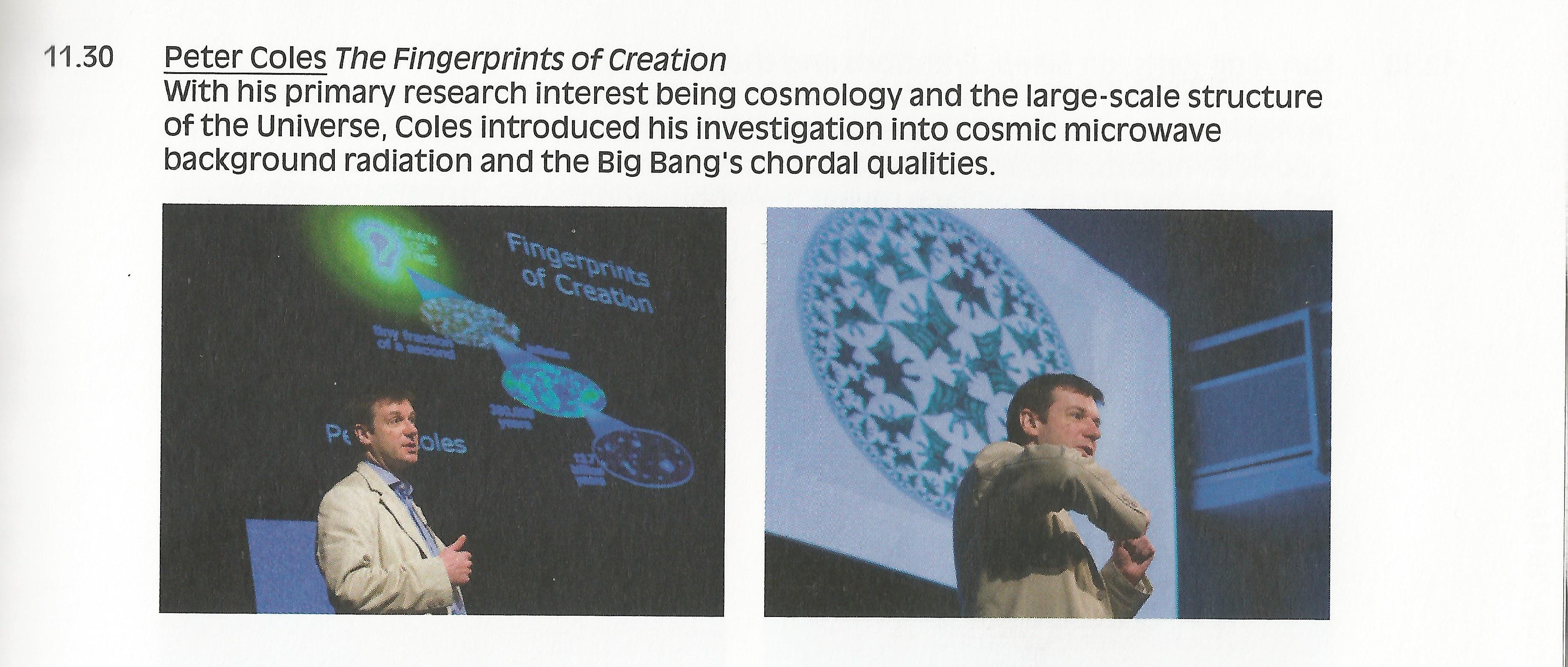
A while ago I blogged about an event I attended, called  Experimental Marathon, which was held in Reykjavik Art Museum in May 2008. I was reminded about this for various reasons recently and managed to dig up a couple of pictures of my presentation, which appeared in the glossy book of the event that was produced later on.

As you can probably infer, I gave a talk which was basically about the cosmic microwave background. My “experiment” was a television set that wasn’t tuned properly producing a screenful of static. I pointed out that some (actually not that much) of the buzz was coming from the beginning of the universe. Pretty unoriginal and gimmicky, I know, but it seemed to go down quite well with the audience and I had some nice questions and comments at the end of my 20 minutes.

During the three days of the event I also got to meet quite a few artists, scientists and other luminaries whose names are on the list here.:

You can find one of the numerous reviews of this event here, which also includes quite a few pictures of various experiments including one that some might consider to be NSFW …

Milky Way Satellites and Dark Matter

Posted in Astrohype, Bad Statistics, The Universe and Stuff with tags , , , , on May 4, 2012 by telescoper

I found a strange paper on the ArXiv last week, and was interested to see that it had been deemed to merit a press release from the Royal Astronomical Society that had been picked up by various sites across the interwebs.

The paper, to appear in due course in Monthly Notices of the Royal Astronomical Society, describes a study of the positions and velocities of small satellite galaxies and other object around the Milky Way, which suggest the existence of a flattened structure orientated at right angles to the Galactic plane. They call this the “Vast Polar Structure”. There’s even a nifty video showing this arrangement:

They argue that this is is evidence that these structures have a tidal origin, having been thrown out   in the collision between two smaller galaxies during the formation of the Milky Way. One would naively expect a much more isotropic distribution of material around our Galaxy if matter had fallen into it in the relatively quiescent way envisaged by more standard theoretical models.

Definitely Quite Interesting.

However, I was rather taken aback by this quotation by one of the authors, Pavel Kroupa, which ends the press release.

Our model appears to rule out the presence of dark matter in the universe, threatening a central pillar of current cosmological theory. We see this as the beginning of a paradigm shift, one that will ultimately lead us to a new understanding of the universe we inhabit.

Hang on a minute!

One would infer from this rather bold statement that the paper concerned contained a systematic comparison between the observations – allowing for selection effects, such as incomplete sky coverage – and detailed theoretical calculations of what is predicted in the standard theory of galaxy formation involving dark matter.

But it doesn’t.

What it does contain is a simple statistical calculation of the probability that the observed distribution of satellite galaxies would have arisen in an exactly isotropic distribution function, which they conclude to be around 0.2 per cent.

However, we already know that galaxies like the Milky Way are not exactly isotropic, so this isn’t really a test of the dark matter hypothesis. It’s a test of an idealised unrealistic model. And even if it were a more general test of the dark matter hypothesis, the probability of this hypothesis being correct is not what has been calculated. The probability of a model given the data is not the same as the probability of the data given the model. To get that you need Bayes’ theorem.

What needs to be done is to calculate the degree of anisotropy expected in the dark matter theory and in the tidal theory and then do a proper (i.e. Bayesian) comparison with the observations to see which model gives the better account of the data. This is not any easy thing to do because it necessitates doing detailed dynamical calculations at very high resolution of what galaxy like the Milky Way should look like according to both theories.

Until that’s done, these observations by no means “rule out” the dark matter theory.

It’s JUICE!

Posted in Science Politics, The Universe and Stuff with tags , , on May 3, 2012 by telescoper

Not unexpectedly, the European Space Agency announced yesterday that it’s next large mission will be the Jupiter Icy Moon Explorer (aka JUICE). There’s a piece in Physics World about the selection – and rejection of the other two contenders, NGO and ATHENA. Andy Lawrence has commented already on his own blog and is also quoted extensively in the Physics World article.

A lot of allegations are flying around about how the selection process was conducted, specifically relating to conflicts of interest. I don’t know any details, so I won’t comment on whether this is justified outrage or simply sour grapes.

Anyway, for what it’s worth, I think I agree with what Andy Lawrence says in the Physics World story in that the final decision was pretty inevitable after NASA’s decisions in the areas of gravitational waves and X-ray astronomy pulled the rug out from under the other contenders. I’ll also add that, although it’s far from my own specialism, I think JUICE looks like a very exciting mission. I wish it every success.

It just remains to be seen how long the recriminations will rumble on.

Those earthly godfathers of Heaven’s lights

Posted in Literature, Poetry, The Universe and Stuff with tags , , on May 2, 2012 by telescoper

What was it that Ernest Rutherford said about science and stamp-collecting? It seems Shakespeare had much the same idea!

Study is like the heaven’s glorious sun,
That will not be deep-search’d with saucy looks;
Small have continual plodders ever won,
Save base authority from others’ books.
These earthly godfathers of heaven’s lights
That give a name to every fixed star,
Have no more profit of their shining nights
Than those that walk and wot not what they are.

from Love’s Labour’s Lost (Act I, Scene I) by William Shakespeare.

P.S. “wot” in the last line is an archaic form of  the verb “wit”, meaning “to know”; cf “I wot not what I ought to have braught” from A Midsummer Night’s Dream.

A New Baryon on the Block

Posted in The Universe and Stuff with tags , , , , , on April 29, 2012 by telescoper

I just chanced upon the news that a new particle has been discovered at the Large Hadron Collider. This is probably old hat for people who work at CERN, but for those of us following along in their wake it definitely belongs to the category of things marked Quite Interesting.

The new particle is a baryon, which means that it consists of three quarks. These quarks are held together by the colour force (which I refuse to spell the American way); baryonic states exist by virtue of the colours of constituent quarks being a red-green-blue mixture that is colourless.

Quarks are fermions with spin 1/2. The new particle has spin 3/2 which contrasts with the most familiar baryons, the proton and the neutron, which also consist of three quarks but which have spin 1/2. The difference can be understood from basic quantum mechanics: spins have to be added like vectors, so the three individual quark spins can be added to produce total spin 3/2 or 1/2.

The most familiar spin 3/2 baryons are made from the lightest quarks (the up, down and strange) as shown in the diagram below:

The top row contains no strange quarks, only up and down. In fact the Δ0 and Δ+ contain exactly the same quark compositions as the proton and the neutron (udd and uud respectively), but differ in spin. The next row down contains one strange quark (e.g. uds) , the one below two (e.g uss), and the particle at the bottom is a very famous one called the Ω which is entirely strange (sss). For reasons I’ve never really understood, a strange quark carries a strangeness quantum number S=-1 (why not +1?) and the electrical charge is labelled by q in the diagram.

There are six quark flavours altogether so one can construct further baryonic states by substituting various combinations of heavier quarks (c,b and t) in the basic configurations shown above. There are also excited states with greater orbital energy; all the particles shown above have quarks in the lowest state of orbital angular momentum (L=O). There is then a potential plethora of baryonic particles,  but because all are unstable you need higher and higher energies to bring them into existence. Bring on the LHC.

The new particle is called the Ξb*, and it consists of a combination of up, strange and bottom quarks that required collision energies of 7 TeV to make it. The nomenclature reflects the fact that this chap looks a bit like the particles in the third row of the figure, but with one strange quark replaced by a much more massive bottom quark; this one has zero electrical charge because the charges on the u, s and b are +2/3, -1/3 and -1/3 respectively.

Anyway, here’s the graph that represents the detection of the new baryon on the block:

Only 21 events, mind you, but still pretty convincing. For technical details, see the arXiv preprint here.

Whether you really think of this as a new particle depends on how fundamental you think a particle should be. All six quark species have been experimentally detected and in a sense those are the real particles. Things like the Ξb* are merely combinations of these states. You probably wouldn’t say that an excited state of the hydrogen atom (say with the electron in the 2s energy level) is actually a different particle from the ground state so why do different permutations of the same quarks warrant distinct names?

The answer to this I guess is the fact that the mass of an excited hydrogen atom differs from the ground state by only a tiny amount; electronic energy levels correspond to electron-volt scales compared to the 1000 MeV or so that is the rest-mass energy of the nucleus. It’s all very different when you’re talking about energy levels of quarks in baryonic particles. In such situations the binding energies of the quarks are comparable to, or even larger than, their rest masses because the colour force is very strong and the quarks are whirling around inside baryons  with correspondingly enormous energies. When two creatures have enormously different masses, it’s difficult to force yourself to think of them as different manifestations of the same beast!

Anyway, the naming of this particle isn’t really the important thing. A rose by any other name would smell as sweet. What matters is that existence of this new quark state provides another example of a test of our understanding of quark-quark interactions based on the theory of quantum chromodynamics. You might say that it passed with flying colours…

COBE and after…

Posted in Biographical, The Universe and Stuff with tags , , , on April 24, 2012 by telescoper

An item on the BBC website yesterday reminds me that it is twenty years since the announcement, in April 1992, of the discovery of temperature variations across the sky in the cosmic microwave background radiation by the Cosmic Background Explorer (COBE). Was it really so long ago?

At the time the announcement was made as I actually in the USA. In fact,  I was at the University of Kansas for about a month working on this paper with Adrian Melott and Sergei Shandarin, which eventually came out early in 1993. I remember it very well because we started the project, did all the calculations and wrote up the paper within the short time I was there. Oh what it is to be a postdoc, having only research to think about and none of the other distractions that come with more senior positions.

Anyway, the COBE announcement hit the news while I was there and it got a lot of press coverage. I even did a TV interview myself, for a local cable news channel. Nor surprisingly, they were pretty clueless about the physics of the cosmic microwave background; what had drawn them to the story was George Smoot’s comment that seeing the pattern of fluctuations was “like seeing the face of God”. They were disappointed when I answered their questions about God with “I don’t know, I’m an atheist”.

The Face of God?

I didn’t know at the time that the way the announcement of the COBE discovery was handled had caused such ructions. Apparently George Smoot let his enthusiasm get the better of him, broke ranks with the rest of the COBE team, and did his own press conference which led to accusations that he was trying to steal the limelight and a big falling-out between Smoot and other members of the team, especially John Mather. It’s unfortunate that this cast a shadow over what was undoubtedly one of the most important science discoveries of the twentieth century. Without COBE there would have been no WMAP and no Planck, and our understanding of the early Universe and the formation of galaxies and large-scale structure would still be in the dark ages.

As a lowly postdoc at the time, living a hand-to-mouth existence on short-term contracts, I didn’t realise that I would still be working in cosmology twenty years later, let alone become a Professor.  Nor could I have predicted how much cosmology would change over the next two decades. Most of all, though, I never even imagined that I’d find myself travelling to Stockholm as a guest of the Nobel Foundation to attend the ceremony and banquet at which the 2006 Nobel Prize for Physics was awarded to George Smoot and John Mather for the COBE discovery. It was a wonderful one-in-a-lifetime experience, made all the nicer because Smoot and Mather seemed to have made peace at last.

Where were you when the COBE results came out?

On the Dearth of Dark Matter in the Solar Neighbourhood

Posted in Astrohype, The Universe and Stuff with tags , , , , , , , , on April 22, 2012 by telescoper

I’m a bit late getting onto the topic of dark matter in the Solar Neighbourhood, but it has been generating quite a lot of news, blogposts and other discussion recently so I thought I’d have a bash this morning. The result in question is a paper on the arXiv by Moni Bidin et al. which has the following abstract:

We measured the surface mass density of the Galactic disk at the solar position, up to 4 kpc from the plane, by means of the kinematics of ~400 thick disk stars. The results match the expectations for the visible mass only, and no dark matter is detected in the volume under analysis. The current models of dark matter halo are excluded with a significance higher than 5sigma, unless a highly prolate halo is assumed, very atypical in cold dark matter simulations. The resulting lack of dark matter at the solar position challenges the current models.

As far as I’m aware, Oort (1932, 1960) was the first to perform an analysis of the vertical equilibrium of the stellar distribution in the solar neighbourhood. He argued that there is more mass in the galactic disk than can be accounted for by star counts. A reanalysis of this problem by Bahcall (1984) argued for the presence of a dark “disk” of a scale height of about 700 pc. This was called into question by Bienaymé et al. (1987), and by Kuijken & Gilmore in 1989. In a later analysis based on a sample of stars with HIPPARCOS distances and Coravel radial velocities, within 125 pc of the Sun. Crézé et al. (1998) found that there is no evidence for dark matter in the disk of the Milky Way, claiming that all the matter is accounted for by adding up the contributions of gas, young stars and old stars.

The lack of evidence for dark matter in the Solar Neighbourhood is not therefore a particularly new finding; there’s never been any strong evidence that it is present in significant quantities out in the suburbs of the Milky Way where we reside. Indeed, I remember a big bust-up about this at a Royal Society meeting I attended in 1985 as a fledgling graduate student. Interesting that it’s still so controversial 27 years later.

Of course the result doesn’t mean that the dark matter isn’t there. It just means that its effect is too small compared to that of the luminous matter, i.e. stars, for it to be detected. We know that the luminous matter has to be concentrated more centrally than the dark matter, so it’s possible that the dark component is there, but does not have a significant effect on stellar motions near the Sun.

The latest, and probably most accurate, study has again found no evidence for dark matter in the vicinity of the Sun. If true, this may mean that attempts to detect dark matter particles using experiments on Earth are unlikely to be successful.

The team in question used the MPG/ESO 2.2-metre telescope at ESO’s La Silla Observatory, along with other telescopes, to map the positions and motions of more than 400 stars with distances up to 13000 light-years from the Sun. From these new data they have estimated the mass of material in a volume four times larger than ever considered before but found that everything is well explained by the gravitational effects of stars, dust and gas with no need for a dark matter component.

The reason for postulating the existence of large quantities of dark matter in spiral galaxies like the Milky Way is the motion of material in the outer parts, far from the Solar Neighbourhood (which is a mere 30,000 light years from Galactic Centre). These measurements are clearly inconsistent with the distribution of visible matter if our understanding of gravity is correct. So either there’s some invisible matter that gravitates or we need to reconsider our theories of gravitation. The dark matter explanation also fits with circumstantial evidence from other contexts (e.g. galaxy clusters), so is favoured by most astronomers. In the standard theory the Milky Way is surrounded by am extended halo of dark matter which is much less concentrated than the luminous material by virtue of it not being able to dissipate energy because it consists of particles that only interact weakly and can’t radiate. Luminous matter therefore outweighs dark matter in the cores of galaxies, but the situation is reversed in the outskirts. In between there should be some contribution from dark matter, but since it could be relatively modest it is difficult to estimate.

The study by Moni Bidin et al. makes a number of questionable assumptions about the shape of the Milky Way halo – they take it to be smooth and spherical – and the distribution of velocities within it is taken to have a very simple form. These may well turn out to be untrue. In any case the measurements they needed are extremely difficult to make, so they’ll need to be checked by other teams. It’s quite possible that this controversy won’t be actually resolved until the European Space Agency’s forthcoming GAIA mission.

So my take on this is that it’s a very interesting challenge to the orthodox theory, but the dark matter interpretation is far from dead because it’s not obvious to me that these observations would have uncovered it even if it is there. Moreover, there are alternative analyses (e.g. this one) which find a significant amount of dark matter using an alternative modelling method which seems to be more robust. (I’m grateful to Andrew Pontzen for pointing that out to me.)

Anyway, this all just goes to show that absence of evidence is not necessarily evidence of absence…

Bad News for Astrophysics from ESA

Posted in Science Politics, The Universe and Stuff with tags , , , , , , , , on April 18, 2012 by telescoper

Just a quick post to pass on the news (which I got from Steinn Sigurdsson’s blog) that the ESA Executive (see correction in comments below) Space Science Advisory Committee (SSAC) of the European Space Agency (ESA) has made a recommendation as to the next large mission to be flown. The short list consisted of a mission to Jupiter’s moons (JUICE), an X-ray observatory (ATHENA), and a gravitational wave observatory (NGO). The last two of these are severely de-scoped versions of missions (IXO and LISA respectively) that had to be re-designed in the aftermath of decisions made in the US decadal review not to get involved in them.

Not unexpectedly, the winner is JUICE. Barring a rejection of this recommendation by the ESA Science Programme Committee (SPC) this will be the next big thing for ESA space science.

The School of Physics and Astronomy at Cardiff University has a considerable involvement in gravitational wave physics, so the decision is disappointing for us but not entirely surprising. It’s not such a big blow either, as we are mainly involved in ground-based searches such as LIGO.

The biggest local worry will be for the sizeable community of X-ray astronomers in the UK. With no big new facilities likely for well over a decade one wonders how the expertise in this area can be sustained into the future, even if LOFT is selected as one of the next medium-sized missions. Or, given that STFC funding is already spread extremely thin, perhaps this is time for the UK to organize a strategic withdrawal from X-ray astronomy?

Going Virial

Posted in The Universe and Stuff with tags , , , on April 16, 2012 by telescoper

Here’s something a bit different. I was talking the other day with some folks here about the use of the Virial Theorem to measure masses of galaxy clusters. In case you’ve forgotten,  an important consequence of the virial theorem is that the average potential energy of an isolated system in gravitational equilibrium is equal to minus twice the average kinetic energy, i.e.

\langle \Phi \rangle = -2 \langle T \rangle

Being mathematicians they wanted to  have a precise definition of when this theorem holds, i.e. what it means for a system to be in virial equilibrium. I have to admit I was a bit stumped.

The problem is that the proof of the theorem (which you can find on the wikipedia page) involves assuming that the time-average of a scalar quantity (the virial), derived from the positions and momenta of the particles in the system, is zero. That’s fine, but the average is taken over an infinite time and most cosmic objects we apply it too are rather younger than the age of the Universe. So how accurately does it apply to, e.g., galaxy clusters? How large are the fluctuations about the mean?

Another problem is that clusters aren’t really isolated either. According to prevailing wisdom clusters sit at the intersections of filaments and sheets of dark matter from which matter continually accretes onto them, increasing their mass.

Clusters also contain a sizeable amount of substructure. Does this cast further doubt on how well actual clusters are described by the virial theorem?

I’ve heard a number of lectures and seminars about virial mass estimates of clusters but never have I heard a precise, testable definition of when it is expected to apply and how large the deviations from it are in realistic situations. I’ve taught courses in which the theorem is applied to a variety of situations, but I never looked too deeply into its foundations – which is, of course, very sloppy of me.  I tried asking a few people, and posted a question of Twitter, but didn’t get a really convincing response. Naturally, therefore, I decided to try it out on the readership of this blog….

So, please, would anyone out there please give me a precise  testable definition of what is meant by a “virialised system”  and explain how how well the virial theorem is supposed to apply to real clusters? Pointers to convincing discussions in the literature would be welcome!