Archive for the The Universe and Stuff Category

Fifty Years of the UK in Space

Posted in The Universe and Stuff with tags , , on April 12, 2012 by telescoper

I got an email just now advertising this event which I hadn’t heard about before today, so I thought I’d put my community service hat on and spread the word via the medium of this blog by passing on the content of the email with a minimum of edits. Unfortunately I won’t be going to the thing myself as I’ll be teaching on 26th April…

On 26 April 1962, Britain became the third space-faring nation with the launch of Ariel-1, the first satellite to be developed and operated by the UK. Fifty years on, the UK space sector is a world leader in space science, innovative technology and applications development helping Planet Earth.

To commemorate the launch of Ariel-1 and to celebrate the continued excellence of UK space activities, on the anniversary of the launch, 26 April 2012, the UK Space Agency and the Science Museum are co-hosting a two-day conference celebrating 50 years of the UK in space. It will bring together those who started the UK on the road to being a world-renowned centre for space technology and research with the scientists and engineers of the next fifty years. The Director of Science and Robotic Exploration at the European Space Agency will make the keynote speech and there will exciting announcements and memorable moments to enjoy at the evening reception hosted by the UK Space Agency on the 26th April. Come along, mingle with friends old and new and look forward to the next chapter of the UK in space. Admission is free.

More information can be found here, and at the conference website here. You can download a PDF of the conference programme here.

Bayes, Bridge and the Brain

Posted in Books, Talks and Reviews, The Universe and Stuff with tags , , , on April 12, 2012 by telescoper

I was having a chat over coffee yesterday with some members of the Mathematics Department here at the University of Cape Town, one of whom happens to be an expert at Bridge, actually representing South Africa in international competitions. That’s a much higher level than I could ever aspire to so I was a bit nervous about mentioning my interest in the game, but in the end I explained that I have in the past used Bridge (and other card games) to describe how Bayesian probability works; see this rather lengthy post for more details. The point is that as cards are played, one’s calculation of the probabilities of where the important cards lie changes in the light of information revealed. It makes much more sense to play Bridge according to a Bayesian interpretation, in which probability represents one’s state of knowledge, rather than what would happen over an ensemble of “random” realisations.

This particular topic – and Bayesian inference in general – is also discussed in my book From Cosmos to Chaos (which is, incidentally, now available in paperback). On my arrival in Cape Town I gave a copy of this book to my genial host, George Ellis, and our discussion of Bridge prompted him to say that he thought I had missed a trick in the book by not mentioning the connections between Bayesian probability and neuroscience. I hadn’t written about this because I didn’t know anything about it, so George happily enlightened me by sending a few review articles, such as this:

I can’t post it all, for fear of copyright infringement, but you get the idea. Here’s another one:

And another…

Nature Reviews Neuroscience 11, 605 (August 2010) | doi:10.1038/nrn2787-c1

A neurocentric approach to Bayesian inference    Christopher D. Fiorillo

Abstract A primary function of the brain is to infer the state of the world in order to determine which motor behaviours will best promote adaptive fitness. Bayesian probability theory formally describes how rational inferences ought to be made, and it has been used with great success in recent years to explain a range of perceptual and sensorimotor phenomena.

As a non-expert in neuroscience, I find these very interesting. I’ve long been convinced that from the point of view of formal reasoning, the Bayesian approach to probability is the only way that makes sense, but until reading these I’ve not been aware that there was serious work being done on the possibility that it also describes how the brain works in situations where there is insufficient information to be sure what is the correct approach. Except, of course, for players of Bridge who know it very well.

There’s just a chance that I may have readers out there who know more about this Bayes-Brain connection. If so, please enlighten me further through the comments box!

Dyson on Eddington

Posted in Books, Talks and Reviews, The Universe and Stuff with tags , , , , , , on April 10, 2012 by telescoper

I’m grateful to George Ellis for sending me a link to a book review written by Freeman Dyson that appeared in a recent  edition of the New York Review of Books. I was particularly interested to read the following excerpt about Arthur Stanley Eddington. I have been intrigued by Eddington since I wrote a book about his famous expeditions (to Principe and Sobral) in 1919 to measure the bending of light by the Sun as a test of Einstein’s general theory of relativity; I blogged about this on its ninetieth anniversary, by the way, in case anyone wants to read any more about it.

Although I read quite a lot about Eddington, not only during the course of researching the book but also afterwards, as there are many things about his character that fascinate me. He died long before I was born, of course, but whenever I meet someone who knew him I ask what they make of him. Not altogether surprisingly, opinions differ rather widely from one person to another as his character seems to have been extremely contradictory. He doesn’t seem to have been very good at small talk, but was nevertheless a much sought-after dining companion. He was a man of great moral integrity, but at times treated his colleagues (notably Chandrasekhar) rather shamefully. He was a brilliant astrophysicist, but got himself hooked on his peculiar Fundamental Theory which was a dead end. He remains an enigma.

Anyway, this is what Dyson has to say about him:

Eddington was a great astronomer, one of the last of the giants who were equally gifted as observers and as theorists. His great moment as an observer came in 1919 when he led the British expedition to the island of Principe off the coast of West Africa to measure the deflection of starlight passing close to the sun during a total eclipse. The purpose of the measurement was to test Einstein’s theory of General Relativity. The measurement showed clearly that Einstein was right and Newton wrong. Einstein and Eddington both became immediately famous. One year later, Eddington published a book, Space, Time and Gravitation, that explained Einstein’s ideas to English-speaking readers. It begins with a quote from Milton’s Paradise Lost:

Perhaps to move
His laughter at their quaint opinions wide
Hereafter, when they come to model heaven
And calculate the stars: how they will wield
The mighty frame: how build, unbuild, contrive
To save appearances.

Milton had visited Galileo at his home in Florence when Galileo was under house arrest. Milton wrote poetry in Italian as well as English. He spoke Galileo’s language, and used Galileo as an example in his campaign for freedom of the press in England. Milton had witnessed with Galileo the birth struggle of classical physics, as Eddington witnessed with Einstein the birth struggle of relativity three hundred years later. Eddington’s book puts relativity into its proper setting as an episode in the history of Western thought. The book is marvelously clear and readable, and is probably responsible for the fact that Einstein was better understood and more admired in Britain and America than in Germany.

As a student at Cambridge University I listened to Eddington’s lectures on General Relativity. They were as brilliant as his books. He divided his exposition into two parts, and warned the students scrupulously when he switched from one part to the other. The first part was the orthodox mathematical theory invented by Einstein and verified by Eddington’s observations. The second part was a strange concoction that he called “Fundamental Theory,” attempting to explain all the mysteries of particle physics and cosmology with a new set of ideas. “Fundamental Theory” was a mixture of mathematical and verbal arguments. The consequences of the theory were guessed rather than calculated. The theory had no firm basis either in physics or mathematics.

Eddington said plainly, whenever he burst into his fundamental theory with a wild rampage of speculations, “This is not generally accepted and you don’t have to believe it.” I was unable to decide who were more to be pitied, the bewildered students who were worried about passing the next exam or the elderly speaker who knew that he was a voice crying in the wilderness. Two facts were clear. First, Eddington was talking nonsense. Second, in spite of the nonsense, he was still a great man. For the small class of students, it was a privilege to come faithfully to his lectures and to share his pain. Two years later he was dead.

The World as a Beach

Posted in Biographical, The Universe and Stuff with tags , , , , , , on April 10, 2012 by telescoper

Well, as some of you will have noticed, I’ve been offline over the long weekend. There’s no internet connection – not one that I could get to work, anyway – at the residence I’m staying in and I couldn’t be bothered to traipse all the way up the hill to the department in the pouring rain to connect from my office. Hence the first gap in my postings this year. I don’t suppose anyone minds that much. Anyway, here are a few pictures and random thoughts from the weekend.

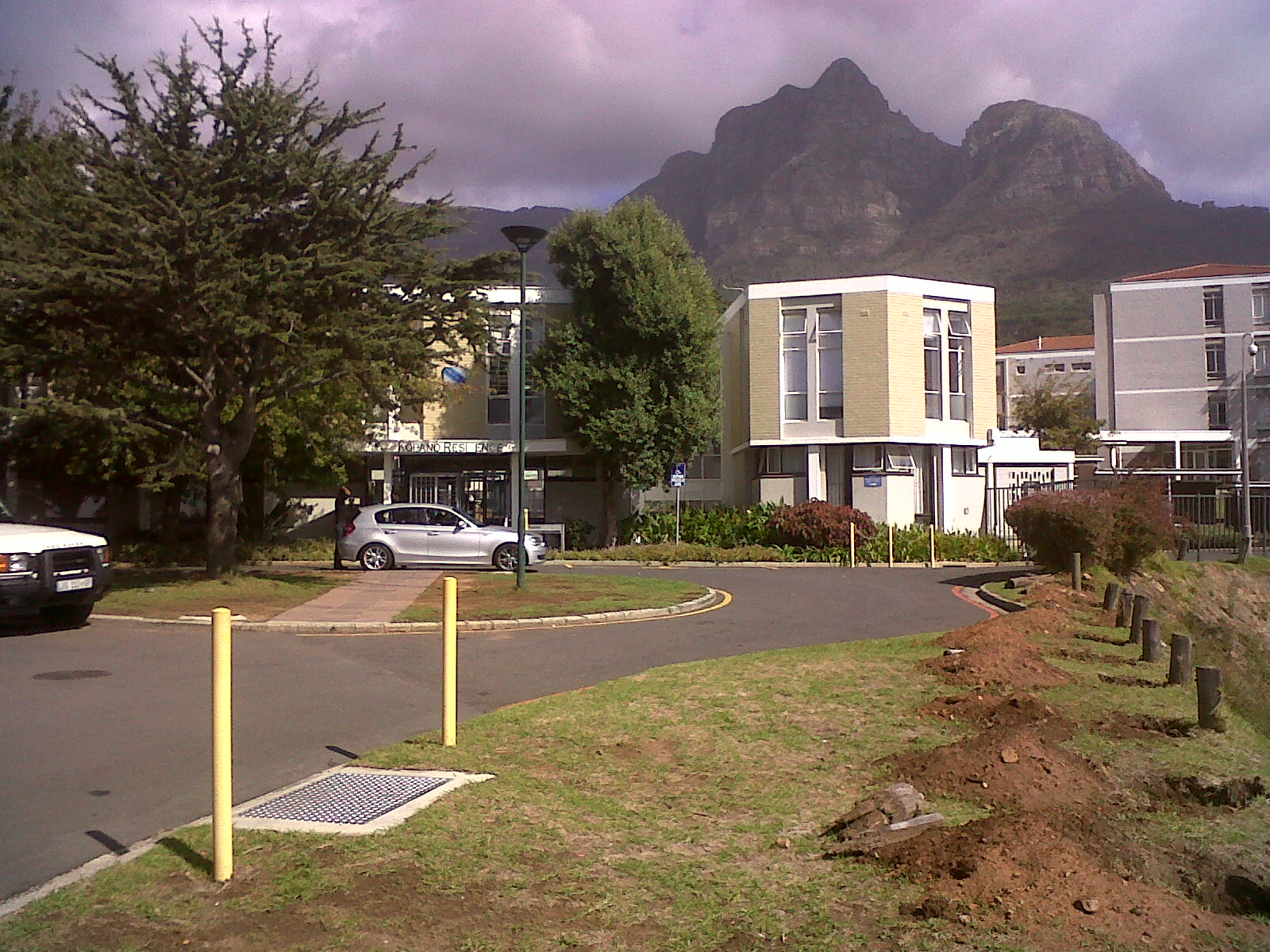
Here’s a picture of the residence, by the way. It’s called Kopano, although when I previously stayed it was called Driekoppen. The old name was a relic of the days of slavery – three slaves were tortured and executedin public  after rebelling against the terrible conditions they were held in. Their heads were displayed on pikes nearby, hence the name which means “Three Heads”. This was in 1724. I’m not surprised that the end of apartheid brought a change in the name, although keeping it as it was would have served as a reminder of South Africa’s terrible past. One shouldn’t  become obsessed by events that took place such a long time ago, but neither should one forget them.

Good Friday was a very Good Friday indeed, starting with a lovely breakfast and a walk on the beach in Muizenberg. Apparently this is something of a surfer’s paradise but, as I said, I didn’t have an internet connection so couldn’t join in. Also, they have sharks here. I mean big ones. Great White ones, as  a matter of fact. None showed up while I was there, though, and in any case I was only paddling along the shoreline. It may not be obvious from the picture, but it was pretty hot. Almost 30 degrees.
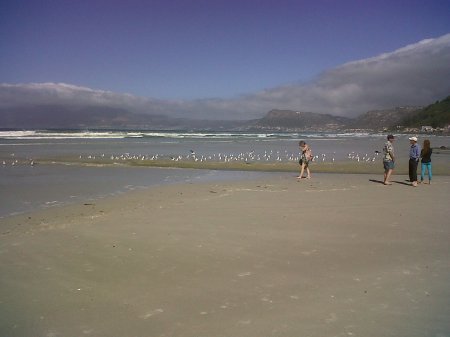
 I was watching a chap surfing while we walked along and it reminded me of the post I did a while ago about teaching analogies. Standing on a beach looking out towards the horizon is a bit like doing cosmology. Off in the far distance everything looks smooth; the waves on the surface are much lower in amplitude than the depth of the sea out there, so everything evolves linearly and is quite easy to understand. That’s like looking back in time at the early Universe imprinted on the cosmic microwave background. Nearer to the shore, however, the waves become non-linear because their height is comparable to, or larger than, the depth of the water. These waves evolve in a non-linear way producing, breaking on the beach to produce foam and spray, just as the primordial waves collapse to form galaxies and the foam of large-scale structure when their self-gravity becomes sufficiently strong.

That’s enough of that, I think.

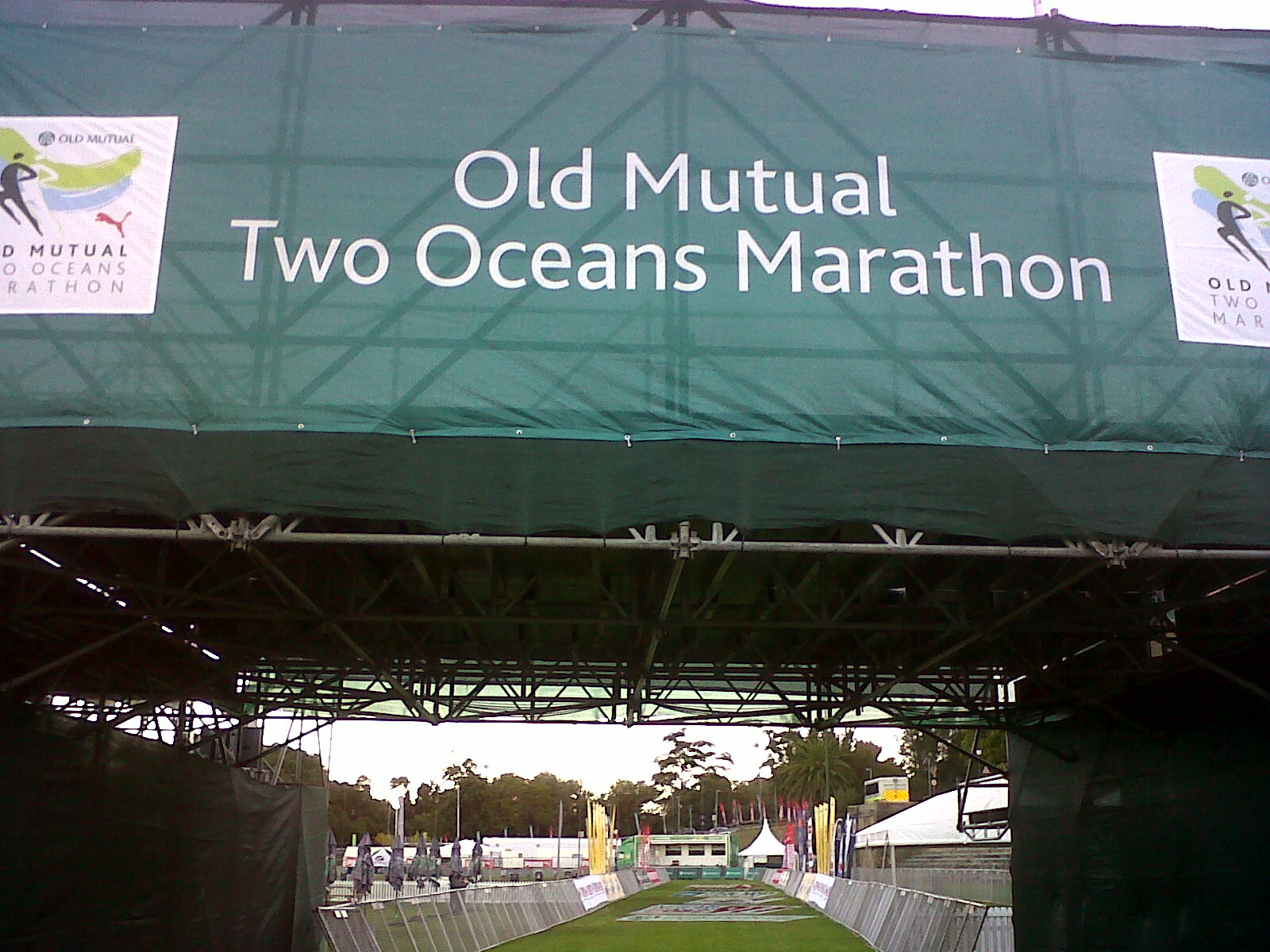
Unfortunately, the weather changed for the worse over the rest of the Easter weekend and torrential rain kept me from doing much on Saturday or Sunday. The finishing section of the  Two Oceans Marathon, which ended on the UCT campus on Saturday, was like a quagmire. As you can see from the picture, I reached the line well in front of the pack. About two days in front, actually. I took this as they were building the stands and hospitality tents a few days before the race.

Anyway, the good side of the bad weather was that I got quite a lot of work done, catching up on things I have let slip for far too long. I also exhausted the reading material I brough with me, so will have to find a good bookshop in the next day or two. Well, that’s about enough for now. I hope to continue regular dispatches from now on until I return to Blighty  next week.

The Long Weekend

Posted in Books, Talks and Reviews, The Universe and Stuff with tags , , , , , on April 5, 2012 by telescoper

It’s getting even warmer in Cape Town as we approach the Easter vacation. The few clouds to be found in the sky over the last couple of days have now disappeared and even the mountain behind the campus has lost its white fluffy hat:

It’s going to be a busy weekend in these parts over the forthcoming weekend. As in the UK, tomorrow (Good Friday) is a national holiday and there will be a 5K fun run around the campus. The temporary stands and marquees you can see in the picture are associated with that. On Saturday there’s a really big event finishing there too – the Two Oceans Marathon – which will finish on the University of Cape Town campus. At the moment it’s 30 degrees, but the forecast is to cool down a bit over the holiday weekend. Good news for the runners, but not I suspect for everyone who’s disappearing off for a weekend at the beach!

Anyway, I did my talk this morning which seemed to go down reasonably well. It was followed by a nice talk by Roberto Trotta from Imperial College in a morning that turned out to be devoted to statistical cosmology. I didn’t get the chance to coordinate with Roberto, but suspected he would focus on in the ins and outs of Bayesian methods (which turned out to be right), so I paved the way with a general talk about the enormous statistical challenges cosmology will face in the era after Planck. The main point I wanted to make – to an audience which mainly comprised theoretical folk  – was that we’ve really been lucky so far in that the nature of the concordance cosmology has enabled us to get away with using relatively simple statistical tools, i.e. the power spectrum.This is because the primordial fluctuations from which galaxies and large-scale structure grew are assumed to be the simplest possible statistical form, i.e. Gaussian.  Searching for physics beyond the standard model, e.g. searching for the  non-Gaussianities which might be key to understanding the physics of the very early stages of the evolution of the Universe,  will be more difficult  by an enormous factor and will require much more sophisticated tools than we’ve needed so far.

Anyway, that’s for the future. Cosmological results from Planck won’t be freely available until next year at the earliest, so I think I can still afford to take the long weekend off  without endangering the “Post-Planck Era” too much!

News from the BOSS

Posted in The Universe and Stuff with tags , , , on April 1, 2012 by telescoper

No April Fool’s from me today I’m afraid!

New results from the Baryon Oscillation Spectroscopic Survey (known to its friends as BOSS) were one of the highlights of the National Astronomy Meeting last week (which I wasn’t at) and they’ve received quite a lot of press attention over the past few days. Rather than repeat what’s been said I thought I’d reblog this lengthy piece, which gives a lot of detail and is also written by an insider!

Rita's avatarwe are all in the gutter

I wrote the following post yesterday, but I fell asleep before I could do anything with it. It’s about the first set of results from the Baryon Oscillation Spectroscopic Survey (BOSS), part of Sloan Digital Sky Survey-III project, which we announced to the science community and to the press yesterday. How this whole project was picked up by the press in a way I hadn’t anticipated is the matter for another post. What really matters is the science, and the science – if you don’t mind my exceedingly biased opinion – is just excellent.

============================

I’m now making my way back home from this year’s National Astronomy Meeting (NAM) 2012 in Manchester. I love NAM. It’s always a chance to see old friends and listen to good science, to catch up on gossip and long-promised pints. This year, I did almost none of these things. The reason is that one…

View original post 2,265 more words

Last Week of Term

Posted in Biographical, Education, The Universe and Stuff with tags , , , , , on March 26, 2012 by telescoper

So the glorious weather continues. Unfortunately, unlike most UK universities, we’re not finished for Easter yet; at Cardiff University we only get three weeks for the Easter recess instead of the four that colleagues over the border seem to enjoy.

One of the consequences of this is that the annual National Astronomy Meeting (NAM) often falls in Cardiff term time. This year NAM is taking place in the fine city of Manchester (which, for those of you unfamiliar with British geography, is in the Midlands). Many colleagues in the School of Physics & Astronomy are attending NAM, and most of my research group are either there already or travelling up today. I particularly wish Jo and Ian well when they give their talks; one of the excellent things about NAM is the opportunity it offers for younger researchers to talk about their work to a large audience. Nerve-wracking, no doubt, but invaluable experience.

I’m not going to NAM this year because I have too much to do back here at the ranch, including filling in a few lectures for staff who are away.  I’m always reluctant to cancel lectures during term-time, but in the current spell of good weather I doubt if any students would complain too much! I did a cosmology lecture this morning – only the second I’ve done here – and it the room was uncomfortably stuffy. A few of the students failed to fall asleep, however, so I regard that as a major success.

It’s strange how often good weather coincides with times of great stress for students. I recall that most of my undergraduate examinations took place in glorious sunshine, which seemed to have been laid on by some malevolent being to make us suffer. This week our students have project reports and presentations to worry about and other coursework to finish before term ends, as well as revision for the exams that take place in May; being couped up inside is no fun on days like this and I’m sure they’d prefer it to be raining outside so as not to distract them from the tasks in hand…

It’s so quiet around here today that it occurred to me now would be a good time to stage a Coup d’Etat. Come to thank of it, there’s a Staff Meeting  been called on Wednesday which may well amount to something pretty similar…

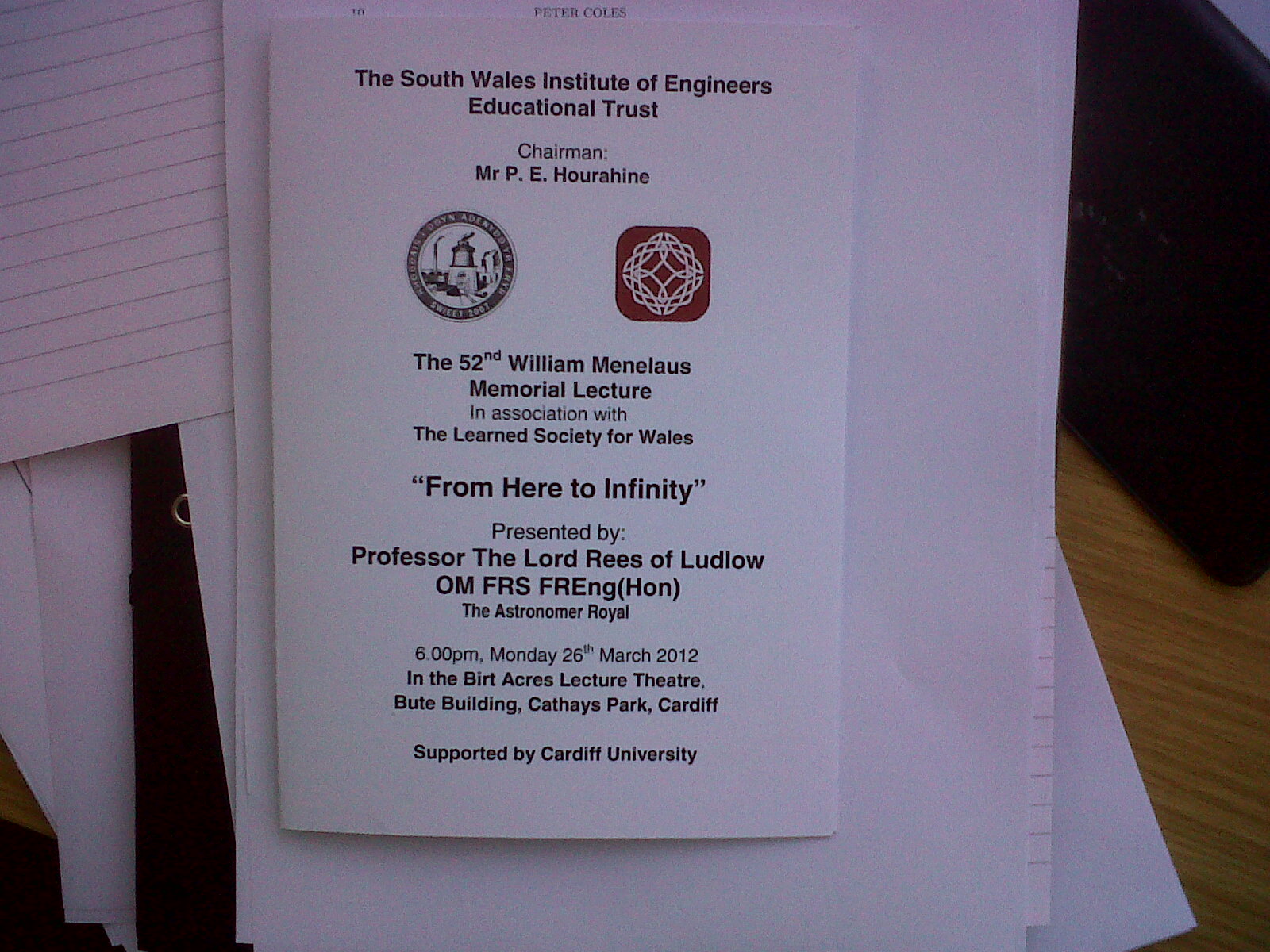
Anyway, those of us around today have a nice event this evening to look forward to, a lecture by Lord Rees followed by a nice dinner in Aberdare Hall. Here’s the invitation:

You’ll see that this is organized “in association with The Learned Society for Wales“, which I only just learned about when I saw it on the invitation!

Anyway, the prospect of a slap-up dinner persuaded me to just have a sandwich for lunch. Now that’s eaten methinks I’ll get back to work!

UPDATE: It was indeed a very interesting and entertaining lecture by Lord Rees; here he is, in action, watched by Prof. Disney…

VISTA on Video

Posted in The Universe and Stuff with tags , , , , , on March 23, 2012 by telescoper

A chance tweet brought to my attention this video that fits well with a news story that’s been doing the rounds for a few days.   This concerns a very deep and wide survey called UltraVISTA, that has been made using the VISTA telescope at the European Southern Observatory’s Paranal Observatory in Chile. You can find the full press release from ESO that started the media interest here, where some lovely images can also be found.

VISTA is the world’s largest infra-red survey telescope, and is unusual among telescopes for having only one instrument on it, an Infra-red camera.  Technically, therefore,  it should really be called ISTA; owing to cost constraints the Visible camera that was initially proposed to accompany the Infra-red one and supply the V in its acronym,  was never built. Anyway, VISTA was designed explicitly to do survey work involving very distant and faint objects; its forte is to allow very deep images to be made with a very wide field of view, as demonstrated on the video…

Since I’m using the handle “telescoper” on this blog, I suppose I really should post about telescopes a bit more often than I do but I hope this will do for now!

B2FH

Posted in The Universe and Stuff with tags , , , , , , , , on March 22, 2012 by telescoper

I spent a pleasant evening yesterday at a public lecture arranged by Cardiff Scientific Society and given by Professor Mike Edmunds, former Head of the School of Physics & Astronomy at Cardiff University and now Emeritus Professor here. The subject of his talk was Origin of the Chemical Elements, a subject Mike has worked on for many years. Here’s the abstract of his talk:

When the Universe was 300,000 years old, the only chemical elements with significant abundance were hydrogen, helium and a small amount of lithium. All the atoms of all the other elements in the Periodic Table have been synthesised during the 13.7 billion years since that time. Research in physics and astronomy over the last 64 years has allowed us to identify the nuclear processes involved, including the importance of the humble neutron in the manufacture of the heavier elements. We now have a good picture of the astronomical sites where elements such as the carbon, nitrogen, oxygen and iron in our bodies were made, including violent supernova explosions. It is a picture that appears almost, but not quite, complete.

That last sentence is tempting fate a bit, but it’s fair comment! The lecture, which I had the pleasure of chairing, was both entertaining and informative, and very warmly received by the large audience in the Reardon Smith Lecture Theatre (in the National Museum of Wales).

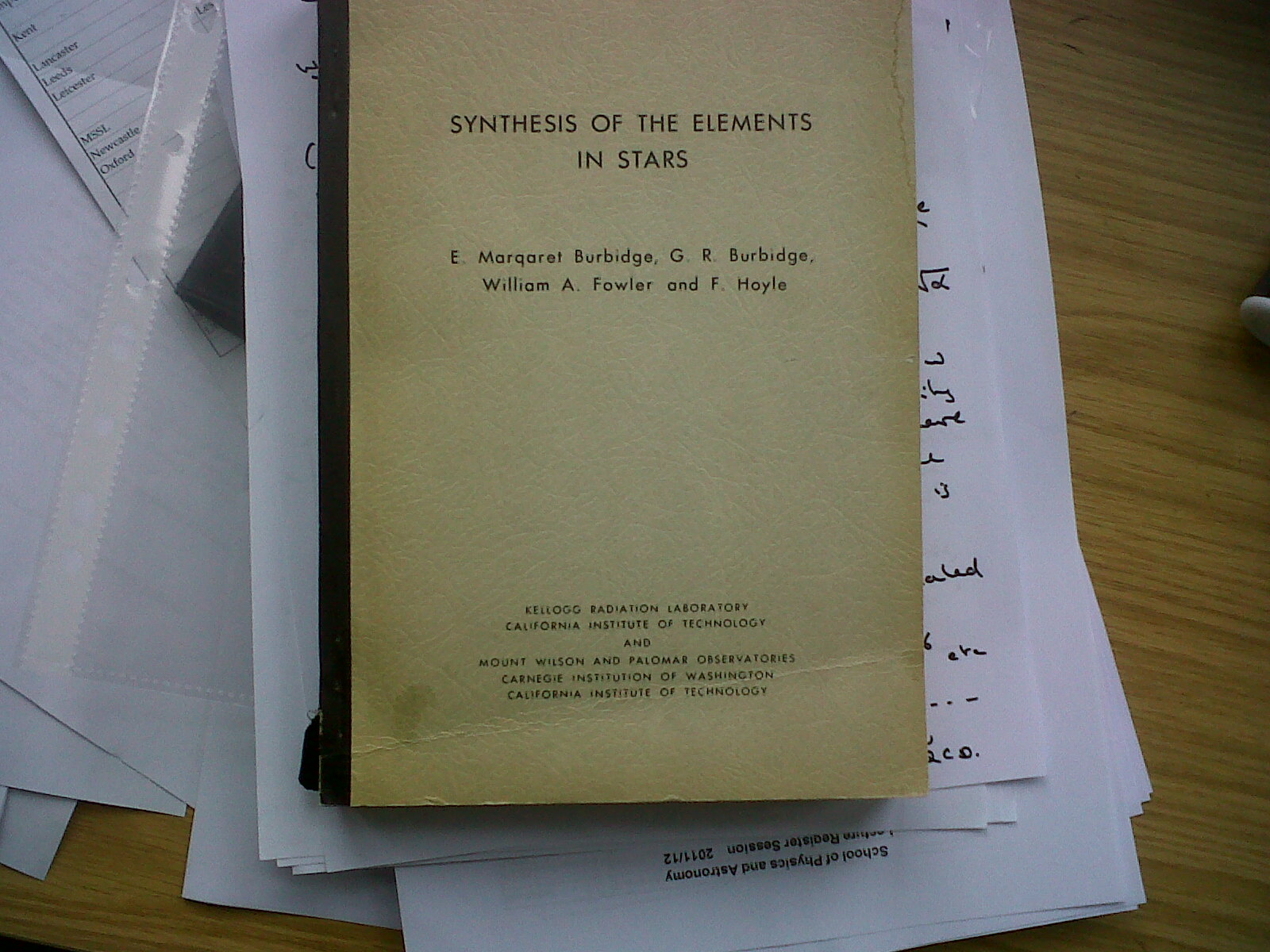
Inevitably in a talk on this subject, the subject came up of the classic work of Burbidge, Burbidge, Fowler and Hoyle in 1957 (a paper usually referred to as B2FH after the initials of its authors). It’s such an important contribution, in fact, that it has its own wikipedia page

This reminded me that one of the interesting astronomical things I’ve acquired over the years is a preprint of the B2FH paper. Younger readers will probably not be aware of preprints – we all used to post them in large numbers to (potentially) interested colleagues before publication to get comments – because in the age of the internet people don’t really bother to make them any more.

Anyway, here’s a snap of it.

It’s a hefty piece of work, and an important piece of astronomical history. In years to come perhaps it may even acquire some financial value. Who knows?

Teaching Physics

Posted in Education, The Universe and Stuff with tags , , on March 22, 2012 by telescoper

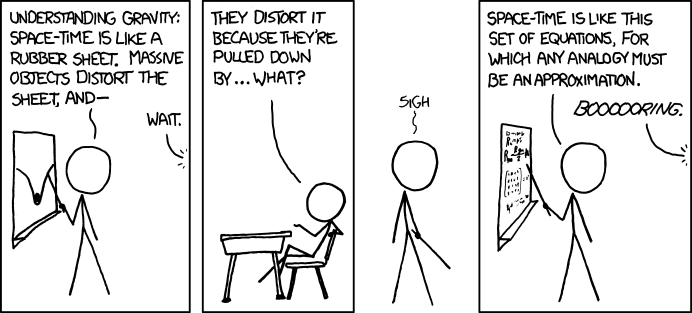
More on this weeks’ theme, from the inestimable xkcd