Archive for the The Universe and Stuff Category

Cosm(et)ology

Posted in The Universe and Stuff with tags , , , , on January 5, 2012 by telescoper

I’ve mentioned before that in some parts of the world, cosmology is likely to be confused with cosmetology. I now think cosmologists are missing a trick, and should in fact be borrowing terms from the world of cosmetics.

I suggested on Twitter that the Dark Energy responsible for making the Universe expand more rapidly should henceforth be known as Volumiser, a term which could also apply to the scalar field that drives cosmic inflation. I do think, however, that it might be better to think of inflation as an anti-wrinkle agent, as it smooths away any primordial irregularities.

Anyway, esteemed Nobel laureate and even more esteemed wine producer Brian Schmidt offered this contribution to show that someone has already had the idea…

I’m sure Quintessence isn’t the only example of physics that’s entirely made up, and no doubt you’ll be offering your own suggestions through the comments box…

The Aurorae

Posted in The Universe and Stuff with tags , on January 1, 2012 by telescoper

I saw this wonderful time-lapse movie of the Aurora Borealis on Bad Astronomy, and couldn’t resist posting it here as a New Year’s gift. If you can watch it full screen at high-definition then you’ll enjoy it even more. And if you’ve never experienced the Aurorae in reality, then put it on your things-I-must-do-before-I-die list immediately!

Hylas and Philonous

Posted in History, The Universe and Stuff with tags , , , , , , , on December 21, 2011 by telescoper

I’ve just finished reading (and writing a review of) a funny little book about quantum mechanics called Quantum Enigma: Physics Encounters Consciousness by Bruce Rosenblum and Fred Kuttner. I won’t repeat the review here for fear of copyright infringement, but I will say that, somewhat to my surprise, I actually liked some of the book although it does go off the rails a bit now and then. Don’t we all, though?

Anyway, one thing did strike me that I didn’t really have time to write about in my piece concerns the philospher George Berkeley (1685-1753). In case you weren’t aware, the town of Berkeley (near San Francisco, in California) is actually named after him.

Berkeley was one of a number of philosophers responsible for the emergence in the 17th and 18th centuries of a movement now known as empiricism. The most striking of Berkeley’s arguments is that matter (or substance) cannot be said to exist in a manner that’s independent of the mind, butHis work has turned out to be nowhere near as durable as some of his contemporaries, notably David Hume,  but he’s actually a much more interesting thinker  than most people seem to give him credit for. Indeed, many writers – including the authors of the book I mentioned above – dismiss his views as a preposterously naive form of solipsism. Although I’m no empiricist myself, I think this Berkeley-bashing is a bit unfair.

I think Berkeley’s ideas are best understood in relation to the others that were being suggested around the time he was writing, particularly René Descartes whose method was to try to understand what could be known with certainty when all possible scepticism was argued away. In Berkeley’s most important work The Dialogues of Hylas and Philonous (1710)  he developed this approach into an argument that only ideas, perceived and created by the mind, could be known with any certainty, doing so through a dialogue between two characters. Hylas represents the view of “normal” scientific common sense (as one imagines would be exemplified by, say, Isaac Newton); Philonous represents Berkeley’s own views.

Time and time again Philonous comes up with ingenious counters to the “obvious” arguments presented by Hylas. Our understanding of what we consider to be actually existing objects to which we attribute certain qualities (such as white clouds or hot water) is essentially a mental affair. Sensations such as taste and pain have no basis in existence outside the mind, but what about trickier concepts like colour? Can it be said that when  an object looks red that it must contain in itself the quality of redness? Berkeley says no, because “red” is merely a category and cannot therefore exist in the colour. Of course we now know a lot more about how colour comes about than Berkeley did, but it remains an interesting point.

He suggested quite generally that impressions we get from our senses are not necessarily based on an innate qualities of the objects or substances with which our senses come into contact. For example, our sense of distance is not caused by the actual distance between objects themselves.

I have to re-iterate that I’m not an empiricist and I don’t agree with Berkeley’s position, just that his position is a great deal subtler and more interesting than usually represented. I mis-spent a large part of my youth struggling with  impenetrable works of philsophy, but Hylas and Philonous is one I definitely don’t regret reading. Not quite up to the standard of David Hume, mind you, but who is?

So give George Berkeley a break! Karl Popper, on the other hand…

The Geordie Particle

Posted in The Universe and Stuff with tags , , , , on December 20, 2011 by telescoper

As the media frenzy abates after the latest experimental results from the Large Hadron Collider show tantalising but inconclusive evidence for the existence of the Higgs boson, it’s perhaps now time to focus on the hard facts surrounding this elusive particle. At yesterday’s Christmas lunch I stumbled upon one piece of information of which I was previously unaware and which is clearly of national importance. The eponymous creator of the Higgs particle, Professor Peter Higgs, was in fact born in the fine city of Newcastle upon Tyne, which really is in The North. This fact identifies him as a Geordie, although having just heard him on the radio I think there’s not much sign of it in his accent.

Anyway, in honour of this important discovery I respectfully submit that  The Large Hadron Collider should be given a more appropriate name,  i.e. The Geet Big Hadron Basher. And I’m sure God won’t mind if the Higg’s boson is henceforth known as the Geordie Particle.

The Day After…

Posted in The Universe and Stuff with tags , , , on December 14, 2011 by telescoper

Yesterday was a memorable day for more reasons than the outbreak of Higgs-teria I blogged about. The main event was in fact the PhD examination of my student Jo Short. Being the supervisor, I didn’t actually attend the examination in person but did get to have lunch with the Chair and other examiners, including external examiner Andrew Jaffe from Imperial College, who blogs at Leaves on the Line.

After lunch the Examiners, Chair and candidate disappeared into the special room we keep for such occasions (complete with thumbscrews, etc) and I went back to my office to wait it out while Jo was grilled. I always feel a bit protective towards my PhD students, and a viva voce examination always brings back painful memories of the similar ordeal I went through twenty-odd years ago. Although I had every confidence in Jo, I was a bit nervous sitting in my office wondering how it was going. However, this is something a PhD candidate has to go through on their own, a sort of rite of passage during which the supervisor has to stand aside and let them stand up for their own work.

About 90 minutes after the viva started I remembered that I had to pick up some medication from a chemist, so braved the inclement weather to do that.  Yesterday, incidentally, threw an extraordinary range of weather at us: hail, thunder, gales and dark apocalyptic clouds. When I returned the examination was already over; Jo passed with minimal corrections to be made. My nerves clearly weren’t justified. Congratulations Dr Short!

Caught on the hop by the fact that the viva finished in just over 2 hours, I then had to mobilize the obligatory champagne which was chilling in a fridge belonging to the Astronomy Instrumentation Group. Worse, a team of PhD students which had been dispatched to buy celebratory gifts hadn’t returned with the goodies by the time we opened the bubbly. Nevertheless, an appropriate celebration was eventually held in the department, followed – so I’m told – by an evening of revelry in the town. I didn’t go to the latter, as I’m far too old for that sort of thing.

By the way, Jo’s thesis is partly about the analysis of the pattern of temperature variations in the cosmic microwave background and partly about modelling galaxy clustering revealed by the Herschel Space Observatory and she’s staying on at Cardiff on a research fellowship.

P.S. Our genial external was last seen getting into a taxi to get to the station and thence back to London. I assume he got home safely…

P.P.S. For the sake of complete disclosure I should admit that I wrote this blog post while chairing another viva…

Higgs-mania Day

Posted in Science Politics, The Universe and Stuff with tags , , , , , on December 13, 2011 by telescoper

I woke up this morning to the BBC Radio News at 7am announcing that scientists at CERN were going to report “hints” of the discovery of the Higgs Boson at the Large Hadron Collider;  you can find a longer discussion by the BBC here. This was later accompanied by articles tackling the important questions of the day such as whether the discovery of the Higgs would justify the enormous expense of Brian Cox the LHC.

Prize for the most  inaccurate science report goes to  the Daily Fail:

‘God’ particle found:

Atom smasher reveals Higgs boson, the key to the universe

Evidence soon emerged however that this particular squib might be of the damp variety. Consistent with previous blogospheric pronouncements, a paper on the arXiv this morning suggested no convincing detection of the Higgs had actually been made by the ATLAS experiment.

I then had to make an important choice between watching the live webcast of the CERN seminar at which detailed information on the Higgs searches was to be presented or to accept a free lunch with the examiners of a PhD candidate. I chose the latter.

Catching up on events after lunch confirmed the underwhelming nature of the Higgs “detection”, but with some intriguing evidence an excess signal at around 126 GeV at the 2.3 sigma level, in the frequentist parlance favoured by particle physicists and others who don’t know how to do statistics properly. In the words of the late John Bahcall:  “half of all three-sigma detections are false“. Of course if they used proper Bayesian language, scientists wouldn’t make so many nonsensical statements. Personally, I just don’t do sigmas.

My attention then switched to the CMS experiment. As a point of information you should be aware that CMS stands for Compact Muon Solenoid, where “compact” is a word used by particle physicists to mean “fucking enormous”. CMS makes  pictures like this:
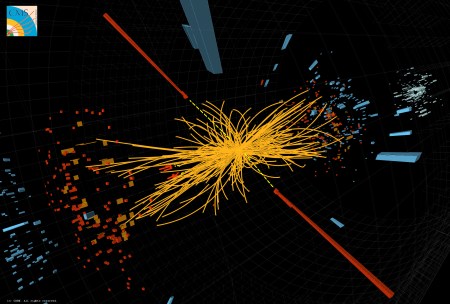
Anyway, it seems from the CMS part of the presentation that they find a bit of a peak at a similar mass ~ 125 GeV but spread out over a larger range, this time at a level of – sigh – 2.6 sigma.

All in all, it’s a definite maybe. Putting the results together in the way only a frequentist can the result is a 2.4 sigma detection. In other words,  nothing any serious scientist would call convincing.

It’s interesting how certain these particle physicists are that the Higgs actually exists. It might, of course, and I think these results may be pointing the way to more convincing evidence based on more data. However,  I still think we should bear in mind the words of Alfred North Whitehead:

There is no more common error than to assume that, because prolonged and accurate mathematical calculations have been made, the application of the result to some fact of nature is absolutely certain.

If there is a Higgs boson with a mass of 125 GeV then that would of course be an exciting discovery, but if there isn’t one at all wouldn’t that be even more exciting?

Final word from the Director of CERN:

We have not found it yet, we have not excluded it yet, stay tuned for next year.

Thunder and hail descended on Cardiff just as the webcast finished, which is clearly not a coincidence although I couldn’t say how many sigmas were involved.

And a final, final word from the Chief Executive of the Science & Technology Facilities Council, John Womersley:

There is still some way to go before the existence of the Higgs boson can be confirmed or not, but excitement is mounting. UK physicists and engineers have played a significant role in securing today’s results, and will continue to be at the forefront of exploring the new frontiers of knowledge opened by the results coming from the LHC. This is an incredibly exciting time to be involved in physics!

Brian Cox is 43.

Planck Publications

Posted in Science Politics, The Universe and Stuff with tags , , , , on December 2, 2011 by telescoper

I just noticed that a Special Issue of Astronomy and Astrophysics which contains the early science papers from Planck has now finally appeared, swelling a considerable number of personal bibliographies just in time for the next round of grant and/or job applications!

The thing is, though, that these papers were all placed on the arXiv in January 2011, so it has taken almost 11 months for them to get officially published. Such a delay seems ridiculous to me in this digital age.  I wonder why it took A&A  so long to publish these papers? Were they all held up by refereeing delays? Are the final published versions significantly different from the arXiv version? I’ve only looked at a few, and can’t see any major changes.

Or maybe this is all normal for A&A?

If you know, please tell…

Of course the main science results from Planck won’t be out until 2013. I wonder how long they’ll take to referee?

Necrodelic Reverie

Posted in Art, The Universe and Stuff with tags , , , on November 25, 2011 by telescoper

Among the delights of having a blog are the friendly emails you get from complete strangers. I got one last week from an artist, who is quite new to me, called Tobias Collier, concerning an old post of mine about randomness. Looking at his website I can see why he was interested in that particular topic, and also found so many things  of interest myself that I decided to do a small showcase here.

According to one of the reviews on his website:

Tobias Collier’s work can be seen as an attempt to visually articulate a great epistemological challenge: that of the human mind encountering the intellectually imponderable. Encompassing elements of sculpture, installation, drawing, performance and video, Tobias Collier’s practice partly relies upon the translation of scientific research methodologies to the processes of art making. Using Art as their field of enquiry, the subsequent works function as mechanisms within the context of a research practice and present a unique combination of scientific processes with poetic artistry.

Playing with current ideas around Astronomy and Cosmology, Tobias Collier’s quotidian metaphors examine our cultural relationship to outer space, using objects of daily existence. They highlight the limitations and inadequacy of man-made processes such as logic (modelling, hypothesizing, inferring and inducing), analogies and metaphors when attempting to comprehend systems and structures that extend beyond our everyday experience.

You can find a host of fascinating things on his website, including sculptures that manage to be both whimsical and profound:

Predicting Random Events, 2011

My favourite pieces, however, admittedly based only on what I have viewed on the website, are the stunning “inductive dot”  drawings, done in ink on paper, and described in the following passage:

The revelation of science that our universe, governed by the second law of thermodynamics, is ultimately fated to a cold quiet ‘heat death’, becomes an unavoidable issue for the work of London based artist Tobias Collier. His response is to propose the pursuit of necrodelic reverie. Small, yet hugely ornate, pointillist drawings are produced as a result of hours of ritualised practice. Like moments in an ongoing process, or records of a timeless activity, the end results are un-human, naturalised, nebulous star-fields or perhaps cloudscapes. In his sculpture references to collapsing or eroded structures, chemical reactions and combustions abound. Conscious cosmic thought entropically linked to the arrow of time, reconciled to universal destiny.

Here’s an example

Necrodelic Reverie, 2010

And this one, reminiscent of cloud formations in a planetary atmosphere:

Untitled, 2010

I find it fascinating that so many contemporary artists take their inspiration, and sometimes their techniques, from the sciences but so few scientists take a reciprocal interest in contemporary art. Anyway, I hope at least a few readers of this blog will now go and have a look at the work of Tobias Collier!


Yet another cute physics problem

Posted in Cute Problems, The Universe and Stuff with tags , , on November 22, 2011 by telescoper

I’ve spent all day either teaching or writing draft grant applications and am consequently a bit knackered, so in lieu of one of my usual rambling dissertations here is another example from the file marked Cute Physics Problems, this time from thermodynamics. It’s quite straightforward. Or is it? Most people I’ve asked this question in private have got it wrong, so let’s see if the blogosphere is smarter:

Three identical bodies of constant  heat capacity are at temperatures of 300, 300 and 100 K. If no work is done on the system and no heat transferred to it from outside, what is the highest temperature to which any one of the bodies can be raised by the operation of heat engine(s)?

Are Quantum States “Real”?

Posted in The Universe and Stuff with tags , , on November 20, 2011 by telescoper

Busy day today, despite it being a Sunday, so I’ve only got time for a quick post, by way of a diversion while I take a break for a cup of tea.

There’s been an attack of the hyperbolics this week arising from a paper entitled “The quantum state cannot be interpreted statistically”.  The abstract of the paper reads:

Quantum states are the key mathematical objects in quantum theory. It is therefore surprising that physicists have been unable to agree on what a quantum state represents. There are at least two opposing schools of thought, each almost as old as quantum theory itself. One is that a pure state is a physical property of system, much like position and momentum in classical mechanics. Another is that even a pure state has only a statistical significance, akin to a probability distribution in statistical mechanics. Here we show that, given only very mild assumptions, the statistical interpretation of the quantum state is inconsistent with the predictions of quantum theory. This result holds even in the presence of small amounts of experimental noise, and is therefore amenable to experimental test using present or near-future technology. If the predictions of quantum theory are confirmed, such a test would show that distinct quantum states must correspond to physically distinct states of reality.

According to a commentary published in the journal Nature, this paper could “rock quantum theory to the core” and a number of quantum physicists have reacted, e.g.:

“I don’t like to sound hyperbolic, but I think the word ‘seismic’ is likely to apply to this paper,” says Antony Valentini, a theoretical physicist specializing in quantum foundations at Clemson University in South Carolina.

I have to admit I haven’t had time to read the paper in detail yet, so I’m just passing this on as something fresh that may be of wider interest, rather than something I’ve got particularly strong views about. I have to admit, though, that I find the way quantum theorists use words, especially what is meant by “physically real” and what “states of reality” could be. Can a mathematical theorem ever prove itself to be applicable to the physical world anyway? You’ll see that ontology was never my strong suit.

However, if anyone out there in blogland has read this paper and would like to pass on their thoughts for the edification of me and my readers I’d be delighted. I might return to it in a longer post if and when I’ve been able to digest it fully.

Now, back to reality…