Oooh….somebody’s written me a letter via a blog!
Follow @telescoper
A nice blog on the evidence (such as it is) for water on Mars, which is good because it means I don’t have to try writing about it!
I’m not sure it is water. That dark colour suggests to me it might be Guinness…
Looking around for a hot cosmological topic for a brief diversionary post, I came across a news item on the BBC website entitled ‘Multiverse theory suggested by microwave background‘. I’ll refer you to the item itself for a general description of the study and to the actual paper (by Feeney et al.), which has been accepted for publication in Physical Review D, for technical details.
I will, however, flagrantly steal Auntie Beeb’s nice picture which shows the location on the sky of a number of allegedly anomalous features; they being the coloured blobs that look like Smarties in the bottom right. The greyed out bits of the map are areas of the sky masked out to avoid contamination from our own Galaxy or various other foreground sources.

One possible explanation of the Smarties from Outer Space is furnished by a variant of the theory known as chaotic inflation in which the universe comprises a collection of mini-universes which nucleate and expand rather like bubbles in a glass of champagne. Assuming this “multiverse” picture is correct – a very big “if”, in my opinion – it is just possible that two bubbles might collide just after nucleation leaving a sort of dent in space that we see in the microwave background.
It’s a speculative idea, of course, but there’s nothing wrong with such things. Everything starts off with speculation, really. I’ve actually read the paper, and I think it’s an excellent piece of work. I can’t resist commenting, however, that there’s a considerable gap between the conclusions of the study and the title of the BBC article, either the present `Multiverse theory suggested by microwave background’ or the original one `Study hints at bubble universes’.
My point is that the authors concede that they do not find any statistically significant evidence for the bubble collision interpretation, i.e. this is essentially a null result. I’m not sure how “study fails to find evidence for..” turned into “study hints at…”.
Nonetheless, it’s an interesting paper and there’s certainly a possibility that better, cleaner and less noisy data may find evidence where WMAP couldn’t. Yet another reason to look forward to future data from Planck!
Follow @telescoperMy (probably ill-informed) earlier post about particle physics seems to have generated quite a lot of traffic, so I thought I’d reblog this short article (by a real particle physicist) for the benefit of those people who want to find out about the latest results from someone who actually knows what they’re talking about.
There’s been a big conference on High Energy Physics going on in Grenoble since last Thursday, which I’ve been following a little bit via Tweets from various participants and links to blog articles contained therein. The media seem to be almost exclusively focussed on the Higgs boson but, as is made clear in a Guardian blog article by John Butterworth, the situation is that the latest data from the Large Hadron Collider do not provide clear evidence for it yet. Strangely, though, the Guardian ran another piece at the weekend claiming that “CERN scientists suspect a glimpse of the Higgs”, which appears to have been based on a blog article which offers various possible interpretations of a set of measurements which lie at the margin of statistical significance. It must be very frustrating not having a clear detection, but this strikes me as clutching at straws. Far better to wait for more data before speculating in public. Nobody really expected to see the Higgs so soon, so it’s surely better to wait for more data rather than over-interpreting what’s there. Let’s put it down to overenthusiasm.
However the real point of the latest news is not in my view the lack of, or marginal nature of, evidence for the Higgs Boson. It’s the extremely strong limits that have been placed on supersymmetry. This is of particular (geddit?) interest to me as a cosmologist because supersymmetric theories provide us with plausible candidates for the non-baryonic dark matter we think pervades the Universe. The possibilities include fermionic counterparts of the bosons that mediate the standard model interactions. The photon, for example, which is a boson, mediates the electromagnetic interaction between charged particles; in SUSY theories it would have a fermionic partner called a photino. There would also be the Higgsino (assuming there is a Higgs!), gluino, gravitino and so on. Supersymmetry is a beautiful idea and many theorists love it to bits, but there isn’t a shred of evidence that has anything to do with the way nature is.
The search for supersymmetry is thus more directly relevant to my work than the Higgs, in fact, but the Large Hadron Collider was largely “sold” to politicians and the public in terms of the quest for the Higgs. That’s the MacGuffin, as Alfred Hitchcock would have said. Actually the LHC will do many other things, but I guess it’s easier to make the case for funding to government if you have one Big Idea rather than lots of smaller ones.
Anyway, a piece from New Scientist today hits the nail on the head. While the Higgs search may or may not be producing tantalising clues, the searches for supersymmetry has drawn a complete blank. Zilch. Nada. Not the merest smidgeon of a scintilla. The class of supersymmetric theories is broad and no doubt many possibilities remain viable; the current measurements only rule out the “minimal” variety. But I think this is a timely reminder not to take nature for granted. Perhaps an ugly fact is about to slay a beautiful hypothesis…
UPDATE: Bookmaker Paddy Power has shortened the odds on a Higgs discovery this year from 12-1 against to 3-1 on.
Follow @telescoperJust time for a quickie this morning, prompted by the appearance of our own Professor Matt Griffin on the Today programme on BBC Radio 4 earlier on talking about newly published results from the Herschel Space Observatory. I didn’t hear it live as I’m strictly a Radio 3 person, but it must have made a pleasant change from stories about the imminent collapse of the euro and continuing extraordinay revelations about widespread corruption involving the British media, police force and political establishment. Among all this doom and gloom it’s nice to hear news of something that’s actually successful.
Anyway, the news from Herschel is that it has unveiled a ring structure in the centre of our Milky Way galaxy. The ribbon of gas and dust is more than 600 light years across and appears to be twisted, for reasons which have yet to be explained. The origin of the ring could yield important clues about the history of the Milky Way.
Warmer gas and dust from the Centre of our Galaxy is shown in blue in the image below, while the colder material appears red. The ring, in yellow, is made of gas and dust at a temperature of just 15 degrees above absolute zero. The bright regions are denser, and include some of the most massive and active sites of star formation in our Galaxy.

and here it is with the curious ring drawn on with crayons:

The central region of our Galaxy is dominated by an elongated structure, rather like a bar, which stirs up the material in the outer galaxy as it rotates over millions of years and is probably connected with the spiral structure seen in the disk of the Milky Way. The ring seen by Herschel lies right in the middle of this bar, encircling the region which harbours a super-massive black hole at the centre of our galaxy. The ring of gas is twisted, so we see two loops which appear to meet in the middle. These are seen in yellow in the image above, tilted slightly such that they run from top-left to bottom-right. Secondly, it seems to be slightly offset from the very centre of our Galaxy. The reason for the ring’s twist and offset are unknown, but understanding their origin may help explain the origin of the ring itself. Computer simulations indicate that bars and rings such as those we see in the centre of our Galaxy can be formed by gravitational interactions, either within the Milky Way itself or between it and the nearby Andromeda galaxy, M31.
For the experts, and others interested, the scientific paper containing these results can be found here.
Follow @telescoperNot long ago I posted an item about the exciting discovery of a quasar at redshift 7.085. I thought I’d return briefly to that topic in order (a) to draw your attention to a nice guest post by Daniel Mortlock on Andrew Jaffe’s blog giving more background to the discovery, and (b) to say something about the theoretical interpretation of the results.
The reason for turning the second theme is to explain a little bit about what difficulties this observation might pose for the standard “Big Bang” cosmological model. Our general understanding of galaxies form is that gravity gathers cold non-baryonic matter into clumps into which “ordinary” baryonic material subsequently falls, eventually forming a luminous galaxy forms surrounded by a “halo” of (invisible) dark matter. Quasars are galaxies in which enough baryonic matter has collected in the centre of the halo to build a supermassive black hole, which powers a short-lived phase of extremely high luminosity.
The key idea behind this picture is that the haloes form by hierarchical clustering: the first to form are small but merge rapidly into objects of increasing mass as time goes on. We have a fairly well-established theory of what happens with these haloes – called the Press-Schechter formalism – which allows us to calculate the number-density 


Anyway, courtesy of my estimable PhD student Jo Short, this is how the mass function of haloes is predicted to evolve in the standard cosmological model (the different lines show the distribution as a function of redshift for redshifts from 0 to 9):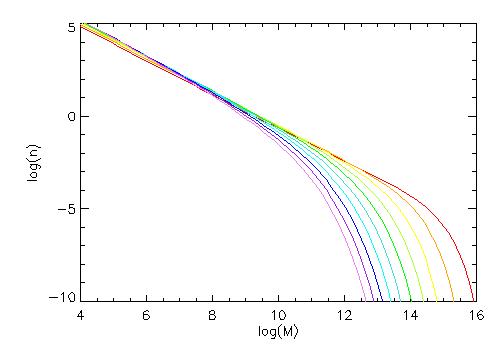
It might be easier to see what’s going on looking instead at this figure which shows 


You can see that the typical size of a halo increases with decreasing redshift, but it’s only at really high masses where you see a really dramatic effect.
The mass of the black hole responsible for the recently-detected high-redshift quasar is estimated to be about 
This question is very difficult to answer, as it depends on how luminous the quasar is, how long it lives, what fraction of the baryons in the halo fall into the centre, what efficiency is involved in generating the quasar luminosity, etc. Efstathiou and Rees argued that to power a quasar with luminosity of order 


The abundance of such haloes is down by quite a factor at redshift 7 compared to redshift 0 (the present epoch), but the fall-off is even more precipitous for haloes of larger mass than this. We really need to know how abundant such objects are before drawing definitive conclusions, and one object isn’t enough to put a reliable estimate on the general abundance, but with the discovery of this object it’s certainly getting interesting. Haloes the size of a galaxy cluster, i.e. 
Another thing worth mentioning is that, although there might be a sufficient number of potential haloes to serve as hosts for a quasar, there remains the difficult issue of understanding how precisely the black hole forms and especially how long that takes. This aspect of the process of quasar formation is much more complicated than the halo distribution, so it’s probably on detailed models of black-hole growth that this discovery will have the greatest impact in the short term.
Follow @telescoperSome of you might think this is just ridiculous hype, but I couldn’t possibly comment…
via viXra log
Well up above the tropostrata
There is a region stark and stellar
Where, on a streak of anti-matter
Lived Dr. Edward Anti-Teller.
Remote from Fusion’s origin,
He lived unguessed and unawares
With all his antikith and kin,
And kept macassars on his chairs.
One morning, idling by the sea,
He spied a tin of monstrous girth
That bore three letters: A. E. C.
Out stepped a visitor from Earth.
Then, shouting gladly o’er the sands,
Met two who in their alien ways
Were like as lentils. Their right hands
Clasped, and the rest was gamma rays.
by Prof. Harold P. Furth (1930-2002)
Follow @telescoperLast week I found myself a bit perplexed by the frenzy of twitter angst surrounding the last ever launch of the Space Shuttle. It’s not the first time something like this has happened. I’ve often felt like there must be something wrong with me for not getting agitated over such things. After Altantis returns to Earth in a couple of weeks’ time she will be taken out of service and, for the foreseeable future, America will no longer have the ability to put humans into orbit. This does mark the end of an era, of course, but is it really something to get all upset about?
I find myself agreeing with the Guardian editorial, which I’ve taken the liberty of copying here:
Fewer than 600 people have been admitted an exclusive club: space travel. Now, with the last flight of the space shuttle under way, the membership list is harder to join than ever. When Yuri Gagarin orbited the earth, half a century ago, and when astronauts landed on the moon eight years later, it would have been inconceivable to think of a time when manned space flight began to slip from the present to the past. But America, at least for the moment, no longer has the capacity to send people into space. In terms of national pride, this may be a failure. In terms of scientific advancement, it may not matter that much at all. Deep space exploration – using robot probes – is a very different and more useful thing than the expensive and unreliable effort to send human beings into low earth orbit, no further from Cape Canaveral than New York. The shuttle has been an icon of its age, but its human passengers – however brave and skilled – have made their flights as much to show the world what America could do as for any particular and necessary purpose. Even the International Space Station, extraordinary though it is, could operate without a human presence, its experiments automated. The only good argument for sending people into space is the simple daring of it – the need, as Star Trek used to claim, “to boldly go where no man has gone before”. Visit Mars, by all means – but there is little to be gained by sending astronauts to orbit this planet, not all that far above our heads.
For me, the most remarkable thing about the Space Shuttle is how matter-of-fact it has become. It’s rather like Concorde, which was an engineering marvel that people would drop everything and gawp at when it first appeared, but which soon became a part of everyday life. Technology is inevitably like that – what seemed remarkable twenty years ago is now pretty commonplace.
I had similar feelings a couple of years ago, when Planck and Herschel were launched. Of course I was extremely nervous then , because many of my colleagues had invested so much time and effort in these missions. However, watching the behaviour of the mission control staff at ESA during the launch it struck me how routine it all was for them. It’s a great achievement, I think, to take something so complex and turn it into an everyday operation.
Incidentally, it always strikes me as curious that people use the phrase “rocket science” to define something incredibly difficult. In fact rocket science is extremely simple: the energy source is one of the simplest chemical reactions possible, and the path of the rocket is a straightforward consequence of Newton’s laws of motion. It’s turning this simple science into working technology where the difficulties lie, and it’s a powerful testament to the brilliance of the engineers working in the space programme that workable solutions have been found and implemented in working systems.
So now the era of the Shuttle has passed, what next? Should America (and Europe, for that matter) be aiming to send people to Mars? Should manned spaceflight resume at all?
Different people will answer these questions in different ways. Speaking purely from a scientific point of view I would say that manned space exploration just isn’t cost effective. But going to Mars isn’t really about science; going to the Moon wasn’t either. It’s partly an issue of national pride – note how loss of the Shuttle programme has effectively ended America’s dominance in space, and how keenly that has been felt by many US commentators.
Others argue that manned space flight inspires people to become scientists, and should be done for that reason. I can’t speak for anyone but myself, and I’m sure there will be many who disagree with me, but it wasn’t the Apollo missions that inspired me to become a scientist. When I was a kid I found the footage of people jumping around on the Moon rather boring, to be honest. What inspired me was the excellent science education I received at School. And just think how many physics teachers you could train for the cost of, e.g. the ESA Aurora program…
Another argument is “because it’s there” or, as Walt Whitman put it,
| THE untold want, by life and land ne’er granted, | |
| Now, Voyager, sail thou forth, to seek and find. |
As a species we have an urge to set challenges for ourselves, whether by asking difficult questions, by designing and building difficult devices, or by attempting difficult journeys – sometimes all three! This is our nature and we shouldn’t shy away from it. But we should also recognize that “going there” is just one of the ways in which we can explore the cosmos. Modern telescopes can see almost to the visible edge of the Universe, the Large Hadron Collider can probe scales much smaller than the nucleus of an atom. I worry sometimes that the political lobbying for manned space flight often seems to be arguing that it should be funded by taking money from other, more fundamental, scientific investigations. Astronomers and particle physcisists are explorers too, and they also inspire. Don’t they?
Follow @telescoper


 In the Dark