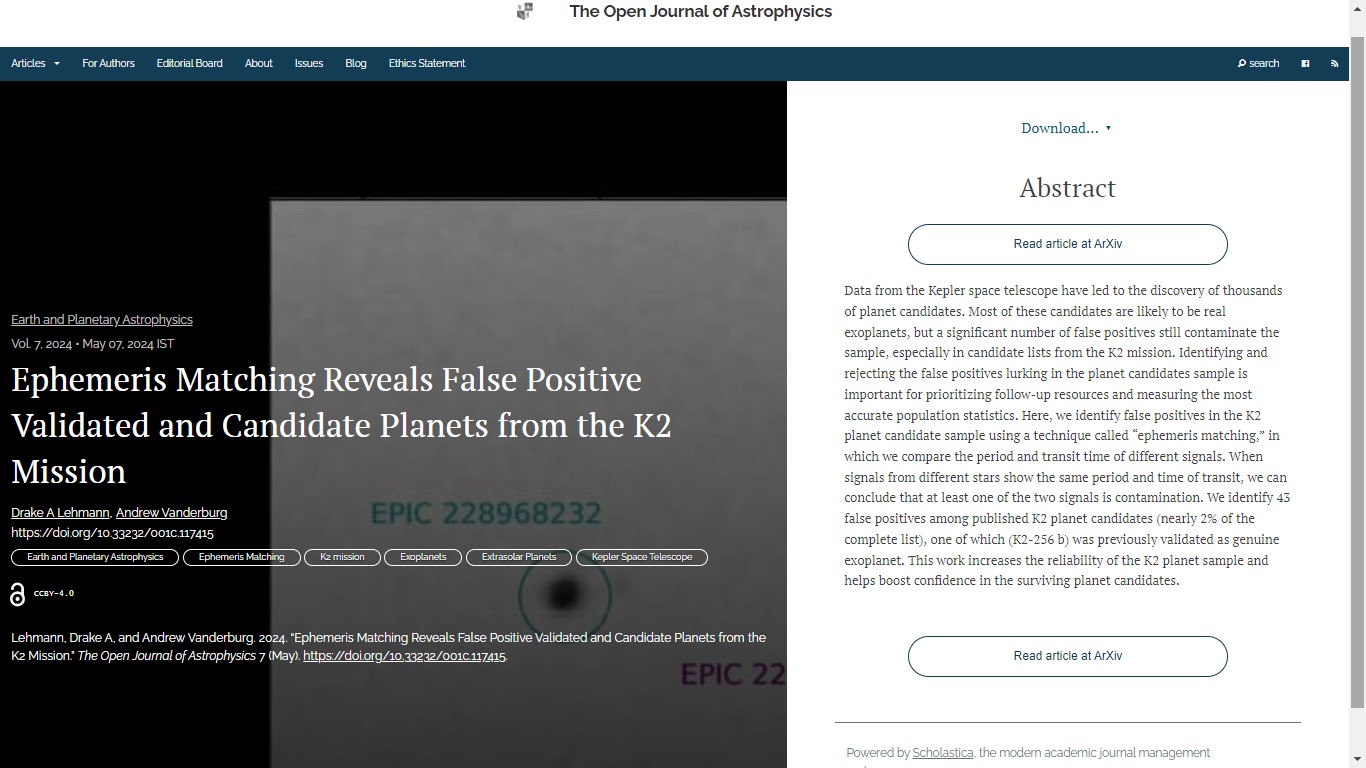
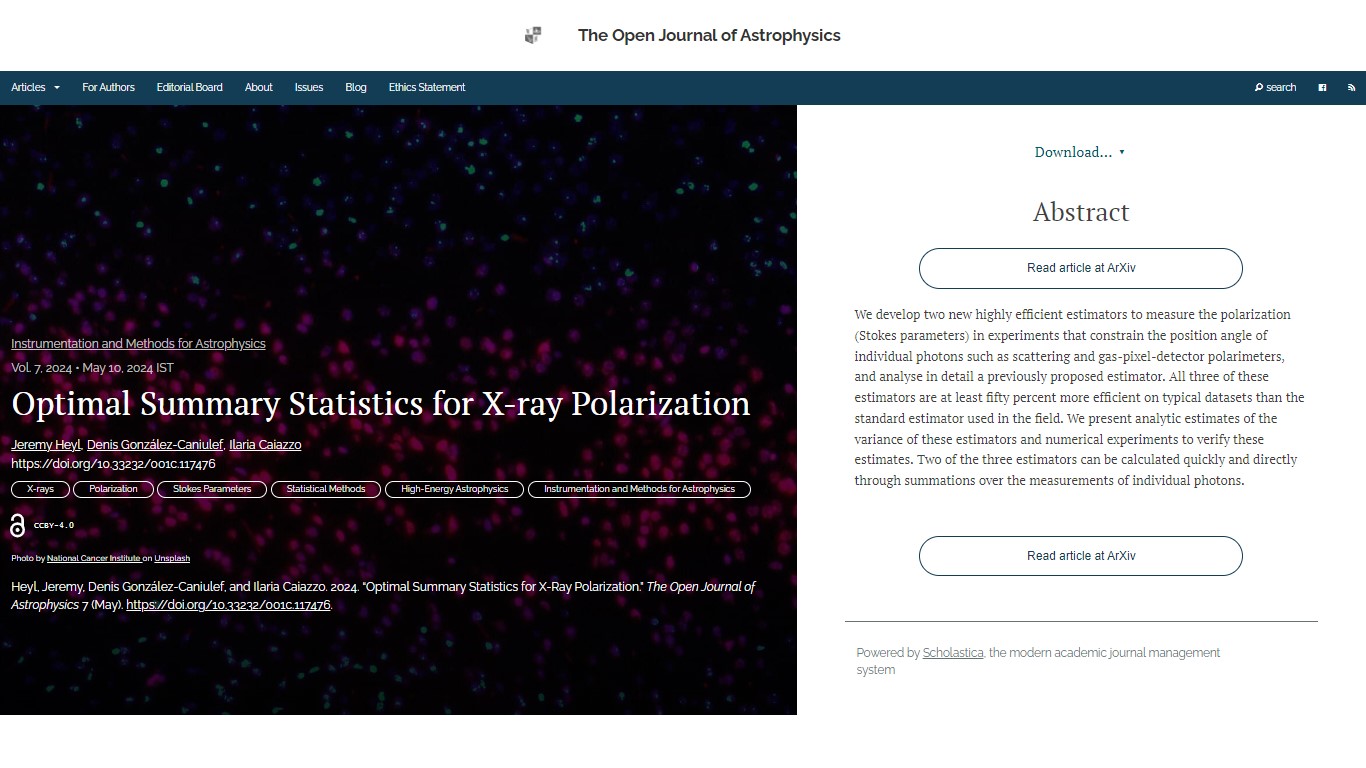
Archive for the The Universe and Stuff Category

Two New Publications at the Open Journal of Astrophysics

Posted in OJAp Papers, Open Access, The Universe and Stuff with tags , , , , , , , , , , on February 24, 2024 by telescoper

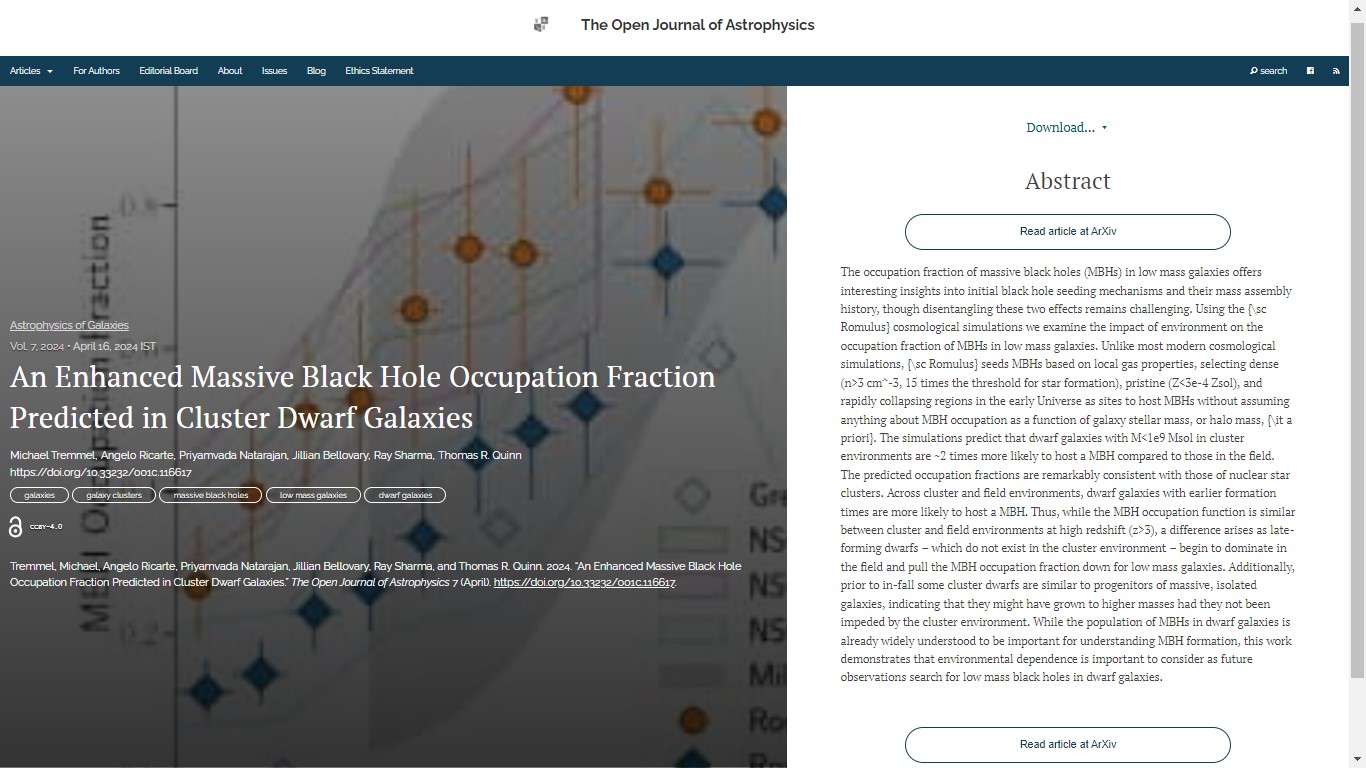
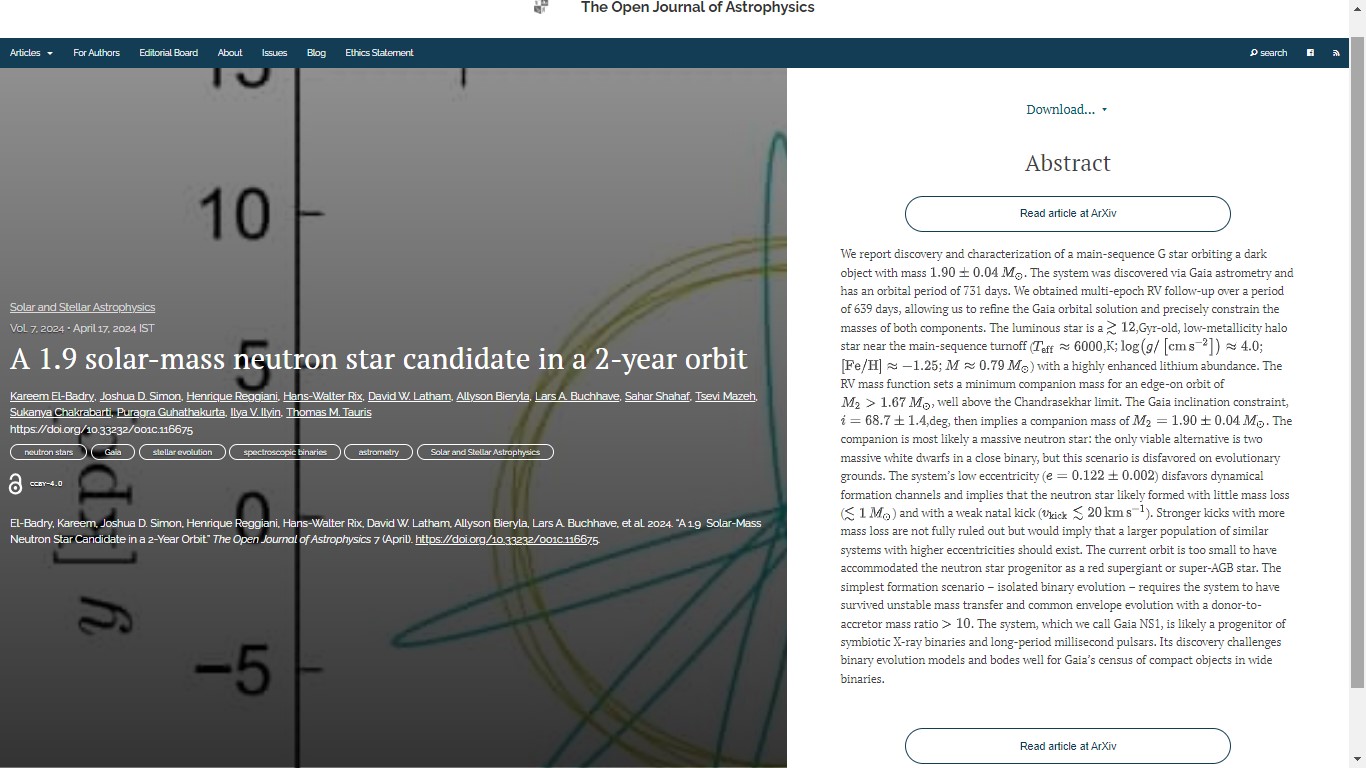
It’s Saturday morning in Sydney, and time to post another update relating to the  Open Journal of Astrophysics.  Since the last update we have published two more papers, taking  the count in Volume 7 (2024) up to 15 and the total published by OJAp up to 130. I should have posted these before leaving but it slipped my mind.

The first paper of the most recent pair – published on  Thursday 22nd February – is “Modelling cross-correlations of ultra-high-energy cosmic rays and galaxies” by Federico Urban (Prague, Czech Republic), Stefano Camera (Torino, Italy) and David Alonso (Oxford, UK). It presents a discussion of the possible statistical correlations between Ultra-High-Energy Cosmic-Ray (UHECR) directions in various models and structure in the galaxy distribution and whether or not this signal could be measurable.  This one is in the folder marked “High-Energy Astrophysical Phenomena“.

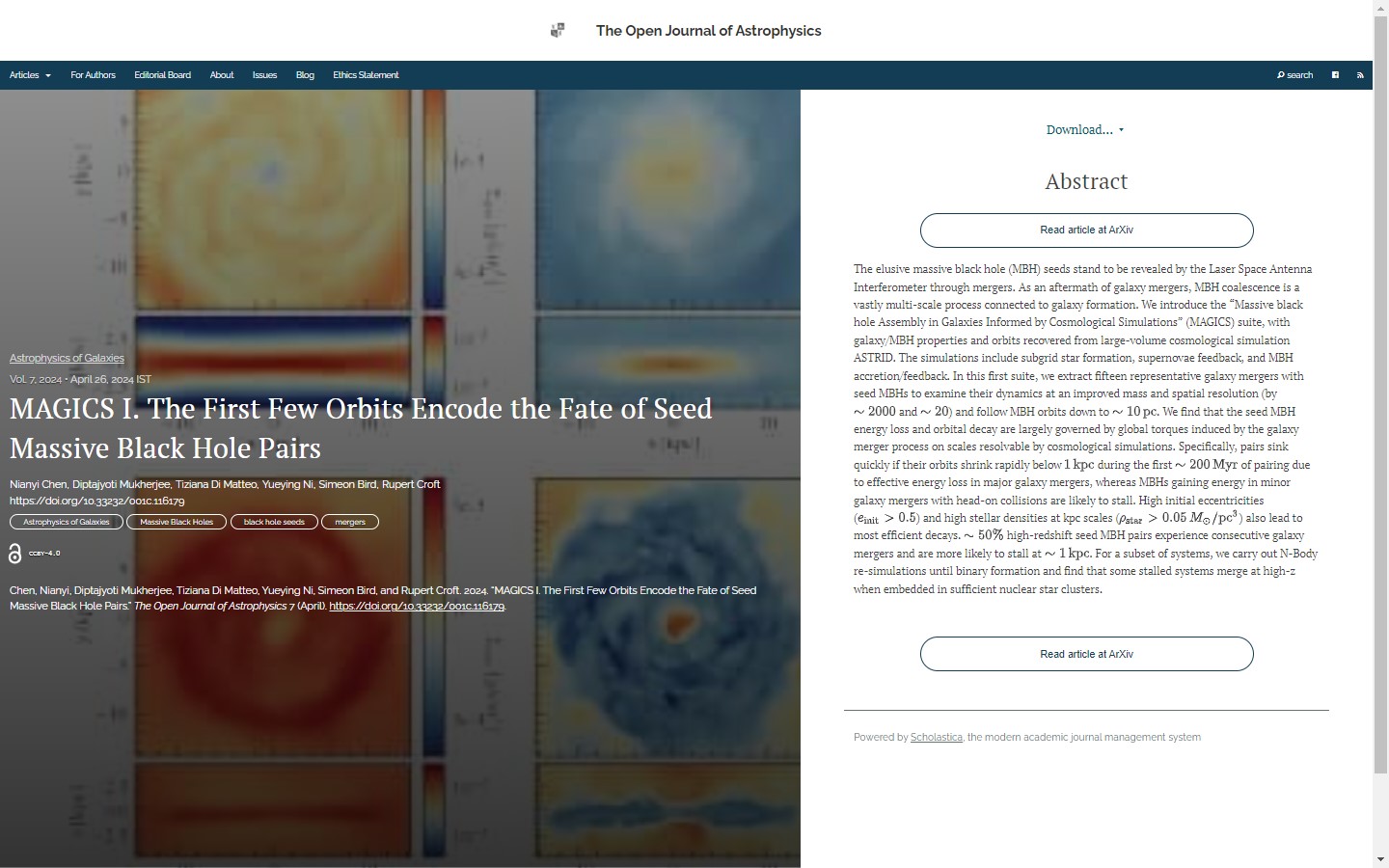
Here is a screen grab of the overlay which includes the abstract:

You can click on the image of the overlay to make it larger should you wish to do so. You can find the officially accepted version of the paper on the arXiv here.

The second paper was published on Friday 23rd February and has the title “The IA Guide: A Breakdown of Intrinsic Alignment Formalisms” and the authors are: Claire Lamman (Harvard, USA);  Eleni Tsaprazi (Stockholm, Sweden);  Jingjing Shi (Tokyo, Japan); Nikolina Niko Šarčević (Newcastle, UK); Susan Pyne (UCL, UK); Elisa Legnani (Barcelona, Spain); and Tassia Ferreira (Oxford, UK). This one, which is in the folder marked Cosmology and NonGalactic Astrophysics, presents a review of Intrinsic Alignments, i.e. physical correlations involving galaxy shapes, galaxy spins, and larger scale structure, especially important for weak gravitational lensing

Here is a screen grab of the overlay which includes the abstract:


You can click on the image of the overlay to make it larger should you wish to do so. You can find the officially accepted version of the paper on the arXiv here.

That concludes this week’s update!

SN1987A, Past and Present

Posted in Biographical, The Universe and Stuff with tags , , , , , , on February 23, 2024 by telescoper

There’s a new paper in Science featuring observations using the MIRI and NIRSpec instruments on JWST of Supernova SN1987A in the Large Magellanic Cloud. I couldn’t resist doing a short post about this result, partly because the paper features Maynooth colleague Paddy Kavanagh, and partly because I’m old enough to remember when this supernova was detected, in 1987. In fact I was doing my PhD at the time. When I started lecturing a few years later I used to use it as an example of a Type II (core-collapse) supernova. At first I would say “you will remember SN1987A” then, as the years passed, I realized that students would have been quite young in 1987 so I changed this to “some of you will remember SN1987A”. Still later, I realized that none of my students had even been born in 1987 so I forgot about the remembering bit and just talked about SN1987A. As of 2024, nobody under the age of 37 was born in 1987. Tempus has a distinct tendency to Fugit.

In 1987 I was in Sussex and I remember Roger Tayler getting very excited about the detection of anti-neutrinos from SN1987A at the Kamioka Observatory in Japan. There weren’t many – 12 altogether – but he wanted to do a statistical analysis of the arrival times to see if there was any evidence that might indicate the neutrinos had mass. Being rather “old-school”, he did a Monte Carlo experiment involving drawing numbers written on bits of paper out of a cardboard box. After a brief chat I suggested I could do a much better job using a random-number generator on a computer so I wrote a bit of code and did the computation. The results showed no evidence for neutrino mass.

Anyway, this type of supernova should produce a neutron star or black hole sitting inside a ring-shaped remnant. The ring has been well studied, but in 37 years of observation the central object has not been detected. The results in the latest paper (by Fransson et al.) involve a spectroscopic study of the emission lines of ionized argon from the SN1987a remnant at sufficiently high spectral resolution to map the velocity structure. The results suggest that ionizing radiation from a neutron star is illuminating gas from the inner parts of the remnant.

https://doi.org/10.1126/science.adj5796

For more details, see the paper.

DES and the BAO Scale

Posted in The Universe and Stuff with tags , , , , on February 22, 2024 by telescoper

I just saw a press release about new results from the Dark Energy Survey relating to measurements of baryon acoustic oscillations. These are basically the residue of the oscillations seen in the power spectrum of the cosmic microwave background (CMB) temperature distribution imprinted on the galaxy distribution. They are somewhat less obvious that the primordial temperature fluctuations because the growth of structure produces a much larger background but they are measurable (and indeed are one of the things Euclid will measure).

Anyway, there is a very nice detailed description in the press release and you can find the preprint of the work in full on arXiv here, so I’ll just show the key figure:

The effective redshift of this measurement is about 0.85; in the CMB the redshift is about 1000. You can see that there is a characteristic scale but it is slightly offset from that predicted using the standard ΛCDM model based on the Planck determination of cosmological parameters. One has to be careful in interpreting this diagram because it is determined using autocorrelation functions; the errors on different bins are therefore correlated, not statistically independent. They are also, as you can see, quite large. Nonetheless, it’s a tantalizing result…

Open Access Talk at UNSW

Posted in Biographical, Open Access, The Universe and Stuff with tags , , , on February 21, 2024 by telescoper

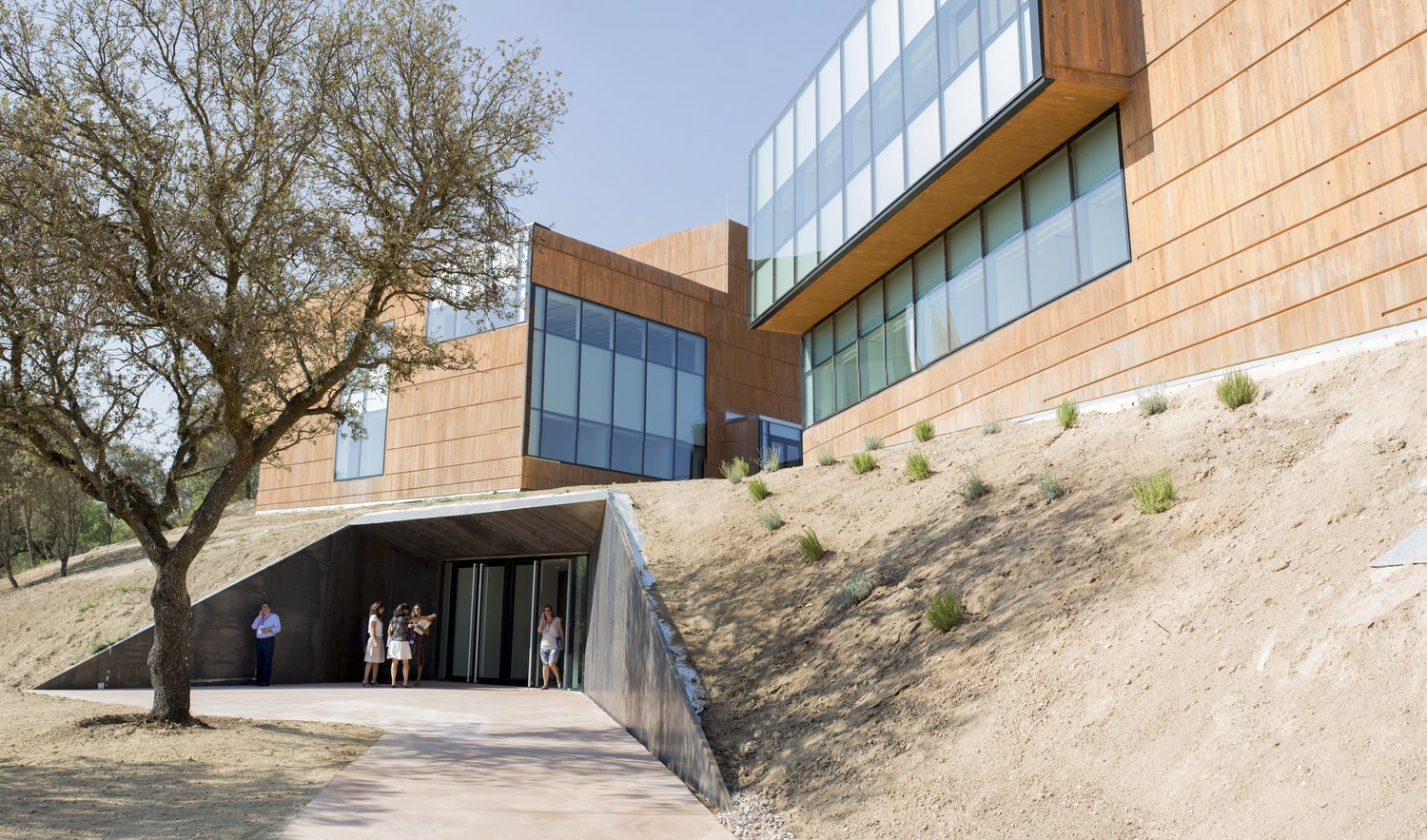
After an exciting start to the day involving a fire alarm and consequent evacuation of my hotel, I today ventured into the suburbs of Sydney via the Light Rail system (i.e. the tram) to the University of New South Wales. The tram ride took about 20 minutes from Central and, incidentally, took me right past the Sydney Cricket Ground. Anyway, the UNSW campus at Kensington is very impressive:

After a few gremlins with the WIFI connection, the talk I gave was a longer version of the one I did at the University of Sydney on Monday. In discussions with the Astrophysics group at UNSW, I found they were particularly unhappy about the decision of Monthly Notices of the Royal Astronomical Society to charge a high level of APC (Article Processing Artificial Profit Charge) so is looking at alternative journals that aren’t so exploitative. A journal has no right to call itself “open access” if it excludes researchers on grounds of cost. The problem with the Open Journal of Astrophysics in this case is that they need their publications to be in “high impact journals” for research assessment purposes, and OJAp doesn’t have an “official” journal impact factor yet. The fascination of bureaucrats with the obviously flawed journal impact factor disturbs me greatly but I hope we will have one soon so we may be able to help them out before too long.

Anyway, here are the slides from today’s talk:

Talking Down Under

Posted in OJAp Papers, Open Access, The Universe and Stuff with tags , , , on February 19, 2024 by telescoper

This morning I gave a short talk at the “Astronomy Tea” at the Sydney Institute for Astronomy. No prizes for guessing what I talked about. The talk was followed by questions and then by a huge thunderstorm.

Here are the slides:

P.S. Today was the first day of teaching of the new academic year at the University of Sydney, so the campus was much busier today than it has been.

New Publication at the Open Journal of Astrophysics

Posted in OJAp Papers, Open Access, The Universe and Stuff with tags , , , , , , , on February 16, 2024 by telescoper

It’s Saturday morning here in Sydney, which means it is time for another weekly update from the Open Journal of Astrophysics. In fact there is only one paper to report this week, being  the 13th paper in Volume 7 (2024)  and the 128th altogether. It was published on February 15th 2024.

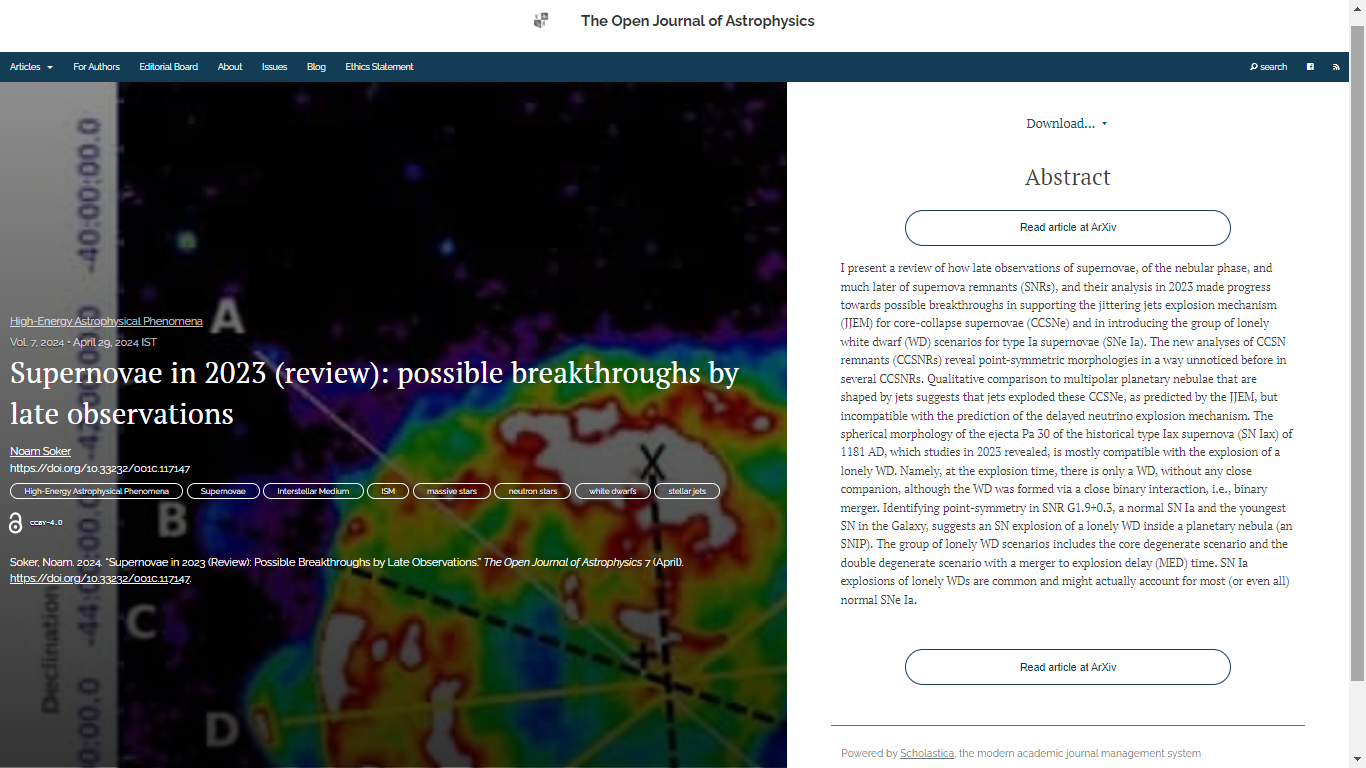
The title is “Jet – counter-jet asymmetry in the jittering jets explosion mechanism of supernovae” and it  This one is in the folder called High-Energy Astrophysical Phenomena. The paper presents a discussion of the production of jets in core-collapse supernovae and the resulting formation of neutron stars, and the implications for the morphology of the supernova remnant.

The sole author of the paper is Noam Soker of Technion, Haifa, in Israel.

Here is the overlay of the paper containing the abstract:


You can click on the image of the overlay to make it larger should you wish to do so. You can find the officially accepted version of the paper on the arXiv here.

Big Ring Questions and Answers

Posted in Astrohype, The Universe and Stuff with tags , , , , , on February 14, 2024 by telescoper

A month ago I wrote a piece about observations of an apparent “Big Ring” of absorption systems that was claimed to be inconsistent with the Cosmological Principle and hence with the standard cosmological model. At the time there was no paper describing the results, but a preprint has now appeared on arXiv. I haven’t read it carefully yet, but at a cursory reading it confirms my prior expectation that it does not contain a comparison of the observations with predictions of the standard model. I’ll say more after I’ve had a chance to digest the paper.

One of the things that irked me at the time of the announcement of this “discovery” was that there was no way to scrutinize the claims because they hadn’t been written up. Another was that the media covering the Big Ring did not appear to want to present balancing opinions.

An exception was Danish journalist Peter Harmsen who writes for the weekly broadsheet Weekendavisen who asked me for an interview after seeing my sceptical blog post. The results appeared in an article that came out yesterday (13th February). It’s behind a paywall but here’s a screengrab to give you an idea (if you can read Danish):

The word “store” in Danish means “big” or “large”; it comes up quite often if you want to buy a beer in Denmark. The key quote of mine is

Det er meget dårlig stil at fremsætte resultater i offentlige fora, uden at de er nedfældet skriftligt

Weekendavisen, 13th February 2024

I actually kept a transcript of the interview which I thought it might be useful to share here in the form of questions and answers. You will find the original English version of the above quote in my response to the last question.

Fundamentally, do you think that the cosmological principle still stands or is in need of adjustment or even replacement?The Cosmological Principle, in the form used in the standard cosmological model, requires the Universe to be sufficiently homogeneous and isotropic on large scales that its behaviour can be described by relatively simple solutions of Einstein’s equations called the Friedman equations. We know the Universe is not exactly​ homogenous and isotropic, and the standard model predicts actually fluctuations on rather large scales that do not violate it.  Of course the part of the Universe we have actually observed directly is relatively small, but as I see it there is no compelling evidence that the Cosmological Principle is violated. 
Specifically regarding the research on the so-called Big Ring, is the jury still out on whether the people behind the research are on to something, pending publication of a peer-reviewed paper, or is it your assessment, based on what has been made public so far, that it is probably not the breakthrough that it has been made out to be in some reports?I am sceptical of the claims made about the Big Ring because there is no scientific paper describing the result. Based on what I have seen, however, just like other claims of arcs and filaments, the structure described does not seem to be on a sufficiently large scale to violate the cosmological principle. A careful comparison of the results with simulations would be required to draw more definite conclusions. I am not aware that the authors have done that.
The PhD student credited with the research is quoted in the Financial Times as making the following remark: “Lots of people are excited but, having said that, you do get this [resistant] attitude in cosmology that you don’t generally find elsewhere in science… Good science should be about pushing back and testing our fundamental assumptions but there are clearly people who want to protect the Standard Model.” What is your comment on this? Is cosmology stifled by a scientific community resistant to change?Science is – or should be – based on evidence. In my view the weight of evidence supporting the standard model is substantial, but that does not mean that it is proven to be true; it is a working hypothesis. If anyone does come up with evidence that shows it to be wrong then that would be the most exciting thing possible. I don’t see such evidence here. There are of course many people working on alternative theories , for example involving different forms of gravitational theory. I’d say cosmologists are very open to such ideas. Indeed we know that the standard model is incomplete and will eventually be replaced by a more complete theory. That has to be driven by evidence.
You describe in your blog “an increasing tendency for university press offices to see themselves entirely as marketing agencies.” Have there been other recent examples of universities being a little too eager to sell their scientific advances to the public?There’s quite a lot of this about, and I have to say that scientists, sadly, are often willing participants. A famous example  from some years ago was the BICEP2 “discovery” concerning the cosmic microwave background, which made headlines around the world but was later shown to be false. More recently there have been many claims that very distant galaxies observed with JWST are incompatible with the standard cosmology. In that case some of the observations turned out to be incorrect and the theoretical interpretation misleading. Very high redshift galaxies would indeed be difficult to account for in the standard model, but we haven’t seen enough evidence yet. 
The narrative of a young scholar proposing revolutionary new ideas despite resistance from established science seems to resonate with the public and has echoes of Galilei and Darwin. Are we, the lay public, too easy victims of such dramatic story-telling, and does it give us a wrong idea about how science actually works?I think the public don’t really understand how science really works for a number of reasons. I think many people expect scientists to be  certain about things, when really it’s about dealing with statistical evidence in as careful and rational a way as possible. Earlier you asked me about the Cosmological Principle. If you asked me if the Cosmological Principle is valid I would answer “I don’t know, but as a working hypothesis it accounts very well for the reliable data”. That sort of statement, however, does not make headlines.  A significant problem is that extravagant unsubstantiated claims make headlines, but subsequent retractions don’t. This presents a very misleading picture to the public.
In your blog, you write that headline-hunting without the presence of even a pre-print is “not the sort of thing PhD supervisors should be allowing their PhD students to do.” Is it because it is harmful to science as a whole, or because there is a risk of derailing a young scientist’s career before it has even begun due to an early debacle?My objection is more that I think it is very bad form to present in public results which have not even been written up, let alone subject to proper peer review. It’s essential for science that this happens, so that the claims can be properly evaluated by experts in the field. Bypassing this is potentially extremely damaging to the proper public understanding of this subject.
Q&A about the Big Ring

Euclid Update

Posted in Euclid, History, The Universe and Stuff on February 13, 2024 by telescoper

It’s a lovely sunny Saint Ash Valentine’s Wednesday Day in Australia though I’m not sure what day it is at the 2nd Lagrange Point of the Earth-Sun system. Nevertheless, as I mentioned last week, Euclid’s Wide Survey starts today; here is the official announcement of this from ESA. To mark this momentous event here is another nice video update showing the preparations that have been going on ahead of the arrival of the deluge of real data:

Among other things, you will see an appearance by Henry Joy McCracken whose namesake led the United Irishmen in the Rebellion of 1798.

New Publication at the Open Journal of Astrophysics

Posted in OJAp Papers, Open Access, The Universe and Stuff with tags , , , , , , on February 12, 2024 by telescoper

With all the excitement of my first weekend in Sydney I completely forgot to post an update from the Open Journal of Astrophysics. In fact there is only one paper to report from last week, being  the 12th paper in Volume 7 (2024)  and the 127th altogether. This one was published on 9th February 2024 and is the first published from Down Under.

The title is “Galaxy Clusters Discovered via the Thermal Sunyaev-Zel’dovich Effect in the 500-square-degree SPTpol Survey” and it presents a catalogue of 689 galaxy clusters detected through the thermal Sunyaev-Zel’dovich using the dual-frequency polarization-sensitive camera SPTPol on the South Pole Telescope. This one is in the folder called Cosmology and NonGalactic Astrophysics.

This paper has lead author Lindsey Bleem  of the Argonne National Laboratory in the USA and has 127 other authors – too many to list individually here – but you can see them on the overlay below. I see quite a few names of people I know well!

Here is the overlay of the paper containing the abstract:


You can click on the image of the overlay to make it larger should you wish to do so. You can find the officially accepted version of the paper on the arXiv here.

P.S. Incidentally, while I’m here I thought I’d share this little graphic I’ve generated (for other purposes) that shows how the rate of submissions to OJAp has increased over the last 5 years:

A Euclid Milestone!

Posted in Euclid, The Universe and Stuff with tags , , , , , , , , on February 9, 2024 by telescoper

I just heard some excellent news about Euclid so thought I would post a quick update here. I won’t say much because there will no doubt be official communications from the European Space Agency and the Euclid Consortium. You can find a variety of Euclid-related posts on this blog here.

Over the past few months, there has been a huge amount of activity relating to commissioning the instruments, verifying their performance, and measuring parameters of the optical system that will be needed for analysis of the huge amount of data due to come from Euclid. All this effort fed into the Mission Commissioning Results Review (MCRR) which concluded yesterday that all was well.

This is an important milestone for Euclid because, in ESA parlance, it marks the change from a project to a mission. Until commissioning, there is a project manager who works with ESA and the industrial contractors to ensure everything functions properly; when nominal operations start the project team is disbanded and the mission team takes over; and so it came to pass that the Project Manager (Giuseppe Racca) handed over the reins to the Mission Manager (Pierre Ferruit).

That’s when the role of the Euclid Consortium increases substantially. In particular the Science Ground Segment (SGS), which includes the pipelines that will process the data, has been declared to be ready for business. You can read more about the SGS here but here’s a graphic that shows how data comes from the telescope, external telescopes, or simulations, then run through their respective pipelines for VIS, NISP, or external data, then are merged into a coherent format. Pipelines then extract scientific information and compute science data products for further analysis

Each element of this diagram is rather complex. Here, for example, is the organization of the Science Data Centre (SDC) component of the Science Ground Segment at the bottom of the above picture, consisting of computing centers responsible for implementing and running the data processing pipelines:

Anyway, the immediate upshot of all this is that full surveying activities of Euclid can now proceed. The Euclid mission will conduct primarily two different surveys: a “Wide Survey”, covering about 15,000 square degrees on the sky, and a “Deep Survey” of about 50 square degrees, where the instruments will observe three fields much longer than the rest of the sky to capture much fainter galaxies and hence look further out into space. I understand that the Wide Survey will commence in earnest on 14th February.The timescale from now is that the first full set of survey data (DR1) will be available internally to the Euclid Consortium in May or June 2025 and will be made public a year later (i.e. by June 2026).

That doesn’t mean that Euclid will be silent until 2026. In fact, the first batch of post-launch papers will come out very soon, in May 2024. This will include science papers resulting from the Early Release Observations – the data from these will also be made public at the same time – as well as an overview paper for the whole mission and papers describing the details of NISP and VIS instruments using measurements made during commissioning. There will also be a release in May 2025 of data from the Deep Survey patch of about 50 square degrees.

So, the board is set. The pieces are moving.