In yesterday’s Mechanics lecture I decided to illustrate the use of energy conservation arguments with an application to the pole vault. I have done this a few times and indeed wrote a blog post about it some years ago. At the time I wrote that post however the world record for the pole vault was held by the legendary Ukrainian athlete Sergey Bubka at a height of 6.14m which he achieved in 1994. That record stood for almost 20 years but has since been broken several times, and is now held by Armand Duplantis at a height of 6.21m.
Here he is breaking the record on July 24th 2022 in Eugene, Oregon:
He seemed to clear that height quite comfortably, actually, and he’s only 23 years old, so I dare say he’ll break quite a few more records in his time but the fact that world record has only increased by 7cm in almost 30 years tells you that the elite pole vaulters are working at the limits of what the human body can achieve. A little bit of first-year physics will convince you why.
Basically, the pole is a device that converts the horizontal kinetic energy of the vaulter , as he/she runs in, to the gravitational potential energy acquired at the apex of his/her vertical motion, i.e. at the top of the vault.
Now assume that the approach is at the speed of a sprinter, i.e. about , and work out the height that the vaulter can gain if the kinetic energy is converted with 100% efficiency. Since the answer to that little sum turns out to be about 5 metres.
This suggests that 6.21 metres should not just be at, but beyond, the limit of a human vaulter, unless the pole were super-elastic. However, there are two things that help. The first is that the centre of mass of the combined vaulter-plus-pole does not start at ground level; it is at a height of a bit less than 1m for an an average-sized person. Nor does the centre of mass of the vaulter-pole combination reach 6.21 metres.
The pole does not go over the bar, but it’s pretty light so that probably doesn’t make much difference. However, the centre of mass of the vaulter actually does not actually pass over the bar. That doesn’t happen in the high jump, either. Owing to the flexibility of the jumper’s back the arc is such that the centre of mass remains under the bar while the different parts of the jumper’s body go over it.
Moreover, it’s not just the kinetic energy related to the horizontal motion of the vaulter that’s involved. A human can in fact jump vertically from a standing position using elastic energy stored in muscles. In fact the world record for the standing high jump is an astonishing 1.9m. In the context of the pole vault it seems likely to me that this accounts for at least a few tens of centimetres.
Despite these complications, it is clear that pole vaulters are remarkably efficient athletes. And not a little brave either – as someone who is scared of heights I can tell you that I’d be absolutely terrified being shot up to 6.21 metres on the end of a bendy stick, even with something soft to land on!
Following last week’s Maynooth Astrophysics and Cosmology Masterclass, a student asked (in the context of the Big Bang or a black hole) what a singularity is. I thought I’d share my response here in case anyone else was wondering. The following is what I wrote back to my correspondent:
–oo–
In general, a singularity is pathological mathematical situation wherein the value of a particular variable becomes infinite. To give a very simple example, consider the calculation of the Newtonian force due to gravity exerted by a massive body on a test particle at a distance r. This force is proportional to 1/r2,, so that if one tried to calculate the force for objects at zero separation (r=0), the result would be infinite.
Singularities are not always signs of serious mathematical problems. Sometimes they are simply caused by an inappropriate choice of coordinates. For example, something strange and akin to a singularity happens in the standard maps one finds in an atlas. These maps look quite sensible until one looks very near the poles. In a standard equatorial projection, the North Pole does not appear as a point, as it should, but is spread along straight line along the top of the map. But if you were to travel to the North Pole you would not see anything strange or catastrophic there. The singularity that causes this point to appear is an example of a coordinate singularity, and it can be transformed away by using a different projection.
More serious singularities occur with depressing regularity in solutions of the equations of general relativity. Some of these are coordinate singularities like the one discussed above and are not particularly serious. However, Einstein’s theory is special in that it predicts the existence of real singularities where real physical quantities (such as the matter density) become infinite. The curvature of space-time can also become infinite in certain situations.
Probably the most famous example of a singularity lies at the core of a black hole. This appears in the original Schwarzschild interior solution corresponding to an object with perfect spherical symmetry. For many years, physicists thought that the existence of a singularity of this kind was merely due to the special and rather artificial nature of the exactly spherical solution. However, a series of mathematical investigations, culminating in the singularity theorems of Penrose, showed no special symmetry is required and that singularities arise in the generic gravitational collapse problem.
As if to apologize for predicting these singularities in the first place, general relativity does its best to hide them from us. A Schwarzschild black hole is surrounded by an event horizon that effectively protects outside observers from the singularity itself. It seems likely that all singularities in general relativity are protected in this way, and so-called naked singularities are not thought to be physically realistic.
There is also a singularity at the very beginning in the standard Big Bang theory. This again is expected to be a real singularity where the temperature and density become infinite. In this respect the Big Bang can be thought of as a kind of time-reverse of the gravitational collapse that forms a black hole. As was the case with the Schwarzschild solution, many physicists thought that the initial cosmologcal singularity could be a consequence of the special symmetry required by the Cosmological Principle. But this is now known not to be the case. Hawking and Penrose generalized Penrose’s original black hole theorems to show that a singularity invariably exists in the past of an expanding Universe in which certain very general conditions apply.
So is it possible to avoid this singularity? And if so, how?
It is clear that the initial cosmological singularity might well just be a consequence of extrapolating deductions based on the classical ttheory of general relativity into a situation where this theory is no longer valid. Indeed, Einstein himself wrote:
The theory is based on a separation of the concepts of the gravitational field and matter. While this may be a valid approximation for weak fields, it may presumably be quite inadequate for very high densities of matter. One may not therefore assume the validity of the equations for very high densities and it is just possible that in a unified theory there would be no such singularity.
Einstein, A., 1950. The Meaning of Relativity, 3rd Edition, Princeton University Press.
We need new laws of physics to describe the behaviour of matter in the vicinity of the Big Bang, when the density and temperature are much higher than can be achieved in laboratory experiments. In particular, any theory of matter under such extreme conditions must take account of quantum effects on a cosmological scale. The name given to the theory of gravity that replaces general relativity at ultra-high energies by taking these effects into account is quantum gravity, but no such theory has yet been constructed.
There are, however, ways of avoiding the initial singularity in classical general relativity without appealing to quantum effects. First, one can propose an equation of state for matter in the very early Universe that does not obey the conditions laid down by Hawking and Penrose. The most important of these conditions is called the strong energy condition: that r+3p/c2>0 where r is the matter density and p is the pressure. There are various ways in which this condition might indeed be violated. In particular, it is violated by a scalar field when its evolution is dominated by its vacuum energy, which is the condition necessary for driving inflationary Universe models into an accelerated expansion. The vacuum energy of the scalar field may be regarded as an effective cosmological constant; models in which the cosmological constant is included generally have a bounce rather than a singularity: running the clock back, the Universe reaches a minimum size and then expands again.
Whether the singularity is avoidable or not remains an open question, and the issue of whether we can describe the very earliest phases of the Big Bang, before the Planck time, will remain open at least until a complete theory of quantum gravity is constructed.
I thought quite a few readers of In the Dark might be interested that there’s a new open-access journal starting up called Philosophy of Physics. It’s published by LSE Press. See this post for more details.
Thank you very much to everyone in the Governing Board and the Society who contributed to realizing our key initiative!
Special thanks go to David Wallace for having accepted to act as the journal’s founding Editor-in-Chief. Read his announcement on the LSE Press’s blog here.
Please consider submitting your best work to Philosophy of Physics. In order to do so, you should become a member of the Society. It’s free for students and unwaged people, £10 for postdocs, and £20 for others. Once you are a member, you will find instructions on how to submit a paper inside the members’ area, as explained here.
There’s a new interactive map of the Universe created by astronomers at Johns Hopkins University using data from the Sloan Digital Sky Survey. You can read all about it here There’s also a nice video to watch:
The picture at the top of this post is not the actual map, it’s just a publicity poster. You can play with the fully interactive version here.
This reminds me that when I started as a researcher in cosmology, back in 1985, the biggest galaxy redshift survey available had only just over a thousand galaxies in it and probed only a tiny fraction of the volume of the Universe that has now been mapped, i.e. only out to a redshift of about 0.05.
Well it seems there has been progress and, according to the Irish Times, a proposal to join CERN is going to be tabled by the Minister Simon Harris. This follows a long hiatus after a move reported in the news here in Ireland several years ago of a report from a Committee of the Houses of the Oireachtas making the case for Ireland to join CERN. You can download the report here (PDF) and you’ll find this rather striking graphic therein:
You will see that there are only three European countries other than Ireland that don’t have any form of membership or other agreement with CERN: Latvia, Bosnia-Herzegovina, Moldova. The fact that almost everyone else is in is not in itself necessarily a good argument for Ireland to join, but it does make one wonder why so many other countries have found it important to join or have an agreement with CERN while Ireland has not.
As the document explains, if the Irish government were to decide to take Ireland into CERN then it would first have to become an Associate Member, which would cost around €1.2 million per year. That’s small potatoes really, and the financial returns to Irish industry and universities are likely to far exceed that, so the report strongly recommends this step be taken. This Associate member stage would last up to 5 years, and then to acquire full membership a joining fee of around €15.6 million would have to be paid, which is obviously a much greater commitment but in my view still worthwhile.
There were some positive noises when the document came out, but that was near the end of 2019. Not far into 2020 the pandemic struck and the idea sank without trace. Now it looks like the idea is alive again. It’s not exactly a done deal but at least there’s some movement.
While I strongly support the idea of Ireland joining CERN I do have a couple of concerns about the case as presented in the Oireachtas report.
One is that I’m very sad that the actual science done at CERN is downplayed in that report. Most of it is about the cash return to industry, training opportunities, etc. These are important, of course, but it must not be forgotten that big science projects like those carried out at CERN are above all else science projects. The quest for knowledge does have collateral benefits, but it a worthy activity in its own right and we shouldn’t lose sight of that.
My other (related) concern is that joining CERN is one thing, but in order to reap the scientific reward the government has to invest in the resources needed to exploit the access to facilities membership would provide. Without a related increase in research grant funding for basic science the opportunity to raise the level of scientific activity in Ireland would be lost.
Ireland recently joined the European Southern Observatory (ESO), a decision which gave Irish astronomers access to some amazing telescopes. However, there is no sign at all of Irish funding agencies responding to this opportunity by increasing funding for academic time, postdocs and graduate students needed to do the actual science. In one respect ESO is very like CERN: the facilities do not themselves do the science; we need people to do that. The jam for research is already spread very thinly in Ireland so having an extra thing to spread it on will not necessarily be a good thing for science in general.
In recent times I’ve posted quite a few times about the Hubble Tension and possible resolutions thereof. I also had polls to gauge the level of tension among my readers, like this one
and this one:
I’m not sure if these are still working, though, as I think I’ve reached the number of votes allowed on the basic free version of crowdsignal that comes with the free version of WordPress. I refuse to pay for the enhanced version. I’m nothing if not cheap. You can however still see the votes so far.
Anyway, there is a new(ish) paper on the arXiv by Mark Kamionkowski and Adam Riess that presents a nice readable introduction to this topic. I’m still not convinced that the Hubble Tension is anything more than an observational systematic, but I think this is a good discussion of what it might be if it is more than that.
Here is the abstract:
Over the past decade, the disparity between the value of the cosmic expansion rate directly determined from measurements of distance and redshift or instead from the standard ΛCDM cosmological model calibrated by measurements from the early Universe, has grown to a level of significance requiring a solution. Proposed systematic errors are not supported by the breadth of available data (and “unknown errors” untestable by lack of definition). Simple theoretical explanations for this “Hubble tension” that are consistent with the majority of the data have been surprisingly hard to come by, but in recent years, attention has focused increasingly on models that alter the early or pre-recombination physics of ΛCDM as the most feasible. Here, we describe the nature of this tension, emphasizing recent developments on the observational side. We then explain why early-Universe solutions are currently favored and the constraints that any such model must satisfy. We discuss one workable example, early dark energy, and describe how it can be tested with future measurements. Given an assortment of more extended recent reviews on specific aspects of the problem, the discussion is intended to be fairly general and understandable to a broad audience.
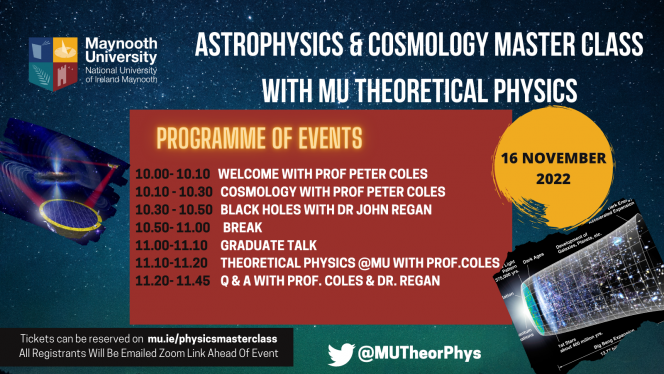
As next week is Science Week I thought I’d remind readers that as part of the festivities we are hosting a virtual Masterclass in Astrophysics & Cosmology in Maynoothon Wednesday 16th November 2022 .
You may remember that we have presented such events twice before. Last year’s event was a particularly big success, with over a hundred schools joining in, with probably over a thousand young people listening and asking questions.
Like last year’s event this year’s will be a half-day virtual event via Zoom. It’s meant for school students in their 5th or 6th year of the Irish system. There might be a few of them or their teachers who see this blog so I thought I’d share the news here. You can find more information, including instructions on how to book a place, here.
Here is the flyer for the event:
I’ll be talking about cosmology early on, and John Regan will talk about black holes later on. After the coffee break one of our students will talk about why they wanted to study astrophysics. Then I’ll say something about our degree programmes for those students who might be interested in studying astrophysics and/or cosmology as part of a science course. We’ll finish with questions either about the science or the studying!
I’m delighted to be able to announce the 10000th paper this year, and 1000000th publication overall, at the Open Journal of Astrophysics!
That is counting in binary, of course. In base ten the new paper at the 16th paper in Volume 5 (2022) as well as the 64th in all.
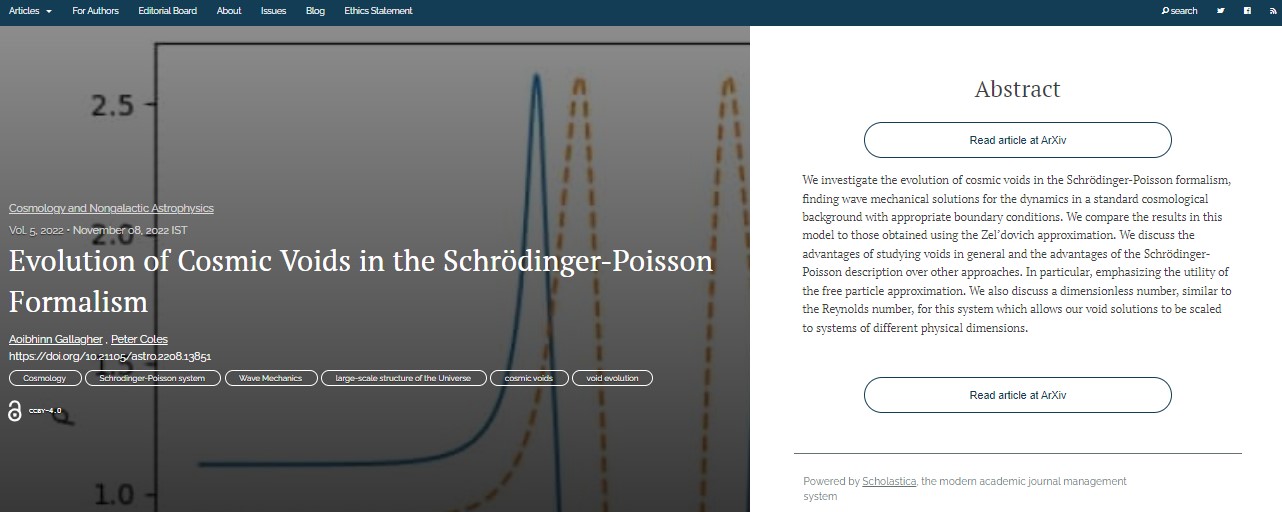
The latest publication is entitled “Evolution of Cosmic Voids in the Schrödinger-Poisson Formalism” and the authors are Aoibhinn Gallagher and Peter Coles (Who he? Ed) both of the Department of Theoretical Physics at Maynooth University. Obviously as author I played no role in the selection of referees or any other aspect of the editorial process.
Aoibhinn Gallagher – bonus marks for pronouncing both names correctly – is my first Maynooth PhD student and this is her first paper, of many I hope (and expect)! We’re already working on extensions of this approach to other aspects of large-scale structure. You can find some discussion of this general approach here.
Anyway, here is a screen grab of the overlay which includes the abstract:
You can click on the image to make it larger should you wish to do so. You can find the officially accepted version of the paper on the arXiv here.
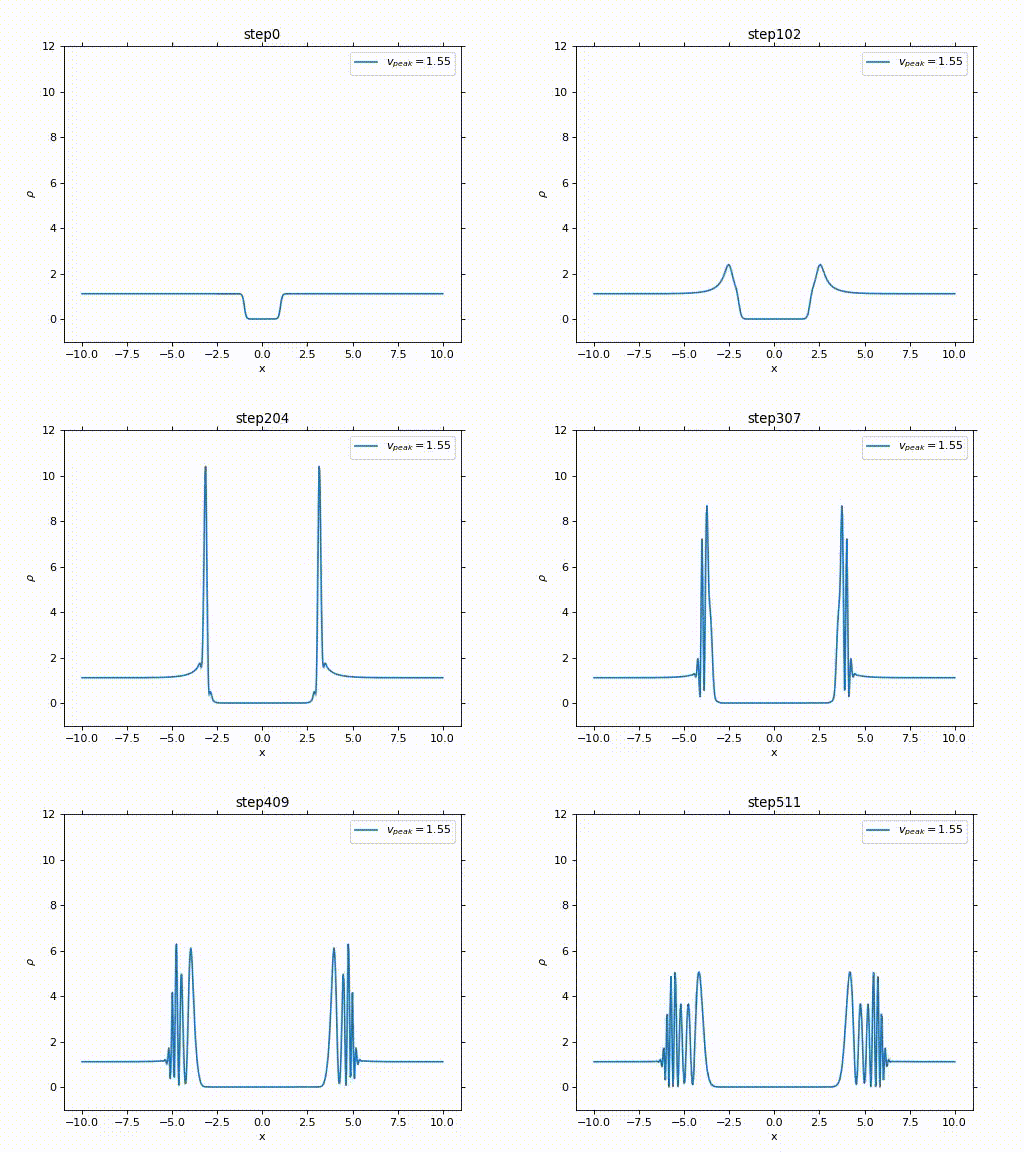
Here is a nice animated version of Figure 5 of the paper showing, for a 1D slice, the radial expansion of a spherically symmetric void (i.e. underdense region) using periodic boundary conditions:
The x-axis is in (scaled) comoving coordinates, i.e. expanding with the cosmological background, so that the global expansion is removed. You can see that the void expands in these coordinates, so is expanding more quickly than the background, initially pushing matter into a dense ring around the rim of the empty void. That part of the evolution is just the same as for “normal” matter but in this case the wave-mechanical behaviour of the matter prevents it from being confined to a strongly-localized structure as well as affecting the subsequent expansion rate.
Of course in the real Universe, voids are not isolated like this but instead tend to push into each other, but we felt it was worth studying the single void case to understand the dynamics!
DIRAC is a high-performance computing facility designed to serve the research community supported in the UK by the Science and Technology Facilities Council (STFC). Recently DIRAC ran a competition to select the best images produced using results obtained by this facility, and I was honoured to be asked to be one of the judges. Entries were divided into two Themes: Theme 1 (Particle and Nuclear Physics) and Theme 2 (Astronomy, Cosmology and Solar & Planetary Science) and scores were allocated by the judges based on visual impact and scientific interest. There were 41 entries altogether, all of a very high standard.
So, without further ado, I shall now show you the winning entries!
The winning image in Theme 1 was submitted by Ed Bennett and Biagio Lucini of Swansea University and called Let it (Wilson) flow. The description supplied by the creators reads:
A space-time slice of the topological charge density distribution of a 128 times 643 lattice field configuration (with periodic boundaries) from an ensemble of the SU(2) gauge theory with two flavours of Dirac fermion in the adjoint representation (also known as Minimal Walking Technicolor). Moving along the time direction from left to right, successive time-slices are also iterated using the gradient flow of the Wilson action, which removes the ultraviolet noise that would otherwise prevent computation of the configuration’s topological charge. This noise is clearly visible on the left, with the actual instantons (orange) and anti-instantons (blue) becoming visible at longer flow times to the right.
Here is the winning image for Theme 1:
Theme 1 winner: Let it (Wilson) flow by Ed Bennett and Biagio Lucini.
The winning entry of Theme 2 is entitled Immediate origin of the Moon as a post-impact satellite and was submitted by Jacob Kegerreis of Durham University who supplied the following description:
The Moon is thought to have formed following a giant impact, but the details are still hotly debated. New high-resolution simulations, like the one shown here, reveal that a Moon-like satellite can be immediately placed into a wide orbit around the Earth, in contrast with the traditional idea of later accretion from a debris disk. This opens up new possibilities for the Moon’s initial orbit and interior, which could help to solve mysteries like its tilted orbit, thin crust, and Earth-like isotopes. The 3D smoothed particle hydrodynamics (SPH) simulations were run using the SWIFT code on the DiRAC COSMA8 system with over 100 times higher resolution than the current standard. The SPH data from this mid-impact snapshot are rendered using Houdini and Redshift, with the colour, opacity, and emission controlled by the particle material, density, and internal energy.
Here is the winning image of Theme 2:
Theme 2 Winner: Immediate origin of the Moon as a post-impact satellite by Jacob Kegerreis
Congratulations to the winners!
It was a lot of fun being one of the judges for this competition and I learnt a lot about the science from the clever way in which many of the entries displayed their results. The field was very strong, and many more images were worthy of recognition, but we were only allowed to pick one winner from each Theme. I am however given to understand that it is planned to include the best of the rest alongside the winners in a 2023 calendar which will be distributed to the DIRAC user community.
I’m a bit late onto this as I was rather busy last week, but I couldn’t resist passing on the news that the IceCube Neutrino Observatory has detected high-energy neutrinos (Tev) from the active galaxy NGC1068 (also known as Messier 77). The result is published in Science whence I stole this figure showing the concentration neutrinos correlated with the position of NGC1068, along with a couple of other sources.
The hotspot associated with NGC 1068 is the most intense feature observed on the whole sky. I won’t write any more because there are two videos about this discovery, the first a quick summary for general viewers:
/
And the second is the full hour-long presentation as given last week.
The views presented here are personal and not necessarily those of my employer (or anyone else for that matter).
Feel free to comment on any of the posts on this blog but comments may be moderated; anonymous comments and any considered by me to be vexatious and/or abusive and/or defamatory will not be accepted. I do not necessarily endorse, support, sanction, encourage, verify or agree with the opinions or statements of any information or other content in the comments on this site and do not in any way guarantee their accuracy or reliability.






 In the Dark