Archive for the The Universe and Stuff Category

ChatGPT and Physics Education

Posted in Education, The Universe and Stuff with tags , , , on January 24, 2023 by telescoper

Following on the theme of ChatGPT, I see that Phil Moriarty has done a blog post about its use in Physics Education which many of my readers will find well worth reading in full. His findings are well in accord with mine, although I haven’t had as much time to play with it as he has. In particular, it is easily defeated by figures and pictures so if you want to make your assessment ChatGPT-proof all you need to do is unlike lots of graphics. More generally, ChatGPT is trained to produce waffle so avoid questions that require students to produce waffle. This shouldn’t pose too many problems, except for disciplines in which waffle is all there is.

Phil Moriarty also done a video in the Sixty Symbols series, on that YouTube thing that young people look at, which you can view here:

I start teaching Computational Physics next week and will be seeing how ChatGPT does at the Python coding exercises I was planning to set!

ChatGPT in the Swampland

Posted in Maynooth, Open Access, The Universe and Stuff with tags , , , , , on January 22, 2023 by telescoper

My inestimable PhD student Kay Lehnert has been having a look at the capabilities of the Artificial Intelligence platform ChatGPT at writing about string theoretical ideas, specifically the swampland conjectures. It’s remarkable what this does well but also notable what it doesn’t do well at all. What he found was so interesting he wrote it up as a little paper, which you can find on the arXiv here. The abstract is:

In this case study, we explore the capabilities and limitations of ChatGPT, a natural language processing model developed by OpenAI, in the field of string theoretical swampland conjectures. We find that it is effective at paraphrasing and explaining concepts in a variety of styles, but not at genuinely connecting concepts. It will provide false information with full confidence and make up statements when necessary. However, its ingenious use of language can be fruitful for identifying analogies and describing visual representations of abstract concepts.

It took arXiv a while to decide what to do with this paper as it doesn’t fit in any of the usual categories. The arXiv sections that usually cover string theory are General Relativity and Quantum Cosmology (gr-qc) and/or high-energy physics theory (hep-th), which was where it was originally submitted, but this isn’t really a string theory paper per se. After being held by the moderators for a while it eventually it appeared in Popular Physics (physics.pop-ph), cross-listed in Artificial Intelligence (cs.AI) & Computation and Language (cs.CL); the latter two are computer science categories, obviously.

Figure 2 of the paper, which you should read if you want to know what it represents!

The reclassification of this paper was perfectly reasonable. In fact with this, as with any other arXiv paper, the thing that matters most is that it it is freely available to anyone who wants to read it and is discoverable, i.e. can easily be found via search engines. In the era of Open Access, things will generate interest if they are interesting (and accessible).

We posted the following on the Maynooth University Theoretical Physics Department Twitter account, something we do whenever a new paper by someone in the Department comes out:

Judging by the number of views (101K) by this morning, this one certainly seems to be attracting interest! Hopefully this blog post will generate even more..

Finally, there might be people reading this blog who can suggest a journal that might consider publishing an article on this sort of subject? Whatever you think about ChatGPT I think it’s generating a lot of discussion right now, so the topic is… er… topical.

Please use the box below for any suggestions.

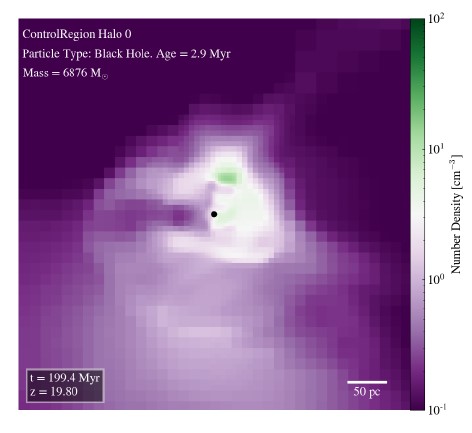
PhD Opportunity in Theoretical Astrophysics at Maynooth!

Posted in Maynooth, The Universe and Stuff with tags , , , on January 18, 2023 by telescoper

Posting this again because the deadline (31st January) is coming up fast….

The Department of Theoretical Physics at Maynooth University invites applications for a PhD in Theoretical Astrophysics starting in September 2023. The successful applicant will work in the group led by Dr. John Regan on a project examining the formation processes of massive black holes in the early Universe. Massive black holes populate the centres of all massive galaxies and are now also observed in both the centres and in off-centre locations in less massive dwarf galaxies.

For more details and instructions on how to apply, see here.

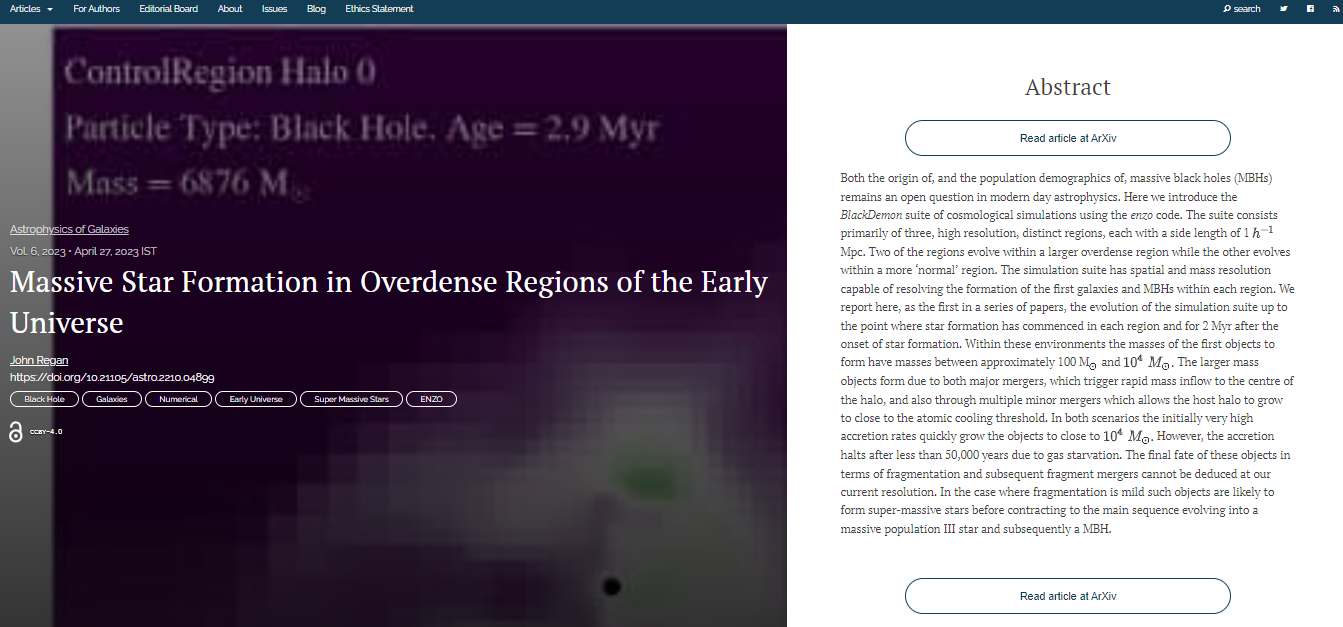
New Publication at the Open Journal of Astrophysics

Posted in OJAp Papers, Open Access, The Universe and Stuff with tags , , , on January 12, 2023 by telescoper

Time to announce another new paper at the Open Journal of Astrophysics. This one was published officially on 9th January 2023. The latest paper is the second paper in Volume 6 (2023) as well as the 67th in all. This one is in the Astrophysics of Galaxies folder.

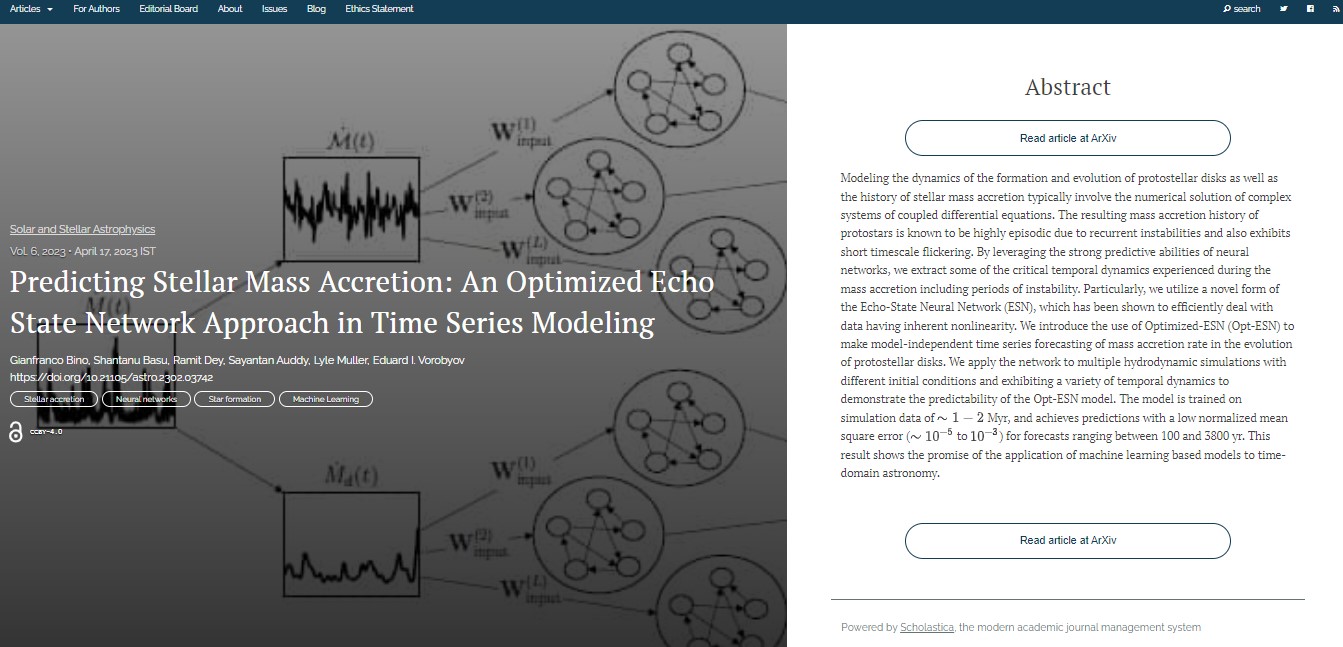
The latest publication is entitled “Wide Binaries as a Modified Gravity test: prospects for detecting triple-system contamination” and the authors – Dhruv Manchanda, Will Sutherland Charalambos Pittordis – are all based at Queen Mary, University of London.

Here is a screen grab of the overlay which includes the  abstract:


You can click on the image to make it larger should you wish to do so. You can find the officially accepted version of the paper on the arXiv here.

R.I.P. Richard Bower

Posted in Biographical, R.I.P., The Universe and Stuff with tags , , , , on January 10, 2023 by telescoper

I was shocked and saddened this weekend to hear of the death from cancer of Professor Richard Bower of Durham University. Richard was a leading light in the Institute for Computational Cosmology (ICC) at Durham, though his research interests spanned observational and theoretical studies of galaxy and cluster formation as well as numerical studies. 

I heard the sad news via social media and there have many tributes to and personal reminiscences of Richard have been circulated from friends, colleagues and former students, including this lovely one by Josh Borrow. I’m sure there will be official obituaries in due course that do justice to Richards personality and achievements in teaching and research; I’ll add links when I see them.

If I can add a personal note, I only worked on one project with Richard, about thirty years ago while I was still at Queen Mary & Westfield College in London. Doing the project was tremendous fun – so much so that the paper we ended up writing bears little relation to what we thought it would be like when we started. We were both young then – I think Richard was about a year younger than me – and both had a tendency to fly off at tangents, but fortunately we were working with two responsible adults (Carlos Frenk and Simon White) who kept us in order. I think the paper we wrote is a nice one, but the real point is that the whole experience was so enjoyable that it was not only formative experience for me from an intellectual point of view but also left me with very fond memories. Whenever we met subsequently, which happened fairly frequently and conferences and on panels and the like, we always talked about what a great time that was. It’s hard to accept we’ll never have that conversation again.

I send heartfelt condolences to Richard’s family, friends and colleagues, both past and present, and in Durham and elsewhere. was an irrepressible and irreplaceable character who will be greatly missed by the entire cosmological community.

Rest in peace, Richard Bower.

New Publication at the Open Journal of Astrophysics

Posted in OJAp Papers, Open Access, The Universe and Stuff with tags , , , , on January 7, 2023 by telescoper

Continuing the process of catching up with business at the Open Journal of Astrophysics, here is the first paper of 2023. This one was accepted before Christmas but the final version only appeared on arXiv after the holiday and was published officially on 4th January 2023.

The latest paper is the first paper in Volume 6 (2023) as well as the 66th in all. It’s yet another in the Cosmology and Non-Galactic Astrophysics folder.

The latest publication is entitled “It takes two to know one: Computing accurate one-point PDF covariances from effective two-point PDF models“. This is a British-French-German collaboration led by Cora Uhlemann of Newcastle University with co-authors  Oliver Friedrich, Aoife Boyle, Alex Gough, Alexandre Barthelemy, Francis Bernardeau, and Sandrine Codis.

This is such an interesting paper that we discussed it at our cosmology journal club at Maynooth University a while ago when it first appeared on arXiv and reading it again since then has suggested a nice project to me!

Anyway, here is a screen grab of the overlay which includes the  abstract:


You can click on the image to make it larger should you wish to do so. You can find the officially accepted version of the paper on the arXiv here.

Fifty Years of Gravitation

Posted in The Universe and Stuff with tags , , on January 5, 2023 by telescoper

I was surprised to discover, a couple of days ago, that the classic textbook Gravitation by Misner, Thorne and Wheeler is 50 years old this year. MTW as it is usually known was first published in 1973, and has has now been reprinted 24 times. I bought my copy (shown above) about 30 years ago. I’ve often joked that this tome is so hefty that it not only allows one to read about Gravitation but also to experience its practical effects!

This anniversary reminds me that there was a competition running at ITP2022 last year that involved holding out a copy of the book  in one hand at arm’s length for as long as possible following the instructions below:

The winner of the competition was John Brennan of Maynooth University, with a time of 3 minutes and 29 seconds. If you can lay your hands on a copy of MTW you can try to do better!

New Publication at the Open Journal of Astrophysics

Posted in OJAp Papers, Open Access, The Universe and Stuff with tags , , on January 5, 2023 by telescoper

I’ve been catching up on publishing matters over the past day or so, including dealing with a bit of a backlog generated by the Christmas break. The Open Journal is run entirely by volunteers and we all need some time off at some point.

To start with I’m delighted to be able to announce the last paper of 2022 at the Open Journal of Astrophysics.  The latest paper is the 17th paper in Volume 5 (2022) as well as the 65th in all. It’s yet another in the Cosmology and Non-Galactic Astrophysics folder.

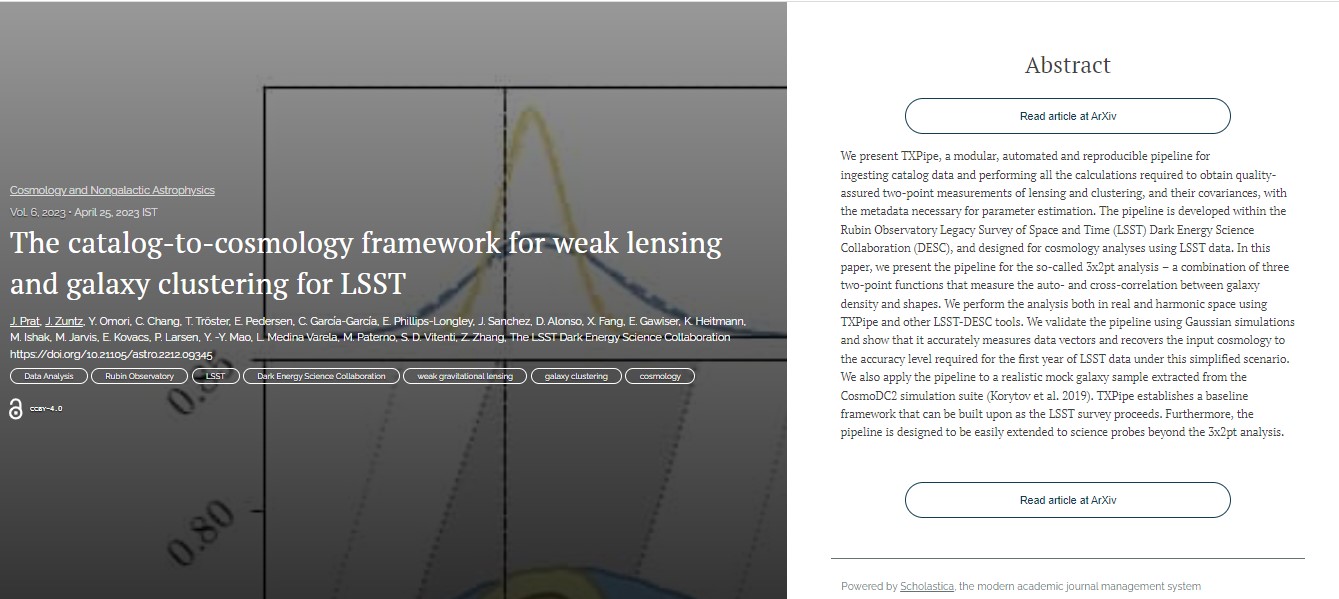
The latest publication is entitled “The Cosmic Graph: Optimal Information Extraction from Large-Scale Structure using Catalogues“. It is written by a distinguished collection of cosmologists from around the world (and Alan Heavens).

Anyway, here is a screen grab of the overlay which includes the  abstract:


You can click on the image to make it larger should you wish to do so. You can find the officially accepted version of the paper on the arXiv here.

Here is a bigger version of the image from the paper used on the overlay:


Code and a tutorial for the analysis and relevant software can be found here .

Perihelion Again

Posted in The Universe and Stuff with tags on January 4, 2023 by telescoper

Earth’s elliptical orbit viewed at an angle (which makes it look more eccentric than it is – in reality is very nearly circular).

According to my new RAS Diary,  today (Wednesday 4th January 2023) at approximately 16.17 GMT the Earth reaches at the point on its orbit which which it is at its closest to the Sun, i.e. its perihelion. At this time the distance from the Sun’s centre to Earth’s centre will be  147,098,925 km. This year, aphelion (the furthest distance from the Sun) is at 21.06 GMT on July 6th 2023 at which point the centre of the Earth will be 152,093,251 km from the centre of the Sun. You can find a list of times and dates of perihelion and aphelion for future years here.

At perihelion the speed of the Earth in its orbit around the Sun is greater than at aphelion (about 30.287 km/s versus 29.291 km/s). This difference, caused by the Earth’s orbital eccentricity, contributes to the difference between mean time and solar time I blogged about when discussing the Winter Solstice a couple of weeks ago.

It surprises me how many people think that the existence of the seasons has something to do with the variation of the Earth’s distance from the Sun as it moves in its orbit in that the closer to the Sun we get the warmer the weather will be. The fact that perihelion occurs in the depth of winter should convince anyone living in the Northern hemisphere that this just can’t be the case, as should the fact that it’s summer in the Southern hemisphere while it is winter in the North.

The real reason for the existence of seasons is the tilt of the Earth’s axis of rotation. I used to do a little demonstration with a torch (flashlight to American readers) to illustrate this when I taught first-year astrophysics. If you shine a torch horizontally at a piece of card it will illuminate a patch of the card. Keep the torch at the same distance but tilt the card and you will see the illuminated patch increase in size. The torch is radiating the same amount of energy but in the second case that energy is spread over a larger area than in the first. This means that the energy per unit area incident on the card is decreases when the card is tilted. It is that which is responsible for winter being colder than summer. In the summer the sun is higher in the sky (on average) than in winter. From this argument you can infer that the winter solstice not the perihelion, is the relevant astronomical indicator of winter.

That is not to say that the shape of the Earth’s orbit has no effect on temperatures. It may, for example, contribute to the summer in the Southern hemisphere being hotter than in the North, although it is not the only effect. The Earth’s surface possesses a significant North-South asymmetry: there is a much larger fraction of ocean in the Southern hemisphere, for example, which could be responsible for moderating any differences in temperature due to insolation. The climate is a non-linear system that involves circulating air and ocean currents that respond in complicated ways and on different timescales not just to insolation but to many other parameters, including atmospheric composition (especially the amount of water vapour).

The dates when Earth reaches the extreme points on its orbit (apsides) are not fixed because of the variations in its orbital eccentricity so, in the short-term, the dates can vary up to 2 days from one year to another. The perihelion distance varies slightly from year to year too; it’s slightly smaller this year than last year, for example.

There is however a long-term trend for perihelion to occur later in the year. For example, in 1246, the December Solstice (Winter Solstice for the Northern Hemisphere) was on the same day as the Earth’s perihelion. Since then, the perihelion and aphelion dates have drifted by an average of one day every 58 years and this trend will continue. This means that by the year 6430 the timing of the perihelion and the March Equinox will coincide, although I will probably have retired by then…


Ireland and CERN

Posted in Maynooth, Politics, Science Politics, The Universe and Stuff with tags , , , on December 30, 2022 by telescoper

Not long ago I posted an item about Ireland’s potential membership of CERN. There seems to have been some progress at political levels in this direction. In Mid-December, the Seanad called for a detailed proposal for CERN membership to be drawn up. More recently still, Minister Simon Harris has indicated that he will bring such a proposal to Cabinet on the matter.

There’s an article in yesterday’s Irish Times by Cormac O’Raifeartaigh reviewing the situation.

As I understand things, if the Irish Government were to decide to take Ireland into CERN then it would first have to become an Associate Member, which would cost around €1.5 million per year. That’s a modest contribution, and the financial returns to Irish industry and universities are likely to far exceed that. This Associate member stage would last up to 5 years, and then to acquire full membership a joining fee of around €16.8 million would have to be paid, though that could be spread out over ten years, along with an annual contribution of around €13.5m.

While I support the idea of Ireland joining CERN I feel obliged to stress my concerns. The most important of these is that there seems to me to be a real danger that the Government would simply appropriate funding for CERN membership from within existing programmes leaving even less for other forms of scientific research. In order to reap the scientific reward of CERN membership the Government will have to invest the additional resources needed to exploit the access to facilities membership would provide. Without a related increase in research grant funding for basic science, the opportunity to raise the level of scientific activity in Ireland would be lost and science overall may end up worse off.

Ireland recently joined the European Southern Observatory (ESO), a decision which gave Irish astronomers access to some amazing telescopes. However, there is no sign at all of Irish funding agencies responding to this opportunity by increasing funding for academic time, postdocs and graduate students needed to do the actual science. In one respect ESO is very like CERN: the facilities do not themselves do the science. We need people to do that. CERN membership could turn out to be like a very expensive Christmas gift that looks very exciting until you open the box and find that the batteries are not included.

P.S. At least Cormac’s employers in Waterford have been quick off the mark in exploiting the potential of CERN by renaming their entire institution after it…