Archive for the The Universe and Stuff Category

A Road to Living Documents?

Posted in Open Access, The Universe and Stuff with tags on May 4, 2022 by telescoper

A few weeks ago I posted an item arguing that the scientific paper is an outdated concept and the whole business of research publishing should change to reflect more accurately how science is actually done. I’d argued previously that

the future for many fields will be defined not in terms of “papers” which purport to represent “final” research outcomes, but by living documents continuously updated in response to open scrutiny by the community of researchers. I’ve long argued that the modern academic publishing industry is not facilitating but hindering the communication of research. The arXiv has already made academic journals virtually redundant in many of branches of  physics and astronomy; other disciplines will inevitably follow.

I thought I would explain how the Open Journal of Astrophysics represents a small move in the direction of the “living document” idea.

Recently the author of a paper we published in 2019 contacted me to explain that readers had pointed some errors in that publication and he wished to amend it to correct the mistakes, which were typographical in nature but did propagate through a number of equations though they did not affect the main results. We had dealt with one post-publication amendment in the past and we handled this one in the same way:

  1. The author sent us a new version containing the proposed revisions;
  2. The Editor checked that they were reasonable (i.e. minor and without any significant changes to the scientific content);
  3. After getting the green light the author placed a revised version on arXiv with a comment explanation the revisions (in this case v3);
  4. We changed our overlay to point at the new version.

Here is the new overlay updated this morning.

You will see that there is a note on the overlay after the abstract. There is also a comment alongside the arXiv submission and another in the acknowledgements section of the revised paper. Owing to the separation between the overlay and the arXiv it is not necessary to change the Digital Object Identifier (DOI) or any of the article metadata.

This is a lot easier than the old-fashioned method of publishing an erratum. It may not represent the idea of a living document exactly, but it does demonstrate a way of feeding back to the publication after the “open scrutiny by the community of researchers” I referred to in my quote above.

It also demonstrates that peer review, however thorough, is never perfect and having wider scrutiny can find errors a referee might not.

Astronomical Heads Up

Posted in The Universe and Stuff with tags , , , , on May 3, 2022 by telescoper

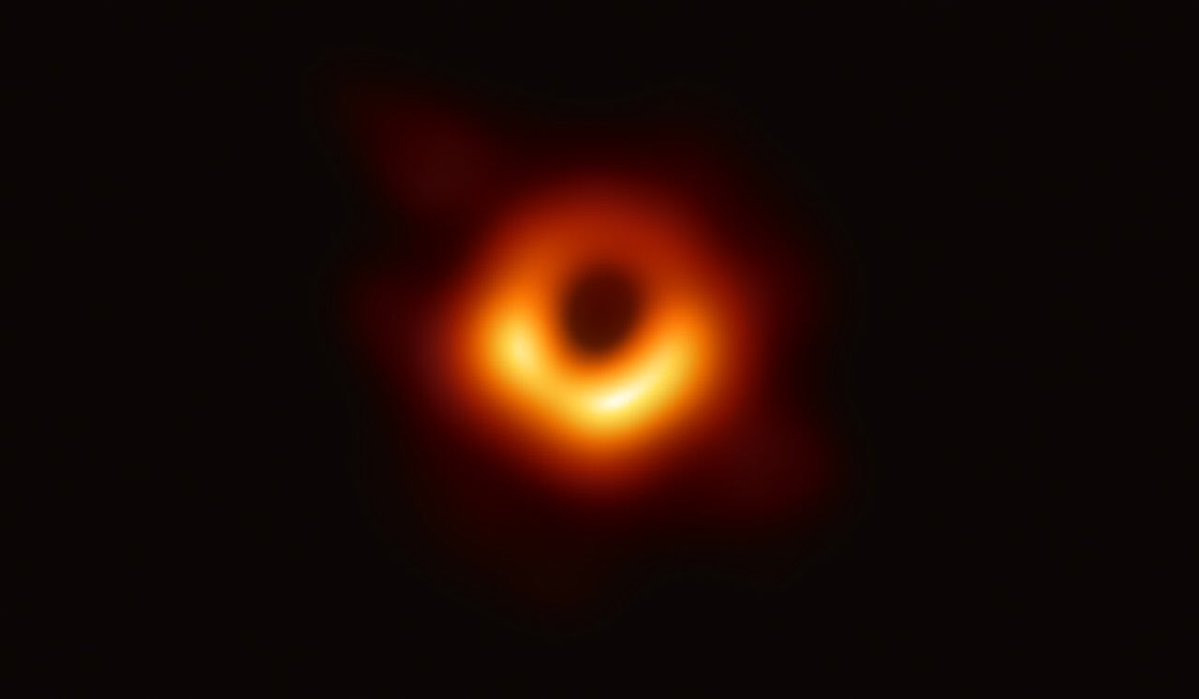
You may recall a great deal of excitement about three years ago concerning the imaging of the “shadow” of the event horizon of the black hole in the centre of the galaxy M87. There was so much interest in this measurement that you could hardly move without seeing this picture somewhere or other:

The question I was asked most frequently back then is that there’s a much closer black hole in the centre of our own Galaxy, the Milky Way, so why wasn’t that imaged first? The answer is that the black hole in the centre of M87 is about 1000 times further away from us than the black hole in the centre of the Milky Way – known to its friends as Sagittarius A* or SgrA* for short – but is also about 1000 times more massive, so its Schwarzschild radius is 1000 times larger. In terms of angular resolution, therfore, the observational challenge of imaging the event horizon is similar in the two cases.

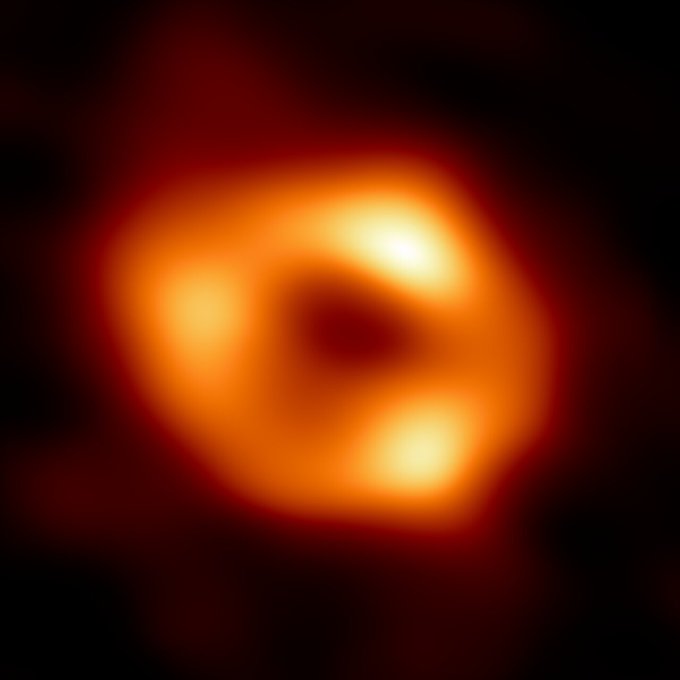
I mention this because the Event Horizon Telescope team who made the above image are holding a press conference next week at ESO on “groundbreaking Milky Way results from the Event Horizon Telescope Collaboration”.

I wonder what these “groundbreaking results” might be?

Full Focus JWST!

Posted in The Universe and Stuff on April 29, 2022 by telescoper

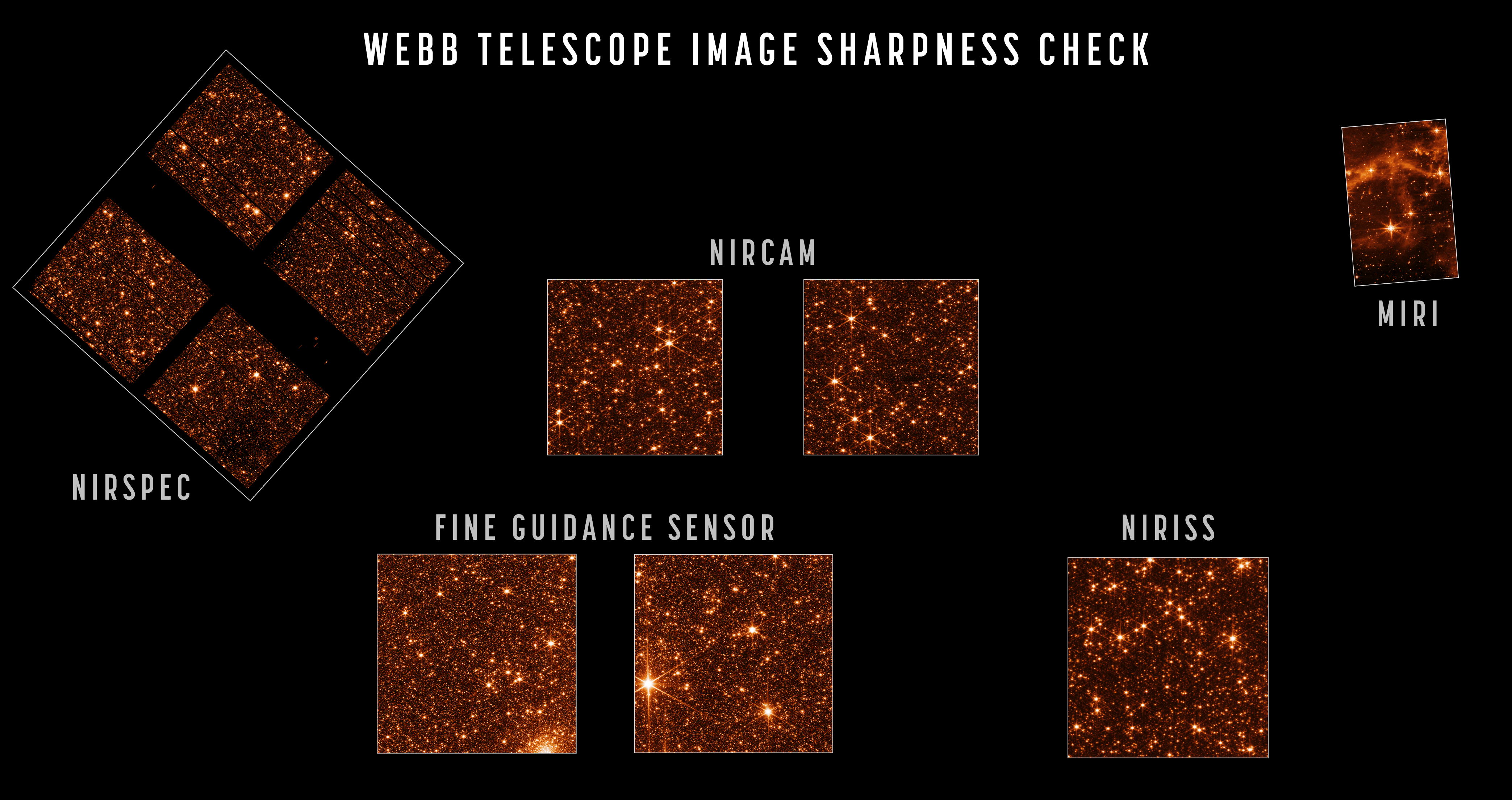
I just saw a very welcome news item announcing that after months of work by the relevant teams, the James Webb Space Telescope is at last completely aligned, in full focus and all the associated instruments are working well. Here is a composite of images demonstrating this:

For reference here is a glossary of the abbreviations:

(NIRISS is actually coupled within the same module with the Fine Guidance Sensor (FGS) so they can be regarded as parts of the same instrument.)

Anyway, congratulations to everyone involved on this impressive achievement, which is a testament to a great deal of skill and hard work. The job isn’t over yet, of course, as there is still a great deal detailed testing and science validation to be carried out. No doubt we can look forward to some really exciting images from the commissioning period in due course!

Euclid Launch Concern

Posted in Euclid, Politics, Science Politics, The Universe and Stuff with tags , , on April 27, 2022 by telescoper

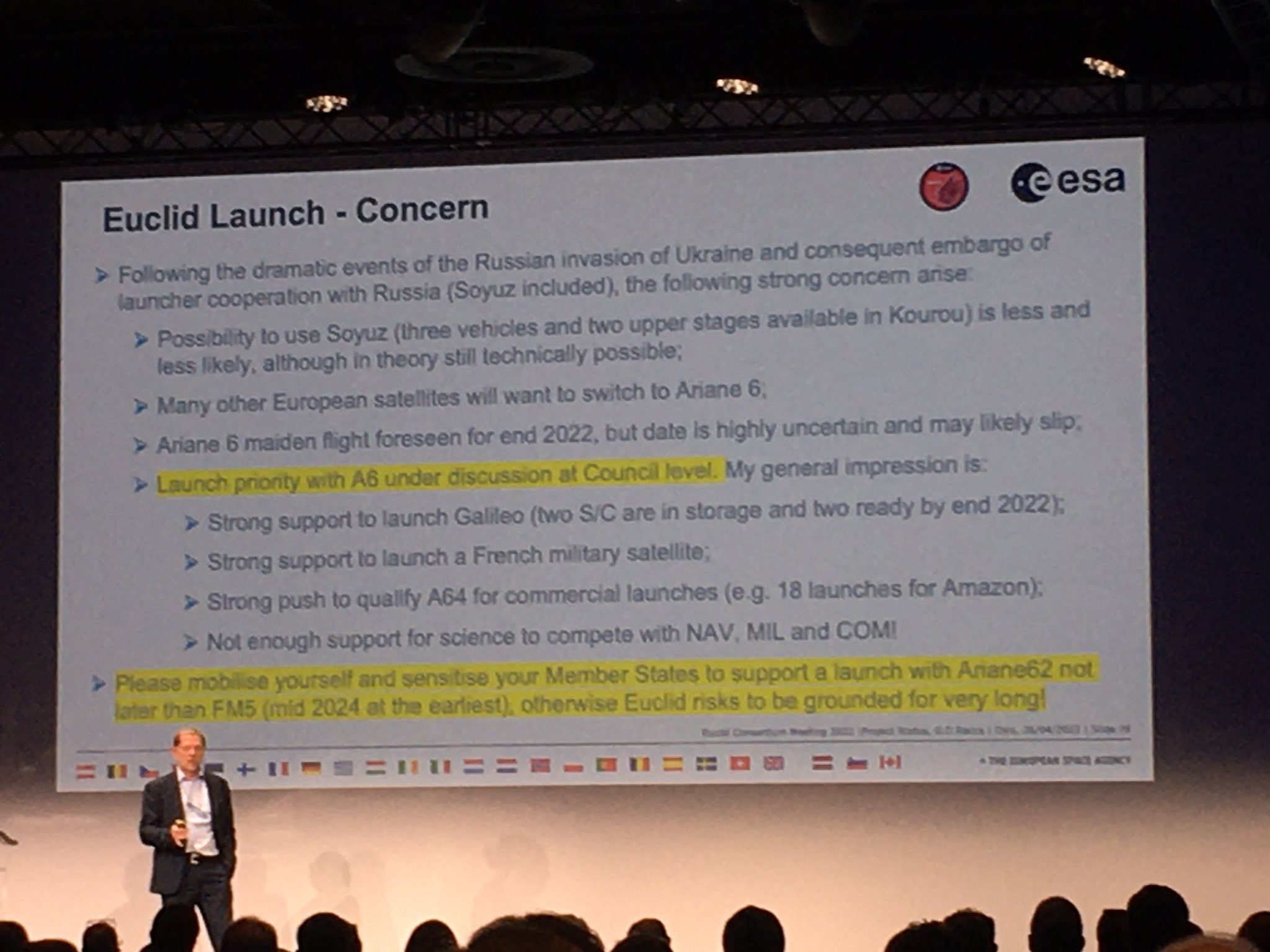
I saw the following picture on Twitter. It was taken during a talk at the annual Euclid Consortium Meeting (which I am not at) and it gives a not -very-optimistic update about the timescale for the launch of Euclid.

Picture Credit: Hervé Aussel

I thought a delay in the launch was inevitable as soon as news broke of the Russian invasion of Ukraine (see here) because the original plan was to launch on a Russian Soyuz vehicle. The subsequent decision by the Russians to remove all their personnel from the launch site at Kourou (see here) made these even more likely, although according to the slide not certain.

The basic problem is that Plan B involves launching Euclid on an Ariane 6 rocket (which comes in two varieties, Ariane62 and Ariane64, with two and four payloads boosters respectively). The problems are (a) that Ariane 6 is that it hasn’t yet had its first flight and (b) Euclid isn’t the only spacecraft having to find an alternative launcher. The competition from commercial and military satellites may mean a lengthy delay to the Euclid Launch unless lobbying succeeds at a political level, which is what the last lines of the slide are about.

Being one of life’s pessimists I think a long delay is the likeliest outcome, though this is not based on any specific knowledge at all about the discussions going on and I’d be delighted to be proved wrong. I am now however seriously wondering whether Euclid will be launched before I retire!

A Question of the Past

Posted in Biographical, Cute Problems, Education, Maynooth, The Universe and Stuff with tags , , , , , on April 20, 2022 by telescoper

I was tidying up some old files earlier today and came across some old examination papers, including those I took for my final examinations in Part II of the Natural Sciences Tripos in 1985. There were six of these, in the space of three consecutive days…

I picked one of the questions to share here because it covers similar ground to my current (!) Advanced Electromagnetism module for final-year students in Maynooth. Sorry it’s a bit grubby!

It’s been a long time since I took my finals and I’d largely forgotten what the format was. The question above was taken from Paper II which consisted of nine questions altogether in three Sections, A (Solid State Physics), B (Statistical Physics) and C (Electromagnetism, from which Q9 above was taken; I think the course was actually called Electrodynamics & Relativity). The examination was 3 hours in duration and students were asked to answer four questions, including one from each Section. That means each question would be expected to take about 45 minutes.

Looking at the paper in general and the above question in particular, a number of things sprang to mind about differences between then in Cambridge and now in Maynooth:

  1. Our theoretical physics papers in Maynooth are 2 hours in duration in which time students are to answer four questions, so that the questions are a bit shorter – 30 minutes each rather than 45.
  2. Our papers are also on a single subject rather than a composite of several; we typically don’t offer the students choice; my Advanced Electromagnetism paper has four questions and students have to answer all four for full marks.
  3. The questions on the old Tripos papers are less structured. There is no indication of the marks allocated to each part of the question in the question above.
  4. As far as I can recall there was no formula booklet back in 1985, though there was a sheet of physical constants. My Advanced Electromagnetism examination this year comes with a couple of pages of useful formulae from vector calculus and key equations in EM theory. One might argue that the old Cambridge papers relied rather more on memory (especially when you take into account that everything was in the space of three days).
  5. Back to Question 9, it is true that this along with the other Electromagnetism questions is at a similar level to what I have been teaching this Semester. If I recall correctly the relevant course in Cambridge was of 24 lectures, the same length as the course I’m teaching this year.
  6. Students taking my course should know how to do both parts of Question 9 without too much difficulty.

On the final point, the easiest way to tackle this sort of problem is to do what the question says: determine the electric and magnetic potentials, derive the electric and magnetic fields from them, then work out the Poynting vector quantifying the energy flux. The part of this that survives in the far-field limit gives you the radiated power then – Bob’s your Uncle – the answer is basically the Larmor Formula which is ubiquitous in problems of this type. The case of an oscillating dipole is a standard derivation but this method works for any time-varying source, as long as you remember to include the retarded potentials if it’s not periodic.

Had I been writing this question for a modern exam I think I would at very least have ended the first part with “Show that the radiated power is…” and then given the formula, so that it could be used for the second part even if a student could not derive it.

How to enjoy doing your PhD

Posted in Biographical, The Universe and Stuff on April 18, 2022 by telescoper

I’ve seen quite a number of posts on Twitter recently about how difficult it is doing a PhD, so I thought I’d just add a bit of a counter based on my own experiences in case the amount of doom and gloom circulating is in danger of putting anyone off. I have to say that although at times it was tough going, I had the best time of my life doing my PhD – well, DPhil actually – and I know many others who feel the same.

The point is that a postgraduate research degree is very different from a programme of undergraduate study. For one thing, as a research student you are expected to work on your own a great deal of the time. That’s because nobody else will be doing precisely the same project so, although other students will help you out with some things, you’re not trying to solve the same problems as your peers as is the case with an undergraduate. Your supervisor will help you of course and make suggestions (of varying degrees of helpfulness), but a PhD is still a challenge that you have to meet on your own.

(Incidentally, I don’t think it is good supervisory practice to look over a research student’s shoulder all the time. It’s part of the purpose of a PhD that the student learns to go it alone. There is a balance of course, but my own supervisor was rather “hands off” and I regard that as the right way to supervise. I’ve always encouraged my own students to do things their own way rather than try to direct them too much.)

That loneliness is tough in itself, but there’s also the scary fact that you do not usually know whether your problem even has a solution, let alone whether you yourself can find it. There is no answer at the back of the book; if there were you would not be doing research. A good supervisor will suggest a project that he or she thinks is both interesting and feasible, but the expectation is that you will very quickly be in a position where you know more about that topic than your supervisor.

I think almost every research student goes through a phase in which they feel out of their depth. There are times when you get thoroughly stuck and you begin to think you will never crack it. Self-doubt, crisis of confidence, call it what you will, I think everyone who has done a postgraduate degree has experienced it. I certainly did. A year into my PhD I felt I was getting nowhere with the first problem I had been given to solve. All the other research students seemed much cleverer and more confident than me. Had I made a big mistake thinking I could this? I started to panic and began to think about what kind of job I should go into if I abandoned the idea of pursuing a career in research.

So why didn’t I quit? There were a number of factors, including the support and encouragement of my supervisor, staff and fellow students in the Astronomy Centre at Sussex, and the fact that I loved living in Brighton, but above all it was because I knew that I would feel frustrated for the rest of my life if I didn’t see it through. I’m a bit obsessive about things like that. I can never leave a crossword unfinished either…

What happened was that after some discussion with my supervisor I shelved that first troublesome problem and tried another, much easier one. I cracked that fairly quickly and it became my first proper publication. Moreover, thinking about that other problem revealed that there was a way to finesse the difficulty I had failed to overcome in the first project. I returned to the first project and this time saw it through to completion. With my supervisor’s help that became my second paper, published in 1987.

I know it’s wrong to draw inferences about other people from one’s own particular experiences, but I do feel that there are some general lessons. One is that if you are going to complete a research degree you have to have a sense of determination that borders on obsession. I was talking to a well-known physicist at a meeting not long ago and he told me that when he interviews prospective physics students he asks them “Can you live without physics?”. If the answer is “yes” then he tells them not to do a PhD. It’s not just a take-it-or-leave-it kind of job being a scientist. You have to immerse yourself in it and be prepared to put long hours in. When things are going well you will be so excited that you will find it as hard to stop as it is when you’re struggling. I’d imagine it is the just same for other disciplines.

The other, equally important, lesson to be learned is that it is essential to do other things as well as your research. Being “stuck” on a problem is part-and-parcel of mathematics or physics research, but sometimes battering your head against the same thing for days on end just makes it less and less likely you will crack it., ’m sure that I’m not the only physicist who has been unable to sleep for thinking about their research or who has spent hours sitting at their desk achieving nothing at all. The human brain is a wonderful thing, but it can get stuck in a rut. One way to avoid this happening is to have more than one thing to think about.

I’ve lost count of the number of times I’ve been stuck on the last clue in a crossword. What I always do in that situation is put it down and do something else for a bit. It could even be something as trivial as making a cup of tea, just as long as I don’t think about the clue at all while I’m doing it. Nearly always when I come back to it and look at it afresh I can solve it.

It can be difficult to force yourself to pause in this way, but I think it is essential to learn how to effect your own mental reboot. In the context of my actual research this involved simply turning to a different research problem, but I think the same purpose can be served in many other ways: taking a break, going for a walk, playing sport, listening to or playing music, reading poetry, doing a crossword, or even just taking time out to socialize with your friends. Back in Brighton in the 1980s I spent most evenings in bars and nightclubs. I never felt the slightest bit of guilt for having so much fun. Without the nightlife and all that I’m not sure I would have finished my PhD.

So, for what it’s worth, here is my advice to new or prospective postgraduate students: work hard but enjoy the challenges. Listen to advice from your supervisor, but remember that the PhD is your opportunity to establish your own identity as a researcher so take ownership of it. Never feel guilty about establishing a proper work-life balance. Having more than one dimension to your life will not only improve your well-being but may also make you a better researcher.

Massive Excitement

Posted in The Universe and Stuff with tags , , , on April 9, 2022 by telescoper

Last week’s announcement of a new high-precision estimate of the mass of the W boson by the CDF collaboration at Fermilab has generated a lot of excitement in the news because it doesn’t seem to fit the predictions of the Standard Model of Particle Physics. Here is a graphic showing the latest result (which is not a new measurement, but a new analysis of old data) together with some previous values:

The units of the measurements are MeV/c2 and the latest number is 80,443.5 ± 9.4 MeV/c2 while calculations based on the standard model give 80,357± 4 [inputs]± 4[theory] MeV/c2. The difference is small but apparently significant, though I’m not sufficiently expert to understand all the details of the statistical analysis.

If true, this result has implications for the Standard Model because although this model has free parameters which have to be measured rather than obtained from theory, the model does imply relationships between these parameters. The reason this applies to particle masses is that these are affected to a greater or lesser extent by interactions with all the fields present in the theory. The first thing you learn when you study particle physics is that it’s not primarily about particles, it’s about fields. The mass of the W-boson is significantly affected by the mass of the top quark and the Higgs boson both of which have been measured to some level of accuracy, but the new W measurement doesn’t seem fit with these known values.

Anyway, here is the discrepancy with the top quark mass

So it’s definitely interesting, though it clearly needs further analysis: there could be uncorrected systematics in the measurement, for example. Also, as far as I know, some of the other masses feeding into this calculation may turn out to be wrong.

Incidentally, a student asked me yesterday why there’s no corresponding measurement for the Z-boson. The answer I gave (which I think is correct) is that the mass of the Z is already known much better than the W because it, being neutral, can decay into an electron-positron pair, both of which are easy to measure, but the W, being charged, has to decay into a charged lepton and a neutrino (or antineutrino) combination and the latter is much harder to deal with experimentally.

P.S. For some comments by a physicist who knows much more about this stuff than I do, see here.

Elliptical Discussions

Posted in Cute Problems, Education, Maynooth, The Universe and Stuff with tags , , on April 7, 2022 by telescoper

It’s the ninth week of Semester 2 and I’m coming to the end of lectures and laboratory sessions for my Computational Physics module; for the remaining three weeks (plus the Easter vacation) the students in this class will be mainly concentrating on the mini-projects that form part of the assessment.

This afternoon, though we had a session on how to transform higher-order differential equations into sets of coupled first-order ODEs suitable for vectorization and consequent solution using standard techniques. The problem we focussed on today was the simple problem of orbital motion of a test particle under the gravitational force in plane-polar coordinates, which can be prepared for physical solution thusly:

This sort of thing reminds me of my undergraduate theory project at Cambridge, where I did a similar thing to solve the equations governing the action of a four-level laser, though that was in Fortran rather than Python. In my own solution I used Python’s off-the-shelf solver odeint.

I like the orbital motion problem a lot because it’s a bit more than a coding exercise: students have to think about how to choose initial data, how to test the their code and interpret the results. Even before that there’s the issue of what units to use; SI units are a bit daft for astronomical problems. For solar system calculations it makes sense to use Astronomical Units for distances and years for time; in such a system it’s easy to work out that GM is just 4π2, which avoids having to deal with ridiculously large or ridiculously small numbers.

Anyway, the fun thing about this lab was that once everyone had got their code working they could try setting initial data to get a circular orbit as a special case, explore how the shape of elliptical orbits depends on the input data, how to make an unbound orbit, and so on. It’s important to understand the output of a numerical calculation in terms of basic physical principles. All that led to a discussion in class of solar system exploration, transfer orbits, what would happen if the mass of the Sun suddenly changed, or if G was a function of time, and lots of other things.

I find sessions like this that encourage students to explore problems themselves very rewarding and I think they add a valuable extra dimension to standard teaching formats. I hope the projects that they’ll be doing from now on – involving topics in areas ranging from atomic physics, cosmology, particle physics and climate science, and done in groups – will provoke even more discussion of this type.

Census Day

Posted in Bad Statistics, Biographical, The Universe and Stuff with tags , on April 3, 2022 by telescoper

Today is April 3rd 2022 which means that it’s Census Day here in Ireland; I’ve just finished filling in the form, which is 24 pages long but it turns out lots of the pages are duplicates for use in homes with multiple occupancy, and others don’t apply to me at all, so in fact I only had to complete 8 pages and it didn’t take all that long.

The Census should have taken place last year but was postponed because of the Covid-19 pandemic. Apparently the corresponding 2021 census in the UK went ahead, though I wasn’t at, and couldn’t get to, the property I still own in Wales so couldn’t participate. Although I was initially threatened with a fine, the UK Census people seem to have given up trying to chase me. I blogged about the previous census in Wales in 2011 here.

On the holiday after St Patrick’s Day I was at home when I noticed a card had been pushed through my letterbox while I was still in the house. It was from a ‘Census Enumerator’ who said he had tried to deliver the form but I was out. I wasn’t out and he hadn’t rung the doorbell. More importantly he hadn’t simply put the census form through the letterbox. In the UK the census forms are just sent out in the post. This little episode didn’t inspire me with confidence. Anyway, the bloke came back a week later and gave me the form. He also asked me for some personal information such as my phone number, which I naturally refused to give him. Apparently he has to collect the form in person too, which seems daft to me. Why can’t people just send their census returns back in the post?

On the last page there is a so-called ‘time capsule’ in which to leave information for historians to read 100 years from now. All I could think of to write was any historians reading this in 2122 would probably think that it was absurd to be doing this wasteful paper-based census when the digital age started some time ago, so I just said for the record that I was one of the people who thought that in 2022…

Distant Things!

Posted in The Universe and Stuff with tags , , , on April 1, 2022 by telescoper

I’m a bit late passing this on but there was a great deal of excitement this week at the news that the Hubble Space Telescope (HST) has made an astonishing discovery about the early Universe as illustrated by the above picture published in Nature. As well as an individual star (?) observed at redshift 6.2, so distant that its light set out when the Universe was just 8% of its current age, the image also reveals the presence in the early Universe of large geometric shapes (such as rectangles) as well as a remarkable giant arrow. The presence of these features at such high redshift is completely inconsistent with the standard theory of structure formation.