Archive for the The Universe and Stuff Category

New Publication at the Open Journal of Astrophysics

Posted in Open Access, The Universe and Stuff with tags , , , , , on July 10, 2022 by telescoper

Time to announce another new publication in the Open Journal of Astrophysics! This one, published last week, is the 9th paper in Volume 5 (2022) and the 57th in all.

The latest publication is entitled “Coronal Mass Ejection Image Edge Detection In Heliospheric Imager STEREO SECCHI Data” and is written by Marc Nichitiu of the Stony Brook School (NY, USA).  If you want to know more about the Solar observatory STEREO you can look here. SECCHI stands for “Sun-Earth Connection Coronal and Heliospheric Investigation”, which is a camera array on the STEREO spacecraft.

This paper is in the Solar and Stellar Astrophysics folder. It’s a slightly unusual paper because it is mainly software, so could have been in the Instrumentation and Methods for Astrophysics section.

Here is a screen grab of the overlay which includes the (very short) abstract:


You can click on the image to make it larger should you wish to do so. You can find the arXiv version of the paper here.

Phase Correlations and Cosmic Structure

Posted in Biographical, The Universe and Stuff with tags , , , on July 9, 2022 by telescoper

I’m indebted to a friend for tipping me off about a nice paper that appeared recently on the arXiv by Franco et al. with the title First measurement of projected phase correlations and large-scale structure constraints. The abstract is here:

Phase correlations are an efficient way to extract astrophysical information that is largely independent from the power spectrum. We develop an estimator for the line correlation function (LCF) of projected fields, given by the correlation between the harmonic-space phases at three equidistant points on a great circle. We make a first, 6.5σ measurement of phase correlations on data from the 2MPZ survey. Finally, we show that the LCF can significantly improve constraints on parameters describing the galaxy-halo connection that are typically degenerate using only two-point data.


I’ve worked on phase correlations myself (with a range of collaborators) – you can see a few of the papers here. Indeed I think it is fair to say I was one of the first people to explore ways of quantifying phase information in cosmology. Although I haven’t done anything on this recently (by which I mean in the last decade or so), other people have been developing very promising looking approaches (including the Line Correlation Function (LCF) explored in the above paper. In my view there is a lot of potential in this approach and as we await even more cosmological data and hopefully more people will look at this in future. In my opinion we still haven’t found the optimal way to exploit phase information statistically so there’s a lot of work to be done in this field.

Anyway, I thought I’d try to explain what phase correlations are and why they are important.

One of the challenges we cosmologists face is how to quantify the patterns we see in, for example, galaxy redshift surveys. In the relatively recent past the small size of the available data sets meant that only relatively crude descriptors could be used; anything sophisticated would be rendered useless by noise. For that reason, statistical analysis of galaxy clustering tended to be limited to the measurement of autocorrelation functions, usually constructed in Fourier space in the form of power spectra; you can find a nice review here.

Because it is so robust and contains a great deal of important information, the power spectrum has become ubiquitous in cosmology. But I think it’s important to realize its limitations.

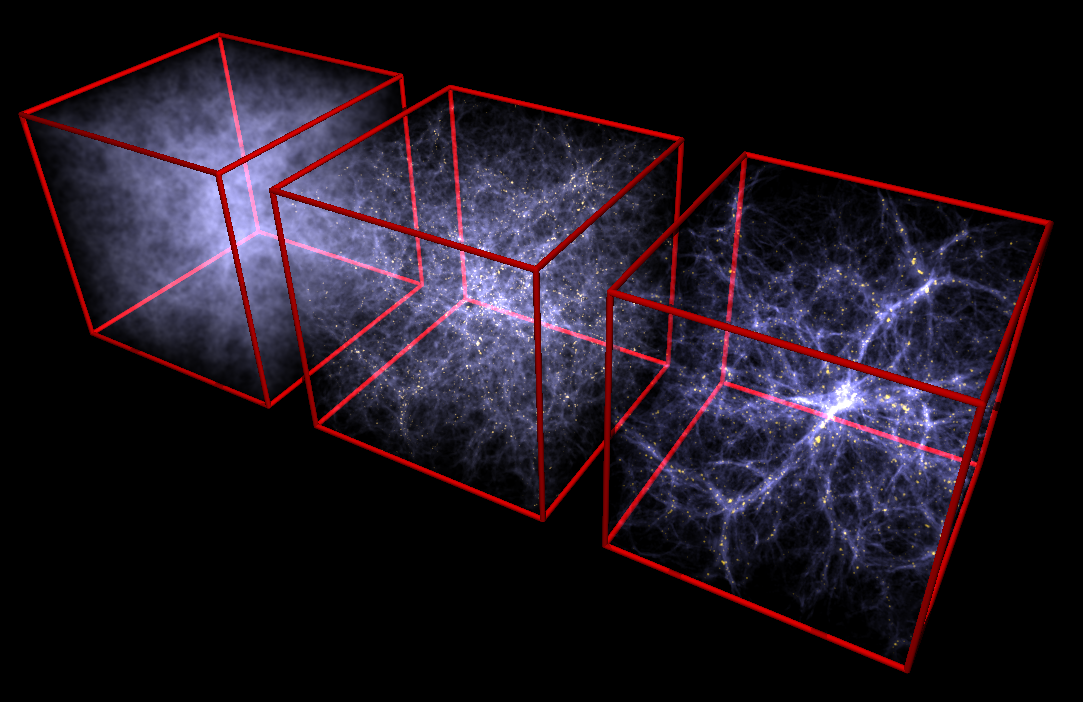
Take a look at these two N-body computer simulations of large-scale structure:

The one on the left is a proper simulation of the “cosmic web” which is at least qualitatively realistic, in that in contains filaments, clusters and voids pretty much like what is observed in galaxy surveys.

To make the picture on the right I first  took the Fourier transform of the original  simulation. This approach follows the best advice I ever got from my thesis supervisor: “if you can’t think of anything else to do, try Fourier-transforming everything.”

Anyway each Fourier mode is complex and can therefore be characterized by an amplitude and a phase (the modulus and argument of the complex quantity). What I did next was to randomly reshuffle all the phases while leaving the amplitudes alone. I then performed the inverse Fourier transform to construct the image shown on the right.

What this procedure does is to produce a new image which has exactly the same power spectrum as the first. You might be surprised by how little the pattern on the right resembles that on the left, given that they share this property; the distribution on the right is much fuzzier. In fact, the sharply delineated features  are produced by mode-mode correlations and are therefore not well described by the power spectrum, which involves only the amplitude of each separate mode.

If you’re confused by this, consider the Fourier transforms of (a) white noise and (b) a Dirac delta-function. Both produce flat power-spectra, but they look very different in real space because in (b) all the Fourier modes are correlated in such away that they are in phase at the one location where the pattern is not zero; everywhere else they interfere destructively. In (a) the phases are distributed randomly.

The moral of this is that there is much more to the pattern of galaxy clustering than meets the power spectrum…

New Publication at the Open Journal of Astrophysics

Posted in OJAp Papers, Open Access, The Universe and Stuff with tags , , , , , , , on July 5, 2022 by telescoper

Time to announce another new publication in the Open Journal of Astrophysics! This one, published on Sunday, is the 8th paper in Volume 5 (2022) and the 56th in all.

The latest publication is entitled “Search for a distance-dependent Baryonic Tully-Fisher Relation at low redshifts” and is written by by Aditi Krishak (IISER-Bhopal, India) and Shantanu Desai (IIT Hyderabad, India).

This paper is in the Cosmology and Nongalactic Astrophysics folder.

Here is a screen grab of the overlay which includes the abstract:


You can click on the image to make it larger should you wish to do so. You can find the arXiv version of the paper here.

R.I.P. Jim Bardeen (1939-2022)

Posted in Biographical, The Universe and Stuff with tags , , , , , on July 4, 2022 by telescoper

I was saddened this morning to hear news of the death at the age of 83 of Jim Bardeen who passed away on June 20th 2022. Jim – the son of John Bardeen, who won two Nobel physics prizes – did important work in theoretical cosmology and general relativity. In my own field of cosmology he is probably best known for his work on perturbation theory where he clarified many longstanding issues about gauge-dependence and as the first author of the famous and heavily cited “BBKS” (Bardeen, Bond, Kaiser & Szalay) paper, published in 1986:

BBKS

I received this as a very hefty preprint when I started my graduate studies back in 1985 and it scared the hell out of me. I still have the photocopy of the published version I made when it came out (in the days when PhD meant Doctor of Photocopying). You can find the paper on the NASA/ADS system here.

I met Jim Bardeen only once, at an Aspen Summer Workshop back in the 90s. He was a very shy and modest man but very kindly and polite. I remember a couple of times out hiking with him, when a discussion about physics was going on he would keep quiet until he had figured out what he thought and when he did choose to speak it was usually brief and invariably very incisive. He didn’t write all that many papers either, but those he did publish were invariably excellent.

Rest in peace, James Maxwell Bardeen (1939-2022)

On Astropy

Posted in The Universe and Stuff with tags , , on July 3, 2022 by telescoper

Just a quick post to draw your attention to an important paper on arXiv about the Astropy Project, which is community effort to develop a common core package for Astronomy in Python and foster an ecosystem of interoperable astronomy packages. The abstract of the paper is:

The Astropy Project supports and fosters the development of open-source and openly-developed Python packages that provide commonly needed functionality to the astronomical community. A key element of the Astropy Project is the core package astropy, which serves as the foundation for more specialized projects and packages. In this article, we summarize key features in the core package as of the recent major release, version 5.0, and provide major updates for the Project. We then discuss supporting a broader ecosystem of interoperable packages, including connections with several astronomical observatories and missions. We also revisit the future outlook of the Astropy Project and the current status of Learn Astropy. We conclude by raising and discussing the current and future challenges facing the Project.

One of the great advantages of using Python for scientific programming in general and for applications to astrophysics in particular is the existence of extensive software libraries of which Astropy is a prominent example. This is one reason why Python is now the state-of-the-art language in many fields, as exemplified by the following graphic (Figure 1 from the paper) showing the frequency of mentions of various languages in the astronomical literature.

This is on a logarithmic scale so Python is really way out in front.

Most people I know use Python for their scientific programming, and most undergraduate physics courses also use it (including mine at Maynooth). I’m a big fan of the astropy project but it faces many challenges, including funding and management issues. I can’t do much about those but I can encourage users of astropy at least to ensure they acknowledge and cite it properly in their papers, following the instructions here.

Final Reminder – Professorial Position in Observational Astrophysics or Cosmology at Maynooth!

Posted in Maynooth, The Universe and Stuff with tags , , , , on July 1, 2022 by telescoper

With just a few days to go to the deadline (3rd July), I thought I would take the opportunity to remind readers that Maynooth University has a Chair (i.e. Full Professor) position in Astrophysics or Cosmology under the Strategic Academic Leadership Initiative (SALI). I blogged about this scheme here and announced this Chair position originally here.

You can find the full announcement of the competition for all the SALI positions here; you can apply for the position at Maynooth here. The position is now also advertised on the AAS Jobs Register here.

As I said, the deadline for applications is 3rd July 2022, and the provisional start date is January 2023 (although this is flexible). As well as a good salary (starting at €124,683 at current rates, rising by annual increments to €157,611) the position comes with membership of the Irish public service pension scheme, a defined benefit scheme (comparable to the older version of the UK’s USS which has now been scrapped).

The key rationale for these SALI positions is clear from the statement from Simon Harris, the Minister responsible for Third Level education in Ireland:

“Championing equality and diversity is one of the key goals of my department. The Senior Academic Leadership Initiative (SALI) is an important initiative aimed at advancing gender equality and the representation of women at the highest levels in our higher education institutions.

We have a particular problem with gender balance among the staff in Physics in Maynooth, especially in Theoretical Physics where all the permanent staff are male, and the lack of role models has a clear effect on our ability to encourage more female students to study with us.

The wider strategic case for this Chair revolves around broader developments in the area of astrophysics and cosmology at Maynooth. Currently there are two groups active in research in these areas, one in the Department of Experimental Physics (which is largely focussed on astronomical instrumentation) and the other, in the Department of Theoretical Physics, which is theoretical and computational. We want to promote closer collaboration between these research strands. The idea with the new position is that the holder will nucleate and lead a new research programme in the area between these existing groups as well as getting involved in outreach and public engagement.

It is intended that the position to appeal not only to people undertaking observational programmes using ground-based facilities (e.g. those provided by ESO, which Ireland recently joined), or those exploiting data from space-based experiments, as well as people working on multi-messenger astrophysics, gravitational waves, and so on.

Exciting as this position is in itself, it is part of wider developments and we are expecting to advertise further job opportunities in physics and astronomy very soon! I’d be happy to be contacted by any eligible person wishing to discuss this position (or indeed the general situation in Maynooth) on an informal basis.

A First Course in General Relativity

Posted in Biographical, Cardiff, Maynooth, The Universe and Stuff with tags , on June 30, 2022 by telescoper

This morning I received delivery of a brand new copy of the Third Edition (left) of A First Course in General Relativity by Bernard Schutz. I bought the First edition (right) way back in 1985 when I started out as a graduate student. Not surprisingly there is a lot of additional material in the 3rd edition about gravitational waves, which had not been discovered when the first edition was published. I notice also that Bernard has lost his “F”…

 In fact I have known Bernard for quite a long time, most recently as colleagues in the Data Innovation Research Institute in Cardiff. Before that he chaired the Panel that awarded me an SERC Advanced Fellowship in the days before STFC, and even before PPARC, way back in 1993. It just goes to show that even the most eminent scientists do occasionally make mistakes…

Anyway, the arrival of this book is a double coincidence because I’ve been thinking over the last couple of days about starting to organize teaching for next academic year. This isn’t easy as we still don’t know who is going to be available. We’re interviewing tomorrow for one of our vacant positions, actually. Yesterday also the University Bookshop sent out a request for textbooks to stock ahead of next academic year.

I was reflecting on the fact that I’ve been doing research in cosmology and theoretical astrophysics since 1985 and teaching undergraduate and postgraduate students since 1990 but I’ve never taught a course on general relativity. This may or may not change next year when teaching is allocated. There are many textbooks out there but, prompted by the arrival of Bernard’s new book, I was wondering if anyone reading this blog has any other recommendations, suitable for final-year undergraduate theoretical physics students, that might complement it on the reading list for my first course in general relativity, should I happen to give one?

Suggestions, please, through the comments box below!

On the Relativity of Time

Posted in The Universe and Stuff on June 25, 2022 by telescoper

I feel seen…

(HT to Stephen Curry for implicating me in this..)

Schrödinger’s Theatre

Posted in Education, History, The Universe and Stuff with tags , , on June 21, 2022 by telescoper

Although it’s relatively old news in Ireland, a colleague recently sent me a story from Physics World about Trinity College Dublin’s decision to change the name of its Schrödinger Lecture Theatre (to the Physics Lecture Theatre). The Provost, Fellows, Foundation Scholars and the other members of Board, of the College of the Holy and Undivided Trinity of Queen Elizabeth near Dublin (to give it its proper title) took this decision in the light of revelations about Erwin Schrödinger‘s predatory sexual conduct towards very young girls.

According to my careful research carried out by reading his Wikipedia page, Schrödinger never actually worked at Trinity College Dublin; the Theatre in question was named in his honour after he delivered his famous lectures on What is Life there in 1943.

Reactions to the decision to rename the Theatre have generated a wide range of reactions from physicists and non-physicists alike. For my part I think it is the right decision. As the Physics World article states:

As an educational institute, we cannot condone or glorify someone who abused the trust between teacher and student.

Jonathan Coleman, Head of School Physics TCD

To me this is quite different from attaching Schrödinger’s name to his equation or even his cat. His unsavoury conduct should not mean that his scientific achievements should be “cancelled” . These are and should continue to be recognized through terms like Schrödinger’s Equation. As far as I am aware, however, Schrödinger did not build any lecture theatres.

It’s up to Trinity to decide what to call its rooms, of course, but that doesn’t mean we’re not allowed to have opinions about the decision. I’d therefore invite you to express yours through the following poll:

Of course if you wish to expand on your opinion you may do so through the box below.

Summer Solstice 2022

Posted in History, The Universe and Stuff on June 21, 2022 by telescoper

The Summer Solstice in the Northern hemisphere takes place today, Tuesday 21st June 2022, at 10.14am Irish Time (9.14 UTC). Among other things, this means that tomorrow is the longest day of the year around these parts. According to this website, the interval between sunrise and sunset in Dublin today will be 17 hours 5 minutes and 6 seconds. which is 2 seconds longer than yesterday while tomorrow will be four whole seconds shorter than that.

It’s all downhill from now on.

Days will get shorter from tomorrow until the Winter Solstice in December, although this does not mean that sunset will necessarily happen earlier on 22nd than it does tomorrow. In fact it is a little later. Nor does it mean that sunrise will happen later tomorrow; in fact it is a little earlier.

You can find such things out by looking at a table of the local mean times of sunrise and sunset for Dublin around the 2022 summer solstice. This shows that the earliest sunrise was actually on 17th June and the latest sunset is on 25th.

This arises because there is a difference between mean solar time (measured by clocks) and apparent solar time (defined by the position of the Sun in the sky), so that a solar day does not always last exactly 24 hours. A description of apparent and mean time was given by Nevil Maskelyne in the Nautical Almanac for 1767:

Apparent Time is that deduced immediately from the Sun, whether from the Observation of his passing the Meridian, or from his observed Rising or Setting. This Time is different from that shewn by Clocks and Watches well regulated at Land, which is called equated or mean Time.

The discrepancy between mean time and apparent time arises because of the Earth’s axial tilt and the fact that it travels around the Sun in an elliptical orbit in which its orbital speed varies with time of year (being faster at perihelion than at aphelion).

If you plot the position of the Sun in the sky at a fixed time each day from a fixed location on the Earth you get a thing called an analemma, which is a sort of figure-of-eight curve whose shape depends on the observer’s latitude. Here’s a photographic version taken in Edmonton, with photographs of the Sun’s position taken from the same position at the same time on different days over the course of a year:

maxresdefault

The summer solstice is the uppermost point on this curve and the winter solstice is at the bottom. The north–south component of the analemma is the Sun’s declination, and the east–west component is the so-called equation of time which quantifies the difference between mean solar time and apparent solar time. This curve can be used to calculate the earliest and/or latest sunrise and/or sunset.