Archive for the The Universe and Stuff Category

New Publication at the Open Journal of Astrophysics

Posted in OJAp Papers, Open Access, The Universe and Stuff with tags , , , on February 21, 2022 by telescoper

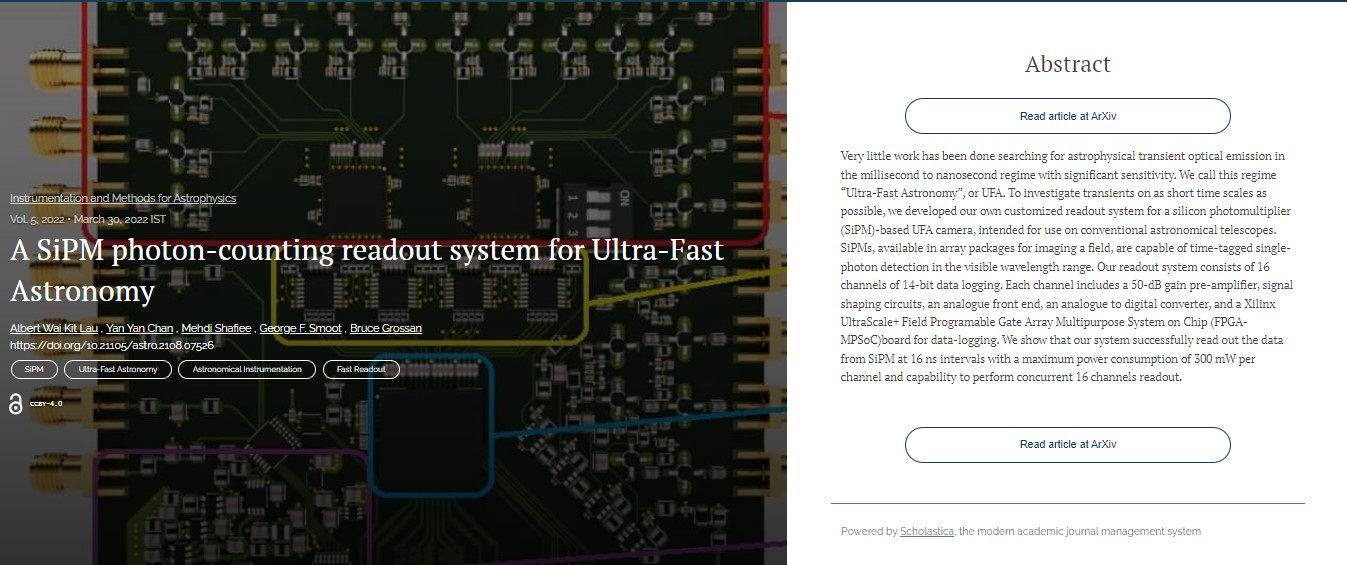
It’s time yet again to announce a new publication in the Open Journal of Astrophysics! This one is the 3rd paper in Volume 5 (2022) and the 51st in all. We actually published this on Friday, byt I’ve only just got around to announcing it here now.

The latest publication is entitled Differentiable Predictions for Large Scale Structure with SHAMNet and is written by Andrew Hearin, Nesar Ramachandra and Matthew R. Becker of the Argonne National Laboratory and Joseph DeRose of the Lawrence Berkeley Laboratory (both institutions being in the USA).

Here is a screen grab of the overlay which includes the abstract:

You can click on the image to make it larger should you wish to do so. You can find the arXiv version of the paper here. This paper is in our popular Cosmology and Non-galactic Astrophysics section.

P. S. Here’s a bit of feedback from the author of this paper about the referees:

They reviewed the paper in conscientious detail, and every comment was thoughtful. We feel that our paper has materially improved in clarity as a result of their critique.”

Sins of Omission

Posted in The Universe and Stuff with tags , , , , , on February 20, 2022 by telescoper

There’s a paper recently published in Nature Astronomy by Moreno et al, which you can find on the arXiv here. The title is Galaxies lacking dark matter produced by close encounters in a cosmological simulation and the abstract is here:

The standard cold dark matter plus cosmological constant model predicts that galaxies form within dark-matter haloes, and that low-mass galaxies are more dark-matter dominated than massive ones. The unexpected discovery of two low-mass galaxies lacking dark matter immediately provoked concerns about the standard cosmology and ignited explorations of alternatives, including self-interacting dark matter and modified gravity. Apprehension grew after several cosmological simulations using the conventional model failed to form adequate numerical analogues with comparable internal characteristics (stellar masses, sizes, velocity dispersions and morphologies). Here we show that the standard paradigm naturally produces galaxies lacking dark matter with internal characteristics in agreement with observations. Using a state-of-the-art cosmological simulation and a meticulous galaxy-identification technique, we find that extreme close encounters with massive neighbours can be responsible for this. We predict that approximately 30 percent of massive central galaxies (with at least 1011 solar masses in stars) harbour at least one dark-matter-deficient satellite (with 108 – 109 solar masses in stars). This distinctive class of galaxies provides an additional layer in our understanding of the role of interactions in shaping galactic properties. Future observations surveying galaxies in the aforementioned regime will provide a crucial test of this scenario.

It’s quite an interesting result.

I’m reminded of this very well known paper from way back in 1998, available on arXiv here, by Priya Natarajan, Steinn Sigurdsson and Joe Silk, with the abstract:

We propose a scenario for the formation of a population of baryon-rich, dark matter-deficient dwarf galaxies at high redshift that form from the mass swept out in the Intergalactic Medium (IGM) by energetic outflows from luminous quasars. We predict the intrinsic properties of these galaxies, and examine the prospects for their observational detection in the optical, X-ray and radio wavebands. Detectable thermal Sunyaev-Zeldovich decrements (cold spots) on arc-minute scales in the cosmic microwave background radiation maps are expected during the shock-heated expanding phase from these hot bubbles. We conclude that the optimal detection strategy for these dwarfs is via narrow-band Lyman-α imaging of regions around high redshift quasars. An energetically scaled-down version of the same model is speculated upon as a possible mechanism for forming pre-galactic globular clusters.

It’s true that the detailed mechanism for forming dwarf galaxies with low dark matter densities is different in the two papers, but it does show that the issue being addressed by Moreno et al. had been addressed before. It seems to me therefore that the Natarajan et al. paper is clearly relevant background to the Moreno et al. one. I always tell junior colleagues to cite all relevant literature. I wonder why Moreno et al. decided not to do that with this paper?

Had Moreno et al. preprinted their paper before acceptance by Nature Astronomy I’m sure someone would have told them of this omission. This is yet another reason for submitting your papers to arXiv at the same time as you submit them to a journal rather than waiting for them to be published.

Particle Physics Masterclass at Maynooth

Posted in Covid-19, Maynooth, The Universe and Stuff on February 9, 2022 by telescoper

You may remember that we ran a very successful virtual Astrophysics & Cosmology Masterclass at Maynooth University last November. Now it’s time to announce the forthcoming International Masterclass on Particle Physics. This will take place on campus at Maynooth during the half-term break:


You can find more information, including instructions on how to book a place, here. The first such Masterclass at Maynooth took place in March 2012, so this year we will be celebrating the 10th anniversary.

These Masterclasses give secondary school students the opportunity to discover the world of quarks and leptons for themselves, by performing measurements on real data from CERN, meeting active particle physics researchers and linking up with like-minded students from other countries.  We will join thousands of other secondary school students at more than 100 universities and laboratories around Europe and worldwide in a programme stretching over four weeks.

Physics at the most fundamental level – the smallest and most basic building blocks of matter – is an exotic world.  But a few introductory talks and working with data from CERN will give the students insight into the fundamental particles of matter and the forces between them, as well as what went on during the Big Bang.

On Sunday afternoon, the students are introduced to particle physics, experiments and detectors in lectures given by active particle physics researchers.  On Monday, after a virtual visit to the ALICE detector at CERN, they work on their own with data from ALICE Afterwards they participate in a video conference with students from other countries and moderators at CERN, where they discuss and compare their results.

For more information on the Particle Physics Masterclasses, see the International Masterclasses web site.

First Light at L2 for JWST

Posted in History, The Universe and Stuff with tags , , , on February 5, 2022 by telescoper

After a successful launch, subsequent deployment of its sunshield and mirrors, and arrival at its orbit around the Second Lagrange Point, the goal now for the James Webb Space Telescope is to align the optical components of the telescope to the required accuracy. This is not a simple task – each of the segments of the main mirror has to be aligned to within a fraction of a wavelength of the light it will observe (in the near-infrared part of the electromagnetic spectrum) – and it will take several months to complete. However, we did hear yesterday that the telescope has now seen “first light”, in the sense that the first photons have landed on its detectors. The first images to be formed will be blurry and distorted, but these will be used to adjust the components until they reach the required sharpness.

For more details of this process see here.

Incidentally, it is worth saying a little bit about L2, the second Lagrange point of the Earth-Sun system. As the diagram below shows, this orbits the Sun at a greater distance from the Sun than the Earth. According to Kepler’s Laws, and ignoring the Earth’s gravitation, a test particle placed in a circular orbit at this radius would move more slowly than the Earth and would not therefore hold a fixed position relative to the Earth and Sun as it went around. The effect of the Earth’s gravity however is to supply an extra force to speed it up a bit, so it can keep up and thus remain in a fixed configuration relative to both Earth and Sun.

The opposite applies to L1: an object placed here would, in the absence of Earth’s gravity, move more quickly and thus pull ahead of the Earth. Having the Earth there holds it back by just the right amount to maintain a fixed position in the rotating frame.

The interesting thing about L1 & L2 is that while they are both equilibrium points, they are both unstable to radial perturbations. An object placed at either of these points would move away if disturbed slightly. JWST does not therefore just sit passively at L2 – it moves in a so-called halo orbit around L2 a process which requires some fuel. It’s not that there’s an actual mass at L2 for it to orbit around, but that its motion produces a Coriolis Force that keeps it from moving away. It’s very clever, but does require a bit of energy to keep it in this orbit.

Unlike L1 & L2, the Lagrange Points L4 & L5 are stable and therefore attract all kinds of space junk, such as asteroids, cometary debris, and preprints by Avi Loeb.

Another interesting Lagrange Point is that Joseph-Louis Lagrange was born in 1736 in Turin, but that does not mean that he was Italian. At that time Italy did not exist as a political entity; in 1736 Turin was part of the Kingdom of Sardinia. Although born in the part of the world now known as Italy, he was never an Italian citizen. In fact he lived most of his life in Berlin and Paris and died in 1813, long before the Kingdom of Italy was founded (in 1861).

A Day of Computing

Posted in Biographical, Education, Maynooth, The Universe and Stuff with tags , , , , , , on February 3, 2022 by telescoper

Last Semester, Thursday was what I optimistically called a “Research Day” (on the basis that I had no teaching on it). This Semester it’s one of my busiest teaching days, with lecturing in the morning and a lab session in the afternoon, both for Computational Physics.

For most of the last two years I’ve been delivering the lectures and running the lab remotely, but now that we’re back teaching face-to-face I gave the lecture in person and was in the lab with the class for this afternoon’s session. I’ve got about twice as many students this year as last year swill be running two lab sessions (one next Tuesday repeating the material from the Thursday one, and so on throughout the term).

Running the lab remotely worked reasonably well because Python is available to download for free and works on a standard Windows-based PC. In the lab however we use a Linux (Ubuntu) system, which gives the students the chance to try a different operating system (and one which is for many purposes better than Windows).

It’s good to be back running the computing laboratory class in person but I was a bit nervous this morning because since I last did it that way the machines we have in our laboratory have all been upgraded to a new operating system and have a new (and very different) version of Python (3.9 versus the now obsolete 2.7). I’ve been around long enough to realize that things can go wrong in such situations, so I warned the class during this morning’s lecture that there might be teething troubles. Sure enough we had quite a few technical glitches but, to be honest, it it could have been a lot worse. Next Tuesday’s lab should be a bit less stressful as we’ve fixed a few of the things that went wrong.

So, by no means a disaster, but a busy and quite stressful day. Time to go home and relax.

Back to Electromagnetism

Posted in Biographical, Education, Maynooth, The Universe and Stuff with tags , , , on February 1, 2022 by telescoper

So today I gave my first lecture of the new Semester, it being a gentle reintroduction to Maxwell’s equations for a 4th-year class on Advanced Electromagnetism. They have seen these equations before but it doesn’t do any harm to spend a bit of time refreshing the memory. In what follows I do some potential theory, applications to electrostatics (method of images, multipole expansions, use of the complex potential, etc), dielectric materials and polarization, magnetostatics, relativistic formalism of electromagnetism, gauge invariance, electromagnetic radiation and energy transport, and (if time) plasma physics (if time).

When I taught this module last year I did it all remotely from home – using the blackboard shown above – but this year until further notice I’ll be doing it in person in an actual lecture theatre, though I will be recording the lectures in case any students wish to look at them again for revision, etc, and webcasting them for any students unable to attend on campus. I know there are differences of opinion on this, but I think recording of lectures should become routine practice – as it is in all UK universities I’m aware of – but that is difficult here in Maynooth because the equipment available is inadequate (by which I mean virtually non-existent). Let’s hope the necessary investment will be made at some point.

New Publication at the Open Journal of Astrophysics

Posted in OJAp Papers, Open Access, The Universe and Stuff with tags , , , , , on January 29, 2022 by telescoper

It’s time yet again to announce a new publication in the Open Journal of Astrophysics! This one is the 2nd paper in Volume 5 (2022) and the 50th in all. We actually published this one a couple of days ago I’ve only just got around to announcing it now.

It’s very nice to mark our 50th publication with two firsts: (1) this is the first ‘Citizen Science’ paper we have published; and (2) it is the first paper in the folder corresponding to the arXiv section on Earth and Planetary Astrophysics (astro-ph.EP).

The latest publication is entitled The CosmoQuest Moon Mappers Community Science Project: The Effect of Incidence Angle on the Lunar Surface Crater Distribution and is written by Matthew Richardson (Planetary Sciences Institute, Tucson = PSI), Andrés A. Plazas Malagón (Princeton & Astronomical Society of the Pacific=ASP; corresponding author), Larry A. Lebofsky (PSI), Jennifer Grier (PSI), Pamela Gay (PSI & ASP), Stuart J. Robbins (Southwest Research Institute) and The CosmoQuest Team.

Here is a screen grab of the overlay which includes the abstract:

You can click on the image to make it larger should you wish to do so. You can find the arXiv version of the paper here. As I mentioned above this is the first publication in the folder marked Earth & Planetary Astrophysics.

There is a nice twitter thread by the corresponding author explaining what the paper is about:

If you click on the above it will take you to the rest of the Twitter thread.

The Complex Heart of the Milky Way

Posted in Art, The Universe and Stuff with tags , , , on January 26, 2022 by telescoper

I couldn’t resist sharing this amazing radio image of the Galactic Centre made using the South African MeerKAT radio telescope:

Radio frequency electromagnetic radiation is able to penetrate the dust that permeates this region so can reveal what optical light can not. In particular you can see the very active region around the black hole at the centre of the Milky Way, bubbles caused by exploding stars and – most interesting of all – a number of magnetized filamentary structures.

It’s an extraordinarily beautiful picture made from a mosaic of 20 separate observations. In fact I like it so much I’ve cross-filed it in my “Art” folder. Those of us who work in astronomy or astrophysics are wont to say that there’s much more to it than pretty pictures, but when one like this comes along we’re all sure to geek out over it!

For more information about this image at the science behind it, see here.

What’s the difference between Astronomy and Astrophysics?

Posted in Biographical, Education, Maynooth, The Universe and Stuff on January 24, 2022 by telescoper

I’ve been a bit busy today but I did notice at lunchtime that an old question has been going around on Twitter which gives me the excuse to post an old answer to it, what’s the difference between Astronomy and Astrophysics? This is something I’m asked quite often, and have blogged about before, but I thought I’d repeat it here for those who might stumble across it.

The Oxford English Dictionary gives the following primary definition for astronomy:

The science which treats of the constitution, relative positions, and motions of the heavenly bodies; that is, of all the bodies in the material universe outside of the earth, as well as of the earth itself in its relations to them.

Astrophysics, on the other hand, is described as

That branch of astronomy which treats of the physical or chemical properties of the celestial bodies.

So astrophysics is regarded as a subset of astronomy which is primarily concerned with understanding the properties of stars and galaxies, rather than just measuring their positions and motions.

It is possible to assign a fairly precise date when astrophysics first came into use in English because, at least in the early years of the subject, it was almost exclusively associated with astronomical spectroscopy. Indeed the OED gives the following text as the first occurrence of astrophysics, in 1869:

As a subject for the investigations of the astro-physicist, the examination of the luminous spectras of the heavenly bodies has proved a remarkably fruitful one

The scientific analysis of astronomical spectra began with a paper by   William Hyde Wollaston in the Philosophical Transactions of the Royal Society Vol. 102, p. 378, 1802. He was the first person to notice the presence of dark bands in the optical spectrum of the Sun. These bands were subsequently analysed in great detail by Joseph von Fraunhofer in a paper published in 1814 and are now usually known as Fraunhofer lines.  Technical difficulties  made it impossible to obtain spectra of stars other than the Sun for a considerable time, but  William Huggins finally succeeded in 1864. A drawing of his pioneering spectroscope is shown below.

Meanwhile, fundamental work by Gustav Kirchoff and Robert Bunsen had been helping  to establish an understanding of the spectra produced by hot gases.  The identification of features in the Sun’s spectrum  with similar lines produced in laboratory experiments led to a breakthrough in our understanding of the Universe whose importance shouldn’t be underestimated. The Sun and stars were inaccessible to direct experimental test during the 19th Century (as they are now). But spectroscopy now made it possible to gather evidence about their chemical composition as well as physical properties. Most importantly, spectroscopy provided definitive evidence that the Sun wasn’t made of some kind of exotic unknowable celestial material, but of the same kind of stuff (mainly Hydrogen) that could be studied on Earth.  This realization opened the possibility of applying the physical understanding gained from small-scale experiments to the largest scale phenomena that could be seen. The science of astrophysics was born.

One of the leading journals in which professional astronomers and astrophysicists publish their research is called the Astrophysical Journal, which was founded in 1895 and is still going strong. The central importance of the (still) young field of spectroscopy can be appreciated from the subtitle given to the journal:

Initially the branch of physics most important to astrophysics was atomic physics since the lines in optical spectra are produced by electrons jumping between different atomic energy levels. Spectroscopy of course remains a key weapon in the astrophysicist’s arsenal but nowadays the term astrophysics is taken to mean any application of physical laws to astronomical objects. Over the years, astrophysics has therefore gradually incorporated nuclear and particle physics as well as thermodynamics, relativity and just about every other branch of physics you can think of.

I realize, however, that this  isn’t really the answer to the question that potential students want to ask. What they (probably) want to know is what is the difference between undergraduate courses called Astronomy and those called Astrophysics? The answer to this one depends very much on where you want to study. Generally speaking the differences are in fact quite minimal. You probably do a bit more theory in an Astrophysics course than an Astronomy course, for example. Your final-year project might have to be observational or instrumental if you do Astronomy, but might be theoretical in Astrophysics.  If you compare the complete list of modules to be taken, however, the difference will be very small.

Over the last twenty years or so, most Physics departments in the United Kingdom have acquired some form of research group in astronomy or astrophysics and have started to offer undergraduate degrees with some astronomical or astrophysical content. My only advice to prospective students wanting to find which course is for them is to look at the list of modules and projects likely to be offered. You’re unlikely to find the name of the course itself to be very helpful in making a choice.

To confuse things further, here in Maynooth there is a degree programme called Physics with Astrophysics which is taught primarily by the Department of Experimental Physics and has a heavy focus on observational techniques. If students want to do the interesting theoretical bits of Astrophysics, such as black holes and general relativity, they have to choose  options with the Department of Theoretical Physics.  As a theoretical astrophysicist I feel a bit frustrated by this.

One of the things that drew me into astrophysics as a discipline is that it involves such a wide range of techniques and applications, putting apparently esoteric things together in interesting ways to develop a theoretical understanding of a complicated phenomenon. I only had a very limited opportunity to study astrophysics during my first degree as I specialized in Theoretical Physics.  This wasn’t just a feature of Cambridge. The attitude in most Universities in those days was that you had to learn all the physics before applying it to astronomy. Over the years this has changed, and most departments offer some astronomy right from Year 1.

I think this change has been for the better because I think the astronomical setting provides a very exciting context to learn physics. If you want to understand, say, the structure of the Sun you have to include atomic physics, nuclear physics, gravity, thermodynamics, radiative transfer and hydrostatics all at the same time. This sort of thing makes astrophysics a good subject for developing synthetic skills while more traditional physics teaching focusses almost exclusively on analytical skills.

I hope this clarifies the situation.

Memories of Perugia

Posted in Biographical, The Universe and Stuff with tags , on January 23, 2022 by telescoper

My friend and colleague Vicent Martínez sent me this picture which dates from the spring of 1988.

Picture credit: Vicent Martinez

It took me a while to figure out where it was taken but I finally came to the conclusion that it was in Perugia (the University thereof) in Italy at a small workshop organized there by Silvio Bonometto. If memory serves that room was called the Aula Mussolini

I am on the far left (looking deranged) and talking to Alain Blanchard (with the long black hair). In between us is Vincent Icke. Further along the same row you can see Dennis Sciama, who is sadly no longer with us, and John Miller. In the middle looking at the camera is Rien van de Weijgaert. Just behind me is Bernard Jones. I guess Vicent must have taken the picture!

You can find this and other pictures from this bygone era here.

Yes, I know it’s very white and very male. Meetings tended to be like that in those days.

Incidentally 1988 was the year that I finished my DPhil thesis so I was still a graduate student at the time of this meeting. I think I gave a talk but can’t remember what it was about! In fact I don’t remember much about that meeting except for the splendid lunch that happened at the end. We took a coach trip to a magnificent Castello in the country and were treated to a lavish banquet of many courses. As luck would have it I sat next to Dennis Sciama at the meal, which I enjoyed greatly. Dennis was my academic grandfather (i.e. he supervised my supervisor). He was a lovely gracious man as well as hugely knowledgeable about a wide range of things, wonderful to talk to, and very generous with his time. He was also teetotal, so when they came to fill up his glass he gave it to me so I had a double wine ration, and a single ration would have been a lot!

If I recall correctly the coach trip also took in quick visits to the towns of Cortona and Arezzo.

Anyway, seeing that picture sent me a bit down memory lane during which I opened up a box of old photographs to find some more of Perugia. That meeting in 1988 was the first time I’d visited that ancient and beautiful place but I’ve been back a few times since then and on one occasion took a few snaps as I wandered round. I thought black-and-white would capture the atmosphere of the place. You can decide whether I was right!

The first picture is of the main square (Piazza IV Novembre) and the second the famous Etruscan Arch, which dates from pre-Roman times, emphasizing how ancient this place is! The town is perched on top of a steep-sided hill so it’s quite hard work getting around on foot but well worth exploring.